ADAPT at IJCNLP-2017 Task 4: A Multinomial Naive Bayes
Classification Approach for Customer Feedback Analysis task
Pintu Lohar, Koel Dutta Chowdhury, Haithem Afli, Mohammed Hasanuzzaman and Andy Way
ADAPT Centre School of Computing Dublin City University
Dublin, Ireland
{FirstName.LastName}@adaptcentre.ie
Abstract
In this age of the digital economy, promot-ing organisations attempt their best to en-gage the customers in the feedback pro-visioning process. With the assistance of customer insights, an organisation can de-velop a better product and provide a bet-ter service to its customer. In this pa-per, we analyse the real world samples of customer feedback from Microsoft Of-fice customers in four languages, i.e., En-glish, French, Spanish and Japanese and conclude a five-plus-one-classes categori-sation (comment, request, bug, complaint, meaningless and undetermined) for mean-ing classification. The task is to determine what class(es) the customer feedback sen-tences should be annotated as in four lan-guages. We propose following approaches to accomplish this task: (i) a multinomial naive bayes (MNB) approach for multi-label classification, (ii) MNB with one-vs-rest classifier approach, and (iii) the com-bination of the multilabel based and the sentiment classification-based approach. Our best system produces F-scores of 0.67, 0.83, 0.72 and 0.7 for English, Spanish, French and Japanese, re-spectively. The results are competitive to the best ones for all languages and se-cure3rdand5thposition for Japanese and
French, respectively, among all submitted systems.
1 Introduction
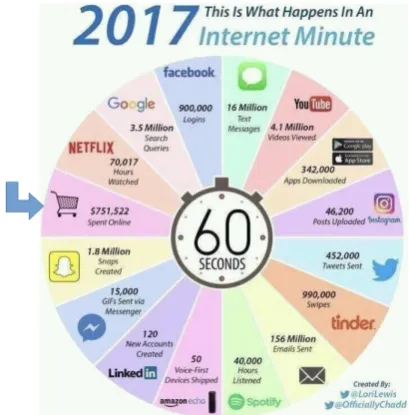
With the rapid development of the Internet, the generation of online content has been near expo-nential during the last few years. A snapshot of the amount of online content generated per minute
is shown in Figure1. One of the items (shown by
Figure 1: Statistics of UGC generated per minute2
an arrow) in this figure shows that a huge amount of money ($750k) is spent online per minute. Such an activity of the Internet users reflects how they are very much involved in online shopping. Due to this reason, industry sectors nowadays are more inclined to make use of online business develop-ment. For example, the big multinational compa-nies (e.g., Microsoft3, Ebay4, Amazon5 etc.) ad-vertise and sell products via Internet. In response to this, customers frequently post product reviews on various websites in different languages. It is very important to understand the customers’ be-haviour because it provides marketers and busi-ness owners with insight that they can use to im-prove their business, products and overall
cus-2Created by Lori Lewis, Vice President, Social Media
-Cumulus Media/Westwood One
3https://www.microsoft.com/ 4https://www.ebay.com/ 5https://www.amazon.com/
tomer experience. The present work is based on a joint ADAPT6-Microsoft research project, where the representative real world samples of customer feedback are extracted from Microsoft Office customers in four languages, i.e. English, French, Spanish and Japanese and concluded a five-plus-one-classes categorisation (comment, re-quest, bug, complaint, meaningless and undeter-mined) for meaning classification. They prepared this corpus in order to provide an open resource for international customer feedback analysis. The task is to develop a system in order to find out which one among the provided six classes a cus-tomer feedback sentence belongs to. According to the criteria of classification, each feedback sen-tence must have at least one tag assigned to it. The sentence can also be annotated with multiple tags. We propose following three approaches to accom-plish the task of feedback categorisation:
(i) the multinomial naive bayes (MNB) ap-proach for multi-label classification,
(ii) the MNB with one-vs-rest classifier ap-proach, and
(iii) the combination of the multilabel classifica-tion and the sentiment classificaclassifica-tion-based approach.
For sentiment classification, we use an automatic sentiment analysis tool (see Section4.3). The ex-perimental results show that the MNB with one-vs-rest classifier alone is sufficient enough to pro-duce competitive results and hence becomes our best system among all the three approaches. Our system secures3rdand5thpositions for Japanese
and French, respectively.
The remainder of this paper is organised as fol-lows. In Section 2, we provide a brief history of works in this field. Section3describe the process of customer feedback analysis along with some examples provided in this shared task. We pro-vide a detailed description of the experiments in Section4. The results are discussed in Section5. Finally, we conclude and point out some possible future works in Section6.
2 Related work
There is a number of research works done in the area of feedback analysis. For example,
Bent-6https://www.adaptcentre.ie/
ley and Batra (2016) implement the Office Cus-tomer Voice system that combines classification, on-demand clustering and other machine learning techniques with a rich web user interface. They use this approach to solve the problem of finding the signal in the feedback posted by the Microsoft office users. The work inPotharaju et al. (2013) presents NetSieve, a problem inference system that aims to automatically analyse ticket text writ-ten in natural language to infer the problem symp-toms, troubleshooting activities, and resolution ac-tions. In Nasr et al. (2014), they contribute to the literature on Transformative Service Research and customer feedback management by studying the overlooked area of positive customer feed-back impact on the well-being of service entities. Wu et al. (2015) perform following three steps for understanding the customer reviews: (i) col-lectively using multiple machine learning algo-rithms to pre-process review classification, (ii) se-lecting the reviews on which all machine learning algorithms cannot agree and assign them to hu-mans to process, and (iii) the results from machine learning and crowd-sourcing are aggregated to be the final analysis results. The work in Morales-Ramirez et al.(2015) presents a user feedback on-tology specified in ontoUML (Guizzardi(2005)). They focus on online feedback given by the users upon their experience in using a software service or application. Dalal and Zaveri (2014) propose an opinion mining system that can be used for both binary and fine-grained sentiment classifica-tions of user reviews. Their technique extends the feature-based classification approach to incorpo-rate the effect of various linguistic hedges by us-ing fuzzy functions to emulate the effect of mod-ifiers, concentrators, and dilators. The work pre-sented in Hu and Liu (2004) aims at mining and summarising all the customer reviews of a prod-uct. They only mine the features of the product on which the customers have expressed their opinions and whether the opinions are positive or negative. Their task is performed in three steps: (i) min-ing product features that have been commented on by customers, (ii) identifying opinion sentences in each review and deciding whether each opinion sentence is positive or negative, and (iii) finally summarizing the results.
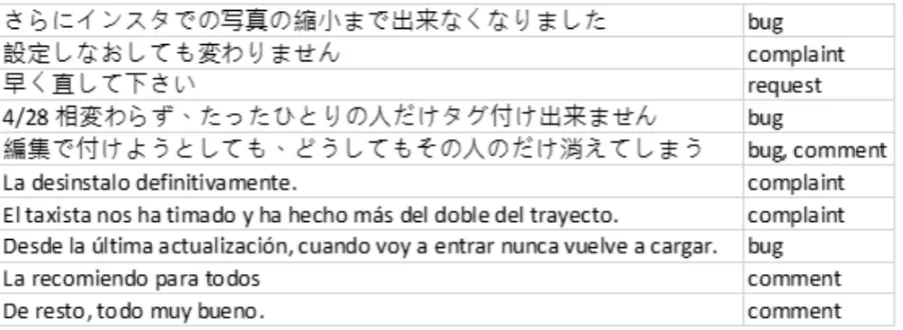
to-Figure 2: Some examples of Feedback sentences in Spanish and Japanese
wards the product they are using and hence con-veys a specific sentiment (e.g., negative, neu-tral, positive etc.). The work in Fang and Zhan (2015) categorises sentiment polarity of the on-line product reviews collected fromAmazon.com
by performing the experiments for both sentence-level categorisation and review-sentence-level categorisa-tion. Broß (2013) detect the individual product aspects reviewers have commented on and to de-cide whether the comments are rather positive or negative. They focus on the two main subtasks of aspect-oriented review mining: (i) identify-ing relevant product aspects, and (ii) determinidentify-ing and classifying expressions of sentiment.Gr¨abner et al. (2012) propose a system that performs the classification of customer reviews of hotels by means of a sentiment analysis. They elaborate on a process to extract a domain-specific lexicon of se-mantically relevant words based on a given corpus (Scharl et al. (2003); Pak and Paroubek (2010)). The resulting lexicon backs the sentiment analysis for generating a classification of the reviews.
3 Customer feedback analysis
Most app companies treat the contents of these reports as confidential materials and also regard things such as categorisation of customer feed-back as business secrets. To the best of our knowledge, there are only few openly available categorisations from these app companies. One of them is the commonly used categorisation which could be found in many websites, i.e., the five-class Excellent-Good-Average-Fair-Poor
(SurveyMonkey7). The other one is a combined categorisation of sentiment and responsiveness, i.e. another five-class Positive-Neutral-Negative-Answered-Unanswered, used by an app company Freshdesk8. There are many other categorisations for customer feedback analysis, however, most of them are not publicly available (e.g., Clarabridge9, Inmoment10)
To provide an open resource for international customer feedback analysis, the organisers of the shared task of customer feedback analysis in IJCNLP-2017 prepared a corpus using their pro-posed five-class categorisation of meanings as an-notation scheme. As mentioned earlier in Section 1, a feedback sentence must have at least one tag and can also be annotated with multiple tags. Fig-ure2 shows some feedback examples in Spanish and Japanese provided by the organisers of the shared task. These examples are taken directly from the shared task webpage11. We can see from these examples that each sentence is most likely to be assigned one tag but it is also possible to assign more than one tag in case of multiple possibilities. For example, one of the sentences in Japanese in Figure2is assigned two tags (bugandcomment). 4 Experiments
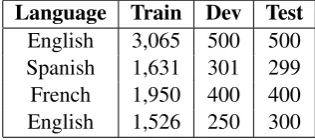
Statistics of the whole data sets in all four languages (i.e., English, Spanish, French and
7https://www.surveymonkey.com/r/BHM_
Survey
8https://freshdesk.com/ 9http://www.clarabridge.com/ 10https://www.inmoment.com/ 11https://sites.google.com/view/
Japanese) is shown in Table 1. In this paper, we
Language Train Dev Test
English 3,065 500 500 Spanish 1,631 301 299 French 1,950 400 400 English 1,526 250 300 Table 1: Data statistics per language
propose three different approaches (see Section 4.1,4.2and4.3) to analyse the customer feedback in English. For the other languages, we apply the method that produces the best output for English feedback. In addition to this, we also apply this method to the available translations of the Span-ish, French and Japanese feedback into English (see Section4.4).
4.1 MNB classification
MNB is a specific instance of a Naive Bayes clas-sifier which uses a multinomial distribution12 for each of the features instead of referring to con-ditional independence of each of the features in the model. In this classification method, the dis-tribution is estimated by considering the genera-tive Naive Bayes principle, which assumes that the features are multinomially distributed in order to compute the probability of the document for each label and keep the label maximizing probability. Assuming the feature probabilities P(xi|cj) are
independent given the classcand for a documentd
represented as featuresx1,x2, ...,xn; the equation
for MNB can be written as follows:
CNB = arg maxc∈C P(cj) Y
x∈X
P(x|c) (1)
Applying MNB classifiers to text classification, the equation can be represented as:
CNB = arg maxcj∈CP(cj) Y
i∈positions
P(xi|cj) (2)
where,positions←all word positions in test doc-ument
For this task, we initially applied MNB classi-fication method to label the whole training dataset in a single step. Subsequently, we also performed iterative process which is discussed in detail in the following section.
12https://web.stanford.edu/class/cs124/
lec/naivebayes.pdf
4.2 MNB with one-vs-rest approach
This approach is a variation of MNB classification that works as follows:
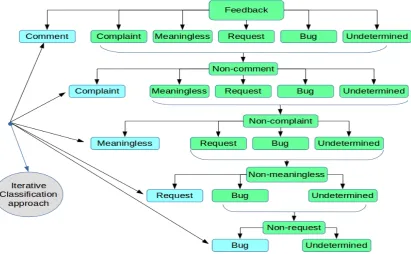
(i) We apply an iterative process of one-vs-rest classification method. As there are total of six different categories available (comment,
complaint, meaningless, request, bug and
undetermined), we select one of these cate-gories asone-class and consider the remain-ing as therest-class. For example, we may select comment as one-class and treat the remaining as rest-class. These two groups of feedback can be considered as comment
andnon-comment classes, respectively. We then perform the classification process be-tween the comment and the non-comment
categories.
(ii) Once the feedback sentences are labeled as
comment andnon-comment classes, we opt out the sentences tagged as comment class and consider the rest with two new group of classes (for example,complaint and non-complaint). This iterative process continues until all the feedback sentences are assigned tags.
meaning-Figure 3: Iterative MNB classification with one-vs-rest approach
less,request,bugandundetermined) in the subse-quent steps.
4.3 Multilabel classifier with sentiment classification
In addition to the approaches discussed in Section 4.1and Section4.2, we also apply sentiment clas-sification approach and incorporate with the mul-tilabel classification approach. We extract the sen-timent scores (between0and1, both inclusive) of all the feedback sentences using an automatic sen-timent analysis tool (Afli et al.,2017), with0 be-ing extremely negative and1being extremely pos-itive whereas any score close to0.5is considered to be neutral. Table 2 shows the observed senti-ment range for different categories.
category sentiment range
bug, complaint 0.2 to 0.6 meaningless, request 0.4 to 0.7 comment 0.4 to 0.9 undetermined not fixed
Table 2: Sentiment range of Feedback categories
It is observed that some of the categories belong to overlapping ranges of sentiment scores. This observation implies that it is very difficult to iden-tify a specific feedback category solely based on the sentiment scores due to the overlapping range
of sentiment scores. However, it is visible in Table 2that thebugand thecomplaintclasses fall under the lower sentiment-score category. In contrast,
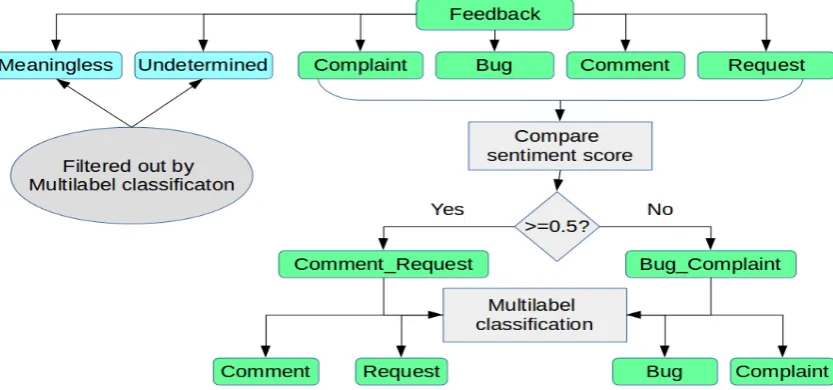
meaningless,requestandcommentcategories usu-ally have higher sentiment scores, whereas the sentiment score for the undetermined category does not have any fixed range. Figure4shows the combination of multilabel classification and sen-timent classification-based approach. Initially we filter out theundeterminedandmeaningless cate-gories using the multilabel classification approach. The reasons behind performing this filtering are as follows: (i) the undetermined class has no fixed sentiment range, and (ii) themeaninglessclass has a specific sentiment range, but they are not related to customer feedback. This method works in fol-lowing steps:
(i) Out of the six categories, meaningless and
undetermined are filtered out using multil-abel classification approach.
(ii) Sentiment scores are extracted for all the re-maining feedback sentences.
Figure 4: Machine learning combined with sentiment classification
if score < 0.5, it is treated as either bug
orcomplaint class, and grouped together as
Bug Complaintcategory.
(iv) Finally, we apply multilabel classification to theComment Request category and identify each ofCommentandRequest classes. In a similar manner, each ofBug andComplaint
classes are identified from theBug Comment
group.
4.4 MNB for translated feedback
The translations of non-English (i.e., Spanish, French and Japanese) test data into English are also provided by the organisers. Since the trans-lations of training data in these languages are not available, we train our classifier on English train-ing data and then test it on the translations of Span-ish, French and Japanese test data, respectively. Although our objective was to utilise the provided translations, this approach produces lower scores than other two approaches. The probable reason is that the trained model and the test data were orig-inally in different languages.
5 Results
As the training and development data in English are larger than that of the other languages, we perform a series of different approaches (dis-cussed in Section 4.1, Section 4.2 and Sec-tion 4.3) on English training data and applied the best approach to identify the feedback cat-egories in other languages. These three ap-proaches are termed as (i) MNB all (for the MNB
classification), (ii) ML SentClass (for the multi-label classifier with sentiment classification ap-proach), and (iii) MNB one-vs-rest (for the MNB with one-vs-rest approach). It can be seen from
Systems Precision Recall F1 score MNB all 0.674 0.6493 0.6614 ML SentClass 0.6687 0.6455 0.6569 MNB one vs rest 0.692 0.6667 0.6791
Table 3: Three different methods for English data
the table that the best results are obtained by the “MNB one vs rest” approach. For the other two approaches the scores obtained are relatively lower due to the fact that (i) inMNB allapproach (see Section4.1 for details), we identify the tags for all categories in a single step which is relatively more difficult task as compared to the iterative approach, and (ii) in ML SentClass system (see Section4.3), it is difficult to distinguish between the feedback categories based on their sentiment scores as some of them have overlapping range of scores as shown in Table2. Based on the above ob-servations, we apply the “MNB one vs rest” ap-proach to the other languages. However, each of the above three systems performs more or less similar in predicting the feedback sentences per category. For more detailed analysis, we provide Table4that highlights the performance of one of our systems per feedback category.
It can be observed for Table 4 that our sys-tem produce the best results for the comment
Tag
Oracle count Predicted Correct Precision Recall F1 score
comment
285
261
214
0.8199
0.7508
0.7838
complaint
145
178
103
0.5786
0.7103
0.6377
bug
10
11
2
0.1818
0.2
0.1904
meaningless
62
27
11
0.4074
0.1774
0.2471
request
13
23
7
0.3043
0.5384
0.3888
undetermined
4
0
0
0
0
0
Table 4: System performance per feedback category using MNB one vs rest approach
to the comment category contain positive words, and (ii) it is seen that the majority of the train-ing data belongs to thecommentclass. It therefore becomes easier for the system to learn the model that can better identify a feedback under this cate-gory as compared to the other ones. In contrast, the other categories share much smaller portion of the whole training data and hence it becomes more difficult to correctly identify these tags by the models learned from these categories. How-ever, our system fails to identify any tag under un-determined category as the training data for this category is too small to train a classifier model.
Table5provides the summary of the results for English feedback. A total of53systems was sub-mitted and this table shows some of them. The ranking was performed in the decreasing order of F1 scores. A total of12teams participated in this shared task in4languages mentioned above. The team names are published as coded names start-ing from “TA” to “TJ” and end with language code name (e.g., “EN” for English). The full name of a submission is represented as “<TX>
-<method name>-<land ID>” where X can be any letter from “A” to “J”. All of our submitted systems start with “TK”. For example, our best performing system (highlighted in bold letters in Table5) is named as “TK-MNB one vs rest-EN” where “‘MNB one vs rest” is the method name and “EN” is the language ID (English in this case). Most of the teams submitted multiple runs for all the 4 languages. As mentioned earlier, we con-duct3 different experiments and applied the best one to the other language data sets. In addition to this, we also test our system on the transla-tions of Spanish, French and Japanese feedback sentences into English. Therefore, we submitted3 systems for English and2systems for each of the other languages but as mentioned earlier in Sec-tion4.4, the models learned from the English data produce lower score when tested on the translated
non-English test data into English. We therefore apply “MNB one vs rest” method to the other lan-guages. The performance of all the systems are evaluated using the precision, recall and F1 scores. We can observe in Table 5 that out of the 53 submissions in English, our system (TK-MNB-one vs rest-EN) secures18th position with
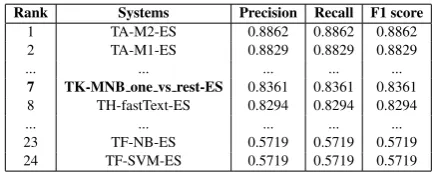
0.6791ofF1score whereas the highestF1score achieved is0.7557and the lowest is0.4175. Ta-ble6,7and8show the results for Spanish, French and Japanese, respectively. For French and Span-ish test data, our system achieves5thand7thrank
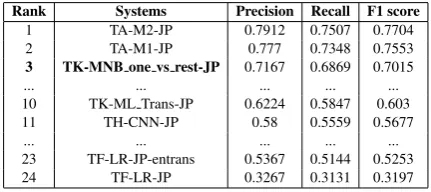
with the F1 scores of0.8361and0.7268, respec-tively. The system performs best for the Japanese data in terms of ranking and secures the 3rd
po-sition. In overall, we can observe from the Ta-ble5,6,7and8that all the scores produced by our approach are relatively much closer to the highest scores than the lowest scores for all languages.
Rank Systems Precision Recall F1 score
1 TL-biLSTMCNN-EN 0.7485 0.7630 0.7557 2 TL-biCNN-EN 0.7383 0.7611 0.7495
... ... ... ... ...
18 TK-MNB one vs rest-EN 0.692 0.6667 0.6791 19 TG-biLSTM-EN 0.6782 0.6782 0.6782
... ... ... ... ...
52 TB-M2-EN 0.4277 0.4277 0.4277 53 TB-M3-EN 0.4132 0.422 0.4175
Table 5: Results for English feedback sentences
Rank Systems Precision Recall F1 score
1 TA-M2-ES 0.8862 0.8862 0.8862 2 TA-M1-ES 0.8829 0.8829 0.8829
... ... ... ... ...
7 TK-MNB one vs rest-ES 0.8361 0.8361 0.8361 8 TH-fastText-ES 0.8294 0.8294 0.8294
... ... ... ... ...
23 TF-NB-ES 0.5719 0.5719 0.5719 24 TF-SVM-ES 0.5719 0.5719 0.5719
Table 6: Results for Spanish feedback sentences
Rank Systems Precision Recall F1 score
1 TA-M1-FR 0.785 0.7476 0.7658 2 TC-CNN-FR-entrans 0.765 0.7286 0.7463
... ... ... ...
5 TK-MNB one vs rest-FR 0.745 0.7095 0.7268 6 TC-CNN-FR 0.735 0.7 0.7171
... ... ... ... ...
26 TF-NN-FR 0.515 0.4905 0.5024 27 TF-ss predtest-FR 0.4875 0.4643 0.4756
Table 7: Results for French feedback sentences
Rank Systems Precision Recall F1 score
1 TA-M2-JP 0.7912 0.7507 0.7704 2 TA-M1-JP 0.777 0.7348 0.7553
3 TK-MNB one vs rest-JP 0.7167 0.6869 0.7015
... ... ... ... ...
10 TK-ML Trans-JP 0.6224 0.5847 0.603 11 TH-CNN-JP 0.58 0.5559 0.5677
... ... ... ... ...
23 TF-LR-JP-entrans 0.5367 0.5144 0.5253 24 TF-LR-JP 0.3267 0.3131 0.3197
Table 8: Results for Japanese feedback sentences
Lang No. of Our Highest Baseline Lowest Our submission rank score score score score
JP 24 3 0.7704 0.5933 0.3197 0.7015 FR 27 5 0.7658 0.6026 0.4756 0.7268 ES 24 7 0.8862 0.7726 0.5719 0.8361 EN 53 18 0.7557 0.5393 0.4175 0.6791
Table 9: Summary of results for all languages
comparison among the highest score, the base-line scores (provided by the organisers), the lowest scores and the scores produced by our system. For all languages, our system performs better than the baseline and produces comparable results to the top ones. Our system secures3rdand5thrank for
Japanese and French, respectively. In overall, the scores produced by our approach are competitive and relatively much closer to the highest scores than the lowest scores for all languages.
6 Conclusions and Future work
In this work, we presented different approaches based on (i) multinomial naive bayes algorithm, and (ii) a combination of multilabel classification and sentiment analysis technique to identify the tags of a collection of customer feedback in four languages. Initially we applied three different approaches for customer feedback-classification in English. We then selected one of these proaches that produced the highest scores and ap-plied it to the other languages. In addition to this, we also tested our system on the translations of the feedback sentences (non-English feedback into English). Our system produced competitive
re-sults for all of the languages and secured3rd and
5th rank for Japanese and French, respectively in
terms of F1 score. However, all of the method-ologies were not tested on non-English datasets. In future, we plan to apply them to the other lan-guages in order to see the effects in the results. We will also extend our study on the frameworks us-ing other efficient machine learnus-ing techniques to develop a new algorithm utilising the benefits of the sentiment analyser so that it can be effectively used in prediction.
Acknowledgments
This research is supported by Science Foundation Ireland in the ADAPT Centre (Grant 13/RC/2106) (www.adaptcentre.ie) at Dublin City Uni-versity.
References
Haithem Afli, Sorcha McGuire, and Andy Way. 2017. Sentiment translation for low resourced languages: Experiments on irish general election tweets. In Proceedings of the 18th International Conference on Computational Linguistics and Intelligent Text Pro-cessing, Budapest, Hungary.
Michael Bentley and Soumya Batra. 2016. Giving voice to office customers: Best practices in how of-fice handles verbatim text feedback. InThe fourth IEEE International Conference on Big Data, pages 3826–3832, Washington DC, USA.
J¨urgen Broß. 2013. Aspect-Oriented Sentiment Analy-sis of Customer Reviews Using Distant Supervision Techniques. Ph.D. thesis, Freie Universit¨at Berlin, Berlin, Germany.
Mita K. Dalal and Mukesh A. Zaveri. 2014. Opinion mining from online user reviews using fuzzy linguis-tic hedges. Applied Computational Intelligence and Soft Computing, 2014:735942:1–735942:9.
Xing Fang and Justin Zhan. 2015. Sentiment analy-sis using product review data. Journal of Big Data, 2(1):5.
Dietmar Gr¨abner, Markus Zanker, G¨unther Fliedl, and Matthias Fuchs. 2012. Classification of customer reviews based on sentiment analysis. In Proceed-ings of the International Conference on Information and Communication Technologies, pages 460–470, Helsingborg, Sweden. Springer Vienna.
Giancarlo Guizzardi. 2005. Ontological foundations for structural conceptual models. Ph.D. thesis.
ACM SIGKDD International Conference on Knowl-edge Discovery and Data Mining, pages 168–177, Seattle, Washington, USA. ACM.
Itzel Morales-Ramirez, Anna Perini, and Renata S. S. Guizzardi. 2015. An ontology of online user feed-back in software engineering. Applied Ontology, 10:297–330.
Linda Nasr, Jamie Burton, Thorsten Gruber, and Jan Kitshoff. 2014. Exploring the impact of customer feedback on the well-being of service entities: A tsr perspective. Journal of Service Management, 25(4):531–555.
Alexander Pak and Patrick Paroubek. 2010. Twitter as a corpus for sentiment analysis and opinion mining. In Proceedings of the Seventh conference on Inter-national Language Resources and Evaluation, pages 1320–1326, Valletta, Malta.
Rahul Potharaju, Navendu Jain, and Cristina Nita-Rotaru. 2013. Juggling the jigsaw: Towards auto-mated problem inference from network trouble tick-ets. InThe 10th USENIX Symposium on Networked Systems Design and Implementation (NSDI), pages 127–141, Lombard, Illinois, USA.
Arno Scharl, Irene Pollach, and Christian Bauer. 2003. Determining the semantic orientation of web-based corpora. In4th International Conference on Intel-ligent Data Engineering and Automated Learning, Hong Kong, China.