A quantitative model of word order and movement
in English, Dutch and German complement constructions
K
ARINH
ARBUSCHComputer Science Department
University of Koblenz-Landau
PB 201602, 56016 Koblenz/DE
G
ERARDK
EMPENCognitive Psychology Unit
Leiden University, and
Max Planck Institute, Nijmegen/NL
Abstract We present a quantitative model of word order and movement constraints that enables a simple and uniform treatment of a seemingly het-erogeneous collection of linear order phenomena in English, Dutch and German complement con-structions (Wh-extraction, clause union, extraposi-tion, verb clustering, particle movement, etc.). Un-derlying the scheme are central assumptions of the psycholinguistically motivated Performance Gram-mar (PG). Here we describe this formalism in de-clarative terms based on typed feature unification. PG allows a homogenous treatment of both the within- and between-language variations of the or-dering phenomena under discussion, which reduce to different settings of a small number of quantita-tive parameters.
1. Introduction
We propose a quantitative model for expressing word order and movement constraints that enables a simple and uniform treatment of a heterogeneous collection of linear ordering phenomena in English, Dutch and German complement structures. Under-lying the scheme are central tenets of the psy-cholinguistically motivated Performance Grammar (PG) formalism, in particular the assumption that linear order is realized at a late stage of the gram-matical encoding process. The model is described here in declarative terms based on typed feature unification. We show that both the within- and be-tween-language variations of the ordering phe-nomena under scrutiny reduce to differences be-tween a few numerical parameters.
The paper is organized as follows. In Section 2, we sketch PG's hierarchical structures. Section 3, the kernel of the paper, describes the linearization and movement model. In Section 4, we turn to cen-tral word order phenomena in the three target lan-guages. Section 5, finally, contains some conclu-sions.
2.
Hierarchical structure in PG
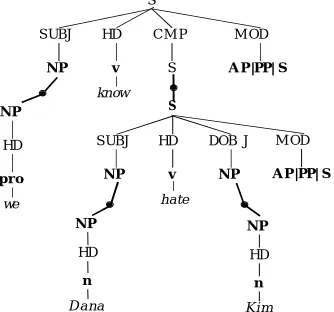
PG's hierarchical structures consist of unordered trees ('mobiles') composed out of elementary build-ing blocks called lexical frames. These are 3-tiered mobiles assembled from branches called segments. The top layer of a frame consists of a single phrasal node (the 'root'; e.g. Sentence, Noun Phrase, ADJectival Phrase, Prepositional Phrase), which is connected to one or more functional nodes in the second layer (e.g., SUBJect, HeaD). At most one exemplar of a functional node is al-lowed in the same frame. Every functional node dominates exactly one phrasal node ('foot') in the third layer, except for HD which immediately dominates a lexical (part-of-speech) node. Each lexical frame is 'anchored' to exactly one lexical item: a lemma (printed below the lexical node serv-ing as the frame's HeaD). A lexical frame encodes the word category (part of speech), subcategoriza-tion features, and morphological diacritics (person, gender, case, etc.) of its lexical anchor (cf. the elementary trees of Tree Adjoining Grammar (TAG; e.g. Joshi & Schabes, 1997).
with the root of another frame. The tree in Figure 1 is well-formed because the MODifier segments are not obligatory.
N P HD
p ro we
S S UBJ
N P HD
v h ate
DOB J
N P
N P HD
n D a n a
N P HD
n K im S
S UBJ
N P HD
v kn ow
C M P
S
M OD
A P |PP| S
M OD
A P |PP| S
Figure 1. Simplified lexical frames underlying the sentences We know Dana hates Kim and Kim we know Dana hates (example from Sag & Wasow,1999). Or-der of branches is arbitrary. Filled circles denote sub-stitution. (The feature matrices unified as part of the substitution operations are not shown.)
3. Linear structure in PG
The above-mentioned topological features are as-sociated with the phrasal root nodes of lexical frames. Their value is a feature matrix specifying a 'topology', that is, a one-dimensional array of left-to-right slots. In this paper we will only be con-cerned with topological features associated with S-nodes. They serve to assign a left-to-right order to the segments (branches) of verb frames (i.e. lexical frames specifying the major constituents of clauses). On the basis of empirical-linguistic ar-guments (which we cannot discuss here), we pro-pose that S-topologies of English, Dutch and Ger-man contain exactly nine slots:
E F1 F2 F3 M1 M2 M3 M4 E1 E2
D/G F1 M1 M2 M3 M4 M5 M6 E1 E2
The slots labeled Fi make up the Forefield (from Ger. Vorfeld); the Mj slots belong to the Midfield (Mittelfeld); the Ek's define the Endfield (Nachfeld; terms adapted from traditional German grammar; cf. Kathol, 2000). Table 1 illustrates which clause constituents select which slot as their 'landing site'. Notice, in particular, that the placement conditions refer not only to the grammatical function fulfilled by a constituent but also to its shape. For instance, while the Direct Object takes M3 as its default landing site, it selects F1 if it is a Wh-phrase or carries focus, and M2 if it is a personal pronoun (it). In terms of Figure 1, if Kim carries focus, it
may occupy slot F1 of the topology associated with the complement clause headed by hate.
Table 1. Examples of topology slot fillers (English). MODifier constituents are not shown. Precedence be-tween constituents landing in the same slot is marked by "<".
Slot Filler
F1 Declarative main clause: Topic, Focus (one constituent only)
Interrogative main clause: Wh-constituent. Complement clause: Wh-constituent
(includ-ing CoMPlementizeR whether/if)
F2 Complement clause: CoMPLementizeR that F3 Subject (iff non-Wh)
M1 Pre-INFin. to < HeaD (oblig.) < PaRTicle M2 Direct OBJect (iff personal pronoun)
Interrogative main clause: SUBJect (iff non-Wh); SUBJ < DOBJ
M3 Indirect OBJect < Direct OBJect (non-Wh) M4 PaRTicle
E1 Non-finite CoMPlement of 'Verb Raiser' E2 Non-finite CoMP of 'VP Extraposition' verb
Finite CoMPlement clause
How is the Direct Object NP Kim 'extracted' from the subordinate clause and 'moved' into the main clause? Movement of phrases between clauses is due to lateral topology sharing. If a sen-tence contains more than one verb, each of the verb frames concerned instantiates its own topology. This applies to verbs of any type, whether main, auxiliary or copula. In such cases, the topologies are allowed to share identically labeled lateral (i.e. left- and/or right-peripheral) slots, conditionally upon several restrictions to be explained shortly. After two slots have been shared, they are no longer distinguishable; in fact, they are the same object. In the example of Figure 1, the embedded topology shares its F1 slot with the F1 slot of the matrix clause. This is indicated by the dashed bor-ders of the bottom F1 slot:
F1 F3 M1 E2
•
we know•
↑ ⇑
Kim Dana hates
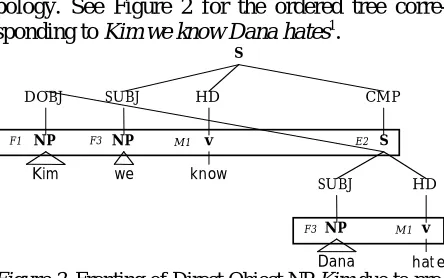
to-pology. See Figure 2 for the ordered tree corre-sponding to Kim we know Dana hates1.
S
SUBJ
NP
we
HD
v
know
CMP
S
SUBJ
NP
Dana
HD
v
hat e DOBJ
NP
Kim
F1 F3 M1 E2
F3 M1
Figure 2. Fronting of Direct Object NP Kim due to pro-motion (cf. Figure 1). Rectangles represent (part of) the topologies associated with the verb frames.
The number of lateral slots an embedded topol-ogy shares with its upstairs neighbor is determined by the parameters LS (left-peripherally shared area) and RS (right-hand share). The two laterally shared areas are separated by a non-shared central area. The latter includes at least the slot occupied by the HeaD of the lexical frame (i.e., the verb) and usu-ally additional slots. The language-specific pa-rameters LS and RS are defined in the lexical en-tries of complement-taking verbs, and dictate how (part of) the feature structure associated with the foot of S-CMP-S segments gets instantiated. For instance, the lexical entry for know (Figure 1) states that LS=1 if the complement clause is finite and declarative. This causes the two S-nodes of the CoMPlement segment to share one left-peripheral slot, i.e. F1. If the complement happens to be inter-rogative (as in We know who Dana hates), LS=0, implying that the F1 slots do not share their con-tents and who cannot 'escape' from its clause.
In the remainder of this Section we present a rule system for lateral topology that is couched in a typed feature logic and uses HPSG terminology. The system deals with a broad variety of movement
phenomena in English, Dutch and German.
We define a clausal topology as a list of slot types serving as the value of the topology ("TPL") feature associated with S-nodes:
S [TPL〈F1t,F2t,F3t,M1t,M2t,M3t,M4t,E1t,E2t〉]
1The value of a TPL feature may be a disjunctive set of
alternative topologies rather than a single topology. See the CMP-S node of Figure 3 for an example.
As for syntactic parsing, in Harbusch & Kempen (2000) we describe a modified ID/LP parser that can compute all alternative hierarchical PG structures li-censed by an input string. We show that such a parser can fill the slots of the topologies associated with any such structure in polynomial time.
for English, and
S [TPL〈F1t,M1t,M2t,M3t,M4t,M5t,M6t,E1t,E2t〉] for Dutch and German. Slot types are defined as attributes that take as value a non-branching list of lemmas or phrases (e.g. SUBJect-NP, CoMPle-ment-S or HeaD-v). They are initialized with the value empty list, denoted by "〈〉" (e.g., [F1tF1 〈〉]).
Lists of segments can be combined by the ap-pend operation, represented by the symbol "⊕". The expression "L1⊕L2" represents the list com-posed of the members of L1 followed by the mem-bers of L2. We assume that L2 is non-empty. If L1 is the empty list, "L1⊕L2" evaluates to L2. Slot types may impose constraints on the cardinality (number of members) of the list serving as its value. Cardinality constraints are expressed as sub-scripts of the value list. E.g., the subscript "c=1" in [F1t F1 〈〉c=1] states that the list serving as F1's value should contain exactly one member. Cardinality constraints are checked after all constituents that need a place have been appended.
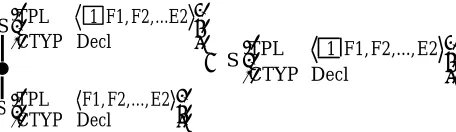
Depending on the values of sharing parameters LS and RS, the list can be divided into a left area (comprising zero or more slot types), the central area (which includes at least one slot for the HeaD verb), and the right area (possibly empty). Topol-ogy sharing is licensed exclusively to the lateral areas. LS and RS are set to zero by default; this ap-plies to the topologies of main clauses and adver-bial subclauses. The root S of a complement clause obtains its sharing parameter values from the foot of the S-CMP-S segment belonging to the lexical frame of its governing verb. For example, the lexi-cal entry for know states that the complement of this verb should be instantiated with LS=1 if the clause type (CTYP) of the complement is declara-tive. This causes the first member of the topologies associated with the S-nodes to receive a corefer-ence tag (indicated by boxed numbers):
S
[
TPL 1 F1,F2,...,E2]
CMPS TPL 1 F1,F2,...E2 CTYP Decl
S TPL 1 F1,F2,...E2
Filling a slot also involves coreference tags. For example, the HeaDs of English verb frames obtain their position in the local topology by looking up the slot associated with the coreference tag:
S TPL F1,...,M1
[
⊕ 1 ,...,E2]
HD
v 1 LEMMA hate
[
]
The information associated with the foot node of the HeaD segment will now be appended to the current content, if any, of slot M1. The same mechanism serves to allocate the finite comple-ment clause (or rather its root S-node) to slot E2 of the matrix clause:
S TPL
[
1 F1,...,E1, E2⊕ 2]
Other clause constituents receive their landing site (cf. Table 1) in a similar manner. Figure 2 depicts the configuration after Fronting of NP Kim.
Figure 3 below includes a paraphrase where the focus on Kim is stressed prosodically rather than by Fronting. This is indicated by the disjunctive set carrying the tag 4 . In sentence generation, the Read-out module selects one alternative, presuma-bly in response to pragmatic an other context fac-tors. In parsing mode, one or the alternatives is ruled out because it does not match word order in the input string.
The formalism defined so far yields unordered hierarchical structures. However, the values of the
TPL features enable the derivation of ordered out-put strings of lexical items. As indicated above in connection with Figure 2, we assume that this task can be delegated to a simple Read-out module that traverses the clause hierarchy in a depth-first man-ner and processes the topologies from left to right2.
If a slot is empty, the Reader jumps to the next slot. If a slot contains a lexical item, it is appended to
2 A slot may contain more than one phrase (e.g., Direct
and Indirect OBJect in slot M3; cf. Table 1). We assume they have been ordered as part of the append operation, according to the sorting rule associated with the slot.
the current output string and tagged as already processed. It follows that, if a slot happens to be shared with a lower topology, its contents are only processed at the higher clause level, i.e., undergo promotion.
4. Linearization of complement clauses in
English, Dutch and German
The PG formalism developed above provides a simple quantitative linearization method capturing both within-clause and between-clause phenomena. The assignment of constituents to topology slots (including, e.g., scrambling in Dutch and German) has been dealt with in Kempen & Harbusch (in press; forthcoming). In the present paper we focus on promotion in complement constructions — a domain where the three target languages exhibit rather dissimilar ordering patterns. We highlight the fact that PG enables highly similar treatments of them, differing only with respect to the settings of some quantitative parameters.
The movement (promotion) phenomena at issue here depend primarily on the values assigned to sharing parameters LS and RS in five different types of complement clauses. These settings are shown Table 2. They are imported from the lexi-con and lexi-control the instantiation of the TPL feature of the root S-node of the complement. We begin with some illustrations from English.
Table 2. Size of the left- and right-peripheral shared topology areas (LS and RS) in diverse complement constructions.
Clause type English Dutch German
Interrogative LS=0 RS=0
LS=0 RS=1
LS=0 RS=1 Declarative & Finite LS=1
RS=0
LS=1 RS=1
LS=1 RS=1 Decl. & Non-Finite,
VP Extraposition Decl. & Non-Finite,
Verb Raising Decl. & Non-Finite,
Figure 3. Analysis of Kim we know Dana hates (cf. Figure 1) and We know Dana hates Kim. The versions correspond to different options of the topology value associated with the CoMPlement (indicated within curly brackets). Empty slots are not shown in the TPL features.
(1) Who do I have to call?
F1 M1 E1 E2
•
do I•
↑ ⇑
have
•
↑ ⇑
who to call In example (2), the lower clause is finite and de-clarative —cf. the paraphrase “For which person x is it the case that you said that John saw x”. The scope of who exceeds its ‘own’ clause and includes the matrix clause. In (3), on the other hand, the scope of the interrogative pronoun does not include the main clause (“I know for which person x it is the case that John saw x”). Therefore, the com-plement is interrogative and cannot share its F1 slot with that of the main clause.
(2) Who did you say John saw?
F1 F3 M1 M2 E1 E2
•
did you•
↑ ⇑
say
•
↑ ⇑
who John saw (3) I know who John saw
F1 F3 M1 E2
I know
•
⇑
who John saw
The system predicts 'island effects' as in (4). (4) a. Who did you claim that you saw?
b.*Who did you make the claim that you saw? The lexical frame of the verb claim includes an S-CMP-S segment identical to that of know above (repeated here for convenience):
S TPL
[
1 F1,...,E1, E2⊕ 2]
CMPS 2 TPL 1 F1,...,E1, E2 CTYP Decl_finite
The feature matrices of root and foot nodes of this
segment both specify a TPL feature referencing the slot F1. This enables insertion of coreference tag
2 and thus promotion of the filler of slot F1. However, the complement segment of the noun claim is rooting in an NP node, which cannot have a TPL feature with type F1t.
NP ...
[ ]
CMPS TPL 1 F1
CTYP Decl_finite
So, tag 1 is meaningless here, ruling out promo-tion in (4b).
Turning now to Dutch, we first refer to Table 3, which specifies some important landing sites for major clause constituents. Because of the similarity with German, we combine the two languages. First, we illustrate question formation.
Dutch interrogative main clauses feature Sub-ject-Verb inversion without the equivalent of do-insertion (cf. 5).
(5) a. M1 Zag M2 je M3 dat? saw you that ‘Did you see that?’ b. F1 Wie M1 zag M3 dat?
who saw that ‘Who saw that?’ c. F1 Wat M1 zagen M2 ze?
‘What did they see?’
Because the complement in (6) is interrogative, the sharing rule in Table 2 prohibits left-peripheral sharing (LS=0).
(6) Zij vroeg of ik hem kende She asked whether I him knew ‘She asked whether I knew him’
F1 M1 M2 M3 M6 E2
zij vroeg
•
⇑
Table 3. Examples of topology slot fillers (Dutch and German). Precedence between constituents landing in the same slot is marked by "<".
Slot Filler
F1 Declarative main clause: SUBJect, Topic or Focus (one constituent only)
Interrogative main clause: Wh-constituent, including Du. of and Ger. ob 'whether' Complementclause: Wh-constituent M1 Main clause: HeaD verb
Complement clause: CoMPLementizeR dat/om (Du.), dass (Ger.)
M2 Subject NP (iff non-Wh), Direct Object (iff personal pronoun)
M3 Direct < Indirect OBJect (iff non-Wh) M4 PaRTicle (Du. only)
M5 Non-finite CoMPlement of Verb Raiser M6 Subordinate clause:
Du.: Pre-INFinitive te < HeaD verb
Ger.: PaRTicle < Pre-INFinitive zu < HeaD E1 Non-finite Complement of Verb Raiser (Du.
only)
E2 Non-finite CoMP of VP Extraposition verb Finite Complement
The subordinate clause in (7) features clause union, causing the auxiliary zal to intervene be-tween the Direct hem the latter's governor bellen. The left-peripheral sharing area may vary between 4 and 6 slots (LS=4:6). Because hem lands in M3, i.e. in the shared area, it is promoted. The remain-der of the lower topology, including the HeaD bel-len itself, occupies E1 — one of the options of the complement of a Verb Raiser. The other option, with the complement in M5 (giving bellen zal) is also allowed.
(7) ...dat ik hem zal bellen that I him will phone '...that I will phone him'
M1 M2 M3 M6 E1
dat ik
•
zal•
↑ ⇑
hem bellen
Sentence (8) illustrates the treatment of 'particle hopping'. The positions marked by "∧" are gram-matical alternatives to the particle (op) position mentioned in the example; no other positions are allowed. Given LS=4:6 for complements of Verb Raisers, it follows that hem is obligatorily pro-moted into the higher topology:
(8) ...dat ik hem∧ zou∧ hebben op gebeld that I him would have up called '...that I would have called him up'
M1 M2 M3 M4 M6 E1 dat ik
•
zou•
↑ ⇑
hebben
•
↑ ⇑
hem op gebeld
However, sharing of the fifth slot (M4) is optional. If this option is realized in the middle topology, the order zou op hebben gebeld ensues. If, in addition, the middle topology shares M4 with its governor, the string comes out as op zou hebben gebeld.
The treatment of cross-serial dependencies is exemplified in (9). In order to deal with this con-struction, we need to make an additional assump-tion about the order of constituents that land in the same slot but originate from different levels in the clause hierarchy. We stipulate that constituents from more deeply embedded clauses trail behind constituents belonging to higher clauses. This or-dering can be determined locally within a slot if we equip every constituents in the hierarchy with a numerical 'clause depth' index (for instance, a Gorn number; Gorn, 1967). Given this index (not shown in the topology diagram accompanying (9)), the order hem de fiets results.
(9) ... dat ik hem de fiets wil helpen maken that I him the bike want-to help repair
'... that I want to help him to repair the bike' M1 M2 M3 M6 E1 dat ik
•
•
wil•
↑ ↑ ⇑
hem helpen
•
↑ ⇑
de fiets maken
We now turn to German, concentrating on structures usually labeled "VP Extraposition" (10) and "Third Construction" (11).
(10) ... dass er uns zwingt es zu tun that he us forces it to do '... that he forces us to do it'
M1 M2 M3 M6 E2 dass er uns zwingt
•
⇑
es zu tun
b. ... dass er es uns zu tun verspricht
M1 M2 M3 M5 M6
dass er
•
uns•
verspricht↑ ⇑
es zu tun c. ...dass er uns es zu tun verspricht
M1 M2 M3 M5 M6
dass er uns
•
verspricht⇑
es zu tun
d. ...dass er es uns verspricht zu tun
M1 M2 M3 M6 E2
dass er
•
uns verspricht•
↑ ⇑
es zu tun
e. ? ...dass er uns es verspricht zu tun
M1 M2 M3 M6 E2
dass er uns
•
verspricht•
↑ ⇑
es zu tun
The verb zwingen allows its complement to share slot F1 only (LS=1). This prevents promotion of the Direct OBJect es. Third Construction verbs like versprechen allow a great deal of variation in the size of the left-peripherally shared topology area (LS=1:6), thereby licensing optional promotion of es. However, since es is a personal pronoun, it only takes M2 as its landing site (see Table 3). The lat-ter constraint is violated in (11e).
5. Discussion
We have shown that the introduction of topologies with a fixed number of slots, in conjunction with cross-clause lateral topology sharing, enables a simple treatment of word order and movement (promotion) in complement structures of the three target languages. The considerable within- and be-tween-language variation typical of these construc-tions could be analyzed as resulting from different settings of a small number of quantitative parame-ters, in particular the size of shared areas. We claim that our approach is conducive to theoretical parsimony (and, presumably, computational effi-ciency). For instance, HPSG-style treatments of Wh-movement and Clause Union typically invoke very different types of mechanisms (e.g., the SLASH or GAP feature for WH-movement, and argument composition for Clause Union; cf. Sag & Wasow, o.c., andKathol o.c.).
Elsewhere we have provided a more fine-grained discussion of our approach and its psycho-linguistic motivation (Kempen & Harbusch, in press; forthcoming). Future study is needed to find out whether the PG approach generalizes to other languages.
Finally, we refer to the PG sentence generator for Dutch which was implemented by Camiel van Breugel. It covers the ordering phenomena de-scribed here and in Kempen & Harbusch (forth-coming) and runs under Java-enabled Internet browsers (www.liacs.nl/~cvbreuge/pgw). Vosse & Kempen (2000) describe a computational model of human syntactic parsing based on a PG-like for-malism.
References
GORN, S. (1967). Explicit Definition and Linguistic
Dominoes. Systems and Computer Science. To-ronto: University of Toronto Press.
HARBUSCH, K. & KEMPEN, G. (2000). Complexity of linear order computation in Performance Grammar, TAG and HPSG. In: Proceedings of Fifth International Workshop on Tree Adjoining Grammars and Related Formalisms (TAG+5), University of Paris 7, May 2000.
JOSHI, A.K. & SCHABES, Y. (1997). Tree Adjoin-ing Grammars. In: Rozenberg, G. & Salomaa, A. (Eds.), Handbook of formal languages (Vol. 3). Berlin: Springer.
KATHOL, A. (2000). Linear Syntax. New York: Oxford University Press.
KEMPEN, G. & HARBUSCH, K. (in press). Word order scrambling as a consequence of incre-mental sentence production. In: Haertl, H., Olsen, S. & Tappe, H. (Eds.), The syntax-semantics in-terface: Linguistic structures and processes. Ber-lin: De Gruyter.
KEMPEN, G. & HARBUSCH, K. (forthcoming). Dutch and German verb clusters in Performance Grammar. In: Seuren, P. & Kempen, G. (Eds.), Verb clusters in Dutch and German. Amsterdam: Benjamins.
SAG, I.A. & WASOW, T. (1999). Syntactic theory: a formal introduction. Stanford CA: CSLI Publi-cations.