When Candidates Attack:
Who Goes Negative and Why It Works
Thesis by Kyle Mattes
In Partial Fulfillment of the Requirements for the Degree of
Doctor of Philosophy
California Institute of Technology Pasadena, California
2008
Acknowledgements
I earnestly thank Matt Jackson, Jonathan Katz, and Tom Palfrey for both their
encouraging words and their excellent suggestions to improve this project. Thanks especially to Mike Alvarez for excellent research advice and for help navigating through the stages of the Caltech Ph.D. program. I am also grateful to Matias Iaryczower, Rod Kiewiet, Morgan Kousser, Andrea Mattozzi, and Leeat Yariv for their helpful comments and suggestions.
I also wish to thank the Division of Humanities and Social Sciences, the Haynes
Abstract
Political candidates use a variety of negative campaigning strategies, and these attacks have different degrees of success. To explain this, I first introduce a formal model of campaign strategy to show when candidates will engage in negative campaigning and how it can affect election results. Whether candidates choose negative campaigning depends upon three factors: the voters’ preconceptions about political candidates, the voters’ preferred dimension, and the candidates’ character traits. I show that eliminating negative campaigning has an ambiguous effect on voter welfare. Then, I extend the formal model of campaigning to include situations in which candidates campaign dishonestly. I find that allowing this is strictly inferior for voter welfare. Often this is because whenever lying becomes more probable, all campaigns start to look the same.
In order to understand the implications of the formal model, I use multiple empirical testing methods. I use laboratory experiments to test how voter beliefs and voter behavior affect the frequency and content of candidates’ negative campaigning. I find support for the above comparative statics hypothesis about when candidates are more likely to negatively campaign. Furthermore, the laboratory results are better explained by a quantal response equilibrium model in which voters are risk averse and are more naïve than sophisticated in their Bayesian updating ability.
of the real elections. Such correlation could arise from common neural mechanisms engaged when viewers make social judgments about faces, and when voters evaluate candidates. This was shown in two independent fMRI studies in which subjects again made judgments about images of unfamiliar politicians who had run in real elections. We found that for judgments of threat, election loss correlated with activity in the insula and ventral anterior cingulate cortex, structures known to be involved in processing negative emotions. These findings suggest that voters are influenced by negative emotions elicited by a candidate’s mere appearance.
Finally, we examine the role of candidate fear in explaining voter choice in presidential elections using ANES data from 1980–2004. We find that certain groups of voters are more susceptible to fear appeals. After controlling for the factors commonly thought to affect voter decision-making, we also find further evidence that fear of presidential candidates directly affects vote choice. The results have implications for future research on negative political
Table of Contents
ACKNOWLEDGEMENTS...III ABSTRACT... IV
TABLE OF CONTENTS... VI LIST OF FIGURES ... VII
LIST OF TABLES ...VIII
CHAPTER 1 ... 1
CHAPTER 2 ... 13
CHAPTER 3 ... 36
CHAPTER 4 ... 71
CHAPTER 5 ... 96
CHAPTER 6 ... 112
CHAPTER 7 ... 129
CHAPTER 8 ... 136
CONCLUSION... 167
APPENDICES ... 169
List of Figures
Figure 1: Range of parameters for equilibrium nonexistence ... 50
Figure 2: Credibility conflicts result in a cycle ... 59
Figure 3: Monitoring and Credibility Conflict ... 63
Figure 4: Incidence of Negativity by Case and Treatment... 85
Figure 5: Relevance of Campaign Information About an Opponent... 101
Figure 6: Responses by Voters Opposed to Criticizing Political Opponents ... 103
Figure 7: Voters’ Initial Opinions About Candidates... 105
Figure 8: Importance of Campaign Topics to Issue and Character Voters... 107
Figure 9: Sample Screen Shot ... 118
Figure 10: Voter and Non-Voter Fear ... 143
Figure 11: Voter Fear in 2004 ... 144
Figure 12: Voter Fear by Election Year ... 145
Figure 13: Fear and Presidential Vote ... 146
Figure 14: Fear and Ideology ... 150
Figure 15: Example Screen for Players in the Candidate Role ... 186
Figure 16: Example Screen for Players in the Voter Role ... 187
Figure 17: Campaign Probabilities at the QRE/CE Estimate of λ, χ, and q (30% Treatment) .... 188
Figure 18: Campaign Probabilities at the QRE/CE Estimate of λ, χ, and q (50% Treatment) .... 189
Figure 19: Campaign Probabilities at the QRE/CE Estimate of λ, χ, and q (70% Treatment) .... 190
Figure 20: Trial design of the two studies ... 193
Figure 21: Activity in the insula/parainsula correlates with election loss in both studies... 195
List of Tables
Table 1: Four Campaign Types ... 4
Table 2: Voter Payoff Table ... 77
Table 3: Experiment Session Summary ... 77
Table 4: Candidate Equilibrium Strategies with a Naïve Voter ... 79
Table 5: Candidate Equilibrium Strategies with a Sophisticated Voter ... 81
Table 6: Empirical Candidate Strategy Comparisons... 87
Table 7: Voter Behavior ... 88
Table 8: QRE Maximum Likelihood Results ... 92
Table 9: Cursed Equilibrium Maximum Likelihood Results ... 93
Table 10: Voters’ acceptance of campaign criticism depends upon their initial opinions about the candidates. ... 105
Table 11: Factors Affecting Voter Preference for Negativity (dependent variable: relevance aggregate) ... 108
Table 12: Factors Affecting Voter Preference for Negativity (dependent variable: never criticize?) ... 110
Table 13: Pearson Correlations (p-values are Bonferroni corrected) ... 120
Table 14: Logit Regression Predicting Election Outcomes... 122
Table 15: Predicting Election Winners From Aggregate Subject Choices... 123
Table 16: Percentage of Subjects Choosing Election Winners ... 124
Table 17: Factor Analysis of Emotion Variables ... 141
Table 18: Correlations Between Affect Variables... 142
Table 19: Determinants of Voters’ Fear... 148
Table 21: Comparing Unafraid and Afraid Voters... 157
Table 22: Vote Choice in 1988 and 2004... 159
Table 23: First Differences on the Likelihood of Voting Democrat ... 161
Table 24: QRE/CE Probability of Voting for Candidate ℓ (row) over Candidate –ℓ (column) .. 181
Table 25: Candidates’ Preferred Strategies ... 185
Table 26: Factors Affecting Voter Preference Against Negativity (dependent variable: topic relevance) ... 191
Table 27: Factors Affecting Voter Preference Against Negativity (dependent variable: topic relevance) ... 191
Table 28: Factors Affecting Voter Preference Against Negativity (dependent variable: topic relevance) ... 192
Table 29: Determinants of Voter Fear... 199
Table 30: Determinants of Fearing the Democratic Candidate ... 200
Table 31: Determinants of Fearing the Democratic Candidate (continued)... 201
Table 32: Determinants of Fearing the Democratic Candidate (continued)... 202
Table 33: Determinants of Fearing the Republican Candidate... 203
Table 34: Determinants of Fearing the Republican Candidate (continued) ... 204
Table 35: Determinants of Fearing the Republican Candidate (continued) ... 205
Table 36: Determinants of Vote Choice... 206
Chapter 1
Introduction
Although few campaign strategies are as maligned as negative campaigning, that hardly changes the fact that negative campaigns—or at least charges of negative campaigning—are ubiquitous. A recent article in the Washington Post (Grunwald 2006) stated that the National Republican Campaign Committee was dedicating over 90% of its campaign budget to negative advertising. But if nearly all campaigning is classified as “negative”, how meaningful is this term for describing political communication? Certainly not every politician uses the same strategy, a simple fact obscured by statements such as that by the Post. If the conventional approach used to classify advertising puts 90% in the same category, we need a better method of classifying campaign styles. Perhaps conveniently, candidates accusing their opponents of negative campaigning use a different definition than candidates employing such criticism (Maisel et al. 2007). “Negative campaigning is vicious personal attacks,” said House candidate Paul Nelson in the aforementioned Washington Post article. Nelson’s campaigning easily met his definition of negative when he targeted his opponent in a television ad stating “Representative Ron Kind pays for sex” while showing a picture of Kind with “XXX” stamped across his face (Grunwald 2006). This type of attack is very different from pointing out the shortcomings of an opponent’s health care reform plan. Clearly, not all negatively toned advertising is the same.
Nevertheless, “negative campaigning” is often maligned in general, often due to the perceived falseness or triviality of the attack. Take this advertisement, for example:
office right-side up. President Bush endorses Kolbe because he is dedicated to the fight for freedom and lower taxes.” (Jamestown Associates 2004)
Here, Kolbe insinuates that his opponent Randy Graf is a traitor and bases this accusation upon Graf’s inappropriate handling of a photograph. While potentially engaging for staunch Bush or Kolbe supporters, the advertisement probably comes off as specious character assassination to many others. Advertisements of this sort tend to devalue political attacks in general, causing candidates who engage in negative campaigning to be labeled as manipulators who are discouraging voter participation (Nelson, Dulio, and Medvic 2002). It is not uncommon to hear that “in overwhelming numbers, people say that negative campaigning is wrong and is damaging to our democracy”(Carr 2002).1 The leaders of the Anglican Church have called for an
end to negative campaigning (Watt 2001), and political candidates have also ventured to state their opposition directly. For example, Kathleen Brown, in the 1994 California gubernatorial race, implored all candidates to sign her proposal to “run a different kind of campaign. No negative ads bashing your opponent, but instead an election about the issues” (Stanford PCL 2006). Would political discourse really be better off without negative campaigning?
As explained by Geer (2006), negativity can improve the information received by voters. Moreover, impressions formed on the basis of negative information tend to be more lasting and more resistant to change (Cobb and Kuklinski 1997). As character is an important aspect of politics, character assaults have been prominent in politics throughout the history of the United States. For example, John Adams’ supporters accused Thomas Jefferson of being an atheist, the Van Buren campaign attempted but failed to brand William Henry Harrison as broken-down and incompetent, and proponents of James Blaine mocked Grover Cleveland’s admitted infidelity (Ferling 2004; Cleaves 1939; Troy 1996).
1 Carr (2002) is quoting Kathryn Hunt of the University of Maine’s Margaret Chase Smith Center for
However, if negativity generally has deleterious effects on election outcomes, that would bolster arguments in favor of its reduction or elimination.2 So, in order to assess the critiques of negative campaigning, one must ask: Who goes negative, when do they go negative, and how does it work?
What is Negative Campaigning?
In order to answer these questions, we need a formal definition of negative campaigning. It should capture the fundamental aspects that make campaign themes negative and also allow for easy comparison with other campaign styles. Not all attacks are the same. Surveys show that voters can differentiate between attacks on an opponent’s personal life and attacks on policy issues, and perceive attacks on a candidate’s personal qualities as more negative than issue attacks (Jamieson 2000). Popkin (1991) argues that voters use personal information about a candidate as a proxy for information that is otherwise difficult to obtain—specifically, evidence regarding how that candidate might behave in office.
Thus, the definition of negative campaigning should not only distinguish between promoting oneself and attacking the opponent but also separate campaigning on political issues from campaigning on character traits. Political issues, such as gun control and abortion, are generally represented by a left-right continuum (Poole and Rosenthal 1985). Character issues, such as honesty, competence, and leadership ability, are more typically represented by a valence dimension. This distinction is important but certainly not a recent innovation; for example, it has long been recognized that the perceived character of politicians affects their ability to persuade the voters.3 A valence dimension measures an attribute on which all voters have the same
2 In some countries, such a ban may be possible in practice. With the stated goal of protecting the
reputation of the candidates and political parties, a recent political reform in Mexico has made negative campaigning advertising illegal (Serra 2008).
3 Aristotle, in the Rhetoric, (Book 1, Chapter 2) argued that “of the modes of persuasion furnished by the
preferences, generally preferring more to less (or vice versa). Adding a valence dimension to definitions of campaign discourse provides a simple means of separating political issues, on which voters have varied opinions, from character traits, about which voters’ preferences
essentially agree. Stokes (1992) shows that both left-right and valence dimensions are needed to accurately represent voters’ preferences. A framework with two dimensions and two candidates suggests four campaign possibilities. The following matrix delineates each campaign type: Table 1: Four Campaign Types
Issue Dimension Character Dimension Talk about one’s opponent Issue Differentiation Negative Campaigning Talk about oneself Issue Bolstering Positive Campaigning
Each of the four main cells in Table 1 represents a different campaign strategy. As the table shows, I specifically define negative campaigning as campaigning against an opponent on the character dimension. A good example of this is Charles Shumer’s recurring theme, “Al D’Amato. Too many lies for too long,” which appeared in many of Shumer’s spots during his 1998 Senate campaign against D’Amato (Smith 1998). Notice that, in this framework, negative issue campaigning (i.e., stating that an opponent has the wrong stance on political issues) is referred to as issue differentiation, which is a separate campaign strategy from negative character campaigning. This is because negative issue campaigning, while it may be caustic in tone, does not directly impugn character. Most common in the issue differentiation category are contrast ads, which highlight the weaknesses of an opponent’s policy position by offering a comparison of the candidates’ issue stances. Also shown in Table 1 are the two self-promotional campaign
types. Highlighting one’s own valence qualities is defined as positive campaigning, and promoting one’s own ideological positions is issue bolstering.
This framework helps to better understand campaign discourse. For example, in the 2005 Los Angeles Mayoral Race between James Hahn and Antonio Villaraigosa, the candidates held similar issue positions, so instead battled over character – who was less corrupt, and who was more trustworthy. Villaraigosa’s negative advertising alleged Hahn’s involvement in trading city contracts for campaign donations. Meanwhile, Hahn’s commercials connected Villaraigosa to both corporate scandal and street gangs. “Los Angeles just can’t trust Antonio Villaraigosa,” one Hahn commercial stated (Blood 2005).
Of course, most political advertisements are not confined to a single dimension, but instead combine various themes. For example, the Kolbe ad above combines character attacks on Graf with a non-sequitur about Kolbe’s stand on taxation. Things get even more complicated when a candidate uses an opponent’s issue positions to make a statement about his character, such as labeling an opponent a waffler or flip-flopper. One example of this is the “windsurfing” advertisement that the Bush campaign used against John Kerry, which disparaged Kerry’s
character by claiming that he had both supported and opposed the Iraq war, education reform, and increasing Medicare premiums.4 Another example occurred in California Congressional District 26, when Cynthia Matthews used her opponent’s David Dreier’s political record to insinuate that he has major character flaws. Matthews, openly homosexual, accused Dreier of being a closeted homosexual and therefore a hypocrite because he consistently voted against gay issues. “If David Dreier is gay, it is absolutely shameful to me that he would amass a 24-year voting record against his own community,” she stated.5
4 To view this advertisement, see “The Living Room Candidate: Presidential Campaign Commercials,
1952-2004”, http://livingroomcandidate.movingimage.us/index.php.
Previously, scholars (e.g., Geer 2006) who have coded the content of advertisements for empirical research have quite reasonably tended to look at discrete advertisements as points of analysis, because their studies have generally focused on evaluating the content of or gauging voter response to those campaign advertisements. In contrast, the conditions that make a candidate more likely to choose negative campaigning in the first place are understudied. Since I’m looking at the reasons why candidates initially choose their strategies, I focus instead on overall campaign themes. Because political commercials can incorporate many themes, it is better to look at the array of advertisements offered by a campaign before determining the candidate’s political strategy; one negative comment does not necessarily constitute a negative strategy. This framework is intended to capture the overarching themes that appear in multiple campaign advertisements, and it is these themes which can be categorized into specific
dimensions and campaign types.
Other Approaches to Negative Campaigning
Campaign observers, as West (1993) explains, often “define negativity as anything they do not like about campaigns.” For example, some make the error of evaluating the veracity of the advertising to determine its negativity.6 While the truth of the statements contained within the
ads is clearly important, it is a separate issue from the style of the campaign. Nearly everyone is in agreement that campaign strategies involving calumny can harm the political system.
However, not all negative campaigning is mendacious, nor are all lies negative campaigning. Candidates can just as easily lie (or stretch the truth) about themselves as they can present misinformation about their opponents. Furthermore, Davis and Ferrantino (1996) postulate that candidates run less risk of being caught if they lie about the opponent rather than exaggerate the benefits they will provide if elected. This is because campaign promises can be used against a
candidate in future elections, while it is impossible to invalidate claims of what the opposing candidate would have done if elected.
Formal studies of negative campaigning have not adequately addressed the fundamental distinction between issue and character campaigning in their definition of the term. In Harrington and Hess (1996), though candidates inherit initial locations on both a valence and an issue
dimension, they are restricted to campaigning on the issue dimension, where negative
campaigning consists solely of relocating the opponent on that dimension. Hinich and Munger (1989) assume that candidates use negative campaigning to increase the variance of their opponent’s policy, and positive campaigning to decrease the variance of their own policy. This systematically proscribes a candidate from clarifying an opponent’s extremist position (e.g., by providing details of his voting record) or clarifying an opponent’s reprobate character (e.g., by providing details of his police record). In other words, going negative does not necessarily entail creating uncertainty about an opponent.
Although Ansolabehere and Iyengar (1995a) do not provide an explicit definition, they imply that negative campaigning equates to negative tone or negative word choice. However, the tone of an advertisement can be difficult to determine; Sigelman and Kugler (2003) show that voters can strongly disagree in their perceptions about the tone of a given campaign. And though “opposes” is a negatively charged word, the statement “I opposed tax hikes,” is certainly not negative campaigning, and “opposes immigration reform” could be a component of a positively or negatively toned statement, depending upon the context and the audience receiving the
Most other studies offer a very broad definition of the term. For example, Lau and Pomper (2002) say that “negative campaigning is talking about the opponent—his or her
programs, accomplishments, qualifications, associates, and so on—with the focus, usually, on the defects of these attributes”. Skaperdas and Grofman (1995) define negative campaigning as “that which attacks the other candidate personally, the issues for which the other candidate stands, or the party of the other candidate”.7
These definitions equate negative campaigning with “campaigning against an opponent”, a category that covers nearly the entire spectrum of political advertising. But there are many reasons to mention an opponent during political discourse. Mayer (1996) argues that “any serious, substantive discussion about what a candidate intends to do after the election can only be conducted by talking about the flaws and shortcomings of current policies.” This means that for candidates challenging incumbents, campaigning about political issues requires campaigning against the opponent. These comparisons are often necessary to provide voters with a better standard of evaluation (Ansolabehere and Iyengar, 1995a) and are almost mandatory for
challengers facing incumbents (Maisel et al. 2007). But, there is little explanatory power gained by labeling every challenger’s issue ads as negative. If an opponent is against the death penalty, stating that fact should be considered issue differentiation, and not negative campaigning. Using broader definitions conflates these vastly different campaign strategies, which also have different effects on the electorate, into the general category of “negative”.
All of this has confused the empirical literature. Because of the lack of a precise, consensus definition of negative campaigning, there is no solid foundation for empirical research on the subject. Thus, it is no surprise that the outcomes of empirical studies are inconsistent. For
7 They also assume that positive campaigning attracts undecided voters only, while negative campaigning
example, Ansolabehere and Iyengar (1994, 1995a) concluded that negative campaigning
decreases turnout; Wattenberg and Brians (1999) and Freedman and Goldstein (1999) determined that it increases turnout; Finkel and Geer (1998) found no consistent effect between negative campaigning and turnout; Kahn and Kenney (1999) found that “useful negative information” increased turnout, while “unsubstantiated and shrill attacks” decreased turnout. Niven (2006) supports the idea that more informed voters are more likely to vote regardless of information tone. After all, there is no necessary causation between being repulsed by negative campaigning and deciding whether to vote. Subjects who feel contempt for politics just after seeing a vicious attack may deem the attack insignificant or false (and then possibly refuse to vote) or instead believe the information is true and that it creates enough differentiation between the candidates to make participation worthwhile.
In another line of research, Theilmann and Wilhite (1998) found that a candidate tends to go negative if behind or in a dead heat. However, Sigelman and Buell (2003) found that in U.S. presidential races, major-party tickets were far more attack-oriented only if their election prospects looked bleak. Yet, Sigelman and Shiraev (2002) concluded that the relative negativity of the candidates is not a function of who is ahead and who is behind, and that candidates rarely adjust their strategies due to the ebb and flow of the campaign. Plus, Lau and Pomper (2001) showed that position in the polls does not affect a candidate’s usage of negative strategies. In a meta-analysis of empirical studies of negative campaigning, Lau et al. (1999) found no reliable statistical basis for concluding that negative ads are liked less than positive ones, or that negative political ads are more effective than positive political ads, or that negative campaigning affects voter turnout.
theoretical model that can be used as a foundation to understand the fundamental aspects of campaign strategy decisions. This framework also facilitates a shift in focus from discrete ads, which often combine multiple themes, to the underlying campaign strategy, in which themes are more readily separable. Most importantly, it provides answers to the original questions posed earlier: Who goes negative, when do they go negative, and how does it impact election results?
Overview
With the formal model in Chapter 2, I find that whether candidates choose negative campaigning depends upon three factors: the voters’ preconceptions about political candidates, the voters’ preferred dimension, and the candidates’ character traits. I show that eliminating negative campaigning has an ambiguous effect on voter welfare. While it is sometimes possible to improve election outcomes by not allowing negative campaigning, in some other cases, eliminating the negative option can hurt superior candidates. One cannot use a broad sword to cut away all of the negativity from a campaign without permitting inferior candidates to slip into office through the resulting gaps.
In Chapter 3, I extend the formal model of campaigning to include situations in which candidates lie. Here, I find that allowing this option is strictly inferior for voter welfare. Often this is because whenever lying becomes more probable, all campaigns start to look the same. In some instances, allowing candidates to lie also removes the possibility of a pure strategy
equilibrium in the formal model, meaning that candidates must employ mixed strategies and thus run the risk of making ex post “errors” in campaign choice.
of poor quality, when voters’ prior information suggests that candidates are of high quality, and when voters care strongly about the specific issue to which the negative campaigning is targeted. Furthermore, the results are better explained by a quantal response equilibrium model in which voters are risk averse and are more naïve than sophisticated in their Bayesian updating ability.
Having discussed which candidates are more likely to utilize negative campaigning, I next consider how negative campaigning translates into votes. In Chapter 5, I use survey results to look at how voters respond to character attacks in general. From this, I also show empirical support for candidate tactics that target specific segments of voters based upon their predilections toward accepting negativity in campaigns.
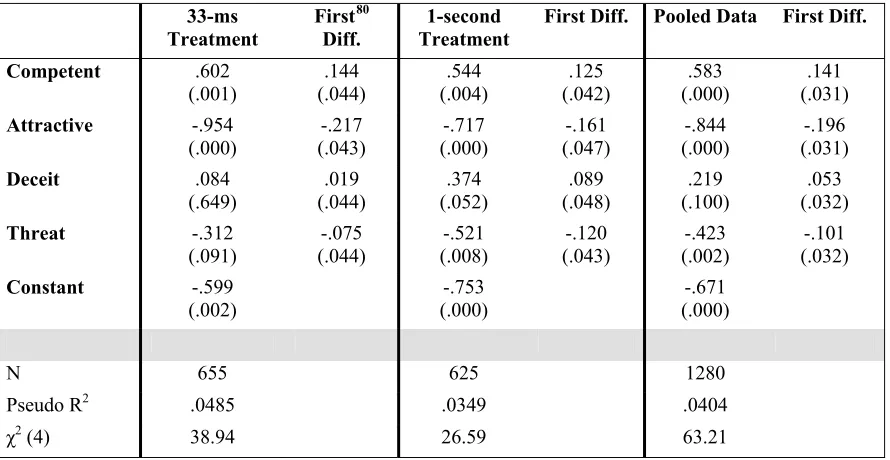
One way candidates attack their rivals is by trying to make voters afraid of them. Conventional wisdom, and a growing body of behavioral research, suggests that the nonverbal image of a candidate influences voter decision making; election outcomes are known to correlate with judgments about a candidate’s visual appearance. In the study reported in Chapter 6, we presented subjects with images of political candidates and asked them to make four trait
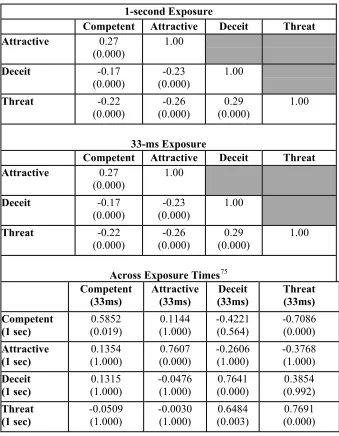
judgments based solely on viewing the photographs. Subjects were asked which of the two faces exhibited more competence, attractiveness, deceitfulness, and threat, which are arguably four of the most salient attributes that can be conveyed by faces. When we compared our subjects’ choices to the actual election outcomes, we found that the candidates chosen as more likely to physically threaten the subjects actually lost 65% of the real elections. Such correlation could arise from common neural mechanisms engaged when viewers make social judgments about faces, and when voters evaluate candidates.
judgments of threat. Furthermore, election loss correlated with activity in the insula and ventral anterior cingulate cortex, structures known to be involved in processing negative emotions. In the second study subjects cast hypothetical votes. Here we also found activation in the insula and anterior cingulate that correlated with loss in the hypothetical (lab vote) election, as well as activation in the insula that correlated with real-world election loss. These findings suggest that voters are influenced by negative emotions elicited by a candidate’s mere appearance.
Finally, Chapter 8 examines the role of candidate fear in explaining voter choice in presidential elections using ANES data from 1980-2004. We find that there are certain segments of the electorate, such as Protestants and Democrats, that more susceptible to fear appeals. After controlling for the factors commonly thought to affect voter decision-making, we also find further evidence that fear of presidential candidates directly affects vote choice. The results have
Chapter 2
The Formal Model
In this chapter, I incorporate the matrix of campaign strategy definitions from Table 1 into a formal model of campaign strategy. The model is a game for political campaigns in which candidates maximize their standing with the electorate via the optimal dissemination of
information.
With this model, I find that the type of campaign chosen by political candidates depends upon three factors: the traits of the candidates, the dimension of greatest importance to the voters, and the degree to which the candidates’ character and ideology differ from initial expectations. As a result, negative campaigning will be more likely when the voters have positive initial opinions of the attacked candidate’s personal qualities (and of political candidates in general), candidates are of poor character quality, and voters care strongly about the character traits of office seekers. This helps us understand why candidates choose negativity in varying degrees, and why we cannot rely on simple benchmarks, such as the closeness of the race, to determine optimal candidate strategies.
campaign choices. When candidates are also allowed to campaign about their own character (positive campaigning) and their opponents’ ideological position (issue differentiation), eliminating negative campaigning has an ambiguous effect on voter welfare.
The General Model
This campaigning game takes place between two candidates, A and B. The two candidates inherit positions on each of two dimensions, Issues and Character, that are assumed throughout to be separable. The issue dimension, I, is the traditional left-right dimension and is given by the set { 1,0,1}− . The character dimension, C, is a valence dimension given by the set { , }−x x .
There is one voter, V. Preferences of the voter are single-peaked on the issue dimension, and the voter’s ideal policy point is 0. By definition, the voter always prefers higher values on the valence dimension. Thus, the voter’s ideal point in (I, C) space is (0, x). She represents the preferences of the median voter on the issue dimension, and of every voter on the valence dimension.8
Candidates campaign by revealing the true location of one candidate on one dimension. The goal of the voter is to maximize her expected utility. Using the candidates’ campaign messages and her prior information, she will attempt to determine both the issue position and the character type of the two candidates, A and B. The voter’s utility function for candidate ℓ is:
( ) - | ( ) | ( ) V
U = I + C . (1)
8 Because one of these dimensions is defined as valence, this setup allows for simplification to one voter
So, the voter will choose the candidate ℓ that maximizes the expected value of UV
( )
. In the case of a tie, she will flip a coin to choose between the candidates. The winning candidate implements his preferred policy and receives a utility β from winning the election or zero from losing the election. So the utility function for candidate ℓ is U =βω , where ωℓ is theprobability of candidate ℓ winning the election.
Candidate Locations
Initially, the candidates’ locations θ =
(
I C,)
are assigned by nature and both are known to the candidates, but not known to the voter.9 However, the voter is aware that the typeθℓ of each candidate has been drawn independently from Φ = [{ 1, 0, 1} { ,− × x x− }] with the
distribution described as follows.10 The value p is the probability that a candidate has good
personal qualities (x), while 1−p is the probability he has undesirable character traits
( )
−x . Furthermore, each candidate has probability 1 2− q of being a centrist, and probability q of favoring each extreme.11I assume that p and q are independent, so at this stage the voter’s expected utility is
(
)
2 2q x p 1
− + − . Since the voter has Euclidean preferences on the issue dimension, the issue positions of 1 and -1 are mathematically identical when calculating the voter’s expected utility.
9 The important point is that a candidate will know his opponent’s position better than the voter does. 10 Although simple, this distribution provides enough richness to capture all of the relevant cases (i.e., one
candidate is better on both dimensions; each candidate is better on one dimension; candidates are equal on one or more dimensions).
11 An alternative formulation, in which the variance is different for each candidate (e.g., one candidate is
The x term defines the range of the character dimension and captures the importance to the voter of the issue dimension relative to the character dimension.12 As the value of x increases,
this can be interpreted as the voter caring more about the character dimension relative to the issue dimension. Note that the issue dimension range is normalized at [-1, 1] to better capture these effects. So, if the voter cares mainly about personal qualities, x will be of high magnitude and dwarf the utility effects of political issues. Conversely, if the voter cares mainly about policy issues, this will be represented by near-zero values of x.
This one-period game consists of two phases. First is the campaign phase, which is followed by the voting phase.
Campaign Phase
In this game, each candidate has a limited budget, so he can choose exactly one campaign type. Although this modeling choice is simplified, campaigns do generally have an overarching theme, and candidates cannot effectively transmit information on every topic.13 In the model, a
candidate’s campaign is the announcement of one of the four unknown locations.14 That is, a
candidate can choose from among the campaign strategies originally shown in Chapter 1:
Issue Differentiation: Revealing the opponent’s location on the issue dimension. Issue Bolstering: Revealing one’s own location on the issue dimension.
Negative Campaigning: Revealing the opponent’s location on the character dimension. Positive Campaigning: Revealing one’s own location on the character dimension.
12 It is convenient to use x as a weight. It technically consists of two components: the weight (w) the voter
gives character relative to issues, and the range (ν) of the character dimension. Thus, the voter utility function could be alternatively written as:UV
( )
= −( )
I +w C( )
, where E C( )
= ν(
2p−1)
and ν =1.13 Jamieson et al. (2000) showed that when voters learned from the 2000 presidential primary campaigns,
the learning occurred on the topics featured by the candidates.
Formally, this means that each candidate ℓ must simultaneously choose a strategy
2
:[{ , } { 1,0,1}]
s x x− × − → Σ, where
{
(C x C),( − x I),( 0),(I− 1),}
Σ = = = − = = ± ∅ . (2)
On line (2) above, each action a∈Σ is designated by the notationD =ι, where D is the dimension of revelation, ℓ is the candidate whose information is provided, and ι is the location. For example,(CA =x) means that candidate A is revealed to be located at x on the character dimension. Candidates cannot choose “defeatist” strategies (i.e., revealing bad information about oneself or good information about the opponent), which are excluded from Σ. While Σ contains five different types of messages, the realization of θA and θB may limit the possible choices in Σ
because candidates are required to tell the truth. However, candidates will always have at least one option, which is the choice not to campaign (a = ∅).
Notice that each of the possible campaign choices leads to a change in the voter’s expected utility for one of the two candidates. Each candidate ℓ improves his standing in the election whenever his campaign announcement a ∈Σ increases the voter’s expected utility for ℓ
or decreases the voter’s expected utility for the opponent -ℓ. Let d a a( , − ) indicate the benefit to candidate ℓ from employing campaign announcement aℓ with voter posterior beliefs μ and the opponent using strategy a-ℓ. In other words, the function ( ,d a a− ) captures changes in the
voter’s utility difference between the candidates, and can be written as:
Voting Phase
In this phase, the voter chooses the candidate who gives her the highest expected utility. In making this decision, the voter must rely on both her prior knowledge of the location
distribution and the information given her by the candidates via the two campaign themes.15
Although there is undoubtedly a wide range of analytic ability which can be ascribed to voters, I will consider two separate archetypes for the voter, described as follows:16
Naïve voter: The voter accepts the candidates’ two announcements a∈Σ, but does not consider the correlation between the candidates’ revelations and their underlying types.
Sophisticated voter: The voter assumes that the revelation of a candidate may also give information about the traits (of both candidates) that the candidate did not reveal. She uses the information revealed by the candidates and the candidates’ entire announcement strategies s(θ) to refine her understanding of the candidates’ spatial positions.
The voter, regardless of analytic ability, is not perfect. In any election, she has the probability ε( ( ))d a →[0, ]12 of “miscalculating” and voting for the wrong candidate. I assume
that 1
2
(0)
ε ≤ , that for all z, ( ) 0ε z > , that the function is monotonic, and that the first derivative
ε′< 0.17 So, as the difference between the candidates increases, the voter is less likely to err.
15 In this model, the voter cannot seek out information on her own.
16 While the standard for formal modeling is to assume Bayesian updating, there is empirical evidence both
that voters engage (Alvarez 1998), and that voters do not engage (Redlawsk 2002), in such updating. Eyster and Rabin (2005), citing “evidence that people do not fully take into account how other people’s actions depend on these other people’s information,” model a cursed equilibrium in which players’ analytical abilities lie on a continuum between Bayesian updating and ignoring updating altogether (fully cursed). In this model, I consider the voter to be on either end of the continuum, either sophisticated (Bayesian) or naïve (fully cursed) but not a mixture of the two.
17 A quantal response function fits these criteria; this would lead to a Quantal Response Equilibrium, as
Because the probability of winning also increases with the utility difference between candidates, this helps avoid situations where losing candidates can pick any campaign strategy in equilibrium.
When discussing election outcomes, candidate ℓ is said to “win” the election if the voter intends to vote for candidate ℓ. In this case, ℓ’s opponent, -ℓ, is said to “lose” the election. If the voter has the same expected utility for each candidate, the race will be called a tie, regardless of the coin flip outcome or the subsequent vote.
Results
In this section, I use the general model to answer the questions on negative campaigning that I posed above. First, I define equilibrium for this game and prove existence. Then, I explain how the candidates will choose strategies, and later, I discuss election outcomes with a particular emphasis on the importance of negative campaigning. I begin by assuming that the voter is of the sophisticated type.
Elections with a Sophisticated Voter
DEFINITION 1: Sophisticated Voter Equilibrium
The equilibrium concept for this game is perfect Bayesian in pure strategies. Thus, for each candidate ℓ and for the voter V, the equilibrium consists of:
(1) Candidate strategies ( ,s θ θ− ) arg max∈ ω ( ,s s− ( ), , )θ τ θ where ( ,s s ( ), , ) ( ,s s ( )) (1 2 ( ,s s ( ))) ( ( ( ),d s s ( )))
ω − θ τ θ =τ − θ + − τ − θ ε θ − θ
(2) Voter strategies ( ) arg maxτ a ∈ E U sμ V( , )τ
It follows from (1) that if the voter chooses candidate ℓ, his probability of winning, ( ,s s ( ), , )
ω − θ τ θ , is 1−ε( ( ( ),d s θ s− ( )))θ . But if the voter chooses candidate -ℓ, then ℓ’s probability of winning is only ( ( ( ),ε d s θ s− ( )))θ , which is the chance of voter error. Furthermore, this definition simply requires that the voter maximizes her expected utility, and that each candidate ℓ is using a best response to the opponent’s equilibrium strategy s− . In other words, given the strategy of his opponent, a candidate should not have any incentive to change strategies.
Shortly, I will describe a sophisticated voter equilibrium that exists for all values of the parameters, p, q, and x. First, I will focus on possible equilibria with candidate strategies
( , )
s θ θ− in which candidate ℓ chooses a specific campaign theme aℓ whenever it is true. In this
case, the sophisticated voter can rightly assume that the preferred theme aℓ is false if candidate ℓ
does not use it, though the voter may not necessarily be able to make any additional inferences if
aℓ is chosen. If both candidates are using aℓ whenever possible, and both candidates campaign
with aℓ, the sophisticated voter’s utility updates will look like those of the naïve voter.
So, define a* as a campaign message that maximizes ( ) ( V( ) | ( , )) ( V( ) | ( , ))
d a =E Uμ a ∅ −E Uμ − a ∅ where voter beliefs μ are naïve. It seems logical that candidates would prefer as often as possible to reveal a*, because that information, being the greatest departure from the voter’s prior beliefs, is in that sense most useful to her. However, there are sometimes equilibria in the sophisticated voter game where candidates choose a campaign theme aℓ whenever it is available, even though a ≠a*. Following is an example of
EXAMPLE 1: Candidates Ignore the Voter’s Campaign Preferences negative campaigning is the biggest departure from the voter’s prior beliefs, so in that sense it is the voter’s preferred campaign. However, suppose that candidate strategies (and voter beliefs) dictate that issue bolstering will be chosen whenever possible. In this case, a moderate candidate will always reveal his own issue position—even if his opponent is of bad character. So, in one equilibrium, each candidate’s strategy is to choose a campaign theme with the following order of preference: issue bolstering (IB), negative campaigning (NC), positive campaigning (PC), issue differentiation (ID).18 The voter knows that the candidates’ types will affect which campaign
themes they choose, and will update accordingly. For example, if a candidate uses positive campaigning, this means that both IB and NC were not available, and thus that candidate is an extremist and his opponent is of good character.
Candidates using issue bolstering will have no incentive to deviate to negative
campaigning. To see this, suppose that both candidates are
(
0,−x)
and that a=(
IB IB,)
. Voter voter utility by 2q, while negative campaigning lowers voter utility for the opponent by2px− −(1 2 )q because the sophisticated voter assumes from the lack of issue bolstering that ℓ is an extremist. So, this equilibrium requires that 2px<1. However, if p = 0.7, now ℓ has incentive
18 Recall that candidates cannot choose campaigns that reveal harmful information about themselves or
to switch to a=
(
NC IB,)
from a=(
IB IB,)
, because UV( )
= −0.68 and UV( )
− = −0.8, and the election favors ℓ. □A more optimistic equilibrium, in which the candidates show more responsiveness to the voter by always trying to campaign using a*, exists for all values of p, q, and x. This is shown in Proposition 1 below. Define a** as the campaign on the opposite dimension from a* that maximizes d a( )=E Uμ( V( ) | ( , ))a ∅ −E Uμ( V( ) | ( , ))− a ∅ whenever voter beliefs μ are naive. This is what candidates will use as a secondary theme if the optimal theme a* is not available.
PROPOSITION 1: The following is always an equilibrium. Candidates choose the optimal theme a* if it is available (i.e., does not reveal information harmful to the campaigner). If unable to use
theme a*, candidates choose the best theme from the opposite dimension, termed a**. If unable
to choose either of these two themes, candidates in order try – **a (the other theme on the same dimension as a**) and then the redundant – *a (the other theme on the same dimension as a*). If none of these are available, candidates do not campaign. If any candidate uses a harmful
campaign or does not campaign (i.e., reveals bad information about himself, or good information
about the opponent), then he is assumed to have two negative traits
(
± −1, x)
and his opponent two positive traits 0,(
x .)
19The proof is in the appendix. ■
I focus on the Proposition 1 equilibrium because it provides the voter with more information than any other pure strategy equilibrium in the sense of Blackwell (1953); a more
19 The voter’s strategy is τ =( , )1 0 , for ℓ and -ℓ, respectively, whenever ( ) ( )
V V
E Uμ >E Uμ − . In the case where E Uμ V( )=E Uμ V( )− , 1 1
2 2
( , )
informative structure is that which provides a higher expected utility to the decision-maker. This is explained further in the appendix.
The above proposition is also important because it provides behavioral predictions which will be tested in Chapter 4. The reason the secondary option a** must be on the opposite
dimension from the primary option a* is that once both candidates fail to choose a*, the sophisticated voter gains perfect information on the dimension of a*, so any revelation on that dimension is redundant. And if exactly one candidate chooses a* (e.g., suppose it is negative campaigning), then his opponent can’t profitably choose – *a , the opposite campaign on that dimension (in this example, positive campaigning). Note that whenever neither candidate uses
a*, the voter will always get perfect information about the candidate types from the campaign revelations.
In the sophisticated voter model, there is another equilibrium that always exists. It is very similar to that of Proposition 1. The difference is that the candidates’ preferred first announcement is now −a*, defined as the other announcement on the dimension of a*. This works because the opponent’s failure to choose −a* automatically implies that a* is not true, and thus provides the same information to the voter as in the Proposition 1 version (though less often).20 Proposition 14, which also allows either theme on the opposite dimension from a* as a
secondary choice, details this equilibrium and appears in the appendix along with its proof. In any equilibrium apart from that of Proposition 1 or Proposition 14, candidates and voters would sometimes have to coordinate upon a campaign on the dimension opposite from the optimal primary theme a* even when it is a viable campaign option. Then, for some values of p,
q, and x, the candidates will have incentives to defect, such as in the latter analysis of Example 1. If ' { **,a ∈ a −a**} is the first choice campaign type instead of a* (or −a*), then this
20 Along the same lines, there are two other equilibria which always exist, specifically those replacing a**
equilibrium holds only when candidates do not have the incentive to reveal a* instead of a’, that is, when under naïve voting d a( *, )∅ <d a( ', )∅ +d (− ∅a', ).
Elections with a Naïve Voter
Next, I consider elections with a naïve voter who does not use Bayesian updating to analyze the candidates’ campaign revelations. This requires a change in the equilibrium definition to account for the alteration of voters’ beliefs.
DEFINITION 2: Naïve Voter Equilibrium
The equilibrium concept for this game is fully cursed perfect Bayesian in pure strategies (Eyster and Rabin 2005). Thus, for each candidate ℓ and for the voter V, the equilibrium consists of:
(1) Candidate strategies ( ,s θ θ− ) arg max∈ ω ( ,s s− ( ), , )θ τ θ where ( ,s s ( ), , ) ( ,s s ( )) (1 2 ( ,s s ( ))) ( ( ( ),d s s ( )))
ω − θ τ θ =τ − θ + − τ − θ ε θ − θ
(2) Voter strategies ( ) arg maxτ a ∈ E U sμ V( , )τ
(3) Voter posterior beliefs μ θ
(
|a)
are identical to the voter’s prior beliefs about the probability distribution unless the candidate location is directly revealed by a. □The difference between this and Definition 1 is the rule governing voter posterior beliefs
(
|a)
μ θ , which has been modified so that the sophisticated voter does not make use of Bayesian updating. As with the Sophisticated Voter Equilibrium, the voter must be maximizing her
PROPOSITION 2: The naïve voter equilibrium always exists.
Explanation and Proof. In equilibrium, the voter strategy is simply to vote for the candidate that yields the highest expected utility given her beliefs. Thus if E Uμ V( )>E Uμ V( )− ,
then τ( ,s s− ( ))θ =
( )
1,0 for ℓ and -ℓ, respectively. In the case where E Uμ V( )=E Uμ V( )− , then1 1 2 2
( , )
τ = , and it follows that 1 2
ω = for each candidate. Candidates do not have to take into account the opponent’s strategy a-ℓ, because the voter cannot make any inferences from the
campaign styles that either candidate did not choose. So, the candidates’ strategy is to maximize ( , )
d a ∅ , where aℓ is any of the five possible disclosures. The voter’s original expected utility
for each candidate, UV
( )
, is − +2q x(
2p−1)
. Calculating d a( , )∅ in the naïve voter case just requires computing the change in the voter’s expected utility once the voter learns that aℓ istrue. Issue differentiation changes UV (-ℓ) by 1 2− q, while issue bolstering changes UV (ℓ) by 2q. Negative campaigning changes UV (-ℓ) by 2xp, while positive campaigning changes UV(ℓ) by
(
)
2 1x −p . Because ε( ( ( ),d s θ s− ( )))θ is monotonic, a candidate who chooses aℓ to maximize
( ( ( ),d s s ( )))
ε θ − θ also maximizes his probability of winning the election. Therefore, choosing any option other than the action aℓ that maximizes d a( , )∅ is a dominated strategy because it
lowers a candidate’s probability of winning. ■
potential upside, while Q does the same for issue strategies. Character campaigning is preferred wheneverx>2QP ; issue campaigning when x<2QP. The second factor, 2QP, captures the
relationship between the voter’s preconceptions about (i.e., priors for) each dimension. The voter’s prior beliefs about candidates’ issue stances and character traits determine which campaign strategy will provide information that most diverges from those preconceptions. For example, when p increases, she believes that candidates are better people (i.e., have higher expected valence), and so negative campaigning becomes a more effective strategy because it provides a greater deviation from the voter’s prior expectations. Whenever 1
2
p> , negative campaigning will be more effective than positive, and whenever 1
2
2q> , issue bolstering will be more effective than issue differentiation. The third key factor is the realization of candidate types. Following is an example of strategy choice at work.
EXAMPLE 2: Candidates with Different Strengths
Assume that candidate A is
(
±1, x)
, candidate B is(
0,−x)
, 3 4p= , 1
3
q= , and x = 1. In other words, candidate A is an extremist with good valence characteristics, and candidate B is a moderate with bad valence characteristics. Before the election, from the voter’s perspective each candidate is of good character (x) with probability 3
4 , bad character
( )
−x with probability 14, anp> , negative campaigning is optimal.21 Notice that this is just another way of saying that
negative campaigning, if available as a revelation (i.e., the opponent is a bad character type),
21 Note that in Example 2 the values of p, q, and x determine both the campaign themes chosen and the
expected election outcome. Whenever 2q >2Px, then issue bolstering will win for A. If 1 2− q>2Px, then issue differentiation will win for A. If Q < 2px, then negative campaigning will win for B, and if
(
)
2 1
maximizes ( )d a . However, candidate B, due to his opponent’s valence advantage, is forced to campaign on the issue dimension. While A employs negative campaigning, B resorts to his best option, issue bolstering. □
Example 2 shows how campaigns can diverge whenever there are highly dissimilar opponents. Just because two candidates employ wildly different tactics does not mean that one of those candidates is making a strategic blunder. In fact, based upon this paradigm, we should generally expect political campaigns to differ in content. This is due not only to the wide variety of candidates that run for political office, but also to the changing relevance to voters of political and candidate-specific information.
I will now move forward to discuss election outcomes. First, for sake of plausibility, it would be preferable if a candidate superior to the opponent on both dimensions was heavily favored to win the election. Definition 3 describes a superior candidate, and Proposition 3 shows that such a candidate will be victorious.
DEFINITION 3: Let ℓ be a strictly better candidate than -ℓ if he is strictly preferable to the voter in both character (C >C− )and ideological placement ( )I < I− .
PROPOSITION 3: A strictly better candidate will always win the election.
While strictly better candidates will win elections, this result does not carry over to weakly better candidates, as defined and shown below.
DEFINITION 4: Let ℓ be a weakly better candidate than -ℓ if he is weakly preferable to the voter in both character (C ≥C− )and ideological placement ( )I ≤ I− , with at least one of these being a strict inequality.
PROPOSITION 4: A weakly better candidate will not always win the election.
Proof. Example 3 below demonstrates this. ■
EXAMPLE 3: A Weakly Better Candidate
Assume that candidate A is
(
0,−x)
, candidate B is(
± −1, x)
, 3 4p= , 1
3
q= , and x = 1. In other words, candidate A is a moderate with bad valence characteristics, and candidate B is an extremist with bad valence characteristics. Because, just as in Example 2, a negative campaign maximizes ( )d a , in equilibrium both candidates will be slinging mud, and the race will end in a dead heat. ■
Notice that a simple remedy to improve the election outcome in Example 3 would be to eliminate negative campaigning. This would shift the campaign to the issue dimension, on which A is a clear winner.
In general, negative campaigning will hurt election outcomes (by giving an inferior candidate a much better chance to win) whenever the following two conditions are met. First, the voter must care mainly about character issues and second, candidates must have similarly poor character traits but significantly different issue positions.
However, as Example 4 shows below, in some elections negative campaigning is the only way to weed out an inferior candidate.
EXAMPLE 4: Another Weakly Better Candidate
Assume that candidate A is
( )
0,x , candidate B is(
0,−x)
, and that 3x= . In other words, both candidates are moderates and A is of superior character. As in the previous examples, negative campaigning is the ideal campaign theme. Without interference, A will choose negative campaigning, and B will choose issue bolstering. However, once the option of negative campaigning is removed, A will also choose issue bolstering. But now, the race will be a tie. Even worse, if A is
(
±1,x)
and B is(
0,−x)
, then A will only have positive campaigning as an option. The voter, who prefers issue campaigning over positive campaigning (due to the relatively high probability that candidates are of good character), will choose B, who provideslower voter utility than A. In this example, negative campaigning improves voter welfare because it allows the character of the messengers to outweigh any political issues that the candidates address. □
Negative campaigning is more likely to affect election outcomes when the voter cares strongly about character ( 2Q
P
x> ) and has a generally positive opinion of candidates ( 1 2
Interestingly, in a world of truthful revelations, only a candidate of bad character will strive to eliminate negative campaigning. As in Example 3, he may be trying to highlight his issue advantage. Or, as in Example 4, he might be hoping to hide his character disadvantage and move the fight to a more neutral ground. The intricacies of the situation will dictate whether a shift away from negative campaigning will help or hinder the political environment.
In the Proposition 1 equilibrium, the existence of a sophisticated voter rarely changes the election outcome of the analogous naïve voter case. One exception is that she chooses a weakly better candidate in fewer cases than the naïve voter does. This happens only when the voter cares so strongly about one dimension that she prefers both types of information on that dimension. Following is an example.
EXAMPLE 5: Campaign Strategy Dependent on Voter Sophistication
Assume that candidate A is
(
0,−x)
, candidate B is(
± −1, x)
, 1 4p= , 1
3
reveals
(
IA=0)
, he must be sure that the voter is sophisticated. With a naïve voter, if A chooses issue bolstering, it ensures his defeat. □Again, this situation only occurs if two themes on the same dimension both result in ( )
d a larger than that from the two themes on the other dimension. Otherwise, it is possible for a sophisticated equilibrium to exist where a weakly better candidate may still lose the election, and one can easily construct cases where Example 3 and Example 4 still apply. If a* had been negative campaigning, the effect of its elimination depends upon which new equilibrium the candidates coordinate, as there will usually be multiple equilibria to choose from, some of which have a* as positive campaigning. However, if the new equilibrium places a* on the issue dimension, then even with a sophisticated voter, eliminating negative campaigning can still have an ambiguous effect on voter welfare.
Discussion
This section introduces various interpretations and extensions to the theory presented. The first of these approaches is the introduction of uncertainty regarding the median voter’s ideal point.
Median Uncertainty
Heretofore, the general model has mainly used the distinction between valence
campaigning and issue campaigning by discussing its impact on median voter results. However, the importance of character relative to issues can be further addressed by the following model extension, in which candidates are uncertain of the median voter’s location.22
22 For an explanation about how uncertainty affects an election with two valence dimensions, see Wittman
Suppose that the median voter is located at -1 with probability α, located at 1 with probability α, and located at 0 with probability 1-2α. This setup would better incorporate the distinction between issue and character campaigning, because for a valence dimension, there is never uncertainty about the voter’s preferences. She always prefers higher values. Especially in the naïve voter case, we should expect a larger incidence of negative campaigning as α increases, because candidates will be certain of how and to what extent it would work. In contrast,
candidates could actually lower their chances of winning by making the wrong revelation on the issue dimension.
Modeling Variance Discrepancies
The general model can be modified to capture the effects of incumbency (or other situations when candidates have different variances) by limiting the incumbent to a smaller range of values on each dimension. An incumbent’s variance would likely be smaller than that of a previously unknown challenger because of the voter’s presumed knowledge of the incumbent’s performance in office as well as information revealed about the incumbent during his previous successful campaign(s). Strategy differences may arise if voters are risk-averse and thus prefer a lower variance candidate to a higher variance candidate with the same expected value.
This scenario can be modeled as follows. The type of Candidate A (Incumbent),
(
)
A I ,CA A
θ = , is drawn independently from Φ = −[{ yA,0,yA} { ,× xA −xA}] with the probability
pA that candidate A has good personal qualities (xA), and the probability 1−pA that he has
undesirable character traits (-xA). Furthermore, A has the probability 1 2− qA of being a centrist,
and probability qA of favoring each extreme. The type of Candidate B (Challenger),
(
)
B I ,CB B
θ = , is drawn independently from Φ = −[{ yB,0,yB} { ,× xB −xB}] with the probability pB
undesirable character traits (-xB), where xA < xB. Furthermore, B has the probability 1 2− qB of
being a centrist, and probability qB of favoring each extreme, where 0<yA <yB ≤ 1. Before the campaign stage, the voter’s expected utility from electing candidate ℓ is -2q y - ( ) f y + x (2p -1) - ( )f x , where ()f is some function of the range between the possible realizations of candidate locations.
Allowing Candidates to Lie
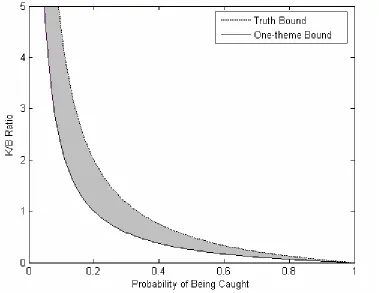
Another useful modification allows candidates an opportunity to misrepresent their true character and issue positions. While the model presented here assumes that candidates will tell the truth, this extension would explain how changes in the likelihood of being caught lying would affect their campaign strategies. One possible formulation introduces an independent monitor (e.g., free press) that uses some exogenous effort level that results in some positive probability that a candidate’s lie will be revealed.23 In addition to the voter inferences available to the
sophisticated voter whenever a candidate is caught lying, mendacious candidates would also pay a fixed cost of exposure. This extension is further developed in Chapter 3.
Conclusion
First, I will review the questions posed at the outset. Who engages in negative
campaigning? If negative campaigning most affects voter expected utility, any rational candidate does so. Otherwise, it may be a strategy forced upon a candidate whose issue position or
character does not meet voter standards. Of course, in this case, the candidate is likely to lose the election anyway.
23Alternatively, the model could include strategic monitors who generally favor one party over another, or
When do candidates choose negative campaigning? Campaign choices depend upon three factors: the character and issue positions of the candidates, the predispositions of the voters, and the dimensions of political importance to the voters. These three variables should be the starting point of any empirical testing of this model. Negative campaigning will be more likely when the voters have positive initial opinions of the candidate’s personal qualities and care strongly about the character traits of office seekers.
Candidates at the onset of a campaign will use these three variables to choose a strategic goal and a plan toward achieving that goal. It follows naturally from this model that candidates, once they have determined the optimal campaign themes, should have little incentive to alter their strategies throughout the course of the campaign. However, the candidates could change their communication tactics to ensure that their original strategy is properly conveyed to the electorate.
When does negative campaigning matter? It can help a superior candidate to victory, but can also help an inferior candidate muddle the landscape. Again this depends on the voters. If they are especially interested in information about character, they are likely to see more negative campaigning. Interestingly, voters who generally have positive impressions of political
candidates will also see more negative campaigning, which could frustrate the voters because the information would be dissonant with their general perception of politicians. Conversely, voters who generally view politicians as untrustworthy scoundrels will be less inundated with negative advertising, because these people would view the information as less surprising and so would not be much affected by it.
because those campaign types benefit that candidate in comparison to all other candidates. However, negative campaigning benefits a candidate in relation to only one other candidate— while also increasing the utility difference for all of the opponents in relation to the attacked candidate. Another possible route would be to include independent actors (e.g., the 527 group “Swift Boat Veterans for Truth”, though these independent parties need not be so partisan) that have the ability to launch advertisements.24 In order to answer the important questions about
negati