Probabilistic Reasoning for Entity & Relation Recognition
∗Dan Roth
Wen-tau Yih
Department of Computer Science
University of Illinois at Urbana-Champaign
{
danr, yih
}
@uiuc.edu
Abstract
This paper develops a method for recognizing rela-tions and entities in sentences, while taking mutual dependencies among them into account. E.g., the kill (Johns, Oswald) relation in: “J. V. Oswald was murdered at JFK after his assassin, K. F. Johns...” depends on identifying Oswald and Johns as people, JFK being identified as a location, and the kill relation between Oswald and Johns; this, in turn, enforces that Oswald and Johns are people.
In our framework, classifiers that identify entities and relations among them are first learned from local infor-mation in the sentence; this inforinfor-mation, along with con-straints induced among entity types and relations, is used to perform global inference that accounts for the mutual dependencies among the entities.
Our preliminary experimental results are promising and show that our global inference approach improves over learning relations and entities separately.
1
Introduction
Recognizing and classifying entities and relations in text data is a key task in many NLP problems such as in-formation extraction (IE) (Califf and Mooney, 1999; Freitag, 2000; Roth and Yih, 2001), question an-swering (QA) (Voorhees, 2000) and story comprehen-sion (Hirschman et al., 1999). In a typical IE application of constructing a jobs database from unstructured text, the system has to extract meaningful entities like title and salary and, ideally, to determine whether the entities are associated with the same position. In a QA system, many questions ask for specific entities involved in some rela-tions. For example, the question “Where was Poe born?” in TREC-9 asks for the location entity in which Poe was born. The question “Who killed Lee Harvey Oswald?” seeks a person entity that has the relation kill with the person Lee Harvey Oswald.
In all earlier works we know of, the tasks of identify-ing entities and relations were treated as separate prob-lems. The common procedure is to first identify and clas-sify entities using a named entity recognizer and only
∗ Research supported by NSF grants CAREER IIS-9984168 and ITR IIS-0085836 and an ONR MURI Award.
then determine the relations between the entities. How-ever, this approach has several problems. First, errors made by the named entity recognizer propagate to the relation classifier and may degrade its performance sig-nificantly. For example, if “Boston” is mislabeled as a person, it will never be classified as the location of Poe’s birthplace. Second, relation information is sometimes crucial to resolving ambiguous named entity recognition. For instance, if the entity “JFK” is identified as the vic-tim of the assassination, the named entity recognizer is unlikely to misclassify it as a location (e.g. JFK airport).
This paper develops a novel approach for this prob-lem – a probabilistic framework for recognizing entities and relations together. In this framework, separate clas-sifiers are first trained for entities and relations. Their output is used to represent a conditional distribution for each entity and relation, given the observed data. This information, along with constraints induced among rela-tions and entities (e.g. the first argument of kill is likely to be a person; the second argument of born in is a lo-cation) are used to make global inferences for the most probable assignment for all entities and relations of in-terest. Our global inference approach accepts as input conditional probabilities which are the outcomes of “lo-cal” classifiers. Note that each of the local classifiers could depend on a large number of features, but these are not viewed as relevant to the inference process and are abstracted away in this process of “inference with classifiers”. In this sense, this work extends previous works in this paradigm, such as (Punyakanok and Roth, 2001), in which inference with classifiers was studied when the outcomes of the classifiers were sequentially constrained; here the constraints are more general, which necessitates a different inference approach.
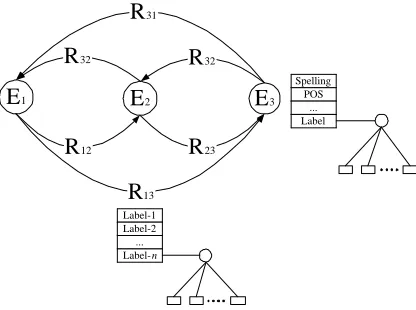
E
1R
31Spelling POS
... Label
Label-1 Label-2 ... Label-n
E
2E
3R
32R
32R
23R
12 [image:2.595.80.288.76.231.2]R
13Figure 1: Conceptual view of entities and relations
2
Global Inference of Entities/Relations
The problem at hand is that of producing a coherent la-beling of entities and relations in a given sentence. Con-ceptually, the entities and relations can be viewed, tak-ing into account the mutual dependencies, as the labeled graph in Figure 1, where the nodes represent entities (e.g. phrases) and the links denote the binary relations between the entities. Each entity and relation has sev-eral properties – denoted as labels of nodes and edges in the graph. Some of the properties, such as words inside the entities, can be read directly from the input; others, like pos tags of words in the context of the sentence, are easy to acquire via learned classifiers. However, proper-ties like semantic types of phrases (i.e., class labels, such as “people”, “locations”) and relations among them are more difficult to acquire. Identifying the labels of entities and relations is treated here as the target of our learning problem. In particular, we learn these target properties as functions of all other “simple to acquire” properties of the sentence.
To describe the problem in a formal way, we first de-fine sentences and entities as follows.
Definition 2.1 (Sentence & Entity) A sentence S is a
linked list which consists of wordswand entitiesE. An entity can be a single word or a set of consecutive words with a predefined boundary. Entities in a sentence are labeled asE1, E2,· · ·according to their order, and they
take values that range over a set of entity typesCE.
Notice that determining the entity boundaries is also a difficult problem – the segmentation (or phrase de-tection) problem (Abney, 1991; Punyakanok and Roth, 2001). Here we assume it is solved and given to us as input; thus we only concentrate on classification.
Example 2.1 The sentence in Figure 2 has three
enti-ties:E1=“Dole”,E2=“Elizabeth”, andE3 =
“Sal-isbury, N.C.”
Dole ’s wife , Elizabeth , is a native of Salisbury , N.C.
E1 E2 E3
Figure 2: A sentence that has three entities
A relation is defined by the entities that are involved in it (its arguments). In this paper, we only discuss binary relations.
Definition 2.2 (Relation) A (binary) relation Rij =
(Ei, Ej) represents the relation between Ei and Ej,
whereEiis the first argument andEj is the second. In
addition,Rijcan range over a set of entity typesCR.
Example 2.2 In the sentence given in Figure 2, there are
six relations between the entities:R12= (“Dole”,
“Eliz-abeth”),R21= (“Elizabeth”, “Dole”),R13= (“Dole”,
“Salisbury, N.C.”),R31= (“Salisbury, N.C.”, “Dole”),
R23 = (“Elizabeth”, “Salisbury, N.C.”), and R32 =
(“Salisbury, N.C.”, “Elizabeth”)
We define the types (i.e. classes) of relations and enti-ties as follows.
Definition 2.3 (Classes) We denote the set of predefined
entity classes and relation classes asCEandCR
respec-tively.CEhas one special element other ent, which
rep-resents any unlisted entity class. Similarly,CRalso has
one special element other rel, which means the involved entities are irrelevant or the relation class is undefined.
When clear from the context, we useEiandRijto refer
to the entity and relation, as well as their types (class labels).
Example 2.3 Suppose CE = { other ent, person,
lo-cation } and CR = { other rel, born in, spouse of }. For the entities in Figure 2,E1andE2belong to person
andE3belongs to location. In addition, relationR23is
born in,R12andR21are spouse of. Other relations are
other rel.
The class label of a single entity or relation depends not only on its local properties, but also on properties of other entities and relations. The classification task is somewhat difficult since the predictions of entity labels and relation labels are mutually dependent. For instance, the class label ofE1 depends on the class label ofR12
and the class label of R12also depends on the class
la-bel of E1 and E2. While we can assume that all the
data is annotated for training purposes, this cannot be assumed at evaluation time. We may presume that some local properties such as the word, pos, etc. are given, but none of the class labels for entities or relations is.
following probabilistic framework. First, the classifiers are trained independently and used to estimate the proba-bilities of assigning different labels given the observation (that is, the easily classified properties in it). Then, the output of the classifiers is used as a conditional distribu-tion for each entity and reladistribu-tion, given the observadistribu-tion. This information, along with the constraints among the relations and entities, is used to make global inferences for the most probable assignment of types to the entities and relations involved.
The class labels of entities and relations in a sentence must satisfy some constraints. For example, ifE1, the
first argument ofR12, is a location, thenR12cannot be
born in because the first argument of relation born in has to be a person. We define constraints as follows.
Definition 2.4 (Constraint) A constraintCis a 3-tuple
(R,E1,E2), where R ∈ CR andE1,E2 ∈ CE. If the
class label of a relation isR, then the legitimate class labels of its two entity arguments areE1andE2
respec-tively.
Example 2.4 Some examples of constraints are:
(born in, person, location), (spouse of, person, person), and (murder, person, person)
The constraints described above could be modeled us-ing a joint probability distribution over the space of val-ues of the relevant entities and relations. In the context of this work, for algorithmic reasons, we model only some of the conditional probabilities. In particular, the proba-bilityP(Rij|Ei, Ej)has the following properties.
Property 1 The probability of the label of relationRij
given the labels of its argumentsEi andEjhas the
fol-lowing properties.
• P(Rij =other rel|Ei=e1, Ej =e2) = 1, if there
exists nor, such that(r, e1, e2)is a constraint.
• P(Rij =r|Ei =e1, Ej =e2) = 0, if there exists
no constraintc, such thatc= (r, e1, e2).
Note that the conditional probabilities do not need to be specified manually. In fact, they can be easily learned from an annotated training dataset.
Under this framework, finding the most suitable coherent labels becomes the problem of searching the most probable assignment to all the E and R variables. In other words, the global prediction
e1, e2, ..., en, r12, r21, ..., rn(n−1)satisfies the following
equation.
(e1, ..., en, r12, r21, ..., rn(n−1)) =
arg maxei,rjkP rob(E1, ..., En, R12, R21, ..., Rn(n−1)).
3
Computational Approach
Each nontrivial property of the entities and relations, such as the class label, depends on a very large number
of variables. In order to predict the most suitable co-herent labels, we would like to make inferences on sev-eral variables. However, when modeling the interaction between the target properties, it is crucial to avoid ac-counting for dependencies among the huge set of vari-ables on which these properties depend. Incorporating these dependencies into our inference is unnecessary and will make the inference intractable. Instead, we can ab-stract these dependencies away by learning the proba-bility of each property conditioned upon an observation. The number of features on which this learning problem depends could be huge, and they can be of different gran-ularity and based on previous learned predicates (e.g. pos), as caricatured using the “network-like” structure in Figure 1. Inference is then made based on the probabili-ties. This approach is similar to (Punyakanok and Roth, 2001; Lafferty et al., 2001) only that there it is restricted to sequential inference, and done for syntactic structures. The following subsections describe the details of these two stages. Section 3.1 explains the feature extraction method and learning algorithm we used. Section 3.2 in-troduces the idea of using a belief network in search of the best global class labeling and the applied inference algorithm.
3.1 Learning Basic Classifiers
Although the labels of entities and relations from a sen-tence mutually depend on each other, two basic classi-fiers for entities and relations are first learned, in which a multi-class classifier for E(or R) is learned as a func-tion of all other “known” properties of the observafunc-tion. The classifier for entities is a named entity classifier, in which the boundary of an entity is predefined (Collins and Singer, 1999). On the other hand, the relation clas-sifier is given a pair of entities, which denote the two arguments of the target relation. Accurate predictions of these two classifiers seem to rely on complicated syntax analysis and semantics related information of the whole sentence. However, we derive weak classifiers by treat-ing these two learntreat-ing tasks as shallow text processtreat-ing problems. This strategy has been successfully applied on several NLP tasks, such as information extraction (Califf and Mooney, 1999; Freitag, 2000; Roth and Yih, 2001) and chunking (i.e. shallow paring) (Munoz et al., 1999). It assumes that the class labels can be decided by lo-cal properties, such as the information provided by the words around or inside the target. Examples include the spelling of a word, part-of-speech, and semantic re-lated attributes acquired from external resources such as WordNet.
The propositional learner we use is SNoW (Roth, 1998; Carleson et al., 1999)1SNoW is a multi-class clas-sifier that is specifically tailored for large scale learning tasks. The learning architecture makes use of a network of linear functions, in which the targets (entity classes or relation classes, in this case) are represented as linear
functions over a common feature space. Within SNoW, we use here a learning algorithm which is a variation of Winnow (Littlestone, 1988), a feature efficient algorithm that is suitable for learning in NLP-like domains, where the number of potential features is very large, but only a few of them are active in each example, and only a small fraction of them are relevant to the target concept.
While typically SNoW is used as a classifier, and pre-dicts using a winner-take-all mechanism over the activa-tion value of the target classes, here we rely directly on the raw activation value it outputs, which is the weighted linear sum of the features, to estimate the posteriors. It can be verified that the resulting values are mono-tonic with the confidence in the prediction, therefore is a good source of probability estimation. We use softmax (Bishop, 1995) over the raw activation values as proba-bilities. Specifically, suppose the number of classes isn, and the raw activation values of classiisacti. The
pos-terior estimation for class iis derived by the following equation.
pi= e
acti
P
1≤j≤neactj
3.2 Bayesian Inference Model
Broadly used in the AI community, belief network is a graphical representation of a probability distri-bution (Pearl, 1988). It is a directed acyclic graph (DAG), where the nodes are random variables and each node is associated with a conditional probabil-ity table which defines the probabilprobabil-ity given its par-ents. We construct a belief network that represents the constraints existing among R’s and E’s. Then, for each sentence, we use the classifiers from sec-tion 3.1 to compute the P rob(E|observations) and
P rob(R|observations), and use the belief network to compute the most probable global predictions of the class labels.
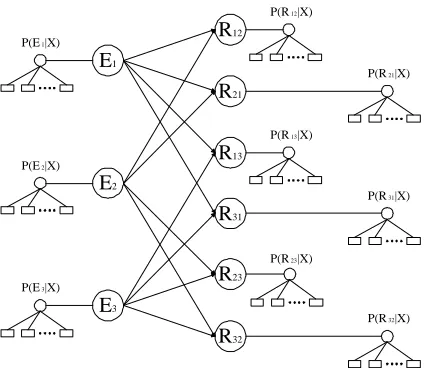
The structure of our belief network, which represents the constraints is a bipartite graph. In particular, the vari-ableE’s andR’s are the nodes in the network, where the
Enodes are in one layer, and theRnodes are in the other. Since the label of a relation is dependent on the entity classes of its arguments, the links in the network connect the entity nodes, and the relation nodes that have these entities as arguments. For instance, nodeRij has two
incoming links from nodesEiandEj. The conditional
probabilitiesP(Rij|Ei, Ej)encodes the constraints as in
Property 1. As an illustration, Figure 3 shows a be-lief network that consists of 3 entity nodes and 6 relation nodes.
Finding a most probable class assignment to the en-tities and relations is equivalent to finding the assign-ment of all the variables in the belief network that maximizes the joint probability. However, this most-probable-explanation (MPE) inference problem is in-tractable (Roth, 1996) if the network contains loops
E2
E1
E3
R12
R21
R13
R31
R23
R32
P(R12|X)
P(R21|X)
P(R13|X)
P(R31|X)
P(R23|X)
P(R32|X)
P(E1|X)
P(E2|X)
[image:4.595.322.534.72.256.2]P(E3|X)
Figure 3: Belief network of 3 entity nodes and 6 relation nodes
(undirected cycles), which is exactly the case in our net-work. Therefore, we resort to the following approxima-tion method instead.
Recently, researchers have achieved great success in solving the problem of decoding messages through a noisy channel with the help of belief networks (Gal-lager, 1962; MacKay, 1999). The network structure used in their problem is similar to the network used here, namely a loopy bipartite DAG. The inference algorithm they used is Pearl’s belief propagation algorithm (Pearl, 1988), which outputs exact posteriors in linear time if the network is singly connected (i.e. without loops) but does not guarantee to converge for loopy networks. However, researchers have empirically demonstrate that by iterat-ing the belief propagation algorithm several times, the outputted values often converge to the right posteriors (Murphy et al., 1999). Due to the existence of loops, we also apply belief propagation algorithm iteratively as our inference procedure.
4
Experiments
The following subsections describe the data preparation process, the approaches tested in the experiments, and the experimental results.
4.1 Data Preparation
In order to build different datasets, we first collected sen-tences from TREC documents, which are mostly daily news such as Wall Street Journal, Associated Press, and San Jose Mercury News. Among the collected sentences, 245 sentences contain relation kill (i.e. two entities that have the murder-victim relation). 179 sentences contain relation born in (i.e. a pair of entities where the second is the birthplace of the first). In addition to the above sentences, we also collected 502 sentences that contain no relations.2
Entities in these sentences are segmented by the sim-ple rule: consecutive proper nouns and commas are com-bined and treated as an entity. Predefined entity class la-bels include other ent, person, and location. Moreover, relations are defined by every pair of entities in a sen-tence, and the relation class labels defined are other rel, kill, and birthplace.
Three datasets are constructed using the collected sen-tences. Dataset “kill” has all the 245 sentences of re-lation kill. Dataset “born in” has all the 179 sentences of relation born in. The third dataset “all” mixes all the sentences.
4.2 Tested Approaches
We compare three approaches in the experiments: basic, omniscient, and BN. The first approach, basic, tests our baseline – the performance of the basic classifiers. As described in Section 3.1, these classifiers are learned in-dependently using local features and make predictions on entities and relations separately. Without taking global interactions into account, the features extracted are de-scribed as follows. For the entity classifier, features from the words around each entity are: words, tags, conjunc-tions of words and tags, bigram and trigram of words and tags. Features from the entity itself include the number of words it contains, bigrams of words in it, and some attributes of the words inside such as the prefix and suf-fix. In addition, whether the entity has some strings that match the names of famous people and places is also used as a feature. For the relation classifier, features are extracted from words around and between the two en-tity arguments. The types of features include bigrams, trigrams, words, tags, and words related to “kill” and “birth” retrieved from WordNet.
The second approach, omniscient, is similar to basic. The only difference here is the labels of entities are re-vealed to the R classifier and vice versa. It is certainly impossible to know the true entity and relation labels in advance. However, this experiment may give us some ideas about how much the performance of the entity clas-sifier can be enhanced by knowing whether the target is involved in some relations, and also how much the rela-tion classifier can be benefited from knowing the entity labels of its arguments. In addition, it also provides a comparison to see how well the belief network inference model can improve the results.
The third approach, BN, tests the ability of making global inferences in our framework. We use the Bayes Net Toolbox for Matlab by Murphy3 to implement the
network and set the maximum number of the iteration of belief propagation algorithm as 20. Given the probabili-ties estimated by basic classifiers, the network infers the labels of the entities and relations globally in a sentence. Compared to the first two approaches, where some pre-dictions may violate the constraints, the belief network model incorporates the constraints between entities and
3available at http://www.cs.berkeley.edu/∼murphyk/Bayes/bnt.html
relations, thus all the predictions it makes will be coher-ent.
All the experiments of these approaches are done in 5-fold validation. In other words, these datasets are ran-domly separated into 5 disjoint subsets, and experiments are done 5 times by iteratively using 4 of them as training data and the rest as testing.
4.3 Results
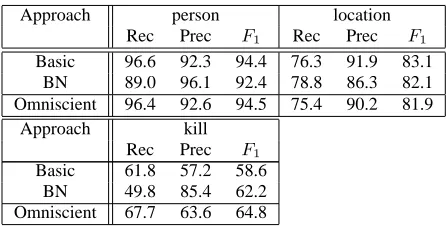
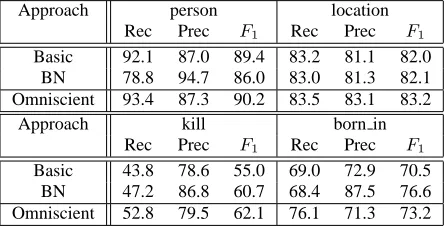
The experimental results in terms of recall, precision,and
Fβ=1 for datasets “kill”, “born in”, and “all” are given
in Table 1, Table 2, and Table 3 respectively. We discuss two interesting facts of the results as follows.
First, the belief network approach tends to decrease re-call in a small degree but increase precision significantly. This phenomenon is especially clear on the classification results of some relations. As a result, the F1 value of
the relation classification results is still enhanced to the extent that is near or even higher than the results of the Omniscient approach. This may be explained by the fact that if the label of a relation is predicted as positive (i.e. not other rel), the types of its entity arguments must sat-isfy the constraints. This inference process reduces the number of false positive, thus enhance the precision.
Second, knowing the class labels of relations does not seem to help the entity classifier much. In all three datasets, the difference of Basic and Omniscient ap-proaches is usually less than 3% in terms ofF1, which
is not very significant given the size of our datasets. This phenomenon may be due to the fact that only a few of en-tities in a sentence are involved in some relations. There-fore, it is unlikely that the entity classifier can use the relation information to correct its prediction.
Approach person location
Rec Prec F1 Rec Prec F1
Basic 96.6 92.3 94.4 76.3 91.9 83.1
BN 89.0 96.1 92.4 78.8 86.3 82.1
Omniscient 96.4 92.6 94.5 75.4 90.2 81.9
Approach kill
Rec Prec F1
Basic 61.8 57.2 58.6
BN 49.8 85.4 62.2
[image:5.595.314.537.453.566.2]Omniscient 67.7 63.6 64.8
Table 1: Results for dataset “kill”
5
Discussion
The promising results of our preliminary experiments demonstrate the feasibility of our probabilistic frame-work. For the future work, we plan to extend this re-search in the following directions.
Approach person location
Rec Prec F1 Rec Prec F1
Basic 85.5 90.7 87.8 89.5 93.2 91.1
BN 87.0 90.9 88.8 87.5 93.4 90.3
Omniscient 90.6 93.4 91.7 90.7 96.5 93.4
Approach born in
Rec Prec F1
Basic 81.4 63.4 70.9
BN 87.6 70.7 78.0
[image:6.595.72.295.71.182.2]Omniscient 86.9 71.8 78.0
Table 2: Results for dataset “born in”
Approach person location
Rec Prec F1 Rec Prec F1
Basic 92.1 87.0 89.4 83.2 81.1 82.0
BN 78.8 94.7 86.0 83.0 81.3 82.1
Omniscient 93.4 87.3 90.2 83.5 83.1 83.2
Approach kill born in
Rec Prec F1 Rec Prec F1
Basic 43.8 78.6 55.0 69.0 72.9 70.5
BN 47.2 86.8 60.7 68.4 87.5 76.6
Omniscient 52.8 79.5 62.1 76.1 71.3 73.2
Table 3: Results for dataset “all”
data and using the new data to train and improve exist-ing classifiers, is a promisexist-ing approach. Since the pre-cision of our framework is pretty high, it seems possible to use the global inference to annotate new data. Based on this property, we can derive an EM-like approach for labelling and inferring the types of entities and relations simultaneously. The basic idea is to use the global infer-ence output as a means to annotate entities and relations. The new annotated data can then be used to train classi-fiers, and the whole process is repeated again.
The second direction is to improve our probabilistic inference model in several ways. First, since the results of the inference procedure we use, the loopy belief prop-agation algorithm, produces approximate values, some of the results can be wrong. Although the computational time of the exact inference algorithm for loopy network is exponential, we may still be able to run it given the small number of variables that are of interest each time in our case. Therefore, we can further check if the perfor-mance suffers from the approximation. Second, the be-lief network model may not be expressive enough since it allows no cycles. To fully model the problem, cycles may be needed. For example, the class labels ofR12
andR21actually depend on each other. (e.g. If R12 is
born in, thenR21will not be born in or kill.) Similarly,
the class labels ofE1 andE2 can depend on the labels
ofR12. To fully represent the mutual dependencies, we
would like to explore other probabilistic models that are more expressive than the belief network.
References
S. P. Abney. 1991. Parsing by chunks. In S. P. Abney R. C. Berwick and C. Tenny, editors, Principle-based parsing: Computation and Psycholinguistics, pages 257–278. Kluwer, Dordrecht.
C. Bishop, 1995. Neural Networks for Pattern Recogni-tion, chapter 6.4: Modelling conditional distributions, page 215. Oxford University Press.
M. Califf and R. Mooney. 1999. Relational learning of pattern-match rules for information extraction. In Na-tional Conference on Artificial Intelligence.
A. Carleson, C. Cumby, J. Rosen, and D. Roth. 1999. The SNoW learning architecture. Technical Report UIUCDCS-R-99-2101, UIUC Computer Science De-partment, May.
M. Collins and Y. Singer. 1999. Unsupervised mod-els for name entity classification. In EMNLP-VLC’99, the Joint SIGDAT Conference on Empirical Methods in Natural Language Processing and Very Large Cor-pora, June.
D. Freitag. 2000. Machine learning for information extraction in informal domains. Machine Learning, 39(2/3):169–202.
R. Gallager. 1962. Low density parity check codes. IRE Trans. Info. Theory, IT-8:21–28, Jan.
L. Hirschman, M. Light, E. Breck, and J. Burger. 1999. Deep read: A reading comprehension system. In Pro-ceedings of the 37th Annual Meeting of the Associa-tion for ComputaAssocia-tional Linguistics.
J. Lafferty, A. McCallum, and F. Pereira. 2001. Con-ditional random fields: Probabilistic models for seg-menting and labeling sequence data. In Proc. of the International Conference on Machine Learning. N. Littlestone. 1988. Learning quickly when irrelevant
attributes abound: A new linear-threshold algorithm. Machine Learning, 2:285–318.
D. MacKay. 1999. Good error-correcting codes based on very sparse matrices. IEEE Transactions on Infor-mation Theory, 45.
M. Munoz, V. Punyakanok, D. Roth, and D. Zimak. 1999. A learning approach to shallow parsing. In EMNLP-VLC’99, the Joint SIGDAT Conference on Empirical Methods in Natural Language Processing and Very Large Corpora, June.
K. Murphy, Y. Weiss, and M. Jordan. 1999. Loopy belief propagation for approximate inference: An empirical study. In Proc. of Uncertainty in AI, pages 467–475. J. Pearl. 1988. Probabilistic Reasoning in Intelligent
Systems. Morgan Kaufmann.
V. Punyakanok and D. Roth. 2001. The use of classi-fiers in sequential inference. In NIPS-13; The 2000 Conference on Advances in Neural Information Pro-cessing Systems.
[image:6.595.72.295.225.338.2]case study. In Proc. of the International Joint Con-ference on Artificial Intelligence, pages 1257–1263. D. Roth. 1996. On the hardness of approximate
reason-ing. Artificial Inteligence, 82(1-2):273–302, April. D. Roth. 1998. Learning to resolve natural language
am-biguities: A unified approach. In Proc. National Con-ference on Artificial Intelligence, pages 806–813. E. Voorhees. 2000. Overview of the trec-9 question