Large Scale Parallel Document Mining for Machine Translation
Jakob Uszkoreit Jay M. Ponte Ashok C. Popat Moshe Dubiner
Google, Inc.
{uszkoreit,ponte,popat,moshe}@google.com
Abstract
A distributed system is described that re-liably mines parallel text from large
cor-pora. The approach can be regarded
as cross-language near-duplicate detec-tion, enabled by an initial, low-quality batch translation. In contrast to other ap-proaches which require specialized meta-data, the system uses only the textual con-tent of the documents. Results are pre-sented for a corpus of over two billion web pages and for a large collection of digi-tized public-domain books.
1 Introduction
While the World Wide Web provides an abun-dance of readily available monolingual text, par-allel data is still a comparatively scarce resource, yet plays a crucially important role in training sta-tistical machine translation systems.
We describe an approach to mining document-aligned parallel text to be used as training data for a statistical machine translation system. Pre-vious approaches have focused on rather homo-geneous corpora and relied on metadata such as publication dates (Munteanu and Marcu, 2005; Munteanu and Marcu, 2006; Udupa et al., 2009; Do et al., 2009; Abdul-Rauf and Schwenk, 2009) or information about document structure (Resnik and Smith, 2003; Chen and Nie, 2000). In large and unstructured collections of documents such as the Web, however, metadata is often sparse or un-reliable. Our approach, in contrast, scales com-putationally to very large and diverse collections of documents and does not require metadata. It is
based solely on the textual contents of the input documents.
Casting the problem as one of cross-language near duplicate detection, we use a baseline ma-chine translation system to translate all input doc-uments into a single language. However, the words and phrases that are most discriminatory for the purposes of information retrieval and du-plicate detection are the relatively rare ones, pre-cisely those that are less likely to be translated well by the baseline translation system.
Our approach to circumvent this problem and to avoid the prohibitive quadratic computational complexity of the naive approach of performing a comparison of every possible pair of input docu-ments is similar to previous work in near duplicate detection (Broder, 2000; Henzinger, 2006; Man-ber, 1994) and noisy data retrieval (Harding et al., 1997).
We use shingles consisting of wordn-grams to
construct relatively rare features from more com-mon, in-vocabulary words. For each input doc-ument, we identify a comparatively small set of candidate pairings with documents sharing at least a certain number of such features. We then per-form a more expensive comparison between each document and all documents in its candidate set
using lower ordern-gram features that would
2 System Description
The input is a set of documents from diverse sources such as web pages and digitized books. In a first stage, all documents are independently translated into English using a baseline statistical machine translation system.
We then extract two different sets of n-grams
from the translated documents: matchingn-grams
that are used to construct the candidate sets as well
as scoringn-grams used only in the computation
of a score for a given pair of documents. This
stage generates two indexes: aforward index
list-ing all extracted scorlist-ingn-grams, indexed by
doc-Machine translate input data
Extract n-grams
Filter inverted index by document frequency and number of original languages
Generate all pairs of documents sharing matching n-grams
Score unique document pairs, querying the forward Index
Discard non-symmetric pairs
Join with original input data Evaluate on reference document
alignments Fold global, per-scoring n-gram information from inverted index
into forward index
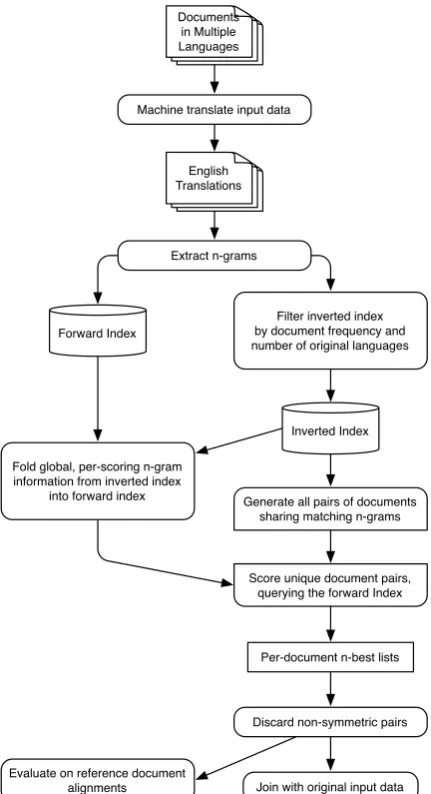
Figure 1: Architecture of the Parallel Text Mining System.
ument; and aninverted indexreferencing all
doc-uments from which we extracted a given
match-ing n-gram, indexed by n-grams. The inverted
index is also used to accumulate global
informa-tion about scoring n-grams, such as their
docu-ment frequency, yet for scoring n-grams we do
not accumulate a posting list of all documents in which they occur.
In the next step, the system generates all
possi-ble pairs of documents for each matchingn-gram
posting list in the inverted index. Since we keep only those pairs of documents that originated in different languages, we can discard posting lists from the inverted index that contain only a single
document, i.e. those of singletonn-grams, or only
documents in a single language.
Crucially, we further discard posting lists for
matching n-grams whose frequency exceeds a
certain threshold. When choosing a sufficiently
large order for the matchingn-grams, their
long-tailed distribution causes only a small fraction of
matching n-grams to be filtered out due to
fre-quency, as we show empirically in Section 5. It is this filtering step that causes the overall runtime of the system to be linear in the size of the input data and allows the system to scale to very large document collections.
In parallel, global information about scoringn
-grams accumulated in the inverted index that is required for pairwise scoring, such as their doc-ument frequency, is folded into the forward in-dex by iterating over all forward inin-dex entries, re-questing the respective per-feature quantities from the inverted index and storing them with each
oc-currence of a scoringn-gram in an updated
for-ward index.
In the next stage, we compute pairwise scores for all candidate document pairs, accessing the forward index entry of each of the two scored
doc-uments to obtain the respective scoringn-grams.
Document pairs with a score below a given thresh-old are discarded. For each input document, this
results in onen-best list per language. In the last
step we retain only those document pairs where
each document is contained in the n-best list of
the other document for its original language.
Fi-nally we perform ajoin of our identified
pass over the original, untranslated input data where the contents of document pairs with suffi-ciently high scores are then aggregated and out-put. Document pairings involving all languages are identified simultaneously. Each stage of the system fits well into the MapReduce program-ming model (Dean and Ghemawat, 2004). The general architecture is shown in Figure 1.
2.1 Pairwise Scoring
For scoring a pair of documents d and d0, the
forward index is queried for the entries for both
documents. Let Fd = {f1, f2, ...fn} andFd0 =
{f10, f20, ...fn00} be the sets of scoring n-grams in
the forward index entries ofdandd0, respectively.
Let idf(f) = logdf|D(f|) be the inverse document
frequency of a scoring n-gram f, where |D| is
the number of documents in the input corpus and
df(f) is the number documents from which we
extracted the featuref. InterpretingFdandFd0 as
incidence vectors in the vector space ofn-grams
and replacing each non-zero component f with
idf(f), we compute the score of the document pair
as the inverse document frequency weighted
co-sine similarity ofFdandFd0
score(d, d0) = Fd·Fd0
||Fd|| · ||Fd0|| (1) The per-document n-best lists are sorted ac-cording to this score and document pairs for which the score is below a threshold are discarded com-pletely.
We do not use term frequency in the scoring metric. In preliminary experiments,
incorporat-ing the term frequency to yield basic tf/idf as
well as using other information retrieval ranking functions incorporating term frequencies such as
BM25(Robertson et al., 1995) resulted in a
degra-dation of performance compared to the simpler scoring function described above. We believe this is due to the fact that, in contrast to the standard information retrieval setting, the overall length of our queries is on par with that of the documents in the collection.
The scoring is completely agnostic regarding
the scoringn-grams’ positions in the documents.
Since especially for long documents such as
books this may produce spurious matches, we ap-ply an additional filter to remove document pairs for which the relative ordering of the matching
scoringn-grams is very different. Together with
each scoring n-gram we also extract its relative
position in each document and store it in the for-ward index. When scoring a document pair, we compute the normalized permutation edit distance (Cormode et al., 2001) between the two sequences
of overlappingn-grams sorted by their position in
the respective document. If this distance exceeds a certain threshold, we discard the document pair.
2.2 Computational Complexity
By limiting the frequency of matching n-grams,
the complexity becomes linear. Let the tunable
parametercbe the maximum occurrence count for
matching n-grams to be kept in the inverted
in-dex. Letm be the average number of matching
n-grams extracted from a single document whose
count is belowc andD be the set of documents
in the input corpus. Then the system generates up
to|D| ·m·ccandidate pairings. Scoring a given
candidate document pair according to cosine sim-ilarity involves computing three dot-products be-tween sparse vectors with one non-zero
compo-nent per scoringn-gram extracted and not filtered
from the respective document. Let s be the
av-erage number of such scoringn-grams per
docu-ment, which is bounded by the average document length. Then the time complexity of the entire document alignment is in
O(|D| ·m·c·s) (2)
and therefore linear in the number of input doc-uments in the corpus and the average document size.
The space complexity is dominated by the size of the inverted and forward indexes, both of which are linear in the size of the input corpus.
2.3 Sentence-Level Alignment
words within each pair of aligned source and tar-get sentences. This crude alignment is used only
to filter nonparallel sentences. Let S be the set
of source words, T the set of target words and
S × T the set of ordered pairs. Let the source
sentence contain words S0 ⊂ S and the target
sentence contain words T0 ⊂ T. An alignment
A0 ⊂S0×T0will be scored by
where the joint probabilitiesp(s, t) and marginal
probabilitiesp(s),p(t)are taken to be the
respec-tive empirical distributions (without smoothing) in an existing word aligned corpus. This is greed-ily maximized and the result is divided by its ap-proximate expected value
We discard sentence pairs for which the ratio be-tween the actual and the expected score is less
than1/3. We also drop sentence pairs for which
both sides are identical, or a language detector de-clares them to be in the wrong language.
2.4 Baseline Translation System
To translate the input documents into English we use phrase-based statistical machine translation systems based on the log-linear formulation of the problem (Och and Ney, 2002).
We train the systems on the Europarl Cor-pus (Koehn, 2002), the DGT Multilingual Translation Memory (European Commission Directorate-General for Translation, 2007) and the United Nations ODS corpus (United Nations, 2006). Minimum error rate training (Macherey et al., 2008) under the BLEU criterion is used to optimize the feature function weights on
de-velopment data consisting of thenv-dev2007 and
news-dev2009 data sets provided by the organiz-ers of the 2007 and 2009 WMT shared translation
tasks1. We use a 4-gram language model trained
on a variety of large monolingual corpora. The BLEU scores of our baseline translation system
1available athttp://statmt.org
on the test sets from various WMT shared trans-lation tasks are listed in Table 5. An empirical analysis of the impact of the baseline translation system quality on the data mining system is given in Section 6.3.
3 Input Document Collections
We evaluate the parallel text mining system on two input data sets:
web A collection of 2.5 Billion general pages
crawled from the Web, containing only pages in Czech, English, French, German, Hungar-ian and Spanish
books A collection of 1.5 Million public domain books digitized using an optical character recognition system. The collection consists primarily of English, French and fewer Span-ish volumes
3.1 Reference Sets
We created reference sets of groups of docu-ments in multiple languages which are true
trans-lations of one another for both the web and the
booksdata set. Due to the presence of duplicates, each reference pairing can contain more than a single alternative translation per language. The
web reference set was constructed by exploiting
the systematic hyperlink structure of the web-site
http://america.gov/, that links pages in one language to their respective translations into one or more other languages. The resulting refer-ence set contains documents in Arabic, Chinese, English, French, Russian and Spanish, however, for most English pages there is only one transla-tion into one of the other languages. Overall, the reference set contains 6,818 documents and 7,286 translation pairs.
The books reference set contains 30 manually aligned groups of translations covering a total of 103 volumes in English and French.
4 Evaluation Metrics
Let C be a set of candidate parallel document
pairs and letRbe a possibly incomplete reference
set of groups of parallel documents known to exist in the corpus. Consider the following two subsets
ofC:
• Matchingpairs which are in some reference cluster.
• Touching pairs which are non-matching but
have at least one document in some reference cluster.
We define
Precision = |CMatching|
|CMatching|+|CTouching|
and
Recall = |CMatching|
|R| (5)
5 Parameter Selection
We conducted a series of small-scale experiments
on only those documents contained in theweb
ref-erence data set to empirically determine good set-tings for the tunable parameters of the text min-ing system. Among the most important
parame-ters are the orders of the n-grams used for
pair-ing documents as well as scorpair-ing them. Aside from the obvious impact on the quality of the out-put, these parameters have a very large influence on the overall computational performance of the system. The choice of the order of the extracted
matching n-grams is mainly a trade-off between
recall and efficiency. If the order is too large the system will miss valid pairs; if too small the
the threshold on matchingn-gram frequency will
need to be increased.
Figure 2 shows the F1-scores obtained
run-ning only on the documents contained in theweb
reference set with different orders of matching
and scoring n-grams. Figure 3 shows the
corre-sponding number of pairwise comparisons made
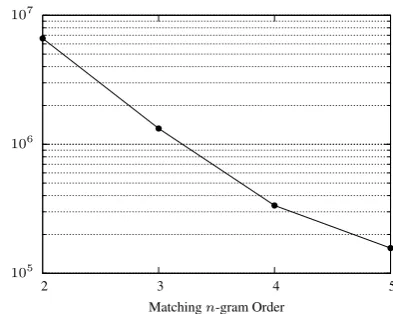
when using different orders of matchingn-grams.
While there is a drop of 0.01 in F1 score between
using 2-grams and 5-grams as matchingn-grams,
this drop in quality seems to be well worth the 42-fold reduction in resulting pairwise comparisons.
0.89
Scoringn-gram Order 2-gram matching
3-gram matching 4-gram matching 5-gram matching
Figure 2: F1 scores on theweb reference set for
different scoring and matchingn-gram orders.
105
Matchingn-gram Order
Figure 3: Number of pairwise comparisons made
when using matchingn-grams of different orders.
The largest portion of the loss in F1 score is
in-curred when increasing the matchingn-gram
or-der from 4 to 5, the reduction in pairwise compar-isons, however, is still more than twofold.
Table 1 shows the precision and recall on the
web reference set when running only on
docu-ments in the reference set using 5-grams as
match-ing n-grams and bigrams for scoring for
score threshold 0.06 0.10 0.12 0.16 0.20 precision 0.92 0.97 0.98 0.99 0.99 recall 0.91 0.91 0.90 0.89 0.83
Table 1: Precision and recall on thewebreference
set when running only on documents contained in the reference set.
6 Evaluation
We run the parallel text mining system on theweb
and books data sets using 5-grams for matching and bigrams for scoring. In both cases we discard
matching n-grams which occurred in more than
50 documents and output only the highest scoring candidate for each document.
In case of thewebdata set, we extract every
5-gram as potential matching feature. For thebooks
data set, however, we downsample the number of candidate matching 5-grams by extracting only those whose integer fingerprints under some hash function have four specific bits set, thus keeping
on average only 1/16 of the matching n-grams.
Here, we also restrict the total number of
match-ing n-grams extracted from any given document
to 20,000. Scoring bigrams are dropped from the forward index if their document frequency ex-ceeds 100,000, at which point their influence on the pairwise score would be negligible.
Running on the web data set, the system on
average extracts 250 matching 5-grams per doc-ument, extracting a total of approximately 430
Billion distinct 5-grams. Of those, 78% are
singletons and 21% only occur in a single lan-guage. Only approximately 0.8% of all
match-ing n-grams are filtered due to having a
docu-ment frequency higher than 50. The forward in-dex initially contains more than 500 Billion bi-gram occurrences; after pruning out singletons and bigrams with a document frequency larger than 100,000, the number of indexed scoring fea-ture occurrences is reduced to 40%. During scor-ing, approximately 50 Billion pairwise compar-isons are performed.
In total the n-gram extraction, document
scor-ing and subsequent filterscor-ing takes less than 24 hours on a cluster of 2,000 state-of-the-art CPUs.
The number of words after sentence-level fil-tering and alignment that the parallel text mining
baseline books web
Czech 27.5 M 0 271.9 M
French 479.8 M 228.5 M 4,914.3 M
German 54.2 M 0 3,787.6 M
Hungarian 26.9 M 0 198.9 M Spanish 441.0 M 15.0 M 4,846.8 M
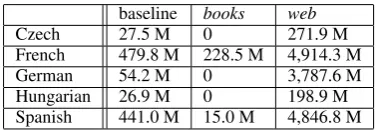
Table 2: The number of words per language in the baseline training corpora and extracted from the two different data sets.
system extracted for the different languages from each dataset are listed in Table 2.
score threshold 0.06 0.10 0.12 0.16 0.20 precision 0.88 0.93 0.95 0.97 0.97 recall 0.68 0.65 0.63 0.52 0.38
Table 3: Precision and recall on the reference set
when running on the completeweb data set with
different score thresholds.
score threshold 0.06 0.10 0.12 0.16 0.20 precision 0.95 1.00 1.00 1.00 1.00 recall 0.71 0.71 0.71 0.48 0.38
Table 4: Precision and recall on the reference set
when running on the completebooksdata set with
different score thresholds.
6.1 Precision and Recall
Tables 3 and 4 show precision and recall on the
re-spective reference sets for theweband thebooks
input data sets. While the text mining system maintains a very high precision, recall drops sig-nificantly compared to running only on the doc-uments in the reference set. One reason for this
behavior is that the number ofn-grams in the test
data set which are sufficiently rare to be used as queries drops with increasing amounts of input data and in particular short documents which only
share a small number of matchingn-grams
any-way, may happen to only share matchingn-grams
sub-Language Pair Training Data WMT 2007 news commentary WMT 2008 news WMT 2009 news Czech English baselineweb 21.5929.26 (+7.67) 14.5920.16 (+5.57) 16.4623.25 (+6.76) German English baselineweb 27.9932.35 (+4.36) 20.3423.22 (+2.88) 20.0323.35 (+3.32) Hungarian English baselineweb -- 10.2112.92 (+2.71) 11.0214.68 (+3.66) French English baselinebooks 34.2634.73 (+0.47) 22.1422.39 (+0.25) 26.3927.15 (+0.76)
web 36.65 (+2.39) 23.22 (+1.08) 28.34 (+1.95)
Spanish English baselinebooks 43.6744.07 (+0.40) 24.1524.32 (+0.17) 26.8827.16 (+0.28)
web 46.21 (+2.54) 25.52 (+1.37) 28.50 (+1.62)
English Czech baselineweb 14.7820.65 (+5.86) 12.4518.70 (+6.25) 11.6216.60 (+4.98) English German baselineweb 19.8923.49 (+3.60) 14.6716.78 (+2.11) 14.3116.96 (+2.65) English Hungarian baselineweb -- 07.9310.16 (+2.23) 08.5211.42 (+2.90) English French baselinebooks 31.5931.92 (+0.33) 22.2922.42 (+0.13) 25.1425.46 (+0.32)
web 34.35 (+2.76) 23.56 (+1.27) 27.05 (+1.91)
English Spanish baselinebooks 42.0542.05 24.6524.79 (+0.14) 25.8526.07 (+0.22)
web 45.21 (+3.16) 26.46 (+1.81) 27.79 (+1.94)
Table 5: BLEU scores of the translation systems trained on the automatically mined parallel corpora and the baseline training data.
set of the document. This problem seems to affect news articles in particular where there are often multiple different translations of large subsets of the same or slightly changed versions of the arti-cle.
6.2 Translation Quality
Arabic English NIST 2006 NIST 2008 Baseline (UN ODS) 44.31 42.79 Munteanu and Marcu 45.13 43.86
Present work 44.72 43.64
Chinese English NIST 2006 NIST 2008 Baseline (UN ODS) 25.71 19.79 Munteanu and Marcu 28.11 21.69
Present work 28.08 22.02
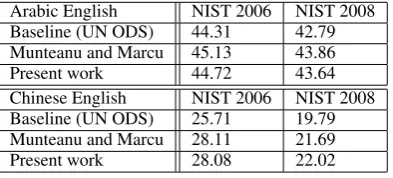
Table 6: BLEU scores of the Chinese and Arabic to English translation systems trained on the base-line UN ODS corpus and after adding either the Munteanu and Marcu corpora or the training data mined using the presented approach.
We trained a phrase-based translation system on the mined parallel data sets and evaluated it on translation tasks for the language pairs Czech, French, German, Hungarian and Spanish to and from English, measuring translation quality with
the BLEU score (Papineni et al., 2002). The trans-lation tasks evaluated are the WMT 2007 news commentary test set as well the WMT 2008 and 2009 news test sets.
The parallel data for this experiment was mined using the general settings described in the previ-ous section and a threshold of 0.1 on the pairwise score. We ensure that the test data is not included in the training data by filtering out all sentences from the training data that share more than 30% of their 6-grams with any sentence from one of the test corpora.
Table 5 shows the BLEU scores of the differ-ent translation systems. The consistdiffer-ent and signif-icant improvements in BLEU score demonstrate the usefulness of the mined document pairs in training a translation system.
Even though the presented approach works on a less granular level than the sentence-level approach of Munteanu and Marcu (2005), we
compare results on the same input data2 used
by those authors to automatically generate the
2LDC corpora LDC2005T12, LDC2005T14 and
Sampling Rate WMT 2007 news commentary WMT 2008 news WMT 2009 news degraded Cz→En En→Cz degraded Cz→En En→Cz degraded Cz→En En→Cz
1.0 21.59 29.26 20.65 14.59 20.16 18.70 16.46 23.25 16.60
0.5 20.12 29.16 20.55 13.65 20.16 18.71 15.44 23.16 16.56
0.25 18.59 29.09 20.61 12.79 20.09 18.58 14.35 23.18 16.50
0.125 16.69 29.10 20.39 11.87 20.07 18.48 13.05 23.06 16.53
0.0625 14.72 29.04 20.44 10.87 20.06 18.49 11.62 23.11 16.44
0.0312 12.60 28.75 20.28 09.71 19.97 18.45 10.43 23.04 16.41
Table 7: BLEU scores of the degraded Czech to English baseline systems used for translating Czech
documents from thewebdata set as well as those of Czech to and from English systems trained on data
mined using translations of varying quality created by sampling from the training data.
Arabic English and Chinese English sentence-aligned parallel LDC corpora LDC2007T08 and LDC2007T09. We trained Arabic and Chinese English baseline systems on the United Nations ODS corpus (United Nations, 2006); we also use these to translate the non-English portions of the input data to English. We then evaluate the effects of also training on either the LDC2007T08 and LDC2007T09 corpora or the parallel documents mined by our approach in addition to the United Nations ODS corpus on the NIST 2006 and 2008 MT evaluation test sets. The results are presented in Table 6.
The approach proposed in (Munteanu and Marcu, 2005) relies critically on the existence of publication dates in order to be computation-ally feasible, yet it still scales superlinearly in the amount of input data. It could therefore not easily be applied to much larger and less structured input data collections. While our approach neither uses metadata nor operates on the sentence level, in all but one of the tasks, the system trained on the data mined using our approach performs similarly or slightly better.
6.3 Impact of Baseline Translation Quality
In order to evaluate the impact of the translation quality of the baseline system on the quality of the mined document pairs, we trained artificially degraded Czech to English translation systems by sampling from the baseline training data at de-creasing rates. We translate the Czech subset of
the web document collection into English with
each of the degraded systems and apply the paral-lel data mining system in the same configuration.
Table 7 shows the BLEU scores of the degraded baseline systems and those resulting from adding
the different mined data sets to the non-degraded Czech English and English Czech systems. De-grading the input data translation quality by up to 8.9% BLEU results in a consistent but only com-paratively small decrease of less than 0.6% BLEU in the scores obtained when training on the mined document pairs. This does not only show that the impact of variations of the baseline system quality on the data mining system is limited, but also that the data mining system will already work with a rather low quality baseline system.
7 Conclusion
We presented a scalable approach to mining paral-lel text from collections of billions of documents with high precision. The system makes few as-sumptions about the input documents. We demon-strated that it works well on different types of data: a large collection of web pages and a col-lection of digitized books. We further showed that the produced parallel corpora can significantly im-prove the quality of a state-of-the-art statistical machine translation system.
8 Acknowledgments
We thank the anonymous reviewers for their in-sightful comments.
References
Abdul-Rauf, Sadaf and Holger Schwenk. 2009. On the use of comparable corpora to improve SMT per-formance. InEACL, pages 16–23.
Pat-tern Matching, pages 1–10, London, UK. Springer-Verlag.
Chen, Jiang and Jian-Yun Nie. 2000. Parallel web text mining for cross-language IR. InIn In Proc. of RIAO, pages 62–77.
Cormode, Graham, S. Muthukrishnan, and S¨uleyman Cenk Sahinalp. 2001. Permutation editing and matching via embeddings. In ICALP ’01: Proceedings of the 28th International Collo-quium on Automata, Languages and Programming,, pages 481–492, London, UK. Springer-Verlag.
Dean, Jeffrey and Sanjay Ghemawat. 2004. MapRe-duce: Simplified data processing on large clusters. In Proceedings of the Sixth Symposium on Operat-ing System Design and Implementation (OSDI-04), San Francisco, CA, USA.
Do, Thi-Ngoc-Diep, Viet-Bac Le, Brigitte Bigi, Lau-rent Besacier Eric, and Castelli. 2009. Mining a comparable text corpus for a Vietnamese - French statistical machine translation system. In Proceed-ings of the 4th EACL Workshop on Statistical Ma-chine Translation, pages 165–172, Athens, Greece, March.
European Commission Directorate-General for Trans-lation. 2007. DGT-TM parallel corpus. http://langtech.jrc.it/DGT-TM.html.
Harding, Stephen M., W. Bruce Croft, and C. Weir. 1997. Probabilistic retrieval of OCR degraded text using n-grams. In ECDL ’97: Proceedings of the First European Conference on Research and Advanced Technology for Digital Libraries, pages 345–359, London, UK. Springer-Verlag.
Henzinger, Monika. 2006. Finding near-duplicate web pages: a large-scale evaluation of algorithms. InSIGIR ’06: Proceedings of the 29th annual inter-national ACM SIGIR conference on Research and development in information retrieval, pages 284– 291, New York, NY, USA. ACM.
Koehn, Philipp. 2002. Europarl: A multilingual cor-pus for evaluation of machine translation. Draft.
Macherey, Wolfgang, Franz Och, Ignacio Thayer, and Jakob Uszkoreit. 2008. Lattice-based minimum er-ror rate training for statistical machine translation. In Proceedings of the 2008 Conference on Empiri-cal Methods in Natural Language Processing, pages 725–734, Honolulu, Hi, October. Association for Computational Linguistics.
Manber, Udi. 1994. Finding similar files in a large file system. InProceedings of the USENIX Winter 1994 Technical Conferenc.
Munteanu, Dragos Stefan and Daniel Marcu. 2005. Improving machine translation performance by ex-ploiting non-parallel corpora. Comput. Linguist., 31(4):477–504.
Munteanu, Dragos Stefan and Daniel Marcu. 2006. Extracting parallel sub-sentential fragments from non-parallel corpora. InACL.
Och, Franz Josef and Hermann Ney. 2002. Dis-criminative training and maximum entropy models for statistical machine translation. InProceedings of the 40th Annual Meeting of the Association for Computational Linguistics (ACL), pages 295–302, Philadelphia, PA, USA.
Papineni, Kishore, Salim Roukos, Todd Ward, and Wei-Jing Zhu. 2002. BLEU: a method for auto-matic evaluation of machine translation. In Pro-ceedings of the 40th Annual Meeting of the Asso-ciation for Computational Linguistics (ACL), pages 311–318, Philadelphia, PA, USA.
Resnik, Philip and Noah A. Smith. 2003. The web as a parallel corpus. Computational Linguistics, 29:349–380.
Robertson, S E, S Walker, S Jones, M M Hancock-Beaulieu, and M Gatford. 1995. Okapi at TREC–3. InProceedings of the Third Text REtrieval Confer-ence (TREC-3).
Udupa, Raghavendra, K. Saravanan, A. Kumaran, and Jagadeesh Jagarlamudi. 2009. Mint: A method for effective and scalable mining of named entity transliterations from large comparable corpora. In
EACL, pages 799–807.