Dependency-driven Anaphoricity Determination for Coreference
Resolution
Fang Kong Guodong Zhou Longhua Qian Qiaoming Zhu
*JiangSu Provincial Key Lab for Computer Information Processing Technology
School of Computer Science and Technology Soochow University
{kongfang, gdzhou, qianlonghua, qmzhu}@suda.edu.cn
*
Corresponding author
Abstract
This paper proposes a dependency-driven scheme to dynamically determine the syn-tactic parse tree structure for tree ker-nel-based anaphoricity determination in coreference resolution. Given a full syntactic parse tree, it keeps the nodes and the paths related with current mention based on con-stituent dependencies from both syntactic and semantic perspectives, while removing the noisy information, eventually leading to a dependency-driven dynamic syntactic parse tree (D-DSPT). Evaluation on the ACE 2003 corpus shows that the D-DSPT out-performs all previous parse tree structures on anaphoricity determination, and that apply-ing our anaphoricity determination module in coreference resolution achieves the so far best performance.
1
Introduction
Coreference resolution aims to identify which noun phrases (NPs, or mentions) refer to the same real-world entity in a text. According to Webber (1979), coreference resolution can be decomposed into two complementary sub-tasks: (1) anaphoricity determination, determining whether a given NP is anaphoric or not; and (2) anaphor resolution, linking together multiple mentions of a given entity in the world. Al-though machine learning approaches have per-formed reasonably well in coreference resolu-tion without explicit anaphoricity determina-tion (e.g. Soon et al. 2001; Ng and Cardie 2002b; Yang et al. 2003, 2008; Kong et al. 2009), knowledge of NP anaphoricity is ex-pected to much improve the performance of a coreference resolution system, since a
non-anaphoric NP does not have an antecedent and therefore does not need to be resolved.
Recently, anaphoricity determination has been drawing more and more attention. One common approach involves the design of some heuristic rules to identify specific types of non-anaphoric NPs, such as pleonastic it (e.g. Paice and Husk 1987; Lappin and Leass 1994, Kennedy and Boguraev 1996; Denber 1998) and definite descriptions (e.g. Vieira and Poe-sio 2000). Alternatively, some studies focus on using statistics to tackle this problem (e.g., Bean and Riloff 1999; Bergsma et al. 2008) and others apply machine learning approaches (e.g. Evans 2001;Ng and Cardie 2002a, 2004,2009; Yang et al. 2005; Denis and Bal-bridge 2007; Luo 2007; Finkel and Manning 2008; Zhou and Kong 2009).
ef-fectively capturing the structured syntactic in-formation via a tree kernel-based method. In particular, a dependency-driven scheme is proposed to dynamically determine the syntac-tic parse tree structure for tree kernel-based anaphoricity determination by exploiting con-stituent dependencies from both the syntactic and semantic perspectives to keep the neces-sary information in the parse tree as well as remove the noisy information. Our motivation is to employ critical dependency information in constructing a concise and effective syntactic parse tree structure, specifically targeted for tree kernel-based anaphoricity determination.
The rest of this paper is organized as follows. Section 2 briefly describes the related work on both anaphoricity determination and exploring syntactic parse tree structures in related tasks. Section 3 presents our dependency-driven scheme to determine the syntactic parse tree structure. Section 4 reports the experimental results. Finally, we conclude our work in Sec-tion 5.
2
Related Work
This section briefly overviews the related work on both anaphoricity determination and ex-ploring syntactic parse tree structures.
2.1 Anaphoricity Determination
Previous work on anaphoricity determination can be broadly divided into three categories: heuristic rule-based (e.g. Paice and Husk 1987;Lappin and Leass 1994; Kennedy and Boguraev 1996; Denber 1998; Vieira and Poe-sio 2000; Cherry and Bergsma 2005), statis-tics-based (e.g. Bean and Riloff 1999; Cherry and Bergsma 2005; Bergsma et al. 2008) and learning-based methods (e.g. Evans 2001; Ng and Cardie 2002a; Ng 2004; Yang et al. 2005; Denis and Balbridge 2007; Luo 2007; Finkel and Manning 2008; Zhou and Kong 2009; Ng 2009).
The heuristic rule-based methods focus on designing some heuristic rules to identify spe-cific types of non-anaphoric NPs. Representa-tive work includes: Paice and Husk (1987), Lappin and Leass (1994) and Kennedy and Boguraev (1996). For example, Kennedy and Boguraev (1996) looked for modal adjectives (e.g. “necessary”) or cognitive verbs (e.g. “It is
thought that…” in a set of patterned construc-tions) in identifying pleonastic it.
Among the statistics-based methods, Bean and Riloff (1999) automatically identified ex-istential definite NPs which are non-anaphoric. The intuition behind is that many definite NPs are not anaphoric since their meanings can be understood from general world knowledge, e.g. “the FBI”. They found that existential NPs ac-count for 63% of all definite NPs and 76% of them could be identified by syntactic or lexical means. Cherry and Bergsma (2005) extended the work of Lappin and Leass (1994) for large-scale anaphoricity determination by addi-tionally detecting pleonastic it. Bergsma et al. (2008) proposed a distributional method in de-tecting non-anaphoric pronouns. They first ex-tracted the surrounding context of the pronoun and gathered the distribution of words that oc-curred within the context from a large corpus, and then identified the pronoun either ana-phoric or non-anaana-phoric based on the word dis-tribution.
determi-nation on coreference resolution of different NP types. Yang et al. (2005) made use of non-anaphors to create a special class of train-ing instances in the twin-candidate model (Yang et al. 2003) and improved the perform-ance by 2.9 and 1.6 to 67.3 and 67.2 in F1-measure on the MUC-6 and MUC-7 cor-pora, respectively. However, their experiments show that eliminating non-anaphors using an anaphoricity determination module in advance harms the performance. Denis and Balbridge (2007) employed an integer linear program-ming (ILP) formulation for coreference resolu-tion which modeled anaphoricity and corefer-ence as a joint task, such that each local model informed the other for the final assignments. Experiments on the ACE 2003 corpus showed that this joint anaphoricity-coreference ILP formulation improved the F1-measure by 3.7-5.3 on various domains. However, their experiments assume true ACE mentions (i.e. all the ACE mentions are already known from the annotated corpus). Therefore, the actual effect of this joint anaphoricity-coreference ILP for-mulation on fully automatic coreference reso-lution is still unclear. Luo (2007) proposed a twin-model for coreference resolution: a link component, which models the coreferential relationship between an anaphor and a candi-date antecedent, and a creation component, which models the possibility that a NP was not coreferential with any candidate antecedent. This method combined the probabilities re-turned by the creation component (an ana-phoricity model) with the link component (a coreference model) to score a coreference par-tition, such that a partition was penalized whenever an anaphoric mention was resolved. Finkel and Manning (2008) showed that transi-tivity constraints could be incorporated into an ILP-based coreference resolution system and much improved the performance. Zhou and Kong (2009) employed a global learning method in determining the anaphoricity of NPs via a label propagation algorithm to improve learning-based coreference resolution. Experi-ments on the ACE 2003 corpus demonstrated that this method was very effective. It could improve the F1-measure by 2.4, 3.1 and 4.1 on the NWIRE, NPAPER and BNEWS domains, respectively. Ng (2009) presented a novel ap-proach to the task of anaphoricity
determina-tion based on graph minimum cuts and demon-strated the effectiveness in improving a learn-ing-based coreference resolution system.
In summary, although anaphoricity determi-nation plays an important role in coreference resolution and achieves certain success in im-proving the overall performance of coreference resolution, its contribution is still far from ex-pectation.
2.2 Syntactic Parse Tree Structures
For a tree kernel-based method, one key prob-lem is how to represent and capture the struc-tured syntactic information. During recent years, various tree kernels, such as the convo-lution tree kernel (Collins and Duffy, 2001), the shallow parse tree kernel (Zelenko et al 2003) and the dependency tree kernel (Culota and Sorensen, 2004), have been proposed in the literature. Among these tree kernels, the con-volution tree kernel represents the state-of-the art and has been successfully applied by Collins and Duffy (2002) on syntactic parsing, Zhang et al. (2006) on semantic relation extrac-tion and Yang et al. (2006) on pronoun resolu-tion.
and Yang et al. (2006) is that their parse tree structures are context-free and do not consider the information outside the sub-trees. Hence, their ability of exploring structured syntactic information is much limited. Motivated by Zhang et al. (2006) and Yang et al. (2006), Zhou et al. (2007) extended the SPT to become context-sensitive (CS-SPT) by dynamically including necessary predicate-linked path in-formation. Zhou et al. (2008) further proposed a dynamic-expansion scheme to automatically determine a proper parse tree structure for pronoun resolution by taking predicate- and antecedent competitor-related information in consideration. Evaluation on the ACE 2003 corpus showed that the dynamic-expansion scheme can well cover necessary structured information in the parse tree for pronoun reso-lution. One problem with the above parse tree structures is that they may still contain unnec-essary information and also miss some useful context-sensitive information. Qian et al. (2008) dynamically determined the parse tree structure for semantic relation extraction by exploiting constituent dependencies to keep the necessary information in the parse tree as well as remove the noisy information. Evaluation on the ACE RDC 2004 corpus showed that their dynamic syntactic parse tree structure outperforms all previous parse tree structures. However, their solution has the limitation in that the depend-encies were found according to some manu-ally-written ad-hoc rules and thus may not be easily applicable to new domains and applica-tions.
This paper proposes a new scheme to dy-namically determine the syntactic parse tree structure for anaphoricity determination and systematically studies the application of an ex-plicit anaphoricity determination module in improving coreference resolution.
3
Dependency-driven Dynamic
Syn-tactic Parse Tree
Given a full syntactic parse tree and a NP in consideration, one key issue is how to choose a proper syntactic parse tree structure to well cover structured syntactic information in the tree kernel computation. Generally, the more a syntactic parse tree structure includes, the more structured syntactic information would be
available, at the expense of more noisy (or un-necessary) information.
It is well known that dependency informa-tion plays a key role in many NLP problems, such as syntactic parsing, semantic role label-ing as well as semantic relation extraction. Mo-tivated by Qian et al. (2008) and Zhou et al. (2008), we propose a new scheme to dynami-cally determine the syntactic parse tree struc-ture for anaphoricity determination by exploit-ing constituent dependencies from both the syntactic and semantic perspectives to distin-guish the necessary evidence from the unnec-essary information in the syntactic parse tree. That is, constituent dependencies are explored from two aspects: syntactic dependencies and semantic dependencies.
1) Syntactic Dependencies: The Stanford de-pendency parser1 is employed as our syn-tactic dependency parser to automatically extract various syntactic (i.e. grammatical) dependencies between individual words. In this paper, only immediate syntactic de-pendencies with current mention are con-sidered. The intuition behind is that the im-mediate syntactic dependencies carry the major contextual information of current mention.
2) Semantic Dependencies: A state-of-the-art semantic role labeling (SRL) toolkit (Li et al. 2009) is employed for extracting various semantic dependencies related with current mention. In this paper, semantic dependen-cies include all the predicates heading any node in the root path from current mention to the root node and their compatible argu-ments (except those overlapping with cur-rent mention).
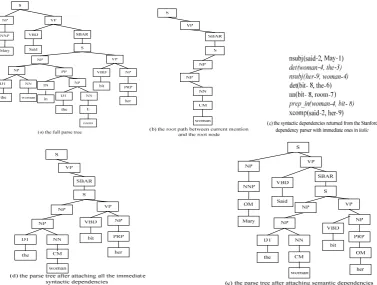
We name our parse tree structure as a depend-ency-driven dynamic syntactic parse tree (D-DSPT). The intuition behind is that the de-pendency information related with current mention in the same sentence plays a critical role in anaphoricity determination. Given the sentence enclosing the mention under consid-eration, we can get the D-DSPT as follows: (Figure 1 illustrates an example of the D-DSPT generation given the sentence “Mary said the woman in the room bit her” with “woman” as current mention.)
1
Figure 1: An example of generating the dependency-driven dynamic syntactic parse tree
1) Generating the full syntactic parse tree of the given sentence using a full syntactic parser. In this paper, the Charniak parser (Charniak 2001) is employed and Figure 1 (a) shows the resulting full parse tree.
2) Keeping only the root path from current mention to the root node of the full parse tree. Figure 1(b) shows the root path corresponding to the current mention “woman”. In the fol-lowing steps, we attach the above two types of dependency information to the root path. 3) Extracting all the syntactic dependencies in the sentence using a syntactic dependency parser, and attaching all the nodes, which have immediate dependency relationship with cur-rent mention, and their corresponding paths to the root path. Figure 1(c) illustrates the syntac-tic dependences extracted from the sentence, where the ones in italic mean immediate de-pendencies with current mention. Figure 1(d) shows the parse tree structure after considering syntactic dependencies.
4) Attaching all the predicates heading any node in the root path from current mention to the root node and their corresponding paths to the root path. For the example sentence, there are two predicates “said” and “bit”, which head the “VP” and “S” nodes in the root path
re-spectively. Therefore, these two predicates and their corresponding paths should be attached to the root path as shown in Figure 1(e). Note that the predicate “bit” and its corresponding path has already been attached in Stop (3). As a re-sult, the predicate-related information can be attached. According to Zhou and Kong (2009), such information is important to definite NP resolution.
5) Extracting the semantic dependencies re-lated with those attached predicates using a (shallow) semantic parser, and attaching all the compatible arguments (except those overlap-ping with current mention) and their corre-sponding paths to the root path. For example, as shown in Figure 1(e), since the arguments “Mary” and “her” are compatible with current mention “woman”, these two nodes and their corresponding paths are attached while the ar-gument “room” is not since its gender does not agree with current mention.
4
Experimentation and Discussion
This section evaluates the performance of de-pendency-driven anaphoricity determination and its application in coreference resolution on the ACE 2003 corpus.
4.1 Experimental Setting
The ACE 2003 corpus contains three domains: newswire (NWIRE), newspaper (NPAPER), and broadcast news (BNEWS). For each do-main, there exist two data sets, training and devtest, which are used for training and testing. For preparation, all the documents in the corpus are preprocessed automatically using a pipeline of NLP components, including to-kenization and sentence segmentation, named entity recognition, part-of-speech tagging and noun phrase chunking. Among them, named entity recognition, part-of-speech tagging and noun phrase chunking apply the same state-of-the-art HMM-based engine with er-ror-driven learning capability (Zhou and Su, 2000 & 2002). Our statistics finds that 62.0%, 58.5% and 61.4% of entity mentions are pre-served after preprocessing on the NWIRE, NPAPER and BNEWS domains of the ACE 2003 training data respectively while only 89.5%, 89.2% and 94% of entity mentions are preserved after preprocessing on the NWIRE, NPAPER and BNEWS domains of the ACE 2003 devtest data. This indicates the difficulty of coreference resolution. In addition, the cor-pus is parsed using the Charniak parser for syntactic parsing and the Stanford dependency parser for syntactic dependencies while corre-sponding semantic dependencies are extracted using a state-of-the-art semantic role labeling toolkit (Li et al. 2009). Finally, we use the SVM-light2 toolkit with the tree kernel func-tion as the classifier. For comparison purpose, the training parameters C (SVM) and ¬(tree kernel) are set to 2.4 and 0.4 respectively, as done in Zhou and Kong (2009).
For anaphoricity determination, we report the performance in Acc+ and Acc-, which measure the accuracies of identifying anaphoric NPs and non-anaphoric NPs, respectively. Ob-viously, higher Acc+ means that more ana-phoric NPs would be identified correctly, while
2
http://svmlight.joachims.org/
higher Acc- means that more non-anaphoric NPs would be filtered out. For coreference resolution, we report the performance in terms of recall, precision, and F1-measure using the commonly-used model theoretic MUC scoring program (Vilain et al. 1995). To see whether an improvement is significant, we also conduct significance testing using paired t-test. In this paper, ‘***’, ‘**’ and ‘*’ denote p-values of an improvement smaller than 0.01, in-between (0.01, 0,05] and bigger than 0.05, which mean significantly better, moderately better and slightly better, respectively.
4.2 Experimental Results
Performance of anaphoricity determination
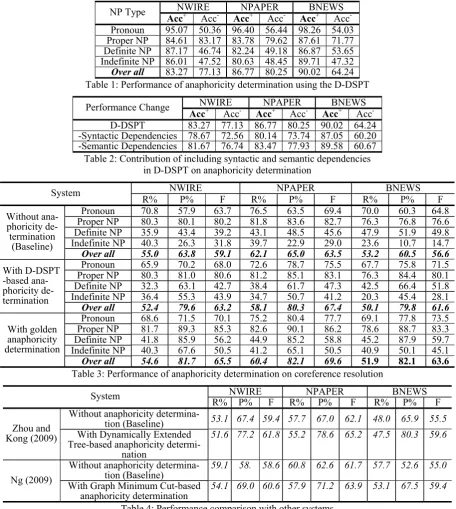
NWIRE NPAPER BNEWS NP Type
Acc+ Acc- Acc+ Acc- Acc+ Acc
-Pronoun 95.07 50.36 96.40 56.44 98.26 54.03 Proper NP 84.61 83.17 83.78 79.62 87.61 71.77 Definite NP 87.17 46.74 82.24 49.18 86.87 53.65 Indefinite NP 86.01 47.52 80.63 48.45 89.71 47.32
Over all 83.27 77.13 86.77 80.25 90.02 64.24 Table 1: Performance of anaphoricity determination using the D-DSPT
NWIRE NPAPER BNEWS Performance Change
Acc+ Acc- Acc+ Acc- Acc+ Acc
-D-DSPT 83.27 77.13 86.77 80.25 90.02 64.24
-Syntactic Dependencies 78.67 72.56 80.14 73.74 87.05 60.20 -Semantic Dependencies 81.67 76.74 83.47 77.93 89.58 60.67 Table 2: Contribution of including syntactic and semantic dependencies
in D-DSPT on anaphoricity determination
NWIRE NPAPER BNEWS System
R% P% F R% P% F R% P% F
Pronoun 70.8 57.9 63.7 76.5 63.5 69.4 70.0 60.3 64.8
Proper NP 80.3 80.1 80.2 81.8 83.6 82.7 76.3 76.8 76.6
Definite NP 35.9 43.4 39.2 43.1 48.5 45.6 47.9 51.9 49.8
Indefinite NP 40.3 26.3 31.8 39.7 22.9 29.0 23.6 10.7 14.7
Without ana-phoricity de-termination (Baseline)
Over all 55.0 63.8 59.1 62.1 65.0 63.5 53.2 60.5 56.6
Pronoun 65.9 70.2 68.0 72.6 78.7 75.5 67.7 75.8 71.5
Proper NP 80.3 81.0 80.6 81.2 85.1 83.1 76.3 84.4 80.1
Definite NP 32.3 63.1 42.7 38.4 61.7 47.3 42.5 66.4 51.8
Indefinite NP 36.4 55.3 43.9 34.7 50.7 41.2 20.3 45.4 28.1
With D-DSPT -based ana-phoricity de-termination
Over all 52.4 79.6 63.2 58.1 80.3 67.4 50.1 79.8 61.6
Pronoun 68.6 71.5 70.1 75.2 80.4 77.7 69.1 77.8 73.5
Proper NP 81.7 89.3 85.3 82.6 90.1 86.2 78.6 88.7 83.3
Definite NP 41.8 85.9 56.2 44.9 85.2 58.8 45.2 87.9 59.7
Indefinite NP 40.3 67.6 50.5 41.2 65.1 50.5 40.9 50.1 45.1
With golden anaphoricity determination
Over all 54.6 81.7 65.5 60.4 82.1 69.6 51.9 82.1 63.6
Table 3: Performance of anaphoricity determination on coreference resolution
NWIRE NPAPER BNEWS System
R% P% F R% P% F R% P% F
Without anaphoricity
determina-tion (Baseline) 53.1 67.4 59.4 57.7 67.0 62.1 48.0 65.9 55.5 Zhou and
Kong (2009) With Dynamically Extended Tree-based anaphoricity
determi-nation
51.6 77.2 61.8 55.2 78.6 65.2 47.5 80.3 59.6
Without anaphoricity
determina-tion (Baseline) 59.1 58. 58.6 60.8 62.6 61.7 57.7 52.6 55.0
Ng (2009)
With Graph Minimum Cut-based
anaphoricity determination 54.1 69.0 60.6 57.9 71.2 63.9 53.1 67.5 59.4 Table 4: Performance comparison with other systems
Table 2 further presents the contribution of including syntactic and semantic dependencies in the D-DSPT on anaphoricity determination by excluding one or both of them. It shows that both syntactic dependencies and semantic de-pendencies contribute significantly (***).
Performance of coreference resolution
We have evaluated the effect of our D-DSPT-based anaphoricity determination module on coreference resolution by including
ana-phoricity determination, with D-DSPT-based anaphoricity determination and. with golden anaphoricity determination. Table 3 shows that: 1) There is a performance gap of 6.4, 6.1 and 7.0 in F1-measure on the NWIRE, NPAPER and BNEWS domain, respectively, between the coreference resolution system with golden anaphoricity determination and the baseline system without anaphoricity determination. This suggests the usefulness of proper ana-phoricity determination in coreference resolu-tion. This also agrees with Stoyanov et al. (2009) which measured the impact of golden anaphoricity determination on coreference resolution using only the annotated anaphors in both training and testing.
2) Compared to the baseline system without anaphoricity determination, the D-DSPT-based anaphoricity determination module improves the performance by 4.1(***), 3.9(***) and 5.0(***) to 63.2, 67.4 and 61.6 in F1-measure on the NWIRE, NPAPER and BNEWS do-mains, respectively, due to a large gain in pre-cision and a much smaller drop in recall. In addition, D-DSPT-based anaphoricity determi-nation can not only much improve the per-formance of coreference resolution on pro-nominal NPs (***) but also on definite NPs(***) and indefinite NPs(***) while the improvement on proper NPs can be ignored due to the fact that proper NPs can be well ad-dressed by the simple abbreviation feature in the baseline system.
3) D-DSPT-based anaphoricity determination still lags (2.3, 2.2 and 2.0 on the NWIRE, NPAPER and BNEWS domains, respectively) behind golden anaphoricity determination in improving the overall performance of corefer-ence resolution. This suggests that there exists some room in the performance improvement for anaphoricity determination.
Performance comparison with other systems
Table 4 compares the performance of our sys-tem with other syssys-tems. Here, Zhou and Kong (2009) use the same set of features with ours in the baseline system and a dynami-cally-extended tree structure in anaphoricity determination. Ng (2009) uses 33 features as described in Ng (2007) and a graph minimum cut algorithm in anaphoricity determination. It shows that the overall performance of our
baseline system is almost as good as that of Zhou and Kong (2009) and a bit better than Ng’s (2009).
For overall performance, our coreference resolution system with D-DSPT-based ana-phoricity determination much outperforms Zhou and Kong (2009) in F1-measure by 1.4, 2.2 and 2.0 on the NWIRE, NPAPER and BNEWS domains, respectively, due to the bet-ter inclusion of dependency information. De-tailed evaluation shows that such improvement comes from coreference resolution on both pronominal and definite NPs (Please refer to Table 6 in Zhou and Kong, 2009). Compared with Zhou and Kong (2009) and Ng (2009), our approach achieves the best F1-measure so far for each dataset.
5
Conclusion and Further Work
This paper systematically studies a depend-ency-driven dynamic syntactic parse tree (DDST) for anaphoricity determination and the application of an explicit anaphoricity deter-mination module in improving learning-based coreference resolution. Evaluation on the ACE 2003 corpus indicates that D-DSPT-based anaphoricity determination much improves the performance of coreference resolution.
To our best knowledge, this paper is the first research which directly explores constituent dependencies in tree kernel-based anaphoricty determination from both syntactic and semantic perspectives.
For further work, we will explore more structured syntactic information in coreference resolution. In addition, we will study the inter-action between anaphoricity determination and coreference resolution and better integrate anaphoricity determination with coreference resolution.
Acknowledgments
References
D. Bean and E. Riloff 1999. Corpus-based Identifi-cation of Non-Anaphoric Noun Phrases. ACL’ 1999
S. Bergsma, D. Lin and R. Goebel 2008. Distribu-tional Identification of Non-referential Pronouns. ACL’2008
C. Cherry and S. Bergsma. 2005. An expectation maximization approach to pronoun resolution. CoNLL’2005
M. Collins and N. Duffy. 2001. Covolution kernels for natural language. NIPS̓2001
M. Denber 1998. Automatic Resolution of Anapho-ria in English. Technical Report, Eastman Ko-dakCo.
P. Denis and J. Baldridge. 2007. Global, joint de-termination of anaphoricity and coreference resolution using integer programming. NAACL/HLT’2007
R. Evans 2001. Applying machine learning toward an automatic classification of it. Literary and Linguistic Computing, 16(1):45-57
F. Kong, G.D. Zhou and Q.M. Zhu. 2009 Employ-ing the CenterEmploy-ing Theory in Pronoun Resolution from the Semantic Perspective. EMNLP’2009 F. Kong, Y.C. Li, G.D. Zhou and Q.M. Zhu. 2009.
Exploring Syntactic Features for Pronoun Reso-lution Using Context-Sensitive ConvoReso-lution Tree Kernel. IALP’2009
S. Lappin and J. L. Herbert. 1994. An algorithm for pronominal anaphora resolution. Computational Linguistics, 20(4)
J.H. Li. G.D. Zhou, H. Zhao, Q.M. Zhu and P.D. Qian. Improving nominal SRL in Chinese lan-guage with verbal SRL information and auto-matic predicate recognition. EMNLP '2009 X. Luo. 2007. Coreference or not: A twin model for
coreference resolution. NAACL-HLT’2007 V. Ng and C. Cardie 2002. Identify Anaphoric and
Non-Anaphoric Noun Phrases to Improve Coreference Resolution. COLING’2002
V. Ng and C. Cardie 2002. Improving machine learning approaches to coreference resolution. ACL’2002
V. Ng 2004. Learning Noun Phrase Anaphoricity to Improve Coreference Resolution: Issues in Rep-resentation and Optimization. ACL’ 2004 V. Ng 2009. Graph-cut based anaphoricity
determi-nation for coreference resolution. NAACL’2009 L.H. Qian, G.D. Zhou, F. Kong, Q.M. Zhu and P.D.
Qian. 2008. Exploiting constituent dependencies for tree kernel-based semantic relation extrac-tion. COLING’2008
W. M. Soon, H. T. Ng and D. Lim 2001. A ma-chine learning approach to coreference resolution
of noun phrase. Computational Linguistics, 27(4):521-544.
V. Stoyanov, N. Gilbert, C. Cardie and E. Riloff. 2009. Conundrums in Noun Phrase Coreference Resolution: Making Sense of the State-of-the Art. ACL’2009
B. L. Webber. 1979. A Formal Approach to Dis-course Anaphora. Garland Publishing, Inc. X.F. Yang, G.D. Zhou, J. Su and C.L. Chew. 2003.
Coreference Resolution Using Competition Learning Approach. ACL’2003
X.F. Yang, J. Su and C.L. Chew. 2005. A Twin Candidate Model of Coreference Resolution with Non-Anaphor Identification Capability. IJCNLP’2005
X.F. Yang, J. Su and C.L. Chew. 2006. Ker-nel-based pronoun resolution with structured syntactic knowledge. COLING-ACL’2006
X.F. Yang, J. Su and C.L. Tan 2008. A Twin-Candidate Model for Learning-Based Anaphora Resolution. Computational Linguistics 34(3):327-356
M. Zhang, J. Zhang, J. Su and G.D. Zhou. 2006. A composite kernel to extract relations between en-tities with both flat and structured features. COLING/ACL’2006
S. Zhao and R. Grishman. 2005. Extracting relations with integered information using kernel methods. ACL’2005
D. Zelenko, A. Chinatsu and R. Anthony. 2003. Kernel methods for relation extraction. Machine Learning Researching 3(2003):1083-1106 G.D. Zhou, F. Kong and Q.M. Zhu. 2008.
Con-text-sensitive convolution tree kernel for pronoun resolution. IJCNLP’2008
G.D. Zhou and F. Kong. 2009. Global Learning of Noun Phrase Anaphoricity in Coreference Reso-lution via Label Propagetion. EMNLP’2009 G.D. Zhou and J. Su. 2002. Named Entity
recogni-tion using a HMM-based chunk tagger. ACL’2002