Proceedings of the IJCNLP-08 Workshop on NER for South and South East Asian Languages, pages 51–58,
Bengali Named Entity Recognition using Support Vector Machine
Asif Ekbal
Department of Computer Science and
Engineering, Jadavpur University
Kolkata-700032, India
Sivaji Bandyopadhyay
Department of Computer Science and
Engineering, Jadavpur University
Kolkata-700032, India
Abstract
Named Entity Recognition (NER) aims to classify each word of a document into prede-fined target named entity classes and is nowa-days considered to be fundamental for many Natural Language Processing (NLP) tasks such as information retrieval, machine transla-tion, information extractransla-tion, question answer-ing systems and others. This paper reports about the development of a NER system for Bengali using Support Vector Machine (SVM). Though this state of the art machine learning method has been widely applied to NER in several well-studied languages, this is our first attempt to use this method to Indian languages (ILs) and particularly for Bengali. The system makes use of the different contex-tual information of the words along with the variety of features that are helpful in predicting the various named entity (NE) classes. A por-tion of a partially NE tagged Bengali news corpus, developed from the archive of a lead-ing Bengali newspaper available in the web, has been used to develop the SVM-based NER system. The training set consists of approxi-mately 150K words and has been manually annotated with the sixteen NE tags. Experi-mental results of the 10-fold cross validation test show the effectiveness of the proposed SVM based NER system with the overall av-erage Recall, Precision and F-Score of 94.3%, 89.4% and 91.8%, respectively. It has been shown that this system outperforms other ex-isting Bengali NER systems.
1 Introduction
Named Entity Recognition (NER) is an important tool in almost all NLP application areas such as information retrieval, machine translation, ques
tion-answering system, automatic summarization etc. Proper identification and classification of NEs are very crucial and pose a very big challenge to the NLP researchers. The level of ambiguity in NER makes it difficult to attain human perform-ance
NER has drawn more and more attention from the NE tasks (Chinchor 95; Chinchor 98) in Mes-sage Understanding Conferences (MUCs) [MUC6; MUC7]. The problem of correct identification of NEs is specifically addressed and benchmarked by the developers of Information Extraction System, such as the GATE system (Cunningham, 2001). NER also finds application in question-answering systems (Maldovan et al., 2002) and machine translation (Babych and Hartley, 2003).
The current trend in NER is to use the machine-learning approach, which is more attractive in that it is trainable and adoptable and the maintenance of a machine-learning system is much cheaper than that of a rule-based one. The representative ma-chine-learning approaches used in NER are Hidden Markov Model (HMM) (BBN’s IdentiFinder in (Bikel, 1999)), Maximum Entropy (New York University’s MEME in (Borthwick, 1999)), Deci-sion Tree (New York University’s system in (Se-kine, 1998) and Conditional Random Fields (CRFs) (Lafferty et al., 2001). Support Vector Ma-chines (SVMs) based NER system was proposed by Yamada et al. (2002) for Japanese. His system is an extension of Kudo’s chunking system (Kudo and Matsumoto, 2001) that gave the best perform-ance at CoNLL-2000 shared tasks. The other SVM-based NER systems can be found in (Takeu-chi and Collier, 2002) and (Asahara and Matsu-moto, 2003).
Named entity identification in Indian languages in general and particularly in Bengali is difficult and challenging. In English, the NE always ap-pears with capitalized letter but there is no concept of capitalization in Bengali. There has been a very
little work in the area of NER in Indian languages. In Indian languages, particularly in Bengali, the works in NER can be found in (Ekbal and Bandyopadhyay, 2007a; Ekbal and Bandyop-adhyay, 2007b) with the pattern directed shallow parsing approach and in (Ekbal et al., 2007c) with the HMM. Other than Bengali, a CRF-based Hindi NER system can be found in (Li and McCallum, 2004).
The rest of the paper is organized as follows. Support Vector Machine framework is described briefly in Section 2. Section 3 deals with the named entity recognition in Bengali that describes the named entity tagset and the detailed descrip-tions of the features for NER. Experimental results are presented in Section 4. Finally, Section 5 con-cludes the paper.
2
Support Vector Machines
Support Vector Machines (SVMs) are relatively new machine learning approaches for solving two-class pattern recognition problems. SVMs are well known for their good generalization performance, and have been applied to many pattern recognition problems. In the field of NLP, SVMs are applied to text categorization, and are reported to have achieved high accuracy without falling into over-fitting even though with a large number of words taken as the features.
Suppose we have a set of training data for a two-class problem:
{( ,
x y
1 1),...(
x y
N,
N)}
, whereD
i
x
R
is a feature vector of the i-th sample in the training data andy
i { 1, 1} is the class to whichi
x
belongs. The goal is to find a decision function that accurately predicts class y for an input vector x. A non-linear SVM classifier gives a decision functionf(x)
sign(g(x)
for an input vector where,1
( )
i( , )
m
i i
g x
¦
w K x z
b
Here,
f(x)
+1 means x is a member of a cer-tain class andf(x)
-1 means x is not a member. zi s are called support vectors and arerepresenta-tives of training examples, m is the number of sup-port vectors. Therefore, the computational com-plexity of
g x
( )
is proportional to m. Support vec-tors and other constants are determined by solving a certain quadratic programming problem.( , )
iK x z
is a kernel that implicitly maps vectorsinto a higher dimensional space. Typical kernels use dot products:
K x z
( , )
ik x z
( . )
. A polynomial kernel of degree d is given by( , )
iK x z
=(1
x
)
d. We can use various kernels,and the design of an appropriate kernel for a par-ticular application is an important research issue.
We have developed our system using SVM (Jochims, 1999) and (Valdimir, 1995), which per-forms classification by constructing an N-dimensional hyperplane that optimally separates data into two categories. Our general NER system includes two main phases: training and classifica-tion. Both the training and classification processes were carried out by YamCha1 toolkit, an SVM based tool for detecting classes in documents and formulating the NER task as a sequential labeling problem. Here, the pair wise multi-class decision method and second degree polynomial kernel func-tion were used. We have used TinySVM-0.072 classifier that seems to be the best optimized among publicly available SVM toolkits.
3
Named Entity Recognition in Bengali
Bengali is one of the widely used languages all over the world. It is the seventh popular language in the world, second in India and the national lan-guage of Bangladesh. A partially NE tagged Ben-gali news corpus (Ekbal and Bandyopadhyay, 2007d), developed from the archive of a widely read Bengali newspaper. The corpus contains around 34 million word forms in ISCII (Indian Script Code for Information Interchange) and UTF-8 format. The location, reporter, agency and different date tags (date, ed, bd, day) in the par-tially NE tagged corpus help to identify some of the location, person, organization and miscellane-ous names, respectively that appear in some fixed places of the newspaper. These tags cannot detect the NEs within the actual news body. The date in-formation obtained from the news corpus provides example of miscellaneous names. A portion of this partially NE tagged corpus has been manually an-notated with the sixteen NE tags as described in Table 1.
3.1 Named Entity Tagset
A SVM based NER system has been developed in this work to identify NEs in Bengali and classify
1http://chasen-org/~taku/software/yamcha/
them into the predefined four major categories, namely, ‘Person name’, ‘Location name’, ‘Organi-zation name’ and ‘Miscellaneous name’. In order to properly denote the boundaries of the NEs and to apply SVM in NER task, sixteen NE and one non-NE tags have been defined as shown in Table 1. In the output, sixteen NE tags are replaced ap-propriately with the four major NE tags by some simple heuristics.
NE tag Meaning Example PER Single word
per-son name
sachin / PER
LOC Single word loca-tion name
jdavpur/LOC
ORG Single word or-ganization name
infosys / ORG
MISC Single word mis-cellaneous name
Table 1. Named Entity Tagset
3.2 Named Entity Feature Descriptions
Feature selection plays a crucial role in the Support Vector Machine (SVM) framework. Experiments have been carried out in order to find out the most suitable features for NER in Bengali. The main features for the NER task have been identified based on the different possible combination of available word and tag context. The features also include prefix and suffix for all words. The term prefix/suffix is a sequence of first/last few charac-ters of a word, which may not be a linguistically
meaningful prefix/suffix. The use of prefix/suffix information works well for highly inflected lan-guages like the Indian lanlan-guages. In addition, vari-ous gazetteer lists have been developed for use in the NER task. We have considered different com-bination from the following set for inspecting the best feature set for NER task:
F={
w
i m,...,
w w w
i1, ,
i i1,...,
w
i n, |prefix|dn, |suffix|dn, previous NE tags, POS tags, First word, Digit in-formation, Gazetteer lists}Following are the details of the set of features that have been applied to the NER task:
xContext word feature: Previous and next words of a particular word might be used as a feature.
xWord suffix: Word suffix information is helpful to identify NEs. This feature can be used in two different ways. The first and the naïve one is, a fixed length word suffix of the current and/or the surrounding word(s) might be treated as feature. The second and the more helpful approach is to modify the feature as binary valued. Variable length suffixes of a word can be matched with pre-defined lists of useful suffixes for different classes of NEs. The different suffixes that may be particu-larly helpful in detecting person (e.g., -babu, -da, -di etc.) and location names (e.g., -land, -pur, -lia
etc.) are also included in the lists of variable length suffixes. Here, both types of suffixes have been used.
xWord prefix: Prefix information of a word is also helpful. A fixed length prefix of the current and/or the surrounding word(s) might be treated as fea-tures.
xPart of Speech (POS) Information: The POS of the current and/or the surrounding word(s) can be used as features. Multiple POS information of the words can be a feature but it has not been used in the present work. The alternative and the better way is to use a coarse-grained POS tagger.
Here, we have used a CRF-based POS tagger, which was originally developed with the help of 26 different POS tags3, defined for Indian languages. For NER, we have considered a coarse-grained POS tagger that has only the following POS tags:
NNC (Compound common noun), NN (Com-mon noun), NNPC (Compound proper noun), NNP (Proper noun), PREP (Postpositions), QFNUM (Number quantifier) and Other (Other than the above).
The POS tagger is further modified with two POS tags (Nominal and Other) for incorporating the nominal POS information. Now, a binary val-ued feature ‘nominalPOS’ is defined as: If the cur-rent/surrounding word is ‘Nominal’ then the ‘nominalPOS’ feature of the corresponding word is set to ‘+1’; otherwise, it is set to ‘-1’. This binary valued ‘nominalPOS’ feature has been used in ad-dition to the 7-tag POS feature. Sometimes, post-positions play an important role in NER as postpo-sitions occur very frequently after a NE. A binary valued feature ‘nominalPREP’ is defined as: If the current word is nominal and the next word is PREP then the feature ‘nomianlPREP’ of the current word is set to ‘+1’, otherwise, it is set to ‘-1’.
xNamed Entity Information: The NE tag(s) of the previous word(s) can also be considered as the fea-ture. This is the only dynamic feature in the ex-periment.
xFirst word: If the current token is the first word of a sentence, then the feature ‘FirstWord’ is set to ‘+1’; Otherwise, it is set to ‘-1’.
xDigit features: Several digit features have been considered depending upon the presence and/or the number of digit(s) in a token (e.g., ContainsDigit [token contains digits], FourDigit [token consists of four digits], TwoDigit [token consists of two digits]), combination of digits and punctuation symbols (e.g., ContainsDigitAndComma [token consists of digits and comma], ConatainsDigi-tAndPeriod [token consists of digits and periods]), combination of digits and symbols (e.g., Con-tainsDigitAndSlash [token consists of digit and slash], ContainsDigitAndHyphen [token consists of digits and hyphen], ContainsDigitAndPercent-age [token consists of digits and percentContainsDigitAndPercent-ages]). These binary valued features are helpful in recog-nizing miscellaneous NEs such as time expres-sions, monetary expresexpres-sions, date expresexpres-sions, per-centages, numerical numbers etc.
xGazetteer Lists: Various gazetteer lists have been developed from the partially NE tagged Bengali news corpus (Ekbal and Bandyopadhyay, 2007d). These lists have been used as the binary valued features of the SVM framework. If the current to-ken is in a particular list, then the corresponding feature is set to ‘+1’ for the current and/or sur-rounding word(s); otherwise, it is set to ‘-1’. The following is the list of gazetteers:
(i). Organization suffix word (94 entries): This list contains the words that are helpful in identifying organization names (e.g., kong, limited etc.). The
feature ‘OrganizationSuffix’ is set to ‘+1’ for the current and the previous words.
(ii). Person prefix word (245 entries): This is use-ful for detecting person names (e.g., sriman, sree,
srimati etc.). The feature ‘PersonPrefix’ is set to ‘+1’ for the current and the next two words. (iii). Middle name (1,491 entries): These words generally appear inside the person names (e.g.,
chandra, nath etc.). The feature ‘MiddleName’ is set to ‘+1’ for the current, previous and the next words.
(iv). Surname (5,288 entries): These words usually appear at the end of person names as their parts. The feature ‘SurName’ is set to ‘+1’ for the current word.
(v). Common location word (547 entries): This list contains the words that are part of location names and appear at the end (e.g., sarani,road,lane etc.). The feature ‘CommonLocation’ is set to ‘+1’ for the current word.
(vi). Action verb (221 entries): A set of action verbs like balen, ballen, ballo, shunllo, haslo etc. often determines the presence of person names. The feature ’ActionVerb’ is set to ‘+1’ for the previous word.
(vii). Frequent word (31,000 entries): A list of most frequently occurring words in the Bengali news corpus has been prepared using a part of the corpus. The feature ‘RareWord’ is set to ‘+1’ for those words that are not in this list.
(viii). Function words (743 entries): A list of func-tion words has been prepared manually. The fea-ture ‘NonFunctionWord’ is set to ‘+1’ for those words that are not in this list.
(ix). Designation words (947 entries): A list of common designation words has been prepared. This helps to identify the position of the NEs, par-ticularly person names (e.g., neta, sangsad,
kheloar etc.). The feature ‘DesignationWord’ is set to ‘+1’ for the next word.
(x). Person name (72, 206 entries): This list con-tains the first name of person names. The feature ‘PersonName’ is set to ‘+1’ for the current word. (xi). Location name (7,870 entries): This list con-tains the location names and the feature ‘Loca-tionName’ is set to ‘+1’ for the current word. (xii). Organization name (2,225 entries): This list contains the organization names and the feature ‘OrganizationName’ is set to ‘+1’ for the current word.
English and Bengali calendars. The feature ‘MonthName’ is set to ‘+1’ for the current word. (xiv). Weekdays (14 entries): It contains the name of seven weekdays in Bengali and English both. The feature ‘WeekDay’ is set to ‘+1’ for the cur-rent word.
4 Experimental
Results
A partially NE tagged Bengali news corpus (Ekbal and Bandyopadhyay, 2007d) has been used to cre-ate the training set for the NER experiment. Out of 34 million wordforms, a set of 150K wordforms has been manually annotated with the 17 tags as shown in Table 1 with the help of Sanchay Editor4, a text editor for Indian languages. Around 20K NE tagged corpus is selected as the development set and the rest 130K wordforms are used as the train-ing set of the SVM based NER system.
We define the baseline model as the one where the NE tag probabilities depend only on the current word:
1 2 3 1 2 3
1...
( , , ..., |
n,
,
...,
n)
( ,
i i)
i nP t t t
t w w w
w
P t w
In this model, each word in the test data is as-signed the NE tag that occurs most frequently for that word in the training data. The unknown word is assigned the NE tag with the help of various gazetteers and NE suffix lists.
Seventy four different experiments have been conducted taking the different combinations from the set ‘F’ to identify the best-suited set of features for NER in Bengali. From our empirical analysis, we found that the following combination gives the best result for the development set.
F
={
w
i3w
i2w
i1w w
i i1w
i2, |prefix|<=3, |suffix|<=3, NE information of the window [-2, 0], POS information of the window [-1, +1], nominal-POS of the current word, nominalPREP, FirstWord, Digit features, Gazetteer lists}The meanings of the notations, used in experi-mental results, are defined below:
pw, cw, nw: Previous, current and the next word; pwi, nwi: Previous and the next ith word from the current word; pt: NE tag of the previous word; pti: NE tag of the previous ith word; pre, suf: Prefix and suffix of the current word; ppre, psuf: Prefix and suffix of the previous word; npre, nsuf: Prefix and suffix of the next word; pp, cp, np: POS tag of the previous, current and the next word;
4Sourceforge.net/project/nlp-sanchay
ppi, npi: POS tag of the previous and the next ith word; cwnl: Current word is nominal.
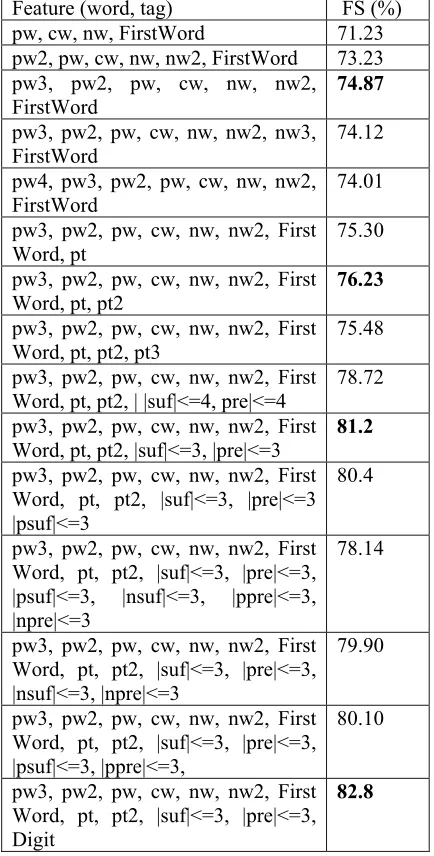
Evaluation results of the development set are presented in Tables 2-4.
Feature (word, tag) FS (%) pw, cw, nw, FirstWord 71.23 pw2, pw, cw, nw, nw2, FirstWord 73.23 pw3, pw2, pw, cw, nw, nw2, FirstWord
74.87
pw3, pw2, pw, cw, nw, nw2, nw3, FirstWord
74.12
pw4, pw3, pw2, pw, cw, nw, nw2, FirstWord
74.01
pw3, pw2, pw, cw, nw, nw2, First Word, pt
75.30
pw3, pw2, pw, cw, nw, nw2, First Word, pt, pt2
76.23
pw3, pw2, pw, cw, nw, nw2, First Word, pt, pt2, pt3
75.48
pw3, pw2, pw, cw, nw, nw2, First Word, pt, pt2, | |suf|<=4, pre|<=4
78.72
pw3, pw2, pw, cw, nw, nw2, First Word, pt, pt2, |suf|<=3, |pre|<=3
81.2
pw3, pw2, pw, cw, nw, nw2, First Word, pt, pt2, |suf|<=3, |pre|<=3 |psuf|<=3
80.4
pw3, pw2, pw, cw, nw, nw2, First Word, pt, pt2, |suf|<=3, |pre|<=3, |psuf|<=3, |nsuf|<=3, |ppre|<=3, |npre|<=3
78.14
pw3, pw2, pw, cw, nw, nw2, First Word, pt, pt2, |suf|<=3, |pre|<=3, |nsuf|<=3, |npre|<=3
79.90
pw3, pw2, pw, cw, nw, nw2, First Word, pt, pt2, |suf|<=3, |pre|<=3, |psuf|<=3, |ppre|<=3,
80.10
pw3, pw2, pw, cw, nw, nw2, First Word, pt, pt2, |suf|<=3, |pre|<=3, Digit
82.8
Table 2. Results on the Development Set
rows) that prefixes and suffixes of length up to three of the current word are very effective. It is also evident (12th-15th rows) that the surrounding word prefixes and/or suffixes do not increase the F-Score value. The F-Score value is improved by 1.6% with the inclusion of various digit features (15th and 16th rows).
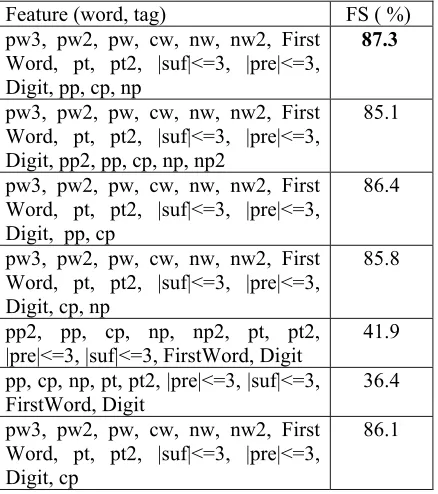
Feature (word, tag) FS ( %) pw3, pw2, pw, cw, nw, nw2, First
Word, pt, pt2, |suf|<=3, |pre|<=3, Digit, pp, cp, np
87.3
pw3, pw2, pw, cw, nw, nw2, First Word, pt, pt2, |suf|<=3, |pre|<=3, Digit, pp2, pp, cp, np, np2
85.1
pw3, pw2, pw, cw, nw, nw2, First Word, pt, pt2, |suf|<=3, |pre|<=3, Digit, pp, cp
86.4
pw3, pw2, pw, cw, nw, nw2, First Word, pt, pt2, |suf|<=3, |pre|<=3, Digit, cp, np
85.8
pp2, pp, cp, np, np2, pt, pt2, |pre|<=3, |suf|<=3, FirstWord, Digit
41.9
pp, cp, np, pt, pt2, |pre|<=3, |suf|<=3, FirstWord, Digit
36.4
pw3, pw2, pw, cw, nw, nw2, First Word, pt, pt2, |suf|<=3, |pre|<=3, Digit, cp
86.1
Table 3. Results on the Development Set
Experimental results (2nd-5th rows) of Table 3 suggest that the POS tags of the previous, current and the next words, i.e., POS information of the window [-1, +1] is more effective than the window [-2, +2], [-1, 0], [0, +1] or the current word alone. In the above experiment, the POS tagger was de-veloped with 7 POS tags. Results (6th and 7th rows) also show that POS information with the word is helpful but only the POS information without the word decreases the F-Score value significantly. Results (4th and 5th rows) also show that the POS information of the window [-1, 0] is more effective than the POS information of the window [0, +1]. So, it can be argued that the POS information of the previous word is more helpful than the POS information of the next word.
In another experiment, the POS tagger was de-veloped with 26 POS tags and the use of this tag-ger has shown the F-Score value of 85.6% with the feature (word, tag)=[pw3, pw2, pw, cw, nw, nw2, FirstWord, pt, pt2, |suf|<=3, |pre|<=3, Digit, pp, cp, np]. So, it can be decided that the smaller POS
tagset is more effective than the larger POS tagset in NER. We have observed from two different ex-periments that the overall F-Score values can fur-ther be improved by 0.5% and 0.3%, respectively, with the ‘nominalPOS’ and ‘nominalPREP’ fea-tures. It has been also observed that the ‘nominal-POS’ feature of the current word is only helpful and not of the surrounding words. The F-Score value of the NER system increases to 88.1% with the feature: feature (word, tag)=[pw3, pw2, pw, cw, nw, nw2, FirstWord, pt, pt2, |suf|<=3, |pre|<=3, Digit pp, cp, np, cwnl, nominalPREP].
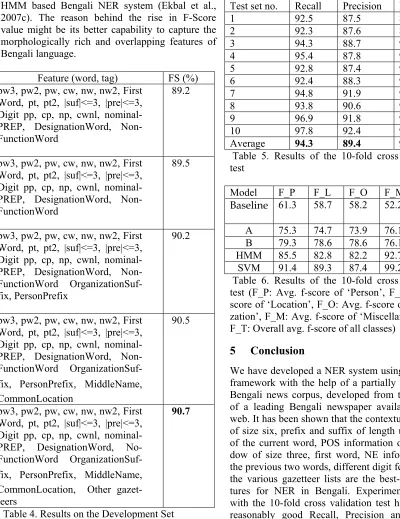
Experimental results with the various gazetteer lists are presented in Table 4 for the development set. Results demonstrate that the performance of the NER system can be improved significantly with the inclusion of various gazetteer lists. The overall F-Score value increases to 90.7%, which is an improvement of 2.6%, with the use of gazetteer lists.
The best set of features is identified by training the system with 130K wordforms and tested with the help of development set of 20K wordforms. Now, the development set is included as part of the training set and resultant training set is thus con-sisting of 150K wordforms. The training set has 20,455 person names, 11,668 location names, 963 organization names and 11,554 miscellaneous names. We have performed 10-fold cross valida-tion test on this resultant training set. The Recall, Precision and F-Score values of the 10 different experiments for the 10-fold cross validation test are presented in Table 5. The overall average Re-call, Precision and F-Score values are 94.3%, 89.4% and 91.8%, respectively.
HMM based Bengali NER system (Ekbal et al., 2007c). The reason behind the rise in F-Score value might be its better capability to capture the morphologically rich and overlapping features of Bengali language.
Feature (word, tag) FS (%) pw3, pw2, pw, cw, nw, nw2, First
Word, pt, pt2, |suf|<=3, |pre|<=3, Digit pp, cp, np, cwnl, nominal-PREP, DesignationWord, Non-FunctionWord
89.2
pw3, pw2, pw, cw, nw, nw2, First Word, pt, pt2, |suf|<=3, |pre|<=3, Digit pp, cp, np, cwnl, nominal-PREP, DesignationWord, Non-FunctionWord
89.5
pw3, pw2, pw, cw, nw, nw2, First Word, pt, pt2, |suf|<=3, |pre|<=3, Digit pp, cp, np, cwnl, nominal-PREP, DesignationWord, Non-FunctionWord OrganizationSuf-fix, PersonPrefix
90.2
pw3, pw2, pw, cw, nw, nw2, First Word, pt, pt2, |suf|<=3, |pre|<=3, Digit pp, cp, np, cwnl, nominal-PREP, DesignationWord, Non-FunctionWord OrganizationSuf-fix, PersonPrefix MiddleName, CommonLocation
90.5
pw3, pw2, pw, cw, nw, nw2, First Word, pt, pt2, |suf|<=3, |pre|<=3, Digit pp, cp, np, cwnl, nominal-PREP, DesignationWord, No-FunctionWord OrganizationSuf-fix, PersonPrefix MiddleName, CommonLocation, Other gazet-teers
90.7
Table 4. Results on the Development Set
The F-Score value of the system increases with the increment of training data. This fact is repre-sented in Figure 1. Also, it is evident from Figure 1 that the value of ‘Miscellaneous name’ is nearly close to 100% followed by ‘Person name’, ‘Loca-tion name’ and ‘Organiza‘Loca-tion name’ NE classes with the training data of 150K words.
Test set no. Recall Precision FS (%)
1 92.5 87.5 89.93
2 92.3 87.6 89.89
3 94.3 88.7 91.41
4 95.4 87.8 91.40
5 92.8 87.4 90.02
6 92.4 88.3 90.30
7 94.8 91.9 93.33
8 93.8 90.6 92.17
9 96.9 91.8 94.28
10 97.8 92.4 95.02
Average 94.3 89.4 91.8
Table 5. Results of the 10-fold cross validation test
Model F_P F_L F_O F_M F_T
Baseline 61.3 58.7 58.2 52.2 56.3
A 75.3 74.7 73.9 76.1 74.5 B 79.3 78.6 78.6 76.1 77.9 HMM 85.5 82.8 82.2 92.7 84.5
SVM 91.4 89.3 87.4 99.2 91.8 Table 6. Results of the 10-fold cross validation test (F_P: Avg. score of ‘Person’, F_L: Avg. f-score of ‘Location’, F_O: Avg. f-f-score of ‘Organi-zation’, F_M: Avg. f-score of ‘Miscellaneous’ and F_T: Overall avg. f-score of all classes)
5 Conclusion
The proposed SVM based system is to be trained and tested with the other Indian languages, particularly Hindi, Telugu, Oriya and Urdu. Ana-lyzing the performance of the system using other methods like MaxEnt and CRFs will be other in-teresting experiments.
F-Score(%) vs Training file size(K)
0 20 40 60 80 100 120
0 100 200
Number of Words (K)
F-Score (%)
Person
Location
Organisation
Miscellaneous
Fig. 1. F-Score VS Training file size
References
Anderson, T. W. and Scolve, S. 1978. Introduction to the Statistical Analysis of Data. Houghton Mifflin.
Asahara, Masayuki and Matsumoto, Yuji. 2003. Japa-nese Named Entity Extraction with Redundant Mor-phological Analysis. In Proc. of HLT-NAACL.
Babych, Bogdan, A. Hartley. 2003. Improving Machine Translation Quality with Automatic Named Entity Recognition. In Proceedings of EAMT/EACL 2003 Workshop on MT and other language technology tools, 1-8, Hungary.
Bikel, Daniel M., R. Schwartz, Ralph M. Weischedel. 1999. An Algorithm that Learns What’s in Name. Machine Learning (Special Issue on NLP), 1-20.
Bothwick, Andrew. 1999. A Maximum Entropy Ap-proach to Named Entity Recognition. Ph.D. Thesis, New York University.
Chinchor, Nancy. 1995. MUC-6 Named Entity Task Definition (Version 2.1). MUC-6, Maryland.
Chinchor, Nancy. 1998. MUC-7 Named Entity Task Definition (Version 3.5). MUC-7, Fairfax, Virginia.
Cunningham, H. 2001. GATE: A General Architecture for Text Engineering. Comput. Humanit. (36), 223-254.
Ekbal, Asif, and S. Bandyopadhyay. 2007a. Pattern Based Bootstrapping Method for Named Entity Rec-ognition. In Proceedings of ICAPR, India, 349-355.
Ekbal, Asif, and S. Bandyopadhyay. 2007b. Lexical Pattern Learning from Corpus Data for Named Entity Recognition. In Proc. of ICON, India, 123-128.
Ekbal, Asif, Naskar, Sudip and S. Bandyopadhyay. 2007c. Named Entity Recognition and Transliteration in Bengali. Named Entities: Recognition, Classifica-tion and Use, Special Issue of Lingvisticae Investiga-tiones Journal, 30:1 (2007), 95-114.
Ekbal, Asif, and S. Bandyopadhyay. 2007d. A Web-based Bengali News Corpus for Named Entity Rec-ognition. Language Resources and Evaluation Jour-nal (To appear December).
Joachims , T. 1999. Making Large Scale SVM Learning Practical. In B. Scholkopf, C. Burges and A. Smola editions, Advances in Kernel Methods-Support Vec-tor Learning, MIT Press.
Kudo, Taku and Matsumoto, Yuji. 2001. Chunking with Support Vector Machines. In Proceedings of NAACL, 192-199.
Kudo, Taku and Matsumoto, Yuji. 2000. Use of Support Vector Learning for Chunk Identification. In Pro-ceedings of CoNLL-2000.
Lafferty, J., McCallum, A., and Pereira, F. 2001. Condi-tional Random Fields: Probabilistic Models for Seg-menting and Labeling Sequence Data. In Proc. of 18th International Conference on Machine learning, 282-289.
Li, Wei and Andrew McCallum. 2003. Rapid Develop-ment of Hindi Named Entity Recognition Using Conditional Random Fields and Feature Inductions. ACM TALIP, 2(3), (2003), 290-294.
Moldovan, Dan I., Sanda M. Harabagiu, Roxana Girju, P. Morarescu, V. F. Lacatusu, A. Novischi, A. Badulescu, O. Bolohan. 2002. LCC Tools for Ques-tion Answering. In Proceedings of the TREC, 1-10.
Sekine, Satoshi. 1998. Description of the Japanese NE System Used for MET-2. MUC-7, Fairfax, Virginia.
Takeuchi, Koichi and Collier, Nigel. 2002. Use of Sup-port Vector Machines in Extended Named Entity Recognition. In Proceedings of 6th CoNLL, 119-125.
Vapnik, Valdimir N. 1995. The Nature of Statistical Learning Theory. Springer.