Computing Semantic Relatedness
Iryna Gurevych
EML Research gGmbH, Schloss-Wolfsbrunnenweg 33, 69118, Heidelberg, Germany http://www.eml-research.de/∼gurevych
Abstract. We present a new method for computing semantic relatedness of con-cepts. The method relies solely on the structure of a conceptual network and eliminates the need for performing additional corpus analysis. The network struc-ture is employed to generate artificial conceptual glosses. They replace textual definitions proper written by humans and are processed by a dictionary based metric of semantic relatedness [1]. We implemented the metric on the basis of GermaNet, the German counterpart of WordNet, and evaluated the results on a German dataset of 57 word pairs rated by human subjects for their semantic re-latedness. Our approach can be easily applied to compute semantic relatedness based on alternative conceptual networks, e.g. in the domain of life sciences.
1
Introduction
Semantic relatedness of words represents important information for many applications dealing with processing of natural language. A more narrowly defined phenomenon of semantic similarity has been extensively studied in psychology, cognitive science, artificial intelligence, and computational linguistics. In the context of linguistics, it is typically defined via the lexical relation of synonymy. While synonymy is indeed an example of extreme similarity (suggesting that two words are interchangeable in a cer-tain context), many natural language processing applications require knowledge about semantic relatedness rather than just similarity [2]. Departing from that, we define se-mantic relatedness as any kind of lexical or functional association that may exist be-tween two words. For example, the words “car” and “journey” apparently display a close semantic relationship, while they are not synonymous.
Many natural language processing applications, e.g. word sense disambiguation or information retrieval, do not need to determine the exact type of a semantic relation, but rather to judge if two words are closely semantically related or not. For example, for an application in the domain of career consultancy it might be important to conclude that the words “baker” and “bagel” are closely related, while the exact type of a semantic relation does not need to be assigned.
Metrics of semantic relatedness are increasingly embedded into natural language processing applications for English due to the availability of free software, e.g. [3] and pre-computed information content values from English corpora. The evaluation of all approaches to compute semantic relatedness has so far been done for the task of semantic similarity. The underlying data was based on the English language [4,5]. We propose the following classification of the metrics of semantic relatedness:
R. Dale et al. (Eds.): IJCNLP 2005, LNAI 3651, pp. 767–778, 2005. c
– intrinsic or extrinsic. Intrinsic metrics employ no external evidence, i.e. no
know-ledge sources except for the conceptual network itself [1,6,7]. Extrinsic metrics re-quire additional knowledge, e.g. information content values of concepts computed from corpora [8,9,10].
– the type of knowledge source employed, e.g. a dictionary or a conceptual
net-work. Metrics can either employ a machine readable dictionary, i.e. textual defi-nitions of words therein as an underlying knowledge base [1,11], or operate on the structure of a conceptual network, whereby textual definitions themselves are not available [9,7].
Researchers working on the processing of languages such as English, for which many resources exist, have a large choice of options for choosing a metric or a knowl-edge source. This is, however, not the case for many other languages. Extrinsic met-rics relying on a conceptual network and additional corpus data cannot always be ap-plied. It is difficult and time-consuming to find and process a corpus, which is sub-stantially large to compute information content of concepts for a new language. The same is true for domain-specific corpora, e.g. in the domain of life sciences. Before information content of domain concepts, e.g. protein names can be computed, a con-siderable effort has to be invested in compiling and processing a substantially large corpus in the respective domain. This makes it difficult to apply corpus-based met-rics. At the same time, many domains already have a kind of domain model in the form of thesauri or at least taxonomies, which appear to be instances of conceptual networks.
For dictionary based metrics, the difficulty is that textual definitions of word senses in dictionaries are often inconsistent. [12] note that dictionary definitions often do not contain enough words to be effectively deployed in dictionary based metrics. Fur-thermore, an important dimension is the portability of a metric to new domains, i.e. whether the metric can be applied e.g. to medical or biological domains. They typically have well developed taxonomies, but are lacking language based descriptions (defi-nitions). Therefore, the application of both extrinsic and dictionary based metrics is problematic.
Simultaneously, in this and in many other cases elaborated conceptual networks or taxonomies are available. One of the most prominent examples of that is the Open Di-rectory Project (http://www.dmoz.com). Therefore, we propose a method for computing semantic relatedness which overcomes the constraints related to previous metrics and is completely intrinsic. It exploits solely the structure of a conceptual network, while the need for both external statistical data and textual definitions of concepts is completely eliminated. Thus, our method is language independent and can be applied to different knowledge bases represented as conceptual networks.
machine-readable dictionary compiled by human writers. To exhaustively evaluate the metric, we introduced an additional baseline based on co-occurrences of words in the Web. A summary of the results is given in Section 5.
2
Definitions in Dictionaries and Conceptual Networks
Definitions of words and their distinct senses are essential to our approach. What is the definition of a good definition? This question has been disputed in philosophy since the days of Platon and Euklid, recently also in the disciplines such as cognitive science and linguistics. Different types of definitions were proposed, whose names are expressed in various terminologies, e.g. lexical, theoretical, circular and the definition by genus and difference to name just a few. Lexical definitions are what we typically find in a dictionary. They often suffer from inaccuracies as they are confined to established meanings and can prove to be confusing for example in legal matters. According to [13], a good definition should include several indisposable components: a functional part describing what the concept is intended for, the characteristics of the definiendum contrasting the general with particular, and context (time, place, cultural and mental). For example, “window” is a planar discontinuity in a solid artificial (context) surface (genus), which allows to look through it, or for the penetration of light or air (when not covered or open) (differentia). Without the differentia – with the genus alone – the definition can well fit the door; without the context, the definition can well fit a hole in a rock.
When human writers create definitions, they take care of the structural elements and requirements described above. On the other hand, when creating conceptual networks, dictionaries and language based examples are often employed as knowledge sources to determine lexical and semantic relations between words. Therefore, information about functions, general terms, and context is integrated into a conceptual network. The main idea explored in the present paper is, then, the possibility to extract knowledge about concepts from the conceptual network based on known properties of definitions and how they are encoded in the network. We call extracted pieces of knowledge pseudo glosses. Pseudo glosses can be used in the situations when textual definitions proper are not available. The information encoded in the network as lexical semantic relations is transformed into artificially generated glosses. Those can be employed in NLP ap-plications. An additional advantage of pseudo glosses as opposed to real glosses is the possibility to include or exclude certain types of information from a gloss. This way, glosses can be easily tailored to a specific task at hand. In our application, this amounts to experimentally determining the types of information crucial for computing semantic relatedness.
We experimented with different parameters that control which concepts are included in a pseudo gloss:
– size determines the length of a path for the hypernyms to be included in a pseudo
gloss. The values of size range over the interval[1, depthmax], wheredepthmaxis the maximum path length in a conceptual network. The depth is equivalent to the height in this context.
– limit determines the length of a path from the root node of a hierarchy (i.e. the most
abstract concept) towards a given concept. The concepts of the path are excluded from the pseudo gloss. The values of limit range over the interval[0, depthmax]. Givenlimit= 0no concepts will be excluded from the pseudo gloss, and given
limit=depthmaxthe resulting pseudo gloss contains solely the given word sense itself. Ifsizeandlimitare conflicting (e.g. the concept A should be included ac-cording tosize, and excluded according tolimit), the latter takes precedence over the former.
– one sense per synset(OSPS) parameter, either true or false. A synset is often rep-resented by multiple synonymous word senses. If the parameter is set to true, only one word sense from a synset will be included into a pseudo gloss (this is also the case in paper dictionaries). Otherwise, all word senses of a synset are included.
– lexical semantic relations control the type of relations in a conceptual network
which are involved in generating pseudo glosses, i.e. hypernymy, hyponymy, syn-onymy, mersyn-onymy, association, etc.
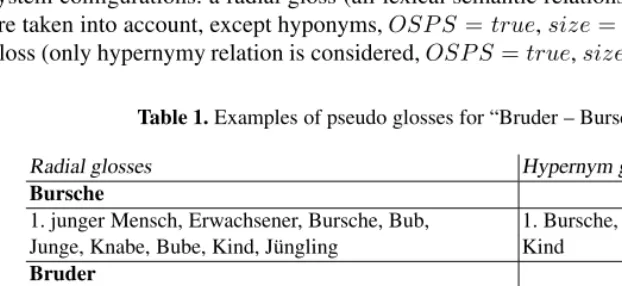
[image:4.512.57.368.394.537.2]Table 1 presents examples of pseudo glosses generated according to two different system configurations: a radial gloss (all lexical semantic relations of a given concept are taken into account, except hyponyms,OSP S=true,size= 3), and a hypernym gloss (only hypernymy relation is considered,OSP S=true,size= 3,limit= 2).
Table 1. Examples of pseudo glosses for “Bruder – Bursche”
Radial glosses Hypernym glosses
Bursche
1. junger Mensch, Erwachsener, Bursche, Bub, 1. Bursche, Junge, Junge, Knabe, Bube, Kind, J¨ungling Kind
Bruder
1. Bruder, Geschwister, Mitmensch, Familie, Verwandter 1. Bruder
2. LaienpredigerIn, Fachkraft, unausgebildeter Mensch, 2. unausgebildeter Mensch, Geistlicher, Prediger, ausgebildeter Mensch, Bruder, Geistlicher, Prediger, Laie, Berufst¨atiger, Laie, Laienprediger Laienprediger
3. christlicher Sakralbau, Kloster, Geistlicher, 3. Geistlicher,
M¨onch, Bruder, M¨onchskloster, Ordensangeh¨origer, Ordensangeh¨origer, M¨onch Berufst¨atiger, Glaubensgemeinschaft, Orden, Laie
3
Dictionary Based Metrics
of this work is to permutate all textual definitions of the senses of two words and to assign them a score based on the number of word overlaps in glosses. Thus, the context which matches best the combination of the two words is assumed to be the disambiguated sense. This can also be viewed as a metric of how the two words are semantically related.
A dictionary gloss is typically represented by textual definitions of word senses cor-responding to a given word. E.g. in the Digital Dictionary of the German Language1we find the following definitions of “Bruder” (Engl. brother), s. Example (1) and “Bursche” (Engl. fellow or lad), s. Example (2).
(1) Bruder, der; -s, Br¨uder /Verkl.: Br¨uderchen, Br¨uderlein/
(11) jede m¨annliche Person einer Geschwisterreihe in ihrer Beziehung zu jedem anderen
Kind derselben Geschwisterreihe
(12) a) enger Freund, Gesinnungsgenosse: b) scherzh. unter Br¨udern offen, ehrlich
gesprochen: c) Rel. kath. M¨onch: d) scherzh. /bezeichnet allgemein einen Mann/ e) salopp abwertend Bursche, Kerl
(2) Bursche, der; -n, -n /Verkl.: B¨urschchen, B¨urschlein/
(21) m¨annliche Person a) Knabe, Junge b) junger Mann c) vertraul. alter B. (Freund)! d)
Studentenspr. Student einer Verbindung e) veraltend Diener, der einem anderen f¨ur pers¨onliche Dienstleistungen zur Verf¨ugung steht
(22) umg. kr¨aftiges Tier
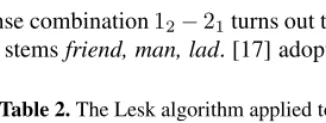
[image:5.512.132.295.378.439.2]In Table 2, we present the results of the Lesk algorithm applied to this word pair. The overlaps are counted on the basis of stems because the German language is highly inflected. The sense combination12−21turns out to be the best fitting one resulting in three overlaps of stems friend, man, lad. [17] adopts the algorithm by Lesk and apply
Table 2. The Lesk algorithm applied to “Bruder–Bursche”
Sense combin. Stem overlaps Score
11−21 m¨annlich, Person 2
11−22 – 0
12−21 Freund, Mann, Bursch 3
12−22 Bursch 1
it to the task of computing semantic relatedness of WordNet concepts. Their metric is based on the number of shared words in the glosses of concepts available through WordNet. They extend the metric to include the glosses of other concepts, to which they are related according to the WordNet hierarchy. Those are encoded in WordNet as semantic relations, but can be found in any dictionary via synonyms, antonyms, and see-also references. The relatedness scorerelw1,w2 is formally defined in Equation 3:
relc1,c2 =
score(R1(c1), R2(c2)) (3) wherec1andc2are the compared word senses,Ris a set of lexical semantic relations,
score()is a function which receives the definitions of word senses and their related 1
concepts and returns a numeric score of word overlaps in them. [17] reports a correla-tion of .67 to the Miller and Charles human study, and one of .60 to the Rubenstein and Goodenough’s experiment, which is below the performance of other semantic related-ness metrics reported in [2]. E.g. the metric by Resnik yielded a correlation of .774 and .779 on the datasets respectively.
4
Experimental Work
In this section, we detail the process of generating artificial glosses from GermaNet. We discuss the set of parameters, their consequences for the creation of glosses and the application of artificially generated glosses to the task of computing semantic relat-edness. The evaluation, then, measures the performance of semantic relatedness algo-rithms based on pseudo glosses with respect to human judgments of semantic ness. We apply the Lesk algorithm to pseudo glosses and compute a semantic related-ness score for each sense combination of a word pair. The scores are related to average human ratings by means of interclass correlation analysis.
As no datasets for evaluating semantic relatedness are available, we translated 65 word pairs from the dataset by [4] to German. Their word pairs were selected to cover a range of semantic distances. We asked 24 subjects (native speakers of German) to rate the word pairs on the scale from 0 to 4 for their semantic relatedness. Semantic relatedness was defined in a broader sense than just similarity. To determine the up-per bound of up-performance for automatic semantic relatedness metrics, we computed a summarized correlation coefficient for a set of 24 judges. This means that we com-puted correlations for all judges pairwise, transformed them to a Z-score, comcom-puted the average and transformed back to a correlation coefficient yielding r = .8098, which is statistically significant at p = .01. The evaluation results for relatedness metrics are reported on the basis of 57 from 65 word pairs in the test dataset com-pared with average human judgments. The remaining words were not covered in GermaNet.
4.1 Experiment 1
We evaluated different methods to generate pseudo glosses according to the parameters: lexical semantic relations and size. The range of values for size was set from 2 to 6. The four system configurations for generating pseudo glosses were the following:
1. a radial gloss based on all types of lexical semantic relations in GermaNet; 2. a hypernymy gloss based exclusively on the hypernymy relation;
3. a hyponymy gloss utilizing the hyponymy relation only;
4. a gloss consisting of coordinate sisters of a given concept, i.e. the immediate hy-ponyms of the concepts’ hypernyms.
structural components of conventional glosses more accurately. In Examples 1 and 2, we hardly find hyponyms in the definitions. At the same time, e.g. Lausbube would be included in the gloss as a hyponym and Boy as a coordinate of Bursche. Summarizing this experiment, we conclude that the information on hyponymy and coordinate word senses for computing semantic relatedness is not very relevant. The remaining system configurations will be further analyzed in the following.
4.2 Experiment 2
The aim of the experiment was to examine the performance of radial glosses under different experimental conditions. We observed that many high scores of semantic re-latedness were caused by a large number of hyponyms that some of the words, e.g. Edelstein (Engl. gem) and Juwel (Engl. jewel) have. Due to this effect, e.g. atsize= 3, the number of overlaps for radial glosses increases to 199, whereas it is only 7 for hy-pernym glosses. As there exist no well-defined guidelines or criteria as to what number of hyponyms a synset should have, it is rather arbitrary and heavily skews the distribu-tion of semantic relatedness scores.
Another parameterone sense per synset(OSPS) controls whether all of the word senses belonging to a synset are included in a pseudo gloss or only one. The motiva-tion to investigate this effect is similar to the one described previously, i.e. the number of synonyms (word senses) for a given synset is arbitrary. This means that counting overlaps according to the Lesk algorithm will “favour” those word pairs, whose synsets have a large number of word senses.
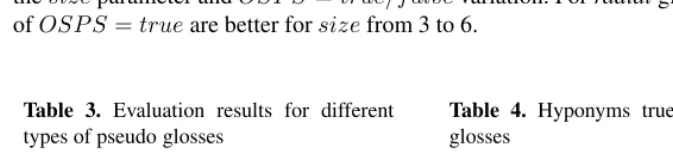
Table 4 shows the results of thehyponyms=true/f alseparameter variation. We also varied thesizewhileOSP S was set to true and false. The data makes evident that ignoring hyponyms in generating pseudo glosses consistently improves the perfor-mance. It eliminates the bias in the counts of overlaps due to hyponyms, which do not skew the overall distribution of scores any more. Table 5 further explores the effects of thesizeparameter andOSP S=true/f alsevariation. For radial glosses, the results ofOSP S=trueare better forsizefrom 3 to 6.
Table 3. Evaluation results for different types of pseudo glosses
[image:7.512.44.381.471.551.2]Config.Size=2 Size=3 Size=4 Size=5 Size=6 1 .3885 .4570 .4377 .4027 .4021 2 .5936 .6350 .6682 .6072 .6279 3 .3167 .3296 .3244 .3322 .3538 4 .3140 .2560 .2474 .2062 .1305
Table 4. Hyponyms true/false for radial glosses
Hypo true Hypo false OSPS true, size 1 .3939 .4513 OSPS true, size 2 .4235 .5494 OSPS false, size 1 .3885 .4945 OSPS false, size 2 .4570 .5567
4.3 Experiment 3
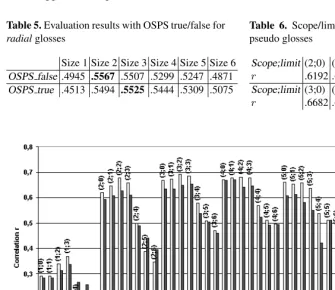
false in glosses, the use and interaction of size and limit as well as the optimal set-tings for those. The results of this experiment are presented in Figure 1, which shows the correlation values for different combinations of size and limit settings. The value
OSP S =trueleads to consistently better results for the parameter combinations of size and limit. Furthermore, the performance of the system rapidly drops for the limit range [4,6]. However, the use of limit is generally justified as it improves the perfor-mance forsize= 2andsize= 3. At these points the performance is most optimal, s. Table 6 for exact results.
[image:8.512.49.385.247.537.2]If neither size nor limit are in use (which corresponds to the case when all hy-pernyms of a concept become part of the gloss), the correlation drops to .568. These parameters, therefore, turn out to be necessary to control the choice of concepts in a gloss. As a consequence, the most abstract (close to the root) concepts of the hierarchy will not appear in the gloss.
Table 5. Evaluation results with OSPS true/false for radial glosses
Size 1 Size 2 Size 3 Size 4 Size 5 Size 6 OSPS false .4945 .5567 .5507 .5299 .5247 .4871 OSPS true .4513 .5494 .5525 .5444 .5309 .5075
Table 6. Scope/limit in hypernym pseudo glosses
Scope;limit (2;0) (2;1) (2;2) (2;3)
r .6192 .6456 .6768 .6581 Scope;limit (3;0) (3;1) (3;2) (3;3)
r .6682 .6735 .6914 .6842
5
Evaluation Summary
To our knowledge, no datasets are available for validating the results of semantic re-latedness metrics.2 The results obtained for semantic similarity with WordNet are not
directly comparable due to differences in the underlying knowledge bases, and – most importantly – in the task definition (changed from similarity to relatedness). The dataset designed during the present study is based on the German language. We opted for Ger-maNet as the underlying semantic network. Testing the results of metrics for another language, e.g. English, would involve an experiment with native speakers to collect judgments of semantic relatedness and employing an appropriate semantic resource for the chosen language and the domain of interest. However, our evaluation results can be extrapolated to other languages and similar semantic resources, as semantic related-ness metrics themselves are not tied to a particular language or resource. Experimental verification of this fact remains beyond the scope of our paper.
To better understand the performance of the semantic relatedness metrics, we de-signed and implemented several baselines. The first baseline compares the performance of our system to the original version of the Lesk algorithm operating on the glosses from traditional dictionaries written by human authors. As GermaNet itself does not contain a sufficient number of textual definitions of word senses, they were retrieved from the Digital Dictionary of the German Language.3 We excluded all additional
information from definitions, such as citations and examples of usage. The remain-ing “pure” definitions were stemmed. The resultremain-ing correlation with human judgments yieldedr=.5307.
The second baseline for the evaluation was represented by word co-occurrence counts obtained by means of querying the Web through Google. This baseline is based on the assumption that the Web can be used as a corpus. [18] provide estimates of the Web size in words, as indexed by Altavista, for the German language: 7,035,850,000. This exceeds the size of freely available German corpora by a large margin. We con-structed Google queries, where the query string was represented by a particular word pair. Semantic relatedness of words was, then, computed according to Equation 4, where
hitsw1andhitsw2are the frequencies of wordsw1andw2. The correlation of Google based results with human judgments of semantic relatedness was .5723, which is quite impressive if we consider that the method does not employ any sophisticated knowledge sources. It should be noted that we tried several other established measures of lexical association, e.g. PMI and log-likelihood on Google counts, but the results were worse than those achieved by Equation 4.
simw1,w2=hitsjoint/hitsw1+hitsjoint/hitsw2 (4) The third baseline is a conventional approach by [8] to compute semantic related-ness via the information content of the lowest common subsumer of the two concepts. Information content of concepts was calculated on the basis of a German newspaper corpus with 172 million tokens (www.taz.de).
2
English datasets were designed with semantic similarity in mind as described in Section 4. 3
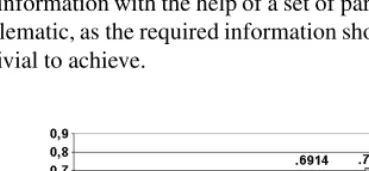
In Figure 2, we summarize the results of our experimental work. These results are based on the most optimal system configurations as described in Section 4:OSP S =
true,hyponyms = f alse,size = 3for radial glosses,OSP S = true,size = 4,
limit= 2for hypernym glosses. The results show that radial pseudo glosses perform approximately on the same level (r=.5525) as the stemmed glosses created by humans (r = .5307). This suggests that radial pseudo glosses mimic the behavior of “real” glosses rather well. Hypernym pseudo glosses outperform their radial counterparts and both the Lesk and the Google based baselines by a large margin, yieldingr =.6914. Their performance is comparable to that of a conventional method by [8] based on external corpus evidence (r=.7152).
[image:10.512.131.316.325.410.2]As the method operates exclusively on pseudo glosses generated on the basis of the hypernymy relation, this type of information from definitions turns out to be the most important one for computing semantic relatedness. In other words, definitio per genus proximum is superior to definitio per differentia specifica in this task. It should be noted that the situation can change for different types of tasks where the knowledge from a conceptual network is employed, e.g. in word sense disambiguation. As opposed to using textual definitions from traditional dictionaries, generating them automatically from a conceptual network has a great advantage: we can easily control the usage of specific types of information with the help of a set of parameters. In naturally occurring texts, this is problematic, as the required information should be first extracted from free text, a task not trivial to achieve.
Fig. 2. A summary of evaluation results
If compared to results reported for the task of computing semantic similarity on the basis of WordNet, we note that our numbers are lower due to a number of reasons:
– The upper bound for the performance of computational algorithms is lower for our
task (r=.8089) as the one given by [8] (r=.8848). Semantic relatedness is not as well defined as semantic similarity. The results have to be interpreted according to this lower upper bound.
– The performance of the metrics is dependent on the underlying knowledge base,
6
Conclusions
We proposed a method to generate artificial definitions of concepts from a concep-tual network. The method was applied to the task of computing semantic relatedness of words and tested on the basis of word senses defined in GermaNet. This approach bridges the gap between gloss based algorithms and the cases, when textual defini-tions of concepts are not available. This is the case for languages, which do not have well developed machine readable dictionaries, and in many applications which do have domain-specific taxonomies, but no additional descriptions of concepts. The main idea is to compensate for the lack of definitions in a conceptual hierarchy by generating a textual definition of the concept automatically from a knowledge base. NLP applica-tions can then employ the resulting glosses.
We have restricted ourselves to nouns in this work, since this part of speech is very important in NLP and thus represents a good starting point. However, the metrics are applicable to other parts of speech represented in a conceptual network. The results of a semantic relatedness metric operating on automatically generated glosses correlate very well with human judgments of semantic relatedness. The metric performs significantly better than the Lesk algorithm itself, employing a traditional dictionary, and the baseline based on word co-occurrences in Web pages (Google hits). It performs on the same scale as the information content based metric, while no additional processing of corpus data is necessary.
We expect to enhance the work presented here in a number of respects. First of all, we are working on a considerably larger dataset including 350 word pairs with corresponding semantic relatedness judgments. The word pairs involve not only nouns, but verbs and adjectives as well. The reliability of human judgments as well as the performance of semantic relatedness metrics based on the new dataset remain to be studied. Also, we have to find our what kind of modifications may be necessary to make the metrics applicable across different parts-of-speech.
Acknowledgments
This work has been funded by the Klaus Tschira Foundation. I would like to thank Hendrik Niederlich who contributed implementations as a part of an internship and Michael Strube for his valuable comments concerning draft versions of this paper.
References
1. Lesk, Michael: Automatic sense disambiguation using machine readable dictionaries: How to tell a pine cone from an ice cream cone. In Proceedings of the 5th Annual International Conference on Systems Documentation, Toronto, Ontario, Canada, June, 1986, pages 24– 26.
2. Hirst, Graeme and Budanitsky, Alexander: Correcting real-word spelling errors by restoring lexical cohesion. In Natural Language Engineering, 11(1):87–111, 2005.
4. Rubenstein, Herbert and Goodenough, John: Contextual Correlates of Synonymy. In Com-munications of the ACM, 8(10), 1965, pages 627–633.
5. Miller, George A. and Charles, Walter G.: Contextual correlates of semantic similarity. In Language and Cognitive Processes, 6(1), 1991, pages 1–28.
6. Leacock, Claudia and Chodorow, Martin: Combining local context and WordNet similarity for word sense identification. In Fellbaum, Christiane (Ed.) WordNet: An Electronic Lexical Database, Cambridge: MIT Press, 1998, pages 265–283.
7. Seco, Nuno and Veale, Tony and Hayes, Jer: An Intrinsic Information Content Metric for Se-mantic Similarity in WordNet. In Proceedings of the 16th European Conference on Artificial Intelligence, Valencia, Spain, 22–27 August 2004, pages 1089–1090.
8. Resnik, Phil: Using information content to evaluate semantic similarity in a taxonomy. In Proceedings of the 14th International Joint Conference on Artificial Intelligence, Montr´eal, Canada, 20–25 August 1995, Volume 1, pages 448–453.
9. Jiang, Jay J. and Conrath, David W.: Semantic similarity based on corpus statistics and lex-ical taxonomy. In Proceedings of the 10th International Conference on Research in Compu-tational Linguistics (ROCLING), Tapei, Taiwan, 1997.
10. Lin, Dekang: An information-theoretic definition of similarity. In Proceedings of the 15th International Conference on Machine Learning, San Francisco, Cal., pages 296–304, 1998. 11. Patwardhan, Siddharth and Banerjee, Satanjeev and Pedersen, Ted: Using measures of
se-mantic relatedness for word sense disambiguation. In Proceedings of the Fourth International Conference on Intelligent Text Processing and Computational Linguistics, Mexico City, Mex-ico, pages 241–257, 2003.
12. Ekedahl, Jonas and Golub, Koraljka: Word Sense Disambiguation using WordNet and the Lesk algorithm, http://www.cs.lth.se/EDA171/Reports/2004/jonas koraljka.pdf, 2004. 13. Vaknin, Sam: The definition of definitions, http://samvak.tripod.com/define.html, 2005. 14. Kunze, Claudia: Lexikalisch-semantische Wortnetze. In Carstensen, K.-U. and Ebert, C. and
Endriss, C. and Jekat, S. and Klabunde, R. and Langer, H. (eds.) Computerlinguistik und Sprachtechnologie. Eine Einf¨uhrung. Heidelberg, Germany: Spektrum Akademischer Ver-lag, 2004, pages 423–431.
15. Fellbaum, Christiane (Ed.): WordNet: An Electronic Lexical Database. MIT Press, Cam-bridge, Mass., 1998.
16. Kunze, Claudia and Lemnitzer, Lothar: GermaNet - representation, visualization, applica-tion. In Proceedings of the International Conference on Language Resources and Evaluation (LREC), Las Palmas, Canary Islands, Spain, 29 - 31 May, 2002, pages 1485-1491. 17. Banerjee, Satanjeev and Pedersen, Ted: Extended gloss overlap as a measure of semantic
relatedness. In Proceedings of the 13th International Joint Conference on Artificial Intelli-gence, Chambery, France, 28 August – 3 September, 1993.