Pattern formation by evaporative drying of
colloidal solutions
by Haye Witteveen
Supervisors:
M.Sc. Robin P. Berkelaar
Dr. James R.T. Seddon
Committee:
M.Sc. Robin P. Berkelaar
Dr. James R.T. Seddon
Abstract
Tabel of Contents
Chapter 1: Introduction...1
Chapter 2: Theory, setup and procedures...2
2.1 Theory
2.1.1 Coffee stain effect...2
2.1.2 Van der Waals and electrostatic forces..……...2
2.1.3 Droplet on an angle...4
2.2 Experimental aspects……….5
2.3 Atomic Force Microscope
2.3.1 Equipment...6
2.3.2 Measuring Technique...7
Chapter 3: Data analysis tools………..8
3.1 Picosync...8
3.2 Matlab program...8
3.3 Clustering Parameter...12
3.4 Simulation...13
3.5 Real histogram data...18
Chapter 4: Results...22
Chapter 5: Conclusions...25
Chapter 6: References……….26
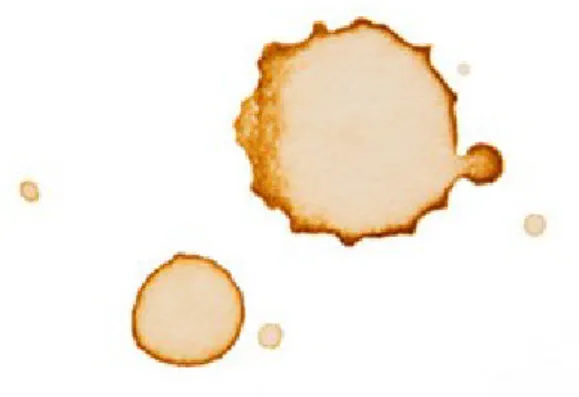
When a colloidal suspension dries up, it usually leaves a dark ring on the perimeter of the stain, where particle concentration is highest, even though the particles were uniformly dispersed in the liquid before drying. This effect is known as the coffee stain effect (figure 1) [1-6]
Figure 1: Some coffee stains, which have a distinctive darker color on the perimeter, suggesting higher concentrations of particles there.
Controlling the distribution of particles during drying is very important in many industrial and scientific processes. In many applications, the inhomogeneous distribution of particles as observed in the coffee stain effect is undesired, such as in inkjet printing, spotting of biofluids, and coating technology. [7,8]
Research on colloidal particles up to now has mainly focused on particles with diameters of several micrometers. However, in this report, particles with diameters of up to 300 nm are used. The main goal is to determine the dependency of different variables, such as
2 Theory, Setup and procedures
2.1 Theory
2.1.1 Coffee stain effect
When a drop of liquid is deposited on a surface, there are two ways it can dry up: either the contact angle remains the same and the drop just shrinks in size (figure 4a) or its contact line is pinned and only the height of the drop changes (figure 4b).
Usually, the pinned contact line is the dominant process, and will dictate how the drop dries up. This is because of the roughness of the surface. Only a little roughness is enough to keep some of the liquid in its place. In later stages however, there is not enough liquid left to replenish what is lost at the edges, and the radius of the drop will shrink as well.
Figure 4: a) Different stages of drying for a drop of liquid. At successive times the drop shrinks in size. b) Different stages of drying for a drop of liquid, with the contact line pinned. At successive times, the height of the drop shrinks, but the perimeter stays at
the same location.
A pinned contact line results in the coffee stain effect. At the contact line, there is less liquid then in the center of the drop. However, the amount of liquid that evaporates is higher at the contact line. This would imply that the drop would disappear at the contact line before all the liquid in the center is evaporated, and that the radius of the drop would shrink, but this is not the case. To prevent the radius of the drop from shrinking, liquid must flow outwards from the center of the drop to replenish lost liquid at the contact line.[1]
This capillary flow is what causes the coffee stain effect: the particles in the liquid get dragged along with the flow, and get deposited at the perimeter of the droplet when all the liquid evaporates. This high concentration of particles is what leaves the dark ring around the perimeter, and is what is known as the coffee stain effect. [9]
2.1.2 Van der Waals and electrostatic forces.
For the dilutions of polystyrene nanoparticles (PSLnp) that are made, exactly one drop of PSL from the bottle it is delivered in is used. Assuming every drop has the same size, the weight of one drop was measured and determined at .0340 gram. 1% of this mass is PSL. The density of the PSL is 1.05 g/ml [10] The PSLnp are almost perfectly spherical, and its radius is known, so we can calculate the mass of a single particle. From this we can determine the number of particles in one drop:
(1)
Here N is the number of particles in a single drop, M the total mass of the PSL in the drop, v the volume of a single particle and ρ the density of PSL. For 150 nm particles N=1.8*1011, and
for 300 nm particles N=2.3*1010. The particles are diluted in
Isopropyl alcohol (IPA). If we call the volume of IPA we use V, we have:
(2)
If we now assume the particles are in a cubic formation in the suspension, the distance between two particles d can now be calculated by:
(3)
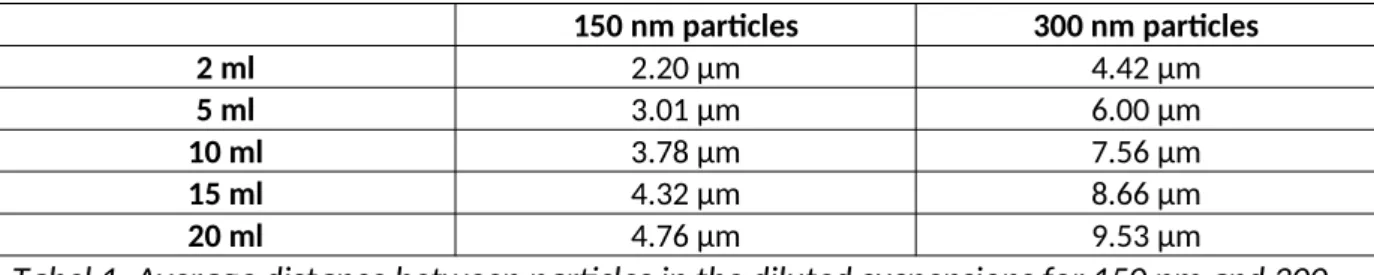
In table 1, d is shown for particle sizes and dilutions used in this report.
150 nm particles 300 nm particles
2 ml 2.20 μm 4.42 μm
5 ml 3.01 μm 6.00 μm
10 ml 3.78 μm 7.56 μm
15 ml 4.32 μm 8.66 μm
20 ml 4.76 μm 9.53 μm
Tabel 1: Average distance between particles in the diluted suspensions for 150 nm and 300 nm particles.
Van der Waals forces only act when the separation distances are of nanometer scale.
The average separation distance however is much higher. This would suggest that there is no clustering prior to drying. This is however an average separation distance. Since the particles undergo Brownian motion, there will be some clustering.
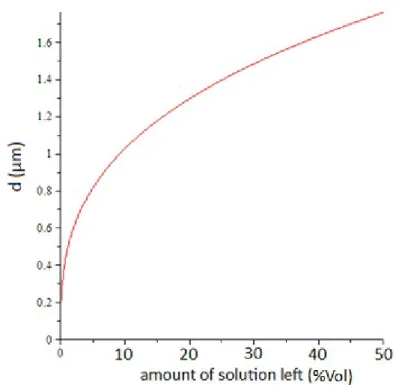
Figure 5: Average separation distance d for 150 nm particles in 2 ml IPA while drying. Only with a few percentages left does the distance become small enough for Van der Waals forces
to attract the particles to each other.
As can be seen, the average
separation distance is only small enough for the Van der Waals
forces to act on the particles when only a few percentage of the solution is left after drying. However, due to the coffee-stain effect, the distance between particles on the edge is much smaller than this, because the concentration of particles is higher than average there. Therefore, we would expect much more clustering at the edge than at the middle of a droplet.
2.1.3 Droplet on an angle
Part of the samples is dried under an angle. Before drying, the shape of the droplet is not symmetrical, but more liquid is on the lower end of the sample, as shown in figure 6.
The particles in the solution will stay evenly distributed throughout the droplet. When the droplet dries, the contact line stays pinned. Since there is more liquid on the lower end, there should be a bigger flow of liquid to the higher end compared to the flow to the lower end to compensate for the liquid lost by evaporating. Whether this will have an effect on clustering will also be investigated in this report.
2.2 Experimental aspects
The PSLnp are available in solution, where 1 mass% of the solution is PSL. Without diluting the solution, drying them will result in multilayers, and since colloidal forming is studied, the solution will therefore have to be diluted. A commonly used solvent, IPA is used for this. Because it’s highly volatile, it will make sure the droplets with the colloids will dry fast. One drop of PSLnp, which is 0.0340 ml, is diluted in 2, 5, 10, 15 and 20 ml of IPA. After diluting the solution, it is put in an ultrasonic bath for five minutes for evenly distribution of the particles.
Silicon wafer is used as a surface for the PSLnp to dry on. The wafer is broken in small pieces of approximately 1x1 cm². The size is arbitrary and only has to be big enough so that the droplet with PSLnp will dry in a circular pattern, without touching the edges of the silicon. , as shown in figure 7.
Figure 7: The droplet on the silicon waver pieces, without touching the edges.
The different concentrations are put on the silicon pieces right after the ultrasonic bath, to make sure they have as little time to form aggregates as possible. A pipette is used to deposit 1 µl onto the surface. The resulting droplet on the silicon surface is approximately 5-6 mm in diameter.
Samples are made with PSLnp diameters of 150 and 300 nm. For the 150 nm particles, samples were also made with the same concentration, but which were left to dry under an angle of 15° (Figure 8)
Figure 8: Schematic drawing of the drying of the samples. One sample is just lying flat, while the other is drying under an angle of 15°.
For each of the 150 and 300 nm PSL samples, two images were made in the center of the droplet, and two at approximately 1 mm from the edge. For the 150 nm PSL samples which were left to dry under an angle, two images were made at the top, bottom and center of the drop. The images at the edges were taken again approximately 1 mm from the edge itself.
2.3 Atomic Force Microscope
2.3.1 Equipment
The atomic force microscope (AFM) which is used is an Agilent 5100, as can be seen in figure 2. For measuring the samples, at first NSC35 cantilevers were used with a force constant ranging from 4.5 to 14 N/m. Due to logistic problems, later on NSC36where used, which have a lower force constant of approximately 1.75 N/m. Larger force constants are more favorable for these measurements, because they are more rigid and therefore more
accurate. The AFM is put in an acoustically damped while measuring, to minimize the noise level. The AFM is computer controlled by PicoView 1.10 software.
2.3.2 Measuring Technique
Because the particle dimensions are much smaller than the wavelength of light, it is not possible to use optical microscopes to see the particles. Therefore, an atomic force microscope (AFM) will be used.
An AFM uses a tip to probe a surface. A laser beam shines on top of the tip, and is reflected to a matrix of four photodiodes via a mirror (figure 3). When the tip touches the surface, it will deflect and the laser beam will hit the photodiodes in a slightly different place. The photodiodes then convert this deflection in an electrical signal to be processed.
There are two modes in which an AFM is conventionally used. These are contact mode and tapping mode. In contact mode, the tip is continuously in contact with the surface. The tip’s movement in the vertical direction is then used to map the surface. In tapping mode, the tip oscillates vertically, and will interact with the surface if it gets close enough, due to Van der Waals forces, electrostatic forces, etc. This interaction will decrease the amplitude of the oscillation. The change in amplitude is then used to map the surface.
3 Data analysis tools
3.1 Picosync
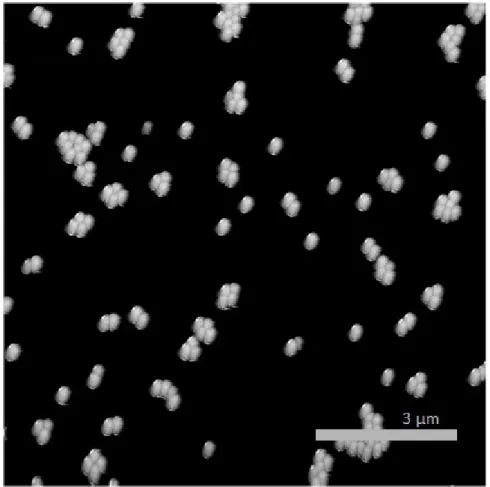
The data extracted from the AFM is a large matrix with x,y, and z-coordinates from the surface. Plotting these coordinates will give an image AFM image, as seen in figure 9. This data is first corrected with PicoSync software, which is included in PicoView. Here the image is leveled to compensate for a tilted surface. This leveled image is then ready to be analyzed.
Figure 9: A typical image plotted from the data extracted from the AFM, after leveling with PicoSync.
3.2 Matlab Program
With the particles separated, the program can then find and select the centers of all the particles. Often it is not possible to find a perfect threshold value, so one is chosen so that as many particles as possible are recognized by the program (figure 11c). After that, it is
possible to select the remaining particles by hand (figure 11d). The coordinates of the centers of the particles are now saved in a matrix, and can be used for further analysis.
Figure 11: a) The original image, plotted with the raw data from PicoSync software. b) The black and white image, where all the individual particles are separated. c) The red dots represent the centers of the images recognized by the Matlab program. d) The green dots represent the centers of the images that are hand selected.
To analyze the results, a parameter describing clustering is used. This parameter is dependent on both the amount of particles that are clustered, and on the amount of clusters. Clustering is obviously higher when more particles are clustered, but lower when the same amount of particles is clustered but divided into more clusters.
The histograms provided by the Matlab analysis give the information needed to describe clustering. The histograms show the count of certain distances between the particles. When two particles are clustered, their centers are one particle diameter apart, and the histogram will therefore show a peak at a distance of 1 particle diameter if there is any clustering to be seen on the image. And this peak will be higher when more particles are clustered.
The histogram also shows a peak at a distance of zero. This is because Matlab also takes into account the distance of the particle with itself, which is always zero. It does this for every particle, and therefore the height of this first peak is just the number of particles.
Now say there are six particles clustered. Two clusters of two particles are less clustered than one cluster of four particles. This is also represented in the second peak at a distance of 1 particle diameter on the histogram, and this can be seen in figure 13.
Figure 13: On the left, two clusters with two particles, on the right, one cluster with four particles
The left side has two distances between particles which are one diameter. Because it is counted for one particle to the other, and vice versa, this would give a peak of 2x2=4 high. The right side has four distances of 1 diameter. Again counting everyting twice, this would give a peak of 8 high.
So our peak in the histogram at one particle diameter is higher when more particles are clustered, and becomes lower when the clustered particles are spread out between more clusters. We therefore define our clustering parameter C as:
(4)
For the particles in figure 13, C=1 for the configuration on the left, and C=2 for the one on the right.
particle would have six nearest neighbors. This would give a theoretical maximum clustering factor of 6. In practice, clusters have borders where the particles have less particles touching them, so for a finite sized cluster, the clustering factor can only approach a value of six.
3.4 Simulation
To check the accuracy of our Matlab program, some simulations are done. Few enough particles are used so that the histogram can be build up by hand, and can then be compare to the histogram Matlab provides, when the coordinates for the centers of the particles are selected by hand.
First the line of six particles is examined. In figure 14 the center-to-center distances are drawn into the figure.
Figure 14: A line of six particles. d1 shows the center-to-center distances of one particle diameter; d2 shows the same for two particle diameters.
As can be seen, there are five center-to-center distances with a distance of one particle diameter. Everything is counted double, again because Matlab counts from one particle to the other and vice versa, so the peak at a distance of one particle diameter will be 10. A distance of two particle diameters appears four times. Again doubling this should give a peak of 8 at a distance of two particle diameters. In the same way, it is easy to see that for three particle diameters, it should show a peak with height of 6. For a distance of four diameters, we get a peak of height 4, and for the largest distance of five particle diameters, it should give a peak of height 2. This is all in agreement with the histogram data calculated with matlab, which is shown in fig 17a. The figure also includes a peak at zero, which is again the distance with the particle itself, and therefore this peak shows the number of particles.
Figure 15: A 3x3 square of particles, with all the unique distances shown.
The smallest distance is the distance between two neighboring particles. First ignoring the particle in the middle, each particle has two neighbors. Eight particles then give a peak of 16. The middle particle has 4 neighbors, and they all count twice again (from the middle to the edge, and from the edge to the middle), so this gives a peak of 8. Combining these two gives a peak of 24 at a distance of one particle diameter.
The second peak is at
√
2 particle diameters, which are all the particles which are diagonally the closest. The particles on the corners all have one particle at a distance√
2 particle diameters, the particles on the middle of the edge all have two, and the particle in the middle has four particles at this distance. This gives a peak of 4∙1+4∙2+1∙4=16.Then there is a peak at a distance of two particle diameters. Only the particles on the corner have particles at this distance, and they all have two, so this peak should give 4∙2=8.
Then there is a peak
√
5, which corrosponds to the particles which are a chess knight’s jump away from each other; or ‘two particles to the side and one vertically’. This distance is only possible between corner particles and middle-edge particles, and they all have two particles at that distance, so this peak should have a height of 8∙2=16.The last peak is at 2
√
2, which are the corner particles farthest away from each other. Each corner particle has one other particle at this distance, so this peak should give a height of 4.Again, this is all in agreement with the histogram provided by the Matlab program.
The last one is a hexagon shape, which is the closest packed structure. This has only three unique distances, as seen in figure 16.
Figure 16: A single hexagon with all the unique distances shown.
The next peak is at
√
3, which is the second smallest distance. Every outer particle has two particles on this distance, and the peak will therefore give 6∙2=12.The last peak is at a distance of 2 particle diameters, which are the particles which are separated by exactly one particle. Every outer particle has one particle at this distance, and the peak should give 6.
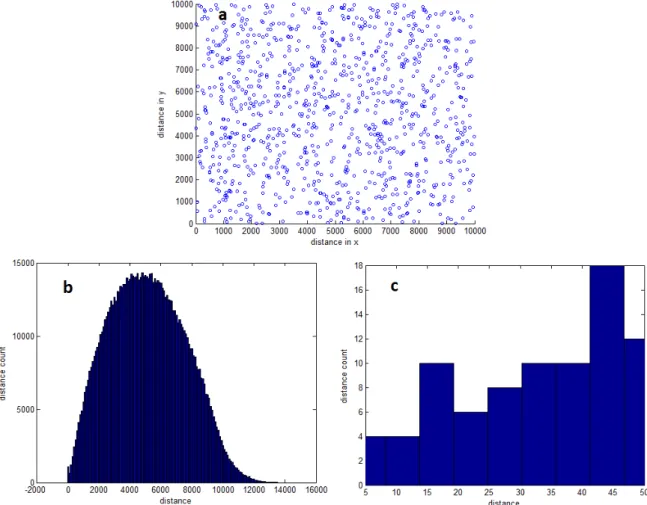
The last simulation is done to see how a histogram for randomly distributed particles works. For this, Matlab is used to randomly generate x- and y-coordinates for 1000 particles on a grid of 10,000 by 10,000. More particles would take too much effort for Matlab to calculate all the particle to particle distances. The plot and the histogram data coming from these randomly generated particles can be seen in figure 18.
Figure 18b can be used to compare to histogram data from the images of the particles that are made for this report. In figure 18c, you can see that there are no significant peaks at short distances. From this we know that if there are peaks in the histogram for short distances, this would mean the particles are not randomly distributed, and we can explain those peaks by the clustering of the particles.
3.5 Real histogram data
Figure 19a shows an image where most of the particles are clustered on the left side of the image. This can also be seen in the histogram data for this image as shown in 19b.
Figure 20 shows an image with little clustering, and the histogram calculated with Matlab for the image. There are three clusters in the image, which corresponds to the peak at 1 particle diameter in the histogram. The cluster with four particles would give a peak with height 12, and the small clusters of two both give a peak of two. All three combined gives a peak of 16. Adding the three peaks shown in figure 19b, indeed gives a peak of height 16.
Figure 20: a) 150 nm particles diluted in 15 ml IPA. The clusters are encircled. b) The
histogram data calculated from the picture in a. To the left of each particle small, dark grey spots can be observed. These are tip images resulting from the shape of the tip, and do not show actual particles at those locations.
4 Results
For all the samples with 150 and 300 nm particles, the number of particles and the clustering parameter are determined. The results can be seen in figure 22&23. Because not all particles are exactly the same size, and because Matlab does not always select exactly the center of the particles, all histogram bins with distances of 0.8 to 1.2 times the particle size were added to determine the height of the second peak.
There is no data available for the 300 nm particles at the middle of the sample, because there were not enough particles to be found there for any clustering to occur. Also, at 20 ml IPA, there were hardly any particles to be found for this particle size at all.
From these graphs, it looks like clustering is seen more with the 300 nm particles, except for the 2 ml sample with 150 nm particles on it, which has the highest clustering factor found. Since the samples with 150 nm particles on it have much more particles, one might expect the chance of two particles finding each other to be much higher, especially since it seems that clustering occurs when the solution is almost entirely dried up. Particles will have higher velocities and are more prone to colliding.
The 150 nm particles that were dried on a skewed surface seem to behave more as expected. The number of particles per sample decrease with higher dilutions more clearly compared to the particles dried on a flat surface. It is also interesting to see that especially with particle numbers, there is little difference in the top and bottom of the sample. The amount of clustering does vary more, however there is no trend indicating clustering is higher or lower on either position.
5 Conclusions
In this report, it is observed that clustering does occur with nanoscale particles in solution. Not only that, it is also possible to determine how much clustering occurs, using the clustering factor.
Using this clustering factor, it can be seen that clustering for 150 and 300 nm particles with the same concentration of PSL do not differ much, suggesting it is the concentration of PSL that determines the amount of clustering, not the amount of particles. It can also be seen that clustering is higher with higher concentration.
Not much difference can be seen between samples that were dried on a skewed surface and those that were dried on a flat surface. However, this was only tested on a single angle.
6 References
[1] R. D. Deegan, O. Bakajin, T. Dupont, G. Huber, S. Nagel, and T. Witten, 1997, Capillary flow as the cause of ring stains from dried liquid drops, Nature 389, p. 827.
[2] R. D. Deegan, O. Bakajin, T. Dupont, G. Huber, S. Nagel, and T. Witten, Contact line deposits in an evaporating drop, 2000, Phys. Rev. E 62, p. 756.
[3] H. Hu and R. G. Larson, Analysis of the Microfluid Flow in an Evaporating Sessile Droplet, 2005, Langmuir 21, 3963.
[4] Y. O. Popov, Evaporative deposition patterns: Spatial dimensions of the deposit,2005 Phys. Rev. E 71, 036313.
[5] H. Bodiguel and J. Leng, Imaging the drying of a colloidal suspension, 2010, Soft Matter 6, 5451.
[6] H. B. Eral, D. M. Augustine, M. H. G. Duits, and F. Mugele, Suppressing the coffee stain effect: how to control colloidal self-assembly in evaporating drops using electrowetting, 2011, Soft Matter 7 (10), p. 4954-4958.
[7] E. Tekin, P. J. Smith and U. S. Schubert, Inkjet printing as a deposition and patterning tool for polymers and inorganic particles, 2008 Soft Matter, 4, p. 703.
[8[ R. G. Larson, Re-shaping the coffee ring, 2012, Angewandte Chemie-International Edition, Vol 51, Issue 11, p. 2546–2548,
[9] A.G. Marín, H. Gelderblom, D. Lohse, and J.H. Snoeijer, Order-to-disorder transition in ring-shaped colloidal stains, 2011, Phys. Rev. Lett. 107, 085502.
[10] PSL Spheres 20nm to 1μm, NIST Traceability Size Accuracy, 2007,