by Arthur Kurzweil
The Torah
FOR
The Torah For Dummies®
Published by
Wiley Publishing, Inc.
111 River St.
Hoboken, NJ 07030-5774
www.wiley.com
Copyright © 2008 by Wiley Publishing, Inc., Indianapolis, Indiana Published simultaneously in Canada
No part of this publication may be reproduced, stored in a retrieval system, or transmitted in any form or by any means, electronic, mechanical, photocopying, recording, scanning, or otherwise, except as permitted under Sections 107 or 108 of the 1976 United States Copyright Act, without either the prior written permis-sion of the Publisher, or authorization through payment of the appropriate per-copy fee to the Copyright Clearance Center, 222 Rosewood Drive, Danvers, MA 01923, 978-750-8400, fax 978-646-8600. Requests to the Publisher for permission should be addressed to the Legal Department, Wiley Publishing, Inc., 10475 Crosspoint Blvd., Indianapolis, IN 46256, 317-572-3447, fax 317-572-4355, or online at http://www.wiley. com/go/permissions.
Trademarks:Wiley, the Wiley Publishing logo, For Dummies, the Dummies Man logo, A Reference for the Rest of Us!, The Dummies Way, Dummies Daily, The Fun and Easy Way, Dummies.com and related trade dress are trademarks or registered trademarks of John Wiley & Sons, Inc. and/or its affiliates in the United States and other countries, and may not be used without written permission. All other trademarks are the property of their respective owners. Wiley Publishing, Inc., is not associated with any product or vendor mentioned in this book.
LIMIT OF LIABILITY/DISCLAIMER OF WARRANTY: THE PUBLISHER AND THE AUTHOR MAKE NO REP-RESENTATIONS OR WARRANTIES WITH RESPECT TO THE ACCURACY OR COMPLETENESS OF THE CONTENTS OF THIS WORK AND SPECIFICALLY DISCLAIM ALL WARRANTIES, INCLUDING WITHOUT LIMITATION WARRANTIES OF FITNESS FOR A PARTICULAR PURPOSE. NO WARRANTY MAY BE CRE-ATED OR EXTENDED BY SALES OR PROMOTIONAL MATERIALS. THE ADVICE AND STRATEGIES CON-TAINED HEREIN MAY NOT BE SUITABLE FOR EVERY SITUATION. THIS WORK IS SOLD WITH THE UNDERSTANDING THAT THE PUBLISHER IS NOT ENGAGED IN RENDERING LEGAL, ACCOUNTING, OR OTHER PROFESSIONAL SERVICES. IF PROFESSIONAL ASSISTANCE IS REQUIRED, THE SERVICES OF A COMPETENT PROFESSIONAL PERSON SHOULD BE SOUGHT. NEITHER THE PUBLISHER NOR THE AUTHOR SHALL BE LIABLE FOR DAMAGES ARISING HEREFROM. THE FACT THAT AN ORGANIZATION OR WEBSITE IS REFERRED TO IN THIS WORK AS A CITATION AND/OR A POTENTIAL SOURCE OF FUR-THER INFORMATION DOES NOT MEAN THAT THE AUTHOR OR THE PUBLISHER ENDORSES THE INFORMATION THE ORGANIZATION OR WEBSITE MAY PROVIDE OR RECOMMENDATIONS IT MAY MAKE. FURTHER, READERS SHOULD BE AWARE THAT INTERNET WEBSITES LISTED IN THIS WORK MAY HAVE CHANGED OR DISAPPEARED BETWEEN WHEN THIS WORK WAS WRITTEN AND WHEN IT IS READ.
For general information on our other products and services, please contact our Customer Care Department within the U.S. at 800-762-2974, outside the U.S. at 317-572-3993, or fax 317-572-4002. For technical support, please visitwww.wiley.com/techsupport.
Wiley also publishes its books in a variety of electronic formats. Some content that appears in print may not be available in electronic books.
Library of Congress Control Number: 2007941222 ISBN: 978-0-470-17345-9
About the Author
Arthur Kurzweil is one of the most popular lecturers and teachers on the Torah, Talmud, Kabbalah, and other topics of Jewish interest in synagogues and at other Jewish gatherings across the United States and Canada. He is a direct descendant of Rabbi Chaim Yosef Gottlieb (1790–1867), Rabbi Isaiah Horowitz (1555–1630), and Rabbi Moses Isserles (1530–1572), three illustrious and revered rabbis and teachers of the Torah.
Arthur is the author of Kabbalah For Dummies(Wiley) and On the Road with Rabbi Steinsaltz: 25 Years of Pre-Dawn Car Trips, Mind-Blowing Encounters, and Inspiring Conversations with a Man of Wisdom(Jossey-Bass). He’s also the author of the best-selling classic From Generation to Generation: How to Trace Your Jewish Genealogy and Family History(Jossey-Bass), coeditor of The Hadassah Jewish Family Book of Health and Wellness(Jossey-Bass), and editor of Best Jewish Writing 2003(Jossey-Bass). He also wrote My Generations: A Course in Jewish Family History(Behrman House), which is used in synagogue schools across America.
Arthur is the recipient of the Distinguished Humanitarian Award from the Melton Center for Jewish Studies at The Ohio State University for his unique contributions to the field of Jewish education. He also received a Lifetime Achievement Award from the International Association of Jewish Genealogical Societies for his trailblazing work in the field of Jewish genealogy.
A member of the Society of American Magicians and the International Brotherhood of Magicians, Arthur frequently performs his one-man show “Searching for God in a Magic Shop,” in which he blends the performance of magic tricks with a serious discussion of Jewish theological ideas. Arthur lives with his wife, Bobby, in a suburb of New York City.
Dedication
For Bobby
Author’s Acknowledgments
My goal in these acknowledgments is to recognize those people who have helped me, in many different ways, to think I’m qualified to write this book. Who am I to write a book on such a sacred subject as the Torah? And who helped me have the nerve to claim I have the qualifications? I think I know. But before I acknowledge them, I take full responsibility for this book. Any errors are mine.
Many years ago, when my children were young, I asked my teacher, Rabbi Adin Steinsaltz, for some advice: How do I teach my children the Torah? He told me to speak with them about the most difficult and abstract spiritual ideas I knew to exist. I took his advice, and the result has been extraordinary. For the past quarter of a century, I have had the deepest religious discussions, sharing amazing words of Torah with my three children. My decision to enroll my children full time in schools of Torah study (with full secular studies as well) created three knowledgeable Torah teachers surrounding me daily. The experience has been mind-blowing — for me. My Torah education has unfolded every day from the process of learning from my children, each of whom is my teacher. I have insisted upon it.
My greatest thanks, appreciation, love and gratitude go to:
Miriam Kurzweil: You will surely see how important your help with this book has been because there is clear evidence of your hard work, knowledge of the Torah, and eager, unfailing assistance on so many of these pages. I hope and pray you also know how precious, deep, intimate, and profound our countless hours of conversations have been to me over the years. You’re awesome.
Moshe Kurzweil: If I were asked 20 years ago to dream my wildest dreams and express what I would hope for in a son, I would have described the person you’ve become. You’re a spiritual searcher and teacher, kind and articulate, gentle, strong, and wise. You and I can speak about God forever. And I hope we will. As I write this, you are in the Holy Land for a year of advanced Torah study. Please keep teaching me.
Malya Kurzweil: As you know, when a question of Torah comes up among some of our family members, the first words spoken are, “Let’s ask Malya.” You have deservedly earned the reputation of having Torah knowledge that is broad and deep and so often profound. And you have proven to so many people that your talents as a teacher of Torah are on the highest level. How rare and priceless have your words of Torah been for me. You are a treasure.
Heartfelt thanks are also due to:
wish for this book it is that its readers will seek out yourbooks and learn from your endless wisdom, understanding, and knowledge.
Saul Kurzweil: My extraordinary father. You personify the spirit of the Talmud. You were always in my mind as I wrote this book and as I tried to anticipate your rich flow of deep and important questions.
Evelyn Kurzweil: My beautiful mother. You personify the words of Hillel when he taught the essence of the Torah, and you are a role model of patience, kindness, empathy, and refinement. Your Hebrew name, Zisil, captures you perfectly.
My editors: Georgette Beatty, Mike Lewis, Elizabeth Rea, and Rabbi Alan Kay. Georgette, your firm and wise guidance, your delicious laughter, and your genuine warmth made the whole process an uplifting one. Mike, thank you for your vision and for your confidence in me. Elizabeth, every question, suggestion, and insight from you enhanced this book. Alan, it is no surprise that your participation inspired me to be more sensitive to others; you are a rare gem. Because I have been in the world of publishing for 30 years, I know the kind of magic that talented editors perform. The four of you are the best!
My editorial consultants: Rebecca Allen — If there’s an editorial job to do, you’re the one for me. Alan Zoldan — When I need creative help, you’re first on my list.
My ancestors: Rabbi Chaim Yosef Gottlieb (1790–1867), Rabbi Isaiah Horowitz (1555–1630), Rabbi Moshe Isserles (1530–1572), Reb Avraham Abusch
Kurzweil, Rabbi Shlomo Zalke Rosenvasser, Rabbi Asher Yeshia Gottlieb, Reb Yekutiel Yehudah (Zalman Leib) Gottlieb, and Reb Yehuda Yaakov Kurzweil. May your descendants continue to invest their lives in the study of Torah.
My teachers: Reb Shabtai Zisel ben Avraham Zimmerman of Hibbing, MN, Reb Eliezer Nehemiah HaCohen of Montreal, Ram Dass, Reb Eliezer ben Shlomo of Sighet, Rabbi Shlomo ben Benzion Halberstam (1907–2000), Rabbi Menachem Mendel ben Levi Yitzchak Schneerson (1902–1994), Rabbi Meshullam Zalman ben Shlomo HaKohen Schachter-Shalomi, Reb Yaakov Yehuda ben Yitzchak Zelig Halevi v’Yehudis Siegel, Yosef Puglisi HaMalamud HaGadol, and Rabbi Israel Nobel of East Meadow.
Ken Kurzweil: My brother and friend. You’re always there when I need you, with patience and endless support.
Ruth Rothwax: With my love and gratitude. Thanks for your belief in me and for the advice and support you always give freely.
very first moment we met, and I am truly impressed by your fertile mind, moved by your sweet soul, and inspired by your thirst for the delicious waters of Torah learning.
Rabbi Simcha Prombaum: Loving friend, gifted Torah teacher, and cherished advisor. I consult you almost daily on all things large and small.
Ed Rothfarb: In every way an artist, fellow seeker, loving friend for nearly 50 years. We went to Hebrew school together, walked to grade school together, and here we are, still celebrating life together and continuing to share our search for spiritual wisdom.
Richard Carlow: Source of infinite joy and delight, loving friend for over 40 years. I can’t imagine life without you.
Robin Kahn Bauer: Loving and loyal friend, and fellow seeker for over 40 years.
Rick Blum: Loving friend, Torah buddy, and confidant for over 40 years. Your spiritual journey and love of Torah is a true inspiration to me.
Gary Eisenberg: My spiritual brother. No words can even begin. From the moment we met, it was love at first sight.
Marc Felix: Loving friend, joined at our soul’s root.
Marcia Cohen: Loving friend for over 45 years. You’ve taught me about spiritual devotion, crazy wisdom, and the pure joy of lifelong friendship.
Margy-Ruth Davis: Special friend, Jewish leader, and role model.
Zsuzsa Barta: Trusted friend and beautiful cousin. I knew you and began loving you the moment I met you on that train platform in Budapest.
Dr. Helen Hecht: Loving friend, gifted healer, extraordinary soul.
Reb Tuvia Frazer: Thank you for inviting me in.
Alan Rinzler: Friend, teacher, soul-brother.
Rashi and Shabbos, who sang as I wrote.
Bobby Dor Kurzweil: My wife, my life, my best friend and chevrusa.
Blessed are You, Lord our God, King of the universe, who has kept us alive, sustained us, and permitted us to reach this moment.
Arthur Kurzweil
Publisher’s Acknowledgments
We’re proud of this book; please send us your comments through our Dummies online registration form located at www.dummies.com/register/.
Some of the people who helped bring this book to market include the following:
Acquisitions, Editorial, and Media Development
Project Editor: Georgette Beatty
Acquisitions Editor: Michael Lewis
Senior Copy Editor: Elizabeth Rea
Editorial Program Coordinator:
Erin Calligan Mooney
Technical Editor: Rabbi Alan Kay
Editorial Manager: Michelle Hacker
Editorial Assistants:Joe Niesen, Leeann Harney
Cover Photo: © Fred de Noyelle/Godong/Corbis
Cartoons: Rich Tennant (www.the5thwave.com)
Composition Services
Project Coordinator: Kristie Rees
Layout and Graphics: Reuben W. Davis, Melissa K. Jester, Christine Williams
Special Art:Pam Tanzey
Anniversary Logo Design:Richard Pacifico
Proofreaders: Laura Albert, John Greenough, Caitie Kelly, Glenn McMullen
Indexer: Cheryl Duksta
Publishing and Editorial for Consumer Dummies
Diane Graves Steele, Vice President and Publisher, Consumer Dummies
Joyce Pepple, Acquisitions Director, Consumer Dummies
Kristin A. Cocks, Product Development Director, Consumer Dummies
Michael Spring, Vice President and Publisher, Travel
Kelly Regan,Editorial Director, Travel
Publishing for Technology Dummies
Andy Cummings,Vice President and Publisher, Dummies Technology/General User
Composition Services
Gerry Fahey,Vice President of Production Services
Contents at a Glance
Introduction ...1
Part I: The Torah 101...9
Chapter 1: Beginning with Torah Basics ...11
Chapter 2: Encountering God, the Ultimate Author...21
Chapter 3: Examining the Treasures of the Torah ...39
Part II: One by One: The Books of the Torah...59
Chapter 4: “In the Beginning”: The Book of Genesis...61
Chapter 5: “These Are the Names”: The Book of Exodus...79
Chapter 6: “And He Called”: The Book of Leviticus ...101
Chapter 7: “In the Wilderness”: The Book of Numbers ...113
Chapter 8: “Words”: The Book of Deuteronomy...127
Part III: The Torah: An Operating Manual
for Planet Earth...141
Chapter 9: Keeping Your Personal Behavior in Line with the Torah ...143
Chapter 10: Living by the Word of the Torah in the Community ...155
Part IV: The Importance of the Torah in Judaism ...165
Chapter 11: Observing the Holy Days in Torah Time ...167
Chapter 12: Following Jewish Customs According to the Torah...191
Chapter 13: Walking through the Torah Synagogue Service...209
Chapter 14: The Final Commandment: Writing a Torah Scroll ...229
Chapter 15: Always Up for Discussion: Analyzing the Torah...247
Chapter 16: Studying the Torah with Translations, Commentaries, and Other Resources ...263
Part V: The Part of Tens ...277
Chapter 17: The Ten Commandments According to the Torah...279
Chapter 18: Ten Frequently Misunderstood Quotes from the Torah ...287
Part VI: Appendixes ...295
Appendix A: A Glossary of Torah Terms and Names...297
Appendix B: The 248 Positive Commandments in the Torah ...305
Appendix C: The 365 Negative Commandments in the Torah ...321
Table of Contents
Introduction...1
About This Book...1
Conventions Used in This Book ...2
What You’re Not to Read ...4
Foolish Assumptions ...4
How This Book Is Organized...5
Part I: The Torah 101...5
Part II: One by One: The Books of the Torah ...5
Part III: The Torah: An Operating Manual for Planet Earth...5
Part IV: The Importance of the Torah in Judaism ...6
Part V: The Part of Tens...6
Part VI: Appendixes...6
Icons Used in This Book...6
Where to Go from Here...7
Part I: The Torah 101 ...9
Chapter 1: Beginning with Torah Basics . . . .11
Introducing God, the Torah’s Author ...12
Examining the Torah’s Important Elements ...13
The Written Torah ...13
The Oral Torah...14
Taking One Torah Book at a Time ...15
Living Life According to the Torah ...16
Watching your personal behavior ...16
Playing well with others in the community ...16
Connecting the Torah to Judaism ...17
Taking note of the holiness of time ...17
Following Jewish customs...18
Witnessing a Torah synagogue service ...18
Writing a Torah scroll ...19
Analyzing and studying the Torah all your life...19
Chapter 2: Encountering God, the Ultimate Author . . . .21
Enter God, Stage Center: Creating a New World (And People to Fill It) ...22
Switching on the light (and keeping it on) ...22
Using the Torah as a blueprint ...23
Creating the world in six “days” ...23
Taking a break from creating (and not because God grew tired) ...24
Calling God by Many Names in the Torah...25
Different aspects of God revealed in common names ...25
YHVH: The name of God that’s never spoken...27
Getting to Know the Nature of God through the Torah...28
God exists eternally ...28
God isn’t a “He”...28
God is a single entity...29
God is everywhere — yes, everywhere ...29
God stretches out His arm, but He has no arms ...30
Growing Closer to God with the Torah’s Help...30
Understanding how awesome God is ...30
Developing faith in and trusting God...31
Dealing with the paradox of free will ...32
Realizing you can never fully grasp God (and what to do about it)...33
Communicating Directly with God...34
Shhh . . . God is speaking! Hearing God’s voice ...34
Saying hello to God ...35
Chapter 3: Examining the Treasures of the Torah . . . .39
A Little History: Moses and the Torah ...39
Who wrote the Five Books of Moses? ...40
Are the five books about Moses or by Moses? ...41
Understanding the Torah’s Structure ...41
Introducing the Five Books of Moses...42
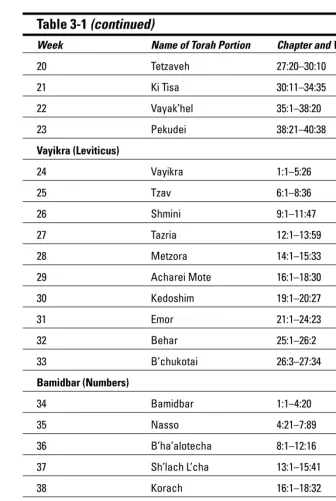
Dividing the Five Books of Moses into 54 sections ...42
Marking the start of the Jewish Holy Scriptures ...45
Building on the Written Torah ...45
Getting a Grip on What the Torah Isn’t ...53
The Torah isn’t a storybook ...53
The Torah isn’t a law book...53
The Torah isn’t a history book ...54
The Torah isn’t literal (even though it’s essentially true) ...54
Considering the Torah’s Commandments ...55
Halachah: The way to walk ...55
The three types of commandments: Rituals, morals, and the mysterious...56
Breaking down the 613 commandments ...57
Part II: One by One: The Books of the Torah ...59
Chapter 4: “In the Beginning”: The Book of Genesis . . . .61
Before You Begin: Approaching the Story of Creation ...62
Get Going: God Creates the World ...63
Setting up took six days...63
It Takes Two: Adam and Eve ...65
Turning dust and breath into body and soul...65
Splitting male and female ...65
Avoiding the Tree of Knowledge of Good and Evil...66
Falling to the temptation of the serpent...66
Sibling Rivalry: Cain and Abel ...67
When It Rains, It Pours: Noah and the Flood...68
A 40-day trip on the high seas ...68
The rainbow covenant ...69
The sons of Noah...69
Reach for the Sky: The Tower of Babel ...70
Father Figure: The Story of Abraham ...71
Abram gets a call and leaves town...71
Abram and Sarai become Abraham and Sarah...72
God’s covenant with Abraham ...73
The destruction of Sodom and Gomorrah ...73
The Birth and Binding of Isaac ...74
The Story of Jacob ...75
Introducing Joseph, Jacob’s Favorite Son...78
Chapter 5: “These Are the Names”: The Book of Exodus . . . .79
The Rise of a New Pharaoh and the Early Life of Moses...80
The peaceful life of Jacob’s descendants ...80
The new Pharaoh’s plan to deal with the Israelites...81
An Israelite baby floats up the Nile River...82
The Pharaoh’s daughter finds the Israelite baby and names him Moses...82
Moses grows up in the Pharaoh’s palace ...82
Moses kills an Egyptian guard and flees...83
Get Moving! The Exodus from Egypt ...84
The burning bush ...84
Arriving in Egypt to deliver God’s message ...86
The Ten Plagues...87
Celebrating the first Passover before leaving Egypt...88
What a Trip: Journeying through the Wilderness ...89
Crossing the Sea of Reeds (also known as the Red Sea) ...89
Singing a Song at the Sea ...90
Gathering manna from heaven and water to drink ...91
Fighting the war against Amalek ...92
Appointing judges ...92
Arriving at Mount Sinai...93
Connecting with God ...93
Going up the mountain to get the Ten Commandments ...94
Returning with the Torah ...95
Aaron and the Incident of the Golden Calf...95
Building a Movable Worship Tent ...96
The Ark of the Covenant (yes, the one Indiana Jones looked for) ....98
The menorah...99
The priests, their special garments, and their rituals ...99
Chapter 6: “And He Called”: The Book of Leviticus . . . .101
Drawing Near to God: The Laws of Sacrifices...102
Burnt offerings ...103
Meal offerings ...103
Peace offerings...104
Sin offerings...104
Guilt offerings ...105
Surveying the Priestly Duties ...106
The Laws of Purity and Impurity...107
Clean and unclean animals...107
Ritual cleanliness...108
The laws of tzarat (some call it leprosy)...108
Yom Kippur, the Day of Atonement...109
Sexual laws ...109
Holiness laws ...110
Priestly laws ...111
Reward and punishment...112
Chapter 7: “In the Wilderness”: The Book of Numbers . . . .113
Counting the Children of Israel ...113
Organizing the Twelve Tribes of Israel ...114
Appointing the Levites to serve in the Tabernacle...115
Looking at a Few Important Laws ...116
Confessing sins ...116
Addressing adultery...117
The laws of the Nazirite...117
The Priestly Blessing ...118
Witnessing Some Wild Events in the Desert ...119
Complaining about manna ...119
Miriam’s sin and punishment ...120
The report of spies to the Holy Land...120
Who does Moses think he is? Korach’s rebellion...122
Getting water from a rock...123
The death of Aaron...123
Balak and Bilaam ...124
The boundaries of the Holy Land...125
Chapter 8: “Words”: The Book of Deuteronomy . . . .127
The First Discourse of Moses ...128
Recalling 40 years of wandering in the desert...128
Asking permission to enter the Promised Land (permission denied) ...129
Teaching the foundation of faith ...129
The Second Discourse of Moses ...132
Reviewing the Ten Commandments...132
Presenting the most important Jewish statement of faith: The Shema...133
Trusting, loving, and remembering God...134
Making the right choices ...135
Recounting the laws of Judaism ...135
The Final Discourse of Moses...137
God asks Moses for a song...138
Moses blesses each tribe for the last time...138
The death of Moses...139
Part III: The Torah: An Operating Manual
for Planet Earth ...141
Chapter 9: Keeping Your Personal Behavior in Line with the Torah . . .143
Defining the Essence of the Torah ...144
Be a Mentsch: Some Basic Torah Principles about Personal Behavior ....145
Good works ...145
Acts of kindness ...145
Hospitality ...146
Charity ...146
Visiting the sick ...147
Evil speech ...147
Look Sharp! Dressing Appropriately...147
Everything Is Relative: The Torah’s Family Rules...148
Be fruitful and multiply...148
Honor your father and mother ...148
Just married? Take a year off ...149
The wife’s rights are just as important as the husband’s ...149
Steer clear of forbidden relationships ...149
All You Need Is (A Lot More than) Love: Treating Everyone Fairly...150
Be kind and welcoming to strangers...150
Don’t just stand there — do something for someone in need...151
Keep the vows you make...152
Honor and respect your elders...152
Showing Kindness to Furry Friends...153
Chapter 10: Living by the Word of the Torah in the Community . . . . .155
It’s Universal: The Seven Laws of the Sons of Noah ...155
Doing Better Business ...157
Lend money compassionately ...157
Make sure your scales and weights are correct ...158
Treat your employees well...158
Property Rights: What’s Mine is Mine, What’s Yours Is Yours ...160
Don’t be sneaky and change boundaries ...160
Order in the Court — the Torah Way ...161
The appointment of judges ...161
The rules of testimony...162
Punishments for wrongdoings...162
Part IV: The Importance of the Torah in Judaism ...165
Chapter 11: Observing the Holy Days in Torah Time . . . .167
Breaking Down Time According to the Torah ...167
The day: “It was evening and it was morning, one day”...168
The week: Torah time is a spiral, not a straight line...169
The month: When the moon hits your eye ...170
The year: When holy days abound ...171
The seven-year cycle: Giving the land and debtors a break ...172
The 50-year cycle: When all land belongs to God ...173
Shabbat: Observing the Holiest of Holy Days ...173
The Torah’s basic Shabbat instructions...173
The start of Shabbat ...175
The 39 things you can’t do on Shabbat ...177
The end of Shabbat ...180
Celebrating Holy Days Appearing in the Torah...180
Rosh Hashanah: Happy birthday, dear universe...180
Yom Kippur: The day of at-one-ment ...182
Sukkot: Recreating the exodus from Egypt ...183
Simchat Torah: Let’s hear it for the Torah! ...186
Passover: The oldest Jewish holy day...186
Shavuot: When God gave the Torah to the world ...188
Chapter 12: Following Jewish Customs According to the Torah . . .191
Torah Traditions Related to the Cycle of Life...191
Circumcision: A big issue over a little piece of tissue ...192
The Bar (or Bat) Mitzvah: Starting to accept responsibility when puberty sets in...194
Marriage: Two halves make a whole ...195
Divorce: Fix it or get out ...197
Death: The end and the beginning ...198
It’s a Sign! Surveying Some Well-Known Jewish Symbols ...200
Mezuzah: A sign of God on the doorpost of your house ...200
Tzitzit: Strings attached...202
Tefillin: The ties that bind ...203
But Is It Kosher? Jewish Eating Practices ...204
Don’t eat the flesh of a beast that died naturally...204
Slaughter animals as painlessly as possible ...205
Cheeseburgers are for never...205
Don’t stuff yourself...206
Chapter 13: Walking through the Torah Synagogue Service . . . .209
Understanding the Basic Customs of Torah Readings ...210
Reading the Torah publicly ...210
Reading a portion of the Torah weekly ...210
Preparing for the Torah Service ...212
Having a quorum of ten ...213
Showing respect by standing ...214
Taking the Torah Scroll from Its Holy Closet ...214
Facing the Ark and Jerusalem...214
Opening the doors...215
Retrieving the scroll and closing the doors ...216
Following the Torah Scroll Procession...216
Moving through the synagogue sanctuary ...217
Kissing the Torah as the procession passes by ...217
Reaching the reading platform ...218
Undressing the Torah Scroll ...218
Receiving the Honor of Blessing the Holy Words ...220
Understanding who can be called ...221
Announcing the honorees’ names...221
Ascending to the Torah ...222
Blessing the Torah before and after each part of the reading...223
Reciting a healing prayer...224
The Big Event: Reading the Torah Out Loud ...225
Qualifying as “the master of the reading” ...225
Looking at every word — no memorizing! ...225
Pronouncing every word correctly ...226
Concluding the Torah Service ...226
Lifting the Torah for all to see ...227
Dressing the Torah ...228
Going through another procession (and more kissing!) ...228
Returning the Torah to the Ark ...228
Chapter 14: The Final Commandment: Writing a Torah Scroll . . . . .229
God Said So! The Law behind Writing a Torah Scroll ...229
Decisions, Decisions: Hiring a Scribe versus Completing a Torah Yourself...231
Hiring a professional ...231
Writing your own Torah...232
Understanding the Ground Rules of Torah Writing ...233
Undergo a ritual bath before beginning...233
Test a pen by writing the name of the ultimate villain ...234
Refrain from relying on memory ...235
Write every word by hand in Hebrew ...237
Avoid making an error ...237
Recite a blessing every time God’s name is written ...240
Using the Right Torah Writing Supplies ...240
A copy to copy...240
A quill from a turkey or a goose ...243
Permanent black ink ...243
A Little TLC: Proper Torah Care, Repair, and Burial...243
Taking good care of a Torah scroll ...244
Discovering errors in a Torah scroll ...244
Repairing a Torah scroll ...245
Storing or burying a Torah scroll when it’s beyond repair...246
Chapter 15: Always Up for Discussion: Analyzing the Torah . . . .247
Grasping the Infinite Possibilities of Interpreting the Torah...247
Just like a diamond: Studying the Torah’s 70 facets ...248
What a great teacher teaches tomorrow is Torah: Finding everything in the Torah ...249
Recognizing that everyone’s on a different level of understanding...250
Every person is a letter: Using the Torah to discover your identity...251
Entering the Garden of Torah Interpretation...251
Just the facts, ma’am: The literal level ...253
What exactly are you implying? The hint...254
So, what’s the point? The moral ...254
Do you want to know a secret? The deepest level ...255
Examining the “Bible Codes”: Are They Legit?...257
The meaning of hidden codes...257
The significance of numbers...259
Chapter 16: Studying the Torah with Translations,
Commentaries, and Other Resources . . . .263
Reading a Translation of the Torah ...263
Surveying translations used by different Jewish movements ...265
Selecting the right translation for your needs...269
Getting Help from Great Classic and Contemporary Commentators ....270
Rashi: You can’t read the Torah without him ...271
Abraham Ibn Ezra: A 12th-century master commentator ...272
The Ramban: The Kabbalistic commentator ...272
Elie Wiesel: An inspirational modern commentator ...273
Rabbi Adin Steinsaltz: A contemporary genius ...273
Using Other Resources to Study the Torah ...274
Surfing the Web...275
Checking out Jewish newspapers ...275
Listening to the local rabbi’s sermon ...275
Part V: The Part of Tens ...277
Chapter 17: The Ten Commandments According to the Torah . . . .279
“I Am the Lord Your God . . .” ...280
“You Shall Not Take the Name of the Lord Your God in Vain . . .” ...281
“Remember the Sabbath Day, to Keep It Holy . . .” ...282
“Honor Your Father and Your Mother . . .”...283
“You Shall Not Murder” ...283
“You Shall Not Commit Adultery” ...284
“You Shall Not Steal” ...284
“You Shall Not Bear False Witness Against Your Neighbor” ...284
“You Shall Not Covet Your Neighbor’s House . . .” ...285
Chapter 18: Ten Frequently Misunderstood Quotes
from the Torah . . . .287
“And God Said, Let Us Make Man in Our Image, after Our Likeness”....288
“Am I My Brother’s Keeper?” ...288
“Two by Two They Came to Noah into the Ark, Male and Female”...289
“God Is a Man of War”...289
“An Eye for Eye, a Tooth for Tooth . . .”...290
“You Shall Not Lie with a Man as with a Woman: It Is an Abomination”...290
“You Shall Love Your Neighbor as Yourself”...291
“For the Lord Thy God Is a Jealous God”...291
“For You Are a People Holy to the Lord Your God . . .” ...292
“You Must Not Make Your Brother Pay Interest . . .” ...292
Part VI: Appendixes...295
Appendix A: A Glossary of Torah Terms and Names . . . .297
Appendix B: The 248 Positive Commandments in the Torah . . . .305
Relating to God ...306
The Torah...306
The Symbols and Signs of Judaism...306
Prayers ...306
Love and Human Relations ...307
The Poor and Unfortunate ...307
The Treatment of Non–Family Members...307
Marriage, Divorce, and Family...308
Holy Days, Times, and Seasons ...308
Dietary Laws ...309
Business Practices ...310
The Treatment of Employees, Servants, and Slaves...310
Promises, Vows, and Oaths...310
The Sabbatical and Jubilee Years...310
The Courts and Court Procedures...311
Injuries and Damages ...312
Property and Related Rights...312
Punishment and Restitution ...312
Idolatry ...313 Agriculture ...313 The Firstborn...313 The Priesthood and Holy Temple Workers...314 Tithes and Taxes ...314 The Temple, the Sanctuary, and Sacred Objects ...315 Offerings and Sacrifices...316 Ritual Purity and Impurity ...318 Lepers and Leprosy ...319 The King ...319 Nazarites ...319 Wars ...319
Appendix C: The 365 Negative Commandments in the Torah . . . .321
Relating to God ...321 Prayers ...321 Love and Human Relations ...322 The Poor and Unfortunate ...322 The Treatment of Non–Family Members...322 Marriage, Divorce, and Family...323 Forbidden Sexual Relations ...323 Holy Days, Times, and Seasons ...324 Dietary Laws ...325 Business Practices ...326 The Treatment of Employees, Servants, and Slaves...326 Promises, Vows, and Oaths...327 The Sabbatical and Jubilee Years...327 The Courts and Court Procedures...328 Injuries and Damages ...329 Property and Related Rights...329 Criminal Laws ...329 Punishment and Restitution ...330 Prophecy ...330 Idolatry ...330 Agriculture and Animal Husbandry ...333 Clothing ...333 The Firstborn...333 The Priesthood and Holy Temple Workers...333 Tithes and Taxes ...334 The Temple, the Sanctuary, and Sacred Objects ...335 Offerings and Sacrifices...336 Lepers and Leprosy ...338 The King ...339 Nazarites ...339 Wars ...339Introduction
T
he Torah is both the most sacred object and the most sacred text in Judaism. It consists of the first five books of the Bible: Genesis, Exodus, Leviticus, Numbers, and Deuteronomy. The word “Torah” comes from the same root as the Hebrew word hora’ah(hoe-rah-ah), which means “instruction” or “teaching.” The Torah’s purpose, simply stated, is to provide people with instructions for finding and following the path of God and the path to God.Although the words in the Torah, which is also known as the Five Books of Moses, consists of exactly 304,805 letters, the great sages of Jewish tradition teach that all the wisdom in the universe is hidden within these letters. Jewish tradition looks carefully at these letters and at the words they form, and great sages throughout history have provided — and continue to provide — the proper instruction for analyzing the Torah text and revealing its divine messages.
As my teacher, the renowned Rabbi Adin Steinsaltz of Jerusalem, has said, “Other religions have a concept of scripture as deriving from Heaven, but only Judaism seems to be based on the idea that the Torah Scripture is itself Heaven. In other words, the Torah of the Jews is the essence of divine revelation; it is not only a basis for social, political, and religious life but is something of supreme value.”
When you study the Torah, you aren’t just studying the word of God. According to Jewish belief, Torah study is actually an authentic encounter withGod. The Torah can be viewed as a collection of concentrated emanations and trans-mutations of divine wisdom. I’m a Jew who studies the Torah in one form or another every day. I’ve been studying the Torah for nearly 40 years, and I’ve come to believe that the Torah is the most profound collection of wisdom and guidance I’ve ever encountered.
About This Book
It’s essential to know that you can’t understand the Five Books of Moses simply by reading it like a storybook. A core belief among the Jewish people is that when Moses encountered God on Mount Sinai and received the Torah, he actually received two Torahs — one written and one oral. The two parts together make up what the Jewish people consider to be the Torah.
the Supreme Court on the other hand. The written Constitution contains basic principles, but it’s the legislation and court decisions that expand upon these principles and give them life. Jewish tradition teaches that the Oral Torah works in much the same way, expanding upon the basic written princi-ples of the Five Books of Moses. These basic principrinci-ples are constantly being applied to new situations as human history unfolds.
In The Torah For Dummies,I explain how both aspects of the Torah work together to form an operating manual for life. Like all For Dummiesbooks, you don’t need to read The Torah For Dummiesfrom cover to cover. Each chapter is self-contained. I’ve constructed each section so that you can flip through the book, find something of interest, and read it without needing to know what the other chapters say. I’ve written this book in plain, down-to-earth language, and if I need to mention an essential technical or foreign word or phrase, I make sure to define it the first time I use it.
Even though the Torah is deep and profound, Jewish tradition teaches that the Torah is written in the language of humans and is meant to be accessible and understandable. I’ve made sure that my explanations and descriptions of the Torah and its contents resulted in a plain-language reference book that will serve you well, even if you have had absolutely no prior experience or familiarity with the Torah.
My goal in writing The Torah For Dummiesis to introduce you to the Torah, its structure, its contents, and its significance in Jewish life. I also want you to understand how the ideas in the Torah provide the basis of Western civilization and the foundations of Judaism, Christianity, and Islam.
Conventions Used in This Book
Because the Torah is a vast subject with so many parts, qualities, aspects, and subjects, I had to establish a few conventions while writing to make the subject as clear and understandable as possible. As you read The Torah For Dummies,please keep in mind my conventions regarding the following:
The word “Torah”:Don’t jump too quickly to define the word “Torah.” It has abstract connotations as well as very specific usages. For the most part, when I use the word in this book, I’m referring to the Five Books of Moses. But as you will find out, “Torah” also refers to the oral tradition that has been passed down from generation to generation ever since Moses encountered God at Mount Sinai. In addition, the word “Torah” refers to the entire body of Jewish teachings.
Occasionally, I refer to God using male pronouns for simplicity’s sake, but I try to avoid this as much as possible.
Pronunciation of Hebrew words:Many Hebrew words and phrases appear throughout this book in boldfacetext, and because not every-one’s familiar with the language, I offer pronunciation help. The syllable that receives the accent is always in italics.But you should be aware that there are two ways to pronounce many Hebrew words:
•Ashkenazic:This is the Central and Eastern European pronuncia-tion that’s used in most, but not all, Orthodox synagogues. An example is Shabbos(shah-bus; Sabbath), with the accent on the first syllable.
•Sephardic:This is the modern Israeli pronunciation that’s used in most liberal synagogues and some Orthodox synagogues in the United States. An example is Shabbat(shah-baht; Sabbath), with the accent on the second syllable.
In this book, I mostly use the transliteration and pronunciation com-monly used in Israel, but sometimes I give the Ashkenazic pronuncia-tion, especially if it has become common usage.
The names of the Five Books of Moses:I use the common names for each of the Five Books of Moses. For example, the first book, Genesis, is actually called Bereshit(beh-ray-sheet) in Hebrew and in Jewish tradition. Even though I would love for you to know the “real” names of each book, I’ve come to the conclusion that using the common names is more useful, especially for a beginner.
Sages, commentators, and rabbis:Throughout this book, I use these terms interchangeably. The term “sage” is a common one in Jewish life and generally refers to any highly regarded Torah teacher. By definition, some-one whose commentaries on the Torah have come to be accepted among traditional Jews throughout history is known as a sage. Occasionally, I refer to “the rabbis.” What I mean by that isn’t simply anyone who happens to be a rabbi but rather those rabbis who have earned reputations as-luminaries among the Jewish people.
English translations of verses from the Torah:The Torah is written in Hebrew; the English translations appearing in this book are mine, but I want you to know that I’m quite familiar with all the available English translations of the Torah and I’ve often borrowed phrases from them. Generally, my translations are composites of all the available English translations as well as my own translations, and my decisions are based on my judgments as to what’s the clearest and most understandable lan-guage to modern English-speaking readers.
What You’re Not to Read
If you have the time and inclination to read this book from cover to cover, by all means, get to it! However, if you’re only looking for the most helpful, most essential facts and explanations, you can skip the sidebars, which appear in shaded gray boxes throughout this book. They’re interesting (I hope!) anec-dotes and pieces of information that supplement the text but aren’t essential for an understanding of the topics being explored.
Foolish Assumptions
When writing this book, I had to make some assumptions about you. First of all, I don’t assume that you’re Jewish, nor do I assume that you want to be. And although the Torah is just as much about spiritual practice as it is about general spiritual ideas, I don’t assume that you want to adopt every practice, custom, and ritual, nor do I assume that you necessarily agree with all the theological assumptions found in the Torah.
Following are some additional assumptions I’ve made. If you fit into any of these categories, this book is for you:
You’ve heard about the Torah and are curious about it because you know that it’s the central book and foundation of Judaism.
You know that both Christianity and Islam have their roots in Judaism and the Torah, and you’re interested in understanding those roots. You have some familiarity with the Bible and know some of its contents
(like Noah’s Ark and the Ten Commandments), but you still want more. You’re a spiritual seeker, and you’ve heard that the Torah is the
corner-stone of the Jewish path and the hiding place of all the secrets of Kabbalah. You’re Jewish but realize that you never received a good Jewish
educa-tion or you want to supplement, enrich, broaden, and expand your Jewish knowledge.
You’re not Jewish, but you’d like to understand more about Jewish life, including that of your Jewish friends and neighbors.
You’ve attended a synagogue service and have witnessed the reverence that the Jewish people give to the Torah, and you’d like to know more about it.
You’ve seen popular films like The Ten Commandmentsand Raiders of the Lost Ark,and you’re curious about the contexts of those films.
How This Book Is Organized
I’ve organized this book so that you can skip around easily. In order to help you get in, get the information you need, and get out without reading cover to cover, I divided the book into parts that give you one piece of the Torah pic-ture at a time.
Part I: The Torah 101
This part provides you with the basics. You get an overview of the entire subject, in particular the major sections of the Torah as well as some of its most important ideas and concepts. I introduce the main “character” of the Torah — God. There’s a lot to say about God, even though, by definition, it’s impossible for humans to grasp God. But once you understand the paradox that the Torah expects you to establish an intimate, personal relationship with a God whom you can’t conceive of, you begin to understand that God is the basis of every-thing. And because the Torah is often profoundly misunderstood, I also explore what the Torah isn’t in this part.
Part II: One by One: The Books
of the Torah
The Five Books of Moses consists of, well, five books: Genesis, Exodus, Leviticus, Numbers, and Deuteronomy. In this part, I walk you through each of the five books, one by one, summarizing the major events and concepts appearing in each. After reading each chapter in this part, you should have a pretty good idea of the books’ contents, from stories you didn’t know of to ones that sound familiar (like the splitting of the Red Sea or the giving of the Ten Commandments). I’ll warn you now that you may end up saying to yourself, “Oh, so that’swhere that comes from!”
Part III: The Torah: An Operating
Manual for Planet Earth
Part IV: The Importance
of the Torah in Judaism
The Torah scroll is the most sacred object in Jewish life. In this part, I show you how the contents of the Torah form the basis for Jewish holy days and Jewish customs and practices (like eating kosher food), and the way in which the Torah scroll is used during synagogue services. According to Jewish tra-dition, every Jewish person must either write a Torah scroll or support those who do, so in this part, I provide you with the details of how a Torah scroll is written. Finally, every Jewish person is required to study the Torah, so I describe just how this is done and provide you with some suggestions if you want to participate in the study of the Torah.
Part V: The Part of Tens
Every For Dummiesbook has a Part of Tens. One natural list of ten items relat-ing to the Torah is the Ten Commandments. But it’s not so simple: Not only are there two versions of the Ten Commandments in the Torah, but different groups of Christians even count them differently! Another group of ten that I give you in this part is ten famous (and often misunderstood) quotations from the Torah, many of which you’ll know.
Part VI: Appendixes
In this part, I include a glossary of terms that you should know for a basic vocabulary about the Torah. And last but not least, I give you a list of the 613 commandments found in the Torah, broken down into positive commandments (what you shoulddo) and negative commandments (what you shouldn’tdo).
Icons Used in This Book
All For Dummiesbooks feature icons (little pictures that grab your attention) in the margins to serve you well. Think of them as road signs pointing to dif-ferent kinds of information in the chapters.
This icon alerts you to concepts, terms, and ideas in the Torah that are of particular importance. Keep the points marked with this icon in mind, and you can’t go wrong.
This icon points out helpful information that you can use if you make the Torah a part of your life.
This icon points to misconceptions about the Torah or actions that are strictly forbidden by the Torah. Read this information carefully!
This icon highlights instances when I quote directly from the Torah or some other important Jewish source, often from some of the great sages of Jewish history.
Where to Go from Here
You can begin this book wherever you like. But you may want to start with the following suggestions:
If you’re interested in all 613 commandments in the Torah, go to Appendixes B and C.
If you want to get a good overview of each of the Five Books of Moses, read Part II.
If you want to put the Torah’s basic principles into practice immediately, read Chapters 9 and 10.
Part I
In this part . . .
Chapter 1
Beginning with Torah Basics
In This Chapter
Meeting the Torah’s author — God
Discovering the most important elements of the Torah
Glimpsing each of the Five Books of Moses
Understanding how to live a righteous life according to the Torah
Seeing how the Torah guides the lives of the Jewish people
T
he Torah, also known as the Five Books of Moses, is the most sacred object and the most important text of the Jewish people. As a sacred scroll found in every synagogue throughout the world, it’s referred to as a sefer Torah(say-fehr toe-rah; Torah scroll); as a bound book, it’s referred to as a chumash(khuh-mahsh; five).The Torah is more than a text, though; it’s also the spiritual tradition of the Jewish people, communicated by God (the Creator and Master of the uni-verse) to Moses (the greatest prophet of the Jewish people) on Mount Sinai in 1280 BCE and handed down from generation to generation.
You can understand the word “Torah” in a third way as well. Torah is the vast and constantly growing body of teachings and wisdom of Judaism, and in this sense it even includes what a qualified Jewish teacher will teach tomorrow. The “study of Torah” is not necessarily the same as the “study of theTorah.” “The Torah” usually means the Written Torah, the Five Books of Moses, whereas “Torah” is Torah studies in the more general sense.
Introducing God, the Torah’s Author
Even though the Torah is mainly aboutGod, it’s also important to remember that the Torah’s author isGod. Although the first line of the Torah says, “In the beginning of God’s creation of heaven and earth . . .,” it’s God who is speaking. God chose Moses to receive and write down a divine message, which is why the Torah is also known as the Five Books of Moses, but the Torah emanates from God. God reaches into the human world with the Torah.
Jewish tradition teaches that God didn’t create the world out of nothing. God’s creation is an emanation of divine light that God sculpted into all that exists. God is not just “in” everything. Rather, everything isGod. This is, of course, a paradox. On the one hand, people live their lives feeling separate from God, but at the same time, Jewish tradition teaches that on the deepest level everything isGod.
In studying the Torah, you’ll often encounter paradoxes. Many spiritual teachers teach that when you encounter a paradox, it usually means that you’re going in the right direction. The endless struggle to grasp and under-stand what is meant by God is both the most important activity of life and, at the same time, an impossible task. The study of Torah is the way in which Jews participate in this paradoxical struggle. Some of the ideas that students of the Torah struggle with include:
Humans are created in God’s image.
God has many names, but no name can possibly be adequate. God exists.
God has no gender.
God is unique; nothing is like God is any way. God is everywhere.
God is, was, and will be; God transcends time. God is beyond human comprehension.
The Torah is mainly God’s communication to people about how to behave. Most of the Torah is directed toward the Jewish people, although it also contains instructions for all other peoples of the world. But for reasons that only God knows, the Jewish people are given extra burdens and responsibilities. God chose the Jewish people, but in no way does this status of being chosen by God imply superiority.
Connecting with God through God’s commandments Having faith in God
Maintaining trust in God Accepting direction from God
Understanding that God directs everything that occurs Struggling to comprehend God
Communicating with God through prayer
See Chapter 2 for more information about God, the ultimate author.
Examining the Torah’s
Important Elements
Jewish tradition maintains that the Five Books of Moses contains everything. Yes, everything.Although the Torah is a religious document, it isn’t a collection of abstractions in spiritual language. Rather, it uses concrete descriptions in the form of laws and stories to express abstract notions. The Torah also deals with all aspects of life, from business, agriculture, and industry to family life, sexuality, and ritual. The Torah directs human conduct in all its aspects. It urges followers to see the whole world as a Holy Temple in which each student functions as a priest whose job it is to constantly purify and sanctify the entirety of life.
The Torah consists of two parts: One is written and the other is oral. Flip to Chapter 3 for a full introduction to the treasures of the Torah.
The Written Torah
As the Torah describes, Moses was the greatest teacher and prophet who ever lived. It’s important, however, to always keep in mind that Moses wasn’t a perfect being. He had the noble attribute of humility, although he was also self-effacing sometimes, and he didn’t always do the right thing. As my teacher has often said, “In Judaism, there are no plastic saints.”
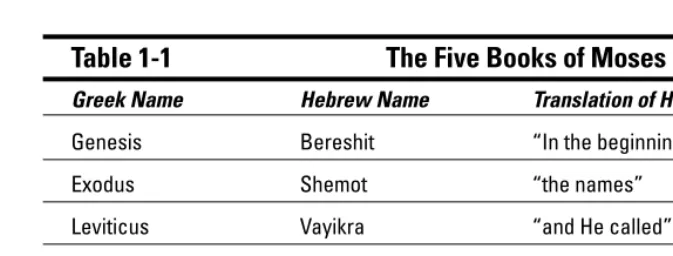
Table 1-1
The Five Books of Moses
Greek Name Hebrew Name Translation of Hebrew Name
Genesis Bereshit “In the beginning”
Exodus Shemot “the names”
Leviticus Vayikra “and He called”
Numbers Bamidbar “in the wilderness”
Deuteronomy Devarim “words”
The Torah isn’t the Bible. The Jewish Bible is the book that Christians call the Old Testament, and the Five Books of Moses are the first five sections of the Jewish Bible. The other sections are the books of the Prophets (of which there are eight) and the books of other sacred writings (of which there are 11). In all, there are 24 books in the Jewish Bible, also often referred to as the Hebrew Scriptures.
The Oral Torah
When Moses encountered God and received God’s message, the divine trans-mission included oral teachings that were never meant to be written down. An oral tradition allows for flexibility; too often when an oral teaching is written down, it’s taken too literally and loses its power to adapt to changing times and circumstances. It was only after much debate and discussion that the great sages of the Jewish people decided to write down the oral teachings in a process that began a few thousand years ago. This compromise was based on the historical fact that the enemies of the Jewish people were killing so many of the Children of Israel and the sacred traditions were at a great risk of being lost.
The major elements of the Oral Torah include
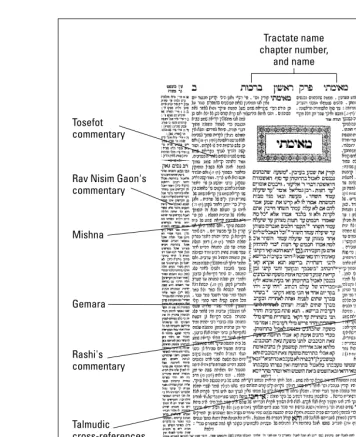
The Mishnah(mish-nah; repetition): A book consisting of six sections, written in Hebrew, that serve as a summary of the oral teachings as handed down by Moses, along with the Written Torah, to the elders of the Jewish people.
The Gemara(geh-mah-rah; completion): Additions, written mostly in Aramaic, that serve to analyze the Mishnah, define its fine points, and also illustrate how the Five Books of Moses and the Mishnah are applied to the ever-changing conditions of life.
The Midrash(mid-rahsh; interpretation): A few dozen books written over a number of centuries that serve to expand upon the details found in the Five Books of Moses and other books of the Jewish Bible. The various collections of Midrashim (plural for Midrash) teach both divine moral lessons and divine laws.
Halachah(ha-lah-khah; the way to walk): The term for Jewish law. Jewish laws are either positive (“do this”) or negative (“don’t do this”), and 613 of them are traditionally found in the Five Books of Moses (see Appendixes B and C for the full list). This number is deceptive because there are actually thousands of Jewish teachings that grow out of the primary 613 commandments in the Torah.
Taking One Torah Book at a Time
There’s an ancient Jewish tradition that the entire Five Books of Moses is actually one long name of God. The Written Torah is also traditionally seen as five separate books, each with its own character and content. The following are the Five Books of Moses, which I cover in detail in Part II:
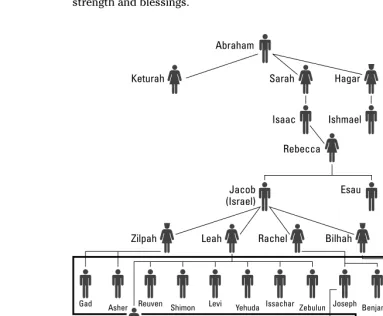
Genesis:The book of Genesis focuses on the creation of the universe and the creation of the Jewish family, starting with Adam and Eve, Noah, his son Shem, and ultimately with the patriarch Abraham and matriarch Sarah. The book is filled with many dramas involving the individuals who form the foundation of the Jewish people, most notably Abraham, Isaac, Jacob, Sarah, Rebecca, Rachel, Leah, and Joseph.
Exodus:The book of Exodus essentially tells the story of the Jewish people’s experience of slavery in Egypt and ultimate liberation under the leadership of Moses and his brother Aaron. This book also describes Moses’s encounters with God and the receiving of the divine transmission called the Torah at Mount Sinai.
Leviticus:This book of the Torah contains the least amount of narrative among the five. Rather, it’s concerned with the rules and functions of a branch of the Jewish family that serves a unique priestly role within Judaism; it’s also filled with laws, rules, and regulations of a wide variety. Numbers:The book of Numbers largely concerns itself with the 40-year
Deuteronomy:The book of Deuteronomy is largely Moses’s farewell address to his people. In this book, Moses recounts many of the key experiences of the Jewish people after their liberation from Egypt. He also takes the opportunity to repeat many teachings contained in the first four books of the Written Torah. This book ends with the death of Moses.
Living Life According to the Torah
The Torah is God’s instruction book to humankind. For practical purposes, you can see these instructions as two different yet overlapping types: One is the instructions by God about how people should behave as individuals on a personal level, and the other is how people should behave in a community.
Watching your personal behavior
The Torah’s instructions to people about personal behavior are based on the assumption that the details are what matters. Sure, it’s lovely to say that people should be nice to each other and should love each other, but it has been proven again and again that lofty generalizations like “Be nice” or “Be fair” are never enough. The trend in the Torah is to add details rather than to make broad, sweeping statements. Without specific instructions to follow, people all too often don’t really get the picture or behave as they’re supposed to. The Written and Oral Torahs together show how the highest, deepest, and most profound ideals from God are applied to the ever-changing circumstances of life.
Head to Chapter 9 for more information on keeping your personal behavior in line with the Torah, including tips on treating both your family and strangers kindly.
Check out Chapter 10 for details on living by the word of the Torah in the community, including information on doing better business, dealing with property rights, and keeping order in the court.
Connecting the Torah to Judaism
The way of Judaism as a spiritual tradition is the way of Torah. The Torah is the link between God and the Jewish people. Jewish belief, Jewish law, Jewish practice, Jewish customs, Jewish holy days, and Jewish values all grow out of the Torah, as you find out in the following sections.
Taking note of the holiness of time
The great Jewish sages teach that it’s possible to connect with holiness (which means connecting with God) in three ways: the holiness of space, the holiness of the human soul, and the holiness of time:
The holiness of spacefocuses on a spot in Jerusalem known as the Holy of Holies; it’s surrounded by the Holy Temple. The Holy Temple is situ-ated in the Holy City of Jerusalem, and the Holy City is in the Holy Land of Israel. An example of a constant recognition of the holiness of space is that the Torah instructs Jews throughout the world to face Jerusalem during the three daily prayer sessions.
The holiness of the human soulimplies that the human soul can refine itself and make itself holy through the holy behavior as instructed by the Torah.
The holiness of timeis expressed through special rituals and prayers that are recited at special times and occasions. The Torah instructs the Jewish people that one of the best ways to connect with God is to observe the commandments that guide them through the various units of time.
The Jewish sages teach that the Torah concerns itself with every moment of life: from the moment of birth to the moment of death, and from the moment you wake until the moment you sleep. Just as God is everywhere in space, so too is God everywhere in time. The Torah instructs its students regarding
The day (three prayer sessions and other daily requirements) The week (the six working days and the Holy Sabbath) The month (the observation of the new moon each month)
The year (many holy days that appear throughout the annual Jewish calendar and are detailed in the Torah)
Following Jewish customs
The Written Torah and the Oral Torah have a lot to say about how Jewish people should conduct themselves throughout each important stage of life, as shown in Table 1-2.
Table 1-2
Key Life Events and Corresponding Jewish Customs
Life Event Jewish Custom
Birth Circumcision for boys; naming the baby for both
boys and girls
Coming-of-age Bar Mitzvah for boys; Bat Mitzvah for girls
Marriage Signing a marriage contract; husband and wife
both have many rights and responsibilities
Death Following a detailed, elaborate, and (I must say)
brilliant series of steps intended to guide mourners through various stages of mourning
The Torah also has a lot to say to the Jewish people regarding all aspects of life, including
The use of symbols in Judaism, such as
• Mezuzah (a sign on the doorpost of every Jewish home) • Tzitzit (a sign on the corners of clothes that some Jews wear) • Tefillin (a sign that actually wraps itself around your head and arm) The way to eat (eating according to the kosher laws is explained in great
detail)
Go to Chapter 12 for more instruction on following Jewish customs according to the Torah.
starts out literally dressed in the finest royal attire and then is undressed, studied, read aloud, and redressed with the utmost care and devotion.
Since ancient times, the Torah has been read publicly each week on Shabbat. This custom certainly served the Jewish people well when printed copies weren’t common like they are today, and the communal gathering of Jews to hear the words of the holy Torah continues to be an emotional high point for Jewish people throughout the world. The Five Books of Moses is divided into weekly sections, and every synagogue community reads the same section each week. The entire Torah is read in the course of one year. On the Jewish holy day of Simchat Torah(sim-kahttoe-rah; the joy of the Torah), the last sen-tences are read and the first sensen-tences begin the round of the year once again.
Writing a Torah scroll
The Five Books of Moses actually comes in two formats:
A handwritten scroll on parchment, essential for use in the synagogue service
A book printed on a printing press and readily available to the masses
According to the Torah, it’s the responsibility of each Jewish person to handwrite a Torah scroll. Because the task is so difficult, not to mention time-consuming, Jewish law is lenient and permits you to fulfill this commandment in a number of ways, including providing financial support to qualified scribes. Some authorities say that you can also fulfill this commandment by buying books about the Torah. So purchasing The Torah For Dummiesmeans that you’ve already begun to fulfill one of the Torah’s commandments!
Flip to Chapter 14 for more information about the commandment of writing a Torah scroll.
Analyzing and studying
the Torah all your life
Throughout the ages it has been frequently said that the most important activity in all Jewish life is the study of the Torah, which is the subject of Chapter 15. Many statements in Jewish holy texts support the notion that Torah study throughout a lifetime is of supreme value. Here are a few from the Talmud:
A single day of Torah study is more important than 1,000 sacrifices in the Holy Temple.
God cries over people who are able but nevertheless neglect Torah study. God studies the Torah every day.
Non-Jews who study the Torah to learn of their obligations are as great as the High Priest in the Holy Temple.
Jewish tradition considers every letter, word, line, story, and detail of the Written Torah to be of divine origin and therefore containing an infinity of meanings. In principle, it’s impossible to say that any one line, story, or book of the Torah means only one thing. There are levels upon levels of meaning in every tiny detail of the Written Torah.
In principle, it’s assumed that everybody hears the Torah differently. This doesn’t mean that Torah study is a free-for-all where every and any interpre-tation is always correct. But as my teacher says, each person has a personal relationship with God, and that relationship is a completely private affair. You can and should work with a Torah teacher and try to understand the Torah through the commentaries of the great sages, but in the final analysis, you have to trust yourself and make your own decisions. As one tradition states, each of us is a letter in the Torah, and each of us must find our letter.
Although the Written Torah is in Hebrew and the Oral Torah is mostly in Aramaic, the good news is that there are lots of English translations of the Five Books of Moses and also English translations of the commentaries that are essential to arriving at a more complete understanding of the Torah (as you find out in Chapter 16). Jewish life is an immersion into the Torah and into the literature that the Torah has inspired. My home library is filled with a few thousand books (literally) on the Torah. The Torah For Dummiesis one more book for that ever-growing Torah library. In fact, this book is designed to be a doorway that opens into a vast garden of profound Torah knowledge.
A well-known statement in the Oral Torah summarizes the importance of Torah study:
Rabbi Tarfon used to say: You are not required to complete the task, but neither are you free to withdraw from it. If you have learned a lot of Torah, much reward has been prepared for you, and your Employer can be trusted to compensate you for your labor. But know that the reward of the righteous is reserved for the World to Come.
Chapter 2
Encountering God,
the Ultimate Author
In This Chapter
Understanding how God created the world and its people
Discovering some of God’s names
Getting a grip on God’s nature
Grasping the ways to grow closer to God
Finding out how to communicate with God
T
he Torah is full of teachings on just about every aspect of human experience. As you find out in Part III and throughout this book, there are teachings about human relations, business practices, ethical behavior, treatment of the poor, family life, sexual relations, holy days, rituals, courts, and criminal law, and that’s just the tip of the iceberg.But at its core, the Torah is a holy book about God and God’s relation to the world. The Torah establishes that the source for all teachings, and indeed the source of everything that exists, is God.
Enter God, Stage Center: Creating a New
World (And People to Fill It)
The Torah doesn’t waste any time introducing God. The very first sentence of the very first book of the Torah, the book of Genesis (see Chapter 4), begins with the famous line, “In the beginning God created the heavens and the earth.” Getting to know God is essential to Jewish life, and as you find out in the following sections, a good way to start gathering this knowledge is to understand the basics of God’s creation of the world as described in the Torah.
Switching on the light
(and keeping it on)
The first words spoken by God as recorded in the Torah are “Let there be light” (Genesis 1:3). Torah commentators (you meet some of them in Chapter 16) have observed that the light created by God at the very beginning of Genesis is in some ways similar but is really not the same as the light that people know in their everyday lives. The natural light of the world comes from the sun. But when God says “Let there be light” at the beginning of the Torah, this light exists before God’s creation of the sun, moon, stars, and planets. Sometimes this original light is referred to in sacred Jewish texts as “Primordial Light.” Many Torah commentators over the centuries point out that an understanding of the light in the world can lead to a deeper under-standing of the original light.
God’s divine light emanates from its divine source. According to the great sages of Jewish tradition, everything in the world ultimately is formed by the primal light at the beginning of the creation story. There’s a fundamental view within Jewish thought that makes an important point about creation: Some people in the world believe that God did indeed create the world but that after the creation was finished, God withdrew from the world. In contrast, Jewish sages express the oral tradition within Judaism that God is continuously creating the world, continuously speaking the words “Let there be light.”
The use of electrical imagery helps to explain this view of creation. When you turn on an electric light switch, the current flows and illuminates an electric light bulb. If you turn off the light switch, the current is blocked, and the light extinguishes itself. As the great Torah sages say, the world is created by the downpour of divine plenty that’s constantly flowing from above; in other words, God never turns off the switch of light and creation.
Using the Torah as a blueprint
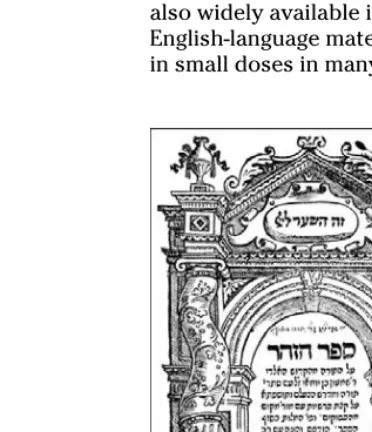
Ancient rabbinic tradition offers a startling and profound image regarding the creation of the world. The rabbis suggest that when God created the world, the Torah was God’s plan. The Zohar (an ancient mystical commentary on the Torah; see Chapter 3) actually says that God looked into the Torah and made the world accordingly.
This image presents a challenge, because how could God create and look into the Torah before He even created the world? After all, isn’t the Torah the sacred text that God gave to Mos