by Gail Stein
Intermediate
Spanish
FOR
DUMmIES
‰by Gail Stein
Intermediate
Spanish
FOR
DUMmIES
‰Intermediate Spanish For Dummies®
Published by
Wiley Publishing, Inc.
111 River St.
Hoboken, NJ 07030-5774
www.wiley.com
Copyright © 2008 by Wiley Publishing, Inc., Indianapolis, Indiana Published simultaneously in Canada
No part of this publication may be reproduced, stored in a retrieval system, or transmitted in any form or by any means, electronic, mechanical, photocopying, recording, scanning, or otherwise, except as permitted under Sections 107 or 108 of the 1976 United States Copyright Act, without either the prior written permission of the Publisher, or authorization through payment of the appropriate per-copy fee to the Copyright Clearance Center, 222 Rosewood Drive, Danvers, MA 01923, 978-750-8400, fax 978-646-8600. Requests to the Publisher for permission should be addressed to the Legal Department, Wiley Publishing, Inc., 10475 Crosspoint Blvd., Indianapolis, IN 46256, 317-572-3447, fax 317-572-4355, or online at
http://www.wiley.com/go/permissions.
Trademarks: Wiley, the Wiley Publishing logo, For Dummies, the Dummies Man logo, A Reference for the Rest of Us!, The Dummies Way, Dummies Daily, The Fun and Easy Way, Dummies.com and related trade dress are trademarks or registered trademarks of John Wiley & Sons, Inc. and/or its affiliates in the United States and other countries, and may not be used without written permission. All other trademarks are the property of their respective owners. Wiley Publishing, Inc., is not associated with any product or vendor mentioned in this book.
LIMIT OF LIABILITY/DISCLAIMER OF WARRANTY: THE PUBLISHER AND THE AUTHOR MAKE NO REPRESENTATIONS OR WARRANTIES WITH RESPECT TO THE ACCURACY OR COMPLETENESS OF THE CONTENTS OF THIS WORK AND SPECIFICALLY DISCLAIM ALL WARRANTIES, INCLUDING WITHOUT LIMITATION WARRANTIES OF FITNESS FOR A PAR-TICULAR PURPOSE. NO WARRANTY MAY BE CREATED OR EXTENDED BY SALES OR PROMOTIONAL MATERIALS. THE ADVICE AND STRATEGIES CONTAINED HEREIN MAY NOT BE SUITABLE FOR EVERY SITUATION. THIS WORK IS SOLD WITH THE UNDERSTANDING THAT THE PUBLISHER IS NOT ENGAGED IN RENDERING LEGAL, ACCOUNTING, OR OTHER PROFESSIONAL SERVICES. IF PROFESSIONAL ASSISTANCE IS REQUIRED, THE SERVICES OF A COMPETENT PROFESSIONAL PERSON SHOULD BE SOUGHT. NEITHER THE PUBLISHER NOR THE AUTHOR SHALL BE LIABLE FOR DAMAGES ARISING HEREFROM. THE FACT THAT AN ORGANIZATION OR WEBSITE IS REFERRED TO IN THIS WORK AS A CITATION AND/OR A POTENTIAL SOURCE OF FURTHER INFORMATION DOES NOT MEAN THAT THE AUTHOR OR THE PUBLISHER ENDORSES THE INFORMATION THE ORGANIZATION OR WEBSITE MAY PROVIDE OR RECOMMEN-DATIONS IT MAY MAKE. FURTHER, READERS SHOULD BE AWARE THAT INTERNET WEBSITES LISTED IN THIS WORK MAY HAVE CHANGED OR DISAPPEARED BETWEEN WHEN THIS WORK WAS WRITTEN AND WHEN IT IS READ.
For general information on our other products and services, please contact our Customer Care Department within the U.S. at 800-762-2974, outside the U.S. at 317-572-3993, or fax 317-572-4002.
For technical support, please visit www.wiley.com/techsupport.
Wiley also publishes its books in a variety of electronic formats. Some content that appears in print may not be available in electronic books.
Library of Congress Control Number: 2007942524 ISBN: 978-0-470-18473-8
Manufactured in the United States of America 10 9 8 7 6 5 4 3 2 1
About the Author
Gail Stein, MA,is a retired language instructor who taught in New York City public junior and
senior high schools for more than 33 years. She has authored several French and Spanish books, including CliffsQuickReview French Iand II, CliffsStudySolver Spanish Iand II, 575+ French Verbs, and Webster’s Spanish Grammar Handbook.Gail is a multiple-time honoree in Who’s Who Among America’s Teachers.
Dedication
This book is dedicated to the memory of my father, Jack Bernstein, who will always be there for me.
This book is also dedicated to my husband, Douglas, for his love and patience; to my wonderful children, Eric, Michael, and Katherine, for their encouragement and support; and to my mother, Sara Bernstein, for always rooting for me.
Author’s Acknowledgments
Many thanks to Michael Lewis, my acquisitions editor, who was so helpful in getting this book off the ground. To Stephen R. Clark, my project editor, and Josh Dials, my copy editor, whose excellent editing skills and suggestions made this book a reality. To Dr. Victor E. Krebs, whose technical expertise and input were invaluable. And to all the other people at Wiley for their patience and help.
Publisher’s Acknowledgments
We’re proud of this book; please send us your comments through our Dummies online registration form located at
www.dummies.com/register/.
Some of the people who helped bring this book to market include the following:
Acquisitions, Editorial, and Media Development Project Editor:Stephen R. Clark
Acquisitions Editor:Michael Lewis
Copy Editor:Josh Dials
Technical Editor: Dr. Victor E. Krebs, Associate Professor of Spanish, Marian College
Editorial Manager: Christine Meloy Beck
Editorial Assistants:Erin Calligan Mooney, Joe Niesen, David Lutton
Cartoons: Rich Tennant (www.the5thwave.com)
Composition Services
Project Coordinator: Patrick Redmond
Layout and Graphics:Carrie A. Cesavice,
Brooke Graczyk, Stephanie D. Jumper, Laura Pence
Proofreaders: Broccoli Information Mgt., Caitie Kelly
Indexer: Broccoli Information Mgt.
Publishing and Editorial for Consumer Dummies
Diane Graves Steele, Vice President and Publisher, Consumer Dummies
Joyce Pepple, Acquisitions Director, Consumer Dummies
Kristin A. Cocks, Product Development Director, Consumer Dummies
Michael Spring, Vice President and Publisher, Travel
Kelly Regan,Editorial Director, Travel
Publishing for Technology Dummies
Andy Cummings,Vice President and Publisher, Dummies Technology/General User
Composition Services
Gerry Fahey,Vice President of Production Services
Debbie Stailey,Director of Composition Services
Contents at a Glance
Introduction...1
Part I: Reviewing the Basics ...7
Chapter 1: Looking at Some Everyday Basics ...9
Chapter 2: Selecting the Proper Part of Speech ...27
Part II: Writing in the Present...37
Chapter 3: Sorting Out Word Gender ...39
Chapter 4: Writing in the Present with Action...61
Chapter 5: Getting Answers with the Right Questions ...81
Chapter 6: Doing It Right Now: Gerunds and the Present Progressive ...95
Chapter 7: Expressing Yourself with Subjunctive Feeling ...105
Part III: Writing for Specific Clarity ...125
Chapter 8: Coloring Your Sentences with Adjectives and Adverbs ...127
Chapter 9: Getting Attention with Commands ...145
Chapter 10: Being Clear and Concise with Object Pronouns...165
Chapter 11: Reflecting on Reflexive Pronouns and Verbs ...181
Chapter 12: Preparing to Connect with Prepositions ...195
Part IV: Writing in the Past and in the Future ...209
Chapter 13: Leaving It Completely in the Past...211
Chapter 14: Looking Back with the Imperfect ...225
Chapter 15: Seeing into the Future...239
Part V: The Part of Tens ...249
Chapter 16: Ten Most Common Writing Mistakes in Spanish...251
Chapter 17: Ten Tips for Writing Well in Spanish...257
Chapter 18: Ten Important Verb Distinctions ...263
Part VI: Appendixes...267
Appendix A: Verb Charts ...269
Appendix B: English-to-Spanish Dictionary ...279
Appendix C: Spanish-to-English Dictionary ...287
Index...303
Table of Contents
Introduction ...1
About This Book...1
Conventions Used in This Book ...2
Foolish Assumptions ...2
How This Book Is Organized...3
Part I: Reviewing the Basics ...3
Part II: Writing in the Present...3
Part III: Writing for Specific Clarity ...3
Part IV: Writing in the Past and in the Future ...4
Part V: The Part of Tens...4
Part VI: Appendixes...4
Icons Used in This Book...4
Where to Go from Here...5
Part I: Reviewing the Basics...7
Chapter 1: Looking at Some Everyday Basics ...9
Focusing on Spanish Numbers ...9
Cardinal numbers ...9
Ordinal numbers...13
Making Dates ...16
Days...16
Months...17
Writing dates...18
Telling Time ...20
Answer Key ...25
Chapter 2: Selecting the Proper Part of Speech ...27
Identifying and Using Parts of Speech...27
Nouns ...28
Pronouns ...29
Verbs ...30
Adjectives...30
Adverbs ...31
Utilizing a Bilingual Dictionary...33
Answer Key ...36
Part II: Writing in the Present ...37
Chapter 3: Sorting Out Word Gender...39
Marking Gender with Definite Articles ...39
Identifying the definite articles...40
Omission of the definite articles ...41
Contractions with the definite articles...42
The neuter lo...42
Marking Gender with Indefinite Articles ...42
Identifying the indefinite articles ...42
Omission of the indefinite articles ...43
Person, Place, or Thing for $200: Using Demonstrative Adjectives and Pronouns ...45
Dealing with demonstrative adjectives ...45
Forming sentences with demonstrative pronouns ...46
Pitting Masculine versus Feminine in the World of Spanish Singular Nouns ...48
Reverse-gender nouns ...49
Nouns that are the same for both genders ...49
Nouns whose meanings change ...50
Special cases ...50
Adding to Your Knowledge with Noun Plurals ...52
These Are My Things! Expressing Possession ...54
Using de ...54
Utilizing possessive adjectives ...54
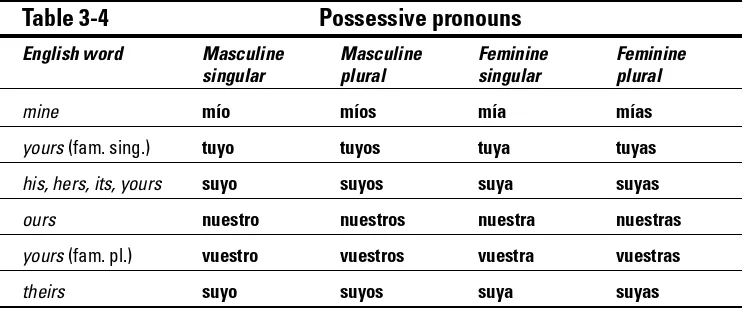
Replacing nouns with possessive pronouns...55
Answer Key ...57
Chapter 4: Writing in the Present with Action ...61
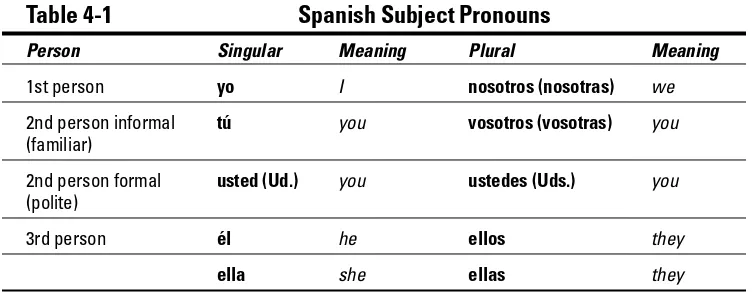
Using Subject Pronouns ...61
Applying subject pronouns...62
Omitting subject pronouns ...64
Writing (And Talking) in the Present ...64
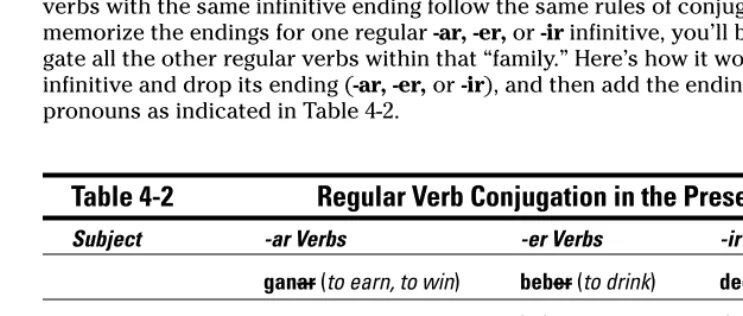
Regular verbs ...65
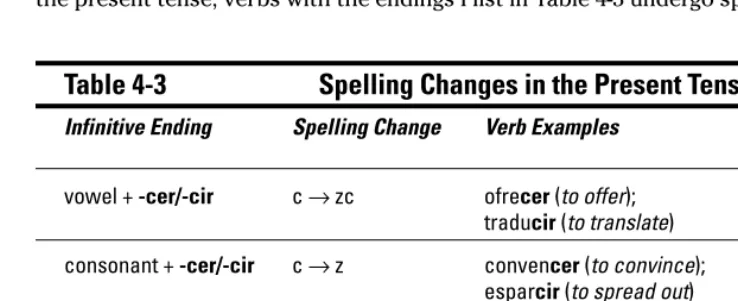
Verbs with spelling changes ...68
Verbs with stem changes...68
Verbs with spelling and stem changes ...71
Irregular verbs ...73
Expressions with irregular verbs ...76
Answer Key ...79
Chapter 5: Getting Answers with the Right Questions ...81
Inquiring in Spanish ...81
Asking yes/no questions ...81
Asking for information ...83
Becoming a Yes (Or No) Man: Answering Questions in Spanish ...88
Answering yes...88
Answering no ...88
Answering information questions ...91
Answer Key ...93
Chapter 6: Doing It Right Now: Gerunds and the Present Progressive ...95
Gerunds: Putting the -ing in Everything ...95
Forming the Gerunds of Regular Verbs ...96
Forming the Gerunds of Stem-Changing and Irregular Verbs...96
The Present Progressive: Expressing an Action in Progress ...98
Using estar...99
Using other verbs ...99
Answer Key ...103
x
Intermediate Spanish For Dummies
Chapter 7: Expressing Yourself with Subjunctive Feeling...105
Forming the Present Subjunctive...105
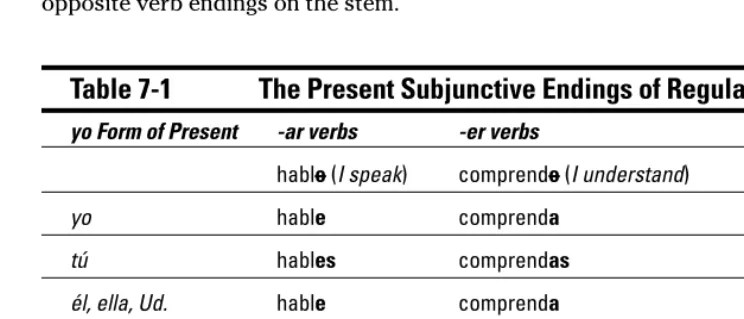
Regular verbs ...106
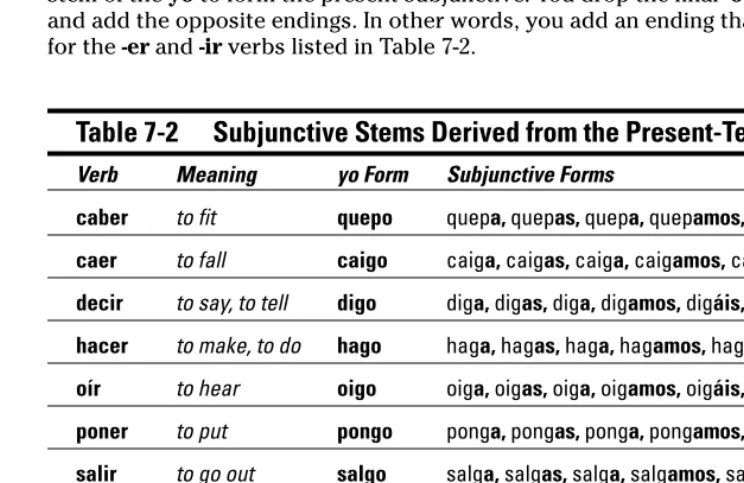
Verbs irregular in the yo form ...107
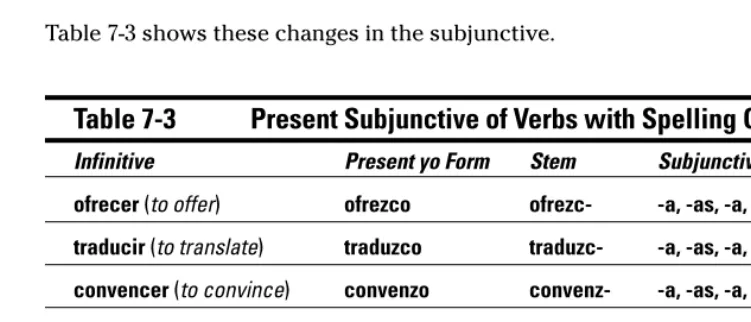
Verbs with spelling changes ...108
Verbs with stem changes...109
Verbs with spelling and stem changes ...110
Irregular verbs ...111
Spanning the Uses of the Present Subjunctive...113
After impersonal expressions...114
To express wishing, emotion, need, and doubt...117
After adjectives that express feelings or emotions ...119
In relative clauses...120
Answer Key ...122
Part III: Writing for Specific Clarity ...125
Chapter 8: Coloring Your Sentences with Adjectives and Adverbs...127
Describing People and Things with Adjectives...127
Agreement of adjectives ...128
Positioning of adjectives ...133
Shortened forms of adjectives...134
Describing Verbs with Adverbs...135
Forming adverbs...135
Positioning of adverbs ...138
Making Comparisons ...139
Comparisons of equality ...139
Comparisons of inequality ...140
The superlative...140
Irregular comparatives ...140
The absolute superlative...142
Answer Key ...143
Chapter 9: Getting Attention with Commands ...145
The Imperative Mood ...145
Forming Formal Commands ...146
Commanding with regular verbs ...146
Commanding with other verbs ...147
Issuing Informal Commands ...151
Giving singular commands with tú ...151
Giving plural commands with vosotros ...156
Answer Key ...162
Chapter 10: Being Clear and Concise with Object Pronouns...165
Dealing Directly with Direct Object Pronouns ...166
Understanding direct object pronouns ...166
Getting personal with the personal a ...167
Using Indirect Object Pronouns ...168
Selecting a Direct or an Indirect Object Pronoun ...170
Common Spanish verbs requiring a direct object ...171
Common Spanish verbs requiring an indirect object...171
xi
Table of Contents
Placing Object Pronouns Correctly ...172
Doing Double Duty with Double Object Pronouns ...174
Getting by with Gustar and Other Similar Verbs...176
Answer Key ...179
Chapter 11: Reflecting on Reflexive Pronouns and Verbs...181
Recognizing and Using Reflexive Verbs...181
Using Reflexive Verbs in Special Cases ...184
Considering Verbs with Special Reflexive Meanings ...186
Using Reflexive Pronouns ...188
Properly Placing Reflexive Pronouns ...190
Answer Key ...193
Chapter 12: Preparing to Connect with Prepositions...195
Reviewing Common Spanish Prepositions ...195
Distinguishing One Preposition from Another ...197
A ...197
De...198
En and hasta...198
Por and para...199
Focusing on Prepositions Used with Infinitives ...200
Spanish verbs requiring a ...200
Spanish verbs requiring de ...202
Spanish verbs requiring en ...202
Spanish verbs requiring con ...203
Spanish verbs requiring no preposition...203
Using Prepositional Pronouns ...205
Answer Key ...207
Part IV: Writing in the Past and in the Future ...209
Chapter 13: Leaving It Completely in the Past...211
Forming the Preterit ...211
Regular verbs ...211
Verbs with spelling changes ...213
Verbs with stem changes...215
Irregular verbs ...216
Using the Preterit ...221
Answer Key ...223
Chapter 14: Looking Back with the Imperfect...225
Perfecting the Imperfect...225
Forming the imperfect of regular verbs ...226
Forming the imperfect of irregular verbs...227
Uses of the Imperfect...228
Comparing the Preterit and the Imperfect...229
Clues to the preterit ...231
Clues to the imperfect ...231
Answer Key ...235
xii
Intermediate Spanish For Dummies
Chapter 15: Seeing into the Future ...239
Forming and Expressing the Future...239
Discussing the future by using the present ...239
Using ir + a to express the near future ...240
Sending regular verbs to the future ...241
Sending irregular verbs to the future ...243
Using the Future Tense to Foretell, Predict, and Wonder ...244
Answer Key ...247
Part V: The Part of Tens ...249
Chapter 16: Ten Most Common Writing Mistakes in Spanish ...251
Confusing Gender Differences ...251
Insisting on Word for Word Translations ...252
Forgetting the Personal a ...252
Using the Indefinite Article with an Unqualified Profession...252
Mixing Up Por and Para...253
Confusing Direct and Indirect Objects ...253
Misusing Gustar and Similar Verbs ...255
Forgetting about Idioms with Tener ...255
Using the Incorrect Past Tense (Preterit or the Imperfect)...256
Ignoring the Subjunctive ...256
Chapter 17: Ten Tips for Writing Well in Spanish...257
Write in Complete Sentences...257
Use Correct Punctuation ...258
Avoid Slang ...258
Steer Clear of False Assumptions...259
Watch Out for Subject/Verb Agreement ...259
Select the Appropriate Verb Tense/Mood...260
Correct Dangling Prepositions ...260
Select the Proper Pronoun...261
Rely on the Net and Your Computer...261
Proofread Your Work ...262
Chapter 18: Ten Important Verb Distinctions ...263
Ser versus Estar...263
Saber versus Conocer...264
Tomar versus Llevar ...264
Deber versus Tener Que...265
Preguntar versus Pedir...265
Jugar versus Tocar...265
Gastar versus Pasar ...266
Dejar versus Salir ...266
Volver versus Devolver ...266
Poder versus Saber...266
xiii
Table of Contents
Part VI: Appendixes ...267
Appendix A: Verb Charts ...269
Regular Verbs...269
-ar verbs...269
-er verbs...269
-ir verbs...270
Stem-Changing Verbs ...270
-ar verbs...271
-er verbs...271
-ir verbs...272
-uir verbs (except -guir)...272
-eer verbs...273
-iar verbs...273
-uar verbs ...273
Spelling-Change Verbs ...273
-car verbs...273
-gar verbs...274
-zar verbs...274
Consonant + -cer or -cir verbs ...274
Vowel + -cer or -cir verbs...274
-ger or -gir verbs ...275
-uir verbs ...275
Irregular Verbs...275
Appendix B: English-to-Spanish Dictionary...279
Appendix C: Spanish-to-English Dictionary...287
Index ...303
xiv
Intermediate Spanish For Dummies
Introduction
A
s someone who has surpassed the beginning level of Spanish, you consider yourself rather proficient in the language and want to discover more. So, here you are, eager to jump up to a higher level and perfect your skills. That’s fantastic! Whether you’re planning a trip, engaging in business with Spanish speakers, or are just a lover of languages, Intermediate Spanish For Dummieswill help you reach your goals painlessly and effortlessly as you enhance your Spanish language writing skills.When it comes to using a foreign language, you may be shy about speaking it, but I’m willing to bet that you’re much more intimidated by writing it. Writing demands a bit more precision. My main goal is to help you become more comfortable with your Spanish language writing skills.
Intermediate Spanish For Dummiesnot only presents you with all the grammar you need to know to communicate on an intermediate level, but also provides you with clear examples and interesting and useful exercises that will help you hone your Spanish writing skills. I give you the opportunity to put what you’ve learned to work and to express your thoughts and ideas in writing. If you can finish the exercises in a flash, you know you’ve mastered the mate-rial well. Some exercises, of course, present more of a challenge and require additional atten-tion and focus. That’s to be expected. Just keep in mind that after you finish all the chapters, you’ll be a full-fledged intermediate Spanish graduate! Feel free to brag to friends.
About This Book
Intermediate Spanish For Dummies is a refresher course, a reference book, and a workbook for people who have some experience with and knowledge of the fundamentals of Spanish and want to take their knowledge to the next level. It serves as a logical extension and com-plement to the ever-popular Spanish For Dummies, by Susana Wald (Wiley). If you want to get “up to speed” with language structures so that you can communicate comfortably and profi-ciently, especially with the written word, this book is for you.
Each chapter in this book presents a different topic that affords you the opportunity to prac-tice your written communication skills by completing, or actually writing, e-mails, postcards, text messages, journal entries, and letters. I reinforce nuances of style, usage, and grammar rules every step of the way so that you learn and practice how native speakers and writers use the language. I also include plenty of examples to guide you through the rules and exer-cises and to expose you to colloquial, everyday, correct Spanish that native speakers expect to hear from someone using Spanish.
Before you move on, I must reiterate an important point: This is a workbook! Don’t be afraid to write in it. Use your favorite pink highlighter or your trusty red pen to underline the points you want to remember. Don’t recite the exercise answers in your head! That doesn’t help you practice your writing skills. Put all the answers down on paper and commit to them before checking them in the Answer Key at the end of each chapter. This technique will help you get the most knowledge out of this book.
Conventions Used in This Book
In order to highlight the most important information and to help you navigate this book more easily, I’ve set up several conventions:
Spanish terms and sentences, as well as endings or stems I want to highlight, are set in boldfaceto make them stand out.
English equivalents, set in italics,follow the Spanish examples.
An Answer Key appears at the end of every chapter. The key provides the correct answers to all practice activities within the chapter. The parts of the answers that you must provide appear in bold. In the more difficult activities, I include explana-tions for the correct answers.
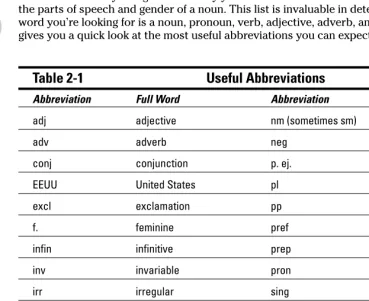
You’ll see many abbreviations throughout the book. Don’t let them throw you. For instance, you may find the following:
• fem. (feminine) • fam. (familiar) • masc. (masculine) • pol. (polite) • sing. (singular) • pl. (plural)
Here’s what you won’t find in this book: Tons of translation exercises. Why not? Because you can’t speak a foreign language colloquially or fluently if you try to trans-late your thoughts word for word from one language to the next. Language-acquisition experiments have proven that this learning method simply doesn’t work, so transla-tion exercises were long ago removed from textbooks across the country. To pick up a new language the way a child learns his or her first language, you must immerse your-self in the language so that you begin thinking in that language — and you can’t do that by slowly and painfully translating one word at a time.
You will find some guided compositions that prompt you to express certain thoughts in this book. Don’t, however, feel that you must translate the sentences given to you exactly as they appear. The Spanish language has its individual idioms and idiomatic expressions that give it color and flair. Here’s a quick example: To say that it’s sunny outside in Spanish, you remark: Hace sol.The literal English translation of this expres-sion is It is making sun.Even my dear old grandma wouldn’t have spoken English like that! Well, make sure you don’t speak Spanish that way, either.
Foolish Assumptions
When writing this book, I made the following assumptions about you, my dear reader: You have some experience with and knowledge of the fundamentals of Spanish
grammar. You’re looking for the opportunity to review what you’ve already mas-tered and are intent on moving forward to new areas of knowledge.
2
Intermediate Spanish For Dummies
You can speak Spanish fairly well and are more interested in improving your writ-ing skills.
You want to perfect your Spanish because you’re planning a trip, conducting business, or are a foreign-language student.
You want to speak and write Spanish colloquially, like a native does, and you want to use Spanish in practical, everyday applications.
You want a book that’s complete but isn’t so advanced that you get lost in the rules. I try to explain the rules as clearly as possible without using too many grammatical terms. I’ve left out the most advanced grammar because you simply don’t need it to be understood in everyday situations. Keep it clean and simple and you’ll do just fine, and others will appreciate your honest attempts at com-municating in another language.
How This Book Is Organized
I’ve divided Intermediate Spanish For Dummiesinto six parts so that you can focus on whatever suits your fancy at the moment. Feel free to skip parts that you feel you already know or that are irrelevant to you. The following sections outline the focus of the six parts of this book.
Part I: Reviewing the Basics
In this part, you review the vocabulary and knowledge of numbers that you need daily when using Spanish. Right from the first chapter, you’re given a working vocabulary that will help you express yourself in most situations. I also give a quick grammar review as a refresher to what you’ve mastered on the elementary level. Finally, although you may think you’re a pro at finding the right word in the dictionary, this part will show you how to avoid making common errors.
Part II: Writing in the Present
This part shows you how to write in the present tense, using verbs that are regular and verbs that are really quite quirky. You practice asking and answering yes/no questions, as well as questions that ask for information. I also introduce the present progressive tense, which allows you to express actions that are taking place as we speak, and the mysteries of the present subjunctive — with clear explanations and examples.
Part III: Writing for Specific Clarity
This part takes you on a tour of fundamental Spanish grammar: nouns, adjectives, adverbs, comparisons, direct and indirect object pronouns, commands, reflexive verbs, and prepositions. These topics reflect the building blocks of the language; you just can’t write clearly without them. You discover how Spanish differs from English because of rules regarding gender (masculine or feminine forms of nouns
3
Introduction
and adjectives). You find out where to properly place the parts of speech in a sen-tence. And oddly enough, in this part, you learn things about English you never knew because no English teacher ever mentioned this grammar in any of your classes.
Part IV: Writing in the Past and in the Future
Part IV presents the two main past tenses in Spanish: the preterit and the imperfect. You find out how to form each of these tenses, and you review the conditions where they must be used. This exercise is particularly important because there’s no English equivalent of the imperfect, making its use a bit strange to many people. You also see how to express what you’re going to do in the future.Part V: The Part of Tens
The three Tens chapters in this part will help you to improve your writing skills. I show you the ten most common writing mistakes people make in Spanish so that you can avoid them at all costs. You get ten tips that will show you how to write better sentences and steer clear of common grammar mistakes. Finally, you discover how to select which Spanish verb to use when two of them seem to have the same English definition.
Part VI: Appendixes
The final part is where you find the important reference material. Here you get multi-ple verb charts that give the conjugations for all types of verbs in all types of Spanish tenses and moods. This appendix will prove to be an invaluable tool when you need a quick reference guide. The other two appendixes in this part provide comprehensive Spanish to English and English to Spanish dictionaries, to which you can refer when you’re doing chapter exercises.
Icons Used in This Book
Icons are those cute little drawings on the left side of the page that call out for your attention. They signal a particularly valuable piece of information, a rule that you should consider to avoid making an unnecessary error, or a list of exercises that you can complete. Here’s a list of the icons in this book:
Remember icons call your attention to important information about the language — something you shouldn’t neglect or something that’s out of the ordinary. Don’t ignore these paragraphs.
Tip icons are there to show you explicitly how to execute a task. Tips present time-saving tidbits that make communication quick and effective. If you want to know the proper way to do things, check out the Tip icons first.
4
Intermediate Spanish For Dummies
The Differences icon points out certain differences between English and Spanish. If you want to know how Spanish constructions differ from those in English, these are the paragraphs you need to consult.
Practice icons flag exercises, which is where you need to go to put the grammar rules you read about into action. Language theory is grand, but if you can’t apply it properly, it really isn’t worth very much. The practice exercises are your golden opportunity to hone your Spanish skills.
Where to Go from Here
One great thing about this book (and all For Dummiesbooks) is that you don’t have to follow it chapter by chapter from the very beginning to the (not-so) bitter end. You can start where you like and jump all over the place if that is your pleasure. Each chapter stands on its own and doesn’t require that you complete any of the other chapters in the book. This saves you a lot of time if you’ve mastered certain topics but feel a bit insecure or hesitant about others.
So, go ahead and jump right in. Get your feet wet. If you’re not sure exactly where to begin, take a good look at the table of contents and select the topic that seems to best fit your abilities and needs. If you’re concerned that your background may not be strong enough, you can start at the very beginning and slowly work your way through the book. If you feel confident and self-assured, skip right to the practice exercises and see how well you do. Because each lesson is an entity unto itself, you can hop around from the middle to the front to the back without missing a beat.
An important thing to keep in mind is that this isn’t a race and it isn’t a contest. Work at a pace that best suits your needs. Don’t hesitate to read a chapter a second or third or even a fourth time several days later. You may even want to repeat some exercises. This is a book that you can easily adapt to your learning abilities. Remember, too, that you need to have a positive, confident attitude. Yes, you’ll make mistakes. Everyone does — as a matter of fact, many native Spanish speakers do all the time. Your main goal should be to write and speak as well as you can; if you trip up and conjugate a verb incorrectly or use the feminine form of an adjective rather than the masculine form, it isn’t the end of the world. If you can make yourself understood, you’ve won the greatest part of the battle.
5
Introduction
6
Intermediate Spanish For Dummies
Part I
Reviewing the Basics
In this part . . .
T
he easiest way to get some Spanish vocabulary under your belt and to feel like you’re making immediate progress in your writing skills is to take a brief refresher course so you can review the basics. The chapters in Part I show you how much you already know.Chapter 1
Looking at Some Everyday Basics
In This Chapter
Mastering your Spanish cardinal and ordinal numbers
Expressing dates as Spanish speakers do
Discussing time effectively and efficiently
W
hether you’re a student, a traveler, a businessperson, or just someone interested in learning and using Spanish, knowing numbers, expressing dates, and relating the time of day are essential skills you’ll need in everyday life. Students must follow a schedule, keep track of due dates, and be able to discuss the grades they receive. Travelers and many businesspeople must refer to flight numbers; departure and arrival times and dates; gate, pier, or track numbers; and currency exchange rates.In addition, businesspeople must keep track of the dates and times of important appoint-ments (this goes for students and travelers, too), the value of certain currencies, and inter-est rates. Surely, the ability to communicate numbers, times, and dates is completely indispensable to you no matter your background, concerns, or interests.
This chapter provides a review of everyday basics that you’ll have to speak and write about. I review both cardinal numbers (the ones used to count) and ordinal numbers (the ones used to express numbers in a series), and I recap how you use these numbers to express dates and times of day (or night). By the time you review all the material in this chapter, you’ll be a pro at doing the right thing at the right time — for the least amount of money!
Focusing on Spanish Numbers
I start off this chapter with numbers because you need them in order to express dates and tell time. And when I talk numbers, I’m talking cardinal and ordinal numbers. You use cardi-nal numbers(the more popular of the two) to count, to bargain with a merchant about a price, to express the temperature, or to write a check. You use ordinal numbersto express the number of a floor, the act of a play, or the order of a person in a race or competition.
Cardinal numbers
You use cardinal numbers many times every day. As a matter of fact, you probably use them at least once an hour in the course of normal conversation or in writing. The Spanish cardi-nal numbers are as follows:
10
Part I: Reviewing the Basics
Number Spanish Number Spanish
0 cero 25 veinticinco (veinte y cinco)
1 uno 26 veintiséis (veinte y seis)
2 dos 27 veintisiete (veinte y siete)
3 tres 28 veintiocho (veinte y ocho)
4 cuatro 29 veintinueve (veinte y nueve)
5 cinco 30 treinta
6 seis 40 cuarenta
7 siete 50 cincuenta
8 ocho 60 sesenta
9 nueve 70 setenta
10 diez 80 ochenta
11 once 90 noventa
12 doce 100 cien (ciento)
13 trece 101 ciento uno
14 catorce 200 doscientos
15 quince 500 quinientos
16 dieciséis (diez y seis) 700 setecientos
17 diecisiete (diez y siete) 900 novecientos
18 dieciocho (diez y ocho) 1.000 mil
19 diecinueve (diez y nueve) 2.000 dos mil
20 veinte 100.000 cien mil
21 veintiuno (veinte y uno) 1.000.000 un millón
22 veintidós (veinte y dos) 2.000.000 dos millones
23 veintitrés (veinte y tres) 1.000.000.000 mil millones
24 veinticuatro (veinte y cuatro) 2.000.000.000 dos mil millones
English speakers generally write the number 1 in one short, downward stroke. In the Spanish-speaking world, however, the number 1 has a little hook on top, which makes it look like a 7. So, in order to distinguish a 1 from a 7, you put a line through the 7, which makes it look like this: 7.
You need to remember the following rules when using cardinal numbers in Spanish: Uno (one), used only when counting, becomes unbefore a masculine noun and
unabefore a feminine noun, whether the noun is singular or plural:
•uno, dos, tres(one, two, three)
•un niño y una niña(a boy and a girl)
•sesenta y un dólares(61 dollars)
•veintiuna (veinte y una) personas(21 people)
11
Chapter 1: Looking at Some Everyday Basics
You use the conjunction y(and) only for numbers between 16 and 99. You don’t use it directly after hundreds:
•ochenta y ocho(88)
•doscientos treinta y siete(237)
You generally write the numbers 16–19 and 21–29 as one word. The numbers 16, 22, 23, and 26 have accents on the last syllable:
• 16: dieciséis • 22: veintidós • 23: veintitrés • 26: veintiséis
When used before a masculine noun, veintiún(21) has an accent on the last syllable:
•veintiún días(21 days)
•veintiuna semanas(21 weeks)
Ciento(100) becomes cienbefore nouns of either gender and before the
num-bers miland millones.Before all other numbers, you use ciento. Un (one), which you don’t use before cien(to)or mil, comes before millón.When a noun follows millón,you put the preposition debetween millónand the noun. Millón drops its accent in the plural (millones):
•cien sombreros(100 hats)
•cien blusas(100 blouses)
•cien mil millas(100,000 miles)
•cien millones de dólares(100 million dollars)
•ciento noventa acres(190 acres)
•mil posibilidades(1,000 possibilities)
•un millón de razones(1,000,000 reasons)
In compounds ofciento(doscientos, trescientos), there must be agreement with a feminine noun:
•cuatrocientos pesos(400 pesos)
•seisientas pesetas(600 pesetas)
When it comes to numerals and decimals, Spanish uses commas where English uses periods, and vice versa:
English Spanish
In most instances, people simply write numerals when they need to express numbers. However, when you write checks, the transactions won’t take place unless you write out the amounts of the checks in words. For this exercise, fill in the incomplete checks with the written Spanish numbers.
Juan Gómez
1000 Calle Cruz Madrid, España
Julia López
1,595
103
00-000/000
Páguese a la orden de
EUROS
€ 20 (Fecha)
Banco Nacional de España 1111 Avenida Cristóbal Colón
Madrid, España
MEMORÁNDUM
FIRMA AUTORIZADA
Juan Gómez
1000 Calle Cruz Madrid, España
José Martín
621
102
00-000/000
Páguese a la orden de
EUROS
€ 20 (Fecha)
Banco Nacional de España 1111 Avenida Cristóbal Colón
Madrid, España
MEMORÁNDUM
FIRMA AUTORIZADA
Juan Gómez
1000 Calle Cruz Madrid, España
Geraldo Nuñez
79
101
00-000/000
Páguese a la orden de
EUROS
€ 20 (Fecha)
Banco Nacional de España 1111 Avenida Cristóbal Colón
Madrid, España
MEMORÁNDUM
FIRMA AUTORIZADA
12
Part I: Reviewing the Basics
Ordinal numbers
You useordinal numbers— those used to express numbers in a series — far less fre-quently than cardinal numbers, but they still have some very important applications in everyday life. Perhaps when you go to work, you must ask for your floor in an elevator. During a job interview or on a college application, you may have to express where you placed in your class standings. The following chart presents the Spanish ordinal numbers:
Ordinal Spanish 1st primero 2nd segundo 3rd tercero 4th cuarto 5th quinto 6th sexto 7th séptimo 8th octavo 9th noveno 10th décimo
Juan Gómez
1000 Calle Cruz Madrid, España
Roberto Cádiz
984,862
105 Banco Nacional de España
1111 Avenida Cristóbal Colón Madrid, España
00-000/000 Páguese a
la orden de
EUROS
€
MEMORÁNDUM
FIRMA AUTORIZADA
20 (Fecha)
Juan Gómez
1000 Calle Cruz Madrid, España
Luz Cabral
42,717
104
00-000/000 Páguese a
la orden de
EUROS
€ 20 (Fecha)
Banco Nacional de España 1111 Avenida Cristóbal Colón
Madrid, España
MEMORÁNDUM
FIRMA AUTORIZADA
13
Chapter 1: Looking at Some Everyday Basics
14
Part I: Reviewing the Basics
The following list outlines everything you must remember when using ordinal num-bers in Spanish:
Spanish speakers rarely use ordinal numbers after “10th.” After that, they usually use cardinal numbers in both the spoken and written language:
•el séptimo mes(the seventh month)
•el siglo quince(the 15th century)
Ordinal numbers must agree in gender (masculine or feminine) with the nouns they modify. You can make ordinal numbers feminine by changing the final -oof the masculine form to -a:
•el cuarto día(the fourth day)
•la cuarta vez(the fourth time)
Primeroand tercerodrop the final -obefore a masculine singular noun:
•el primer muchacho(the first boy)
•el tercer hombre (the third man)
The Spanish ordinal numbers may be abbreviated. You use the superscript ofor masculine nouns and the superscript afor feminine nouns. And you use eronly for the abbreviations of primerand tercer:
•primero(a):1o(a)
•segundo(a):2o(a)
•tercero(a):3o(a) •cuarto(a):4o(a)
•primer:1er
•tercer:3er
A cardinal number that replaces an ordinal number above 10th is always mascu-line, because the masculine word número(number) is understood:
la calle (número) ciento y dos(102nd Street)
In dates, primerois the only ordinal number you use. All other dates call for the cardinal numbers:
•el primero de mayo(May 1st)
•el doce de enero(January 12th)
In Spanish, cardinal numbers precede ordinal numbers:
las dos primeras escenas(the first two scenes)
You use cardinal numbers when expressing the first part of an address:
mil seiscientos Avenida Pennsylvania(1600 Pennsylvania Avenue)
A business associate is visiting from Spain and needs some help. Respond to her e-mail by telling her which floor of the building will provide the assistance she needs. Write out the ordinal numbers. Consult the following directory of offices:
Edificio Cabeza de Vaca
Restaurante El Marino 10o Cabrera y Cabrera, abogados 9o Juan Cruz, contable 8o
Ana Vásquez, asesora fiscal 7o
Santiago López, reparaciones de computadores 6o Rosita Rosario, sistemas de seguridad 5o
Carmen Sánchez, teléfonos celulares 4o María Rodrigo, servicio de mensajero 3o Alejandro Morales, rótulos y logos 2o Tintorería Ruíz 1o
New Message
File
Send
Subject
Copy Paste Undo Check
Cut
Edit View Insert Format Tools Message Help
+
abc
4
From:
To:
Cc:
Querido Lector,
¿Puede Ud. ayudarme? Tengo estos problemas: 6. Necesito un experto en la ley.
7. Quiero instalar una alarma en mi oficina. 8. ¿Dónde puedo comer?
9. Tengo que consultar un experto financiero.
10. ¿Hay alguien que pueda ayudarme con los impuestos? 11. Tengo ropa sucia.
12. Tengo que enviar paquetes a varias compañías. 13. Necesito publicidad.
14. Perdí mi teléfono celular. 15. Mi computadora no funciona. ¿Adónde puedo ir?
Marina
15
Chapter 1: Looking at Some Everyday Basics
Making Dates
Dates are important parts of everyday life (in more ways than one!). If you’re writing a paper with a strict due date, leaving on vacation and need flight confirmations, or scheduling appointments for your clients and customers, you need to know how to express dates. To write out dates in Spanish, which I have you do later in this section, you have to practice the days of the week, the months of the year, and numbers (see the previous section).
Days
If you hear ¿Qué día es hoy?someone must have forgotten what day of the week it is. You should respond with Hoy es . . .(Today is . . .) and then provide the name of one of the days I list here:
New Message
File
Send
Subject
Copy Paste Undo Check
Cut
Edit View Insert Format Tools Message Help
+
abc
4
From:
To:
Cc:
Querida Marina,
6. Vaya al piso.
7. Vaya al piso.
8. Vaya al piso.
9. Vaya al piso.
10. Vaya al piso.
11. Vaya al piso.
12. Vaya al piso.
13. Vaya al piso.
14. Vaya al piso.
15. Vaya al piso.
16
Part I: Reviewing the Basics
17
Chapter 1: Looking at Some Everyday Basics
English Spanish
Monday lunes
Tuesday martes
Wednesday miércoles
Thursday jueves
Friday viernes
Saturday sábado
Sunday domingo
Unlike the English calendar, the Spanish calendar starts with Monday. Here are two more guidelines for talking about days of the week in Spanish:
Unless you use them at the beginning of a sentence, you don’t capitalize the days of the week in Spanish:
•Lunes es un día de vacaciones.(Monday is a vacation day.)
•Lunes y martes son días de vacaciones.(Monday and Tuesday are vacation
days.)
You use elto express onwhen referring to a particular day of the week and losto express onwhen the action occurs repeatedly:
•No trabajo el sábado.(I’m not working on Saturday.)
•No trabajo los sábados. (I don’t work on Saturdays.)
With the exception of sábadoand domingo,the plural forms of the days of the week are the same as the singular forms:
Singular Plural
lunes lunes
martes martes
miércoles miércoles
jueves jueves
viernes viernes
sábado sábados
domingo domingos
Months
English Spanish
January enero
February febrero
March marzo
April abril
May mayo
June junio
July julio
August agosto
September septiembre(or setiembre) October octubre
November noviembre
December diciembre
Like days of the week, the months aren’t capitalized in Spanish:
Junio es un mes agradable. (June is a nice month.)
Junio y julio son meses agradables. (June and July are nice months.)
In South American countries south of the equator, the seasons of the year are reversed. For example, when it’s snowing in the United States, the sun is shining south of the equator.
In Spanish, the seasons are masculine except for la primavera(the spring):
el invierno(the winter)
la primavera(the spring)
el verano(the summer)
el otoño(the autumn [fall])
Writing dates
If you want to ask a passerby or an acquaintance about the date, politely inquire
¿Cuál es la fecha de hoy? (What is today’s date?) The person should respond with
Hoy es . . . (Today is . . .) and then use the following formula to express the correct
date:
day + (el) + cardinal number (except for primero) + de+ month + de+ year The following is an example translation, using this formula:
Sunday, April 15, 2008:Hoy es domingo, el quince de abril de dos mil ocho.
18
Part I: Reviewing the Basics
19
Chapter 1: Looking at Some Everyday Basics
Now that you have a handy formula, you need to know a few more details about writ-ing dates in Spanish:
You express the first day of each month with primero.You use cardinal numbers for all other days:
•el primero de enero(January 1st)
•el siete de enero(January 7th)
•el treinta de octubre(October 30th)
Use elto express onwith Spanish dates:
Partimos el once de octubre.(We are leaving on October 11th.)
In Spanish, you express years in thousands and hundreds, not only in hundreds: 1492: mil cuatrocientos noventa y dos(fourteen hundred ninety-two)
In Spanish, when dates are written as numbers, they follow the sequence day/month/ year, which may prove confusing to English speakers — especially for dates below the 12th of the month:
You write February 9thas 2/9 in English, but in Spanish it’s 9/2.
When speaking of dates in everyday language, the words and expressions that follow may come in handy:
English Spanish English Spanish
a day un día day before yesterday anteayer
a week una semana yesterday ayer
a month un mes today hoy
a year un año tomorrow mañana
in en tomorrow morning mañana por la mañana
ago hace tomorrow afternoon mañana por la tarde
per por tomorrow night mañana por la noche
during durante day after tomorrow pasado mañana
next próximo(a) from desde
last pasado(a) a week from today de hoy en una semana
last(in a último(a) two weeks from tomorrow de mañana en dos semanas series)
eve la víspera within one (two) week(s) dentro de una (dos) semana(s)
You’re writing a paper for your Spanish class on famous Hispanic men who fought for the independence of their country. Fill in the dates of their births and deaths in Spanish:
16.(August 20, 1778–October 24, 1842) Bernardo O’Higgins, hombre que luchó por la independencia de Chile, nació __________________________________ y murió __________________________________.
17.(May 8, 1753–July 30, 1811) Miguel Hidalgo, iniciador de la revolucion mexicana, nació __________________________________ y murió __________________________________. 18.(July 24, 1783–December 17, 1830) Simón Bolívar, libertador y hombre dominante de la independencia de Suramérica nació __________________________________ y murió __________________________________.
19.(January 28, 1853–May 19, 1895) José Martí, espíritu de la lucha por la independencia de Cuba, nació __________________________________ y murió
__________________________________.
Telling Time
If you’re anything like me, you consult your watch or a clock on a nearby wall several times a day. Knowing how to understand, speak, and write time-related words and phrases is a must for anyone who’s studying a foreign language and planning to put these studies to use (to do some traveling one day, for instance).
If you hear ¿Qué hora es?someone wants to know the time. You should start by responding with the following:
Es la una+ 1 o’clock hour or Son las+ any time after 1
To express the time after the hour (but before half past the hour), use y(and) and the number of minutes. Use menos(less) + the number of the following hour to express the time before the next hour (after half past the hour).
You can also express time numerically (as shown in the third example here):
Es la una y media.(It’s 1:30.)
Son las cinco menos veinte.(It’s 4:40.)
Son las cuatro y cuarenta.(It’s 4:40.)
If you want to discuss atwhat time a particular event will occur, you can use a question — ¿A qué hora . . . ?— or answer with A la unaor A las+ any time after 1:
¿A qué hora vienen?(At what time are they coming?)
A la una.(At 1:00.)
A las tres y cuarto.(At 3:15.)
The following chart shows how to express time after and before the hour:
20
Part I: Reviewing the Basics
Time Spanish
1:00 la una
2:05 las dos y cinco
3:10 las tres y diez
4:15 las cuatro y cuartoorlas cuatro y quince
5:20 las cinco y veinte
6:25 las seis y veinticinco
7:30 las siete y mediaor las siete y treinta
7:35 las ocho menos veinticincoor las siete y treinta y cinco
8:40 las nueve menos veinteor las ocho y cuarenta
9:45 las diez menos cuartoor las nueve y cuarenta y cinco
10:50 las once menos diezor las diez y cincuenta
11:55 las doce menos cincoor las once y cincuenta y cinco
noon el mediodía
midnight la medianoche
When expressing time, the words and expressions I present in the following table may come in handy:
English Spanish English Spanish Phrase Equivalent Phrase Equivalent
a second un segundo in an hour en una hora
a minute un minuto in a while dentro de un rato
a quarter of un cuarto until ten hasta las diez
an hour de hora o’clock
an hour una hora before nine o’clock antes de las nueve
a half hour una media hora after seven o’clock después de las siete
in the morning por la mañana since what time? ¿desde qué hora? (a.m.)
in the afternoon por la tarde since eight o’clock desde las ocho (p.m.)
in the evening por la noche one hour ago hace una hora (p.m.)
at what time? ¿a qué hora? early temprano
at exactly nine a las nueve late tarde
o’clock en punto
at about two
o’clock a eso de las dos late (in arriving) de retraso
21
Chapter 1: Looking at Some Everyday Basics
One of your friends, Soledad, is very curious about your other friends’ comings and goings. She wrote Marta an e-mail asking for information. Read the information pro-vided by Soledad and then answer each question in her e-mail by giving the correct time in Spanish.
New Message
File
Send
Subject
Copy Paste Undo Check
Cut
Edit View Insert Format Tools Message Help
+
abc
4
From:
To:
Cc:
Querida Marta,
20. Son las siete y media. Ernesto llegó a casa hace una hora y cuarto. ¿A qué hora llegó a casa?
21. Margarita quiere ir a un partido de fútbol. El
partido empieza a las cuatro y cinco y dura dos horas y cuarenta y cinco minutos. ¿A que hora va a terminar el partido?
22. Carlota fue al doctor a las once y veinte de la mañana. Ella pasó dos horas y media allá. ¿A qué hora salió de su consultorio?
23. A las tres y cuarto Marco fue al club de español. Puede pasar una hora y cuarto allá y después tiene que regresar a casa. ¿A qué hora saldrá del club? 24. Juanita tiene que guardar a su hermano menor. A las cinco y media Juanita ya estaba en el parque con sus compañeras de clase. Ella las dejó después de quince minutos. ¿A qué hora dijo “adiós” a sus compañeras?
22
Part I: Reviewing the Basics
You’re traveling from Barcelona to Madrid; on your way, you must check the Tren (train) schedule. Write out all the numbers and times you see in Spanish.
Barcelona a Madrid
Número del tren Salida Llegada Duración del viaje (1) Cargo por ventas
01578 07:00 12:00 DIARIO Turista: 65.30 del 19-03-2007 Turista Niños: 39.20 hasta el 31-05-2007 Primera Clase: 101.20
Primera Clase Niños: 60.75
New Message
File
Send
Subject
Copy Paste Undo Check
Cut
Edit View Insert Format Tools Message Help
+
abc
4
From:
To:
Cc:
Querida Soledad,
20. 21. 22. 23. 24.
Marta
23
Chapter 1: Looking at Some Everyday Basics
Barcelona a Madrid
Número del tren Salida Llegada Duración del viaje (1) Cargo por ventas
_____ _____ _____ DIARIO Turista: _____ del _________________ Turista Niños: _____ hasta que el__________ Primera Clase: _____
Primera Clase Niños: _____
24
Part I: Reviewing the Basics
Answer Key
a
Check 101: setenta y nueveb
Check 102: seiscientos veintiunoc
Check 103: mil quinientos noventa y cincod
Check 104: cuarenta y dos mil setecientos diecisietee
Check 105: novecientos ochenta y cuatro mil ochocientos sesenta y dosf
noveno.The lawyer is on the 9th floor.g
quinto.The alarm company is on the 5th floor.h
décimo.The restaurant is on the 10th floor.i
séptimo.The financial consultant is on the 7th floor.j
octavo.The accountant is on the 8th floor.k
primer.The laundry service is on the 1st floor.l
tercer.The delivery service is on the 3rd floor.m
segundo.The sign company is on the 2nd floor.n
cuarto.The cellphone company is on the 4th floor.o
sexto. The computer-repair company is on the 6th floor.p
el veinte de agosto de mil setecientos setenta y ochoel veinticuatro de octubre de mil ochocientos cuarenta y dos
q
el ocho de mayo de mil setecientos cincuenta y tresel treinta de julio de mil ochocientos once
r
el veinticuatro de julio de mil setecientos ochenta y tresel diecisiete de diciembre de mil ochocientos treinta
s
el veintiocho de enero de mil ochocientos cincuenta y tresel diecinueve de mayo de mil ochocientos noventa y cinco
t
Ernesto llegó a casa a las seis y cuarto.(Ernesto arrived home at 6:15.)u
El partido va a terminar a las siete menos diez.(The match is going to end at 6:50.)v
Salió del consultorio del doctor a la una y cincuenta.(She left the doctor’s office at 1:50.)25
Chapter 1: Looking at Some Everyday Basics
w
Marco saldrá del club a las cuatro y media.(Marco will leave the club at 4:30.)x
Juanita dijo “adiós” a sus compañeras a las seis menos cuarto. (Juanita said “goodbye” to herfriends at 5:45.)
Barcelona a Madrid
Número Salida Llegada Duración del viaje (1) Cargo por ventas del tren
mil quinientos las siete el mediodía DIARIO Turista: sesenta y del diecinueve de marzo cinco euros treinta
de mil novecientos siete Turista Niños:
hasta el treinta y treinta y nueve uno de mayo de mil euros veinte novecientos siete Primera Clase:
ciento uno euros veinte
Primera Clase Niños:
sesenta euros setenta y cinco
26
Part I: Reviewing the Basics
Chapter 2
Selecting the Proper Part of Speech
In This Chapter
Differentiating between the various parts of speech
Selecting the correct word for every situation
Perfecting your use of a bilingual dictionary
Y
ears ago, diagramming sentences was an essential topic covered in English grammar class. Most students preferred to read the steamy, famous novel du jour,but they were forced to sit in class, pen (and sometimes ruler) in hand, figuring out where to place a noun, a verb, or an elusive direct or indirect object. Many old timers such as myself still remember this experience with a certain amount of distaste. Those tedious exercises, however, have served many of us very well in our careers; we’re now tempted to mark up the grammar errors we see on signs, menus, and correspondences. For those who want to transfer that ability — the ability to understand, write, speak, and correct the “Queen’s Spanish” — this chapter is essential reading.In this chapter, I provide a quick course on identifying and using the parts of speech that make Spanish sentences grammatically correct. Specifically, you discover how to recognize verbs, nouns, adjectives, adverbs, and pronouns, and you get some practice in using them properly. Also, finding the correct word in a bilingual dictionary can be a tricky task. Don’t worry, help is here! I show you how to navigate both sides of the vocabulary lists so that you don’t make a mistake.
Identifying and Using Parts of Speech
28
Part I: Reviewing the Basics
Nouns
A nounis the part of speech that refers to a person, place, thing, quality, idea, or action. Here are some examples of nouns in action:
Person: The boyis friendly. (Elmuchachoes amable.) Place: I want to go home. (Quiero ir a casa.)
Thing: I would like to see that book.(Quisiera ver ese libro.) Quality: I admire her courage. (Admiro su coraje.)
Idea: Communismis a political theory. (Elcomunismoes una teoría política.) Action: The plane’s departureis imminent. (La partidadel avión es inminente.) In everyday speaking/writing, you’ll use nouns most often in the following forms:
As the subject of a verb:
Maryspeaks Spanish. (Maríahabla español.) As the direct object of a verb:
I see Mary. (Yo veo a María.) As the indirect object of a verb:
I speak to Mary.(Yo le hablo a María.) As the object of a preposition:
I went out with Mary. (Yo salí con María.)
Unlike English nouns, all Spanish nouns have a gender: masculine or feminine. All words you use to qualify or describe a noun must agree with the noun with respect to gender. I discuss this in more detail in Chapter 3.
The Spanish language classifies nouns as common or proper, collective, or concrete or abstract. A common nounrefers to a general class of persons, things, places, and so on:
Elhombrees alto. (The man is tall.)
Losedificiosson modernos. (The buildings are modern.)
Me gustan los deportes.(I like sports.)
A proper nounis the specific name of a person, thing, place, and so on:
George Washingtonfue un presidente. (George Washington was a president.)
Guernicaes una pintura por Picasso. (Guernica is a painting by Picasso.)
Españaes un país en Europa. (Spain is a country in Europe.)
A collective nounis used singularly and refers to a group:
Mi familiaes pequeña. (My family is small.)
29
Chapter 2: Selecting the Proper Part of Speech
A concrete nounrefers to something that you can perceive with your senses; an abstract nounrefers to an idea:
Concrete: El aguaes azul. (The water is blue.) Abstract: El odioes un vicio. (Hate is a vice.)
Pronouns
A pronounis a part of speech used in place of a noun. The following list outlines the pronouns I discuss in this book:
Demonstrative pronouns (see Chapter 3) expressthis, that, these,and those: Show me that.(Muéstreme eso.)
Subject pronouns (see Chapter 4) are followed by the verb expressing the main action in the sentence (I, you, he, she, it, we, they):
Youare nice. (Ud.es simpático.)
Possessive pronouns (see Chapter 3) indicate that something belongs to a specific person (my, your, his, her, its, our, their):
That’s myumbrella. (Es miparaguas.)
Interrogative pronouns (see Chapter 5) ask a question (who, which, what,and so on):
Who is that?(¿Quiénes?)
Direct object pronouns (see Chapter 10) replace direct object nouns; they answer whoor whatthe subject is acting upon. The direct object pronouns are me, te, lo, la(lein Spain),nos, (os in Spain),los, andlas(lesin Spain): I’ll be seeing you.(Teveo.)
Indirect object pronouns (see Chapter 10) replace indirect object nouns; they explain toor forwhom something is done. They include me, te, le, nos, (os in Spain), andles:
He wrote to me. (Meescribió.)
Reflexive pronouns (see Chapter 11) show that the subject is acting upon itself (me, te, se, nos, [os in Spain]):
They wake up early. (Ellos sedespiertan temprano.)
Prepositional pronouns (see Chapter 12) are used after prepositions (mí, ti, él,
ella, Ud., nosotros, vosotros (in Spain),ellos, ellas, Uds.):
They’re going to the movies without me.(Van al cine sin mí.)
The prepositional pronouns míand tibecome migoand tigo,respectively, after the preposition con(with):
30
Part I: Reviewing the Basics
Verbs
A verbis a part of speech that shows an action or a state of being. In Spanish, as in English, verbs change from their infinitive form (they’re conjugated, in other words) as follows:
To agree with the person performing the action (I, you, he, she, it, we, they) To indicate the time when the action was performed (past, present, future) To indicate the mood (subjunctive, imperative) of the action
The infinitiveof the verb is its “raw” form — its “to” form before it’s conjugated. Infinitives in Spanish have three different endings, and you conjugate them according to these endings: -ar, -er,and -irwhen a subject is present or is implied. The following presents a sample conjugation of to swim:
nadar(to swim)
He likes to swim. Le gusta nadar.
He swimsrather well. Él nadabastante bien.
We swimwell, too. Nosotrosnadamos bien también.
Verbs are classified as transitive or intransitive. A transitive verbmust be followed by a direct object to complete its meaning:
I opened the door. (Yo abrí la puerta.) An intransitive verbdoesn’t require an object:
I understand. (Yo comprendo.)
You can use some verbs both transitively and intransitively:
She speaksSpanish. (Ella hablaespañol.)
She speakswell. (Ella hablabien.)
Also, a verb may be used reflexively or reciprocally to show that the subject is acting upon itself (see Chapter 11):
I washed myself. (Yo me lavé.)
They love each other. (Ellos se aman.)
Adjectives
An adjectiveis a part of speech that describes a noun: The house is white. (La casa es blanca.)
31
Chapter 2: Selecting the Proper Part of Speech
A Spanish adjective can have other applications, too, which I outline in the follow-ing list:
A possessive adjective tells to whom the noun belongs: It’s mybook. (Es milibro.)
A demonstrative adjective shows this, that, these, orthose: Thatfilm is good. (Esapelícula es buena.)
An interrogative adjective asks the question whose, which, or what:
Whosecar is that? (¿De quiénes ese coche?)
An indefinite adjective shows an indefinite amount: He has manyfriends. (Él tiene muchosamigos.)
A number (cardinal or ordinal; see Chapter 1) is an adjective that gives a specific amount:
I need apen. (Necesito unbolígrafo.)
It’s his tenthbirthday. (Es su décimocumpleaños.)
Adverbs
An adverbis a part of speech that modifies a verb, an adjective, or another adverb (all of which are underlined in the following list):
Modifying a verb: You speakquickly. (Ud. hablarápidamente.)
Modifying an adjective: Her grandmother is veryold. (Su abuela es muyvieja.) Modifying an adverb: They eat tooslowly. (Ellos comen demasiadodespacio.)
In English, many adverbs end in -ly:calmly, certainly, and so on. In Spanish, many adverbs end in -mente: tranquilamente (calmly),ciertamente (certainly), and so on. Read each sentence very carefully and determine the part of speech that’s missing: noun, verb, adjective, or adverb. Select the answer that best completes the sentence. Here’s an example:
Q.
When will the play begin? ¿Cuándo va a empezar _________________? a. el jugob. jugar c. tocar d. la obra
32
Part I: Reviewing the Basics
1.It’s time to act. Hay que _________________. a. acto
b. comportarse c. ponerse en acción d. representarse
2.My back hurts. Me duele _________________. a. la espalda
b. el apoyo c. el trasero d. de atrás
3.Is he going to break his promise? ¿Va a _________________ su promesa? a. romper con
b. descansar c. faltar a d. cambiar
4.She lives c