About This Book
Why is this topic important?
Every day first line managers and supervisors struggle with deficiencies and inequities in their organization, their leadership, and their people. The book recognizes that defi-ciencies exist, yet focuses on those things that first line managers and supervisors can do to be more effective.
What can you achieve with this book?
The book serves as a working guide. It is full of proven, practical guidelines, tools, and tips to overcome deficiencies and inequities, whether they are in the organization, the leadership, or the employees. The guidelines and tools on the accompanying CD can be immediately put to use or modified to accommodate unique situations.
How is this book organized?
The book is organized around the four major roles of first line managers and supervi-sors. There are two chapters dedicated to each role. The first role is to provide direction. The chapters explain how managers and supervisors can provide direction whether or not they have been given clear direction themselves. The second role is to communicate
expectations.The chapters explain how to identify behaviors that lead to results and
About Pfeiffer
Pfeiffer serves the professional development and hands-on resource needs of training and human resource practitioners and gives them products to do their jobs better. We deliver proven ideas and solutions from experts in HR devel-opment and HR management, and we offer effective and customizable tools to improve workplace performance. From novice to seasoned professional, Pfeiffer is the source you can trust to make yourself and your organization more successful.
Essential Knowledge Pfeiffer produces insightful, practical, and comprehensive materials on topics that matter the most to training and HR professionals. Our Essential Knowledge resources translate the expertise of seasoned professionals into practical, how-to guidance on critical workplace issues and problems. These resources are supported by case studies, worksheets, and job aids and are frequently supplemented with CD-ROMs, websites, and other means of making the content easier to read, understand, and use.
Essential Tools Pfeiffer’s Essential Tools resources save time and expense by offering proven, ready-to-use materials—including exercises, activities, games, instruments, and assessments—for use during a training or team-learning event. These resources are frequently offered in loose-leaf or CD-ROM format to facilitate copying and customization of the material.
Pfeiffer also recognizes the remarkable power of new technologies in expanding the reach and effectiveness of training. While e-hype has often created whizbang solutions in search of a problem, we are dedicated to bringing convenience and enhancements to proven training solutions. All our e-tools comply with rigorous functionality standards. The most appropriate technology wrapped around essential content yields the perfect solution for today’s on-the-go trainers and human resource professionals.
◆
Performance-Based
Management
What Every Manager
Should Do to
Get Results
Judith Hale
Copyright © 2004 by John Wiley & Sons, Inc. Published by Pfeiffer
An Imprint of Wiley.
989 Market Street, San Francisco, CA 94103-1741 www.pfeiffer.com
Except as specifically noted below, no part of this publication may be reproduced, stored in a retrieval system, or transmitted in any form or by any means, electronic, mechanical, photocopying, recording, scanning, or otherwise, except as permitted under Section 107 or 108 of the 1976 United States Copyright Act, without either the prior written permission of the Publisher, or authorization through payment of the appropriate per-copy fee to the Copyright Clearance Center, Inc., 222 Rosewood Drive, Danvers, MA 01923, 978-750-8400, fax 978-750-4470, or on the web at www.copyright.com. Requests to the Publisher for permission should be addressed to the Permissions Department, John Wiley & Sons, Inc., 111 River Street, Hoboken, NJ 07030, 201-748-6011, fax 201-748-6008, e-mail: [email protected].
Certain pages from this book and all the materials on the accompanying CD-ROM are designed for use in a group setting and may be customized and reproduced for educational/training purposes. The reproducible pages are designated by the appearance of the following copyright notice at the foot of each page:
Performance-Based Management. Copyright © 2004 by John Wiley & Sons, Inc. Reproduced by permission of Pfeiffer, an Imprint of Wiley. www.pfeiffer.com
This notice may not be changed or deleted and it must appear on all reproductions as printed. This free permission is restricted to limited customization of the CD-ROM materials for your organization and the paper reproduction of the materials for educational/training events. It does not allow for systematic or large-scale reproduction, distribution (more than 100 copies per page, per year), transmission, electronic reproduction or inclusion in any publications offered for sale or used for commercial purposes—none of which may be done without prior written permission of the Publisher. For additional copies/bulk purchases of this book in the U.S. please contact 800-274-4434.
Pfeiffer books and products are available through most bookstores. To contact Pfeiffer directly call our Customer Care Department within the U.S. at 800-274-4434, outside the U.S. at 317-572-3985 or fax 317-572-4002 or visit www.pfeiffer.com.
Pfeiffer also publishes its books in a variety of electronic formats. Some content that appears in print may not be available in electronic books.
Printed in the United States of America ISBN: 0-7879-6036-5
Library of Congress Cataloging-in-Publication Data Hale, Judith A.
Performance-based management : what every manager should do to get results/Judith Hale.
p. cm.
Includes bibliographical references and index. ISBN 0-7879-6036-5 (alk. paper)
1. Management by objectives. 2. Performance. 3. Supervision of employees. I. Title.
HD30.65.H355 2004
658.4'012—dc21 2003008893
Acquiring Editor: Matthew Davis
Director of Development: Kathleen Dolan Davies Editor:Rebecca Taff
Senior Production Editor: Dawn Kilgore Manufacturing Supervisor: Bill Matherly Interior Design: Joseph Piliero
Cover Design: Laurie Anderson
Illustrations:Lynn Kearny and Richard Sheppard Printed in the United States of America
Chapter 1
Chapter 2
◆
Contents
List of Figures / ix CD-ROM Contents / xi Preface / xiii
Introduction / 1
How Leaders Set the Direction / 9 Performance Improvement / 10
Common Missteps / 10 Leadership / 11
Goals, Objectives, and Outcomes / 13 Messages and Direction / 21
Consistency / 21 Off the Cuff / 24 Tips / 30
Summary / 31
Where to Learn More / 32 Notes / 32
How to Provide Direction / 35 Performance Improvement / 35 Common Missteps / 36
Governance / 37
Endorsement and Legitimacy / 42 Operational Protocols / 43
Tools and Techniques / 44 Tips / 54
Summary / 54
Where to Learn More / 54 Notes / 55
How to Set Expectations / 57 Performance Improvement / 58 Common Missteps / 58
What Sets Expectations / 59 Where to Find Measures / 63 What to Measure / 65
Jobs and Measures / 67
What to Use for Comparison / 74 Tips / 74
Summary / 75
Where to Learn More / 75 Note / 75
How to Identify Behaviors That Lead to Performance / 77 Performance Improvement / 77
Common Missteps / 78
Competencies and Competency Statements / 78 Using Competencies to Select People / 83 Tips / 86
Summary / 86
Where to Learn More / 87 Note / 87
How to Use Orientations and Training Effectively / 117 Performance Improvement / 117
Common Missteps / 117 Orientation / 118 Readiness Check / 119 Training / 122
Tips / 130 Summary / 130
Where to Learn More / 130
How to Use Job Aids to Support Performance / 133 Performance Improvement / 133
Common Missteps / 134
Job Aids or Quick Reference Guides / 134 Standards, Work Rules, and Procedures / 145 Chapter 4
Chapter 5
Tips / 152 Summary / 152
Where to Learn More / 152 Notes / 152
How to Make Giving Feedback Less Painful / 155 Performance Improvement / 155
Common Missteps / 156 Performance Problems / 156 Feedback and Coaching / 157 Why We Give Feedback / 158
Why Giving Feedback Is Difficult / 159 System Solutions / 159
Human Connection / 169
Performance Appraisals and Feedback / 170 Tips / 175
Summary / 176
Where to Learn More / 176 Note / 177
How to Recognize and Reward People / 179 Performance Improvement / 180
Common Missteps / 181
Leading and Lagging Indicators / 181 Leading Indicators / 183
Lagging Indicators / 187
Recognizing the Unseen and the Unclean / 188 Peer Recognition / 190
Compensation / 192 Meaningful Work / 193 Aligning Incentives / 193 Tips / 197
Summary / 198
Where to Learn More / 199 Notes / 199
Index / 201
About the Author / 217
How to Use the CD-ROM / 219 Pfeiffer Publications Guide / 223
◆
Contentsvii
◆
List of Figures
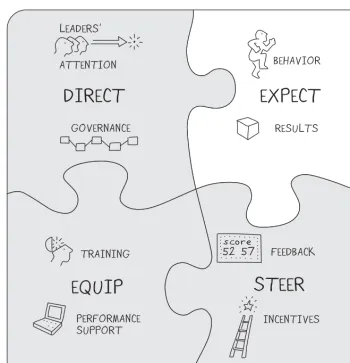
Figure I.1 Leadership Roles for Performance / 5 Figure 1.1 Leadership Roles / 8
Figure 1.2 Ripple Effect of Goals and Objectives / 12 Figure 1.3 Hierarchy of Goals and Objectives / 13 Figure 2.1 Leadership Roles / 34
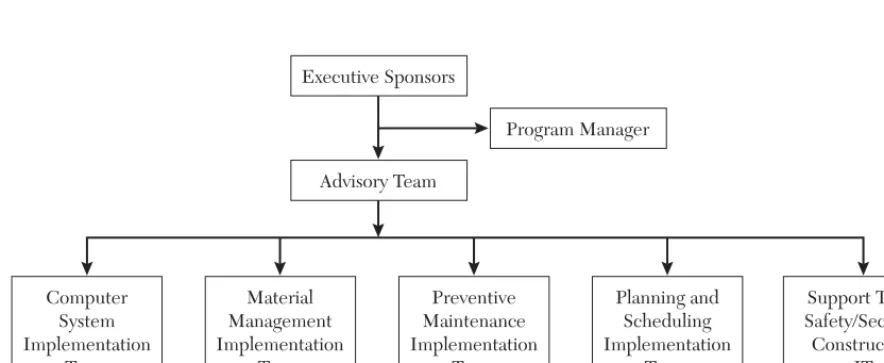
Figure 2.2 Governance Structure / 41
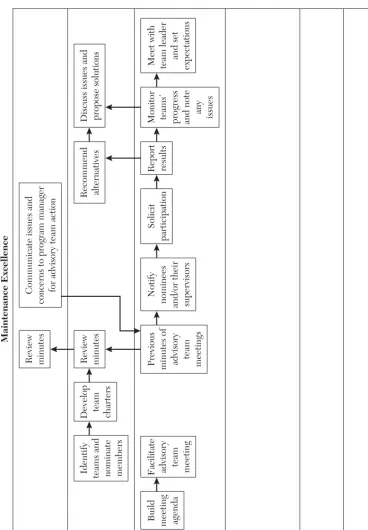
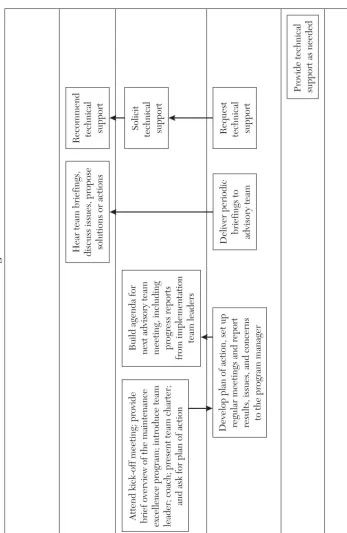
Figure 2.3 Sample Cross-Functional Chart / 46 Figure 2.4 Cross-Functional Chart / 51
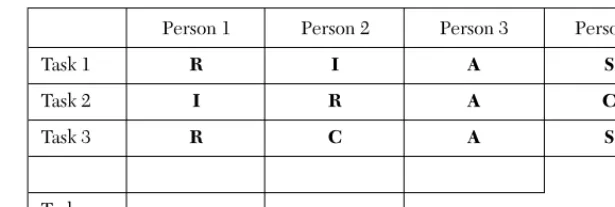
Figure 2.5 Sample RASCI Chart / 53 Figure 3.1 Leadership Roles / 56
Figure 3.2 Three Ways to Measure Job Performance / 68 Figure 3.3 Measures Worksheet / 72
Figure 3.4 Means and Evidence / 73 Figure 4.1 Leadership Roles / 76
Figure 4.2 Comparison of Leader Behaviors / 79 Figure 4.3 Behaviors Across Roles / 80
Figure 4.4 Performance Checklist Template / 82 Figure 4.5 Sample Form to Interview for Project
Management Skills / 85 Figure 5.1 Leadership Roles / 116 Figure 6.1 Leadership Roles / 132
Figure 6.2 Sample Worksheet: How to Balance Your Checkbook / 136
Figure 6.3 Sample Array: Candy Box Lid / 137
Figure 6.4 Sample If, Then Decision Table: How to Clean Exterior Surfaces / 137
Figure 6.5 Sample Flow Chart: Starting a Task / 138 Figure 6.6 Sample Checklist: Air Sampler Maintenance
Checklist / 139 Figure 6.7 Dirty Oil / 144 Figure 6.8 Pitch Card / 145 Figure 7.1 Leadership Roles / 154
Figure 7.2 Meeting Management Checklist / 164
Figure 7.3 Phenomena That Contribute to Unfair Evaluations / 172 Figure 7.4 Sample Rating Scale / 172
Figure 8.1 Leadership Roles / 178
Figure 8.2 A Comparison of Incentives and Rewards / 180 Figure 8.3 Identifying Leading Indicators / 187
◆
CD-ROM Contents
Tool 1.1 How to Identify Goals and Objectives / 16 Tool 1.2 How to Identify What Is Important / 23 Tool 1.3 How to Challenge Mixed Messages / 25 Tool 2.1 How to Design a Governance Structure / 39Tool 2.2 How to Develop and Use Cross-Functional Charts / 45 Tool 2.3 How to Develop Governing Principles, Protocols, and
Ground Rules / 47
Tool 2.4 How to Develop Operating Guidelines and Procedures / 48
Tool 2.5 How to Develop and Use RASCI Charts / 50 Tool 3.1 How to Identify Deliverables / 61
Tool 3.2 How to Evaluate Your Current Use of Measures / 66 Tool 3.3 How to Select Measures / 72
Tool 4.1 How to Identify Desired Behaviors / 81
Tool 4.2 How to Develop Behavioral Interview Questions / 83 Tool 4.3 Job Aid for Describing Behaviors by Job Level and
Level of Performance / 88
Tool 4.3a Job Aid for Describing Behaviors by Job Level and Level of Performance—Senior Manager / 90 Tool 4.3b Job Aid for Describing Behaviors by Job Level and
Level of Performance—Mid-Level Manager / 95 Tool 4.3c Job Aid for Describing Behaviors by Job Level and Level of Performance—First-Level Manager / 100
Tool 4.3d Job Aid for Describing Behaviors by Job Level and Level of Performance—Supervisor / 104
Tool 4.3e Job Aid for Describing Behaviors by Job Level and Level of Performance—Individual Contributor / 111
Tool 5.1 How to Orient New Employees / 120 Tool 5.2 How to Get the Most from Training / 124
Tool 5.3 How to Make On-the-Job Training More Effective / 128 Tool 6.1 How to Select and Use Job Aids / 140
Tool 6.2 How to Identify and Use Standards, Work Rules, and Procedures / 147
Tool 7.1 How to Use Project Plans and Action Plans for Giving Feedback / 161
Tool 7.2 How to Use Meeting Guidelines to Give Feedback / 164 Tool 7.3 How to Obtain and Use Internal Customer
Feedback / 167
◆
Preface
T
his book is based on more than twenty-five years of experience witnessing managers and supervisors succeed despite inept leadership, ill-formed human resource policies, and inadequate information and communication systems. They succeeded because of their respect for others, their ingenuity in ad-dressing problems, and mostly because of their unwavering optimism. I have immense respect for the people who live day-to-day with dysfunctional man-agement systems. Geary Rummler said, “Put a good person in a bad system, and the system will win every time.”1This may be true in many circumstances,but I see people succeeding in bad systems. This book is meant to help man-agers and supervisors become even more effective, whether they work in good or bad systems.
The primary audience for this book is managers and supervisors who are responsible for:
• The performance of employees, contractors, suppliers, and third-party after-market partners
• Facilitating the successful deployment and adoption of major initiatives • Evaluating recommended solutions to improving performance
• Working with others not in their chain of command
A secondary audience is internal and external consultants (human resource development, training and development).
AUDIENCE FOR THE BOOK
The tips, guidelines, and tools are designed to be workable and practical so managers and supervisors can more effectively improve human performance.
Some very special people played a major role in helping make this book pos-sible. They painstakingly read the first draft of every chapter and added insights, examples, and guidance. They are Deb Barrett, Training Manager; Ann Berasley, MBA; Mike Brogan, Manager of Organizational Development, Metropolitan Washington Airports Authority; Ann Daniels, Chipote Restau-rants; Cordell Hauglie, Consultant, Delivery Systems Consulting & Training, Boeing; David R. Haskett, Manager, Instructional Design, Johnson Controls, Inc.; Jim Heine, Manager of Utility Services, Argonne National Laboratory; Nora Holcomb, Manager of Internal and External Training, CCC Information Systems; Roger Kaufman, Professor, Florida State University; Donald L. Kirkey, Learning & Development Manager—Global Operations, Johnson Controls, Inc.; Karen G. Kroczek, Manager of Technical Training, Plant Facilities and Services Division, Argonne National Laboratory; Dean R. Larson, Ph.D., CSP CEM CPEA, Department Manager, Safety & Industrial Hygiene, U.S. Steel—Gary Works; Annemarie Laures, Director, Learning Services, Walgreen Co.; Jim Momsen, Contractor, Instructional Designer; Gwendolyn Nichols-White, Implementation Manager, U.S. Cellular; Tom Norfleet, Manager of Corporate Services, Michigan Auto; Karen Preston, Director, Systems Support & Process Improvement Services, Performance Development Department, Walgreen Co.; George Pollard, Assistant Professor of Education and Director of Advance Programs, Crichton College; Joeli Ridley, Manager of Certification, Charles Schwab; Malou Roth, Consultant; Belinda Silber, Owner, Divanoir Catering; Kenneth Silber, Ph.D., Associate Professor, Educational Technology, Research and Assessment, Northern Illi-nois University; Mike Singleton, Holnam Industries; Charline Wells, Manager of Training and Performance, Sandia National Laboratory.
I was fortunate to have the continued confidence of Kathleen Dolan Davies and Matt Davis of Pfeiffer, whose support made this book possible. Special thanks goes to my friend Sue Simons, who continues to encourage me to be true to my style of simplicity and directness.
1. This quote is fromTrainingmagazine (December 1986, p. 43.)
ACKNOWLEDG-MENTS
◆
Introduction
T
his book has stories, examples, and guidelines to help managers and supervisors improve the performance of their work units. Performance im-provement operates on the premise that to be effective, individuals and groups require:Direction About What the Organization Wants to Accomplish
• Consistent direction from the leadership
• Management processes that allow for efficient decision making
Clear Expectations
• A clear understanding of what is expected of them
• An explanation of the criteria that will be used to judge the adequacy of their work
The Equipment to Do the Job
• Training and the information required for the job
• Performance support tools to help them remember how to do the job right and efficiently
Information and Incentives to Keep Them on Track
• Feedback on how well they are doing and coaching on how to improve • Rewards and incentives that support the behaviors that produce the results
Each of these requirements is discussed in greater detail in subsequent chapters.
The functions of management are generally accepted as plan, staff, organize, and control along with lead, communicate, and motivate. The functions can be thought of as managerial duties and organizational processes. However you think of them, the functions, collectively, describe what has to happen for an organization to be competitive and to fulfill its mandate. These functions are based on a fundamental set of beliefs:
• Goals should be set
• Tasks can and must be planned, organized, and staffed
• Controls can and must be in place to assure that tasks are executed as expected
• Managers and supervisors can and must provide leadership, communicate the goals and plans, and motivate people to execute their tasks
However, the functions of management alone are not sufficient for people and organization to perform. To “perform” means to deliver something of worth with integrity.What you deliver is of worth if it contributes to society, the community, the organization, the customers, and the employees. Integrity is doing it without sacrificing environmental, social, or financial assets or rela-tionships in the long run. Therefore, performance is about the ability to de-liver on a promise while having the resiliency to withstand challenges, with few, if any, negative aftereffects. It applies to organizations, people, individually and collectively, systems, processes, products, and services.
Performance improvement is not a substitute for the functions of planning, organizing, controlling, leading, staffing, and so on. However, it imposes a per-spective that questions the worth and worthiness of the effort, the results achieved, and the methods used. Planning, for example, is a process for setting goals or objectives; and plans are made up of strategies and tactics to accom-plish the goal. Performance improvement questions the worthiness of the goal and the efficacy of the plan.1,2
Performance is about doing meaningful work in effective and efficient ways. Planning, organizing, controlling, leading, communicating, and moti-vating will help you do it. However, the management functions, in and of themselves, are not a substitute for maintaining focus, being grounded in the real constraints facing the organization, collaborating with people who have the resources, talent, and willingness to contribute to accomplishing the goal, FUNCTIONS OF
MANAGEMENT
and adding value to the overall effort. Just as the management functions presume work has to be organized with checks and balances in place, perfor-mance improvement presumes it is management’s responsibility to do the following:
• Assure that where the organization is headed, what it does, and how it does it are appropriate considering the impact on society, the community, investors, customers, employees, and the competition
• Provide people with the direction, information, tools, materials, equip-ment, and appropriate rewards required for their efforts to produce the desired results
Performance improvement is a result-driven perspective to work, the workplace, and the worker. Recognizing the importance of organizing tasks and responsibilities, performance asks, “What are we about? What do we want to accomplish? What do people require to accomplish it? What are the best methods for providing what they require? What is the best way to motivate people so their efforts are more likely to produce the results we want?” And “What do we expect people to bring or contribute to the effort?” The princi-ples of performance improvement advocate a collaborative and systematic approach to answering these questions.
Performance improvement is about what you do, why you do it, and how you go about it. A group performs when it achieves results in ways that are socially, environmentally, and economically prudent. Organizations, divisions, departments, work groups, teams, and individuals generate things that are used by someone else. If those things are not deemed valuable or have too high a social or economic cost, the people, individually and collectively, did not per-form. When we say someone or something performs, we mean it delivers as promised.
Organizationsperform when they produce goods and services that are valued by consumers and reap benefits to stockholders, but not at the expense of the environment, community, or employees. Systemsperform when they support the information, communication, and transformation requirements of production and decision making, but not at the expense of other systems or departments.Processesperform when they generate products to a standard with minimal waste of time, money, materials, or human effort, but not if they operate as stand-alone silos that limit the effectiveness of other groups or processes.Peopleperform when their efforts result in outputs that lead to positive short-term and long-term consequences.
Performance improvement, like management, operates from a fundamental set of beliefs or principles that include:
• Focus on results, keep the end state in mind, and do not become distracted • Look at situations systemically, consider the larger picture, and identify
ways to work effectively within constraints and competing objectives • Add value to your people, your customers, and the organization now and
in the future, because well-being and loyalty are critical to sustainable success
• Partner and collaborate with the appropriate groups and individuals, as success requires the expertise, understanding, and support of many people • Be disciplined in how you approach and execute the work to be done; at minimum assess and analyze the facts, challenge assumptions, test out ideas, weigh alternatives, measure work in progress, and evaluate the results
Therefore, performance improvement is about staying focused on the right goals while dealing with real constraints and competing pressures, doing that which adds value, and collaborating with the right people. It is about being systematic and disciplined when you assess the situation, analyze probable causes, design and implement workable solutions, and evaluate whether what you did made a difference. Being proficient in both manage-ment and performance improvemanage-ment is essential for personal and organiza-tional effectiveness.
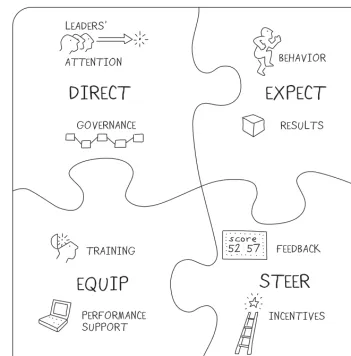
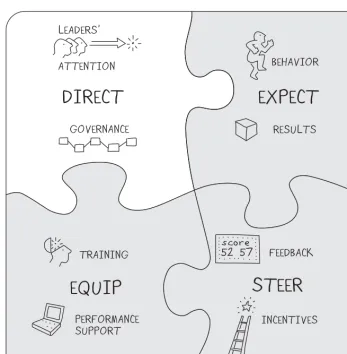
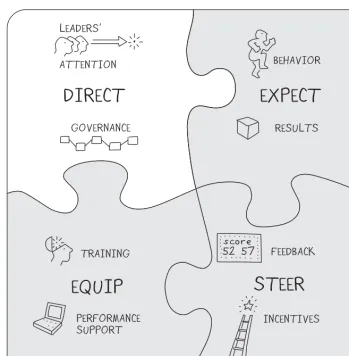
The book has eight chapters that are organized around four main roles of the first line manager and supervisors (see Figure I.1).
Each chapter contains examples, guidelines, tools, tips, common missteps, and suggestions on where to learn more for each role. A CD-ROM disk con-taining all of the job aids and templates is found at the end of the book.
Role One: Provide Direction
Chapter 1: How Leaders Set the Direction. The goal of this chapter is to pre-sent ideas on how first-line managers and supervisors can stay help others stay focused on what matters. There are three tools in this chapter:
• Tool 1.1: How to Identify Goals and Objectives • Tool 1.2: How to Identify What Is Important • Tool 1.3: How to Challenge Mixed Messages PRINCIPLES OF
PERFORMANCE IMPROVEMENT
Chapter 2: How to Provide Direction. The goal of this chapter is to help man-agers and supervisors understand ways to provide direction despite any limitations in leadership. There are five tools in this chapter:
• Tool 2.1: How to Design a Governance Structure
• Tool 2.2: How to Develop and Use Cross-Functional Charts
• Tool 2.3: How to Develop Governing Principles, Protocols, and Ground Rules
• Tool 2.4: How to Develop Operating Guidelines and Procedures • Tool 2.5: How to Develop and Use RASCI Charts
◆
Introduction5
Figure I.1. Leadership Roles for Performance
Role Two: Set Expectations
Chapter 3: How to Set Expectations. The goal of this chapter is to present ideas on how to identify and communicate expectations to employees. It in-cludes defining deliverables, customers, and performance measures. There are three tools in this chapter:
• Tool 3.1: How to Identify Deliverables
• Tool 3.2: How to Evaluate Your Current Use of Measures • Tool 3.3: How to Select Measures
Chapter 4: How to Identify Behaviors That Lead to Performance. The goal of this chapter is to present ideas on how to identify the behaviors that lead to performance and use them to communicate expectations. There are three tools in this chapter:
• Tool 4.1: How to Identify Desired Behaviors
• Tool 4.2: How to Develop Behavioral Interview Questions
• Tool 4.3: Job Aid for Describing Behaviors by Job Level and Level of Performance
Part A—Senior Manager Part B—Mid-Level Manager Part C—First-Level Manager Part D—Supervisor
Part E—Individual Contributor
Role Three: Equip People to Perform
Chapter 5: How to Use Orientations and Training Effectively. The goal of this chapter is to explain how to prepare people to do their jobs. It includes descriptions on how to orient and train people effectively. There are three tools in this chapter:
• Tool 5.1: How to Orient New Employees • Tool 5.2: How to Get the Most from Training
• Tool 5.3: How to Make On-the-Job Training More Effective
are two tools in this chapter:
• 6.1: How to Select and Use Job Aids
• 6.2: How to Identify and Use Standards, Work Rules, and Procedures
Role Four: Steer so People Stay on Course
Chapter 7: How to Make Giving Feedback Less Painful. The goal of this chapter is to present ideas on how to give people feedback in ways that are meaningful to them and less painful for the manager or supervisor. There are four tools in this chapter:
• Tool 7.1: How to Use Project Plans and Action Plans for Giving Feedback • Tool 7.2: How to Use Meeting Guidelines to Give Feedback
• Tool 7.3: How to Obtain and Use Internal Customer Feedback • Tool 7.4: Guidelines for Giving Feedback
Chapter 8: How to Recognize and Reward People. The goal of this chapter is to present ideas on how to shape people’s performance through the use of incentives. There are three tools in this chapter:
• Tool 8.1: How to Identify Leading Indicators • Tool 8.2: How to Identify and Select Incentives • Tool 8.3: How to Align Recognition and Rewards
1. The requirements for performance have been identified and validated by many people. One of those was Tom Gilbert, who presented his “Probe Model” as a framework for diagnosing why people do not perform as expected. His ideas were further developed inHuman Competence(San Francisco, CA: Jossey-Bass, 1978).
2. Roger Kaufman suggests there are three levels of clients and beneficiaries of what any organization uses, does, produces, and delivers. He calls the primary client as society and community that he terms as Mega planning. When the primary client and beneficiary of what is used and done is the organization itself, it is termed macro planning, and when the target is individuals and small groups, that is “micro planning.” Kaufman suggests that strategic thinking and planning is characterized by starting at the mega—societal level. Two of Kaufman’s books that discuss the concept of worth are Strategic Thinking: A Guide to Identifying and Solving Prob-lems(rev. ed.) (Arlington, VA/Washington, DC: American Society for Training & Development and the International Society for Performance Improvement, 1998) andMega Planning: Practical Tools for Organizational Success.(Thousand Oaks, CA: Sage Publications, 2000).
◆
Introduction7
Figure 1.1. Leadership Roles
◆
C h a p t e r 1
How Leaders Set
the Direction
What are we trying to do?
Where are we headed?
T
his chapter explains the role of leadership at all levels in the organization in providing direction. Leadership is like a beacon or navigational aid. People must know what the goal or destination is and they require signals over the course of their efforts to confirm that they are on track. No ship’s captain would set sail without knowing the destination and having the ability to know whether or not he was on course. No airplane pilot would take off without knowing the destination and having the capability to validate whether or not the plane was on its prescribed flight path. Yet organizations repeatedly engage in activities and launch new initiatives, products, and technology without understanding or being in agreement on the goal or having the ability to stay on course.People require three types of information to do their jobs effectively. The first type should come from top leadership, as it is about where the organization is headed, what the priorities are, and what the organization is doing in terms of investment to compete in the marketplace or fulfill its mission. The second type should come from human resources (HR) and the manager or supervisor, as it is about what is expected of individuals in terms of their roles, goals, and per-formance criteria. The third type comes from the training department and the manager or supervisor, as it is about what to do, how to do it, and why. Managers and supervisors have an important role in assuring that people receive all three types of information. This chapter focuses on how to use the information that comes from top management to make sure goals, objectives, deliverables, activities, and measures are aligned and understood by the people.
• A goalis an end state or condition toward which human effort is directed • An objective is an interim or enabling state or condition that, when
combined with other objectives, leads to a goal
• A deliverable is something that is produced to accomplish a goal or objective, a physical or mental object
• Anactivityis a combination of behaviors that contribute to creating a deliverable and achieving an objective
• A measureis an attribute that is used as the basis for judging productivity, proficiency, performance, and worth
From a performance improvement perspective, people deserve clear direc-tion. They should have some understanding of what the organization is trying to accomplish and what role they play in making it happen. The first principle of performance is to focuson results—to not lose sight of the outcomes that are required to meet the organization’s goals. Focus is about making sure goals, objectives, activities, deliverables, and measures are aligned and congruent. Once people know the goals, they should know what is expected of them. Once they know what is expected and the direction they are heading, they will require tools to help them perform the job. Finally, they should get cues or signals to help them stay on course.
Here are some common mistakes managers and supervisors make when it comes to assuring people receive the direction they deserve:
1. They assume that the members of top management are in agreement on the goals.
2. They assume that top management has thought through the implications of what they attend to and that they understand the effect of their shifting their attention or changing their message.
3. They assume that what they want to accomplish is understood and agreed to by the people who do the work and by those who depend on the work being done.
4. They create plans and set objectives without fully understanding the situation or thinking through the ramifications of their actions.
5. They assume there will be no negative side effects to how they go about work and that, if there are, they are in no position to reduce or eliminate them.
6. They fail to confirm that what they use, do, produce, and deliver is working toward the same goal.
PERFORMANCE IMPROVEMENT
7. They fail to exercise judgment when it comes to interpreting top management’s behaviors or messages.
8. They assume that they are part of the solution and not part of the problem. 9. They fail to validate their assumptions.
Leadership is not about standing up and saying, “I’m in charge!” but it does require leaders to behave in certain ways because it is their behaviors that re-inforce or cue people in how to act. Leadership is what assures efforts are focused on the right goals, objectives, deliverables, and activities. It can and must occur at all levels so people are continually reminded of what is impor-tant, where the organization is headed, and what is required of them. Leader-ship can empower people if they understand where the organization is headed and they have confidence in their leaders. There are two sets of behaviors, in particular, that are especially important to providing direction.
1. Focus on resultshappens when leaders overtly state what the goal is, what the rules are for carrying out the work, what is and is not open for discus-sion or debate, what is expected of everyone, and what will be used as evidence of progress and success.
2. Consistency of focusis about leaders consistently sending the same mes-sages about what the goal is and what is important. Mixed mesmes-sages like “Avoid excess inventory but never run out of product” confuse people and distract them from the goal.
Focus on Results
Performance improvement begins by defining:
• The goals and results that you want to have happen or accomplish • The deliverables or outputs required for you to achieve the results and
what each group must produce to get the results
• The side effects of accomplishing the result, specifically the unforeseen implications you want to avoid, whether they are damaged relations or exhausted employees
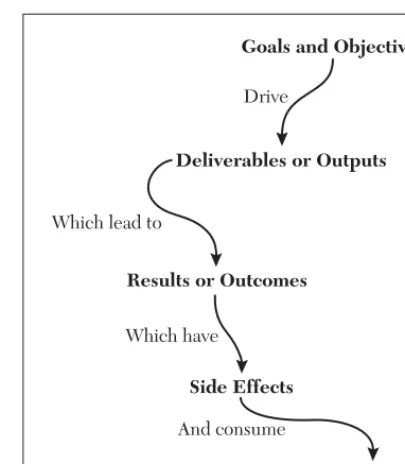
• The sustainability of the effort, what it will take in energy and resources to continue to do the work time and time again (see Figure 1.2)
The terms goals and objectivesandgoals and outcomesare used inter-changeably. However, there is usually an assumed hierarchy with goals having
Chapter 1
◆
How Leaders Set the Direction11
a broader meaning and objectives less so. Organizations set goals that are state-ments that describe what they want to achieve or become. Objectives are the interim milestones or deliverables that have to happen to accomplish the goals and they are usually more specific and more measurable.
People are hired to produce deliverablesoroutputsin the belief that the effort will lead to an outcome,such as more revenue, higher profits, strategic alliances, greater market penetration, and higher retention of customers. What they produce may be things, ideas, or information. However, what is produced or how it is produced usually has side effectsthat may or may not have been predicted. Side effects can be negative or positive. For example, sometimes the cost of the sale in resourcesexceeds the revenue gained and inventory can-not keep up with demand, damaging customer relations.
Sustainabilityis about the ability to continue to deliver in the long-term given the demand on your current resources. Tradeoffs usually have to be made to continue to sustain the results or reap the benefits over time. Some examples are having sufficient qualified people to sell, perform repairs, and service customers and having the dollars to purchase materials or invest in development.
Deliverables, in and of themselves, may not lead to desired results, and results may not have desirable side effects. The demands on resources to deliver or sustain the result may be so great as to limit the ability to take advantage of other opportunities or respond to new challenges.
Goals and Objectives
Drive
Deliverables or Outputs
Which lead to
Results or Outcomes
Which have
Side Effects
And consume
Resources
Top management defines the goals for the organization. Other levels of man-agement interpret the goals for their departments and then set goals or objectives specific for their groups. Then they develop plans or identify the activities required to accomplish the objectives and define the measures of success. Outcomes are the results that occur after having engaged in activities to meet the goals and objectives. An outcome is successful or not based on the measures that were used (see Figure 1.3).
Organization Level
• The organization’s goalsare profits, societal return on investment, market share, and market demand for products
• The organization’s outputsor deliverables are all the goods and services it develops and delivers to the marketplace
• Theoutcomesare the results that occur from having produced the goods and services
• Themeasuresare the criteria used to judge success or effectiveness, such as dollars, ratings, percentages, and so forth, both in the short-term and long-term
• Theside effectsof having achieved or not achieved the goals are the impact on its brand image and relationships with labor, customers, employees, dis-tributors, third-party partners, investors, and regulatory agencies
•Sustainabilityis about having sufficient economic resources, access to materials and talent, and the production and distribution capacity to honor promises to customers, investors, employees, outside agencies, and part-ners in the future
Chapter 1
◆
How Leaders Set the Direction13
GOALS, OBJECTIVES, AND OUTCOMES
Goals
Objective 2 Objective 3 Objective 1
Plans Measures
Activities Measures
Here are some examples.
• A bank’s goal is to service the financial needs of the community at a profit. A bank’s products or outputs are loans, mortgages, investment advice, and savings and checking accounts. The outcome is number of services rendered and at what profit or loss. The impact or side effect is market share. Sustainability is about having qualified personnel to service customers and the resources to continue to offer competitive products.
• An airport’s goal is to positively impact the economy of the local area. The airport’s outputs are services to airlines and passengers that include landing strips, gates, facilities, parking, and concessions. The outcomes are revenues from gates and parking and jobs for concessionaires and other outsourced services. The side effect is economic impact on the community from taxes and spending by passengers, workers, and busi-nesses supporting the airport and airlines. Sustainability depends on the airport’s ability to maintain its facilities so it can attract airlines, passen-gers, and businesses.
Department or Division Level
• Theobjectivesmay include marketable products, profits, retention of cus-tomers and employees, cooperative labor-management relations, efficient distribution channels, and excellent customer service
• Theoutputsor deliverables required to achieve the objectives might in-clude the development of products, marketing strategies, agreements, and policies required to manufacture, promote, sell, distribute, and provide after-market support to the marketplace
• Theoutcomeis the results that were achieved or what actually happened from having delivered the products or services
• Theside effectsmay be higher than anticipated customer loyalty, unex-pected innovation by employees, higher yields in investments, and the ability to leverage relationships with distributors to service new markets or the opposite
• Themeasuresmight include the number of products that reached market, the degree of market penetration, the number of customers retained, and the level of employee and customer satisfaction
Here are some examples.
• The objectives of the bank’s loan department include profitable loans. The outputs of the bank’s loan department are its lending instruments, such as mortgages, home equity loans, and college loans. The outcomes are the earnings from those loans. The side effect might be losses from bad loans or an increased number of customers making use of other bank services because of their loan experience. Sustainability is about the loan officers’ ability to develop and maintain relationships with local businesses and residents in the community and continue to offer cost-competitive, yet profitable, products.
• The objectives of the airport maintenance department are good relations with airlines and concessionaires and passengers because of function-ing jetways, escalators, elevators, and so forth. The outputs are the repair and maintenance of facilities, such as jetways, people movers, bathrooms, escalators, and utilities to restaurants, concessions, and other retail businesses. The outcome is the level of satisfaction airlines, concessions, and passengers have with the airport. The side effects are avoided complaints and lawsuits due to malfunctioning equipment, power outages, or poorly maintained bathrooms. The sustainability is about the airport having the financial ability to retain qualified people to maintain the facilities and buy quality equipment.
Work Unit, Team, and Individual Levels
• Theobjectivesmight include meeting production quotas, satisfying inter-nal and exterinter-nal customers, and controlling costs, as well as setting up capable distribution channels
• Theoutputsmay be the development and delivery of sub-assemblies, pro-totypes, marketing materials, training, documentation, and other resources required to build, market, and deliver products to customers, provide cus-tomer service, operate systems, and assure that employees are capable • Theoutcomesare the actual results achieved from having created the
outputs
• Theside effectscould be trust, cooperation, shorter cycle times, safer performance, lower reject rates, and higher productivity or they might be the ability to rapidly deploy staff to new production lines or field offices in response to unanticipated demand or interrupted distribution capability • Themeasuresmight include the volume and cost of production, the
num-ber of distribution channels set up, and at what cost
• Sustainabilitydepends on the ability to handle increased capacity and chang-ing requirements and on the employees havchang-ing the energy and willchang-ingness to continue to innovate and produce at the same level of intensity over time (If you do not have the right people you cannot sustain performance)
Here are some examples.
• At the bank a loan officer’s objective may be to lend a minimum dollar amount. The outputs are the number and dollar value of loans approved. The outcome is the profit generated from the loans, any losses that may occur, and accurate and cost-efficient transactions. The side effects are satisfied customers and the number of customers purchasing other bank services. The sustainability depends on the loan officer’s continued interest in serving customers and staying current in banking regulations and on the bank’s ability to retain qualified loan officers and friendly tellers.
• The objective of the airport maintenance department is no loss of revenue or life because of accidents on slippery runways or roads. The outputs of the groundskeeping department are clean, cleared runways and access roads and attractive landscaping. The outcome is the amount of revenue lost or accidents that occurred due to poorly
maintained runways and access roads. The side effect is compliments by passengers, the airlines’ confidence in the airport, and community pride in the attractiveness of the area. Sustainability depends on the airport continuing to allocate resources for the maintenance of the grounds.
Here is a set of guidelines to help your work group understand their role in the organization.
TOOL 1.1: HOW TO IDENTIFY GOALS AND OBJECTIVES
Purpose
This guideline is designed to help your work unit gain an understanding of what their goals and objectives are. It can help you determine whether your under-standing of your deliverables is the same as what others in the organization think.
How
A. Begin with the department or division your group is part of. 1. What are the goals of the department or division?
2. What does the department or division as a whole produce? What are its deliverables?
3. What are the outcomes it wants to achieve?
4. What are the side effects it hopes to avoid? Remember to consider factors like relationships, image, cost overruns, and a drain on resources.
5. What will it take to sustain the level of performance it wants? Consider things like there is no change in top management, break-throughs in technology happen at a pace the organization can sup-port, or that promises to customers about new products or services are met.
6. What attributes, criteria, or factors will the department or division use to measure its success?
B. Now ask the same six questions of your particular work unit or group. C. Share your answers with your peers and manager to identify any
differ-ences or things you did not think of.
D. If there is any discrepancy or disagreement over what they believe you do and what the results should be, work with them to resolve the discrepancy.
E. Use what you learn to develop goals and objectives for your group and identify the criteria to judge what you do.
Hint:When you go through the exercise, think about how much has stayed the
same over the last year or so, how much has changed, and to what degree the emphasis has changed. Pay attention to any trends, as this insight will help you when setting priorities for your group.
Here is an example of how one organization works to align its goals, objectives, and deliverables to achieve the desired results.
DULLES AIRPORT
Background
The airport authority has the dual role of managing a major metropolitan airport and supporting the economic stability of the community through its employment and contracting practices. It has approximately 1,200 full-time employees, most of whom work for airport operations, engineering, and main-tenance. The authority also provides jobs for another 26,000 people at the airport, including contractors involved in the construction of new runways,
parking garages, and concourses; those who work for the concessions (restaurants and retail stores); and those who do housekeeping and work in the parking garage.
The Goals and Objectives
Two years ago the airport implemented a new strategic planning process based on a modified balanced-scorecard.1 The planning process was
designed to help departments link their objectives and performance mea-sures to one or more of the airport’s goals—safety and security, customer and partner satisfaction, efficient operations, and growth and development. At the same time it introduced a performance management system (PMP). The objectives of the strategic planning process and PMP are to drive decision making down in the organization, force greater collaboration across depart-ments, and link rewards to performance instead of being an entitlement. The goal is a cost-efficient airport that is attractive to airlines and supports the local economy.
The Objective
The airport manager at Dulles has as one of his objectives the identification and improvement of a major process. He chose maintenance because the cost of maintenance had steadily increased over the years, partially due to the increase in the number of facilities to be maintained and partly due to the aging of facilities. The current computer maintenance system could not measure productivity, accurately identify costs, track material usage, manage inventory, or assure efficient scheduling of personnel. The increasing demands on maintenance raised questions about how to best manage this function.
The airport manager commissioned a study of his maintenance opera-tions and current computer system. The study showed that maintenance was a reactive rather than a planned process and that the current system could not provide the information required to manage the function effectively. A new system presented an opportunity to improve results and change the way main-tenance was managed. At the same time, there was the challenge of how to continue providing maintenance services using the old system during the time of transition to a new computer system.
The Deliverable and Expected Result
lead to a fundamental shift in how maintenance was managed that was collab-orative, responsive to customers, and cost-efficient, and (3) a clarification of roles and responsibilities between maintenance, operations, and customers.
The airport manager was focused on results and worked to align his PMP to support his goals. What follows is another example; however, this company lost sight of what it wanted to accomplish.
PLASTICS
Background
Corp USA is a manufacturer of plastic building materials. It sold its products through numerous independent distributors. Two years ago management decided to buy one of its largest distributors, Premier. A year later it bought the second-largest distributor, a family-owned business, Sons. Before they were purchased, Premier and Sons had from 80 to 90 percent of the market share of the distribution of plastic building products.
The Goal
Corp USA’s goal was to be the largest manufacturer and distributor of plastic building materials to the construction industry.
The Decisions/Actions
Brand Name: As soon as Corp USA acquired Premier, and later Sons, it created a new division called Plastics Distributors.Plasticsceased using the names Premier and Sons almost immediately after it acquired them.
Pricing Policies: Next, Plastics increased the prices charged by Premier and Son. The reason for the increase was Corp USA’s policy that required every division to price its products with the same fixed percentage margin, a much higher margin than what Premier or Sons had used in the past. Sales staff were not allowed to consider the condition of the local market in terms of competition or the size of the order when pricing products. The higher prices went into effect immediately.
Staffing: To reduce costs, Plastics fired the more senior experienced outside and inside sales staff. While they drew more commissions than the less expe-rienced salespeople, these were the people who had established relationships with customers. They had technical expertise and knew their customers’ busi-ness issues. Many operated on a first-name basis with customers. The people who remained had less seniority, and therefore were paid less, but they also lacked the technical expertise to discuss the product’s application with the customer.
The Results and Aftereffects
Loss of Business: Within a year, Plastics had lost over 50 percent of the business it acquired with the purchase of Premier and Sons. The higher prices due to the higher fixed margins angered the larger customers, who were use to price considerations when they placed large orders.
Loss of Brand Image: The change in name angered many customers, who wanted to know who they were suddenly dealing with and why the person they were used to dealing with was not there.
Loss of Buying Power: The loss of business also reduced Plastics’ buying power with manufacturers. It no longer had the clout that comes with being a big volume buyer.
Growth of Competition: The experienced people who had been laid off joined smaller distributors who were merging. The salespeople leveraged their relationships with old customers and their knowledge of the customers’ business to win prize accounts. These smaller yet growing distributors were willing to accept lower margins to get the business. They sold on volume and this increased their buying power with the manufacturers.
What Happened
Plastics management had manufacturing backgrounds and no experience in distribution. They did not understand the nature of the business. Had they done some investigation they would have learned:
• The distribution of building plastics is a low-margin business
• Selling building plastics requires technical expertise in how acrylics are made and used by customers
• Sales depend on knowing your customers’ businesses and building a good relationship with each customer
• Customers who buy in large volume expect price considerations, perhaps in the form of lower margins, a reduction in some or all shipping costs, or not charging extra for multiple shipments or shipments to multiple locations
The New Challenge
Management at Plastics did not do a sufficient analysis of the situation to understand the distribution business and what customers expected; therefore, it was not able to provide the direction required to stay competitive.
We are in the business of making money for stockholders![The words that were deleted were “building safe airplanes.”]
Our overarching principles are value, uninterrupted supply.[The words that were deleted were “safe” and “family friendly.”]
Top management communicates what is important by:
• What is and is not mentioned publicly, during briefings, meetings, and announcements
• Who is left out, not invited, or not given time to speak at meetings • The order in which topics are addressed
• The amount of time, dollars, and talent committed to a topic
People assign meaning based on where management focuses its attention. Says Ed Schein:
“What leaders consistently pay attention to communicates most clearly what their own priorities, goals, and assumptions are. If they pay attention to too many things or if their pattern of attention is inconsistent, subordinates will use other signals or their own experience to decide what is really important, lead-ing to a much more diverse set of assumptions and many more subcultures.”2 To find out what management and others think is important, examine:
• What is and is not on the agenda of formal meetings
• How much time is allotted to different topics and the sequence of the topics
• Who is and is not included in formal and informal communications • Who is and is not included in meetings
• Who is and is not afforded time to speak
Top management begins the process of providing direction when it establishes the goals for the year. Next, middle management provides direction for first-line managers and supervisors by setting department goals based on its inter-pretation of top management’s messages and behavior. Finally, first-line managers and supervisors provide direction for their work units based on their
Chapter 1
◆
How Leaders Set the Direction21
MESSAGES AND DIRECTION
interpretation of their management’s behavior and messages. This trickle-down process only works when the goals that are communicated are congruent with what management pays attention to and with what gets measured, and if what gets measured supports the intended results.
Therefore, leaders provide direction in what they attend to and what they measure, not necessarily by what they say are the goals. However, what gets their attention and is measured should be consistent with what they said were the goals. Unfortunately, this does not always happen. Worse, compensation and bonus plans do not always support what the company says it wants its peo-ple to accomplish. As a result, some companies are now basing a portion of managers’ bonuses on the performance of the work unit over more than one year and have even extended the performance period for twenty-four to thirty-six months. This sends an especially strong message if the manager is on a rotational assignment, makes some change, or implements an initiative and then goes on to the next assignment, never to experience the impact of his or her decisions.
The Burial of Past Initiatives
TOOL 1.2: HOW TO IDENTIFY WHAT IS IMPORTANT
Purpose
The intent of this set of guidelines is to make you more aware of how top management communicates its expectations by what captures its attention.
How
With your boss or peers:
A. Find out:
1. What is and is not on top management’s agenda of formal meetings. 2. How much time is allotted to different topics and the sequence of
the topics.
3. Who is and is not included in formal and informal communications. 4. Who is and is not included in meetings.
5. Who is and is not afforded time to speak during formal meetings. B. If you are unable to answer the questions above, identify people with
whom you need to develop a better relationship so that you are in a position to more accurately interpret top management’s behaviors and messages.
C. Go back to the first of the fiscal year and locate the goals for the year. 1. Have any of them changed?
2. How do you know? On what behaviors or messages are you basing your conclusions?
3. Compare your answers to the above questions to what top manage-ment said were the goals of the organization.
4. How might you reconcile the new silence about what was important with the new noise about what is important?
D. Think about your own messages over the past year. 1. Have they changed?
2. Do you regularly discuss or ask people to report on their progress related to what you said were the goals, as this is how you demon-strate consistency?
3. Do you try to show the relationship between old messages and new ones?
Hint:Changing direction is not a bad thing to do, when the change is warranted.
However, you should be aware of when you change your message and the impli-cation on others’ behavior. Remember that what is not said communicates as much if not more than what is said.
Statements are made in meetings and on the fly. Some of those statements are top management “thinking out loud” and others are merely wish lists but are couched like rules or goals. The onus is on you to interpret what you heard or have been told, decide how much latitude you really have, and figure out how to reframe the message in a way that better reflects the in-tent. Do you honor the spirit of the statement or its literal meaning? Some-times honoring the literal statement can be malicious obedience, especially if you know that is not in the best interest of the organization. Here is an example.
OVERTIME
Steve managed a research facility. One day his boss returned from an all-managers meeting and his first words were, “Well, there’s no more overtime!” It seems top management’s attention had changed to cost containment and their statements made it sound like cutting out overtime was a goal rather than one possible solution. Steve, however, knew that overtime in some cir-cumstances was less costly than forcing work to be completed within a shift. Steve managed highly skilled tradesmen who were responsible for the main-tenance of very sophisticated equipment that simulated different atmospheric conditions that scientists required for their experiments. The equipment operated around the clock, seven days a week. If the equipment failed or did not perform to standard, it affected the results of experiments and the schedules of hundreds of people and put very expensive materials at risk. Equipment does not always break at convenient times. Steve could interpret the message “no overtime” as a rule or a goal instead of as a proposed solution to a larger goal, probably related to reducing costs. If he interpreted it as a rule, the next time the equipment required service and could not be com-pletely repaired during that shift, he would tell the tradesman to stop and come back the next day to complete the work. It could mean scientists would stand idle because they could not continue to work.
Steve’s response to his boss was, “Why don’t we talk now, because at the end of the year either you’re going to be disappointed with my performance or I’m going to be disappointed with my review!” Steve restated top man-agement’s message as wanting to reduce costs and as suggesting that overtime may be one way to accomplish it. He went on to suggest some guidelines for when overtime might be appropriate and how his boss might justify it. He also suggested that he and his peers work together to find other ways to reduce costs.
How much latitude you have to reinterpret or reframe top management’s messages depends on:
• The amount of time you have been with the organization, as seniority should have given you an opportunity to demonstrate that your actions are in the best interest of the company and build relationships with people who have access to top management. In Steve’s case he had continuously demonstrated that he was a good corporate soldier and had implemented many cost savings in his career.
• Whether or not you have the support of your peers. There is strength in numbers. Steve isn’t the only manager whose crew’s schedule can affect the work of highly paid scientists and engineers.
• The amount of access you have to top management or the people who influence them so that you can informally explain your position. It is im-portant to build relationships with people at all levels in the organization. You never know when you will need a friend.
• Your level of knowledge, self-confidence, or belief in what you want to do. Doubt can lead to hesitancy. Self-confidence comes from doing your homework, understanding your work unit’s role in the organization, and knowing how your work impacts others.
You don’t have to have all of these factors, but the more you do have the stronger your position to interpret your company’s direction in ways that make sense for your operation. Here is a set of guidelines to help you evalu-ate the feasibility of your challenging mixed messages effectively.
TOOL 1.3: HOW TO CHALLENGE MIXED MESSAGES
Purpose
To assess your readiness to challenge mixed or unclear messages.
How
Alone or with trusted colleagues meet to discuss the following points. The goal is to assess your readiness to challenge or reinterpret the direction you are given because you want to support the organization’s goals.
A. Think back on those times when you experienced disconnects between what was supposedly the “goal” and what the leadership was paying attention to.
1. What did you do that worked to resolve this disconnect? 2. What might you have done differently?
B. If vague or mixed messages are typical where you work, alone or preferably with your peers:
1. Identify what you think the goal or message should be.
2. Begin (if you haven’t done so already) to document the effect of the vague or mixed messages, such as the number of false starts, time spent doing rework, or people engaged in activities that are counterproductive.
3. Come up with suggestions about how you might approach your manager with recommendations on how to clarify the message or connect it to what you think is important.
C. Ask yourself who benefits from mixed messages. Confusion can be a distraction whether it is from inadequate leadership or from poorly designed processes.
D. Begin to build a plan to increase your own credibility and ability to challenge mixed messages and assure your people are working on the right goals.
1. Identify people in the organization who are either decision makers or in a position to influence others’ decisions. They might include key internal customers, your boss’s peers, or important suppliers. 2. Think about how you might establish a relationship with them so
that you can present your ideas when it is appropriate. One way is to ask to meet with them to better understand their expectations of your group and how your work affects them. Then use the time to better understand their issues, processes, and expectations. Later, they may be willing to hear your issues as well; however, start by showing your interest in them before you ask them to take up your cause. 3. Learn to be a champion of your group’s efforts. Craft and send
mes-sages to your boss and key internal customers about your group’s successes and efforts to improve efficiency and customer satisfaction. You want a reputation as someone who is focused on results that contribute to the success of the organization.
4. Ask yourself how much initiative you are willing to take to help your manager provide consistent direction.
Hint:Consistent direction helps people stay focused on results. You cannot
con-trol what top management does, but you can concon-trol your own messages.
how well the organization is doing. Your job is to transform what the organi-zation measures to criteria that make sense for your work unit and can be tracked. Human performance depends on the goals and measures being aligned; otherwise there is confusion and the misdirection of resources. Here is an example of misaligned goals and measures.
PORTLAND CEMENT
A plant can produce as much as 3.5 million tons of portland cement a year. The kilns used to make the product are long cylindrical furnaces rotating along their axis. These kilns can be as long as 760 feet with diameters large enough for a locomotive to pass through. Kiln operation is the key to produc-tion. The kiln heats powdered limestone, shale, and other materials to tem-peratures approaching one fourth the temperature of the surface of the sun. The intense heat partially melts the material and transforms the powdered rock blend into portland cement clinker.
Cement plants operate twenty-four hours, seven days a week with opera-tion targeted for more than 330 days each year. The remaining days are used for maintenance and to repair the kiln system. It takes from two to three days for these mammoth furnaces to cool down sufficiently for an inspector to enter and check for damage. Crews then do the required repairs for the coming year.
Top management says it wants plant managers to protect the assets of the plant and operate safely while meeting the production quota. However, the only thing that gets measured is amount of cement produced, and the plant manager’s bonus goes up when he exceeds the goal. The amount of cement a plant can produce is dictated by the number of days the kiln is in operation over the course of the year. Plants can exceed the production quota if the kiln operators are encouraged to “run hot” and “run fast.” The damage from running hot and fast may not become evident for days or even weeks, but it does occur. Running at full capacity continuously does not increase profits or decrease maintenance. Some costs are more immediate, such as increased maintenance costs or fines for air pollution. Others costs are non-economic, such as loss of community good will due to the pollution of the air and ground water. Eventually all costs are borne by the plant due to break-downs and lost production. A plant could even be put out of commission for weeks or months for repairs.
Because top management only attended to the amount produced annu-ally, rather than to what was produced over a series of years, it contributed to a cyclical operation—high production year followed by a low production year—rather than optimal production over many years. The plant manager in
turn continued the cycle of sub-optimizing production by rewarding kiln operators on the quantity of production for their shift rather than the yield of all three shifts. Operators who exceeded the shift goal were labeled heroes. Any operator can exceed set production goals for a short period of time if he either runs the kiln hot or accelerates the flow of materials through the system. However, subsequent operators have to reduce production to prevent damage to the system caused by overheating, which harms the refractory lining of the furnace. This can and does lead to cyclical operation, which yields less pro-duction in the long run than if each shift had just held to the set shift production objectives. Top management and the plant manager’s behaviors ultimately undermined the long-term performance of the plant and the organization as a whole.
If you were the shift manager or supervisor at the cement plant, what could you do to help break the cycle? One thing you might do is to stop com-peting with the other shift managers and supervisors. In many organizations the expression “management team” or “supervisory team” is an oxymoron. The words “manager” or “supervisor” and “team” in the same sentence do not make sense because the organization fosters internal competition in how it measures performance and compensates people. However, you and your manager can set measures that foster trust and collaboration instead of competition among the managers and supervisors. You will have to meet with your peers and come to some agreement about how you will measure your performance and the pro-ductivity of your people. Another way to break the cycle is to evaluate people on more than just one factor, such as:
• Meeting the production goal within some range. For the cement plant this might be staying within the recommended yield ⫾some percent (tonnage or other measure), AND
• Meeting cost goals within some range. For the cement plant this might be fuel costs, sporadic outages, and pollution violations, AND
• Not impacting the next shift or the department that receives your group’s work negatively. In the case of the cement plant this might be NOT mak-ing the next shift run slower or cooler because of your shift runnmak-ing fast or hot, AND
You might even suggest that part of your own, your peers,’ and your peo-ple’s bonus be based on the plant’s overall production goal for the year and it meeting some public commitment for safety. Here’s another example.
JERRY THE MECHANIC
Jerry is a master mechanic who supervises a crew that maintains a fleet of trucks. Early in his career he noticed who got ahead in the company and who did not. He observed that some managers operated on the lean or “squeeze out all you can” model of management. These managers became company he-roes because they delivered faster, cut costs, and exceeded production quota. They were rapidly promoted, only to inflict damage somewhere else. What they really did was shift costs to the future or to others because they would not i