Volume 2008, Article ID 462930,12pages doi:10.1155/2008/462930
Research Article
Energy-Constrained Optimal Quantization for
Wireless Sensor Networks
Xiliang Luo1and Georgios B. Giannakis2
1Qualcomm Inc., San Diego, CA 92121, USA
2Department of Electrical and Computer Engineering, University of Minnesota, Minneapolis, MN 55455, USA
Correspondence should be addressed to Georgios B. Giannakis,[email protected]
Received 28 May 2007; Revised 15 October 2007; Accepted 2 November 2007
Recommended by Huaiyu Dai
As low power, low cost, and longevity of transceivers are major requirements in wireless sensor networks, optimizing their de-sign under energy constraints is of paramount importance. To this end, we develop quantizers under strict energy constraints to effect optimal reconstruction at the fusion center. Propagation, modulation, as well as transmitter and receiver structures are jointly accounted for using a binary symmetric channel model. We first optimize quantization for reconstructing a single sensor’s measurement, and deriving the optimal number of quantization levels as well as the optimal energy allocation across bits. The constraints take into account not only the transmission energy but also the energy consumed by the transceiver’s circuitry. Fur-thermore, we consider multiple sensors collaborating to estimate a deterministic parameter in noise. Similarly, optimum energy allocation and optimum number of quantization bits are derived and tested with simulated examples. Finally, we study the effect of channel coding on the reconstruction performance under strict energy constraints and jointly optimize the number of quanti-zation levels as well as the number of channel uses.
Copyright © 2008 X. Luo and G. B. Giannakis. This is an open access article distributed under the Creative Commons Attribution License, which permits unrestricted use, distribution, and reproduction in any medium, provided the original work is properly cited.
1. INTRODUCTION
Wireless sensor networks (WSN) are gaining increasing re-search interest for their emerging potential in both consumer and national security applications. Sensor networks are envi-sioned to be used for surveillance, identification, and track-ing of targets. They can also serve as the first line of detection for various types of biological hazards such as toxic gas at-tacks. In civilian applications, WSN can be used to monitor the environment and measure quantities such as temperature and pollution levels.
In most application scenarios, WSN nodes are powered by small batteries, which are practically nonrechargeable, ei-ther due to cost limitations or because they are deployed in hostile environments with high temperature, high pol-lution levels, or high nuclear radiation levels. These con-siderations motivate well energy-saving and energy-efficient WSN designs. One approach to prolong battery lifetime is the use of energy-harvesting radios as the ones in [1] with power dissipation levels below 100μW. A lot of research has been carried out to devise energy efficient algorithms in each layer of WSN [2]. Optimal modulation with minimum
en-ergy requirements to transmit a given number of bits with a prescribed bit error rate (BER) bound is considered in [3]. Energy efficient medium access control (MAC) and routing protocols are studied in [4,5], respectively.
allowed per burst. The problem of designing quantizers to optimize pertinent reconstruction performance metrics un-der a given energy budget emerges naturally.
Most of the prior works on optimal quantization deal with optimization of the quantization rules for detecting a signal in dependent or independent noise [6–9]. Other related works include [10–15]. Assuming error-free trans-mission, [10, 11] focus on the impact of bandwidth/rate constraints in WSN on the distributed estimation perfor-mance. Optimal quantization thresholds, given the number of quantization levels and channel coding for binary sym-metric channels (BSC), are jointly designed in [13] to mini-mize the mean-square error of reconstruction. In [14], scal-ing of the reconstruction error with the number of quanti-zation bits per Nyquist-period is studied. The rate-distortion region, when taking into account the possible failure of com-munication links and sensor nodes, is presented in [12]. Possibly the most closely related to our present work, [15] minimizes the total transmission energy for a given target estimation error performance. Different from these works, our objective is to optimize the quantization per node (in-cluding the number of quantization bits and the transmis-sion energy allocation across bits) under a fixed total en-ergy per measurement in order to minimize the reconstruc-tion error at the fusion center. We account for both trans-mission energy as well as circuit energy consumption, while we (i) incorporate the noisy channel between each sensor and the fusion center by modeling it as a BSC with cross-over probability controlled by the transmitted bit energy, and (ii) allow different quantization bits to be allocated diff er-ent energy and, thus, effect different cross-over probabili-ties.
The rest of the paper is organized as follows. In Section 2, we consider optimal quantization in a point-to-point (single-hop) link to recover a single sensor’s measure-ment with uncoded transmission schemes. InSection 3, op-timal quantization is addressed in a multisensor (star topol-ogy) setting. The role of channel coding is then examined in Section 4.Section 5provides some illustrative numerical re-sults andSection 6concludes the paper.
2. POINT-TO-POINT LINK
Let us consider the system depicted inFigure 1, where a sin-gle sensor acquires a local measurement A, which is prop-erly scaled so thatA ∈ [0, 1], and wishes to transmit it to the fusion center. For digital transmission, the sensor first quantizes the real valued measurement A to AQ. Letting
A := ∞i=1bi2−i, throughout this paper, we considerN-bit uniform quantization so that
AQ=
N
i=1
bi2−i. (1)
The quantization bits {bi}N
i=1 are transmitted through the wireless channel to the fusion center, and are demodulated as
Observation
A
Sensor
AQ
1 BSC 0
1 0
Wireless channel
b1,b2,. . .
Fusion center
b1,b2,. . .
A
Figure1: System model of a single sensor’s quantized measurement received through a BSC at the fusion center.
{bi}N
i=1. At the fusion center, the sensor’s local measurement is reconstructed as
A=
N
i=1
bi2−i. (2)
Here, for simplicity, we consider only uncoded transmis-sions. The underlying channel is assumed to be memoryless with different raw bits experiencing independent detection errors. Under this condition, we can model the wireless air interface between the sensor and the fusion center as a binary symmetric channel (BSC) with cross-over probability. In fact, the BSC model can be used to characterize a more gen-eral class of channels including multipath fading and mul-tiaccess ones. Even for a channel with memory, BSC is still applicable provided that a suitable equalizer is incorporated, and{bi}denote the bits at the output of the slicer that follows the equalizer.
Because one of the key issues in optimizing the design of sensor networks is the energy constraint, we are interested in the following problem.
If the allowable energy each time we transmit a measure-ment is fixed toE, what is the optimal number of quantization bits and how can the energy per bit be allocated optimally in order to minimize the reconstruction error at the fusion center? In the following subsections, we will first address this question under the assumption that the total energy budget used for RF transmission of the measurementAis fixed and equal toE. The energy consumed by the circuit electronics will be taken into account afterwards.
2.1. Optimizing the number of quantization bits
Let us consider a simple scenario where all quantization bits are allocated equal energy. We wish to find the optimal value ofNin (1) which minimizes a meaningful metric of the re-construction error. When using anN-bit quantizer, with the total transmission energy of all bits fixed to E, the energy per bit depends clearly onN, sinceEb =E/N. Noticing that
the BSC model’s cross-over probabilitywill generally be a function of the bit energy-to-noise ratio, and lettingN0 de-note the channel noise level, we can writeas(Eb/N0) to make this functional relationship explicit. WithEb =E/N,
The reconstruction error, which is defined to beA−A, can be expressed as
A−A=A−AQ+AQ−A
= ∞
i=N+1
bi2−i+
N
i=1
bi−bi2−i. (3)
Using the triangle inequality, we can readily bound the abso-lute value of the reconstruction error as
|A−A| ≤ ∞
i=N+1 2−i+
N
i=1
bi−bi2−i. (4)
Taking expectation on both sides of (4), we have
E|A−A| ≤2−N+
N
i=1
Ebi−bi 2−i
=2−N+
E
NN0
N
i=1 2−i
=2−N+1−2−N
E
NN0
:= f(N), (5)
where in deriving the first equality we used the fact that |bi −bi| is a{0, 1} Bernoulli random variable with mean (E/(NN0)).
In order to minimize the mean-absolute reconstruction error, it suffices to minimize the bound f(N) in (5) with re-spect toN, which corresponds to optimizing the worst-case performance. Under this criterion, the optimal number of quantization bits will be chosen as follows:
Nopt=arg min
N f(N)
=arg min
N
2−N +1−2−N
E
NN0
. (6)
Clearly, the first summand in f(N), namely, 2−N, decreases
asN becomes larger. With (·) being a monotonically de-creasing function of its argument, the second summand, (1−2−N)(E/(NN
0)), will be an increasing function ofN. Intuition suggests that there should exist an optimalNsuch thatf(N), that is, the sum of the two terms, will reach a min-imum. If the latter is unique, a simple one-dimensional nu-merical search will revealNopt, as long as(·) is specified. In Section 5, we will give examples of the optimal number of quantization bits when(γ) is specified for different modu-lations and receiver formats, withγ := Eb/N0denoting the bit energy-to-noise ratio.
2.2. Optimizing the energy allocation per bit
In the previous subsection, we assumed that each bit is al-located identical energy. However, observing that each bit in (4) has a different weight suggests that there is room to op-timize the energy per bit. This motivates us to look for an optimal energy allocation scheme when the total number of bitsNis fixed. Let us suppose that bitiis allocated a fraction
xiof the total energyE fori=1,. . .,N. Then, following the derivation of (5), we have
E|A−A| ≤2−N+
N
i=1
Ebi−bi 2−i
=2−N+
N
i=1
E
xi
N0
2−i.
(7)
In order to account for the mean-absolute reconstruction er-ror with respect tox :=[x1,. . .,xN]T, we can formulate the following optimization problem:
minimizex f0(x;N) :=2−N+
N
i=1
Exi
N0
2−i
subject to fi(x) := −xi≤0, i=1,. . .,N,
h(x) :=
N
i=1
xi=1.
(8)
It is easily seen that the optimal solution and the minimum value of f0(x;N) are actually functions ofN. To make this functional relationship explicit, we denote the optimal solu-tion byx∗N := [x1∗,x∗2,. . .,xN∗]T, and accordingly, the
min-imum of the objective function f0(xN∗;N). Interestingly, as
long asN >N, we find f0(x∗N;N) < f0(x∗N;N), see the
ap-pendix for details.
Withx∗N := [x∗1,x∗2,. . .,x∗N]T denoting the optimal
so-lution, the well-known Karush-Kuhn-Tucker (KKT) condi-tions [16, page 243] dictate that there must exist{λ∗i}
N i=1and
ν∗such that
x∗i ≥0, λ∗i ≥0, λ∗ixi∗=0, i=1, 2,. . .,N, (9)
N
i=1
x∗i =1, (10)
∇f0
x∗N;N
+
N
i=1
λ∗i ∇fi
xN∗
+ν∗∇hx∗N
=0, (11)
where∇denotes the gradient. It follows from (11) that the {xi∗}
N
i=1must satisfy
2−i E
N0
d(γ)
dγ
γ=(E/N0)xi∗
−λ∗i +ν∗=0, i=1,. . .,N.
(12)
In order to gain further insight from (12), let us take a closer look at the optimal energy allocation in two special cases.
2.2.1. BPSK over AWGN channel
The cross-over probabilityexpressed in terms of bit energy-to-noise ratioγis given in this case by [17, page 255]
(γ)=Q2γ:=
+∞ √
2γ
1 √
2πe −t2/2
The derivative of(γ) with respect toγis then calculated as follows:
d(γ)
dγ = −
1 √
2π
e−γ
2γ := −φ(γ). (14)
Substituting (14) into (12), we can express the optimal en-ergy allocation in the following form:
x∗i =φ−1
ν∗−λ∗
i
2iN0 E
N0
E , i=1,. . .,N. (15)
Noticing that the domain ofφ(γ) defined in (14) is (0, +∞), from the complementary slackness conditions in (9), we de-duce thatλ∗i =0, for alli, and finally, we obtain
x∗i =φ−1
ν∗2iN0
E
N0
E , i=1,. . .,N, (16)
where ν∗ is a constant chosen to enforce the constraint
N
i=1xi∗=1.
Equation (16) is intuitively appealing, because the mono-tonicity ofφ(γ) ensures that each bit is allocated energy ac-cording to its significance: the smaller theiis, the more sig-nificant bitiis, and the more energy is allocated to biti.
2.2.2. Binary orthogonal signaling with envelope detection
It is well known that binary orthogonal signals such as binary frequency-shift keying (FSK) or pulse-position modulation (PPM) can be demodulated using noncoherent envelope de-tection [17, pages 307–310]. In this case, the cross-over prob-ability expressed in terms of the bit energy-to-noise ratio is given by
(γ)=1 2e
−γ/2. (17)
The derivative is then
d(γ)
dγ = −
1 4e
−γ/2:= −ϕ(γ). (18)
Substituting (18) into (12), we obtain
x∗i =ϕ−1
ν∗−λ∗
i
2iN0 E
N0
E . (19)
Noticing that the function ϕ(γ) has domain [0, +∞) and range (0,ϕ(0) = 1/4], and supposing thatλ∗i = 0, for all i, we must haveν∗2NN
0/E ≤1/4. Furthermore, the condi-tionNi=1xi∗=1 is not guaranteed to be satisfied whenν∗is
bounded. Based on (9), we can simplify (19) as follows:
xi∗=ϕ−1
min
1 4,ν
∗2iN0 E
N0
E
=2N0 E ln
1 4min1/4,ν∗2iN
0/E
.
(20)
Equation (20) implies that it is possible to havexi∗=0 for
some largei’s. In fact, when(γ)=(1/2)e−γ/2, the problem in (8) can be readily shown to be convex which not only implies
that the optimal solution is guaranteed to exist and is unique, but also can be found using a numerically efficient search.
The optimal energy allocation for a special case will be examined inSection 5, where we will confirm that a certain number of less significant bits should not be allocated any energy.
2.3. Circuit energy consumption
Till now, we have neglected the fact that the circuit itself will also consume a certain amount of energy when transmitting the quantization bitsbi. Optimization in (8) implies that if we ignore circuit energy consumption and optimally allo-cate the transmission energy among bits, then the achieved reconstruction error bound will decrease as we increase the number of quantization bitsN. However, this will not be true when the circuit energy consumption is taken into account. The reason is that the energy consumed by the circuit will also increase as the number of bits grows larger. To quantify this tradeoff, we adopt the model in [3], where the power of the circuit electronics (excluding the RF transmission power) is assumed to bePon when the sensor is transmitting each quantization bit. The energy consumption of the circuit elec-tronics during the sleep and transition modes is assumed to be very small and can be neglected. LettingT0denote the bit period, whenNquantization bits are transmitted, we can ex-press the circuit energy consumption asEc =NT0Pon. With the total energy budget per measurement transmission being E, the remaining energy for RF transmission of theNbits will beEr =E −Ec =E−NT0Pon. In order to haveEr >0, we
obviously need to make sure thatN <E/(T0Pon). Now, with the circuit energy consumption considered, let us revisit the issue of optimizing the number of quantization bits, which we have examined in the previous subsections.
2.3.1. Optimal number of quantization bits with equal energy allocation
Let us first assume that the residual energyEris equally
allo-cated among theNquantization bits. Similar to (5), we can upper bound the mean-absolute reconstruction error as
E|A−A| ≤2−N+1−2−N
E
r
NN0
=2−N+1−2−N
E−
NT0Pon
NN0
:= fc(N)
(21)
from which the optimal value ofNcan be obtained as
Popt=arg min
N fc(N). (22)
2.3.2. Optimal number of quantization bits with optimal energy allocation
When the measurementAis quantized toNbits, the optimal strategy of allocating the residual energyEr=E−NT0Ponis the solution of the following optimization problem:
minimizex f0(x;N) :=2−N +
N
i=1
E
rxi
N0
2−i
subject to fi(x) := −xi≤0, i=1,. . .,N,
h(x) :=
N
i=1
xi=1.
(23)
Denoting the optimal solution byxN∗, we can obtain the
op-timal number of quantization bits as
Nopt=arg min
N f0
xN∗;N
. (24)
InSection 5, we will findNoptfor specific system setups in the case of equal energy allocation and optimal energy allo-cation when energy consumption of the underlying circuitry is taken into account.
3. MULTISENSOR COOPERATION IN ESTIMATING A PARAMETER
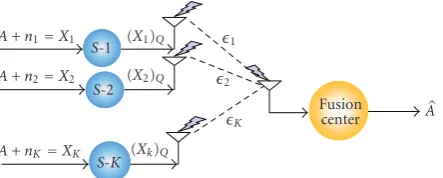
Let us now consider the multisensor setup depicted in Figure 2, where each sensor k has available local bounded noisy observation Xk = A+nk, and nk is zero mean with varianceσ2
kand independent ofnlforl /=k. After
normaliza-tion, we haveXk∈[0, 1]. Sensorkquantizes its local obser-vationXkto theNkmost significant bits, that is, withXk =
∞
i=1b (k)
i 2−i, we have (Xk)Q =
Nk
i=1b (k)
i 2−i. Bits{b
(k)
i } Nk
i=1are then transmitted through the wireless channel, which is again modeled as a BSC with cross-over probabilityk. The fusion
center reconstructsXkwith the demodulated bits{b(ik)} Nk
i=1to obtain
Xk=
Nk
i=1
b(ik)2−i. (25)
When we have available unquantized real valued observa-tionsXk =A+nk, k=1, 2,. . .,K, the best linear unbiased estimator (BLUE) ofAis known to be [18]
ABLUE=
K
k=1 1
σ2
k
−1K
k=1
Xk
σ2
k
. (26)
This motivates us to form the following estimator for the pa-rameterAwhen the noise variances are known at the fusion center, where we have only availableXk, k=1, 2,. . .,K:
A=
K
k=1 1
σ2
k
−1K
k=1
Xk
σ2
k
. (27)
The problem we are interested in can be formulated as fol-lows.
A+n1=X1
A+n2=X2
A+nK=XK
S-1
S-2
S-K
(X1)Q (X2)Q
(Xk)Q
1
2
K
Fusion
center A
Figure2: Multisensor cooperation in estimating a scalar parameter with quantized observations.
For a fixed number of quantization bits(Nk)per sensor, what is the optimal scheme for allocating the total energyET
prescribed to all sensors so that the mean-square estimation er-rorE|A−A|2is minimized? Furthermore, what is the optimal number of quantization bits per sensor so that this energy allo-cation scheme achieves the minimum possible estimation error? In this section, we will neglect the circuit energy sumption. Generalization to the case where the energy con-sumption by the circuit electronics is nonnegligible is rather straightforward using the model described in Section 2.3. Furthermore, we assume that the energy allocated per sen-sor will be equally distributed among the quantization bits. Now, let us take a look at the estimation error
A−A=
K
k=1 1
σ2k
−1K
k=1
Xk−A
σ2k
=
K
k=1 1
σ2
k
−1K
k=1
Xk−Xk+nk
σ2
k .
(28)
Upon defining the reconstruction errorXk := Xk −Xk, we have
E|A−A|2
=
K
k=1 1
σ2
k
−2
EK
k=1
Xk+nk
σ2
k
2
=E
K
k=1 Xk/σ2k
2
K
k=1
1/σ2
k
2
+E
K
k=1 Xk/σ2k
K
k=1
nk/σ2
k +
K
k=1
1/σ2
k
K
k=1
1/σ2k
2 .
(29)
SinceXk −(Xk)Q=
Nk
i=1(b(
k)
i −b( k)
i )2−i, it follows thatXk −(Xk)Q and nk are uncorrelated. Furthermore, as shown
in [19], when the characteristic function of nk is ban-dlimited to 2π/Δ, where Δ = 2−Nk is the quantization
step size, the quantization error (Xk)Q −Xk is
quantization erroris given by [19]E[X]/E[X2]E[2]= [√3/(πE[X2])]
k /=0[(−1)k/k] ˙φ(2πk/Δ), where φ(ω) :=
E[ejωX] and ˙φ(ω) := dφ(ω)/dω. Therefore, as long as the φ(ω) energy is concentrated in the interval [−2π/Δ, 2π/Δ], one can safely consider X and as uncorrelated.) Hence practically, as long as the quantization step Δ = 2−Nk is
sufficiently small relative toσk, one can safely assume the
reconstruction error Xk = Xk − Xk = Xk − (Xk)Q +
(Xk)Q −Xk is statistically uncorrelated with the observa-tion noise nk. Thus, the second summand in the numer-ator disappears. Hence, minimizing E|A−A|2 reduces to minimizing E|Kk=1(Xk/σ 2k)|
2
. Because for any bounded random variable Z ∈ [−U,U] with pdf p(z), we have
E|Z|2=U
−U|z|2p(z)dz≤
U
−UU|z|p(z)dz=UE|Z|,
notic-ing thatKk=1(Xk/σ 2k) is bounded, we can instead minimize
E|K
k=1(Xk/σ 2k)|, which we upper bound as
EK
k=1
Xk
σ2
k
≤
K
k=1
E Xk
σ2
k ≤
K
k=1
2−Nk+1−2−Nk
k
σ2
k
,
(30)
where k is the cross-over probability of the BSC between
sensorkand the fusion center.
3.1. Identical number of bits per sensor
For clarity in exposition, we first consider here a simple sit-uation where each sensor transmits the same fixed number of bits N (i.e., Nk = N, for all k). With xk denoting the fraction of the total energyET allocated to sensork, we can express k as k(ETxk/(NN0)), where N0 is the noise level at the receiver of the fusion center which is assumed com-mon to all channels. The optimal energy allocation scheme will be the solution of the following optimization problem
(x:=[x1,. . .,xK]T):
minimizex f0(x;N) :=
K
k=1 1
σ2
k
1 2N +
1− 1 2N
k
ETxk
NN0
subject to fk(x) := −xk≤0, k=1,. . .,K,
h(x) :=
K
k=1
xk=1.
(31)
As inSection 2, we can write down the KKT conditions for the optimal solutionx∗:=[x1∗,. . .,x∗K]Tas follows:
x∗k ≥0, λ∗k ≥0, λ∗kxk∗=0, k=1, 2,. . .,K, (32)
K
k=1
x∗k =1, (33)
∇f0
x∗;N+
K
k=1
λ∗k∇fk
x∗+ν∗∇hx∗=0. (34)
From (34), we have
1
σ2
k ET
NN0
dk(γ)
dγ
γ=(ET/NN0)xk
−λ∗k +ν∗=0, k=1,. . .,K.
(35)
To delve further into (35), we consider a particular system setup. Letting κdenote the path loss exponent [20] of the wireless channel (dkis the distance between sensorkand the fusion center), and supposing BPSK modulation, we can ex-press the cross-over probability in the presence of AWGN as k(γ)=Q(
2γC/dκk) withCbeing a constant. Under these
operating conditions, (35) and (32) yield
xk∗=φ−k1
ν∗σ2
k
NN0
ET
NN0
ET ,
φk(γ) :=√1
2π
e−γ(C/dκ
k)
2γ
C
dκk
,
(36)
whereν∗ is chosen such thatKk=1xk∗ =1. InSection 5, we
will examine a specific system and find the corresponding optimal energy allocation to gain further insight into these closed-form expressions.
In fact, whenk(γ), for allk, is convex inγ, the problem
in (31) turns out to be convex, which implies that the global optimum exists and can be easily found numerically. In most cases, convexity is guaranteed, for example, whenk(γ) is
ex-pressible in terms ofQ(2γ) or (1/2)e−γ/2.
Subsequently, the optimal number of quantization bits
Nopt can be easily found using one-dimensional numerical search to solve the optimization problem
Nopt=arg min
N f0
x∗;N, (37)
wheref0(x∗;N) is the optimal value of the objective function in (31) when the number of quantization bits per sensor is
N. InSection 5, we will show an example of the functional relationship between f0(x∗;N) andN, from whichNoptcan be readily determined.
3.2. Different number of bits per sensor
Now, let us consider the case where sensork transmits Nk
quantization bits,k = 1,. . .,K. From (30), we can see that the optimal energy allocation scheme which minimizes the estimation error is the solution of the following optimization problem:
minimizex f0
x;Nk, k=1,. . .,K
:= K
k=1 1
σ2
k
1 2Nk +
1− 1 2Nk
k
ETxk
NkN0
subject to fk(x) := −xk≤0, k=1,. . .,K,
h(x) :=
K
k=1
xk=1.
(i) Atlth step, withNk=Nk(l), k=1,. . .,K, find
x(l)=[x(l)
1 ,. . .,x(
l)
K]Tas the optimal solution of (38).
(ii) UpdateNk(l)toNk(l+1)based on the iteration
Nk(l+1)=arg minN
k
1 2Nk+
1− 1
2Nk
k
ETxk(l)
NkN0
.
(39)
(iii) Go to (l+ 1)ststep.
Algorithm1
Given the set ofNk,k=1,. . .,K, the solution to (38) is sim-ilar to (35). The problem we are interested in is the mini-mization of f0(x;Nk, k=1,. . .,K) with respect toNk, k =
1,. . .,K and xk, k = 1,. . .,K. In order to find optimal
Nk, k =1,. . .,K andxk, k = 1,. . .,Kjointly, we advocate
Algorithm 1.
Whenk(γ) is convex and{Nk}Kk=1 are fixed, the prob-lem in (38) is clearly convex, which implies that the opti-mal energy allocation vectorx∗can be found using standard numerically efficient search schemes [16]. Hence, step (i) of Algorithm 1is easily carried out. It is also easy to prove that the objective function is always decreasing from one iteration to another. The argument is as follows:
f0
x(l+1);N(l+1)
k , k=1,. . .,K
≤f0
x(l);N(l+1)
k , k=1,. . .,K
≤f0
x(l);N(l)
k , k=1,. . .,K
.
(40)
Our experience with simulations is thatAlgorithm 1typically converges after 3-4 iterations. InSection 5, we will utilize this approach to jointly optimizeNk andxk,k =1,. . .,K, for a specific wireless sensor network.
Remark 1. In this section, we have dealt with energy and quantization optimization for multiple sensors that are co-operating in the estimation of a common parameter. The op-timum scheme will be first derived in a centralized manner and then released to each individual senor, which may create a lot of scheduling overhead. However, in practice, we will not need to update the optimum scheme frequently unless there is a major change in the configuration of the sensor network.
4. EFFECTS OF CHANNEL CODING
In the preceding sections, we have limited our consideration to uncoded transmissions. In this section, we will examine the performance limit of our reconstruction problem when error control codes are adopted before the quantized bits en-ter the BSC. The total energy budget for RF transmission of
A∈[0, 1] is again constrained to beE. The energy consump-tion of the circuit electronics will be neglected here for clarity in exposition.
4.1. Single measurement transmission
Suppose now thatAis quantized toNQbits as in (1),AQ =
NQ
i=1bi2−i, and that a (2NQ,N) channel code is constructed to transmit theNQbits over the BSC by using the channel
N times. LettingPe(N) denote the average error probability
of maximum likelihood (ML) decoding andA:=NQ
i=1bi2−i denote the reconstruction ofAat the fusion center, we have the following upper bound for the reconstruction error|A−
A|at the fusion center:
E|A−A| =1−P(N)
e
E|A−A| |correct decoding
+P(N)
e E
|A−A| |decoding error
≤1−Pe(N)
EA−AQ +Pe(N)·1 ≤2−NQ+P(N)
e ,
(41)
where in deriving (41) we have used the fact thatAandA
both lie in [0, 1].
In order to proceed, we need the following result from [21, Chapter 5].
Theorem 1(Random coding theorem). For a discrete mem-oryless channel(X,p(x| y),Y), there exists a(eNR,N)block
channel code with average error probability of ML decoding sat-isfying
P(N)
e ≤e−NEr(R), (42)
whereEr(R)is the random coding exponent which is defined as
Er(R)=max
ρ∈[0,1]maxp(x)
−ln
y∈Y
x∈X
p(x)p(y|x)1/(1+ρ)
1+ρ −ρR
.
(43)
The random coding exponent for a BSC with cross-over probability<1/2 is [21]
Er(R,)=
⎧ ⎪ ⎪ ⎪ ⎪ ⎪ ⎪ ⎪ ⎪ ⎨ ⎪ ⎪ ⎪ ⎪ ⎪ ⎪ ⎪ ⎪ ⎩
T(δ)−H(δ),
R=ln 2−H(δ), ρ∈[0, 1],
ln 2−2 ln (√+√1−)−R,
R <ln 2−H
√
√
+√1−
,
(44)
where δ := 1/(1+ρ)/[1/(1+ρ) + (1−)1/(1+ρ)
], H(δ) := −δlnδ−(1−δ) ln (1−δ), andT(δ) := −δln−(1−δ) ln (1− ).
In our case, since we use the channel N times, the bit energy per transmission will be effectively reduced toE/N, and thus, the equivalent BSC’s cross-over probability will become (E/(NN0)). For our (2NQ,N) channel code, the
rate innats/channel usewill be (NQ/N) ln 2. Thus, applying Theorem 1 with an appropriate channel code, we can use (42) to bound (41) as
E|A−A| ≤2−NQ+e−NEr((NQ/N) ln 2,(E/NN0))
:= fcode
Clearly,NQandNcan be optimally selected to minimize
fcode(NQ,N) and thus the reconstruction error. InSection 5, we will compare this upper bound with the bound achieved with the uncoded transmission schemes we developed in Section 2.
4.2. Multiple simultaneously transmitted measurements
The exponentially decreasing behavior of the decoding er-ror probability described by the random coding theorem fa-vors large block sizes. However, in the single measurement transmission case, when the block sizeNbecomes large, the capacity of the underlying BSC goes to zero. To resolve this tradeoff, we can transmit multiple measurements together. In practice, for some application scenarios, it may not be necessary for the remote sensor to transmit its measurement back to the fusion center immediately, that is, one can wait untilL >1 measurements{A1,A2,. . .,AL} ∈[0, 1]Lare ac-quired, and then transmit them jointly to the destination. The critical difference here is that the energy budget increases toLE. We assume no probabilistic model for the source and, again, employ the universal uniform quantizer to quantize each measurement toNQbits. As a result, the total number of bits to be transmitted isLNQ. Adopting an appropriate (2LNQ,LN) channel code with error probability P(LN)
e , as in
(41) and (45), we thus obtain
1
L L
l=1
EAl−Al ≤2−NQ+P(LN)
e
≤2−NQ+e−LNEr((NQ/N) ln 2,(LE/(LNN0)))
:= fcode
NQ,N.
(46)
Comparing the bound for a single measurement trans-mission, fcode(NQ,N) in (45), with the bound for multiple simultaneously transmitted measurements, fcode(NQ,N) in (46), we can see
fcode
NQ,N> fcode
NQ,N,
whenEr
NQ N ln 2,
E
NN0
>0, ∀L >1.
(47)
Equation (47) shows clearly that it is preferable to transmit multiple measurements simultaneously in energy-limited communication settings. However, when we directly trans-mit uncoded quantization bits, there is no preference be-tween transmitting a single or multiple measurements.
Certainly, judicious selection of NQ or/and N should minimize the fcode(NQ,N) bound to ensure reliable perfor-mance in reconstruction. To this end, let us explore further the characteristics of fcode(NQ,N) with large L. As long as
R <ln 2−H(), we know thatEr(R,)>0, see (44). Thus,
asL→∞, we have
lim
L→∞
arg min
NQ
2−NQ+e−LNEr((NQ/N) ln 2,(LE/(LNN0)))
=N
1−H
E/NN0
ln 2
:=NQ∗(N);
(48)
lim
L→∞
min
NQ
2−NQ+e−LNEr((NQ/N) ln 2,(LE/(LNN0)))
=2−NQ∗(N).
(49)
Equation (49) implies that the number of channel uses to transmit one measurement can be optimally chosen to be
N∗=arg max
N N
1−H
E/NN0
ln 2
. (50)
Accordingly, the optimal number of quantization bits is
NQ∗(N∗) given by (48).
InSection 5, we will study howL, the number of simul-taneously transmitted measurements, affects the achievable distortion in source reconstruction with numerical exam-ples.
5. NUMERICAL EXAMPLES
In this section, we provide numerical examples to corrobo-rate the analytical results we derived in the previous sections.
5.1. Optimal number of quantization bits
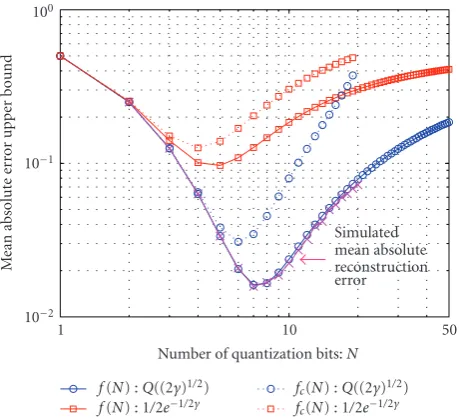
As discussed in Sections2.1 and2.3.1, when the total en-ergy budget is uniformly allocated among quantization bits, there is an optimal value ofN which minimizes the mean-absolute reconstruction error upper bound both when the circuit energy is neglected and also when circuit energy con-sumption is accounted for. Here, we first consider the chan-nel to be AWGN and use BPSK modulation. The BSC cross-over probability as a function of the bit energy-to-noise ratio is(γ)=Q(2γ).Figure 3depicts the boundf(N) in (5) to-gether with the simulated actual mean-absolute reconstruc-tion errorE|A−A|, and the boundfc(N) in (21) withE/N0= 20 andT0Pon/N0=1. It can be seen that the bound f(N) is pretty tight and numerical minimization yieldsNopt = 7 in the first case andNopt=6 in the second case. InFigure 3, we also plot f(N) and fc(N) when(γ)=(1/2)e−γ/2, which is the BER when binary orthogonal modulation is used along with envelope detection;Nopthere turns out to be 5 and 4, respectively.
5.2. Optimal bit energy allocation
1 10 50 Number of quantization bits:N
10−2 10−1 100
M
ean
absolut
e
er
ror
upp
er
b
ound
f(N) :Q((2γ)1/2)
f(N) : 1/2e−1/2γ
fc(N) :Q((2γ)1/2)
fc(N) : 1/2e−1/2γ Simulated mean absolute reconstruction error
Figure3: The bound ofE|A−A|whose minimum yields the opti-mum number of quantization bits.
For the same(γ) = (1/2)e−γ/2,Figure 5compares the reconstruction error between the optimal energy allocation scheme in (8) and the equal energy distribution scheme in (5) with a different number of quantization bitsN. We ob-serve that the reconstruction error decreases to a floor as
Nincreases with optimal energy allocation, which is diff er-ent from the equal energy allocation scheme. The intuitive explanation for this behavior is that as N increases, equal energy allocation increases the cross-over probability for all transmitted bits; on the other hand, optimal energy alloca-tion does not experience this problem. As already noticed in Figure 4, whenN is large enough, the optimal scheme just assigns no (or very little) energy to less significant bits.
InFigure 5, we also plot the reconstruction error as a function ofNwhen circuit energy consumption is taken into account with optimal allocation of the residual energy to the quantization bits as in (23); here we takeT0Pon/N0=1. The optimal number of quantization bits in (24) is easily seen to beNopt=6.
5.3. Optimal energy allocation among sensors
Suppose that K = 10 sensors are deployed with local observation noise variances denoted by σ2
1,σ22,. . .,σ210, the
path loss exponent of the wireless channel isκ = 2 (free space), and accordingly, the cross-over probability is given byk(γ) = Q(
2γC/d2
k), wheredk is the distance between
sensor k and the fusion center. ParameterC is set to be 1 here. In the following, we set the total energy budget to be
ET/N0=200.
5.3.1. IdenticalNk=N, k=1,. . .,K
Using the aforementioned parameters,Figure 6compares the normalized value of the objective function in (31) between
1 2 3 4 5 6 7 8 9 10
Bit index:i
0 0.05 0.1 0.15 0.2 0.25 0.3 0.35
xi
Uniform Optimal
Figure4: Optimal energy allocation over a fixed number of quan-tization bits (N=10).
100 101
N
10−2 10−1 100
R
ec
o
n
str
u
ctio
n
er
ro
r
Optimal energy allocation Equal energy allocation
Optimal residual energy allocation (a) (c) (b)
Figure5: (a) Reconstruction error with optimal energy allocation among bits as in (8). (b) Reconstruction error with equal energy allocation as in (5). (c) Reconstruction error in (23) taking into ac-count the energy consumption of circuit electronics.
the equal energy allocation and the optimal energy allocation scheme for a variable number of bitsNwhile choosing a spe-cific set of values for{dk}10
k=1and{σ2k}
10
k=1. For this particular setup, the optimal value ofNin (37) turns out to beNopt=6. With different sets of values for{dk}10
k=1and{σ2k}
10
k=1, when
2 4 6 8 10 12 14 16 18 20
N
0.11 0.12 0.13 0.14 0.15 0.16 0.17 0.18 0.19 0.2
N
o
rm
al
iz
ed
re
co
n
str
u
ctio
n
er
ro
r
Optimal energy allocation Equal energy allocation Joint optimization
(a) (b)
(c)
Figure6: Withσ2
k =0.01×k,k=1, 2,. . ., 10, and{d1,d2,. . .,d10} = {1, 5, 1, 5, 1, 1, 5, 5, 1, 5}. (a) Normalized value of the objective function in (31) with optimal energy allocation among sensors. (b) Normalized value of the objective function in (31) with equal en-ergy allocation among sensors. (c) Normalized value of the objec-tive function in (38) with joint optimization.
5.3.2. Jointly optimized{Nk,xk}K k=1
As explained inSection 3.2, we can find the optimalNkand
xk,k=1,. . .,K, jointly by utilizingAlgorithm 1. The
result-ing optimal energy allocation scheme and the optimal num-ber of quantization bits per sensor are depicted in Figures 8and9, respectively. Through joint optimization, the nor-malized minimum value of the objective function in (38) is plotted inFigure 6. The gain over the case where each sensor transmits the same number of quantization bits is clear. Fur-thermore, we have also plotted the simulated mean-square estimation error of different schemes inFigure 7, which again demonstrates the benefits of energy and quantization opti-mization.
5.4. Effects of channel coding
5.4.1. Single measurement transmission
With envelope detection of binary orthogonal signals, the underlying BSC’s cross-over probability is(γ)=(1/2)e−γ/2, where γdenotes the bit energy-to-noise ratio. Assuming a total energy budget E/N0 = 100, the reconstruction error upper bound in (41) is depicted inFigure 10, where we also plot the optimal bounds achieved with uncoded transmis-sion schemes (cf. (5) and (8)). From these plots, it is evident that the bound fcode(NQ,N) derived for randomly coded transmission is not tight and is easily achieved with uncoded transmissions.
2 4 6 8 10 12 14 16 18 20
Number of quantization bits 2
3 4 5 6 7 8
×10−3
MS
E
Equal energy allocation Joint optimization Original BLUE perf.
(a)
(b)
(c)
Figure7: Withσ2
k =0.01×k,k=1, 2,. . ., 10, and{d1,d2,. . .,d10} = {1, 5, 1, 5, 1, 1, 5, 5, 1, 5}. (a) Simulated mean-square estimation error with equal energy allocation among sensors. (b) Simulated mean square estimation error with joint optimization of energy al-location and a number of quantization bits per sensor. (c) Simulated MSE of the unquantized BLUE.
0 1 2 3 4 5 6 7 8 9 10 11
Sensor index:k
0 0.1 0.2 0.3 0.4
F
ra
ct
ion
of
tot
al
ene
rg
y
ET
allo
cat
ed
to
each
sen
so
r
Case III
0 1 2 3 4 5 6 7 8 9 10 11
Sensor index:k
0 0.05 0.1 0.15 0.2
Case II
0 1 2 3 4 5 6 7 8 9 10 11
Sensor index:k
0 0.05 0.1 0.15 0.2
Case I
Nk=Nopt,∀k Joint optimization
Figure8: Optimal energy allocation scheme forNk =Nopt, for all
k, and jointly optimizedNk,k =1,. . .,K. Case I:dk =k/4,σ2k =
0.01, for allk,Nopt =6. Case II:dk =1,σ2k =0.01×k, for allk,
Nopt=8. Case III:{d1,d2,. . .,d10} = {1, 5, 1, 5, 1, 1, 5, 5, 1, 5}and,
σ2
0 1 2 3 4 5 6 7 8 9 10 11 Sensor index:k
0 5 10 Nk
Case I
0 1 2 3 4 5 6 7 8 9 10 11
Sensor index:k
0 5 10 Nk
Case II
0 1 2 3 4 5 6 7 8 9 10 11
Sensor index:k
0 2 4 6 8 Nk
Case III
Figure9: Jointly optimized number of quantization bits per
sen-sor:Nk, k=1,. . .,K. Case I:dk =k/4,σ2k =0.01, for allk. Case
II:dk = 1,σ2k = 0.01×k, for allk. Case III:{d1,d2,. . .,d10} = {1, 5, 1, 5, 1, 1, 5, 5, 1, 5}andσ2
k=0.01×k, for allk.
10 20 30 40 50 60 70 80 90 100
N: number of channel uses per source sample 10−3
10−2 10−1 100
min
NQ fcod
e
(
NQ
,
N
)
minNQ fcode(NQ,N)
Equal energy allocation bound Optimal energy allocation bound
(a)
10 20 30 40 50 60 70 80 90 100
N: number of channel uses per source sample 2
3 4 5 6
Optimal
NQ arg minNQfcode(NQ,N)
(b)
Figure10: Single measurement transmission.
5.4.2. Multiple measurements transmitted together
Keeping the same set of parameters, the bound provided in (46) is plotted inFigure 11for different values ofL. We ob-serve that with optimal choices ofNQ andN, the uncoded performance bound is easily achieved by transmitting mul-tiple source samples together with appropriate channel cod-ing. The performance gap between uncoded and coded cases can be large. In this particular example, the reconstruction error with coding can be less than 1% of the one without coding.
6. CONCLUSIONS
Motivated by stringent energy requirements that are preva-lent in wireless sensor networks, we have pursued optimal quantization at sensor nodes to effect optimal reconstruction at the fusion center. (De)modulation and propagation were captured through the use of the classical binary symmetric channel model. In particular, we have found the number of quantization bits for minimizing the mean-absolute recon-struction error bound in a point-to-point link when each bit is allocated the same energy. We also derived an optimal scheme for energy allocation across quantization bits. Both transmission energy as well as circuit energy were considered. When multiple sensors collaborate to estimate a parameter in noise, we also obtained the optimal energy allocation scheme to distribute the limited total energy among different sensors when each sensor assigns the same energy to all its quantiza-tion bits. It turned out that this allocaquantiza-tion scheme depends on the prescribed number of quantization bits{Nk}K
k=1, and thus the optimal {Nk}K
k=1 can also be found with the help of our convex optimization formulation. We also studied the effects of channel coding on energy constrained quantiza-tion and optimized the number of quantizaquantiza-tion levels and the number of channel uses per source sample.
APPENDIX
A. PROOF OF f0(xn∗;n)< f0(x∗n;n), FOR ALLN >N
BecauseN > N, we can construct the followingN -dimen-sional vector
xN:=
x1,. . .,xN T=xN∗T, 0,. . ., 0 T, (A.1)
where xN∗ := [x∗1,. . .,xN∗] T
is the optimal solution of (8) when transmittingNquantization bits. By construction,xN
is a feasible point for the optimization problem in (8) when transmittingNbits because
xi≥0, i=1,. . .,N,
N
i=1
xi=
N
i=1
xi∗=1. (A.2)
Asx∗N is the optimal solution when transmittingNbits,
we have
f0
xN;N
≥ f0
x∗N;N. (A.3)
We can write down f0(xN;N) explicitly as
f0
xN;N
=2−N+
N
i=1
E
xi
N0
2−i
=2−N+
N
i=1
E
x∗i
N0
2−i+
N
i=N+1 (0)2−i
=2−N−2−N+ f
0 x∗N;N
!
+1 2
N
i=N+1 2−i
=2−N−1−2−N−1+ f 0 x∗N;N
!
< f0 x∗N;N
!
10 20 30 40 50 60 70 80 90 100
N: number of channel uses per source sample 10−5
10−4 10−3 10−2
min
NQ fcod
e
(
NQ
,
N
)
L=20
L=200
L=1000
L=+∞
Equal Optimal
2−NQ∗(N)
(a)
10 20 30 40 50 60 70 80 90 100
N: number of channel uses per source sample 5
10 15 20
Optimal
NQ
L=20
L=200
L=1000
L=+∞
NQ∗(N)
(b)
Figure11: Multiple measurements transmitted together.
where we have used the property that(0)=1/2. From (A.3) and (A.4), it follows readily that f0(x∗N;N)< f0(x∗N;N).
ACKNOWLEDGMENTS
This work was supported by the USDoD ARO Grant no. W911NF-05-1-0283, and also through collaborative par-ticipation in the Communications and Networks Consor-tium sponsored by the US Army Research Laboratory un-der the Collaborative Technology Alliance Program, Coop-erative Agreement DAAD19-01-2-0011. The US government is authorized to reproduce and distribute reprints for gov-ernmental purposes notwithstanding any copyright notation thereon. The material in this paper was presented in part at the First IEEE Conference on Sensor and Ad Hoc Commu-nications and Networks (SECON), Santa Clara, CA, USA, on October 4–7, 2004.
REFERENCES
[1] J. M. Rabaey, M. J. Ammer, J. L. Da Silva Jr., D. Patel, and S. Roundy, “PicoRadio supports ad hoc ultra-low power wireless networking,”IEEE Computer, vol. 33, no. 7, pp. 42–48, 2000. [2] A. J. Goldsmith and S. B. Wicker, “Design challenges for
energy-constrained ad hoc wireless networks,”IEEE Wireless Communications, vol. 9, no. 4, pp. 8–27, 2002.
[3] S. Cui, A. J. Goldsmith, and A. Bahai, “Modulation optimiza-tion under energy constraints,” inIEEE International Confer-ence on Communications, vol. 4, pp. 2805–2811, Anchorage, Alaska, USA, May 2003.
[4] W. Ye, J. Heidemann, and D. Estrin, “An energy-efficient MAC protocol for wireless sensor networks,” inProceedings of the Annual Joint Conference of the IEEE Computer and Communi-cations Societies, vol. 3, pp. 1567–1576, New York, NY, USA, June 2002.
[5] A. Michail and A. Ephremides, “Energy efficient routing for connnection oriented traffic in Ad-hoc wireless networks,” in
Proceedings of the 11th IEEE International Symposium on Per-sonal, Indoor and Mobile Radio Communications, pp. 762–766, London, UK, September 2000.
[6] H. V. Poor and J. B. Thomas, “Memoryless quantizer-detectors for constant signals in m-dependent noise,”IEEE Transactions on Information Theory, vol. 26, no. 4, pp. 423–432, 1980. [7] S. A. Kassam, “Optimum quantization for signal detection,”
IEEE Transactions on Communications, vol. 25, no. 5, pp. 479– 484, 1977.
[8] Y. A. Chau and E. Geraniotis, “Asymptotically optimal quan-tization and fusion in multiple sensor systems,” inProceedings of the IEEE Conference on Decision and Control, vol. 1, pp. 585– 587, 1989.
[9] P. Willett and P. F. Swaszek, “Optimal quantization in the dependent gaussian problem,” inProceedings of the Asilomar Conference on Signals, Systems and Computers, vol. 1, pp. 593– 597, 1998.
[10] Z.-Q. Luo, “Universal decentralized estimation in a bandwidth constrained sensor network,”IEEE Transactions on Informa-tion Theory, vol. 51, no. 6, pp. 2210–2219, 2005.
[11] J. Li and G. AlRegib, “Rate-constrained distributed estimation in wireless sensor networks,”IEEE Transactions on Signal Pro-cessing, vol. 55, no. 5 I, pp. 1634–1643, 2007.
[12] R. Puri, P. Ishwar, S. S. Pradhan, and K. Ramchandran, “Rate-constrained robust estimation for unreliable sensor networks,” inProceedings of the Asilomar Conference on Signals, Systems and Computers, vol. 1, pp. 235–239, 2002.
[13] N. Farvardin and V. Vaishampayan, “Optimal quantizer design for noisy channels: an approach to combined soure-channel coding,” IEEE Transactions on Information Theory, vol. 33, no. 6, pp. 827–838, 1987.
[14] P. Ishwar, A. Kumar, and K. Ramchandran, “Distributed sam-pling for dense sensor networks: a “bit-conservation princi-ple”,” inProceedings of Information Processing in Sensor Net-works: Second International Workshop, vol. 2634, pp. 17–31, Palo Alto, Calif, USA, April 2003.
[15] J.-J. Xiao, S. Cui, Z.-Q. Luo, and A. J. Goldsmith, “Joint esti-mation in sensor networks under energy constraints,” in Pro-ceedings of the 1st Annual IEEE Communications Society Con-ference on Sensor and Ad Hoc Communications and Networks (SECON ’04), pp. 264–271, 2004.
[16] S. Boyd and L. Vandenberghe,Convex Optimization, chapter 5 and 11, Cambridge University Press, Cambridge, UK, 2004. [17] J. G. Proakis,Digital Communications, chapter 5,
McGraw-Hill, Columbus, Ohio, USA, 4th edition, 2001.
[18] S. M. Kay,Fundamentals of Statistical Signal Processing: Esti-mation Theory, chapter 6, Prentice Hall, Upper Saddle River, NJ, USA, 1993.
[19] A. B. Sripad and D. L. Snyder, “A necessary and sufficient con-dition for quantization errors to be uniform and white,”IEEE Transactions on Acoustics, Speech, and Signal Processing, vol. 25, no. 5, pp. 442–448, 1977.
[20] T. S. Rappaport, Wireless Communications—Principles and Practice, Prentice Hall, Upper Saddle River, NJ, USA, 2nd edi-tion, 2001.