Volume 2008, Article ID 632134,15pages doi:10.1155/2008/632134
Research Article
Time-Division Multiuser MIMO with Statistical Feedback
Kai-Kit Wong and Jia Chen
Department of Electrical and Electronic Engineering, University College London, Adastral Park Research Campus, Martlesham Heath, IP5 3RE Suffolk, UK
Correspondence should be addressed to Kai-Kit Wong,[email protected]
Received 29 May 2007; Revised 4 September 2007; Accepted 28 October 2007
Recommended by David Gesbert
This paper investigates a time-division multiuser multiple-input multiple-output (MIMO) antenna system inK-block flat fading where users are given individual outage rate probability constraints and only one user accesses the channel at any given time slot (or block). Assuming a downlink channel and that the transmitter knows only the statistical information about the channel, our aim is to minimize the overall transmit power for achieving the users’ outage constraint by jointly optimizing the power allocation and the time-sharing (i.e., the number of time slots) of the users. This paper first derives the so-called minimum power equation (MPE) to solve for the minimum transmit power required for attaining a given outage rate probability of a single-user MIMO block-fading channel if the number of blocks is predetermined. We then construct aconvexoptimization problem, which can mimic the original problem structure and permits to jointly consider the power consumption and the probability constraints of the users, to give a suboptimal multiuser time-sharing solution. This is finally combined with the MPE to provide a joint power allocation and time-sharing solution for the time-division multiuser MIMO system. Numerical results demonstrate that the proposed scheme performs nearly the same as the global optimum with inappreciable difference.
Copyright © 2008 K.-K. Wong and J. Chen. This is an open access article distributed under the Creative Commons Attribution License, which permits unrestricted use, distribution, and reproduction in any medium, provided the original work is properly cited.
1. INTRODUCTION
Due to the instability nature of wireless channels, there has long been the challenge of communicating reliably and effi -ciently (in terms of both power and bandwidth) over wireless channels [1], and the subject of providing diversity transmis-sions and receptions is still a very hot ongoing research area today. An attractive means to obtain diversity is through the use of multiple antennas (or widely known as multiple-input multiple-output (MIMO) antenna systems), which gain di-versity benefits without the need for any bandwidth expan-sion and increase in transmit power (e.g., see [2–8]).
In the past, most efforts focused on which rate a partic-ular wireless channel can support. In particpartic-ular, in an addi-tive white Gaussian noise (AWGN) channel, practical coding techniques with finite (but long) code length are available to approach the Shannon capacity within a fraction of decibel [9,10]. Later in [11], Goldsmith and Varaiya derived the er-godic capacity of a fading channel and showed that erer-godic capacity can be achieved without knowing the channel state information at the transmitter (CSIT) if a very long code-word is permitted. Similar conclusion has also been drawn
to MIMO channels [2,3], which offer a capacity increase by a factor determined by the rank of the channel. Results of this sort are undoubtedly important to system optimization if the aim is to maximize the rate over a wireless channel.
However, for delay-sensitive applications, the rate is usu-ally preset and the preferred aim would be to minimize the transmission cost for a given outage probability constraint (i.e., the probability that the target rate is not reached) [12–
18]. To model this, it is customary to consider aK-block fad-ing channel in which the fade is assumed to occur identically and independently from one block to another, but it remains static (or time-invariant) within a block (A packet of infor-mation data for communications may be regarded as a block. In the context of this paper, the terminologies such as block, packet and time slot will be used interchangeably.) of sym-bols [19]. In light of this, a delay constraint can be described as the probability of the outage event, which allows to in-clude the target rate, the time-delay in the number of blocks, and the outage tolerance in probability as a single constraint [17,18].
In [14], Negi and Cioffi investigated the optimal power control for minimizing the outage probability using a dy-namic programming (DP) approach with certain power con-straints. Similar methodology was also proposed in [15] for a two-user downlink channel for expected capacity maximiza-tion with a short-term power constraint. Furthermore, in [16], Berry and Gallager looked into the delay-constrained problem taking into account the size of the buffer. Most re-cently in [17], an algorithm that finds the optimal power allo-cation over the blocks to minimize the overall transmit power while constraining an upper bound of the outage proba-bility constraint was proposed. Unfortunately, the assump-tion of having perfect CSIT is quesassump-tionable, and the required amount of channel feedback may not justify the diversity gain obtained from the intelligent power control.
The scope of this paper is fundamentally different from the previous works in that field. Only the receiver has per-fect channel state information (CSIR), but the transmitter knows only the channel statistics (CST). Moreover, a time-division multiuser MIMO system in the downlink is con-sidered. (Note that the works in [12–17] are all limited to single-user (or two-user) single-antenna channels.) In this setup, each user is given an individual outage rate probability constraint and only one user is allowed to access the channel for each block. Our goal is to optimize the power allocation among the users and to schedule the users smartly so that the overall transmit power is minimized while the outage proba-bility constraints of the users are satisfied. Assuming that all users are subjected to a delay tolerance ofK-blocks, (The re-sult of this paper is extendable to the case where users have differentK. However, this assumption greatly simplifies the presentation of this paper and makes it more accessible to the readers.) the exact order of how the users are scheduled within the blocks is irrelevant. As a consequence, our aim boils down to finding the optimal power allocation and the optimal time-sharing (i.e., the number of blocks/time slots assigned) among the users. The problem under investigation is specially crucial if the target rates of the users are predeter-mined and the cost of transmission is to be minimized with only statistical channel feedback. Note that this paper can be thought of as an extension of [18] to MIMO channels.
Our proposed approach is based on two major contri-butions: (1) the minimum power equation (MPE), and (2) a convexization of the original multiuser joint power allo-cation and time-sharing problem by upper bound formula-tion and relaxaformula-tion. The soluformula-tion of the MPE gives the min-imum transmit power required for ensuring a given outage rate probability for a single-user MIMOn-block fading chan-nel, while theconvexproblem enables to find a sensible time-sharing solution for a time-division multiuser MIMO chan-nel by taking into account both users’ potential power con-sumption and their likelihood of being in an outage. An algo-rithm that intelligently combines the MPE and convex prob-lem is presented to obtain a suboptimal joint multiuser time-sharing and power allocation solution, which will be shown by numerical results to yield near optimal performance with inappreciable difference.
The remainder of the paper is structured as follows. In
Section 2, we present the block-fading channel model for a
time-division multiuser MIMO antenna system, and formu-late the joint multiuser time-sharing and power allocation problem.Section 3derives the MPE for a single-user MIMO block-fading channel.Section 4proposes a convex problem to obtain a suboptimal multiuser time-sharing solution. In
Section 5, an algorithm which finds a joint time-sharing and power allocation solution is presented. Numerical results will be provided inSection 6. Finally, we have some concluding remarks inSection 7.
2. SYSTEM MODEL AND PROBLEM FORMULATION
2.1. Single-user MIMO block-fading channel
Let us first assume a block flat-fading noisy channel as in [14,
17,19]. Every set of information symbols T0is encoded as a single codeword and transmitted as one block (in a time slot). Data are required to arrive at the receiver in at mostK -blocks of symbols. The channel is assumed to fade identically and independently from one block to another, but the fade can be considered static within a block of T0 symbols. (In this paper, the exact value of T0 is not important but it is assumed to be large enough so that noise can be averaged out from the information-theoretic perspective and the classical Shannon capacity formula is permitted.) We will useck to denote the channel power gain in blockk and assume that the channel amplitude √ck is in Rayleigh fading so that ck has the following probability density function (pdf):
Fck
=
e−ck, c k≥0, 0, ck<0.
(1)
For a given block, sayk, the Gaussian codebook is used with an assigned power ofQ/Kper block (i.e., with total power of
Q), and the rate can be expressed in bps/Hz as
rk=log2
1 +C0d −γQc
k
KN0
, (2)
whereN0is the noise power,ddenotes the distance between the transmitter and the receiver,γis the power loss exponent, and C0 is the distance-independent mean channel power gain. An outage is said to occur ifKk=1rk≤Rfor some target rateR.
Our assumption is that the transmitter knows (1) and the channel statistical parameterC0d−γ (i.e., CST), but the receiver knows {cn}n≤k at time slot k (i.e., CSIR) so that maximum-likelihood decoding can be used to realize the rate in (2).
The above single-antenna model can be extended easily to a channel with MIMO antennas. This extension can be done by replacing the scalar channel√ckby a matrix channel, Hk=[h(i,kj)]∈Cnr×nt, wherent andnrantennas are, respec-tively, located at the transmitter and the receiver. The ampli-tude square of each element,|h(i,kj)|
2
, has the pdf of (1) as that ofck, and the elements ofHkare independent and identically distributed (i.i.d.) for differentkand antenna pairs. The rate achieved for blockkcan be written in bps/Hz as [3]
rk=log2det
I+
C0d−γQ
ntK
H
kH†k
N0
where det (·) denotes the determinant of a matrix, and the superscript†is the conjugate transposition. In (3), we have used the fact that the transmit covariance matrix at timek
isQI/ntK because the transmitter does not have the instan-taneous channel state information, and thus it transmits the same power across the antennas. By transmitting power of
Q/ntKat each antenna, the transmit power at each block is kept asQ/K. For conciseness, in the sequel, we will assume thatnt ≥ nr and that the matrixHk is always of full rank. The case ofnt < nrcan be treated in a similar way and thus omitted.
2.2. Time-division multiuser MIMO system
In a time-division multiuser system, each block (or time slot) will be given to one of the users. If CSIT is available, it will be possible to gain multiuser diversity by assigning the time slot to a user with a strong channel. In that case, schedul-ing of users will be specific to the instantaneous CSIT. In this paper, however, only CST is known to the transmitter, and multiuser diversity of such kind is not obtainable. In what follows, the exact order of how the users are scheduled for transmission within the K-blocks is unimportant, and the only thing that matters is the amount of channel resources (such as the number of time slots) allocated to the users.
As a result, for aU-user system wherewutime slots are al-located to useru(note thatuwu≤K), we can now assume, without loss of generality, that useruaccesses the channels in time slots (or blocks)ksuch that
k∈Du≡
∀k∈Z:
u−1
j=1
wj+ 1≤k≤
u
j=1
wj
. (4)
Following the model described previously, the sum-rate at-tained for useruis given in bps/Hz by
k∈Du
rk=
k∈Du log2det
I+
C0(u)Qu
ntwu
H(u) k H
(u)† k
N0
, (5)
where Qu denotes the transmit power, H(ku) is the MIMO channel matrix from the transmitter to useruat slotk, and
C(0u)C0d− γ
u refers to the mean channel power gain between the transmitter and useru. The statistical property of the am-plitude squared entries ofH(ku)follows exactly (1).
Given a target rateRufor useruinK-blocks, an outage will occur ifk∈Durk< Ru, and the outage tolerance of a user can be characterized by the outage probability constraint
P
k∈Du
rk< Ru
≤εu, (6)
whereP(A) denotes the probability of an eventA, andεu denotes the maximum allowable outage probability for user
u. Note that (6) can be viewed as a probabilistic delay con-straint which enables us to consider requirements such as target rate (Ru), outage tolerance (εu), and time delay in a number of time slots (K) altogether [17].
2.3. The joint multiuser time-sharing and
power allocation problem
The problem of interest is to minimize the overall transmit power (i.e.,uQu) while ensuring the users’ individual out-age probability constraints by jointly optimizing the time-sharing (i.e., the number of allocated time slots{wu}) and the power allocation (i.e.,{Qu}) for the users. Mathemati-cally, this is written as
M−→
⎧ ⎪ ⎪ ⎪ ⎪ ⎪ ⎪ ⎪ ⎪ ⎪ ⎨ ⎪ ⎪ ⎪ ⎪ ⎪ ⎪ ⎪ ⎪ ⎪ ⎩
min {Qu},{wu}
U
u=1
Qu s.t.P k∈Du
rk≤Ru
≤εu∀u,
Qu≥0 ∀u,
U
u=1
wu≤K, wu∈ {1, 2,. . .,K−U+ 1} ∀u,
(7)
where
(i) Quis the total power allocated to useru;
(ii) wuis the number of blocks (or the amount of time) allocated to useru;
(iii) Duis the set storing the indices of the channel assigned to useru;
(iv) Uis the total number of users; (v) Kis the number of blocks; (vi) Ruis the target rate for useru;
(vii) εuis the outage probability requirement for useru. The challenge ofMis that it is a mixed integer problem which has no known method of achieving the global opti-mum [20]. The rest of the paper will be devoted to solving (7). In particular,Section 3will look into obtaining the op-timal{Qu}for a given{wu}.Section 4will focus on finding the suboptimal time-sharing parameters{wu}using relax-ation followed by convex optimizrelax-ation.Section 5combines the two approaches to suboptimally solve (7). Numerical re-sults inSection 6will, however, show that the proposed sub-optimal method performs nearly the same as the global opti-mum with inappreciable difference.
3. MINIMUM POWER EQUATION
In this section, we will derive an equation to determine the minimum power required for attaining a given outage rate probability if the number of blocks is fixed. In time-division systems, as each block is occupied by one user only, if{wu}are fixed, then the optimization for the users is com-pletely uncoupled and will be equivalent to multiple individ-ual users’ power minimization. Therefore, it suffices to focus on a single-user system for a given number of blocks,n, or
min
Q≥0Q s.t.P
r1+r2+· · · +rn≤R
≤ε, (8)
To proceed further, we rewrite the outage probability as follows:
PoutP
n
k=1 log2det
I+
C0d−γQ
ntn
HkH†k
N0
≤R
=P
n
k=1 log2det
I+C0d
−γQΛk
N0ntn
≤R
,
(9)
whereΛkdiag (λ(1k),λ (k) 2 ,. . .,λ
(k)
nr) withλ(1k)≥λ (k)
2 ≥ · · · ≥
λ(nrk) >0 standing for the ordered eigenvalues ofHkH†k. Note also from our assumption thatnr=min{nt,nr} =rank(Hk) for allk. The random variables of the outage probability are the eigenvalues{λ(k)
j }whose joint pdf is [21]
F(Λ)=
nr
i=1λi
nt−nr
e−nri=1λi
nr!
nr i=1
nr−i
!nt−i
!
×
1≤i≤j≤nr
λi−λj
2
forλ1,. . .,λnr>0, (10)
where the time indexkis omitted for conciseness. Evaluation of the outage probability requires knowing the pdf ofkrk with (10), and it has unfortunately been unknown so far. Re-cently, it was found in [22] that the pdf ofr(rkwith the sub-scriptkomitted) can be approximated as Gaussian (so does the sum-ratekrk) with the mean E[r] and variance VAR[r] given, respectively, as [3,22]
μ(Q)E[r]=
∞
0 log2
1 +C0d −γQλ
ntnN0
×
nr−1
j=0
j!λnt−nre−λ
j+nt−nr
!
L(jnt−nr)(λ)
2
dλ,
(11)
whereL(jnt−nr)(x) denotes the generalized Laguerre polyno-mial of orderj, and
σ2(Q)VAR[r]
=nr
∞
0 ω
2(Q,λ)p(λ)dλ
−
nr
i=1 nr
j=1
(i−1)!(j−1)!
i−1 +nt−nr
!j−1 +nt−nr
!
× ∞
0 λ nt−nr
e−λL(nt−nr)
i−1 (λ)L(jnt−1−nr)(λ)ω(Q,λ)dλ 2
(12)
in whichω(Q,λ)log2(1 +C0d−γQλ/ntnN0) and
p(λ) 1
nr nr
i=1
(i−1)!
i−1 +nt−nr
!λ nt−nr
e−λL(i−1nt−nr)(λ)
2
.
(13)
In [22], it was revealed that using Gaussian approxima-tion on the rate of a MIMO channel is accurate even with small number of antennas, and this claim will be substanti-ated inSection 4where numerical results will be provided to verify its validity. In light of this, we will use Gaussian ap-proximation on the sum-ratenk=1rk(as this is a sum of in-dependent random variables, clearly, the approximation will further improve ifnincreases). Consequently, the probability constraint can be expressed as
1 2
1 + erf
R−nμ(Q)
σ(Q)√2n ≤ε, (14)
where erf(x)(2/√π)0xe−t2
dt. This probability constraint can further be simplified as
g(Q)nμ(Q)−√2nerf−1(1−2ε)σ(Q)−R≥0.
(15) Accordingly, (8) can be re-expressed as
Sn−→
⎧ ⎨ ⎩
min Q≥0Q
s.t.g(Q)≥0. (16)
Intuitively,gshould be a strictly increasing function ofQ be-cause more transmit power leads to less chance of being in an outage. As a result, the minimum value ofQoccurs when the equality of (15) holds, or the constraint becomes active, that is,g(Qmin)=0. Throughout this paper, we will refer to this equation as the minimum power equation (MPE). Because of the monotonicity of g, the solution of MPE is unique, and solving the MPE numerically can be done very efficiently using methods such as “fzero” in MATLAB. The challenge, however, remains to derive the closed-form expressions for the mean (11) and the variance (12).
InAppendix A, we have derived that
μΓ0
= 1
ln 2 nr−1
=0
m=0
! (+δ)!
1
m!
+δ
m+δ
2
×
∞
0 ln
1 +Γ0λ
λδ+2me−λdλ
+ 2 ln 2
nr−1
=1 −1
i=0
j=i+1
! (+δ)!
(−1)i+j
i!j!
×
+δ
i+δ
+δ
j+δ
∞
0 ln
1 +Γ0λ
λδ+i+je−λdλ,
σ2Γ0
= 1
ln22 nr−1
=0
m=0
! (+δ)!
1
m!
+δ
m+δ
2
×
∞
0 ln 21 +Γ
0λ
λδ+2me−λdλ
+ 2 ln22
nr−1
=1 −1
i=0
j=i+1
! (+δ)!
(−1)i+j
i!j!
×
+δ
i+δ
+δ
j+δ
∞
0 ln 2
1 +Γ0λ
− 1
ln22 nr−1
i=0 nr−1
j=0
i!j! (i+δ)!(j+δ)!
i
m=0 j
=0 (−1)m+
m!!
i+δ
m+δ
×
j+δ
+δ
∞
0 λ
δ+m+e−λln1 +Γ 0λ dλ 2 , (17) whereΓ0C0d−γQ/ntnN0andδnt−nr. Further, the inte-grals of the forms0∞λje−λln (1+Γ
0λ)dλand
∞
0 λ j
e−λln2 (1+
Γ0λ)dλare, respectively, given by
∞
0 λ j
e−λln1 +Γ0λ
dλ
=e1/Γ0 Γ0j−1
j
=0 (−1)
j
(j−)! (1/)j−E1
1
Γ0
+ 1
Γ0j j−1 =0 j− p=1 (−1)
j
(j−)! (1/)j−·
1
j−+ 1−p
+ 1
Γ0j+1 j−2 =0 j− p=2 p−1 q=1 (−1)
×
j
(j−)! (j−−p+ 1)!
Γ0p
j−−q+ 1
(18) and
∞
0
ln1 +Γ0λ
2
λje−λdλ
=e1/Γ0 Γ0j+1
j
=0 (−1)
j
(j−)!
1/Γ0
j− × Γ0 ln 1
Γ0−γEM
2 +π
2
6
−23F3
[1, 1, 1]; [2, 2, 2];−1 Γ0
+2e 1/Γ0
Γ0j j−1 =0 j− p=1 (−1)
j
(j−)!
1/Γ0
j−
· 1
j−+ 1−pE1
1
Γ0
+ 2
Γ0j j−2
=0 j−−1
p=1 j−
q=p+1 (−1)
j
(j−)!
1/Γ0
j−
· 1
(j−+ 1−p)(j−+ 1−q)
+ 2
Γ0j+1 j−3 =0 j− t=3 t−2 p=1 t−1
q=p+1 (−1)
j
(j−)! (j−−t+ 1)!
· Γ
t 0
(j−+ 1−p)(j−+ 1−q)
(19)
in whichE1(·) stands for the exponential integral,pFqis the generalized hypergeometric function, andγEMis the Euler-Mascheroni constant [23].
To summarize, we now have the MPE to determine the minimum required transmit power for achieving a given in-formation outage probability in an n-block MIMO fading channel. Presumably, if the time-sharing parameters (i.e.,
{wu}) of a time-division multiuser system are known, then the corresponding optimal power allocation for the users can be found from the MPEs. And, the optimal solution of (7) could be found using the MPE by an exhaustive search over the space of{wu}(seeSection 6.1for details). However, this searching approach will be too complex to be done even if the number of users or blocks is moderate. To address this, in the next section, we will focus on how a sensible solution of{wu}can be found suboptimally.
4. MULTIUSER TIME-SHARING FROM
CONVEX OPTIMIZATION
In this section, our aim is to optimize the time-sharing pa-rameters{wu}byjointconsideration of the power consump-tion and the probability constraints of the users. Ideally, it requires to solveM, that is, (7), which is unfortunately not known. Here, we propose to mimicMby considering a sim-pler problem with the probability constraints replaced by some upper bounds, that is,
P
k∈Du
rk≤Ru
≤P
k∈Du log2
1 +C (u) 0 Qu
ntwu ·
λ(maxu,k)
N0
≤Ru
<P
ρ
k∈Du
λ(maxu,k)≤
wuntN0
C0(u)Qu
wu 2Ru
P(u)
UB, (20)
whereλ(maxu,k)denotes the maximum eigenvalue of the channel for useruat time slotk. The first inequality in (20) comes from ignoring the rates contributed by the smaller spatial subchannels, while the second inequality removes the unity inside the log expression (which may be regarded as a high signal-to-noise ratio (SNR) approximation). The pdf ofλ(maxu,k) is given by [24,25]
F(λ)=
nr
i=1
(nt+nr)i−2i2
j=δ
di,j·i j+1
j!
λje−iλ, λ >0, (21)
where the coefficients{di,j}are independent ofλ. In [25], the values ofdi,jfor a large number of MIMO settings have been enumerated.
The original outage rate probability constraint in (7) can therefore be ascertained by constraining the upper bound of the outage probability{P(u)
the distribution of lnρ can be approximated as Gaussian, which permits to evaluatePUB(u)as
P(u) UB =
1 2+
1 2erf
lnwuntN0/C(0u)Qu
wu
2Ru−w uμ
!
2wuσ
, (22)
whereμandσare derived inAppendix Bas
μ=E[lnλ]=
nr
i=1
(nt+nr)i−2i2
j=δ
di,j
Hj−γEM−lni
,
σ2=VAR[lnλ]
=
nr
i=1
(nt+nr)i−2i2
j=δ
di,j
γ2 EM+ 2
lni−Hj
γEM
+π 2
6 −2Hjlni+ (lni) 2
+ 2 j−1
t=1
Ht
t+ 1
−μ2,
(23)
whereHis the harmonic number defined as
m=1(1/m). The constraint{P(u)
UB ≤εu}can therefore be simplified to
Qu≥ ntN0
C(0u)eμ
· wu
2Ru1/wu
e−√2 σerf−1(1−2εu)1/
√wu. (24)
Using the upper bound constraints in the multiuser problem (7), we then have
" M−→
⎧ ⎪ ⎪ ⎪ ⎪ ⎪ ⎪ ⎪ ⎪ ⎪ ⎪ ⎪ ⎨ ⎪ ⎪ ⎪ ⎪ ⎪ ⎪ ⎪ ⎪ ⎪ ⎪ ⎪ ⎩
min {Qu},{wu}
U
u=1
Qu
s.t. Qu≥ ntN0
C0(u)eμ
· wu
2Ru1/wu
e−√2 σerf−1(1−2εu)1/√wu ∀u,
U
u=1
wu≤K, wu∈ {1, 2,. . .,K−U+ 1} ∀u,
(25)
where the constraints are now written in closed forms. It is anticipated that the power allocation from the modified problem (25) may be quite conservative, that is,
Qopt|"M Qopt|M, because the upper bound may be loose.
However, our conjecture is that the problem structure ofM
on {wu} would be accurately imitated by "M. Accordingly, we may be able to obtain near optimal solution for {wu} by solving"M, though accurate power consumption cannot be estimated from"M. Following the same argument, the ex-act tightness of the upper bound and also how accurate the Gaussian approximation is in evaluating the upper bound probability are not important, as long as "M preserves the structure to balance the users’ channel occupancy and power consumption to meet the outage probability requirements.
One remaining difficulty of solvingM"is that the opti-mization is mixed with combinatorial search over the space of{wu}because they are integer-valued [20]. To tackle this,
we relax{wu}to positive real numbers{x2u}so thatM"can be rewritten as
" Mr−→
⎧ ⎪ ⎪ ⎪ ⎪ ⎪ ⎨ ⎪ ⎪ ⎪ ⎪ ⎪ ⎩
min {xu}
ntN0
eμ U
u=1 1
C(0u)
·x2u
au
1/x2
u
bu
1/xu
s.t. U
u=1
x2
u≤K, 1≤xu≤
√
K−U+ 1,
(26)
whereau 2Ru andbu e− √
2 σerf−1(1−2εu)
. Apparently, both constraints in (26) are convex, and if the cost is also convex, the problem can be solved using known convex program-ming routines [20].
Now, let us turn our attention to a function of the form
f(x)=x2·a1/x
2
b1/x ≡x
2h(x) fora,b,x >0, (27)
whereh(x)a1/x2
/b1/x. Our interest is to examine if f(x) is convex, or equivalently whether f(x)>0. To show this, we first obtain
h(x)=h(x)
−
2 lna
x3 +
lnb x2
,
h(x)=h(x)
−
2 lna
x3 +
lnb x2
2 +h(x)
6 lna
x4 −
2 lnb x3
.
(28)
Applying these results, f(x) can be found as
f(x)
h(x) =
−
2 lna
x2 +
lnb x
2 +
−
2 lna
x2 +
2 lnb x
+ 2.
(29)
Lettingα=2 lna/x2andβ= −lnb/x, we have
f(x)
h(x) =(α+β)
2−
α−2β+ 2
=
α−1
2
2
+ (β−1)2+3
4+ 2αβ >0
(30)
sinceα,β >0, which can be seen from the definition of (a,b)
thatα >0 andβ >0 forεu<0.5. (It should be emphasized
that the convexity of f is subjected to the condition thatεu< 0.5. However, in practice, it would not make sense to have a system operating with outage probability greater than 50%.) Together with the fact that h(x) > 0 for allx > 0, we can conclude that f(x) > 0, and therefore f(x) is convex. As the cost function in (26) is a summation of the functions of the form f(x), it is convex, hence the problem (26) or"Mr.
With "Mr being convex, we can find the globally opti-mal {xu}opt at polynomial time complexity. In particular, the complexity grows likeO(U3), which is scalable with the number of users [20]. The remaining task, however, is to derive the integer-valued {wu} from {xu}. Simply, setting
5. THE PROPOSED ALGORITHM
Thus, so far we have presented two main approaches: one that determines the optimal transmit power{Qu}based on MPE (seeSection 3) and another one that finds the subop-timal (relaxed) time-sharing parameters{wu}by constrain-ing the upper bound probability (seeSection 4). In this sec-tion, we will devise an algorithm that combines the two ap-proaches to jointly optimize the power allocation and time-sharing of the users. Our idea is to first map the optimal so-lution{xu}optfromM"rto a proper{wu}inMby rounding the results to the nearest positive integers, and then to step by step allocate one more block to the user who can mini-mize the overall required power using MPE. The proposed algorithm is described as follows.
(1) Solve{xu}in"Mr(see (26)) using convex optimization routines such as interior-point method [20].
(2) Initializewu= x2ufor allu, whereyreturns the great-est integer that is smaller than y. Notice that at this point,{wu}and{Qu}from"Mrmay not give a feasible solution toM, and some outage rate probability con-straints may not be satisfied.
(3) For each useru, compute the minimal required power to ensure the outage rate probability constraint by solving MPE:
Qu=arg
gu
Q|wu
=0=arg min Q≥0##gu
Q|wu##, (31) where the functiongu(Q|wu) is defined similarly as in (15). The notation (Q|wu) is used to emphasize the fact thatwuis given as a fixed constant.
(4) Then, initializem=K−U u=1wu. (5) Compute the power reduction metrics
Qu=Qu−arg min Q≥0##gu
Q|wu+ 1## ∀u. (32)
(6) Findu∗=arg maxuQuand update
wu∗ :=wu∗+ 1,
Qu∗ :=Qu∗− Qu∗,
m:=m−1.
(33)
Ifm≥1, go back to step (5). Otherwise, go to step (7). (7) Optimization is completed and the solutions for both
{wu}and{Qu}have been found.
A first look at the algorithm reveals that the required complexity of the proposed algorithm is
Cproposed=O
U3+mUCfzero
OU3+U2Cfzero, (34) where Cfzerodenotes the required complexity for finding a zero ofg(Q). The actual complexity for finding the root de-pends on the method used (e.g., bisection, secant, Brent’s, etc.) and the required precision of the solution. For more de-tails, we refer the interested readers to the classical paper [26] if Brent’s method is used (note that fzero in MATLAB also implements Brent’s method).
6. NUMERICAL RESULTS
6.1. Setup and benchmarks
Computer simulations are conducted to evaluate the per-formance of the proposed algorithm for the power-minimization problem with outage rate probability con-straints. Only CST has been assumed, and capacity-achieving codec is used so that the expression log2(1 + SNR) can be used to express the rate achieved for each block. The total transmit SNR, defined as ((1/U)Uu=1C(0u))(
U
u=1Qu)(1/N0), is considered as the performance metric. To compute the re-quired SNR for a given set of simulation parameters such as the numbers of users and blocks, the users’ target rates, and outage probabilities, the algorithm presented in Section 5, which iteratively solves the MPE, is used. Note that the MPE itself has already taken into account the randomness of the channel for outage evaluation.
Results for the proposed algorithm will be compared with the following benchmarks.
(1)Global optimum: with MPE presented inSection 3, it is possible to find the global optimal solution of time and power allocations for the users by solvingMover the space of{wu}at the expense of much greater complexity, that is,
M−→
⎧ ⎪ ⎪ ⎪ ⎪ ⎪ ⎪ ⎨ ⎪ ⎪ ⎪ ⎪ ⎪ ⎪ ⎩
min {wu}
U
u=1 arggu
Qu|wu
=0
s.t.
U
u=1
wu≤K, wu∈
1, 2,. . .,K−U+1∀u.
(35) The required complexity is given by
Coptimum=
K U
UCfzero≈
K U
Cproposed−O
U3
U .
(36) For largeK, we have
Coptimum
Cproposed ≈ 1
U
K U
(37)
and the complexity saving by the proposed scheme will be enormous. For instance, ifU =4 andK = 30, the ratio is approximately 6851.
(2) Equal-time with optimized power: an interesting benchmark is the system where each user is allocated more or less an equal number of blocks (i.e., wu ≈ K/U for alluwithuwu =K), while the power allocation for each user is optimized by solving MPE. Obviously, if the system has homogeneous users (e.g., users with the same channel statistics and outage requirements), then equal-time alloca-tion should be optimal. This system can show how important time-sharing optimization is if the system has highly hetero-geneous users.
0 10 20 30 40 50 60 70 80 90 100 Transmission rateR(bps/Hz)
10−4 10−3 10−2 10−1 100
C
u
m
ulati
ve
densit
y
function n=10
n=7
n=5
n=3
n=1
Simulation
Gaussian approximation
Figure1: Comparison between the actual and approximated distri-butions for a (3,2) MIMO system with SNR per block of 10 dB.
6.2. Results
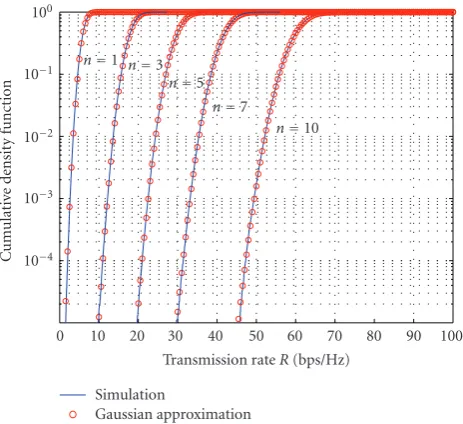
The cumulative distribution functions (cdfs) of the actual sum-rate and Gaussian approximation for a (3,2) system with 10 dB of SNR per block for various numbers of blocksn
and target rates are compared inFigure 1. As we can see, for a wide range of outage probabilities (e.g.,ε≥10−5), they have inappreciable difference even ifnis as small as 1. This shows that using a Gaussian cdf to evaluate the outage probability for a block-fading MIMO channel is accurate and reliable.
Results in Figure 2 are provided for the transmit SNR against the outage probability requirements for a 3-user sys-tem with 20 blocks (i.e.,K =20). The users are considered to have target rates (R1,R2,R3)=(8, 12, 16) bps/Hz, channel power gains (C(1)0 ,C0(2),C0(3))=(0.8, 1, 1.2), multiple receive antennas (n(1)r ,n(2)r ,n(3)r ) = (2, 3, 2), and the same outage probability requirements (ε). The number of transmit anten-nas at the base station is set to be 4 (i.e.,nt =4). Results in this figure show that the total transmit SNR of the proposed scheme decreases if the required outage probability increases. For example, there is about 2 dB power reduction whenε in-creases from 10−5to 10−1. Results also illustrate that the pro-posed method performs nearly the same as the global opti-mum. However, compared with the equal-time method with optimum power solution, there is only about 0.2 dB reduc-tion in SNR by the proposed method. This is because the optimal strategy tends to allocate similar number of blocks to the users, which can be observed from configuration 1 of
Table 1. In addition, as can be seen, the transmit SNR of the equal-time method with suboptimal power is much greater than that with optimum power, which shows that the MPE is very important in optimizing the power allocation. In par-ticular, more than 3 dB of SNR is required when compared with the equal-time method with optimal power solution.
The SNR results against the target rate for a 3-user sys-tem with total numbers of blocks K = 15, (ε1,ε2,ε3) =
10−5 10−4 10−3 10−2 10−1 Outage probability
12 13 14 15 16 17 18
T
o
tal
tr
ansmit
S
NR
(dB)
Equal-time method with suboptimal power solution Equal-time method with optimal power solution Proposed method
Global optimum
Figure2: Results of the transmit SNR against the outage probability whenU =3,K=20, (R1,R2,R3)=(8, 12, 16) bps/Hz, (C0(1),C
(2) 0 , C(3)0 )=(0.8, 1, 1.2),nt=4, and (n(1)r ,n(2)r ,n(3)r )=(2, 3, 2).
10 15 20 25 30
Target rateRT 14
16 18 20 22 24 26 28 30 32
T
o
tal
tr
ansmit
S
NR
(dB)
Equal-time method with suboptimal power solution Equal-time method with optimal power solution Proposed method
Global optimum
Figure3: Results of the transmit SNR against the target rate when U =3,K =15, (ε1,ε2,ε3)=(10−4, 10−3, 10−2), (C(1)0 ,C(2)0 ,C(3)0 )= (0.5, 1, 1.5),nt=3, and (n(1)r ,n(2)r ,n(3)r )=(2, 2, 2).
Table1: Various configurations tested from Figures2–5. The superscripthighlights the solution that is not the same as the optimum.
Configuration u Ru(bps/Hz) εu C(0u) n (u)
r (wu)opt (wu)proposed (wu)equal-time
1 (nt=4 andK=20)
1 8 10−3 0.8 2 6 6 6
2 12 10−3 1 3 5 6 7
3 16 10−3 1.2 2 9 8 7
2 (nt=3 andK=15)
1 16 10−4 0.5 2 6 6 5
2 16 10−3 1 2 5 5 5
3 16 10−2 1.5 2 4 4 5
3 (nt=4 andK=12)
1 16 10−2 1.5 4 2 2 4
2 20 10−3 1 3 3 3 4
3 24 10−4 0.5 2 7 7 4
4 (nt=4 andK=20)
1 8 10−1 1.5 3 2 3 6
2 16 10−3 1 3 6 7 7
3 24 10−4 0.5 3 12 10 7
6 8 10 12 14 16 18 20
Total number of blocksK
15 20 25 30 35 40 45
T
o
tal
tr
ansmit
S
NR
(dB)
Equal-time method with suboptimal power solution Equal-time method with optimal power solution Proposed method
Global optimum
Figure 4: Results of the transmit SNR against the number of blocks whenU =3, (ε1,ε2,ε3)=(10−2, 10−3, 10−4), (R1,R2,R3) = (16, 20, 24) bps/Hz, (C0(1),C0(2),C0(3)) = (1.5, 1, 0.5),nt = 4, and (n(1)r ,n(2)r ,n(3)r )=(4, 3, 2).
the global optimum although the gap between the proposed method and the equal-time method with optimal power so-lution is not very obvious.
In Figure 4, we have the results for the transmit SNR
against the total number of blocks K for a 3-user system with (ε1,ε2,ε3)=(10−2, 10−3, 10−4), (R1,R2,R3) = (16, 20, 24) bps/Hz, and (C0(1),C(2)0 ,C(3)0 ) = (1.5, 1, 0.5). The num-ber of transmit antennas is 4 while users’ numnum-bers of re-ceive antennas are (n(1)r ,n(2)r ,n(3)r ) = (4, 3, 2). Note that in this case, we have set the conditions for different users, such as users’ requirements and channel conditions, to be quite different from each other to see how the proposed scheme performs. As we can see, the total transmit SNR decreases as
Kincreases. In particular, the SNR for the proposed method
2 3 4
Number of receive antennas 13
14 15 16 17 18 19 20 21 22 23
T
o
tal
tr
ansmit
S
NR
(dB)
Equal-time method with suboptimal power solution Equal-time method with optimal power solution Proposed method
Global optimum
Figure5: Results of the transmit SNR against the receive antennas whenU=3,K=20, (ε1,ε2,ε3)=(10−1, 10−3, 10−4), (R1,R2,R3)= (8, 16, 24) bps/Hz, (C(1)0 ,C(2)0 ,C0(3))=(1.5, 1, 0.5), andnt=4.
decreases by 8 dB whenKincreases from 6 to 18. Again, re-sults show that the performance of the proposed scheme is nearly optimal, while this time the gap between the proposed method and the equal-time methods becomes more obvious (about 5 dB forK=6 and 2 dB forK=18). This is because the optimal strategy tends to allocate more blocks to high-demand poor-channel-condition users (the numbers of allo-cated blocks for the users for different methods withK=12 are shown in configuration 3 ofTable 1).
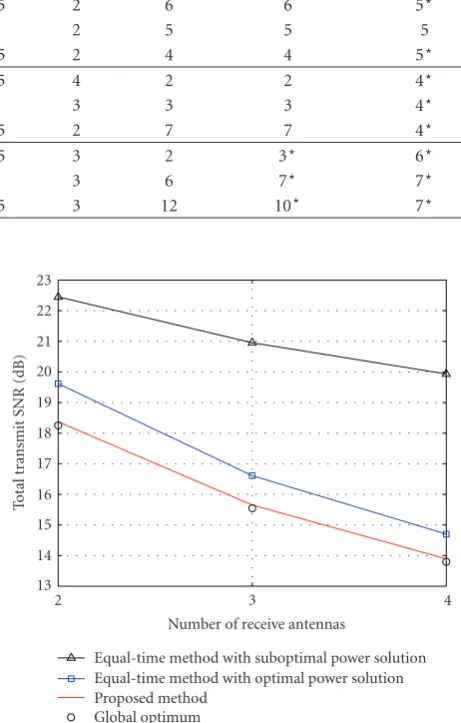
Figure 5plots the SNR results against the number of
re-ceive antennas for a 3-user system withK=20, (ε1,ε2,ε3)=
(10−1, 10−3, 10−4), (R1,R2,R3) = (8, 16, 24) bps/Hz, (C(1)0 ,
antennas. This can be explained by the fact that the trans-mission rate mainly depends on the rank of the MIMO sys-tem, which is limited by the number of receive antennas (nr). The actual number of block allocation for various methods is provided in configuration 4 ofTable 1.
7. CONCLUSION
This paper has addressed the optimization problem of power allocation and scheduling for a time-division multiuser MIMO system in Rayleigh block-fading channels when the transmitter has only the channel statistics of the users, and the users are given individual outage rate probability con-straints. By Gaussian approximation, we have derived the so-called MPE to determine the minimum power for attaining a given outage rate probability constraint if the number of blocks for a user is fixed. On the other hand, we have pro-posed a convex programming approach to find the subopti-mal number of blocks allocated to the users. The two main techniques have been then combined to obtain a joint solu-tion for both power and time allocasolu-tions for the users. Re-sults have demonstrated that the proposed method achieves near optimal performance.
APPENDICES
A. DERIVATION OFμ=E[r]ANDσ2=VAR[r]
A.1. Main derivation
Before we proceed, we find the following expansion of the generalized Laguerre polynomial useful:
Lδ(λ)=
m=0
(−1)m (+δ)! (−m)!(δ+m)!m!·λ
m
. (A.1)
To make our notation succinct, we define Γ0 C0d−γQ/
ntnN0and
bm(,δ)(−1)m
(+δ)!
(−m)!(δ+m)!m! = (−1)m
m!
+δ
m+δ
(A.2) so that Lδ (λ)= m=0
bm(,δ)λm. (A.3)
Also, in the following derivation, we will treatδ =nt−nr for convenience. As a result, the meanμcan be derived as follows:
u=
∞
0 log2
1 +Γ0λ
nr−1
=0
!λδe−λ (+δ)! Lδ (λ) 2 dλ =
nr−1
=0
! (+δ)!
∞
0 log2
1 +Γ0λ
λδe−λLδ (λ)
2
dλ
=
nr−1
=0
! (+δ)!
∞
0 log2
1 +Γ0λ
λδe−λ
m=0
bm(,δ)λm
2
dλ =
nr−1
=0
! (+δ)!
∞
0 log2
1 +Γ0λ
λδe−λ
×
m=0
b2m(,δ)λ2m+ 2 −1
i=0
j=i+1
bi(,δ)bj(,δ)λi+j
dλ
=
nr−1
=0
m=0
! (+δ)!b
2 m(,δ)
∞
0 log2
1 +Γ0λ
λδe−λλ2mdλ
+ 2 nr−1
=1 −1
i=0
j=i+1
!
(+δ)!bi(,δ)bj(,δ)
×
∞
0 log2
1 +Γ0λ
λδe−λλi+jdλ
= 1
ln 2 nr−1
=0 m=0 ! (+δ)! 1 m! +δ
m+δ
2
×
∞
0 ln
1 +Γ0λ
λδ+2me−λdλ
+ 2 ln 2
nr−1
=1 −1
i=0
j=i+1
! (+δ)!
(−1)i+j
i!j!
×
+δ
i+δ
+δ
j+δ
∞
0 ln
1 +Γ0λ
λδ+i+je−λdλ,
(A.4)
where the integral of the form0∞λje−λln (1+Γ
0λ)dλis given by (A.13) inAppendix A.2.
For the variance, we first express it using the standard re-sult as
σ2=
∞
0 log 2 2
1 +Γ0λ
nr−1
=0
!λδe−λ (+δ)!
Lδ(λ)
2
dλ
−
nr−1
i=0 nr−1
j=0
i!j! (i+δ)!(j+δ)!
× ∞
0 λ δe−λLδ
i(λ)Lδj(λ)log2
1 +Γ0λ
dλ
2
≡I1−I2,
(A.5)
which boils down to evaluating the integralsI1andI2. After some manipulations, we haveI1as
I1= 1 ln22
nr−1
=0 m=0 ! (+δ)! 1 m! +δ
m+δ
2
×
∞
0
ln21 +Γ0λ
λδ+2me−λdλ
+ 2 ln22
nr−1
=1 −1 i=0
j=i+1
! (+δ)!
(−1)i+j
i!j!
×
+δ
i+δ
+δ
j+δ
∞
0 ln 2
1 +Γ0λ
where0∞λje−λln (1 +Γ
0λ)2dλis derived inAppendix A.2as (A.17). On the other hand,I2can be obtained as follows:
∞
0 λ δ
e−λLδi(λ)Lδj(λ)log2
1 +Γ0λ
dλ = ∞ 0 λ δ
e−λlog21 +Γ0λ
i
m=0
bm(i,δ)λm
×
j
=0
bm(j,δ)λ
dλ (A.7) = ∞ 0λ δ
e−λlog 2
1 +Γ0λ
i
m=0 j
=0
bm(i,δ)b(j,δ)λm+
dλ (A.8) = i m=0 j =0
bm(i,δ)b(j,δ)
∞
0λ δ+m+
e−λlog21 +Γ0λ
dλ.
(A.9) Now, combining the results (A.5), (A.6), and (A.9), we have
σ2= 1
ln22 nr−1
=0 m=0 ! (+δ)! 1 m! +δ
m+δ
2
×
∞
0 ln 2
1 +Γ0λ
λδ+2me−λdλ
+ 2 ln22
nr−1
=1 −1 i=0
j=i+1
! (+δ)!
(−1)i+j
i!j!
×
+δ
i+δ
+δ
j+δ
∞
0 ln 2
1 +Γ0λ
λδ+i+je−λdλ
− 1
ln22 nr−1
i=0 nr−1
j=0
i!j! (i+δ)!(j+δ)!
× i m=0 j =0 (−1)m+
m!!
i+δ
m+δ
×
j+δ
+δ
∞
0 λ δ+m+
e−λln1 +Γ0λ
dλ
2 , (A.10)
where the integrals of the forms0∞λje−λln (1 +aλ)dλand
∞
0 λje−λln2(1 +aλ)dλare, respectively, given by (A.13) and (A.17).
A.2. Evaluation of0∞ln (1 +Γ0λ)λje−λdλ
To begin, we rewrite the integral as
∞
0 λ j
e−λln1 +Γ0λ
dλ
=e1/Γ0 Γ0j+1
∞
1 e
−(1/Γ0)t(t−1)jlnt dt
=e1/Γ0 Γ0j+1
j
=0 (−1)
j
∞
1 e
−(1/Γ0)ttj−lnt dt,
(A.11)
where the integral of the last line of the right-hand side can be derived as follows:
∞
1 e
−(1/Γ0)ttj−lnt dt
=Γ0
∞
1 e
−(1/Γ0)ttj−−1+tj−−1(j−) lntdt
=Γ0
Γ0
e−1/Γ0+
∞
1 e −(1/Γ0)t
×(j−−1)tj−−2+ (j−)tj−−2
+ (j−−1)(j−)tj−−2lnt
.. .
=Γ0
2
e−1/Γ0+Γ
0
3
(j−−1) + (j−)
+Γ0
4
(j−)(j−−2)
+ (j−−1)(j−−2) + (j−−1)(j−)
+· · · +(j−)! 1/Γ0
j−
× ∞
1 e
−(1/Γ0)tlnt dt+
j−
p=1 1
j−+ 1−p
∞
0 e
−(1/Γ0)tdt
=e−1/Γ0
j−
p=2
Γ0
p (j−)! (j−−p+1)!
p−1
q=1 1
j−−q+1+
(j−)! (1/Γ0)j−
× ∞
1 e
−1/Γ0lnt dt+Γ
0e−1/Γ0 j−
p=1 1
j−+ 1−p
.
(A.12) Substituting this result into (A.11), we can get
∞
0 λ
je−λln1 +Γ 0λ
dλ
=e1/Γ0 Γ0j
j
=0 (−1)
j
(j−)! (1/)j−
∞
1 e
−(1/Γ0)tlnt dt
+ 1
Γ0j j−1 =0 j− p=1 (−1)
j
(j−)! (1/)j−·
1
j−+ 1−p
+ 1
Γ0j+1 j−2 =0 j− p=2 p−1 q=1 (−1)
×
j
(j−)! (j−−p+ 1)!
Γ0
p 1
j−−q+ 1.
(A.13)
InAppendix A.4, we will show that
∞
1 e
−(1/Γ0)tlnt dt=Γ
0E1
1
Γ0
, (A.14)
A.3. Evaluation of0∞[ln (1 +Γ0λ)]2λje−λdλ We start by writing
∞
0
ln1 +Γ0λ
2
λje−λdλ
=e1/Γ0 Γ0j+1
j
=0 (−1)
j
∞
1 e
−(1/Γ0)t(lnt)2tj−dt,
(A.15)
where the integrand on the right can be evaluated as follows:
∞
1 e
−(1/Γ0)t(lnt)2tj−dt
=Γ0
∞
1 e
−(1/Γ0)t2tj−−1lnt+tj−−1(j−)(lnt)2dt
=Γ0
2∞ 1 e
−(1/Γ0)t
×2tj−−2+2tj−−2(j−−1) lnt+2tj−−2(j−) lntdt
+Γ0
2∞ 1 e
−(1/Γ0)ttj−−2(j−−1)(j−)(lnt)2dt
.. .
=2e−1/Γ0
j−
t=3
Γ0
t (j−)! (j−−t+ 1)!
× t−2 p=1 t−1
q=p+1
1
(j−+ 1−p)(j−+ 1−q)
+(j−)! 1/Γ0
j− ∞
1 e
−(1/Γ0)t(lnt)2dt
+ 2 j−
p=1 1
j−+ 1−p
∞
1 e
−(1/Γ0)tlnt dt
+(j−)!
1/Γ0
j−
∞
1 2e −(1/Γ0)t
×
j−−1
p=1 j−
q=p+1
1
(j−+ 1−p)(j−+ 1−q)dt. (A.16)
Using (A.16) into (A.15), we get
∞
0
ln1 +Γ0λ
2
λje−λdλ
=e1/Γ0 Γ0j+1
j
=0 (−1)
j
(j−)!
1/Γ0
j−
∞
1 e
−(1/Γ0)t(lnt)2dt
+2e 1/Γ0
Γ0j+1
∞
1 e
−(1/Γ0)tlnt dt
× j−1 =0 j− p=1 (−1)
j
(j−)!
1/Γ0
j−· 1
j−+ 1−p
+ 2
Γ0j j−2
=0 j−−1
p=1 j−
q=p+1 (−1)
j
(j−)!
1/Γ0
j−
· 1
(j−+ 1−p)(j−+ 1−q)
+ 2
Γ0j+1 j−3 =0 j− t=3 t−2 p=1 t−1
q=p+1 (−1)
× j Γ0
t (j−)! (j−−t+ 1)!
· 1
(j−+ 1−p)(j−+ 1−q).
(A.17) From [23, Section 4.331(2)], we can have
∞
1 e
−(1/Γ0)tlnt dt=Γ
0E1
1
Γ0
. (A.18)
Later inAppendix A.4, we will have
∞
1 e
−(1/Γ0)t(lnt)2dt
=Γ0
ln i
Γ0−γEM
2 +π
2
6
−23F3
[1, 1, 1]; [2, 2, 2];−1 Γ0
, (A.19) wherepFqdenotes the generalized hypergeometric function.
A.4. Evaluation of1∞e−(1/Γ0)t(lnt)2dt
First of all, clearly, we have
∞
1 e
−(1/Γ0)t(lnt)2dt
=
∞
0 e
−(1/Γ0)t(lnt)2dt−
1
0e
−(1/Γ0)t(lnt)2dt.
(A.20)
The first integrand can be found from [23, Section 4.335(1)] as
∞
0 e
−(1/Γ0)t(lnt)2dt=Γ
0
ln 1
Γ0−γEM
2 +π 2 6 , (A.21) whereγEMrefers to the Euler-Mascheroni constant.
Likewise, the second integrand can be evaluated as
1
0e
−(1/Γ0)t(lnt)2dt=
1 0 ∞ =0
−1/Γ0
t
! (lnt)
2dt = ∞ =0
−1/Γ0
!
1
0 t (lnt)2
dt = ∞ =0
−1/Γ0
! ·
(−1)2·2! (+ 1)3
=2
∞
=0
−1/Γ0
! ·
1 (+ 1)3
=23F3
[1, 1, 1]; [2, 2, 2];−1 Γ0