Injection
Thesis by
Bryan E. Schmidt
In Partial Fulfillment of the Requirements for the
degree of
Doctor of Philosophy
CALIFORNIA INSTITUTE OF TECHNOLOGY
Pasadena, California
2016
© 2016
Bryan E. Schmidt ORCID: 0000-0001-9193-7760
ACKNOWLEDGEMENTS
I would first like to thank Professor Joe Shepherd for the opportunity to work in his
research group while at Caltech. He has made the past five years a great pleasure.
I am immensely grateful for his mentorship, guidance, and encouragement. I value
the friendship we have built working together. I also thank Professor Hans Hornung
who has also been a very valuable mentor to me during my time as a Ph.D. student.
I am honored to have worked with these two men and to be a part of each of their
legacies. Bahram Valiferdowsi has been instrumental in keeping the machinery of
the Ludwieg tube laboratory running smoothly, and he has been a pleasure to work
with. I am grateful for the friendship we have formed.
I would like to thank Professors Tim Colonius and Joanna Austin for being a part of
my thesis committee and for the time they have invested in reviewing my work. I am
thankful for the time Professor Guillaume Blanquart has spent reviewing my work
and providing helpful insights. Ravi Ravichandran has served as a mentor for me
and has invested in my career. He has also inspired me with his efforts to promote
STEM education, particularly the partnership between GALCIT and Base11 which
I have had the privilege to have been a part of. Much of the financial support for my
Ph.D. work has come from the Foster and Coco Stanback STEM Fellowship, which
is a direct result of this partnership.
I consider myself fortunate to have shared a laboratory and worked with a number
of excellent researchers and human beings during my time at Caltech. In particular
I thank Professor Nick Parziale for mentoring me and helping me to develop as
a researcher during the beginning of my graduate career. Dr. Joe Jewell was a
pleasure to work with and contributed to my development as well. Andrew Knisely
has been a good friend and collaborator, and I am thankful that Professor Austin
brought him to the T5 laboratory in 2014.
I would like to thank the other past and present members of Professor Shepherd’s
research group. In particular, Dr. Josué Melguizo-Gavilanes has been very generous
with his time and patient with me as he explained to me the subtleties of CFD and
OpenFOAM specifically. Dr. Neal Bitter has been a good friend and colleague, and
I enjoyed our time spent together working out puzzles in high speed fluid mechanics.
His insights have been valuable to this work. I was fortunate to have mentored and
Kennedy and Jason Schlup had a very successful Ae104c project designing and
building the pneumatic valve in the Ludwieg tube that enabled me be much more
productive in the laboratory. Stephanie Coronel, Jean-Christophe Veilleux, and Drs.
Rémy Mevel and Jason Damazo have been a pleasure to work with.
I also formed significant friendships with Professor Daniel Araya and Dr. Brock
Bobbitt. I enjoyed spending time with them and discussing both our respective
research projects and life in general. Both of them contributed many helpful pieces
of advice and comments on my work. I am also thankful for their excellent examples
of fatherhood and am grateful that I had them to learn from and didn’t have to go
first. I value the time our families were able to share with each other.
During my time at Caltech I am proud to have been a part of the GALCIT softball
team and prouder of the fact that we have won four championships together. Playing
softball with Nick Parziale, Joe Jewell, Jason Rabinovitch, Jason Schlup, Reeve
Dunne, Dustin Summy, Andrew Knisely, and others has been one of my favorite
parts of life outside the laboratory in graduate school.
I am grateful for the many caring teachers and mentors who have helped me succeed
academically and pushed me to be better throughout my education. Professor Dennis
Kochman at Caltech and Professors James T’ien, Joe Prahl, and Paul Barnhart at
Case Western Reserve University have had a particularly significant impact.
I would like to thank my church family at Lake Avenue Church in Pasadena for
being a loving and supporting network of friends for my family and I during my
time at Caltech. I am particularly thankful for the friendship and mentorship of
Pastor Jeff Liou who has contributed greatly to my personal growth. I am also
especially grateful for the friendship of the members of my small group: Brock and
Lindsay Bobbitt, Aaron and Daisy Rosales, Josh and Jacqueline Olson, Bassem and
Amber Wahbi, Ben and Julie Immink, Anton and Nataliya Dubrovskiy, Hyun-Sik
and Ok-Young Kim, Jon and Jeni Yackley, and Ryan and Eva Black.
I am very thankful for the loving support of my parents Jayne and Eric Schmidt and
my siblings Cory and Karyn Schmidt, without whom I would not have achieved the
level of success that I have. I am also grateful to the many members of my extended
family who have supported me throughout my academic career including my time
I am most indebted to my family: Karina, Lukas, and Ottery. Their unconditional
love has made my graduate work enjoyable. I am particularly thankful for my wife
Karina, who has been exceedingly patient, kind, and supportive throughout my
Ph.D. I could not ask for a better partner, teammate, and friend. This thesis is also
dedicated to them.
Finally, I thank God for His overly abundant grace. To paraphrase Eric Liddell: God
It is the glory of God to conceal a matter But the glory of kings is to search out a matter
ABSTRACT
The problem of supersonic flow over a 5 degree half-angle cone with injection of
gas through a porous section on the body into the boundary layer is studied
experi-mentally. Three injected gases are used: helium, nitrogen, and RC318
(octafluoro-cyclobutane). Experiments are performed in a Mach 4 Ludwieg tube with nitrogen
as the free stream gas. Shaping of the injector section relative to the rest of the body
is found to admit a "tuned" injection rate which minimizes the strength of shock
waves formed by injection. A high-speed schlieren imaging system with a framing
rate of 290 kHz is used to study the instability in the region of flow downstream of
injection, referred to as the injection layer. This work provides the first experimental
data on the wavelength, convective speed, and frequency of the instability in such a
flow. The stability characteristics of the injection layer are found to be very similar
to those of a free shear layer. The findings of this work present a new paradigm for
PUBLISHED CONTENT AND CONTRIBUTIONS
Parziale, N. J., J. S. Damazo, B. E. Schmidt, P. S. Wang, H. G. Hornung, and J. E. Shepherd (2015). “Pulsed Laser Diode for use as a Light Source for Short-Exposure, High-Frame-Rate Flow Visualization”. In:AIAA SciTech 2015. AIAA-2015-0530. AIAA.
Schmidt, B. E. (2014).Compressible Flow Through Porous Media with Application to Injection. Internal Report FM 2014.001. California Institute of Technology.
Schmidt, B. E., N. P. Bitter, H. G. Hornung, and J. E. Shepherd (2014). “Experimen-tal Investigation of Gas Injection into the Boundary Layer on a Slender Body in Supersonic Flow”. In:Aviation 2014: Stability and Transition. AIAA-2014-2496. AIAA.
– (2015). “Injection into Supersonic Boundary Layers”. In: AIAA Journal. doi: 10.2514/1.J054123.
Schmidt, B. E. and J. E. Shepherd (2015a). “Analysis of Focused Laser Differential Interferometry”. In:Aviation 2015: Ground Testing.
– (2015b). “Analysis of focused laser differential interferometry”. In:Applied Optics 54.28, pp. 8459–8472.
– (2015c). “Oscillations in cylinder wakes at Mach 4”. In: Journal of Fluid Me-chanics785.
TABLE OF CONTENTS
Acknowledgements . . . iii
Abstract . . . vii
Published Content and Contributions . . . viii
Table of Contents . . . ix
List of Illustrations . . . xi
List of Tables . . . xxi
Chapter I: Introduction . . . 1
1.1 Applications of Injection . . . 1
1.2 Remaining Issues . . . 5
1.3 Project Scope and Outline . . . 6
Chapter II: Facility & Test Procedure . . . 8
2.1 Ludwieg Tube . . . 8
2.2 Pneumatic Valve . . . 9
2.3 Test Articles . . . 13
2.4 Injected Gases . . . 19
2.5 OpenFOAM Computations . . . 22
Chapter III: Diagnostics . . . 27
3.1 Measurement Technique Review . . . 27
3.2 Surface Measurements . . . 28
3.3 FLDI Analysis . . . 28
3.4 High-speed Schlieren Technique . . . 29
Chapter IV: Results . . . 35
4.1 Full-field Imaging . . . 35
4.2 High-speed Imaging . . . 43
4.3 OpenFOAM Computations . . . 57
Chapter V: Analysis . . . 78
5.1 Full Field Data . . . 78
5.2 Instability Wave Analysis . . . 82
Chapter VI: Summary and Conclusions . . . 100
6.1 Introduction . . . 100
6.2 Facility & Test Procedure . . . 101
6.3 Diagnostics . . . 102
6.4 Results . . . 102
6.5 Analysis . . . 104
6.6 Conclusions . . . 107
6.7 Recommendations for Future Work . . . 107
Bibliography . . . 110
Appendix A: Mass Diffusion in OpenFOAM . . . 116
Appendix C: Analysis of Focused Laser Differential Interferometry . . . 143
C.1 Introduction . . . 143
C.2 FLDI Theory . . . 144
C.3 Computational Method . . . 148
C.4 Software Verification . . . 152
C.5 Simulated Measurements . . . 164
C.6 Conclusions . . . 175
LIST OF ILLUSTRATIONS
Number Page
1.1 Sketch of the flow field associated with injection into a supersonic
flow. Velocity profiles are shown in blue before and after injection. . 1
2.1 Solid model of the Caltech Ludwieg tube shown with the Mach 4
nozzle. The overall length of the facility is 23.5 m. Republished
with permission of AIAA. From Schmidt et al. (2015); permission
conveyed through Copyright Clearance Center, Inc. . . 8
2.2 Section view of the Ludwieg tube nozzle with the upstream
di-aphragm station labeled. Flow is from left to right. . . 9
2.3 Section view of the Ludwieg tube with the valve installed. The valve
is shown in both the closed (a) and open (b) positions. The sections
of the cylinder are labeled upstream and downstream corresponding
to the direction of flow in the Ludwieg tube. . . 11
2.4 Comparison of the bench test data with the numerical ODE model
described in this section. . . 12
2.5 A photograph of the installed valve in a partially-opened position. . . 12
2.6 Left: Pitot pressure traces from a run with a diaphragm and a run with the valve. The effective opening time of the valve is about 40 ms
and the resulting run time is approximately 60 ms. Right: Power spectra of pitot pressure during the steady run time for a shot with
a diaphragm and a shot with the valve. The valve reduces the noise
level in the tunnel by a factor of about 2-3 across all frequencies.
High-frequency spikes in both spectra are due to electrical noise. . . 13
2.7 Both models used in this work. One has a cylindrical injector section
(top) and the other has a conical section (bottom). The ruler scale is in
inches. Republished with permission of AIAA. From Schmidt et al.
(2015); permission conveyed through Copyright Clearance Center,
Inc. . . 14
2.8 5x-magnified images of the surface of injectors. The red line in the
lower right corner of each image is 100 µm. Republished with
per-mission of AIAA. From Schmidt et al. (2015); perper-mission conveyed
2.9 Exploded view and assembly of solid model of the test article with
the cylindrical injector. Threaded segments of the aluminum tube are
colored yellow. Holes for the PCB pressure transducers are visible
on the frustum section. . . 16
2.10 Sketch illustrating 1-D porous flow. The porous media has thickness hand cross-sectional area A. If the flow is incompressible, the flow
rate is related to the pressure drop by Equation 2.1. . . 17
2.11 Sketch of porous flow through an axisymmetric geometry such as the
cylindrical injector used in this work. The injector has inner radius riand outer radiusro. . . 17
2.12 Pressure vs. mass flow rate data for air for both injectors fit with
Equation 2.13 to determine permeabilities. Republished with
per-mission of AIAA. From Schmidt et al. (2015); perper-mission conveyed
through Copyright Clearance Center, Inc. . . 20
2.13 3-D model of an RC318 molecule. The black spheres represent
carbon atoms and the green spheres are fluorine atoms. Image by
Fvasconcellos - Own work, Public Domain. . . 21
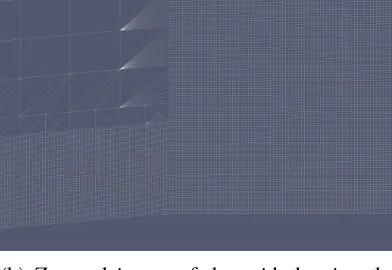
2.14 Refined computational grid for the OpenFOAM simulations. . . 26
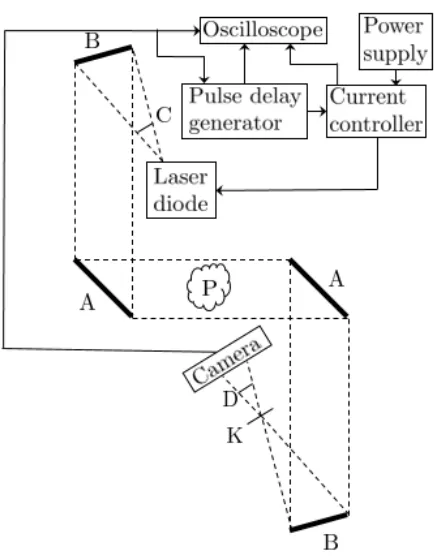
3.1 Schematic and wiring diagram for a schlieren imaging setup with a
pulsed laser diode light source. Light paths are shown as dashed
lines, electrical connections are solid arrows. A: turning mirror, B:
concave mirror (f = 150 cm), C: diverging lens, D: focusing lens, K:
schlieren cutoff, P: phase object. . . 31
3.2 Example timing diagram for the camera and light source. The timing
of this diagram is not specific to any particular experimental case but
is simply to show the desired scheme. Republished with permission
of AIAA. From Parziale, Damazo, et al. (2015); permission conveyed
through Copyright Clearance Center, Inc. . . 32
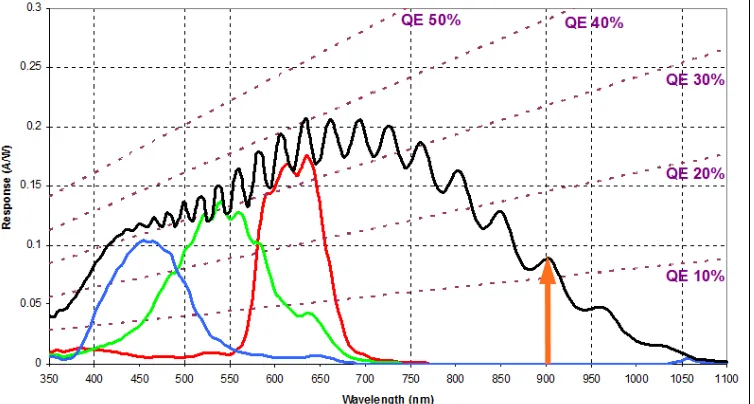
3.3 Spectral response chart for the Phantom v710 camera. The black
curve is the total response. The orange arrow marks 905 nm, the
wavelength of the laser light source. Chart ©Vision Research, Inc. . 33
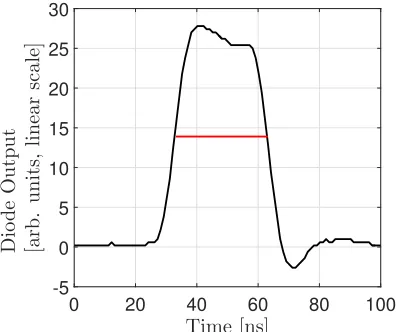
3.4 Output of the laser diode measured with a photodetector. The full
width at half maximum is shown in red, and is 30 ns for a nominal
4.1 Sketch of Fedorov’s hypothesis of a negatively-sloped injector
com-pensating for the additional displacement thickness created by
injec-tion. The graphic on the right shows the desired idealized shock
pattern on a cone model: only the shock at the tip of the cone is
present. Republished with permission of AIAA. From Schmidt et al.
(2015); permission conveyed through Copyright Clearance Center,
Inc. . . 36
4.2 Example schlieren images with the conical injector. The free stream
gas and injected gas for these cases is air. . . 37
4.3 Example schlieren images with the cylindrical injector. . . 38
4.4 Full-field images with a 40 ns-pulse width from three cases with
nitrogen injection at different injection rates. The injector is marked
by red lines and the PCB locations are shown with blue lines. . . 41
4.5 Full-field images with a 40 ns-pulse width from three cases with
different injected gases but the same value of δ. The injector is
marked by red lines and the PCB locations are shown with blue lines. 41
4.6 Injection layer thickness measured at the rear of the injector
sec-tion, normalized by the injection length, plotted versus the
non-dimensional mass flux F. High Reynolds number cases have a
nom-inal unit Reynolds number of 18×106per meter. . . 43
4.7 Transition location measured from the front of the injector section
plotted against the non-dimensional mass fluxF. . . 43
4.8 Images from a sample case to illustrate the image processing routine.
Images (a) through (e) represent stages in the routine with (a) being
the raw image and (e) being the final, processed image. . . 44
4.9 Processed image showing instability waves to be analyzed by
au-tocorrelation. The yellow dashed lines show the region used for
autocorrelation. . . 47
4.10 Autocorrelation curve for the image shown in Figure 4.9. The peak
at non-zero lag corresponds to a wavelength of 9 mm. . . 47
4.11 Histogram of measured wavelengths for an example case. The red
line shows a fitted log-normal distribution. . . 48
4.12 Wavelength normalized by the injector length plotted against the
non-dimensional injection rate F for all cases analyzed. The wavelength
is measured directly for helium and nitrogen injection and calculated
4.13 Series of images of a case with nitrogen injection showing the
prop-agation of waves. Their velocity is determined by cross correlating
the region in the images where the waves are present. . . 50
4.14 Correlation curve for the example case shown in Figure 4.13. The lag,
indicated by the red arrows, is converted to a velocity by multiplying
by the framing rate. . . 50
4.15 Distribution of measured velocities for the example case. . . 51
4.16 Convective velocity normalized by the free stream velocity plotted
versus the non-dimensional mass flux Ffor all cases studied. . . 51
4.17 Example image from a case with RC318 injection. The colored dots
on the left side of the image represent the location of the injection
layer edge determined by the Canny, log, Roberts, zero-cross, Prewitt,
and Sobel edge-detection methods. . . 52
4.18 Power spectral density plots from the Prewitt and Sobel methods for
the example RC318 injection case. Peaks are observed at 24.5 kHz
for both methods. . . 53
4.19 Response of the PCB pressure transducers in the cone frustum to
mechanical vibration. They are labeled in the figure legend according
to their distance from the cone tip, measured along the surface of the
model. . . 54
4.20 Spectra from the PCB pressure transducers for four example
experi-ments with injection. . . 55
4.21 Spectra from transducer 1 for the three injection cases shown in
Figure 4.20 compared to the turbulent baseline shown in Figure 4.20a. 56
4.22 Frequency from image analysis and pressure transducers. The
fre-quency from image analysis for the helium and nitrogen injection
cases is computed using Taylor’s hypothesis while the frequency in
the RC318 cases is computed directly from the image processing
routine. . . 57
4.23 Profiles taken at the rear of the injector section for the various grid
resolutions tested. . . 59
4.24 Relative difference in the flow variables plotted as a function ofyfor
the grid with a resolution of 69 µm/cell compared to the most refined
grid (38 µm/cell). . . 59
4.25 Total relative difference (see Equation 4.5) in flow variables as a
4.26 Results from the three computations with nitrogen injection.
Color-ing corresponds to density, with the color scale normalized to each
case. The value for the non-dimensional mass flux F is given in the
upper-left for each case. . . 61
4.27 Location of wall-normal profiles for all OpenFOAM cases. They
are located 120 mm, 132.5 mm, 152 mm, 172 mm, 180.6 mm,
189.2 mm, 197.8 mm, and 206.4 mm from the cone tip, measured
along the surface of the model. The case with nitrogen injection with uinj =16 m/s is shown as an example. . . 61
4.28 Evolution of flow variables for cases with nitrogen injection. Profiles
are taken at the locations indicated in Figure 4.27. Black, blue, and
red curves correspond to cases with low, medium, and high rates of
injection listed in Table 4.1, respectively. . . 63
4.29 Mass fraction of injected nitrogen at the wall as a function of s, the
variable measured along the cone surface. Here, s = 0 corresponds
to the end of the injector section. Black, blue, and red curves
cor-respond to increasing injection rate with injection velocities listed in
the legend. . . 64
4.30 Results from the three computations with helium injection. Coloring
corresponds to density, with the color scale normalized to each case.
The value for the non-dimensional mass fluxFis given in the
upper-left for each case. . . 65
4.31 Evolution of flow variables for cases with helium injection. Profiles
are taken at the locations indicated in Figure 4.27. Black, blue, and
red curves correspond to cases with low, medium, and high rates of
injection listed in Table 4.1, respectively. . . 67
4.32 Mass fraction of helium at the wall as a function of s, the variable
measured along the cone surface. Here, s = 0 corresponds to the
end of the injector section. Black, blue, and red curves correspond to
increasing injection rate with injection velocities listed in the legend. 68
4.33 Results from the three computations with RC318 injection. Coloring
corresponds to density, with the color scale normalized to each case.
The value for the non-dimensional mass fluxFis given in the
4.34 Evolution of flow variables for cases with RC318 injection. Profiles
are taken at the locations indicated in Figure 4.27. Black, blue, and
red curves correspond to cases with low, medium, and high rates of
injection listed in Table 4.1, respectively. . . 71
4.35 Mass fraction of RC318 at the wall as a function of s, the variable
measured along the cone surface. Here, s = 0 corresponds to the
end of the injector section. Black, blue, and red curves correspond to
increasing injection rate with injection velocities listed in the legend. 72
4.36 Experimental measurements of the injection layer thickness measured
at the rear of the injector section compared with the displacement
thickness at the same location from the OpenFOAM computations
(indicated with "OF" in the legend). . . 73
4.37 Profiles taken at the rear of the injector section for cases with all three
injected gases. Cases are selected such that the value of δ?is similar
for all three. . . 76
4.38 Profiles taken 206.4 mm from the cone tip for cases with all three
injected gases. Cases are selected such that the value of δ?is similar
for all three. . . 77
5.1 δ, measured at the rear of the injector section, normalized by the
length of the injector Linjplotted against the dimensionless
momen-tum flux ratio J for all experimental and computational data. The
black line is a fitted power law curve considering only data from
nitrogen and helium injection cases. The expression for the curve is
given in Equation 5.3. The ⊕symbol indicates the tuned condition. . 79
5.2 Transition locationxtr, measured from the front of the injector section,
normalized by the injection layer thickness δmeasured at the rear of
the injector plotted against the velocity ratio of the injected gas to the
free stream gas. . . 81
5.3 Wavelength normalized by the injector length plotted against the
non-dimensional injection momentum flux J for all cases analyzed. The
wavelength is measured directly for helium and nitrogen injection
and calculated assuming Taylor’s hypothesis for RC318 injection.
5.4 Convective velocity normalized by the free stream velocity plotted
versus the non-dimensional momentum flux J for all cases studied.
Vertical error bars represent uncertainty due to measurement error,
including pixel-locking. . . 83
5.5 Frequency from image analysis and pressure transducers. The
fre-quency from image analysis for the helium and nitrogen injection
cases is computed using Taylor’s hypothesis while the frequency in
the RC318 cases is computed directly from the image processing
routine. . . 83
5.6 Sample image of instability waves in a cone boundary layer at a unit
Reynolds number of 9×10⁶per meter. Yellow arrows indicate the
crests of three consecutive waves, and blue vertical lines indicate the
locations of the first four pressure transducers. The fifth transducer
is outside the viewing window of the camera to the right of the image
in the figure. . . 85
5.7 Spectra from the pressure transducers on a straight cone under the
same conditions as the visualization in Figure 5.6. The spectra show
growth of an instability around 46 kHz that breaks down to a
tur-bulence at or before the location of the final transducer. The insert
shows the spectrum of the first transducer so that the peak at 45.9 kHz
can be clearly perceived. . . 86
5.8 Sketch of a two-dimensional free shear layer flow. Two streams with
different velocities and potentially different densities and specific
heats are initially separated by a splitter plate and allowed to mix
downstream of the plate. A mean velocity profile is sketched in the
mixing region. Stream 1 is the high-speed stream and stream 2 is the
low-speed stream by definition. . . 88
5.9 Streamlines in a frame convecting with structures in a shear layer.
There are stagnation points for each stream between the structures. . 91
5.10 Example momentum profile for a case with nitrogen injection. The
curvature thickness δcis indicated with black dashed lines. . . 92
5.11 Wavelength normalized byδcusing the values in Table 5.1 for the
ex-periments performed with the lower unit Reynolds number condition
5.12 Ratio of the measured experimental value of wave convective speed
to that predicted using Equation 5.14 (tabulated in Table 5.2) plotted
againstJfor cases with a nominal unit Reynolds number of 9×10⁶per
meter. . . 95
5.13 Convective Mach numberMcplotted as a function of the wall-normal
coordinateyfor three example cases. Profiles are taken at the rear of
the injector section. . . 97
A.1 Schmidt number as a function of temperature for each injected gas
diffusing into nitrogen. . . 118
A.2 Comparison of results of the diffusion box test case for nitrogen. . . 119
A.3 Comparison of results of the diffusion box test case for nitrogen
assumingSc= 1 in Equation A.8. . . 120
A.4 Comparison of results of the diffusion box test case for helium. . . . 120
A.5 Comparison of results of the diffusion box test case for RC318. . . . 121
C.1 Schematic of an FLDI setup. The two beams are shown as blue and
green. Regions where the beams overlap are shown as striped. The
coordinate system shown will be the one used throughout this paper. 145
C.2 Illustration of a prism (here, a Wollaston prism). The incident beam
of aribtrary polarization is split into two beams by an angle σ, and
the two beams at the exit have mutually orthogonal polarization. The
ordinary ray is linearly polarized in the direction of beam separation
and the extraordinary ray is polarized 90 degrees from the direction
of separation. . . 145
C.3 Computed beam widths (out to 1/e2) within 30 mm of the best focus.
One beam is outlined in red and the other in blue. The width of the
beams at the waist is too small to see on this scale. . . 150
C.4 Polar grid cross-section non-dimensionalized by the local beam waist
size . . . 151
C.5 Transfer functionHw(k)for a single beam for 1-D sinusoidal distur-bances in xin an infinitesimally-thin plane at z =0 . . . 154
C.6 Transfer function of Equation C.16 plotted for various values ofL. As Lincreases, or, as more signal away from best focus is considered, the
error function in Equation C.16 contributes a k−1 rolloff beginning
at lower values of k. This leads to attenuation of high-wavenumber
C.7 Transfer functionHw(k)for a single beam for uniform 2-D sinusoidal disturbances in xbetween z= ±10 mm centered atz =0. . . 155
C.8 Transfer functionHw(k)for a single beam for uniform 2-D sinusoidal disturbances in xbetween z= ±30 mm centered atz =0. . . 156
C.9 Transfer function H(k) for the two-beam FLDI for 1-D sinusoidal
disturbances in xin an infinitesimally-thin plane at z= 0. . . 157
C.10 Transfer function H(k) for the two-beam FLDI for uniform 2-D
sinusoidal disturbances in xbetween z= ±10 mm centered atz =0. 158
C.11 Transfer function H(k) for the two-beam FLDI for uniform 2-D
sinusoidal disturbances in xbetween z= ±30 mm centered atz =0. 158
C.12 Convergence study for the transfer function shown in Figure C.11.
The red square indicates the chosen resolution. . . 159
C.13 Normalized FLDI output signal for sinusoidal disturbances within
±10 mm of the focus in z, corresponding to the transfer function
plotted in Figure C.10. . . 160
C.14 A solid model of the chamber for the argon jet with dimensions given
in mm. The coordinate system shown corresponds to the orientation
of the coordinate system of the FLDI beams. . . 161
C.15 . . . 161
C.16 Steady-state result of OpenFOAM computation of the flow out of the
argon jet. Velocity vectors are shown on the left and streamlines on
the right. Both are superimposed on a contour plot of argon mass
fraction. Ljetis the length out of the page (inz) that the cross-section
shown here extends. . . 162
C.17 Index of refraction field from the OpenFOAM computation with
spline interpolation. . . 163
C.18 Experimental vs. numerical data for the argon jet experiments
de-tailed in Table C.2. The letters marking each data point correspond
to the configurations in Table C.2. The line is the ideal liney = x. . . 164
C.19 Cone model used in T5 studies . . . 167
C.20 . . . 168
C.21 Output of the FLDI simulation compared to the input boundary layer
wave packet density disturbance. The y-axis on the left corresponds
to the FLDI output and the y-axis on the right corresponds to the
C.22 Output of the FLDI simulation, scaled with Equation C.27, compared
to the input boundary layer wave packet for the optimum value of Z =12.6 mm. . . 171
C.23 PSD of the FLDI simulation, scaled with Equation C.27 and optimum
Z value, compared to the PSD of the input boundary layer wave
packet. . . 171
LIST OF TABLES
Number Page
2.1 Properties of injected gases at 295 K. . . 21
2.2 Sutherland coefficients for the three injected gases to be used in calculating viscosity in Equation 2.18. . . 23
4.1 Flow conditions for the OpenFOAM computations. . . 58
4.2 Estimated Gladstone-Dale constants for the three gases at a wave-length of approximately 600 nm and room temperature with the com-puted displacement thicknesses and thicknesses based on index of refraction calculated at the rear of the injector section for cases with uinj = 16, 40, and 3 m/s for nitrogen, helium, and RC318 injection, respectively. . . 75
5.1 Values of δc for momentum profiles at the beginning of the injector section for the OpenFOAM computations. . . 93
5.2 Values of UU∞c computed with Equation 5.14 and the data from the OpenFOAM computations using the lower point of curvature in the momentum profile to determine the conditions in stream 2. Profiles are taken at the rear of the injector section. . . 95
A.1 Parameters from the Lennard-Jones potential model for the three gases for computing diffusion coefficients. . . 117
C.1 Optical parameters for simulated FLDI. . . 148
C.2 Argon jet configurations tested (dimensions in mm). . . 163
C.3 Boundary layer edge conditions for T5 shot 2789. . . 166
C.4 Boundary layer wave packet parameters. . . 169
C h a p t e r 1
INTRODUCTION
Injection of gas into boundary layers in hypersonic flight has the potential to enable
the next generation of high speed vehicles. Flight at hypersonic Mach numbers
presents a unique set of challenges, among which are high heating loads that create a
need for thermal protection systems and challenges related to supersonic combustion
ramjet (scramjet) propulsion. Figure 1.1 shows a sketch of a typical injection system
and flow field. In this example, gas is injected orthogonally to the mean flow direction
through a porous section in the wall. Injection modifies the velocity profile in the
boundary layer as shown in the figure, and also changes the temperature, density, and
sound speed profiles. Injection also creates a sudden increase in the displacement
thickness of the boundary layer which causes a shock to form in the supersonic free
stream. In this work the boundary layer downstream of injection is referred to as the injection layerto avoid confusion with conventional boundary layers.
Figure 1.1: Sketch of the flow field associated with injection into a supersonic flow. Velocity profiles are shown in blue before and after injection.
The problem of injection into high speed boundary layers has been studied
inter-mittently over the last half-century for a variety of reasons. The following section
reviews some of this research. The work presented here addresses some of the
remaining challenges associated with transition to turbulence in these flows.
1.1 Applications of Injection
This section outlines four of the applications for injection into high-speed boundary
cooling, a surrogate for studying ablation, transition delay in hypervelocity boundary
layers, and enhancement of scramjet performance. For a more complete discussion
of the past work on this topic related to the first two applications, see Schneider
(2010).
Film and transpiration cooling
Heating in high speed boundary layers is a significant issue that creates a need for
substantial thermal protection systems on hypersonic vehicles. Traditionally these
systems are passive, such as the ceramic tiles on the Space Shuttle. The primary
drawback of such a system is additional vehicle weight, although lack of reusability
due to ablation of the protective material is also a concern. Gas injection has been
considered as an active thermal protection system because the layer of cold gas next
to the vehicle surface behind the injector has a cooling effect (Aupoix et al., 1998;
Cary and Hefner, 1971; Sahoo et al., 2005). The cold injected gas displaces the hot
boundary layer fluid away from the vehicle surface, leading to a reduction in heat
transfer. See e.g. Figure 7 of Marvin and Akin (1970). When the injected gas is
blown tangentially to the surface of the vehicle it is referred to as film cooling, and
orthogonally injected gas through a porous surface is called transpiration. Both of
these have been studied in the literature.
Transpiration and film cooling are more effective in high speed flows than low
speed flows, but covering the entirety or even the majority of a vehicle with such
a thermal protection system is likely impractical and the weight savings compared
to traditional passive systems may not be significant. Localized cooling, however,
remains promising. Local cooling would allow placement of a window or instrument
on the surface of a vehicle, which would not be possible if a passive system were
used. An injector placed directly upstream of the instrument could cool that area
actively while the rest of the vehicle is covered by a traditional passive system.
Egorov et al. (2015) performed a numerical study on a blunt geometry and showed
that such a scheme could be effective. Cooling in this type of an arrangement
is most effective while the interface between the injected gas and the free stream
fluid remains laminar. Turbulence enhances mixing of the streams and therefore
decreases cooling. This can be observed in Figure 7 of Marvin and Akin (1970)
where the heating rate returns to its value prior to gas injection after transition to
Ablation surrogate
Ablation is an extremely complex phenomenon as it involves the coupling of a host
of effects including non-equilibrium gas dynamics, chemical reactions, outgassing,
boundary layer stability, turbulence, and heat transfer. Understandably, then,
re-searchers have sought to isolate some of the effects and study each in turn. Gas
injection has been studied for this reason to decouple the outgassing of pyrolysis
products from the other features of flow with ablation.
Some studies have concentrated on blunt geometries such as reentry capsules (Li
et al., 2013), while others have instead focused on slender bodies (Marvin and
Akin, 1970; Pappas and Okuno, 1960, 1964). The works cited here represent
investigations where the stability and transition of the flow were considered. Pappas
and Okuno (1960) observed that transition occurs earlier on a porous cone when
higher blowing rates are employed and when the molecular weight of the injected gas
is lower. This trend is corroborated in many other studies as well (Schneider, 2010),
but Li et al. (2013) curiously found computationally that transpiration stabilized the
second-mode instability on a flat plate and cone. The results of the current study
could be extended to ablation like the investigations cited in this section, but this is
not pursued here.
Transition delay
Boundary layer transition in hypersonic flows is dominated by thesecondor Mack mode, particularly when the wall is cold compared to the adiabatic wall temperature
as is the case in hypersonic free flight (Mack, 1984). Current understanding of the
Mack mode is summarized by Fedorov (2011) and Fedorov and Tumin (2011) and
the interested reader is referred to these for further information. Fujii and Hornung
(2001) and Wagnild et al. (2009) have shown that the strength of the Mack mode
instability can be reduced via acoustic absorption by non-equilibrium effects in
the boundary layer gas. This occurs if the time scale of translational/rotational and
vibrational energy exchange in the gas molecules is on the same order as the acoustic
waves responsible for destabilizing the boundary layer (typically about 1 MHz) and
if the vibrational energy states in the gas are sufficiently populated. Both of these
conditions are met for carbon dioxide in hypersonic flows.
Leyva et al. (2009) and Jewell et al. (2012) performed experiments in the T5
hy-pervelocity shock tunnel at Caltech to determine if transpiration of carbon dioxide
transition. The injector in these studies was approximately 40 mm long and began
135 mm from the cone tip.
The data from these studies suggest a delay in transition for carbon dioxide injection
compared to argon injection, which would not have the non-equilibrium effects
required for acoustic absorption. They are inconclusive, however, regarding the
overall efficacy of carbon dioxide injection versus no injection. The results are
further complicated by the fact that Fedorov, Malmuth, et al. (2001) showed that
a porous surface such as the one on the injector section absorbs acoustic energy
and therefore contributes to stabilization of the Mack mode. Furthermore, Fedorov,
Soudakov, et al. (2014) found that injection in such a configuration has a destabilizing
effect when non-equilibrium effects are not considered. More work is warranted
on this subject, but the current study focuses on low-enthalpy flow where
non-equilibrium effects are not important and therefore the potential application of
transition delay in hypersonic boundary layers is not kept in mind.
Scramjet performance
Scramjet engines are considered by many to be the best method for propulsion at
very high Mach numbers in the atmosphere, and improving scramjet performance is
an active research topic. Gas injection in scramjet inlets in particular has a number
of promising benefits. In this application a small fraction of the vehicle’s fuel is
injected in the inlet prior to the gas reaching the combustor, where the remainder of
the fuel is injected.
Barth, Wheatley, et al. (2013) demonstrated that injection in scramjet inlets not only
produces the cooling effect described earlier in this section, but also significantly
reduces skin friction drag. This is important because skin friction drag in the inlet
forms a substantial fraction of the total scramjet drag, as much as 25%. The effect
is enhanced if combustion occurs. The mechanism seems to be twofold. First, the
modification of the velocity profile reduces the slope of the velocity curve at the
wall, thereby reducing skin friction. Secondly, combustion causes dilatation that
further favorably modifies the velocity profile and the temperature rise associated
with combustion reduces the magnitude of turbulent velocity fluctuations, which in
turn reduces the Reynolds shear stress.
Second, flow separation due to compression in scramjet inlets is a potential issue
that can degrade performance. Laminar boundary layers are more prone to
employed to encourage transition to turbulence (Berry et al., 2001). Injection
desta-bilizes the boundary layer, so injection in the engine inlet could eliminate the need
for physical trips.
Finally, Gehre et al. (2015) and Barth, Wise, et al. (2015) show that if the injected
fuel in the inlet mixes sufficiently with the air in the free stream and is combusted,
significant gains are made in overall engine efficiency. These gains are primarily
due to the production of radical species and heating in the inlet region that promote
combustion in the combustor. All of these effects are much stronger if the interface
between the injected gas and the free stream is turbulent.
1.2 Remaining Issues
The current study is focused on addressing issues related to the implementation of
injection for localized transpiration cooling and fuel injection in scramjet inlets.
Attention is given to the mechanics of the flow field and although the results of this
work have design implications, the design of an injection system is not considered
directly. Effects are subdivided into inviscid and viscous categories.
Formation of waves
Transpiration causes an abrupt increase in the displacement thickness of the
bound-ary layer, which the free stream perceives the same as a change in the geometry of the
body. The supersonic flow is turned in response to these changes by oblique shock
waves and expansion waves. The strength of the shock waves is dependent on the
injection rate and body geometry, but they can be strong enough to be detrimental
to performance, particularly in internal flows.
For instance Ogawa et al. (2015) found that the shock wave formed at the beginning of
the injector in a scramjet inlet was reflected several times in the narrow channel and
caused substantial pressure losses depending on the injection rate. They found that
for their geometry the benefits of injection were counteracted by the total pressure
loss. The amount of fuel that could be injected while maintaining a net benefit was
also limited to avoid larger pressure losses.
Wave formation is more important in internal flows than external flows, but Schmidt
et al. (2015) demonstrate that the shock wave at the beginning of the injector in an
external flow can be strong enough to create an adverse pressure jump capable of
causing the incoming boundary layer to transition to turbulence. Effective cooling
to turbulence would substantially limit the usefulness of transpiration for cooling.
The mitigation of waves is therefore important for the implementation of injection
systems for both applications considered.
Flow stability
Clearly in both applications the state of the boundary layer downstream of injection,
whether laminar or turbulent, is of importance. A laminar injection layer is crucial
for effective cooling because of reduced transport of heat compared to a turbulent
layer. In scramjet inlets, turbulence decreases the efficacy of cooling at the wall, but
it also substantially promotes mixing which is necessary for efficient combustion.
Combustion must occur in the inlet in order for the benefits of injection to be fully
realized.
Even so, the stability of this flow has not been studied in great detail. The vast
majority of experimental data pertaining to stability are transition locations, and
though these are useful, they contribute little to the understanding of the underlying
physics of the transition process. A handful of numerical studies have been
per-formed to analyze stability characteristics of supersonic flows with injection, e.g. Li
et al. (2013), but experimental measurements are scarce (Schneider, 2010). Flow
stability with injection of a foreign gas, i.e. one that is different from the free stream
gas, is more difficult to analyze computationally because fluid properties are
depen-dent on the local composition, which means that the transport equations are coupled
to the Navier-Stokes equations. Stability studies of this kind are even more rare,
but in most practical applications of injection the injected gas would differ from
the free stream gas. These factors motivate an experimental investigation of the
stability properties of supersonic flow with injection, including injection of foreign
gas species.
1.3 Project Scope and Outline
The instability in supersonic flow with injection is analyzed in this work. A method
for diminishing the strength of waves formed by injection by modifying the body
geometry is also presented. Experiments are performed in the Caltech Mach 4
Ludwieg tube with a 5-degree half-angle cone as the base model because of its
canonical shape. Injection is achieved by transpiration through a porous injector
section on the model, and three gases with different molecular weights are injected.
The primary aim of the study is to characterize the disturbances that lead to transition
The Ludwieg tube facility and the test article are described in Chapter 2 along with
computations of the base flow. The choice of injected gases is also explained. In
Chapter 3 the high-speed schlieren technique used to measure instability waves in
the flow is described and is accompanied by a review of potential measurement
techniques that were also considered. Results of the experiments are given in
Chapter 4. Data processing routines are also presented in this chapter. The results
C h a p t e r 2
FACILITY & TEST PROCEDURE
The test facility and experimental apparatus are presented in this chapter. The
Ludwieg tube is described with special attention given to modifications made to the
facility for the current work. The test article is then described and the flow through
the porous injector section is analyzed. The choice of injected gases is explained
and the properties of the gases are given. The flow meter and calibration technique
are also described. Finally, the setup for numerical simulations of the experiments
in OpenFOAM is presented.
2.1 Ludwieg Tube
Experiments for this work were performed in the Caltech Ludwieg Tube. The facility
is described in detail by Mouton (2007) and summarized here. It consists of a 17
m-long, 300 mm-diameter tube, a nozzle, test section, and dump tank. Experiments in
this work exclusively use the axisymmetric Mach 4 nozzle described in Section 6.2
of Mouton (2007). The nozzle has an exit diameter of 315 mm. A perspective view
of the Ludwieg tube is shown in Figure 2.1.
Figure 2.1: Solid model of the Caltech Ludwieg tube shown with the Mach 4 nozzle. The overall length of the facility is 23.5 m. Republished with permission of AIAA. From Schmidt et al. (2015); permission conveyed through Copyright Clearance Center, Inc.
Most Ludwieg tubes use diaphragms to separate the high- and low-pressure sections.
to here as a downstream diaphragm configuration, or just ahead of the nozzle
contraction, called an upstream diaphragm configuration. When it is operated with a
diaphragm, the Caltech Ludwieg Tube uses an upstream diaphragm configuration as
shown in Figure 2.2 because the facility has issues with starting when a downstream
diaphragm is used. This is described in Section 6.3 of Mouton (2007). When
operated with a diaphragm, the nozzle, test section, and dump tank are evacuated
and the driver tube is pressurized until the diaphragm ruptures. When the diaphragm
breaks, a weak shock wave propagates through the nozzle and test section and a
non-steady expansion wave propagates away from the nozzle in the driver tube and
reflects from the tube end wall. These processes establish steady supersonic flow
in the test section, and the reservoir conditions upstream of the nozzle contraction
remain constant until the reflected expansion wave returns to the nozzle-driver tube
junction.
Tube
Diaphragm location
Nozzle Section Test
Figure 2.2: Section view of the Ludwieg tube nozzle with the upstream diaphragm station labeled. Flow is from left to right.
Nitrogen is used as the test gas in this work, and the reservoir temperature in the
driver tube is nominally 297 K. The driver pressure can be varied between 100 and
600 kPa, but is determined by the strength of the diaphragm used when the facility
is operated with a diaphragm. Assuming quasi-1D, isentropic flow of a perfect gas
with a free stream Mach number of 4.0, the free stream temperature is 68 K, the
velocity is 672 m/s, and the unit Reynolds number is between 5−25×106per meter
depending on the reservoir pressure. The maximum test time is fixed by the length
of the driver tube and is approximately 100 ms.
2.2 Pneumatic Valve
Operating the facility with a diaphragm has several drawbacks. First, the stagnation
pressures that can be accessed are limited by commercially available diaphragms.
Polycarbonate film diaphragms are used, and can only be bought in thicknesses of
used. The strength of a diaphragm with a given thickness varies, however, making
it difficult to repeat test conditions precisely. Second, the broken diaphragm creates
disturbances that propagate into the test section, adding to the free stream noise level
of the facility. Finally, the diaphragm needs to be changed after each run, placing a
lower limit on the turnaround time of about 30 minutes.
To address these issues, a fast-acting valve based loosely on the one used in the
Hypersonic Ludwieg tube Braunschweig (HLB) (Estorf et al., 2003) was designed
and installed in the Caltech Ludwieg Tube to replace the diaphragm. A solid model
of the installed valve is shown in Figure 2.3. The primary component of the valve is
a pneumatic cylinder that is suspended in the center of the Ludwieg tube driver. A
plug is attached to the shaft of the cylinder, which creates a seal in the nozzle throat,
separating the high pressure driver from the low-pressure test section until the run
begins, just as a diaphragm would. Operation is as follows. The upstream side of
the cylinder is pressurized with the downstream side open to the ambient air in the
laboratory, moving the plug into the throat of the nozzle (top of Figure 2.3). With
the plug in place, the nozzle, test section, and dump tank are evacuated while the
driver tube is pressurized with the test gas. When the desired stagnation pressure
is reached in the driver section, the upstream side of the cylinder is opened to
the laboratory air and the downstream side is pressurized. When the force on the
piston inside the cylinder becomes sufficiently high to overcome the force due to
the pressure difference across the plug, the plug quickly moves out of the nozzle
throat and joins with the cylinder housing, forming a smooth center body (bottom
of Figure 2.3). Steady flow in the test section is achieved once the plug is secure
against the housing.
Besides the requirement that the valve fit inside a 16.2 cm-diameter shroud, the
primary requirement for the valve is that the plug must move far enough to fully
retract from the converging part of the nozzle while leaving sufficient time for
steady test flow once the valve is open, and it must not recoil upon reaching the
open position. The design point is 15 cm in 20 ms for a 500 kPa stagnation pressure
condition. Opening time is expected to be longer than this for lower-pressure
conditions, but as long as the opening time is sufficiently less than 100 ms the tunnel
will still have a satisfactory steady run time. Operation of the pneumatic cylinder
is modeled assuming isentropic expansion and compression inside the cylinder and
quasi-steady Fanno flow through the exhaust line which is open to the atmosphere
upstream section
(a)
(b)
downstream section
1.04m
Figure 2.3: Section view of the Ludwieg tube with the valve installed. The valve is shown in both the closed (a) and open (b) positions. The sections of the cylinder are labeled upstream and downstream corresponding to the direction of flow in the Ludwieg tube.
once the piston begins to move. These assumptions lead to a system of three
ODEs describing a nonlinear spring-mass-damper system and can be integrated
numerically using standard Runge-Kutta methods.
The valve was bench tested to validate the numerical model using string to hold the
plug in place to simulate the pressure difference during a run. The string was cut
to simulate the start of a run after pressurizing the cylinder. The position of the
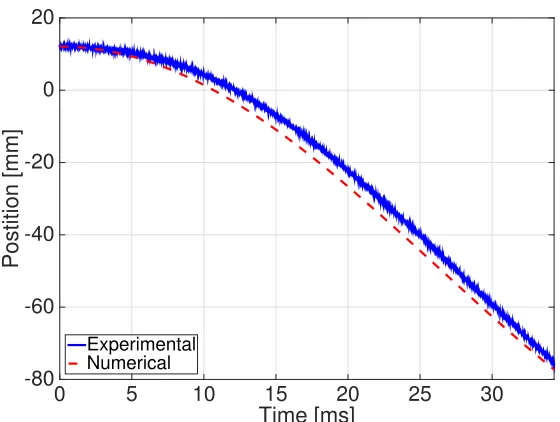
plug was measured with a Keyence LK-G407 laser range finder. Figure 2.4 shows a
comparison between the numerical ODE model and the performance of the valve,
indicating the utility of the model for design purposes.
The valve was designed iteratively with the numerical solution to the model until a
suitable design was obtained. To minimize cost, the cylinder chosen is an
off-the-shelf Parker pneumatic cylinder. The piston is enclosed in a streamlined cylindrical
shroud to minimize perturbation to the flow. The sealing face of the plug, shown in
black in Figure 2.3, is made from polyurethane and is designed to match the slope
of the nozzle contour when the piston is in the closed position. The end of the plug
is made from aluminum and is a streamlined shape. The cylindrical shroud is made
from PMMA and the upstream end of the shroud is rapid-prototyped nylon to reduce
the weight of the structure. Its shape is an ellipsoid and the surface is roughened to
encourage boundary layer transition and therefore minimize flow separation at the
Time [ms]
0 5 10 15 20 25 30
Postition [mm]
-80 -60 -40 -20 0 20
Experimental Numerical
Figure 2.4: Comparison of the bench test data with the numerical ODE model described in this section.
compressed gas cylinders used to fill the driver tube. A photograph of the installed
valve is shown in Figure 2.5.
Figure 2.5: A photograph of the installed valve in a partially-opened position.
Figure 2.6 shows the free stream pitot pressure traces and spectra for nominal
300 kPa-reservoir pressure runs with a diaphragm and the valve. The left-hand plot
shows that the opening process of the valve reduces the total test time from 100 ms
to about 60 ms. This is not detrimental, however, as 60 ms still provides for over
valve reduces the noise in the stagnation pressure across all frequencies by a factor
of 2-3. The RMS noise level in stagnation pressure is reduced from 1-2% to 0.7%.
103 104 105
10−6
10−4
10−2
Frequency [Hz]
(
p
′/0
¯
p0
)
2
Diaphragm Piston
Figure 2.6: Left: Pitot pressure traces from a run with a diaphragm and a run with the valve. The effective opening time of the valve is about 40 ms and the resulting run time is approximately 60 ms. Right: Power spectra of pitot pressure during the steady run time for a shot with a diaphragm and a shot with the valve. The valve reduces the noise level in the tunnel by a factor of about 2-3 across all frequencies. High-frequency spikes in both spectra are due to electrical noise.
The other advantages of the valve over operation with the diaphragm are that the
tunnel can be operated at any pressure between the limits of 100 kPa and 600 kPa
instead of only those determined by available diaphragms. Test conditions are also
now repeatable to within a few percent (see e.g. Appendix D). Additionally, the
Ludwieg tube does not need to be opened after each run to replace a diaphragm, so
the turnaround time is reduced from 30 minutes to about 12 minutes. The remaining
gas in the driver tube after a run does not need to be evacuated after each experiment
as it does when using a diaphragm, so there is also a cost savings associated with
using less gas in the driver per shot along with the cost savings of no longer needing
to purchase diaphragms to operate the tunnel.
2.3 Test Articles
Two test articles are used in this work, both based on a sharp-tipped 5 degree
half-angle cone. The tip radius is measured to be 300 µm. This radius is sufficiently
small that the entropy layer is swallowed before the injector section is reached and
therefore the cone tip can be treated as sharp (Stetson, 1987). The models are shown
in Figure 2.7. Both have an aluminum tip section that is 131 mm long measured
along the surface of the cone, followed by a 40 mm long injector section, followed by
a frustum. The frustum is made from Delrin, a machinable plastic. One model has a
other has a cylindrical injector, and this article is used to analyze the instability in
the flow. The frustum section of this model is instrumented with five PCB 132A31
piezoelectric pressure transducers along its length.
Figure 2.7: Both models used in this work. One has a cylindrical injector section (top) and the other has a conical section (bottom). The ruler scale is in inches. Republished with permission of AIAA. From Schmidt et al. (2015); permission conveyed through Copyright Clearance Center, Inc.
The injectors are manufactured by Mott Corporation and are made of sintered
stainless steel. The surface area of the injectors is 2.66 ×10⁻³ m2. Magnified
images of the injectors are shown in Figure 2.8.
(a) Conical injector (b) Cylindrical injector
Figure 2.8: 5x-magnified images of the surface of injectors. The red line in the lower right corner of each image is 100µm. Republished with permission of AIAA. From Schmidt et al. (2015); permission conveyed through Copyright Clearance Center, Inc.
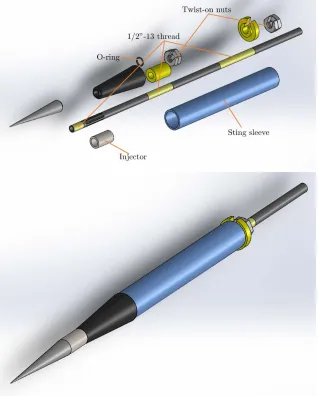
The models are assembled on a 1/2-inch diameter aluminum tube. The cone tip,
injector, and rear frustum interlock. The cone tip has 1/2”-13 internal threads to
injector to facilitate the flow of gas from the tube to the injector. An O-ring at the
rear of the frustum section ensures that gas does not escape through the rear of the
model. Sections of the tube are threaded and twist-on 1/2”-13 nuts are used on these
sections. One nut tightens the frustum, injector, and cone tip together. The other
tightens against the sting sleeve, which interlocks with the back of the frustum. The
sting sleeve fits in the sting in the Ludwieg tube test section. A plastic end cap is
used between the back of the sting sleeve and the corresponding twist-on nut, and
a slot is cut in the end cap to allow wires from the PCB sensors to pass through.
A 1/2-inch Swagelok fitting is fixed to the rear end of the aluminum tube which
mates with the injected gas plumbing line. A solid model of the assembly and an
exploded view are shown in Figure 2.9. Machine drawings for the parts, including
the pneumatic valve components, are included in Appendix B.
Porous Flow Analysis
The flow through the porous material of the injectors is modeled using the
compress-ible version of Darcy’s Law. Darcy’s Law is a well-known relation between the flow
rate and pressure difference for low Reynolds number flows through porous media
(Dullien, 1979). The derivation is straightforward from conservation of momentum.
The 1-D, steady, incompressible equation is
Q= κA µ
p1− p2
h , (2.1)
whereQis the volumetric flow rate,p1andp2are the pressures at the beginning and
end of the porous media section, respectively,his the thickness of the media,Ais the
cross-sectional area, µis the viscosity of the fluid, and κ is the permeability of the
media (see Figure 2.10). Permeability is the key parameter that relates the pressure
drop to the flow rate and has units of area. It must be determined experimentally.
A compressible version of Equation 2.1 can be derived from the continuity and
momentum equations. The analysis here follows closely that of Shepherd and
Begeal (1988). The injectors in this work are axisymmetric, so the continuity
equation is
d
dr ρu
+ ρu
r =0 , (2.2)
which reduces to
ρur = m˙
2πL = constant (2.3)
for a cylinder of lengthL, where ˙mis the mass flow rate. The geometry is shown in
Figure 2.9: Exploded view and assembly of solid model of the test article with the cylindrical injector. Threaded segments of the aluminum tube are colored yellow. Holes for the PCB pressure transducers are visible on the frustum section.
The momentum equation is a balance between viscous forces and the pressure drop
across the porous material:
−dp
dr =
ρu2CD
¯
d . (2.4)
In this expression ¯d is a characteristic length of the porous material. A common
assumption is that the media can be approximated as a bed of closely-packed spheres.
In this case ¯dis the mean sphere diameter.
CD is a drag coefficient for the media. If the Reynolds number based on ¯d (Red¯) is
Figure 2.10: Sketch illustrating 1-D porous flow. The porous media has thicknessh and cross-sectional area A. If the flow is incompressible, the flow rate is related to the pressure drop by Equation 2.1.
Figure 2.11: Sketch of porous flow through an axisymmetric geometry such as the cylindrical injector used in this work. The injector has inner radius ri and outer radiusro.
the drag coefficient:
CD =
¯ d2
κ 1 Red¯ +
λ ¯ d
!
. (2.5)
κis again the permeability of the media, andλis the Forchheimer constant, which is a
property of the media that must also be determined experimentally. The Forchheimer
constant can be related to the permeability by the Carman-Kozeny expression for
the permeability of a bed of packed spheres:
κ = d¯23
180(1−)2
and the Ergun relation for the Forchheimer constant:
κ λ =
¯ d3
1.8(1−) . (2.7)
in these equations is the porosity, or volume fraction of empty space, of the porous
material (Macdonald et al., 1979). According to the manufacturer of the injectors
this is equal to 0.4. Equations 2.5, 2.6, and 2.7 can be combined to give
CD =
¯ d κ µ ρu + ¯ d
100(1−)
!
. (2.8)
A set of experiments was performed to simultaneously measure the pressure inside
the injectors and the gas mass flow rate using a Kulite XT-190 piezoresistive pressure
transducer and a Sensirion EM1 flow meter, respectively, to determine the properties
of the porous media. The two terms in Equation 2.8 can first be compared to
determine if both are necessary to model the flow through the injectors. According
to the manufacturer, the mean pore size is on the order of 10µm, so this can be used
as an estimate for ¯d that is assumed to be accurate within an order of magnitude.
The viscosity of air at room temperature is 1.9×10⁻⁵kg/m s, and the largest mass
flow rate in this set of calibration experiments is 4.5 g/s. Using these values, the
second term in Equation 2.8 is at most 5% of the first term and can be neglected.
This simplifies the expression for the drag coefficient to
CD =
¯ dµ
κ ρu . (2.9)
Equation 2.9 can be substituted into Equation 2.4 to give
−dp
dr = uµ
κ . (2.10)
The velocityucan be expressed in terms of the mass flow rate by using Equation 2.3:
−ρdp
dr = ˙ mµ
2πLκr . (2.11)
Equation 2.11 is integrated frompito poin pand from Ri toRoinr by expressing
the density as a function of pressure using the ideal gas law and assuming isothermal
flow through the porous media. The resulting expression is
p2
i −p2o=
˙ mµRT
πLκ ln ro
ri
!
In the experiments performed in this work the pressure outside the injector is of the
order 1 kPa while the pressure required to drive flow through the injector is of the
order 100 kPa, so p2o << pi2 and p2o can be neglected in Equation 2.12. The final
relation between pressure and mass flow rate is
p2
i =
˙ mµRT
πLκ ln ro
ri
!
. (2.13)
From Equation 2.13, it is clear that if pressure and mass flow rate are measured
simultaneously then the permeability κ is the only unknown parameter and can be
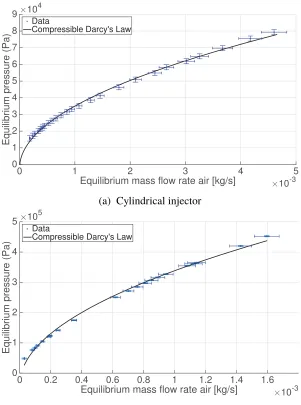
determined by linear least squares. Figure 2.12 shows the data from the calibration
experiments with a fit of Equation 2.13 to determine the permeability. κis equal to
3.5±.003×10−12m2for the cylindrical injector and 1.1±.0006×10−14m2for the
conical injector. Uncertainties are determined by the 95% confidence interval of the
least-squares fit and the measurement uncertainties in pressure and mass flow rate.
These values are typical of those reported for sintered stainless steel (Frederking
et al., 1986).
2.4 Injected Gases
Pappas and Okuno (1960) observed that the molecular weight of the injected gas
affects the transition location on a porous cone in Mach 4.8 flow. The choice of
injected gas is therefore considered to be an important parameter in the investigation
of the instability that leads to transition in this work. Nitrogen was chosen as one
injected gas because it is simpler to model since the free stream gas is also nitrogen
and diffusion of species need not be considered. Helium was selected as a second
injected gas because it is the lightest gas available (that does not require additional
safety measures to use) and therefore produces the largest deviations in behavior. The
properties of helium are similar to those of hydrogen which is a candidate scramjet
fuel, making it particularly relevant to the application of injection in scramjet inlets.
Helium is approximately seven times lighter than nitrogen, so a gas that is seven
times heavier than nitrogen (a molecular weight of 196 g/mol) was sought as the
final injected gas. Most substances with molecules of that size are not gases at room
temperatures, and many that are gases are highly toxic, corrosive, combustible,
and/or prohibitively expensive. Refrigerants were seen as a category of fluids that
may fit the criteria of being a gas at room temperature, non-toxic, compatible with
most materials, non-reactive, and reasonably priced. One refrigerant, RC318, fits
Equilibrium mass flow rate air [kg/s] ×10-3
0 1 2 3 4 5
Equilibrium pressure (Pa)
×104
0 1 2 3 4 5 6 7 8 9
Data
Compressible Darcy's Law
(a) Cylindrical injector
Equilibrium mass flow rate air [kg/s] ×10-3
0 0.2 0.4 0.6 0.8 1 1.2 1.4 1.6
Equilibrium pressure (Pa)
×105
0 1 2 3 4 5
Data
Compressible Darcy's Law
(b) Conical injector
Figure 2.12: Pressure vs. mass flow rate data for air for both injectors fit with Equation 2.13 to determine permeabilities. Republished with permission of AIAA. From Schmidt et al. (2015); permission conveyed through Copyright Clearance Center, Inc.
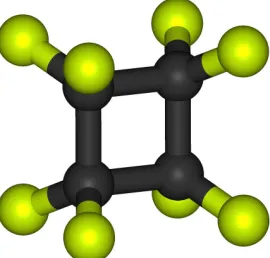
ball-and-stick model of an RC318 molecule. The black spheres represent carbon
atoms and the green spheres are fluorine atoms.
RC318 is a fluorocarbon, its IUPAC name is octofluorocyclobutane. It is effectively
a cyclobutane molecule where all the hydrogen atoms have been replaced with
fluorine atoms. It has few documented applications, but is used in the production
of semiconductor materials and is therefore readily available. It is chemically inert
under most conditions, as the carbon-fluorine bond is extremely strong, often listed
Figure 2.13: 3-D model of an RC318 molecule. The black spheres represent carbon atoms and the green spheres are fluorine atoms. Image by Fvasconcellos - Own work, Public Domain.
are detailed in the safety data sheet provided by Praxair (Praxair Inc., 2015). Some
properties of the three selected injected gases for this work at 295 K are summarized
in Table 2.1.
Gas Formula Molecular weight Specific heat ratio Sound speed (W) [g/mol] (γ) [m/s]
Helium He 4.00 1.67 1011
Nitrogen N2 28.02 1.4 350
RC318 C4F8 200.04 1.054 114
Table 2.1: Properties of injected gases at 295 K.
Flow Rate Measurement
The mass flow rate of the injected gas is measured directly by an Omega FMA1742A
thermal flow meter. The meter outputs a voltage that is linearly proportional to the
mass flow rate, but the constant of proportionality depends on the properties of the
gas. The meter was calibrated for each gas using a King Instruments rotameter in
series with the thermal meter. During experiments, the thermal meter is in series
with the injector and is approximately 3 m upstream of the test section. Flow through
the injector is started several seconds before the wind tunnel is started to ensure that
steady flow has been established and the flow meter gives an accurate reading. The
meter has a rated accuracy of 1.5% of the full scale reading. The uncertainty used
for error propagation is twice this value to conservatively account for potential errors