Abstract
Horiba, Hironobu. 3-D Computed Tomography Using Diffraction Enhanced Imaging Modality. (Under the Direction of Professor Kuruvilla Verghese and Professor Dale E. Sayers.)
Atomic and nuclear radiation has been used to develop a large variety of medical imaging modalities for the benefit of humankind over the past fifty years. Diffraction Enhanced Imaging (DEI) is a new x-ray radiographic imaging modality using
monochromatic x-rays to produce very clear digital radiographs of objects by virtually eliminating the detection of scattered photons and exploiting the refraction properties of the object. Being free of scatter DEI images have shown dramatically improved contrast over standard radiographs of the same object. The main objective of this work was to apply DEI to computed tomography (CT) and obtain three-dimensional tomographic images.
Two sets of experiments on Lucite phantoms were performed at the X15A beamline of National Synchrotron Light Source. The first experiment was performed to evaluate previous work related to this work. The second experiment was performed to obtain three-dimensional CT data. Three-three-dimensional images were successfully obtained and the apparent absorption and refraction images obtained from DEI showed information
unavailable in conventional radiograph in computed tomography. There are two interesting findings in this research. One is that subtraction method for calculating refraction images which we suggested is found to be relatively free from contamination from the absorption component. The other is that the procedural orders of manipulation of taking logarithm and subtraction/addition seriously affect the quality of image. If one mixes this order, the result shows a hump-like artifact in both the absorption and refraction images.
3-D COMPUTED TOMOGRAPHY
USING DIFFRACTION ENHANCED IMAGING MODALITY
By
Hironobu Horiba
A thesis submitted to the Graduate Faculty of North Carolina State University
In partial fulfillment of the Requirements for the Degree of
Master of Science
Department of Nuclear Engineering
North Carolina State University Raleigh, North Carolina
2003
Approved by:
Dr. Kuruvilla Verghese, Co-Chair Dr. Dale E.Sayers, Co-Chair
Biography
Hironobu Horiba was born August 22, 1978 in Nagoya, Japan. He grew up
primarily in Nagoya, Japan with his parents, Kenji and Hideko, as well as his brother and
sister, Koji and Tomomi. He had his primary school education at Ohnogi in Nagoya and
secondary education in Nanzan private school. Hironobu graduated in March of 1997. The
following spring, he began college at Nagoya University as a nuclear engineering student.
After obtaining his B.S. in Nuclear Engineering in March 2001, he began his graduate
study in Nuclear Engineering at Nagoya University. Hironobu came to study at North
Carolina State University in fall 2001 as an exchange student. He transferred to North
Acknowledgements
I would like to show my appreciation to everybody who has helped me with my
research. Dr. Zhong Zhong helped me with my experiments at NSLS and provided
financial support for an experiment at BNL. He also allowed me to use his IDL libraries
and gave me advice on IDL coding. I would like to thank Dr. Sarah Rajala for teaching me
the course related to this research through an independent study. Without her help, I would
not understand digital filtering nearly as well as I do today. I must also acknowledge the
Nuclear Engineering department, for without this department’s financial support I could not
have performed this research at North Carolina State University. Finally, I would like to
thank my advisors for giving me to the chances necessary to do this research and for
Table of Contents
Page
List of Figures···vi
1. Introduction··· 1
2. Background information ··· 4
2.1.General Concepts and Synchrotron X-rays for Medical Imaging··· 4
2.2.Computed Tomography (CT) and CT Image Reconstruction ··· 5
2.3.Diffraction Enhanced Imaging (DEI) ··· 6
2.4.Diffraction Enhanced Computed Tomography (DECT) ··· 10
3. Experimental Methods ··· 12
3.1.The DEI system at the X15A Beamline··· 12
3.2.Data acquisition··· 14
4. Image Analysis and Reconstruction··· 17
4.1.General Procedures for Image Analysis and CT Reconstruction··· 17
4.2.Separation of the Absorption and Refraction Components··· 18
4.3.IDL Code for CT Reconstruction··· 19
5. Result and Discussion··· 23
5.1.Two-dimensional Slice Reconstruction Using Option 3··· 23
5.2.Two-dimensional Slice Reconstruction Using Option 1··· 28
5.3.Three-Dimensional Reconstruction of Phantom C··· 31
6. Conclusion and Recommendation··· 35
7. References··· 38
List of Figures
Page
Figure B.1 Image system··· 59
Figure E.1 Set up at the NSLS X15A beamline··· 60
Figure E.2 The silicon [333] rocking curves of the analyzer crystal at 40 keV··· 60
Figure E.3 The design of phantom A··· 61
Figure E.4 The design of phantom B··· 62
Figure E.5 The design of phantom C··· 62
Figure I.1.1 The block diagram of image processing procedure ··· 63
Figure I.1.2 The example of Higher and lower side images ··· 63
Figure I.1.3 Schematics of back projection ··· 64
Figure I.1.4 Filters in frequency domain. Green line is Shepp Logan Filter··· 65
Figure I.1.5 Filters in spatial domain··· 66
Figure R.1.1 A slice of raw data of Lucite B at lower side of rocking curve··· 67
Figure R.1.2 Raw tomography data of Lucite B at lower side of rocking curve··· 67
Figure R.1.3 Sinogram of Lucite B at lower side of Rocking curve··· 68
Figure R.1.4 Sinogram with Shepp Logan Filter at lower side of Rocking curve··· 68
Figure R.1.5 Reconstructed image with Shepp Logan Filter at lower side of Rocking curve··· 69
Figure R.1.6 Reconstructed image without Filter at lower side of Rocking curve ··· 70
Figure R.1.7 Line profiles of raw tomography data at y=169 at lower side of Rocking curve··· 71
Figure R.1.9 Line profiles of sinogram at y=169 with Shepp Loagan filter at lower side of
Rocking curve··· 72
Figure R.1.10 Line profiles of raw tomography data at y=255 at lower side of Rocking curve··· 73
Figure R.1.11 Line profiles of sinogram at y=255 at lower side of Rocking curve··· 74
Figure R.1.12 Line profiles of sinogram at y=255 with Shepp Logan filter··· 75
Figure R.1.13 Line profiles of reconstructed data at y=255 with Shepp Logan filter at lower side of Rocking curve··· 76
Figure R.1.14 Line profiles of reconstructed data at y=255 without filter at lower side of Rocking curve··· 77
Figure R.1.15 A slice of raw data obtained from the detector ··· 78
Figure R.1.16 The normal image for image adjustment ··· 78
Figure R.1.17 sinogram of Lucite B at higher side of rocking curve ··· 78
Figure R.1.18 Sinogram of Lucite B at higher side of rocking curve with Shepp Logan filter ··· 78
Figure R.1.19 Reconstructed image with Shepp Logan filter ··· 79
Figure R.1.20 A line profile of raw tomography data at y=94 ··· 80
Figure R.1.21 A line profile of sinogram at y=94 ··· 81
Figure R.1.22 The apparent absorption image of the phantom B using option 3··· 82
Figure R.1.23 The refraction image of the Lucite B using option 3 ··· 83
Figure R.1.24 A line profile of absorption image of the phantom B using option 3 ··· 84
Figure R.1.25 A line profile of refraction image of the phantom B using option 3 ··· 85
Figure R.1.27 The refraction image of the Lucite B using option 1 ··· 87
Figure R.1.28 A line profile of absorption image of the phantom B using option 1··· 88
Figure R.1.29 A line profile of refraction image of the phantom B using option 1 ··· 89
Figure R.1.30 The comparison of line profiles Higher, Lower and simulation images of phantom B filled with water without any digital filters ··· 90
Figure R.2.1 Absorption raw tomography data of phantom B filled with water··· 90
Figure R.2.2 Refraction raw tomography data of phantom B filled with water··· 91
Figure R.2.3 Absorption sinogram of phantom B filled with water ··· 91
Figure R.2.4 Refraction sinogram of phantom B filled with water ··· 91
Figure R.2.5 Filtered absorption sinogram of phantom B filled with water ··· 92
Figure R.2.6 Filtered refraction sinogram of phantom B filled with water ··· 92
Figure R.2.7 Reconstructed absorption image of phantom B filled with water ··· 93
Figure R.2.8 Reconstructed refraction image of phantom B filled with water ··· 94
Figure R.2.9 A line profile of reconstructed absorption image of phantom B filled with water ··· 95
Figure R.2.10 A line profile of reconstructed refraction image of phantom B filled with water ··· 96
Figure R.3.1 The refraction image z=0 x-y plane ··· 97
Figure R.3.2 The apparent absorption image of z=0 slice in the radial(x-y) plane ··· 98
Figure R.3.4 Transversel slices of the apparent absorption image; where (a),(b) and (c) are
images of from the channel 1,2, and 3 respectively. The lower number means
higher y position. ··· 100
Figure R.3.5 The line profile of the refraction image at y=241,z=1 showing the refraction
signal from channel 2 ··· 100
Figure R.3.6 The line profile of the absorption image at y=246, z=1 showing the absorption
signal from channel 2 ··· 101
Figure R.3.7 The three-dimensional voxel projection of refraction image. ··· 102
1. Introduction
Atomic and nuclear radiation has been used to develop a large variety of medical imaging
modalities for the benefit of humankind over the past fifty years. These modalities include
digital radiography (DR), Computer Tomography (CT), Positron Emission Tomography
(PET) and Single Photon Emission Computed Tomography (SPECT). Other imaging
modalities such as Magnetic Resonance Imaging (MRI) and Ultrasound systems
compliment the nuclear imaging modalities. Each imaging modality has its own
advantages and disadvantages. MRI can obtain high resolution images, but it takes a long
time to obtain images. On the other hand, CT can obtain images in short period. However,
CT exposes patients to x-rays. Also, CT can measure only one physical parameter, the
mass attenuation coefficient.
Research has shown that x-ray refraction can be another parameter for radiography
and CT. Chapman, et al [1] have invented and reported on such a modality called
Diffraction Enhanced Imaging (DEI). DEI is a new x-ray radiographic imaging modality
using monochromatic x-rays to produce very clear digital radiographs of objects. DEI data
are completely free of scatter and contain only the contributions from photons that are
affected by absorption, extinction and refraction through very small angular deflections of
the order of microradians (5.73 x 10⁻⁵ degree/microradian). Therefore, the images show
dramatically improved contrast over standard radiographic imaging applied to the same
object since those images will contain some contribution from scattered photons. The
contrast is based not only on attenuation of x-rays but also the refraction properties of the
sample. In fact, it is possible to essentially separate the absorption component of the image
component image will contain quite different types of information from that of the
absorption image. DEI imaging shows promise of greatly improving image quality for
medical applications such as mammography[1] and industrial applications for
non-destructive testing, The differences of density between tumor lesions and normal breast
tissue is small(~2%) in mammography. So, it is difficult to detect small lesions in
mammograms particularly in the presence of other heterogeneities in the breast. However,
it should be possible to detect such lesions much better with DEI, because of the enhanced
contrast. DEI consists of two physical parameters, mass attenuation coefficient and
refractive index. Theoretically, the apparent absorption shows mass attenuation coefficient.
However, this image is different from standard radiography in that this image is scatter free.
The refraction image shows the gradient profile of refractive index which enhances the
boundaries of regions with different refractive indices.
Dilmanian, et al [2] reported that DEI can be applied to CT imaging. However, the
results obtained from Diffraction Enhanced Computer Tomography (DECT) shows that
there is still considerable room for further sophistication for this modality. First, there are
problems related to the use of hardware, mainly which, DECT requires adjustment of the
angle of an analyzer crystal around its Bragg angle with microradian accuracy. Thermal
and other effects can cause difficulty in maintaining the crystal angle with the degree of
accuracy required. Secondly, there are problems related to the software, primarily
understanding, the most effective filter for CT reconstruction of the DEI images by the
back projection method. Thirdly, methods for determining the center of image for
correcting for any off-axis rotation of the object are not fully developed and automated.
1. To clarify the problems of combining DEI and CT and solve such problems in
order to enable DECT to be applied to medical diagnosis.
2. To demonstrate the potential for three-dimensional reconstruction of DEI
images by stacking a large number of two-dimensional tomographic images.
Development of proper methods for reconstructing 3-D tomographic images
obtained from DEI, should enable visualization of the wealth of information contained in
2. Background Information
The research reported here falls in the general area of imaging using synchrotron radiation
and its potential for medical diagnosis. Therefore, we briefly wish to introduce the reader
to some of the literature on general concepts of medical imaging first and then focus on a
review of literature dealing with the specific subject of this thesis, namely, Computed
Tomography (CT) and Diffraction Enhanced Imaging (DEI). Finally, one previous work
on combining DEI and CT is introduced.
2.1 General Concepts and Synchrotron X-rays for Medical Imaging:
Synchrotron x-ray radiography has been applied, primarily at a research level, to various
types of medical imaging problems and its potential use has been demonstrated in such
areas as intravenous coronary angiography to look for blockages in coronary blood vessels,
in-vitro monochromatic computed tomography and in-vitro imaging of tissue samples of
human breast. The book, Medical Applications of Synchrotron Radiation [L.1] edited by
Ando and Uyama is a collection of papers and a very good reference for medical
applications of synchrotron radiation. There are three main sections in this book; these are
Clinical Application in Practice or in Approach, Imaging, and Sources and Instruments.
The Imaging section is particularly relevant to the topic of this thesis. In this section,
papers related to phase contrast imaging techniques are introduced. They describe phase
contrast imaging as becoming “a new x-ray eye in the 21st century” in the medical imaging
area. DEI is, of course a phase contrast technique. Also, a paper related to DEI is
introduced. All of the papers give fairly good information for understanding the basis of
Secondary, general topics in medical imaging are briefly mentioned. An excellent
reference for understanding the science of medical imaging is the textbook, The Essential
Physics of Medical Imaging by Bushberg, Seibert, Leidholdt, Jr., and Boone [L.2]. The
second edition of this book is now available. For understanding the basis of this research,
section II, Diagnostic Radiology (except chapter 11 to 13) is well worth reading. This
textbook has good discussions of fundamental concepts such as output intensity spectra of
x-rays source, image quality degradation and related quantities such as Modulation Transfer
Function (MTF) and Signal-to-Noise-Ratio (SNR).
2.2 Computed Tomography (CT) and CT Image Reconstruction:
The chapter on Computed Tomography in reference [L.2] provides an easily
understandable non-mathematical introduction to the basic aspects of computer tomography
and image reconstruction. However, further reading is essential for understanding the
mathematical theory of tomographic reconstruction. The books, Principles of
Computerized Tomographic Imaging [L.3] and Medical Imaging Systems [L.4] are good
references for acquiring more information about the mathematics of tomographic
reconstruction. Chapter 1 to 5 of [L.3] explains basics of signal processing, image
processing and algorithms for reconstruction. Medical Imaging Systems [L.4] is mainly
about radiography. Chapter 7, tomography, explains the mathematics of tomography. It is
possible to get a good background about tomography from studying these two books.
Filtered back projection (FBP) Algorithm is used for reconstruction in this research,
since the filtered back projection or convolution back projection algorithm is the most
The basic idea of back projection is to take the projection at each angle of rotation of the
object and smear the intensities uniformly back into the object. With enough projection
angles (typically 180 projections, each taken at every one degree of rotation), in principle,
this should produce a cross sectional image of the object except for certain characteristic
artifacts. The most significant artifact is the 1/r effect which makes the intensity of the
image decrease from the center of the object to its sides. The 1/r artifact can be minimized
using suitable digital filters. Important digital filters such as Shepp Logan which are
commonly used in conjunction with tomographic reconstruction are explained in chapter 3
of the book, Foundation of Medical Imaging [L.5]. Other artifacts can result from the axis
of rotation not coinciding with the axis of the object and from having insufficient number
of projections in the reconstruction set.
2.3 Diffraction Enhanced Imaging (DEI):
The papers that were referred to in the first Chapter of this thesis (Introduction) are good
for gaining an understanding of the concepts of DEI and DECT. The paper by Chapman, et
al [1] is the best paper for understanding the physical principles and concepts of DEI.
At this point, it is important for the reader to understand the theoretical foundation
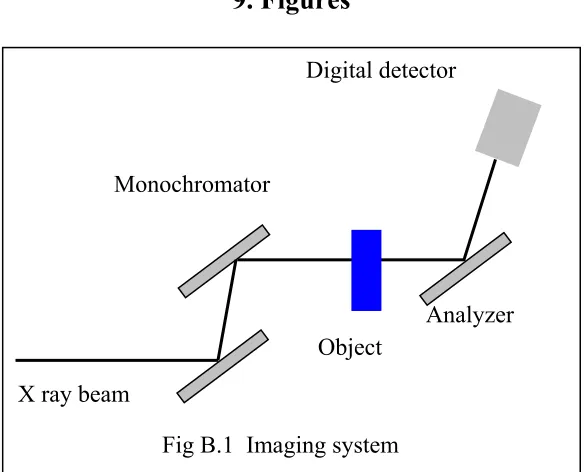
for diffraction enhanced imaging. Figure B.1 shows a schematic diagram of the data
acquisition system for DEI. The plane polarized white beam of synchrotron radiation from
an electron storage ring is Bragg reflected by a pair of monochromator crystals of silicon.
The Bragg angle of the monochromator determines the wavelength (or the energy) of the
reflected photons and thus the wavelength is tunable. Because of the nature of the
selects about a 1mm high beam to pass horizontally through the object to be imaged. The
beam transmitted through the object contains contributions from photons that were not
absorpted in the object, but also those which were diffracted, scattered or refracted by the
object. The latter three contributions typically will degrade the image quality in a
conventional radiograph. For DEI, another Bragg crystal tuned to the wavelength of the
incident beam is placed between the object and the detector. This crystal eliminates
virtually all of the scattered (coherent and incoherent) and diffracted photons from the
detected image. Because of the small but finite width of the rocking curve (reflectivity of
the crystal as a function of the Bragg reflection angle) of the analyzer crystal, and the fact
that refraction angles for x-ray photons are extremely small and fall within the width of the
rocking curve, the detected photons will contain contribution from refraction in addition to
x rays that are transmitted straight through the object. Refraction effects occur primarily at
the boundaries of embedded structures which have different indices of refraction. Thus, if
refraction contribution could be separated from the straight through contribution, the former
could display the valuable information that will delineate the boundaries of even minute
structures in the object.
The DEI methodology developed by Chapman, et al [1] does such separation of the
detected signals into an ‘apparent absorption image’ (actually the image from direct
transmission) and a ‘refraction image’ which correlates to the gradient of the refractive
index along the path of the x rays through the object. To facilitate this, two images of the
object are recorded on the digital recorder: one at an analyzer angle that is slightly greater
than the peak angle of the rocking curve (hereafter called ‘the higher side image’) and one
image’). According to Chapman, et al [1], the intensity diffracted by the analyzer set at a
relative angle θi from the Bragg angle θB where θB + θi is the angle between the incident
beam and diffraction planes and is given by
Ii=IRR( θB ± θi)
where Ii is the intensity at relative angle θi from Bragg angle θB, IR is defined as the portion
of the incident beam which has only been affected by refraction and attenuation by
absorption and extinction, and R(θ) is the analyzer reflectivity function at angle θ. R(θ) is
the function that describes the rocking curve.
By Taylor expansion, the intensity of the images taken on the lower side (θL) and
the higher side (θH) of the rocking curve are approximately
+ ∆
= L z
L R L d dR R I I θ θ θ θ ) ( ) ( + ∆
= H z
H R H d dR R I I θ θ θ θ ) ( ) (
where IL and IH denotes beam intensity at the lower and higher sides of rocking curve. Note
that R(θ) is written in a two-term Taylor expansion for the expressions above.
These two equations are solved for the intensity composed of apparent absorption, IR, and
for the refraction image angle, ∆θz, the angle through which x rays are refracted in the
z-direction in traversing the object. These solutions are
( )
( )
( )
( )
− − = ∆ θ θ θ θ θ θ θ d dR I d dR I R I R I L H H L H L L H ZTypically, the lower and higher side images are taken at the half-widths of the rocking
curve which makes R(θL) = R(θH) = 0.5 with the peak reflectivity normalized to 1.0 and
because of the symmetry of the rocking curve around the peak,
( )
θ θ d dR H = - θ θ d dR( L).
Thus, IR = (IL + IH) and ∆θz =
] [ ] [ dR/d 5 . 0 L H L H I I I I + − θ
∆θz provides the distribution of angles of refraction in the z-direction and it is not
the signal intensity due to refraction. The refraction signal intensity, Ir, is expressed by
IR(dR/dθ) ∆θz and hence proportional to (IL - IH) assuming that dR/dθ, the slope of the
rocking curve, is a constant at the high side and low side angles at which the two images
are measured. Note that simple addition and subtraction of the lower side and higher side
images can yield IR and IR∆θz images. We refer to the IR image as the “apparent absorption
image” and Ir image as the “refraction image”. Chapman, et al have always used IR and ∆θz
images in all of their work. Although ∆θz contains refraction information, we will be using
IR∆θz for the refraction images in this work because of reasons discussed later in Chapter 4.
It is possible to perform a further survey of the DEI modality by reviewing the
references quoted in the paper by Chapman, et al. Next, some of the important papers that
showed that DEI can reveal considerably more details in biological specimens than
conventional radiography are introduced. The papers, “Human breast cancer specimens:
diffraction-enhanced imaging with histologic correlation - improved conspicuity of lesion
contrast mechanisms in breast cancer specimens” [L.7] show that DEI can reveal
considerably more medically relevant details of breast tissue samples when compared with
standard radiography.
In addition to the research at the U.S. synchrotron laboratories, investigation of
phase contrast imaging are being carried out also at all of the major synchrotron light
centers in Europe using synchrotron x-rays, for example, [L.8] and in Russia [L.9].The
Russian work originated independently of the studies elsewhere using standard x-ray tubes
and therefore took prohibitively long times for data accumulation. Although these studies
have produced interesting results, the method of separating the absorption effects from the
refraction effects originated in the U.S. with the extensive work at the National Synchrotron
Light Source (NSLS) at Brookhaven National Laboratory and this method is now used
around the world.
2.4 Diffraction Enhanced Computed Tomography (DECT):
The first publication and so far, the only formal journal paper reporting on generating
tomographic reconstructions from DEI images is the paper by Chapman, et al [2]. This
work was carried out at NSLS using cylindrical acrylic phantoms with vertical and oblique
holes filled with oil. In this paper, the following four conclusions are derived. Firstly,
DECT projections are complete sets and thus can be reconstructed conventionally.
Secondly, the separation of the refraction image from the other image components is
complete for material with little small-angle scattering, such as oil and acrylic. Thirdly, the
refraction image contrast is proportional to the gradient of the refractive index. Finally,
and the theoretical refractive index results. The absolute values agree within 20%. This
thesis is a follow-up of the work reported in [2].
Preliminary work on a more exhaustive and versatile approach to DECT, known as
Multiple Image Reconstruction (MIR) is progressing at the laboratories of Chapman and
colleagues at the Illinois Institute of Technology [D. Chapman, Private communication,
(2002)]. MIR CT is capable of providing images of four x-ray parameters instead of two
(apparent absorption and refraction) in standard DECT. However, for clinical uses, MIR
CT images may turn out to be too difficult to interpret and use at least until the radiology
community gets attuned to viewing such data. Also, many images have to be acquired along
the rocking curve in doing MIR CT and radiation dose accumulation could become a
serious issue.
3. Experimental Methods
All of the data for this thesis were acquired at NSLS, Brookhaven National Laboratory
(BNL), using the X15A beamline. The first experiment was in December 2002. The main
objective of this experiment was to obtain two-dimensional DECT image of Lucite
phantoms and examine the characteristics of DECT images and the choice of the most
appropriate filter for backprojection. The second experiment was performed in the X15A
beam in February 2003. The aim of his experiment was to obtain three-dimensional images
of another Lucite phantom.
3.1 The DEI system at the X15A Beamline:
Figure E.1 shows schematically the experimental setup for DEI data acquisition at beamline
X15A. The Bragg angle of the monochromator selects the wavelength of the x-rays to be
used from the white synchrotron radiation beam. The monochromator and analyzer crystals
are both positioned on a large granite block, 0.375 m wide, 0.3 m tall and 2.1 m long. The
block is isolated from vibrations of the floor by rubber pads and vibration-insulating
composite plates placed under the legs of the steel frame that supports the block [e1]. The
monochromator is positioned inside a steel tank, sitting on the granite block and
mechanically isolated from the beamline pipe by an air gap of 2cm. To reduce the rate of
ozone production, the lower part of the x-ray spectrum is essentially eliminated using a 1
mm thick aluminum filter positioned downstream of the beamline’s beryllium window.
The sample scanning stage and shutter are placed on a platform positioned on a second
steel frame which is directly supported by the floor. Thus, the stage and the shutter are
. The X-ray energy was set to 40 keV and the maximum ring current was 178 m A.
X15A is a standard NSLS bending –magnet beamline. The fan beam is 130 mm wide at the
entrance to the experimental hutch, which is 16.3 m from the source. The useful height of
the fan beam is about 2 mm where the intensity falls 20 % below the flat top. The aperture
of the fan beam used for the experiment was 1.7 mm high and 128 mm wide. The x-ray
storage ring operated at 2.80 GeV energy.
Thomlinson, et al developed the monochromator and analyzer system for DEI in the
planar mode [e2], [e3], [e4]. It employed a two-crystal Bragg-Bragg monochromator using
a silicon [1 1 1] reflection for both crystals. The monochromator was placed inside the
stainless steel tank with helium at atmospheric pressure to prevent corrosion of its
components by ozone. Each crystal was 10mm thick and 150mm wide, with strain relief
cuts at 10mm from the ends of the crystal. Thus, the useful width of the crystal was 128
mm. The first crystal was 60 mm long along the beam’s direction, and the second one was
90 mm. The larger length of the second crystal allowed a long range of energy change
without requiring adjustment of the distance between the two crystals.
The monochromator is a box type design with a vertical offset of 1 cm between the
two crystals [e4]. The first and second crystals are mounted on the bottom and top plates of
the box respectively. Each crystal is mounted on kinematic mounts for adjusting the Bragg
and analyzer angles, and is supported on the back side by three balls placed under the strain
relief region, and secured on the front side by clamps. The box is mounted on a cradle, so
that the middle of the first crystal surface is at the center of rotation. Because of its
simplicity, the box type design is especially resistant to vibration. The instability of the
thermal equilibrium. This instability was assumed to be mainly caused by thermal drifts.
The thermal equilibrium was reached in about 5min after the white beam was first put on
the monochromator crystals. The analyzer crystal is of the same kind as the second crystal
of the monochromator but used the [3 3 3] reflections of silicon. The Bragg angle of crystal
is controlled by a tangent arm of 1m length, driven by a linear translator of resolution 0.1
µm. This arrangement provides an angular resolution of 0.1 µradian, which allows the
analyzer to be tuned at a precision angle equal to 1/30th of the full width at half-maximum
of the rocking curve. The tangent arm is supported by the same granite block that supports
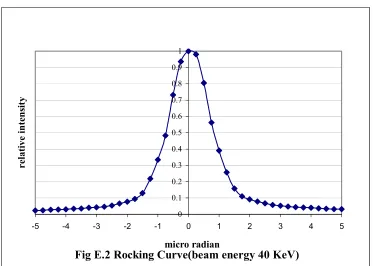
the monochromator. Figure E2 shows the silicon [333] rocking curves of the analyzer
crystal at 40 keV.
3.2 Data acquisition:
The digital detector was a Shad-o-box x-ray camera (Rad-icon Imaging Co. Ltd.) and the
data acquisition system (DAS) was interfaced with a Dell computer. The x-rays detected
by the digital detector in each pixel was transferred to the DAS and the data size was
reduced with IDL computer softwareby cutting out redundant pixels which did not include
any important information for data analysis. The raw data had a dimension of 2048 × 1024
pixels and it was reduced to the data size 2048 × 50. Since the height of x-ray beam is 2.5
mm, there was no important information seen by the detector except over this range. The
detector resolution was 50 µm. Therefore, 1mm is equal to 20 pixels.
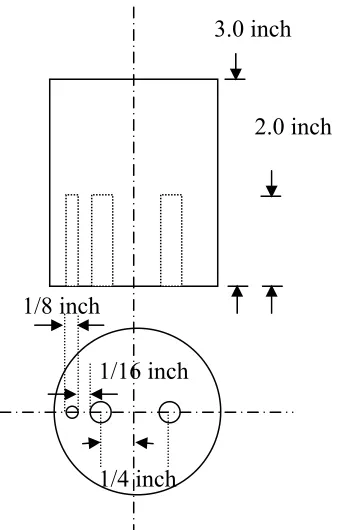
Two Lucite phantoms were used for the first experiment. One was prepared at North
Carolina State University (phantom A) and the other was prepared at BNL (phantom B).
the Phantom B was a lucite rod placed obliquely inside a hollow Lucite cylinder. Figure
E.3 shows the design of phantom A and Figure E.4 shows the design of the other phantom
B. The diameters of the channels for the phantom A were the following: 1/8 inch, 1/4 inch
and 1/4 inch. All of these channels were parallel to the phantom axis. The embedded
Lucite rod inside phantom B is 12.74 mm in diameter and placed at a tilt angle 21.5 degrees
with respect to the phantom axis. The reason that only phantom B was used in this thesis is
that to produce diffraction enhancement, the channels must not be parallel to the z-direction.
The channels in Phantom A are all vertical and hence no DEI could be done on it.
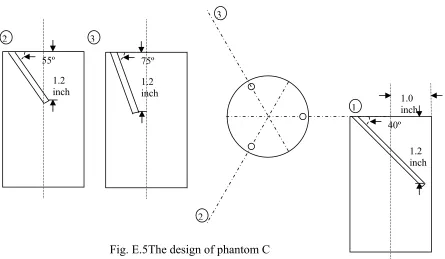
In the second experiment in February 2003, phantom C was prepared for obtaining
three-dimensional reconstruction data. The design of phantom C is shown in Figure E.5.
This phantom has three slanted channels with 1/8 inches diameter. These three channels
have angle of 40, 55 and 75 degree measured from top surface of the phantom. The
diameter of phantom is 2 inch.
Two sets of DEI scans were performed for each phantom by fixing the analyzer at a
specific angle and rotating the sample stepwise through 360º at 1º increment. In one set, the
phantom was filled with water and the other set, the phantom was empty. There are two
reasons for preparing these sets. First, the phantom, which was empty, was used to check
experimental set up accuracy, digital filter kernel size and other parameter adjustments.
This phantom should produce images which can be reconstructed with two parameters,
mass attenuation coefficient and diffraction enhanced signal. Second, the phantom, which
was filled with water, was used to see pure diffraction enhancement signal. Due to the
nearly equal values of mass attenuation coefficients of water and Lucite, the reconstructed
projections were acquired from the same sample with the analyzer angle tuned to -0.8 µrad
and 0.8 µrad from the peak and the sample rotated through 180 one-degree steps. The
FWHM of rocking curve at 40 keV x-ray energy is shown in Fig. E.2.
In each set of scans, three types of data were collected; these were background, air
and actual image. The background image was for obtaining information about detector
artifacts. Therefore, x-rays were not projected. The air image was for obtaining information
about attenuation from air. Therefore, x-rays are projected to the detector without phantom
in the beam. 20 sets of the background and air images were taken. Averaged values for
these were used to analyze data as described in the next section. The actual image is for
obtaining information about the phantoms. 360 images at 1 degree intervals were taken.
While performing experiments, the electron ring current of the synchrotron was in the range
between 215.3 and 184.8 mA.
All scans were controlled by a DEC Alpha computer with a program modified for
the CT experiment. The program obtains from the user data such as the type of scan and
the analyzer positions. Then, it performed the scan by controlling the stepping motors that
rotated. The program also acquired readings from the ion chamber current throughout the
4. Image Analysis and Reconstruction
In this chapter, the way we combined DEI and CT will be described. The manipulation of
order of these two can affect image quality. Therefore, it should be performed in the
appropriate order.
4.1.General Proceduresfor Image Analysis and CT Reconstruction:
As discussed earlier the experimental data for reconstruction of the two 2-D CT images of
apparent absorption and refraction consist of the 180 projections taken at the lower and
higher sides of the rocking curve and corrected for beam non-uniformities and air scattering.
The block diagram in Fig. I.1 shows the general procedure for construction a CT image of
the lower side or higher side data. The data sets are corrected for any non-axial rotation of
the object. They are then filtered and back projected.
Fig. I.2 shows the higher side and lower side CT images of Phantom B. Note that
absorption and refraction components are present in both images. The refraction effects are
visible at the boundary of the Lucite rod embedded within the water. However, the black
and white regions at the boundary of the rod are reversed in the two images. This is due to
the reversal of the polarity of the refraction signals in the high and low side images as seen
from the line scan profiles. The boundary between the water and the outer cylindrical
container shows almost no refraction since that boundary is vertical and the there is no
4.2 Separation of theAbsorption and Refraction Components:
The objective of DECT is to do tomographic reconstructions of the apparent absorption
image and the refraction image. Since this separation of components is peculiar to DECT
and unlike the case for conventional CT, question arises as to when this separation by the
addition/subtraction procedure (discussed in Section 2.3) should be performed during the
data analysis. There are three possible options (see Fig. I.1 also):
1. Separate the two components immediately after the raw projection data taken on the
higher and lower sides have been corrected for air scattering, beam non-uniformity
and non-axial center of rotation and then reconstruct the CT images of these
components using filtered back projection procedure. The absorption image is to be
reconstructed after a logarithmic transformation but the refraction image is to be back
projected without the transformation.
2. Prepare the filtered sinograms of the higher and lower sides after logarithmic
transformation of the corrected data as in the original program of Mark Rivers for
conventional CT and then perform the addition/subtraction step. The added and
subtracted data sets are then reconstructed by back projection.
3. Reconstruct the higher and lower side CT images after logarithmic transformation to
produce images like the figures associated with section 4.1, then perform the
addition/subtraction procedure on these two CT images on a pixel-by-pixel basis.
The three options described above are indicated by their corresponding numbers in
Fig. I.1. Of these, Option 2 is a clearly invalid procedure since the addition/subtraction
procedure is done on logarithmically transformed intensities of the signals and there is no
all of the absorption and refraction CT images from Phantoms B and C displayed a general
halo artifact which led to the recognition of the invalidity and abandonment of this
procedure for subsequent analyses. We will not discuss this procedure any further and we
will focus on Options 1 and 3.
Results of options 1 and 3 will be presented in Section 5. Now we wish to proceed
to the details of constructing sinograms and determining the center of rotation of the
phantom from the projection data.
4.3 IDL Code for CT Reconstruction:
In this section, the mathematical basis about Computed Tomography is briefly mentioned
ant actual calculation using IDL is discussed. For CT reconstruction, backprojection
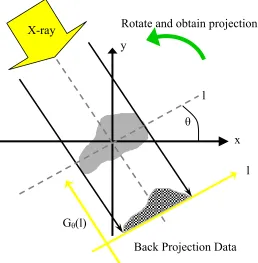
algorithm was used. Fig. I.3 shows the schematics of simple back projection. X ray is
projected to the object from a certain direction and an intensity profile is recorded at the
other side. The l-axis denotes width of beam or detector pixel position. Gθ(l) denotes
intensity profile or back projection data. This Gθ(l) can be mathematically expressed as
equation below;
∫∫ + −
= f x y x y R dxdy
l
Gθ() ( , )δ( cosθ sinθ )
This equation says that line profile Gθ(l) at position l can be obtained by summing up the
mass attenuation effect by function f on the line R. Where R is any line parallel to the x ray
direction. By taking this data from 0 to 180 degrees, sinogram can be obtained. Simple back
projection has intrinsic artifact, called 1/r artifact. Therefore, removal of this artifact is
important. To perform this, Shepp Logan filter was used for this research. The
) 1 4 ( 8 ) ( , 0 2 , 4 sin ) ( 2 2 − − = < = k B k h otherwise B B H SL SL π π ω ω ω ω
HSL denotes Frequency domain and hSL donates mathematical form in the spatial domain.
Lam Rak filter has mathematical form of HLR=|ω|. Lam Rak is a high pass filter and causes
oscillations in the frequency domain. This causes ringing artifacts in an image. Please note
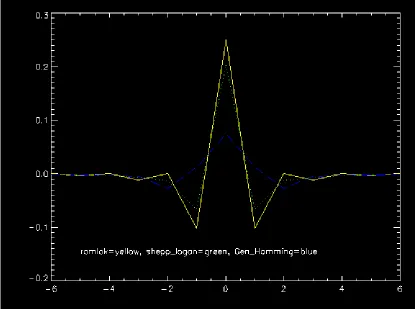
the difference between, HSL and HLR. Fig I.4 and Fig I.5 shows plots of these filters and of
Gen Hamming window. The mitigation of oscillation in spatial domain with Shepp Logan
and Gen Hamming windows can be seen.
Interactive Data Language (IDL) software was used to perform all of the image
analysis, CT reconstructions and graphic visualization. IDL version 5.5 is a specialized
fourth-generation language providing a framework that includes functions and tools for
scientific computing and visualization. Transforms such as Riemann sum or Radon
transform, as well as digital filtering are performed easily using IDL. Practical IDL
programming [I.1] and IDL Programming Techniques [I.2] are good books to understand
basic procedure to write IDL codes. The IDL code that was used to prepare sinograms and
reconstruct tomographic images from the raw data files is attached in Appendix. The basic
summaries of what the code does are given below. There are three types of raw data for
each set of images; background, air and actual projections. Twentysets of background and
air images were averaged and used to produce the normalizing image for calculating the
actual image that is free of beam non-uniformities and air scattering. Here, the normal
image was subtracted from the detector image of the object, and then divided pixel by pixel
by this normalizing image. These were stored as raw tomography images. The detector
had a pixel size of 50 µm and there are 2048 pixels along each row. Since this data set was
too large for data analysis, the image size is reduced by factor of four using the Expand
command of IDL. The expand procedure shrinks or expands a two-dimensional array using
bilinear interpolation. Therefore, there were a total of 512 pixels and each pixel
corresponded to 200 µm. The raw tomography projections were transformed to sinogram
using Sinogram.pro procedure, which was written by Mark Rivers [I.3]. This procedure
mainly does the following. Please note that this procedure was skipped for generating the
refraction image of option 1. First, it averages the air values on the left and right hand sides
of the input. These averaged values were used to adjust horizontal intensity distribution of
the beam. The beam intensity is adjusted linearly. Second, it takes the logarithm of
input/air ratio; the output = - log(input/air). Please note that air images correspond to initial
intensity of the x rays and the input corresponds to actual images, which contains
information about the object. Therefore, the output corresponds to line integral of the
object. Finally, it calculates the center of gravity of the image and shifts the actual image
center to match the center of image by using the center of gravity. The center of gravity of
image at each row was calculated by the equation below.
∑
∑
= = × = m j m j j i I j j i I i COG 0 0 ) , ( ) , ( )Here, COG is center of gravity, I(i, j) is the intensity of the pixel (i,j), (m,n) is dimension
of sinogram; n corresponds to rotation angle and m corresponds to image width. Therefore,
the value of n should be 179 or 359 generally.
The numerator is the moment of each row of the image and the denominator is the
sum of intensity of at each rotation angle, i. The COG of image draws a sine curve. By
taking the average of the max and minimum value of COG, the actual rotation axis is
estimated. To fit this sinusoidal curve, and estimate the center of gravity of image, the
Curve-fit procedure is used. The shifting of raw images to match with the center was done
using a routine called Poly_2D which can shift the image by fractional pixels. Since DEI is
a phase contrast method and enhances the edge contrast, the Shepp Logan filter was chosen
as the digital filter. The raw sinogram was filtered with Shepp Logan filter by calling
tomo_filter.pro procedure. This procedure contains a choice of three major types of high
pass filters; Ram-Lak, Shepp Logan and Gen Hamming window. From this filtered
sinogram, tomography images were reconstructed by using Riemann sum routine, which is
one of the back projection methods of IDL. What the Riemann sum routine does is to
smear the 180 sets of back projections from each angle. Therefore, the manipulation of
image with filters is important for removing halo artifacts or 1/r artifacts that arise from
simple back projection. For example, the Shepp Logan filter enhances high frequency
information while reducing low frequency information in Fourier domain. Please note that
high frequency corresponding to sharp transition of image or edge and low frequency
correspond to smoother transitions in image. This characteristic of the Shepp Logan filter is
clear from Fig. R.1.13 and Fig. R.1.14 which are line profiles of an image with and without
5. Results and Discussion
In this Chapter, we start with the results of a 2-D reconstruction of DEI images and then
proceed to present the results of the three-dimensional visualization of images that were
generated from the 2-D slices. All of the results used projection data for Lucite phantoms B
and C.
5.1 Two-dimensional Slice Reconstruction Using Option 3:
Figure R.1.1to R.1.6 demonstrates how images are reconstructed from raw data. Figure
R.1 shows a slice of the raw projection data which was detected by the digital detector.
Several scratches can be seen everywhere in the projection. These detector artifacts were
removed by dividing the raw image by the normal image. This raw projection data covered
a height of 2.5 mm or 50 pixels. The middle row of pixels from this slice was chosen from
the raw projection data slice for each angle of rotation of the object. Figure R.1.2 shows
raw tomography data of Lucite B at lower side of rocking curve. All images discussed
below were obtained at the lower side of rocking curve, unless mentioned otherwise. Here,
each row of arrays stands for a projection angle (0 degree to 360 degree from top to
bottom) or y-direction and column of arrays stands for intensity or x-direction. In this
figure, the Lucite phantom shows strong refraction signals due to the sharp gradient of the
refractive index between Lucite and air. The stripes in the y-direction are because of beam
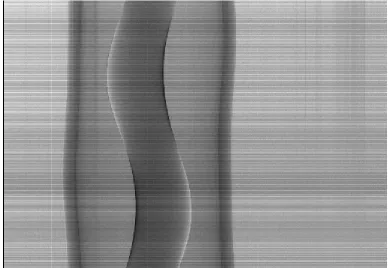
intensity fluctuations. Figure R.1.3 shows the sinogram of Lucite B, where the raw
tomography data is modified to a sinogram by calling the sinogram routine. Therefore, the
center of gravity of this image is matched to the middle of column array and “padding” can
adding some pixels on left side, whose values are same as the very left pixel in the original
image and some pixels in the image were trimmed, since the image was shifted to right.
Also, logarithm of raw tomography data is taken to change the value to correspond to mass
attenuation coefficient. The vertical line which shows up on the left side of the phantom is
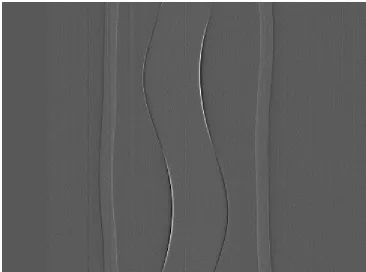
a detector artifact. Figure R.1.4 shows the sinogram of Lucite B with Shepp Logan filter,
which enhances the clarity of the edges. Kernel sizes of 10, 15, 30, and 40 were tried and
the kernel size of 30 was chosen subjectively based on the observed image quality. A
kernel size of 30 is recommended for conventional usage for back projection.
Figure R.1.5 shows reconstructed image with the Shepp Logan filter. The center of
rotation is automatically calculated by the sinogram procedure, but the image shows that it
is a little off from the true center of image. This is because of noise in images and
asymmetry of the DEI signal. This asymmetry is discussed later. Figure R.1.6 shows
reconstructed image without filters. This image shows that simple back projection causes
blurring. Comparison of Figures R.1.5 and R.1.6 is interesting for understanding the effects
of Shepp Logan filter. At the corners of Figure R.1.5, ray artifacts show up, but this can
not be seen in Figure R.1.6. In the very center of Figure R.1.5, a small circle or dot can be
seen because of a detector artifact. Also, a semicircular arch can be seen right below the
Lucite image. These artifacts are not seen in Figure R.1.6. Thus, Shepp Logan filter does
enhance edges in the image, but exaggerates noise at the same time. It should be noted that
filter choice is usually a subjective factor and might cause loss of critically important
information.
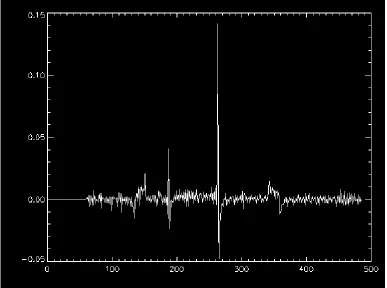
Figure R.1.7 to R.1.14 shows line profiles of raw tomography data, sinograms and
signals. Figure R.1.7 shows a line profile of raw tomography data at y = 169, where DEI
signals disappear. Please note that y-direction is the angle of rotation for sinograms. DEI
signal occurs due to differences of refractive index in the z-direction which is normal to the
x-y plane or the reconstructed image. Figure R.1.8 shows a line profile of the sinogram at
the same point. The center of column and the center of rotation are matched. Due to this
manipulation, the image is shifted to the right and some pixels are padded in the left side of
image. Theoretically, the embedded cylindrical Lucite rod should have an elliptical shape
for its back projection. So this results matches with theoretical back projection profile fairly
well. Figure R.1.9 shows a line profile of sinogram at the same point with Shepp Logan
filter. Noise is exaggerated as previously discussed. The negative signals detected here is
because of Shepp Logan filtering and not because of the refraction signal. Figure R.1.10
shows a line profile of raw tomography data at y = 255, where the refraction signal appears
to be the strongest. Figure R.1.11 shows a line profile of the sinogram at the same point.
The absolute values of intensity of the refraction signal at both of left and right side should
be the same theoretically. However, asymmetries of signals are detected and cause the
center of rotation to be slightly different from the center of image. Figure R.1.12 shows a
line profile of sinogram at the same point with Shepp Logan filter. The strong signal due to
refraction is observed. However, the asymmetry of DEI signals is exaggerated as well.
Figure R.1.13 shows a line profile of the reconstructed image with Shepp Logan filter. This
result shows the effectiveness of this filter for this phantom in that all signal intensities
from Lucite are fairly flat. The maximum noise of back ground is about 0.3 and the
maximum DEI signal is about 3.9. Therefore, SNR is 13 in this case. Figure R.1.14 shows
obvious when compared with Figure R.1.13. Since Figure R.1.14 is from simple back
projection, 1/r artifact can be seen.
Figure R.1.15 to R.1.21 shows the results obtained at the high side of the rocking
curve. Figure R.1.15 shows the raw tomography data and Figure R.1.16 shows the
normalized data. As discussed previously, the raw tomography data wasdivided bythe
normal data and converted to a sinogram after taking logarithm. Figure R.1.17 and Figure
R.1.18 show the sinograms of Lucite B at higher side of rocking curve without filtering and
with filter, respectively. One of the most significant differences between images of the
lower and higher side of rocking curve is that the dark and bright parts are flipped. This is
because the rocking curve has different gradients at lower side and higher side. Therefore,
the same amount of refraction at each side causes opposite DEI signals.
Figure R.1.19 shows the reconstructed image. The dark and bright parts in the
image are different from the result for the lower side of rocking curve (Fig R.1.5). It should
be noted that the mismatch of center in this image is small compared with that of Fig R.1.5.
The line artifact which showed up at the edge of the embedded Lucite is smaller. Figure
R.1.20 and R.1.21 show line profiles of raw tomography data and the sinogram respectively.
The DEI signal is fairly symmetric. This causes the difference in the images of Fig R.1.19
and Fig R.1.5. The center of rotation is estimated by calculating intensity times position at
each row or angle of sinogram. Since the total mass attenuation by the Lucite is the same,
total intensity of each column of sinogram should be same. However, the center of gravity
moves as a sinusoidal curve because of the non-axial rotation of the phantom. It should be
noted that refraction signalcannot be used to estimate the center of image by this method,
is symmetric, the sum of DEI signal at each row is equal to zero. Therefore, the center of
rotation can be estimated by the same method as with conventional tomography data.
For the option 3 method of separating the apparent absorption image and the
refraction images, we add and subtract the CT images of the higher and lower sides of the
rocking curve respectively. We conjecture that the addition provides the absorption image
as specified by the theory of DEI presented in Section 2.3 and that the subtraction will give
the refraction image. The resulting absorption and refraction image for phantom B is shown
in Fig.1.22 and Fig. 1.23. Line scans through absorption and refraction at the location
indicated are shown in Fig.1.24 and Fig.1.25 respectively. Note that a line scan through
this image at the location of x=250 shows that the absorption signals from Lucite
attenuation is fairly flat. It is interesting to note that there is a small amount of refraction
effect evident in the absorption image. This is most probably coming from a slight drift in
the rocking curve during projection data acquisition which causes the higher and lower side
image angles to be slightly asymmetric with respect to the center of the rocking curve.
Since the angular settings are less than only one microradian above and below the center,
even a very minute drift will cause asymmetry and negate the assumptions made in the
theory regarding the reflectivity values of the analyzer crystal. Refraction image was
obtained by subtracting the higher side CT image from the lower side CT image. The
refraction image looks very clean and the line scan through the Lucite rod shows essentially
only the refraction signals at the boundaries.
To compare option 3 with option 1, the apparent absorption and refraction images of
phantom B using option 1 are shown in Fig. R.1.26 and Fig. R.1.27 respectively. Line
option 1 will be discussed in the following section. The biggest differences between option
1 and option 3 is that the refraction signal with option 3 reconstruction shows much larger
values than that of option 1. This is because we are taking logarithm for refraction image
with option 3. This fact shows that less absorption and highly refractive images are
vulnerable to error with the option 3 method.
In summary, option 3 appears to give clean CT images of apparent absorption and
refraction that show the expected results. But one might wonder why subtraction of the CT
images from the high and low sides of the rocking curve which were generated assuming
that the signals are comprised purely of exponential attenuation should produce such good
results for the refraction image; after all, the refraction signals do not follow any
exponential law. The reason appears to be the fact that on both sides of the rocking curve,
for this particular phantom, the signals are comprised almost through the whole phantom by
exponential attenuation and the refraction signals are localized just at the boundaries of the
embedded rod inside the phantom.
To verify this hypothesis, we simulated the projection data for a Lucite cylinder of
the same dimensions as the phantom, assuming just exponential attenuation (no refraction
effects). Fig. R.1.30 shows the comparison of line scans through the same projection for the
simulation and for the higher side data of the water-filled phantom B. The amplitude was
scaled to match the two sets of data. Note that the overall shape of the real image agrees
very closely with the simulation which ignored refraction effects. The minor differences
observed are likely due to the differences in attenuation coefficient between water and
Lucite and the refraction signals present in the real image. Also, the simulated image is free
dominated by exponential attenuation. This is also the case for the lower side data.
Therefore CT reconstruction of the higher and lower side data after logarithmic
transformation is valid and the subtraction ought to provide a good image of the refraction
signals.
5.2 Two-Dimensional Slice Reconstruction Using Option 1:
It is important to recognize that the validity of Option 3 is demonstrated above only for a
simple phantom. In a complex biological sample with a very high degree of heterogeneities
where refraction might be present throughout the specimen, Option 3 might not be a valid
method. Option 1 appears to have a better theoretical basis than Option 3. In this method,
the separation of the two components by the addition/subtraction procedure is performed on
the projection data (raw tomography data) and not on the CT images of the higher and
lower sides. The absorption component projections are reconstructed as in conventional CT
after logarithmic transformation, but the refraction projections are reconstructed by filtered
back projection without taking logarithms.
Figures R.2.1through R.2.8 demonstrate how images are reconstructed from raw
data with using option 1. First of all, raw tomography data of lower side and higher side
are added/subtracted to obtain raw tomography absorption and refraction data. Absorption
and refraction raw tomography data are shown in Fig. R.2.1 and Fig. R.2.2, respectively.
The apparent absorption image looks like one cylindrical object. The inside rod Lucite can
not be seen. Please note that digital addition is a mean filter and subtraction is a high pass
filter. Therefore this mathematical procedure imposes filtering to raw tomography data or
sine curves can be seen. This caused artifacts in refraction reconstructed image, which will
be shown in the later of this section. These raw tomography data were converted to
sinograms. Absorption and refraction sinograms are shown in Fig R.2.3 and Fig R.2.4,
respectively. For the absorption image the conventional method which described in
previous section was used. Therefore, the absorption image was converted to sinogram, or
mass attenuation component. It is performed for the refraction image to shift the refraction
image to match the center of the image and the rotation axis. Please note that logarithm
was not taken for the refraction image. These absorption and refraction images were filtered
using Shepp Logan filter and shown in Fig R.2.5 and R.2.6 respectively. In Fig R.2.5, two
vertical lines can be seen. These are boundary of the digital detector. In Fig R.2.6, square
shape can be seen on the left side of image. This part showed up because of patting due to
shifting the image to the right. This padding caused a big circle-like artifact in the
reconstructed image, which will be shown later. Figure R.2.7 and R.2.8 shows
reconstructed apparent absorption and refraction images respectively. Figure R.2.9 and
R.2.10 shows line profiles at x=250 of those. In Fig. R.2.7, refraction signal still can be
seen, but the image has high quality. In Fig. R.2.8, you can see artifacts outside of the
Lucite. However, outside Lucite is not our concern. Fig. R.2.9 shows slopes outside lucite.
This is intrinsic artifact caused by Shepp Logan filter. The boundary between cylindrical
Lucite and outside air is clear. Fig. R.2.10 shows four big peaks. Two of those outside are
signal from boundary between air and Lucite. These signals are strongest due to the large
refractive index difference between air and Lucite. The two inside signals are signals from
the boundary between water and the inner Lucite rod. Other small signals are those from
A lot of time was spent using option 2 reconstruction method through this research.
However, we found that it produced unexplainable artifacts. Option 3 produces good
images. Through even further in-depth investigation about reconstruction methods, it was
found that option one gave the best result.
5.3 Three-dimensional reconstruction of Phantom C:
In this section, three-dimensional reconstruction of apparent absorption images and
refraction images from the transverse multiple slice data which were acquired on the
second phantom (phantom C shown in Fig. E.5) with the oblique air holes will be presented.
First, two-dimensional images or CT slices of absorption and refraction images obtained
using option 1 are shown. These CT images were then stacked up to compose a
three-dimensional image. The final result had the dimension of (x,y,z)=(487,487,40). Here, the
x and y values denote the transverse image size in pixels and the z-value denotes the height
of image in pixels. Note that the height covers only 2 mm (40 pixels) because of some
difficulties which were encountered with the stability of the synchrotron beam during the
second set of experiments at NSLS. The image is shrunk by factor of four in the x-y plane
using the expand command of IDL. Therefore one x- or y-pixel size corresponds to 200 µm.
In the vertical direction, there is no reduction of pixel size and one pixel corresponds to 50
µm. Using this array, transverse slices of absorption image and refraction image were
obtained. Line profiles of refraction image and absorption image were also obtained, where
line profile means one row or column of image plane(x-y plane). Finally, three-
dimensional voxel projection images of absorption and refraction images will be shown.
signal. However, the voxel projection images show some difficulties of DEI in producing
three-dimensional voxel projection.
Figures R.3.1 and R.3.2 show the CT reconstruction of radial refraction and
apparent absorption images, respectively. Let us label the holes in upper left, center and
lower right as 1, 2, and 3, respectively. The slices for absorption images were taken at the
same locations. Fig R.3.1 shows strong noise outside Lucite. This is caused by beam
intensity being not automatically adjusted for the refraction image. However, the region
outside of the Lucite is of no interest. Fig R.3.2 shows some contamination from refraction
signals within the absorption image. As with the previous results on phantom B, there
appear to be some contamination from refraction effects in the absorption image and vice
versa in the refraction image. This was likely caused by slight drift of the angular position
set on the rocking curve of the analyzer crystal while performing the data acquisition. Since
the angular settings are at only ± 0.8 µrad from the peak of the rocking curve, even a very
slight drift in the rocking curve during the data acquisition will negate the cleanliness of the
refraction and absorption images.
Figure R.3.3 and Figure R.3.4 show the transverse slices of the refraction image and
the apparent absorption image respectively. These images show that signals from the
gradients in the refractive index shows up correctly in the vertical cross section plane. The
reason for some gray scale difference in images is the differences in the refraction signal
strength in the images. For example, if an image has strong positive refraction signal, the
other pixels have relatively low values. Therefore, the image looked darker. (b.1) showed
the elliptical shape in the signal. This was caused by the fact that the slice was taken at near
asymmetry. This was caused by fact that the direction of hole and the transverse plane did
not go in the same direction. In Fig R.3.4, clear surfaces between channels and Lucite can
be seen, although these images include partial contamination from the refraction signal.
From (b.1) to (b.4), the signals from refraction are seen. However, these images showed a
clear edge, since apparent absorption image excludes scattering. Specifically, please note
that the holes and backgrounds have similar gray scale levels in each image.
For further discussion of image qualities, the line profiles of refraction image and
apparent absorption image are shown in Figure R.3.5 and Figure R.3.6 respectively. The
x-axis and y-x-axis in these figures represent pixel number from the left side of an image and
relative intensity. The signals from refractive index can be seen in Fig. R.3.5. The reason
why the edge of Lucite can be seen clearly is that the noise level dramatically increased
outside the Lucite. Please note that this profile is free from the absorption component.
However, Fig R.3.6 shows contamination from refraction signals and slight slope outside
Lucite. However, clear edge between Lucite and the outside air can be seen and channel 2
showed up clearly. This channel has almost identical value with outside air as expected.
Using the 2-D slices, three-dimensional voxel projection of refraction and apparent
absorption images were attempted . The results are shown in Figure R.3.7 and Figure R.3.8
respectively. Voxel projection assigns opacity according to intensity of each voxel. Figure
R.3.7 (a) shows the surfaces of channels since these signals include information on the
gradient of the refractive index. The non-uniformities within the holes are likely caused by
the roughness developed during machining of the holes. The reason that dark regions exist
which the difference of refractive index disappear in z-direction. Signals from refraction
reverse at this point from positive to negative or vice versa.
Fig R.3.8 shows the 3-D apparent absorption image. To obtain this image, the
procedures described below were performed. Since 3-D imaging here is just a procedure
for visualization, empirical adjustments as below could be made in order to make the
images visually acceptable. First, values outside of the Lucite were changed to zero and one
was added to this region. The median of Lucite intensity was calculated andthis value was
divided by two. This value was multiplied by the values outside the Lucite. According to
these processes, outside Lucite has a unique constant equal to the median of Lucite value
divided by two. The high opacity values were assigned to channels. Lucite was assigned
small opacity. The opacity for Lucite was set to one tenth of those of channels. The result