Associate Professor
Dept. of Electrical and Electronic Engineering
University of Dhaka
Dr.
Mohammad
J
unaebur
R
ashid (
JR
)
1
ICT3207: Cellular and Mobile Communication (3.0 Cr)
Course Teacher
Bangladesh University of Professionals
Lecture 18
ICT3207: CMCMultiple access schemes
• GSM time-slot (normal burst)
-Tail are all set to 0 and can be used to enhance the receiver performance.
-The training sequence is used to adapt the parameters and select the strongest signal. -A flag S indicates whether the data field contains user or network control data.
• GSM bursts
-A normal burst for data transmission
-A frequency correction burst allows the MS to correct the local oscillator to avoid
interference
-A synchronization burst with an extended training sequence synchronizes the MS with BTS
in time.
-An access burst is used for the initial connection setup.
3
Lecture 18
ICT3207: CMCLecture 18
ICT3207: CMC5
Lecture 18
ICT3207: CMCChannel coding
• Channel coding improves transmission quality when interference, multipath fading, and
Doppler shift are encountered.
• As a result, the bit error rate and frame error rate or word error rate are reduced, but
throughput is also reduced. Four kinds of channel codings are used in GSM:
• Convolutional codes (L, k) are used to correct random errors: k is the input block bits, and
L is the output block bits.
• Convolutional codes have three different rates in GSM: (1) the one-half rate (L/k = 2), (2)
the one-third rate (L/k = 3), and (3) the one-sixth rate (L/k = 6).
• Fire codes (L, k) are used as a block code to detect and correct a single burst of errors,
where k is the information bits and L is the coded bits.
• Parity check codes (L, k) are used for error detection. L is the bits of a block, k is the
Lecture 18
ICT3207: CMCChannel coding
• Concatenation codes use Convolutional code as an inner code and fire code as an outer
code. Both the inner code and the outer code reduce the probability of error and correct most of the channel code. The advantage of using concatenation code is a reduction of the
implementation complexity as compared with a single coding operation.
• GSM's speech code is sent at a rate of 13 kbps, which represents 260 bits in each 20-ms
speech block. After channel coding, each block contains 456 bits and the transmission rate is
22.8 kbps, or 114 bits for time slots.
• Adding the overhead bits such
as tail bits (6), training bits (26), flag bits (2), and guard time bits
(8.25), the total bits of a traffic channel is 156 bits in one time
7
Lecture 18
ICT3207: CMCInterleaving
• Interleaving scrambles and/or spreads a sequence of bits prior to transmitting them. The
sequence of bits is put back in order at the receiving end. Bursts of errors occur during transmission because of signal fading.
• After being received, these bursts of errors are then converted to random errors and put
back in the correct sequence. Interleaving’s major drawback is the corresponding delay at the
receiving end.
• Interleaving schemes are relatively simple in GSM. A code word of 456 bits could be
spread into the following format:
1. Four full bursts—divide 456 bits into 4 parts, each one filling up a whole burst. This interleaving format takes 4.615 ms × 4 = 18.46 ms.
2. Eight half bursts—divide 456 bits into 8 parts, each one filling up half a burst. This
Lecture 18
ICT3207: CMCRadio resource (RR) management
• In a mobile network, radio channels must allocate for call setup, handover and release, on a
call bias.
• There are three management functions; location, handover, and roaming. The
implementation of the RR functions require some kind of protocol between the mobile station and the network.
Link protocol
• In addition to the user's information, the signaling transfer information exchanges must be
sent and understood by every piece of signaling transport equipment.
• Most information exchange functions are distributed to different kinds of equipment. There
are three link protocols to provide information exchanges.
-Radio link protocol (RLP), specified in GSM link access protocol over the radio link called
LAPDm.
9
Lecture 18
ICT3207: CMCRadio resource (RR) management
Interface associated with link protocols
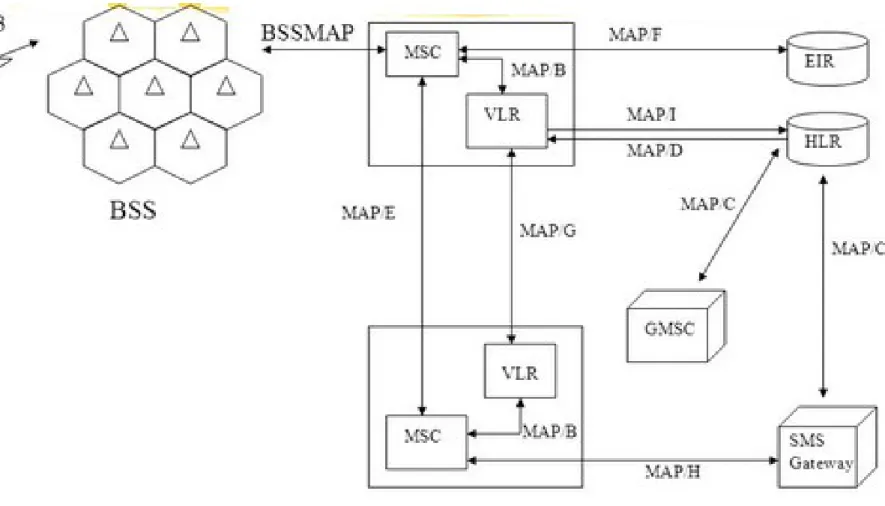
• Non-call-related signals correspond to protocols in the MSC that are different from those in
other MSCs or other HLRs and are grouped together in the Mobile Application Part (MAP).
We can distinguish them by MAP/X, where X can be B, C, D, and so forth. MAP/B Protocol between BSC and relay MSC
MAP/C Protocol between GMSC and an HLR
MAP/B Protocol between another MSC/VLR and HLR
Lecture 18
ICT3207: CMCRadio resource (RR) management
11
Lecture 18
ICT3207: CMCMobility management (MM)
• The mobility of cellular system users requires mobility management for location updates,
handovers, and roaming.
• A handover occurs when a voice channel changes as the mobile station enters another cell
during a call.
• Roaming is the ability to initiate a call in one network system and deliver it to another
network system by using MM and location update management.
Location update management
• Cellular networks are spreading rapidly, leading to overloaded systems, unacceptable
delays, and increasing computational costs due to inefficient Location Management.
• Users can move one cell to another cell, updating their location with the network based
12
Lecture 18
ICT3207: CMCMobility management (MM)
• When a user receives a call, the network must page cells within the cells (also referred to as
polling) to find that user as quickly as possible. This creates the dynamics behind much of
Location Management.
• The network can require more frequent Location Updates (LUs), in order to reduce polling
costs, but only by incurring increased time and energy expenditures from all the updates.
• Conversely, the network could only require rare LUs, storing less information about users
to reduce computational overhead, but at a higher polling cost.
• Additionally, cell sites themselves can be optimized in order to create regions that require
less handoff and quicker locating of users.
13
Lecture 18
ICT3207: CMCMobility management (MM)
Cell selection
• Choosing the best cell by a MS depends on three factors:
(1) the level of the signal received by the MS,
(2) the maximum transmission power of the mobile station, and
(3) two parameters p1 and p2 specified by the cell. This is called the C1 criterion
C1 = A - max (B, O)
A = received level average – p1
B = p2 - maximum RF power of the MS p1 = a value between -110 and -48 dBm
p2 = a value between 13 and 43 dBm
• Both values of p1 and p2 are broadcast
from the cells.
MS maximum power = 29 to 43 dBm
• The cell selection algorithm is as follows:
- A SIM must be inserted.
- The strongest C1 is chosen by obtaining C1 from candidate cells; the C1 has to be higher
than 0.
Lecture 18
ICT3207: CMCMobility management (MM)
Authentication
Authentication protects the network against unauthorized access.
- First Phase: A PIN (personal identification number) code protects the SIM. The PIN is
checked by the SIM locally, so the SIM is not sent out over the radio link. - Second phase: The GSM network
makes an inquiry by sending a random
number (RAND). The 128-bit RAND
is sent from the network to the MS, and mixes with the MS's secret
parameter, Ki, in an A3 processing
algorithm, which produces a
15
Lecture 18
ICT3207: CMCMobility management (MM)
-Encryption: Encryption protects against unauthorized listening. The MS uses the RAND
received from the network and mixes Ki through a different algorithm, called A8, and
generates Kc (64 bits). The ciphering sequences are generated from the Kc (Fig. 15.12). The
frame number and Kc move to a ciphering algorithm, A5, and generate S2 (114 bits), which
Lecture 18
ICT3207: CMCMobility management (MM)
• SIM (MS side) and AUC (network side) are the repositories of the subscriber's key Ki.
• Key Ki never transmits over the air.
• Both sides perform A3 and A8 computations.
User identity protection - security management
Assignments
1. Link budget analysis in mobile communication system
2. Analysis of cell planning and link budgeting in WiMAX
3. Coverage area and power budget calculation in GSM 4. Indoor planning of a cellular network