Volume 2007, Article ID 94068,11pages doi:10.1155/2007/94068
Research Article
Unvoiced Speech Recognition Using Tissue-Conductive
Acoustic Sensor
Panikos Heracleous,1, 2Tomomi Kaino,1Hiroshi Saruwatari,1and Kiyohiro Shikano1
1Graduate School of Information Science, Nara Institute of Science and Technology, 8916-5 Takayama-cho, Ikoma-shi, Nara 630-0192, Japan
2Department of Computer Science, University of Cyprus, 75 Kallipoleos Street, P.O. Box 537, 1678 Nicosia, Cyprus
Received 22 September 2005; Revised 6 January 2006; Accepted 30 January 2006
Recommended by Matti Karjalainen
We present the use of stethoscope and silicon NAM (nonaudible murmur) microphones in automatic speech recognition. NAM microphones are special acoustic sensors, which are attached behind the talker’s ear and can capture not only normal (audible) speech, but also very quietly uttered speech (nonaudible murmur). As a result, NAM microphones can be applied in automatic speech recognition systems when privacy is desired in human-machine communication. Moreover, NAM microphones show ro-bustness against noise and they might be used in special systems (speech recognition, speech transform, etc.) for sound-impaired people. Using adaptation techniques and a small amount of training data, we achieved for a 20 k dictation task a 93.9% word accu-racy for nonaudible murmur recognition in a clean environment. In this paper, we also investigate nonaudible murmur recognition
in noisy environments and the effect of the Lombard reflex on nonaudible murmur recognition. We also propose three methods to
integrate audible speech and nonaudible murmur recognition using a stethoscope NAM microphone with very promising results.
Copyright © 2007 Panikos Heracleous et al. This is an open access article distributed under the Creative Commons Attribution License, which permits unrestricted use, distribution, and reproduction in any medium, provided the original work is properly cited.
1. INTRODUCTION
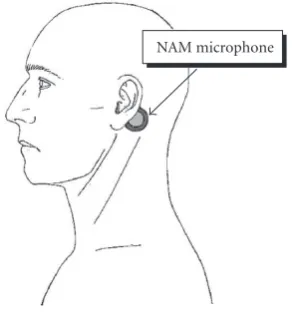
The NAM microphone [1] belongs to the acoustic sensor paradigm, in which speech is conducted not through the air, but within body tissues, bone, or the ear canal. The NAM microphone is attached behind the talker’s ear and speech is captured through body tissue.Figure 1shows the attachment of a NAM microphone to the talker.
The bone-conductive microphone used in [2, 3], the throat microphone used in [4], and the ear-plug used in [5] are acoustic sensors similar to NAM microphones. Basically, in those studies a nonconventional acoustic sensor combined with a standard microphone was used to increase the robust-ness against noise. In [6] a prototype stethoscope NAM mi-crophone and a throat mimi-crophone were used for soft whis-per recognition in a clean environment.
NAM microphones are special acoustic sensors, which can capture not only normal (audible) speech, but also very quietly uttered speech (nonaudible murmur). As a re-sult, NAM microphones can be applied in automatic speech recognition systems when privacy is desired in human-machine communication. Moreover, since a NAM
micro-phone receives the speech signal directly from the body, it shows robustness against the environmental noises. In addition, it might be also used in special systems (speech recognition, speech transform, etc.) for sound-impaired peo-ple.
The stethoscope microphone is based on stethoscopes used by medical doctors to examine the patients. In a very similar device, a microphone is used covered by a membrane. On the other hand, the silicon microphone uses a micro-phone wrapped by silicon. The idea to use silicon is based on the fact that silicon has similar impedance to that of human flesh.
NAM microphone
Figure1: NAM microphone attached to the talker.
models [8] and stethoscope and silicon NAM microphones. However, instead of EM training procedure we applied speaker-adaptation techniques, which require significantly less amount of training data [9–11]. The achieved results are very promising and show the effectiveness of applying adap-tation methods for nonaudible murmur recognition. Using a small amount of training data, we achieved for a 20 k dic-tation task a 93.9% word accuracy for nonaudible murmur recognition in a clean environment. Following the previous works, in [12] they also conducted experiments using a sil-icon NAM microphone and applying adaptation techniques with similar results. In addition to the experiments in a clean environment, we also carried out experiments using clean models and noisy test data [13].
To make a nonaudible murmur-based speech recognition system more flexible, we conducted experiments for audible speech and nonaudible murmur recognition using a stetho-scope NAM microphone. The achieved results show the ef-fectiveness of a NAM microphone in an integrated normal-speech and nonaudible-murmur recognition system [14].
In this paper, we also investigate the NAM microphone robustness against noise using simulated and real noisy data. We also conducted experiments using Lombard nonaudi-ble murmur data, showing that the Lombard reflex affects nonaudible murmur recognition markedly.
2. NONAUDIBLE MURMUR CHARACTERISTICS
Nonaudible murmur and audible speech captured by a NAM microphone have different characteristics compared with air-conducted speech. Similarly to whisper speech, nonaudible murmur is unvoiced speech produced by vocal cords not vi-brating and does not incorporate any fundamental (F0) fre-quency. Moreover, body tissue and loss of lip radiation act as a low-pass filter and the high-frequency components are at-tenuated. However, the nonaudible murmur spectral compo-nents still provide sufficient information to distinguish and recognize sounds accurately.
hms 0.4 0.8 1.2 1.6 2 2.4 2.8 3.2 hms 2 4 6
×103
(Hz)
Figure2: Spectrogram of an audible Japanese utterance captured by a NAM microphone.
hms 0.4 0.8 1.2 1.6 2 2.4 2.8 3.2 hms 2 4 6
×103
(Hz)
Figure3: Spectrogram of an audible Japanese utterance captured by a close-talking microphone.
Figure 2shows the spectrogram of an audible Japanese utterance captured by a stethoscope NAM microphone andFigure 3shows the spectrogram of the same utterance captured by a close-talking microphone. Both figures show that the utterance captured by a NAM microphone is of lim-ited frequency band, namely, it contains frequency compo-nents up to 3–4 kHz.
Due to these differences, normal-speech hidden Markov models (HMMs) cannot be used for recognition of speech captured by a NAM microphone. To realize nonaudible murmur recognition, new HMMs have to be trained using nonaudible murmur database.
3. NONAUDIBLE MURMUR AUTOMATIC RECOGNITION
In this section, we present experimental results for speaker-dependent nonaudible murmur recognition using NAM mi-crophones. The recognition engine used was the Julius 20 k vocabulary Japanese dictation toolkit [15]. The recognition task was large vocabulary continuous speech recognition. A trigram language model trained with newspaper articles was used. The perplexity of the test set was 87.1. The ini-tial models were speaker-independent, gender-independent, 3000-state phonetic PTM HMMs, trained with the JNAS database [16] and the feature vectors were of length 25 (12 MFCC (mel-frequency cepstral coefficients), 12ΔMFCC,Δ E).Table 1shows the system specifications.
Table1: System specifications.
Sampling frequency 16 kHz
Frame length 25 ms
Frame period 10 ms
Pre-emphasis 1−0.97z−1
Feature vectors
12-order MFCC,
12-orderΔMFCCs
1-orderΔE
HMM PTM, 3000 states
Training data JNAS/nonaudible murmur
Test data nonaudible murmur
are used as priors in MAP adaptation. In this way, during MLLR the acoustic space is shifted and the MAP adaptation performs more accurate transformations. Moreover, due to the use of a regression tree in MLLR, parameters which do not appear in the training data, and therefore are not trans-formed during MAP, are transtrans-formed initially during MLLR. Due to the large difference between the training data and the initial models, single-iteration adaptation is not eff ec-tive in nonaudible murmur recognition. Instead, a multi-iteration adaptation scheme was used. The initial models are adapted using the training data and the intermediate adapted models were trained. The intermediate models were used as initial models and were re-adapted using the same train-ing data. This procedure was continued until no further im-provement was obtained. Results show, that after 5–6 itera-tions significant improvement was achieved compared with the single-iteration adaptation. This training procedure is similar to that proposed by Woodland et al. [19], but the ob-ject is different.
3.1. Experiments using clean and simulated noisy test data
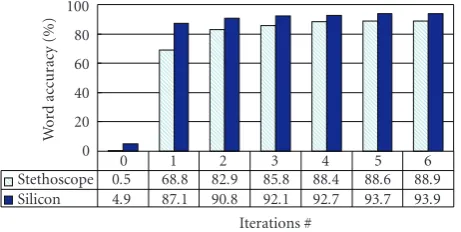
In this experiment, both training and test data were recorded in a clean environment by a male speaker using NAM mi-crophones. For training 350 and for testing 48 nonaudible murmur utterances of a male speaker were used. Figure 4
shows the achieved results. As the figure shows, the results are very promising. Using a small amount of data and adaptation techniques, we achieved high word accuracies. More specif-ically, using a stethoscope microphone we achieved an 88.9% word accuracy and using a silicon NAM microphone we achieved a 93.9% word accuracy for nonaudible mur-mur recognition. The results also show the effect of the multi-iteration adaptation scheme. As can be seen, with in-creasing number of adaptation iterations, the word accuracy was markedly increased.
We also conducted an experiment using simulated noisy data. In this experiment, the same clean 350 utterances were used for adaptation. For testing, 48 noisy nonaudible murmur utterances were used. Noise recorded in an office was played back at 50 dBA (decibels adjusted), 60 dBA, and
Silicon 4.9 87.1 90.8 92.1 92.7 93.7 93.9 Stethoscope 0.5 68.8 82.9 85.8 88.4 88.6 88.9
0 1 2 3 4 5 6
Iterations # 0
20 40 60 80 100
W
o
rd
ac
cur
acy
(%)
Figure4: Nonaudible murmur recognition in a clean environment.
Silicon 93.9 92.6 90.3 76.1 Stethoscope 88.9 86.9 85.6 66.9
35 50 60 70
Noise level (dBA) 0
20 40 60 80 100
W
o
rd
ac
cur
acy
(%)
Figure5: Nonaudible murmur recognition in noisy environments (superimposed noisy data).
70 dBA levels and was recorded using NAM microphones. The recorded noises were superimposed onto the clean data to create the noisy test data.
Figure 5shows the obtained results. As can be seen, for the 50 dBA and 60 dBA noise levels the performance was almost equal to that of the clean case. When the noise level became 70 dBA, the performance decreased, however, still nonaudible murmur recognition with reasonable results was possible. Note, that no additional noise reduction ap-proaches were used, and that the HMMs were trained using clean data. Results show that stethoscope NAM microphone is less robust against noise, particularly at the 70 dBA noise level.
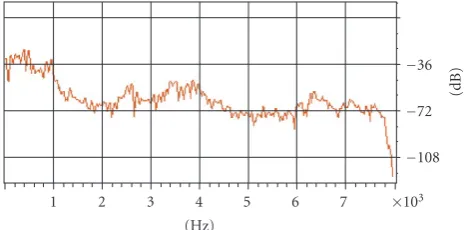
Figure 6shows the long-term spectrum of the noise used in our experiments. Noises captured by NAM microphones were superimposed onto the clean test data to simulate the noisy test data. Figure 7 shows the spectrum of the noise recorded using NAM microphones at 70 dBA level. The fig-ure shows the similarity in the spectra of the two cap-tured noises. Differences appear between 3 kHz and 5 kHz, where noise captured by the stethoscope microphone shows a higher spectral content. This might explain the significant decrease in word accuracy at 70 dBA when using the stetho-scope microphone.
3.2. Experiments using real noisy test data
1 2 3 4 5 6 7 ×10³ (Hz)
−108
−72
−36
(dB)
Figure6: Long-term power spectrum of office noise used in the experiments.
1 2 3 4 5 6 7 ×10³
(Hz)
−108
−72
−36
(dB)
Silicon
Stethoscope
Figure7: Long-term power spectrum of office noise at 70 dBA level captured by NAM microphones.
The noisy test data were recorded in an environment using a silicon NAM microphone, where different types of noise were playing back at 50 dBA and 60 dBA levels, while a female speaker was uttering the test data. Four types of noise were used (office, car, poster-presentation, and crowd). For each noise and each level 24 utterances were recorded. For adapta-tion 100 clean utterances were used. For comparison, we also created superimposed noisy data using the same clean test utterances and office noise captured using a silicon NAM mi-crophone. The speaker in this experiment was different than the speaker in the previous experiments.
Figure 8 shows the obtained results when using office noise in comparison with the case when the same noise was superimposed on the clean data. As can be seen, using real noisy test data, the performance decreases. Namely, at the 50 dBA noise level the obtained word accuracy was 68.4% and at the 60 dBA noise level 46.5%.
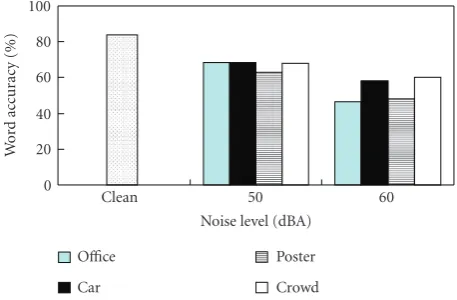
Figure 9shows the word accuracies for the four types of noise. The results are similar to the previous ones. With increasing noise level, word accuracy decreases significantly. For the clean case we achieved an 83.7% word accuracy, for the 50 dBA noise level a 66.9% word accuracy on average, and for the 60 dBA noise level a 53.3% word accuracy on average. In the case of car and crowd noises, the difference between the 50 dBA and 60 dBA performances is not very large. In the case of poster-presentation and office noises, the difference is larger.
Although the performance using real noisy data is not markedly low and nonaudible recognition is still possible,
Real Superimposed
Clean 50 60
Noise level (dBA) 0
20 40 60 80 100
W
o
rd
ac
cur
acy
(%)
83.7 82.9 68.4
80.9
46.5
Figure8: Nonaudible murmur recognition using noisy test data
(office noise).
Clean 50 60
Noise level (dBA) 0
20 40 60 80 100
W
o
rd
ac
cur
acy
(%)
Car Office
Crowd Poster
Figure9: Nonaudible murmur recognition using various types of noise.
further investigations are necessary. In several studies, a neg-ative impact effect of the Lombard reflex [20–24] on auto-matic recognizers for normal speech has been reported. It is possible, therefore, that the degradations in word accuracy for nonaudible murmur recognition when using real noisy data are also related to the Lombard reflex. To realize this, we also addressed the Lombard reflex problem.
4. THE ROLE OF THE LOMBARD REFLEX IN NONAUDIBLE MURMUR RECOGNITION
When speech is produced in noisy environments, speech pro-duction is modified leading to the Lombard reflex. Due to the reduced auditory feedback, the talker attempts to in-crease the intelligibility of his speech, and during this pro-cess several speech characteristics change. More specifically, speech intensity increases, fundamental frequency (F0) and formants shift, vowel durations increase and the spectral tilt changes. As a result of these modifications, the performance of a speech recognizer decreases due to the mismatch be-tween the training and testing conditions.
20 100 1 k 8 k Frequency (Hz)
−100
−84
−72
−60
−48
−36
−24
−120 12
M
ag
nitude
(dB) /O/ 75 dBA
SPL Lombard
/O/ clean
Figure10: Power spectrum of clean vowel /O/ and Lombard vowel /O/.
hms 0.04 0.08 0.12 0.16 0.20 0.24 hms smp 0 200
−200 0 smp
Figure 11: Waveform of clean vowel /O/ (upper) and Lombard vowel /O/.
while the speaker listens to noise through headphones or earphones. Though Lombard speech does not contain noise components, modifications in speech characteristics can be realized.
Figure 10shows the power spectrum of a normal-speech clean vowel /O/ and a Lombard vowel /O/ recorded while lis-tening to office noise through headphones at 75 dBA noise level. The figure clearly shows the modifications leading to the Lombard reflex; power increased, formants shifted, and spectral tilt changed.Figure 11shows the waveforms of the clean and Lombard /O/ vowels. As can be seen, the duration and amplitude of the Lombard vowel also increased. These differences in the spectra cause feature distortions (e.g., mel-frequency cepstral coefficients (MFCC) distortions), and acoustic models trained using clean speech might fail to cor-rectly match speech affected by the Lombard reflex.
Figure 12 shows the waveform, spectrogram, and FO contour of a Lombard nonaudible utterance recorded at 80 dBA using a silicon NAM microphone. The figure shows the effect of the Lombard reflex. Although the speaker at-tempts to speak in nonaudible murmur manner, due to the presence of noise his speech becomes voicing with vocal cords vibrating. As can be seen, this Lombard speech has characteristics similar to those of normal speech (e.g., pitch, formants, etc.) and differs from nonaudible murmur. There-fore, when nonaudible murmur recognition is performed in noisy environments, the produced nonaudible murmur characteristics are different than those of the nonaudible murmur used in the training. As a result, the performance is degraded, even though the NAM microphone can capture nonaudible murmur without a high sensitivity to environ-mental noise.
0.2 0.6 1 1.4 1.8 2.2 2.6 3 3.4 Time
7 5 3 1
kHz
32280
−27767
300 200 100
Hz
Figure12: Lombard nonaudible murmur recorded at 80 dBA.
Clean 50 60
Lombard speech noise level (dBA) 0
20 40 60 80
W
o
rd
ac
cur
acy
(%)
67.3
54.2
47.5
Figure13: Nonaudible murmur recognition using Lombard data.
4.1. Experiment showing the effect of the Lombard reflex on nonaudible murmur recognition
To show the effect of the Lombard reflex on nonaudible murmur recognition, we carried out a baseline experiment using Lombard nonaudible murmur test data recorded us-ing a silicon NAM microphone. The data were recorded in an anechoic room, while the speaker was listening to office noise through headphones. Since we used high-quality head-phones, we assumed that no noise from the headphones was added to the recorded data. We recorded 24 clean utterances, 24 utterances at 50 dBA, and 24 utterances at 60 dBA noise levels. The acoustic models used were trained with clean nonaudible murmur data using 50 utterances and MLLR adaptation. The data were uttered by a female speaker, other than the previous ones.
Figure 13 shows the obtained results and the effect of the Lombard reflex on nonaudible murmur recognition. Us-ing clean test data, we achieved a 67.3% word accuracy, us-ing 50 dBA Lombard data a 54.2% word accuracy, and using 60 dBA Lombard data a 47.5% word accuracy. These results show an analogy between the experiments using real noisy data and the experiment using Lombard data. In both cases, the performances decreased almost equally.
Table2: Lombard nonaudible murmur recognition using matched and crossed models.
HMM level [dBA] Training level [dBA]
50 60 70
50 64.8 51.1 45.4
60 64.2 65.8 39.5
70 50.0 39.8 72.9
they increase their vocal levels, and as a result, nonaudible murmur changes to voicing.
4.2. Lombard nonaudible murmur recognition using matched and crossed HMMs
In this experiment, we further investigate the recognition of Lombard nonaudible murmur. Our final aim is to increase the word accuracies of nonaudible murmur recognition in real noisy environments taking also into account the Lom-bard reflex and incorporating LomLom-bard reflex characteristics in creating acoustic models for nonaudible murmur. There-fore, as a first step we conducted experiments using matched and crossed HMMs, and we propose the training of a multi-level Lombard nonaudible murmur HMMs set for recogni-tion of arbitrary Lombard-level test data.
We trained acoustic models using MLLR and nonaudi-ble murmur data of 50 dBA, 60 dBA, and 70 dBA Lombard level (e.g., level of the noise which hears the talker through headphones while uttering the data. The data do not contain any noise). For training, we used 50 utterances for each level and for testing 24 utterances for each level. Table 2 shows the achieved results. The results show that using matched models the word accuracy increases with increasing the Lom-bard noise level. With increasing the noise level, however, the talker attempts to increase the intelligibility of his speech and as a result the quality of Lombard nonaudible murmur becomes higher. On the other hand, the results show the difficulties in recognizing Lombard nonaudible murmur us-ing acoustic models trained with other Lombard-level data. With increasing the Lombard level, the mismatch between nonaudible murmurs also increases and word accuracies de-crease.
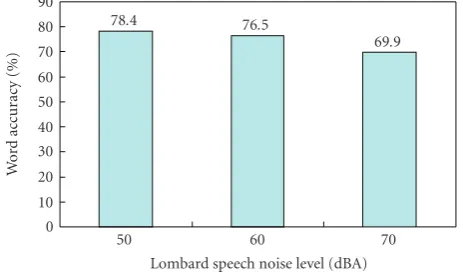
For recognition of Lombard nonaudible murmur of var-ious levels, we applied a method based on multi-level Lom-bard HMMs. More specifically, we trained a common HMMs set using the whole training data (clean, 50 dBA, 60 dBA, and 70 dBA) and we recognized the various Lombard-level test utterances.Figure 14shows the achieved results. Using only a common HMMs set, we recognized arbitrary Lombard utter-ances with a 74.9% word accuracy on average. Moreover, in the cases of 50 dBA and 60 dBA Lombard levels the word ac-curacies are even higher compared with those of the matched cases. However, due to the low mismatch between 50 dBA and 60 dBA Lombard levels the training of a common HMMs set with more data has the same effect as if we increase the adaptation data in the matched cases.
In this experiment, using 24 clean test utterances the recognition accuracy was 82.7% when using clean models (e.g., matched models trained with 50 clean utterances).
50 60 70
Lombard speech noise level (dBA) 0
10 20 30 40 50 60 70 80 90
W
o
rd
ac
cur
acy
(%)
78.4 76.5
69.9
Figure14: Nonaudible murmur recognition using Lombard data and a multilevel common HMM set.
5. AUDIBLE SPEECH RECOGNITION USING A STETHOSCOPE MICROPHONE
The achieved results show the effectiveness of NAM micro-phone in nonaudible murmur recognition, though we con-ducted only speaker-dependent experiments and we used a relatively small test set. Using a NAM microphone and a small amount of adaptation data, we recognized speech uttered very quietly with very high accuracy. NAM mi-crophones can be used as a part of a recognition system, when privacy in communication is very important (e.g., telephone speech recognition applications). A NAM-based speech recognition system, however, has limited applications. Moreover, it requires a special and, less user friendly way in human-machine communication, which is not always neces-sary. For practical reasons, the system should be also able to recognize audible speech.
In this section, we also focus on this problem, and we show that NAM microphone can be used for audible speech recognition, taking also advantage of its robustness against noise.
Figure 15shows the waveform of a normal-speech signal received by a close-talking microphone.Figure 16shows the same signal received by a NAM microphone. The two signals are synchronized, due to a two-channel recording. The fig-ures show the high similarity between the two signals. Figfig-ures
17and18show the spectra of the received speech signals. As can be seen, the spectra show similarities up to 1 kHz. Af-ter 1 kHz the NAM spectral components are attenuated and from 3 kHz remain flat. As a result of the high-frequency at-tenuation, the quality of the signal received by the NAM mi-crophone is lower. Figures19and20show the F0 contours of the previously described signals, which are very similar.
The different frequency characteristics of the two sig-nals require different approach for speech recognition. More specifically, the acoustic models used to recognize audible speech received by a close-talking microphone cannot be used for recognition of normal speech received by a NAM microphone. Therefore, it is necessary to train a new acous-tic models set.
smpl 5 10 15 20 25 30 35 40 45 50 55 smpl
×103
−30
−20
−10 0 10 20 smpl
×103
Figure15: Normal speech waveform—close-talking microphone.
smpl 5 10 15 20 25 30 35 40 45 50 55 smpl
×103
−30
−20
−10 0 10 20 smpl
×103
Figure16: Normal speech waveform—NAM microphone.
128-class regression tree, 350 adaptation utterances, and 4 iterations were used. For evaluation, 72 NAM utterances recorded under several conditions (quiet, background mu-sic, TV-news) were used. For comparison, we trained HMMs for recognition of normal speech received by a close-talking microphone. Single-iteration MLLR with 32-class regression tree, and 100 adaptation utterances were used. The adapta-tion parameters and the adaptaadapta-tion amount were adjusted after conducting several experiments to select the optimal ones.
Table 3 shows the achieved results. As can be seen, in quiet environment the speech received by NAM microphone was recognized with slightly lower accuracy. The reason is that the spectral content is lost during tissue transmission. In the case, however, when there is a background noise (mu-sic, TV-news) the recognition of audible speech received by NAM microphone showed higher performance. Although under noisy environments the performance decreased, we observe that the decreases are not significant. More specif-ically, in a quiet environment we achieved 93.8% word ac-curacy, and in noisy environments 93.2% and 92.9%, re-spectively. The achieved results show the effectiveness of a NAM microphone for audible speech recognition. Especially, in noisy environments this is a very important advantage.
6. INTEGRATED AUDIBLE (NORMAL) SPEECH AND NONAUDIBLE MURMUR
A challenging topic is to integrate audible and nonaudible murmur recognition. In the previous sections, we showed the effectiveness of a NAM microphone in nonaudible mur-mur and audible speech recognition. A recognition system, which combines recognition of the two types of speech using a NAM microphone, can be very flexible and practical.
How-1 2 3 4 5 6 7 ×10³
(Hz)
−108
−72
−36
(dB)
Figure17: Normal speech long-term spectrum—close-talking mi-crophone.
1 2 3 4 5 6 7 ×10³
(Hz)
−108
−72
−36
(dB)
Figure 18: Normal speech long-term spectrum—NAM micro-phone.
ever, in cases when privacy is not important, user can talk in a normal manner. On the other hand, users can communi-cate with a speech recognition-based system in a way that other listeners cannot hear their conversation. In this sec-tion, we introduce three techniques to integrate nonaudible murmur and audible speech recognition. These approaches are based on case-dependent HMMs created using iterative MLLR and training data recorded using a stethoscope NAM microphone.
6.1. Gaussian mixture models (GMMs) based discrimination
The first approach is based on GMM-based discrimination. Two GMMs (one-emitting state HMM) were trained us-ing audible speech and nonaudible murmur received by a NAM microphone, respectively. The transcriptions of the ut-tered speech were merged to form only one model.Figure 21
0.5 1 1.5 2 2.5 3 t (s)
50 100 200
f(
H
z)
Figure 19: F0 contour of normal speech—close-talking micro-phone.
0.5 1 1.5 2 2.5 3
t (s) 50
100 200
f(
H
z)
Figure20: F0 contour of normal speech—NAM microphone.
Table3: Recognition rates for audible speech.
Word Accuracy (%)
Microphone Environment
Quiet TV-news Music
Close-talking 94.4 91.7 91.9
NAM 93.8 93.2 92.9
a simulation experiment using 24 nonaudible murmur ut-terances and 30 audible speech utut-terances.Figure 22shows the histogram of the duration normalized scores of the two GMMs, when the input signal is audible speech. As can be seen, in all the cases the score of the GMM corresponding to normal speech (SN) is higher than the score of the GMM cor-responding to nonaudible murmur speech. Therefore, based on these scores the HMMs set is selected correctly.Figure 23
shows the histogram of the GMM scores when the input sig-nal is nonaudible murmur. The figure shows that the scores of a nonaudible murmur GMM are higher, and therefore the correct HMMs set is selected in this case, too. The sys-tem achieved a 92.1% word accuracy on average, which is a very promising result. A single recognizer using the same NAM models and the same NAM test utterances achieved a 90.4% word accuracy. Using the same normal-speech test ut-terances and the same NAM models, the word accuracy was only 4.7%. Although the system shows high performance, the delay necessary for the GMM matching is a disadvantage.
6.2. Using parallel speech recognizers
To overcome the problem of the delay, we introduce another method based on parallel speech recognizers. Two recogniz-ers using different HMMs (audible speech, nonaudible
mur-NAM microphone
GMM
Normal
SN
GMM NAM
SM
Decision
SN> SM
SM> SN
HMM
Normal HMM NAM
Recognizer
Figure21: GMM-based discrimination.
Input: normal speech
−64 −62 −60 −58 −56 −54 −52
GMM normalized score 0
2 4 6 8 10 12
Co
u
n
t
NAM Normal
Figure22: GMM normalized scores—input normal speech.
Input: NAM speech
−64 −62 −60 −58 −56 −54 −52
GMM normalized score 0
2 4 6 8 10 12 14 16
Co
u
n
t
Normal NAM
Figure23: GMM normalized scores—input nonaudible murmur.
mur) operate in parallel providing two hypotheses with their scores. The system selects the hypothesis with the higher score as the correct recognition result.Figure 24shows the block diagram of the system. Using the same test set as in the previous section, the system achieved a 92.1% word accuracy in this case, too. The disadvantage of this method is the higher complexity due to the use of two recognizers.
6.3. Using a combined HMM set
NAM microphone
HMM Normal
HMM NAM
SN
SM
Recognizer Recognizer
Decision
SN> SM
SM> SN
Hypothesis normal Hypothesis
murmur
Figure24: Parallel recognizers-based recognition.
same data as in Sections6.1and6.2. Using this approach, we achieved a 91.4% word accuracy on average. The results show that this is a very effective approach and does not require ad-ditional sources. On the other hand, the performance of this approach depends on the ratio of the two different training data used to train the combined HMM set. Our experience showed that a larger nonaudible murmur training database is required.
7. CONCLUSIONS
In this paper, we presented nonaudible murmur recognition in clean and noisy environments using NAM microphones. A NAM microphone is a special acoustic device attached be-hind the talker’s ear, which can capture very quietly uttered speech. Nonaudible murmur recognition can be used when privacy in human-machine communication is desired. Since nonaudible murmur is captured directly from the body, it is less sensitive to environmental noises. To show this, we carried out experiments using simulated and real noisy data. Using simulated noisy data at 50 dBA and 60 dBA noise lev-els, the nonaudible murmur recognition performance was almost equal to that of the clean case. Using, however, data recorded in noisy environments, the performance decreased. To investigate the possible reasons for this, we studied the role of the Lombard effect in nonaudible murmur recogni-tion and we carried out an experiment using Lombard data. The results showed that the Lombard reflex has a negative impact effect on nonaudible murmur recognition. Due to the speech production modifications, the nonaudible murmur characteristics under Lombard conditions are changed and show a higher similarity to normal speech. Due to this fact, a mismatch appears between the training and testing con-ditions and the performance decreases. We also proposed a method based on multilevel Lombard HMMs set to recog-nize arbitrary Lombard nonaudible murmur utterances.
In this paper, we also reported audible speech recogni-tion using NAM microphone showing the effectiveness of a NAM microphone in normal speech recognition. To make a nonaudible murmur-based system more flexible and gen-eral, we introduced three approaches to integrate normal speech recognition and nonaudible murmur recognition us-ing a NAM microphone with promisus-ing results.
In this paper, we reported speaker-dependent applica-tions of NAM microphones. As future work, we plan to
in-vestigate nonaudible murmur recognition in the speaker-independent domain. Currently, collection of nonaudible murmur database from several speakers is in progress. Also, sampling the NAM data at 8 kHz seems to be more appropri-ate due to the limited high frequency band of NAM.
ACKNOWLEDGMENTS
The authors would like to thank Dr. Yoshitaka Nakajima for providing the NAM microphones and also all the members of the Speech and Acoustics Processing Laboratory for their collaboration in collecting nonaudible murmur data.
REFERENCES
[1] Y. Nakajima, H. Kashioka, K. Shikano, and N. Campbell, “Non-audible murmur recognition input interface using
stethoscopic microphone attached to the skin,” inProceedings
of IEEE International Conference on Acoustics, Speech, and Sig-nal Processing (ICASSP ’03), vol. 5, pp. 708–711, Hong Kong, April 2003.
[2] Y. Zheng, Z. Liu, Z. Zhang, et al., “Air- and bone-conductive integrated microphones for robust speech detection and
en-hancement,” in Proceedings of IEEE Workshop on Automatic
Speech Recognition and Understanding (ASRU ’03), pp. 249– 254, St. Thomas, Virgin Islands, USA, November-December 2003.
[3] Z. Liu, A. Subramanya, Z. Zhang, J. Droppo, and A. Acero, “Leakage model and teeth clack removal for air- and
bone-conductive integrated microphones,” inProceedings of IEEE
International Conference on Acoustics, Speech, and Signal Pro-cessing (ICASSP ’05), vol. 1, pp. 1093–1096, Philadelphia, Pa, USA, March 2005.
[4] M. Graciarena, H. Franco, K. Sonmez, and H. Bratt, “Combin-ing standard and throat microphones for robust speech
recog-nition,”IEEE Signal Processing Letters, vol. 10, no. 3, pp. 72–74,
2003.
[5] O. M. Strand, T. Holter, A. Egeberg, and S. Stensby, “On the feasibility of ASR in extreme noise using the PARAT earplug
communication terminal,” inProceedings of IEEE Workshop on
Automatic Speech Recognition and Understanding (ASRU ’03), pp. 315–320, St. Thomas, Virgin Islands, USA, November-December 2003.
[6] S.-C. Jou, T. Schultz, and A. Waibel, “Adaptation for soft
whis-per recognition using a throat microphone,” in Proceedings
of International Conference on Speech and Language Processing (ICSLP ’04), Jeju Island, Korea, October 2004.
[7] Y. Nakajima, H. Kashioka, K. Shikano, and N. Campbell,
“Non-audible murmur recognition,” inProceedings of the 8th
European Conference on Speech Communication and Technol-ogy (EUROSPEECH ’03), pp. 2601–2604, Geneva, Switzerland, September 2003.
[8] A. Lee, T. Kawahara, K. Takeda, and K. Shikano, “A new
pho-netic tied-mixture model for efficient decoding,” in
Proceed-ings of IEEE International Conference on Acoustics, Speech, and Signal Processing (ICASSP ’00), vol. 3, pp. 1269–1272, Istanbul, Turkey, June 2000.
[9] P. Heracleous, Y. Nakajima, A. Lee, H. Saruwatari, and K. Shikano, “Accurate hidden Markov models for non-audible murmur (NAM) recognition based on iterative supervised
Speech Recognition and Understanding (ASRU ’03), pp. 73–76, St. Thomas, Virgin Islands, USA, November-December 2003. [10] P. Heracleous, Y. Nakajima, A. Lee, H. Saruwatari, and K.
Shikano, “Non-audible murmur (NAM) recognition using a
stethoscopic NAM microphone,” inProceedings of the 8th
In-ternational Conference on Spoken Language Processing (Inter-speech ’04 - ICSLP), pp. 1469–1472, Jeju Island, Korea, Octo-ber 2004.
[11] P. Heracleous, T. Kaino, H. Saruwatari, and K. Shikano, “Ap-plications of NAM microphones in speech recognition for
pri-vacy in human-machine communication,” in Proceedings of
the 9th European Conference on Speech Communication and Technology (Interspeech ’05 - EUROSPEECH), pp. 3041–3044, Lisboa, Portugal, September 2005.
[12] Y. Nakajima, H. Kashioka, K. Shikano, and N. Campbell, “Re-modeling of the sensor for non-audible murmur (NAM),” in Proceedings of the 9th European Conference on Speech Commu-nication and Technology (Interspeech ’05 - EUROSPEECH), pp. 389–392, Lisboa, Portugal, September 2005.
[13] P. Heracleous, T. Kaino, H. Saruwatari, and K. Shikano, “In-vestigating the role of the Lombard reflex in non-audible
mur-mur (NAM) recognition,” inProceedings of the 9th European
Conference on Speech Communication and Technology (Inter-speech ’05 - EUROSPEECH), pp. 2649–2652, Lisboa, Portugal, September 2005.
[14] P. Heracleous, Y. Nakajima, A. Lee, H. Saruwatari, and K. Shikano, “Audible (normal) speech and inaudible murmur
recognition using NAM microphone,” in Proceedings of the
7th European Signal Processing Conference (EUSIPCO ’04), pp. 329–332, Vienna, Austria, September 2004.
[15] T. Kawahara, A. Lee, T. Kobayashi, et al., “Free software toolkit for Japanese large vocabulary continuous speech
recogni-tion,” inProceedings of 6th International Conference on Spoken
Language Processing (ICSLP ’00), pp. IV-476–IV-479, Beijing, China, October 2000.
[16] K. Itou, M. Yamamoto, K. Takeda, et al., “JNAS: Japanese speech corpus for large vocabulary continuous speech
recog-nition research,”The Journal of the Acoustical Society of Japan
(E), vol. 20, no. 3, pp. 199–206, 1999.
[17] C. J. Leggetter and P. C. Woodland, “Maximum likelihood linear regression for speaker adaptation of continuous
den-sity hidden Markov models,”Computer Speech and Language,
vol. 9, no. 2, pp. 171–185, 1995.
[18] C.-H. Lee, C.-H. Lin, and B.-H. Juang, “A study on speaker adaptation of the parameters of continuous density
hid-den Markov models,”IEEE Transactions on Signal Processing,
vol. 39, no. 4, pp. 806–814, 1991.
[19] P. C. Woodland, D. Pye, and M. J. F. Gales, “Iterative unsu-pervised adaptation using maximum likelihood linear
regres-sion,” inProceedings of the 4th International Conference on
Spo-ken Language (ICSLP ’96), vol. 2, pp. 1133–1136, Philadelphia, Pa, USA, October 1996.
[20] J.-C. Junqua, “The Lombard reflex and its role on human
lis-teners and automatic speech recognizers,”Journal of the
Acous-tical Society of America, vol. 93, no. 1, pp. 510–524, 1993. [21] A. Wakao, K. Takeda, and F. Itakura, “Variability of Lombard
effects under different noise conditions,” inProceedings of the
4th International Conference on Spoken Language (ICSLP ’96), vol. 4, pp. 2009–2012, Philadelphia, Pa, USA, October 1996. [22] J. H. L. Hansen, “Morphological constrained feature
enhance-ment with adaptive cepstral compensation (MCE-ACC) for
speech recognition in noise and Lombard effect,”IEEE
Trans-actions on Speech and Audio Processing, vol. 2, no. 4, pp. 598– 614, 1994.
[23] B. A. Hanson and T. H. Applebaum, “Robust speaker-independent word recognition using static, dynamicand ac-celeration features: experiments with Lombard and noisy
speech,” inProceedings of International Conference on
Acous-tics, Speech, and Signal Processing (ICASSP ’90), vol. 2, pp. 857– 860, Albuquerque, NM, USA, April 1990.
[24] R. Ruiz, E. Absil, B. Harmegnies, C. Legros, and D. Poch, “Time- and spectrum-related variabilities in stressed speech
under laboratory and real conditions,”Speech Communication,
vol. 20, no. 1-2, pp. 111–129, 1996.
Panikos Heracleouswas born in Paphos, Cyprus, on May 22, 1966. He received the M.S. degree in electrical engineering from the Technical University of Budapest, Hun-gary, in 1992, and the Dr. Eng. degree from the Nara Institute of Science and Technol-ogy, Japan, in 2002. In 2001, he joined KDDI R&D Labs as a Research Engineer in telephone speech recognition field. In 2003, he joined the Speech and Acoustics
Process-ing Laboratory, Nara Institute of Science and Technology as a CEO Postdoctoral Research Fellow. During the period from October 2005 to January 2006, he was an Assistant Professor at Nara In-stitute of Science and Technology. He is currently an Assistant Pro-fessor at University of Cyprus. His research interests include signal processing, microphone arrays, automatic speech recognition, and unvoiced speech recognition. He is a Member of ISCA, IEEE, IE-ICE, and the Acoustical Society of Japan.
Tomomi Kaino received the B.S. degree in information and computer science from Nara Woman’s University in 2004, and the M.S. degree in information science from Nara Institute of Science and Technology in 2006. She had been studying in body-transmitted speech recognition in multi-speaking styles including nonaudible mur-mur (NAM) in her Master’s course. She is now working with Sanyo Electric Co., Ltd.
Hiroshi Saruwatariwas born in Nagoya, Japan, on July 27, 1967. He received the B.E., M.E., and Ph.D. degrees in electrical en-gineering from Nagoya University, Nagoya, Japan, in 1991, 1993, and 2000, respectively. He joined Intelligent Systems Laboratory, Secom Co., Ltd., Mitaka, Tokyo, Japan, in 1993, where he engaged in the research and development of the ultrasonic array system for the acoustic imaging. He is currently an
Kiyohiro Shikanoreceived the B.S., M.S., and Ph.D. degrees in electrical engineering from Nagoya University in 1970, 1972, and 1980, respectively. He is currently a Profes-sor at Nara Institute of Science and Technol-ogy (NAIST), where he is directing Speech and Acoustics Laboratory. From 1972, he had been working at NTT Laboratories, where he had been engaged in speech recog-nition research. During 1990–1993, he was