Volume 2006, Article ID 32082, Pages1–13 DOI 10.1155/ASP/2006/32082
Time of Arrival Estimation for UWB Localizers
in Realistic Environments
Chiara Falsi,1Davide Dardari,2Lorenzo Mucchi,3and Moe Z. Win4
1Dipartimento di Elettronica e Telecomunicazioni, Universit`a degli studi di Firenze, Via Santa Marta 3, 50139 Firenze, Italy
2The WiLAB, IEIIT/CNR, CNIT, Universit`a di Bologna, Via Venezia 52, 47023 Cesena, Italy
3Dipartimento di Elettronica e Telecomunicazioni, CNIT, Universit`a degli studi di Firenze, Via Santa Marta 3, 50139 Firenze, Italy
4Laboratory for Information and Decision Systems (LIDS), Massachusetts Institute of Technology, Room 32-D658,
77 Massachusetts Avenue, Cambridge, MA 02139, USA
Received 14 June 2005; Revised 12 December 2005; Accepted 30 April 2006
This paper investigates time of arrival (ToA) estimation methods for ultra-wide bandwidth (UWB) propagation signals. Different algorithms are implemented in order to detect the direct path in a dense multipath environment. Different suboptimal, low-complex techniques based on peak detection are used to deal with partial overlap of signal paths. A comparison in terms of ranging accuracy, complexity, and parameters sensitivity to propagation conditions is carried out also considering a conventional technique based on threshold detection. In particular, the algorithms are tested on experimental data collected from a measurement campaign performed in a typical office building.
Copyright © 2006 Hindawi Publishing Corporation. All rights reserved.
1. INTRODUCTION
There has been great interest in ultra-wide bandwidth tech-nology in recent years because of its potential for a large number of applications. A large body of literature exists on the characterization of indoor propagation channels and many indoor propagation measurements have been made [1–7]. Due to its fine delay resolution properties, UWB shows good capability for short-range communications in dense multipath environments. One of the most attractive capa-bilities of UWB technology is accurate position localization [8–10]. The transmission of extremely short pulses or equiv-alently the use of extremely large transmission bandwidths provides the ability to resolve multipath components. This implies high ranging accuracy.
Position estimation is mainly affected by noise, multipath components, and different propagation speeds through ob-stacles in non-line-of-sight (NLOS) environments. Most po-sitioning techniques are based on the time of arrival (ToA) estimation of the first path [11]. Generally, the first path is not the strongest, making the estimation of the ToA challeng-ing in dense multipath channels.
ToA estimation in a multipath environment is closely re-lated to channel estimation, where channel amplitudes and time of arrivals are jointly estimated using, for example, a maximum likelihood (ML) approach [12,13]. Received paths often partially overlap and thus become unresolvable,
thereby degrading the ToA estimation. This situation is con-sidered in [14] where an ML delay acquisition algorithm for code division multiple access (CDMA) systems in nonresolv-able channels is proposed. First, distinct path packets are lo-cated using a conventional acquisition algorithm to reduce the set of possible delay combinations to be tested, then the mean squared error between the received signal and a set of hypothesized estimated signals is minimized. In [15] a gener-alized ML-based ToA estimation is applied to UWB signals, by assuming that the strongest path is perfectly locked and estimating the relative delay of the first path using statistical models based on experimental data.
in a multipath environment in severe NLOS conditions is described, and a high-resolution ToA estimation algorithm using minimum variance (MV) and normalized minimum variance (NMV) is proposed. In [19] several frequency-domain methods are proposed for UWB channel estima-tion and rapid acquisiestima-tion. In particular, the problem of low-complexity channel estimation and timing synchronization in UWB systems using low sampling rates and low power consumption methods is addressed. In [20] we demonstrate how the presence of multipath can be used to reduce the ac-quisition time.
Methods for calibration and mitigation of NLOS ranging errors are analyzed in [21,22] and, in the specific UWB range estimation context, in [23]. An algorithm for ranging estima-tion in the case of an intermittently blocked LOS is proposed in [24].
Most of these works rely on simulation results and have not been verified with actual experimental data. In addi-tion, the propagation conditions for which a specific ToA estimation technique result to be more convenient from the complexity-accuracy compromise point of view with respect to a simpler method (e.g., the conventional one based on threshold detection) have not yet been investigated. More-over, the previous literature has mainly focused on the effect of NLOS propagation on ranging accuracy. In the case of no high ranging accuracies are required, lower complexity ToA estimators can be considered such as those based on energy detection [25,26].
The main purpose of our work is to investigate the ef-fects of multipath propagation on ToA estimation using real measurement data by considering different algorithms with different levels of complexity. The trade-offbetween estima-tion accuracy, complexity and sensitivity to parameter choice for different propagation conditions is discussed.
Due to the large number of paths characterizing typi-cal UWB propagation environments, the complexity of sys-tem implementation of super-resolution techniques can be prohibitive. On the other hand, the ML criterion for chan-nel estimation requires a multidimensional optimization of a highly oscillatory error function, implying a huge, com-plex computational solution. For these reasons, we eval-uate the performance of suboptimal ToA algorithms with increasing levels of complexity derived from the ML cri-terion and based on a simple peak detection process. In particular, we propose a novel estimation strategy able to cope with the presence of unresolvable multipath, called search subtract and readjust. The performance of a conven-tional technique based on threshold detection is investigated as well, to better understand the conditions for which the adoption of more complex techniques results to be conve-nient.
It is known [27] that the presence of noise and multi-path creates ambiguities in the ToA estimate, mainly because the direct path is not always the strongest one. In this pa-per we will show two fundamental consequences; a notice-able bias and a significant variance are introduced on the ToA estimate. As we will show later, in some propagation con-ditions a good channel estimator does not necessarily give
significant gains in the ToA estimation of the direct path, hence the price for the increased complexity may not be jus-tifiable. Additionally, some discussion on NLOS excess prop-agation delay is presented, showing that its effects would not be always dominant with respect to the effects of mul-tipath if the ToA estimation scheme parameters are not opti-mized.
This paper is organized as follows.Section 2provides the theoretical background from which the multipath estimator is derived.Section 3describes the proposed algorithms and their implementation. The performance of the proposed al-gorithms is given inSection 4.Section 5concludes the pa-per.
2. MULTIPATH ESTIMATOR
2.1. System model
We consider a multipath channel with an impulse response given by
c(t)=
L
l=1 clδ
t−τl
, (1)
whereclandτl, respectively, are the amplitudes and time
de-lays of theLpropagation paths.
In this case, the received signal can be expressed as
r(t)=
L
l=1 clw
t−τl
+n(t), (2)
wherew(t) is the isolated ideal received pulse with duration Tp (i.e., in the absence of multipath and noise) andn(t) is
additive white Gaussian noise (AWGN) with zero mean and spectral densityN0/2.
We are interested in the estimation ofτ1, that is, the ToA of the direct path, when it exists, based on the observation of the received signal in the interval [0,T]. However, due to the presence of multipath, the received waveform depends on a set of unknown parameters, denoted byU = {τ,c}, where
τ [τ1,τ2,. . .,τL]T andc [c1,c2,. . .,cL]T. Note that the
ToA estimation is closely related to the problem of channel estimation, where not onlyτ1but the entire set of unknown parameters is estimated.
This work relies on data collected in a UWB propagation experiment, thus the system is characterized by sampled sig-nals. The transmitted and received signals are composed of ZandMsamples (Z < M), respectively, at the sampling rate 1/Ts, such thatT = M·Ts andTp = Z·Ts. In this
sit-uation, the received signal can be written in vector form as follows:
where
n∈RMwith elementsn i=n
iTs
, fori=1, 2,. . .,M,
r∈RMwith elements
ri=r
iTs = L l=1 clw
iTs−τl
+niTs
, fori=1, 2,. . .,M,
W(τ)=w(D1),w(D2),. . .,w(DL)∈RM×L.
(4)
In the previous expression
w(Dl)=0
Dl,w,0M−Z−Dl
T
∈RM, forl=1, 2,. . ., (5)
where
w∈RZwith elementsw i=w
iTs
, fori=1, 2,. . .,Z,
0Dl =
0,. . ., 0
Dl
,
0M−Z−Dl=
0,. . ., 0
M−Z−Dl
(6)
andDl is the discretized version of time delayτl, such that
τl Dl ·Ts. It is worth noting that L columns of
ma-trixW(τ) represent sampled replicas ofw(t) shifted by de-lays τl forl =1,. . .,L where 0< τ1 < τ2 < · · · < τL and
maxl{τl} ≤T−Tp.
2.2. ML estimator
When the observation noise is Gaussian, the ML criterion is equivalent to the minimum mean squared error (MMSE) criterion. Thus, given an observationrof the received signal, the ML estimates of the delay vectorτand amplitude vector
care the values that minimize the following mean squared error:
S(τ,c)= 1 M
M
i=1
ri−ri2
, (7)
where
ri=r
iTs = L l=1 clw
iTs−τl
, fori=1, 2,. . .,M, (8)
is the reconstructed discrete-time signal, based on the set of parametersU. It can be shown that the ML estimates ofτ andcin the continuous-time domain, here reformulated in the discrete-time domain, are given by [12]
τ=arg max τ
χT(τ)R−1
w (τ)χ(τ)
,
c=R−1
w (τ)χ(τ),
(9)
where
χ(τ)=WT(τ)r=w(D1)Tr,w(D2)Tr,. . .,w(DL)Tr∈RL (10)
is the correlation between the received signal and different delayed versions ofw(t) and
Rw(τ)
=WT(τ)W(τ)
= ⎡ ⎢ ⎢ ⎢ ⎢ ⎢ ⎢ ⎣
w(D1)Tw(D1) w(D1)Tw(D2) · · · w(D1)Tw(DL)
w(D2)Tw(D1) w(D2)Tw(D2) · · · w(D2)Tw(DL) ..
. ... . .. ...
w(DL)Tw(D1) w(DL)Tw(D2) · · · w(DL)Tw(DL)
⎤ ⎥ ⎥ ⎥ ⎥ ⎥ ⎥ ⎦
∈RL×L
(11)
is the autocorrelation matrix of w(t). Hence (9) can be rewritten as
τ=arg max τ
WT(τ)rTWT(τ)W(τ)−1WT(τ)r,
(12)
c=WT(τ)W(τ)−1WT(τ)
pseudo-inverse matrix
r. (13)
When the channel is not separable, that is,
τi−τj< Tp, for somei= j, (14)
we note from (9) that the estimation of the ToA of the direct path, in general, can depend strongly on the estimation of the other channel parameters. Direct optimization of (9) can be computationally complex, since it requires the evaluation of (12) and (13) for each set of hypothesized values ofτ. It could also be highly oscillatory, that is, (12) involves the hard task of the maximization, over all possible sets of hypothe-sized values ofτ, of a multidimensional nonlinear function with several potential local maxima. InSection 3we propose two possible suboptimal optimization strategies with lower complexity.
On the other hand, when the channel is separable, that is, when
τi−τj≥Tp ∀i= j, (15)
the expressions (9) are simplified to
τ=arg max
τl ⎧ ⎨ ⎩ L l=1
χτl
2
Rw(0)
⎫ ⎬
⎭=arg maxτ
l ⎧ ⎨ ⎩ L l=1
w(Dl)Tr2 Ew ⎫ ⎬ ⎭, (16)
c= χ(τ) Rw(0)=
WT(τ)r
Ew
, (17)
whereRw(0) =Ewis the energy ofw(t). In this case the
es-timation of the ToA of the direct path is decoupled from the estimation of the other channel parameters, that is, optimiza-tion of (16) can be accomplished by maximizing each term of the sum independently.
the received signal and a different delayed version ofw(t). As a result, (16) can be simply accomplished observing the MF output at proper instants. The discrete-time impulse re-sponse of the MF is
h=wZTs
,w(Z−1)Ts
,. . .,wTs
T ∈RZ
, (18)
and the sampled output of the MF can be written as the dis-crete convolution (∗) between the impulse response of the MF (h) and the received signal (r) as follows:
y=h∗rwith elements ,
yi= Z
j=1
hjri−j+1, fori=Z,Z+ 1,. . .,M .
(19)
Under condition (15), and considering a transmitted pulse without sidelobes, in the absence of noise, the values τlwithl = 1, 2,. . .,Lcould be easily found from the
loca-tionstlof the peaks of the MF output, sinceτl =tl−Tp. It
is worth noting that the parameter we are interested in for the purpose of ranging isτ1, which is the smallest element in the vectorτ, that is, the path that arrives first among all the detected paths.
In the presence of noise, and in a more realistic situation where the autocorrelation ofw(t) has non-negligible side-lobes, it becomes more challenging to recognize the correct signal peaks at the MF output. InSection 3we suggest two different solutions for selecting the location of the peaks as the best values of the ToAs in order to achieve a high ranging accuracy.
3. ESTIMATION STRATEGIES
3.1. Peak-detection-based estimator
We consider three algorithms based on peak detection, called single search, search and subtract and search, subtract and readjust. As the following will make clear, they are charac-terized by an increasing level of complexity. These algorithms essentially involve the detection ofNlargest positive and neg-ative values of the MF output, where the parameterNis the number of paths considered in the search by the algorithms, and the determination of the corresponding time locations tk1,tk2,. . .,tkN. While these algorithms are equivalent, that is, give the same delay and amplitude estimates, when the multi-paths are separable, the last two algorithms take into account the effects of a nonseparable channel.
3.1.1. Single search
The delay and amplitude vectors are estimated with a single look.
(a) Calculate the MF output using (19).
(b) Given the absolute valuev = |y| of the MF output, findNsamplesvki, withi=1, 2,. . .,N, corresponding to both positive and negativeNlargest peaks ofy. (c) Convert the indexes ki into the time locations tki =
ki·Ts of the peaks and from them derive the delay
estimatesτki = tki−Tp. Then find the minimum of {τki}Ni=1and set it as the delay estimateτ1of the ToA of the direct path.
3.1.2. Search and subtract
This algorithm provides a way to detect multipath compo-nents in a nonseparable channel.
(a) Calculate the MF output using (19).
(b) Find the samplevk1corresponding to the largest peak
of the absolute value of the MF output, convert the in-dex into the corresponding time locationtk1=k1·Ts,
and then derive the delay estimateτk1 = tk1 −Tp of
the strongest path, which does not necessarily coincide with the first path.
(c) Calculate the amplitude estimate ck1 of the strongest
path solving (13), which gives
ck1=
w(k1)Tw(k1)−1w(k1)Tr. (20)
(d) Subtract out the estimated path from the received vec-torrand calculate the new observation signalras fol-lows:r=r−ck1w(k1).
(e) Calculate the following discrete convolution:y=h∗
r; find the sample v
k2 corresponding to the largest
peak of the absolute value of the new MF output, then convert the index into the corresponding time location tk2=k2·Ts, and derive the delay estimateτk2=tk2−Tp
of the second strongest path ofr.
(f) Estimate the corresponding amplitudeck2 using (13),
which is now equal to
ck2=
w(k2)Tw(k2)−1w(k2)Tr. (21)
(g) Subtract out the estimated path from r, obtaining
r=r−c
k2w
(k2).
(h) Repeat the same process until theNstrongest paths are found. Then find the minimum of{τki}Ni=1and set it as the estimateτ1of the ToA of the direct path.
3.1.3. Search subtract and readjust
So far the delay and amplitude of each path are estimated separately at each step; in this algorithm a joint estimation of the amplitudes of different paths is introduced.
(a) Calculate the output of the MF, given by (19). (b) Find the samplevk1corresponding to the largest peak
of the absolute value of the MF output, convert the in-dex into the corresponding time locationtk1=k1·Ts,
and derive the delay estimate τk1 = tk1 −Tp of the
strongest path.
(c) Calculate the amplitude estimate ck1 of the strongest
path from (13):
ck1=
w(k1)Tw(k1)−1w(k1)Tr. (22)
(d) Subtract out the estimated path from the received vec-torrand calculate the new observation signalras fol-lows:r=r−ck1w
(e) Calculate the discrete convolution between the new observation signal and the MF impulse response as fol-lows: y =h∗r. Find the samplev
k2corresponding
to the largest peak of the absolute value of the new MF output, then convert the index into the corresponding time locationtk2=k2·Tsand derive the delay estimate
τk2=tk2−Tpof the second strongest path ofr.
(f) Givenτk1 andτk2, estimate the corresponding
ampli-tudes of the first two strongest paths of the received signal. This step can be accomplished solving the fol-lowing equation:
ck1
ck2
=w(k1),w(k2)Tw(k1),w(k2) −1
×w(k1),w(k2)T ⎡ ⎢ ⎢ ⎣
r1 .. . rM
⎤ ⎥ ⎥ ⎦.
(23)
It is worth noting that, unlike in thesearch and subtract algorithm, here the amplitudes of the paths selected as the strongest are jointly estimated at each step. (g) Subtract out the two estimated paths fromr, obtaining
r=r−c
k1w(k1)−ck2w(k2).
(h) Repeat the same process until theNstrongest paths are found. Then find the minimum of{τki}
N
i=1and set it as the estimateτ1of the ToA of the direct path.
In the above three algorithms, the parameterNhas to be determined with an optimization process, as will be demon-strated. Moreover, the choice ofNalso affects the computa-tional complexity of the strategy adopted. In particular, both search and subtractandsearch subtract and readjustrequire a matrix inversion process at each step for a total ofNmatrix inversions. In thesearch subtract and readjustalgorithm the matrix dimension increases by a factorLat each step, thus making its complexity higher than the other strategies con-sidered. It will be shown in the numerical results that rea-sonable ToA estimation accuracy can be obtained with a low number of stepsN. In general the matrixW(τ) is sparse, thus efficient inversion techniques can be utilized. However, a de-tailed analysis of the complexity issue is out of the scope of this paper. Thesingle searchstrategy does not require com-plex computational processes (only comparisons and order-ing), thus implying a very low complexity.
3.2. Thresholding-based estimator
We now consider the conventional threshold detection algo-rithm, well known from radar theory [28]. We call it thresh-old and search. ToA estimation involves the following steps.
(a) Pass the received discrete-time signal through the MF and calculate the MF output using (19).
(b) Compare the absolute valuev of the MF outputyto fixed thresholdλ.
(c) After the first threshold crossing point is found (detec-tion), search for the peak in an interval of lengthTp
(fine estimation); then convert the index of the peak samplevkto the time locationtk =k·Ts, derive the
delay estimateτk=tk−Tpand set it as the estimateτ1 of the ToA of direct path.
Among the algorithms considered in the paper, this one requires the lowest level of computational complexity since only comparison operations are required, independently on the parameterλ.
The choice of threshold is important. With a small threshold, the probability of detecting peaks due to noise, that is, false alarm, and thus estimating the position of an erroneous path arriving earlier than the actual direct path as
τ1 is high. Whereas with a large threshold, the probability of missing the direct path and thus estimating the position of an erroneous path arriving later asτ1, that is, missed de-tection, is high. We optimized the threshold considering the overall signal dynamics at the MF output over the observa-tion intervalT, to obtain the lowest estimation error, as will be explained in the next section.
4. PERFORMANCE ANALYSIS
4.1. A brief description of a UWB propagation experiment
For convenience we briefly review the UWB experiment [12]. The excitation signal of our propagation channel is a pulse with a duration of approximately one nanosecond, implying a bandwidth signal of 1 GHz. A periodic probing pulse with a repetition rate of 2×10⁶pulses per second is used, so that successive multipath components spread up to 500 nanosec-onds (ns) can be measured unambiguously. In fact the dura-tion of one pulse, inversely propordura-tional to the transmission bandwidth, determines the minimum differential path delay between resolvable multipath components, while the repeti-tion time of the periodic pulse signal determines the maxi-mum observable multipath dispersion of the channel.
The channel response is recorded using a digital sampling oscilloscope (DSO) with a sampling rate of 20.48 GHz, which means that the time between samples isTs=48.828
picosec-onds (ps) and the measurement apparatus is set in such a way that all the multipath profiles have the same absolute delay reference.
Multipath profiles data are collected in 14 rooms and along the hallways on one floor of the building.1 In each room the measurements are made at 49 different points lo-cated at a fixed height on a 7×7 square grid, covering 90×90 centimeters (cm) with 15 cm spacing between measurement points. Moreover, the transmitted pulsew(t) is measured 1 m apart from the antenna in LOS condition and the observed waveform has been used as a template pulse in the imple-mentation of the algorithms.
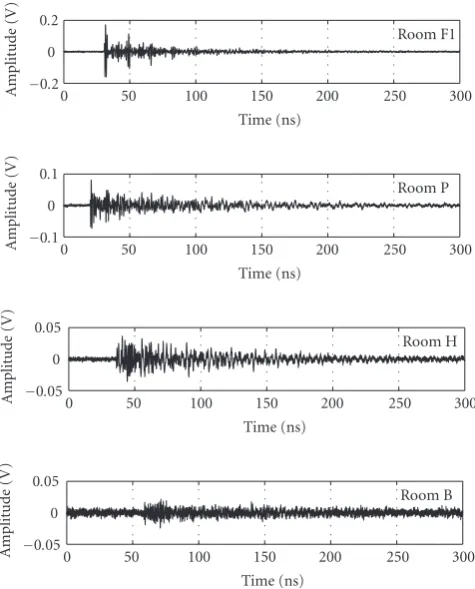
We focus our attention on the measured signals from the following four locations.
(i) Room F1, which represents a typical “direct line-of-sight (LOS)” UWB signal transmission environment,
0.2 0 0.2
A
m
plitude
(V
)
0 50 100 150 200 250 300
Room F1
Time (ns) 0.1
0 0.1
A
m
plitude
(V
)
0 50 100 150 200 250 300
Room P
Time (ns) 0.05
0 0.05
A
m
plitude
(V
)
0 50 100 150 200 250 300
Room H
Time (ns) 0.05
0 0.05
A
m
plitude
(V
)
0 50 100 150 200 250 300
Room B
Time (ns)
Figure1: Multipath profile measured at the center point (4,4) of the grid in room F1, room P, room H, and room B.
where the transmitter and the receiver are located in the same room without any blockage in between. (ii) Room P, which represents a typical “high
signal-to-noise ratio (SNR)” UWB signal transmission environ-ment. The approximate distance between the trans-mitter and the receiver is 6 meters.
(iii) Room H, which represents a typical “low SNR” UWB signal transmission environment. The approximate distance between the transmitter and the receiver is 10 meters.
(iv) Room B, which represents a typical “extreme-low SNR” UWB signal transmission environment. The ap-proximate distance between the transmitter and the re-ceiver is 17 meters.
Figure 1shows some representative examples of the re-ceived waveforms measured in the different locations.
4.2. Measurement-based performance analysis
The multipath profiles collected from theQ=49 locations on the measurement grid in each room are processed us-ing algorithms described inSection 3, in order to analyze the variations caused by small changes of the receiver position. For each pointiof the grid, we evaluate the error on the esti-mate of the ToA of the direct path, defined as(i)=τ(i)
1 −τ (i) 1 . We also obtain the mean and variance of the ToA estima-tion error averaged over theQmeasurement locations inside each room.
(i) The mean value of the ToA estimation error is given by
μ= 1 Q
Q
i=1
(i). (24)
(ii) The standard deviation of the ToA estimation error is given by
σ=
! " " "
#1
Q
Q
i=1
(i)2−μ2. (25)
4.2.1. Peak-detection-based estimator performance
Figures2and3show theQvalues of(i)forsearch and sub-tract algorithm, as a function of the number of considered pathsNfor measurements made in different rooms. The line representing the mean of the ToA estimation error is super-imposed in the plots, where there areQcrosses (each corre-spondent to each measurement location) for every value of N. Two regions in the behavior ofμcan be recognized with respect to the increasing number of considered paths.
20 15 10 5 0 5
Er
ro
r
o
n
T
oA
estimat
e
(ns)
0 10 20 30 40 50 60 70 80 90 100
Room F1
Number of paths ToA estimation error
Mean of the ToA estimation error
20 15 10 5 0 5
Er
ro
r
o
n
T
oA
estimat
e
(ns)
0 10 20 30 40 50 60 70 80 90 100
Room P
Number of paths ToA estimation error
Mean of the ToA estimation error
Figure2: ToA estimation error versus number of paths in the 49 points of the grid in rooms F1 and P (crosses) and mean of the ToA estimation error (line). Searh and subtract algorithm was used.
60 40 20 0 20 40 60
Er
ro
r
o
n
T
oA
estimat
e
(ns)
0 10 20 30 40 50 60 70 80 90 100
Room H
Number of paths ToA estimation error
Mean of the ToA estimation error
60 40 20 0 20 40 60
Er
ro
r
o
n
T
oA
estimat
e
(ns)
0 10 20 30 40 50 60 70 80 90 100
Room B
Number of paths ToA estimation error
Mean of the ToA estimation error
Figure3: ToA estimation error versus number of paths in the 49 points of the grid in rooms H and B (crosses) and mean of the ToA estimation error (line). Search and subtract agorithm was used.
(ii) As the number of considered paths increases, the mean of the ToA estimation error decreases. Especially in the “extreme-low SNR” case with a high number of paths, μkeeps decreasing towards negative values since some paths in the noise portion are detected.
InFigure 4we can see the behavior of the standard devi-ation of the ToA estimdevi-ation error in room F1, room P, room H, and room B. It is worth noting that two regions can be recognized again. Initially,σassumes large values, then, as the number N of considered paths increases, σ decreases, reaching its minimum. In such situations, where the mean assumes values around zero and the standard deviation as-sumes the minimum value, an optimum operating point can be defined. The optimum number of paths to be considered corresponds to the value that minimizes the mean squared error (MSE), defined as
MSE=σ2+μ2 (26)
for the ToA estimation error. Unlike all other cases, it can be seen fromFigure 5that in the “extreme-low SNR” caseσ be-comes high when a large number of paths is considered; this happens because room B presents a high noise floor, which makes it easier to detect false paths in the noise portion.
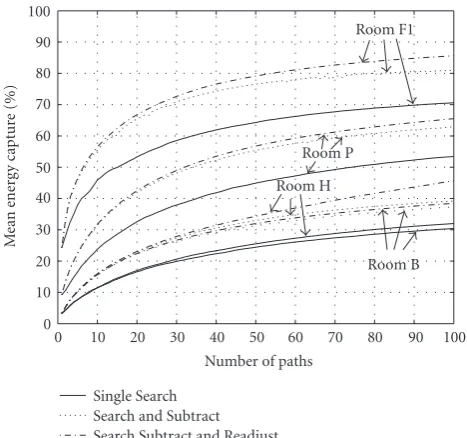
It is worth mentioning that the three algorithms im-plementing thepeak-detection-based estimatorare originally considered for the estimation of the entire set of parameters Uthat characterize the channel.Figure 5shows their perfor-mance in terms of theenergy capture[12,29] defined as
EC(τ,c,N)=1− S(τ,c) (1/M)$Mi=1|ri|2
, (27)
10 9 8 7 6 5 4 3 2 1 0
St
d
d
ev
iation
of
T
o
A
estimation
er
ror
(ns)
0 10 20 30 40 50 60 70 80 90 100
Number of paths Room F1 (a)
Room F1 (b) Room F1 (c) Room P (a) Room P (b) Room P (c)
Room H (a) Room H (b) Room H (c) Room B (a) Room B (b) Room B (c)
Figure4: Standard deviation of the ToA estimation error versus number of paths in rooms P, H, B, and F1 for the three algorithms: single search (a), search and subtract (b), and search subtract and readjust (c).
in all three algorithms. Thesearch subtract and readjust al-gorithm gives almost exactly the same results as the search and subtract in the ToA estimation. Thesingle search algo-rithm, though showing the same general trend forμandσ, is better in the “direct LOS” and “high SNR” cases, while it yields worse results in the “low SNR” and “extreme-low SNR” cases.
4.2.2. Thresholding-based estimator performance
Figures6and7show theQvalues(i)as a function of the thresholdλfor measurements made in different rooms. For every λ in each room there are Q crosses (corresponding to each measurement location). The crosses give an idea of how much the ToA estimation error is spread out around the mean, which is represented by the superimposed line in the plots. Three regions in the behavior ofμcan be recognized with respect to the increasing threshold.
(i) For small values ofλ, similar behaviors of the param-eterμcan be observed in the different SNR environ-ments. The mean assumes negative values, since there is a high probability that an erroneous path corre-sponding to noise is estimated as the first arriving path. This phenomenon is clearly stronger in the “low SNR” and “extreme-low SNR” cases; in fact, in the “direct LOS” and “high SNR” cases, the noise floor is negli-gible, thus the actual direct path is represented by a strong component in the multipath profile, which can be detected with a high probability.
100 90 80 70 60 50 40 30 20 10 0
M
ean
energ
y
cap
tur
e
(%)
0 10 20 30 40 50 60 70 80 90 100
Number of paths
Room F1
Room P Room H
Room B
Single Search Search and Subtract Search Subtract and Readjust
Figure5: Receiver’s captured energy averaged on the 49 points of the grid versus number of paths in rooms P, H, B, and F1 for the three algorithms: single search, search and subtract, and search sub-tract and readjust.
(ii) As the threshold increases,μincreases, assuming val-ues around zero.
(iii) For large values of λ, the mean increases under any SNR conditions for the following two reasons: the first path is missed and other paths above the threshold are detected, or no peaks above the threshold are found. In the latter situation,τ1is set to the time location of the highest peak, which does not always coincide with the first path.
The standard deviation of the ToA estimation error as a function of the ratioλ/vmax, wherevmax is the amplitude of the highest peak of the signal over the observation interval Tat the MF output, is plotted inFigure 8. It is worth noting that three regions can be recognized again with slight dif-ferences among the four environments. The standard devi-ation is initially small in the “direct LOS” and “high SNR” cases, while it assumes large values in the “low SNR” and “extreme-low SNR” cases; then, as the threshold increases,σ decreases, reaching the minimum. In such situations, where the mean assumes values around zero and the standard de-viation assumes the minimum value, an optimum operating point can be defined. In fact, the optimum threshold can be determined by choosing the minimum MSE, given by (26). Finally, asλbecomes larger,σincreases under any SNR con-ditions, though it becomes constant when no paths cross the threshold and the time location of the strongest path is cho-sen for the estimate ofτ1.
An important observation can now be made: from
25 20 15 10 5 0 5
Er
ro
r
o
n
T
oA
estimat
e
(ns)
0 0.5 1 1.5 2 2.5 3 3.5
Room F1
Threshold (V) ToA estimation error
Mean of the ToA estimation error
25 20 15 10 5 0 5
Er
ro
r
o
n
T
oA
estimat
e
(ns)
0 0.25 0.5 0.75 1 1.25 1.5 Room P
Threshold (V) ToA estimation error
Mean of the ToA estimation error
Figure6: ToA estimation error versus threshold in the 49 points of the grid in rooms F1 and P (crosses) and mean of the ToA estimation error (line).
80 60 40 20 0 20 40 60
Er
ro
r
o
n
T
oA
estimat
e
(ns)
0 0.05 0.1 0.15 0.2 0.25 0.3 0.35 0.4 0.45 0.5 Room H
Threshold (V) ToA estimation error
Mean of the ToA estimation error
80 60 40 20 0 20 40 60
Er
ro
r
o
n
T
oA
estimat
e
(ns)
0 0.05 0.1 0.15 0.2 0.25 0.3 Room B
Threshold (V) ToA estimation error
Mean of the ToA estimation error
Figure7: ToA estimation error versus threshold in the 49 points of the grid in rooms H and B (crosses) and mean of the ToA estimation error (line).
is given by the following relationship:λ/vmax ∈ (0.25, 0.3). It can also be seen fromFigure 8that, as the SNR decreases, the choice of the optimumλbecomes constrained within an extremely small interval of values, and thus becomes more critical.
4.3. Ranging accuracy
The evaluation of the ranging accuracy requires the trans-lation of the error on the ToA estimation to the error on the distance estimation, through the following relationships:
15 12.5 10 7.5 5 2.5 0
St
d
d
ev
iation
of
T
o
A
estimation
er
ror
(ns)
0 0.2 0.4 0.6 0.8 1 1.2 Threshold / max peak
Room F1 Room P
Room H Room B
Figure8: Standard deviation of the ToA estimation error on the 49 points of the grid versus threshold in rooms P, H, B, and F1.
σρ=ν·σandμρ=ν·μ, whereρ(i)=d(i)−d(i)is the error
on the distance estimation for each of theQpointsiof the grid, andνis the speed of light.
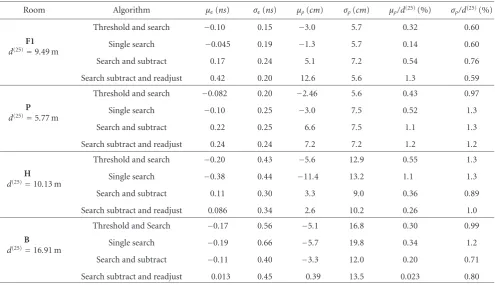
Table1: ToA and distance estimation error in each room for the four algorithms.
Room Algorithm μ(ns) σ(ns) μρ(cm) σρ(cm) μρ/d(25)(%) σρ/d(25)(%)
F1
d(25)=9.49 m
Threshold and search −0.10 0.15 −3.0 5.7 0.32 0.60
Single search −0.045 0.19 −1.3 5.7 0.14 0.60
Search and subtract 0.17 0.24 5.1 7.2 0.54 0.76
Search subtract and readjust 0.42 0.20 12.6 5.6 1.3 0.59
P
d(25)=5.77 m
Threshold and search −0.082 0.20 −2.46 5.6 0.43 0.97
Single search −0.10 0.25 −3.0 7.5 0.52 1.3
Search and subtract 0.22 0.25 6.6 7.5 1.1 1.3
Search subtract and readjust 0.24 0.24 7.2 7.2 1.2 1.2
H
d(25)=10.13 m
Threshold and search −0.20 0.43 −5.6 12.9 0.55 1.3
Single search −0.38 0.44 −11.4 13.2 1.1 1.3
Search and subtract 0.11 0.30 3.3 9.0 0.36 0.89
Search subtract and readjust 0.086 0.34 2.6 10.2 0.26 1.0
B
d(25)=16.91 m
Threshold and Search −0.17 0.56 −5.1 16.8 0.30 0.99
Single search −0.19 0.66 −5.7 19.8 0.34 1.2
Search and subtract −0.11 0.40 −3.3 12.0 0.20 0.71
Search subtract and readjust 0.013 0.45 0.39 13.5 0.023 0.80
Table 1 shows the numerical results for the mean and standard deviation of the ToA and distance estimation error obtained from room F1, room P, room H, and room B. It summarizes the performance of the four algorithms at the optimum operating point of the parametersλandN.
In general, only slight differences can be observed in the performance of the algorithms. However, it is interesting to note that in the “direct LOS” and “high SNR” cases the threshold and searchandsingle searchgive better results than the other algorithms; while in the “extreme-low SNR” and “low SNR” cases, thesearch and subtractandsearch subtract and readjustare superior. Thus, when the operating environ-ment is good in terms of SNR, it is sufficient to use the thresh-old and search or thesingle search algorithms, which have very low complexity. However, in an environment with worse SNR conditions, thesearch and subtractandsearch subtract and readjustcan be used to reach a reasonable ranging accu-racy, in spite of the higher complexity. Moreover, the last two columns ofTable 1 show the values of mean and standard deviation of distance estimation error as a fraction of the to-tal distance between the transmitter and the receiver in each room. It can be noted that a slight performance degradation exists when moving from the “direct LOS” case in room F1 to the NLOS cases in the other rooms. However, there is not a noticeable degradation of the ranging accuracy with the in-creasing distance. In fact, in rooms P, H, and B, where the distance between the transmitter and the receiver is approx-imately 6 meters, 10 meters, and 17 meters, respectively, the performance of the algorithms in terms of ranging accuracy shows only a negligible degradation. This highlights the fact
that the impact of multipath and walls on the ToA estimation is larger than the SNR loss due to distance.
In order to better analyze the performance of the pro-posed algorithms with respect to the effects of noise and multipath, the excessive propagation delay, due to blocked LOS conditions, has been subtracted from our ToA estimates. Since the absolute propagation delays of the received sig-nals are different in each room, a delay reference is necessary to analyze the excessive propagation delays. In particular, we calculated the time offset,Δτ, between the ideal time of arrival, given byτ1=d/ν, wheredis the distance between the transmitter and the receiver, and the actual time of arrival, given by the time location of the first arriving peak in the re-ceived signal, in each room. Then, we assumed the absolute propagation delay of room F1, that is, the delay of the direct LOS path, as the delay reference, takingΔτF1 = 0. The fol-lowing values have been found for the excessive propagation delays of the other rooms: ΔτP = 2 ns,ΔτH = 3.7 ns, and
ΔτB = 3.7 ns. Even if the distance between the transmitter
and the receiver in room B is larger than in room H, they are characterized by the sameΔτ, because the number of ob-stacles is about the same. The results of this work show that the effects of noise and multipath on ranging error could be smaller than those of NLOS propagation delay if the estima-tor parameters, that is,Nin thepeak-detection-based estima-torandλin thethresholding-based estimator, have been op-timized. It can be noted from Figures2–4 and Figures6–8
the parameters N andλ do not assume the optimum val-ues. The schemes proposed in this paper provide a solution to the problem of reducing the ranging error due to noise and multipath effects, making it smaller than that due to NLOS effects. Moreover, it is worth noting that the choice of the optimum parameters is less critical in the algorithms with a higher complexity.
5. CONCLUSION
A ToA estimation algorithm implementing a conventional threshold-based estimator and three algorithms implement-ing an ML estimator based on a peak detection process have been studied in this paper using experimental data. Per-formance analysis underlines the fact that a good channel parameter estimator does not always provide noticeable gains over the conventional threshold-based estimator. The variations in their performance are strongly influenced by the propagation environment; hence, the trade-offbetween ranging accuracy, algorithm complexity, and sensitivity of the parameters’ optimization to propagation conditions be-comes an important issue.
For instance, results show that the low complexity thresh-old-based estimator gives an estimation accuracy close to that obtained using more complex schemes in the case of a high SNR; however, the threshold choice appears much more critical depending on the propagation conditions.
Beyond the numerical values, this paper shows some im-portant results. The presence of noise and multipath gener-ates ambiguities in the ToA estimate, mainly due to the fact that the direct path is not always the strongest one. This has fundamental consequences: a significant bias and variance are introduced in the ToA estimation.
In order to reduce the ToA estimation bias, thereby pro-viding a good ToA estimator, an optimization process of one parameter is necessary. In fact, together with noise, the presence of multipath may lead to a biased ToA estima-tion even in a high SNR environment, if the threshold (in thethresholding-based estimator) or the number of paths (in the peak-detection-based estimator) is not properly chosen. In this case, the increased ranging estimation bias may be greater than that produced by the extra propagation delay due to blocked LOS conditions, if present.
ACKNOWLEDGMENTS
The first author would like to thank Professors E. Del Re and L. Mucchi from the University of Florence for giving the opportunity to visit MIT. The second author would like to thank Professors O. Andrisano and M. Chiani for their support. This research was supported, in part, by the Min-istero dell’ Istruzione, Universit`a e della Ricerca Scientifica (MIUR), under the Virtual Immersive Communications (VI-Com) project, the Institute of Advanced Study Natural Sci-ence & Technology Fellowship, the Charles Stark Draper Lab-oratory Robust Distributed Sensor Networks Program, the Office of Naval Research Young Investigator Award N00014-03-1-0489, and the National Science Foundation under Grant ANI-0335256.
REFERENCES
[1] M. Z. Win, “A unified spectral analysis of generalized time-hopping spread-spectrum signals in the presence of timing jit-ter,”IEEE Journal on Selected Areas in Communications, vol. 20, no. 9, pp. 1664–1676, 2002.
[2] M. Z. Win and R. A. Scholtz, “Ultra-wide bandwidth time-hopping spread-spectrum impulse radio for wireless multiple-access communications,”IEEE Transactions on
Communica-tions, vol. 48, no. 4, pp. 679–689, 2000.
[3] M. Z. Win and R. A. Scholtz, “Impulse radio: how it works,”
IEEE Communications Letters, vol. 2, no. 2, pp. 36–38, 1998.
[4] M. Z. Win and R. A. Scholtz, “On the robustness of ultra-wide bandwidth signals in dense multipath environments,” IEEE
Communications Letters, vol. 2, no. 2, pp. 51–53, 1998.
[5] D. Cassioli, M. Z. Win, and A. F. Molisch, “The ultra-wide bandwidth indoor channel: from statistical model to simu-lations,”IEEE Journal on Selected Areas in Communications, vol. 20, no. 6, pp. 1247–1257, 2002.
[6] C.-C. Chong and S. K. Yong, “A generic statistical-based UWB channel model for high-rise apartments,”IEEE Transactions on
Antennas and Propagation, vol. 53, no. 8, pp. 2389–2399, 2005.
[7] C.-C. Chong, Y.-E. Kim, S. K. Yong, and S.-S. Lee, “Statistical characterization of the UWB propagation channel in indoor residential environment,”Wireless Communications and
Mo-bile Computing, vol. 5, no. 5, pp. 503–512, 2005.
[8] K. Pahlavan, X. Li, and J.-P. M¨akel¨a, “Indoor geolocation science and technology,” IEEE Communications Magazine, vol. 40, no. 2, pp. 112–118, 2002.
[9] R. J. Fontana and S. J. Gunderson, “Ultra-wideband precision asset location system,” inProceedings of IEEE Conference on
Ultra Wideband Systems and Technologies, pp. 147–150,
Bal-timore, Md, USA, May 2002.
[10] D. Dardari, “Pseudo-random active UWB reflectors for accu-rate ranging,”IEEE Communication Letters, vol. 8, no. 10, pp. 608–610, 2004.
[11] K. Yu and I. Oppermann, “Performance of UWB position es-timation based on time-of-arrival measurements,” in Proceed-ings of International Workshop on Ultra Wideband Systems; Joint with Conference on Ultrawideband Systems and
Tech-nologies (Joint UWBST & IWUWBS ’04), pp. 400–404, Kyoto,
Japan, May 2004.
[12] M. Z. Win and R. A. Scholtz, “Characterization of ultra-wide bandwidth wireless indoor channels: a communication-theoretic view,”IEEE Journal on Selected Areas in
Communica-tions, vol. 20, no. 9, pp. 1613–1627, 2002.
[13] V. Lottici, A. D’Andrea, and U. Mengali, “Channel estimation for ultra-wideband communications,”IEEE Journal on Selected
Areas in Communications, vol. 20, no. 9, pp. 1638–1645, 2002.
[14] H. Boujemaa and M. Siala, “On a maximum likelihood de-lay acquisition algorithm,” inProceedings of IEEE International
Conference on Communications (ICC ’01), vol. 8, pp. 2510–
2514, Helsinki, Finland, June 2001.
[15] J.-Y. Lee and R. A. Scholtz, “Ranging in a dense multipath en-vironment using an UWB radio link,”IEEE Journal on Selected
Areas in Communications, vol. 20, no. 9, pp. 1677–1683, 2002.
[16] L. Dumont, M. Fattouche, and G. Morrison, “Super-resolution of multipath channels in a spread spectrum location system,”Electronics Letters, vol. 30, no. 19, pp. 1583– 1584, 1994.
[17] X. Li and K. Pahlavan, “Super-resolution TOA estimation with diversity for indoor geolocation,”IEEE Transactions on
[18] E. R. J`ativa and J. Vidal, “First arrival detection for positioning in mobile channels,” inProceedings of 13th IEEE International Symposium on Personal, Indoor and Mobile Radio
Communi-cations (PIMRC ’02), vol. 4, pp. 1540–1544, Lisbon, Portugal,
September 2002.
[19] I. Maravic and M. Vetterli, “Low-complexity subspace meth-ods for channel estimation and synchronization in ultrawide-band systems,” in Proceedings of International Workshop on
Ultra Wideband Systems (IWUWB ’03), pp. 1–5, Oulu,
Fin-land, June 2003.
[20] W. Suwansantisuk, M. Z. Win, and L. A. Shepp, “On the per-formance of wide-bandwidth signal acquisition in dense mul-tipath channels,”IEEE Transactions on Vehicular Technology, vol. 54, no. 5, pp. 1584–1594, 2005.
[21] Y. Jeong, H. You, and C. Lee, “Calibration of NLOS er-ror for positioning systems,” in Proceedings of IEEE 53rd
Vehicular Technology Conference (VTC ’01), vol. 4, pp. 2605–
2608, Rhodes, Greece, May 2001.
[22] P.-C. Chen, “A non-line-of-sight error mitigation algorithm in location estimation,” in Proceedings of IEEE Wireless
Communications and Networking Conference (WCNC ’99),
vol. 1, pp. 316–320, New Orleans, La, USA, September 1999. [23] B. Denis, J. Keignart, and N. Daniele, “Impact of NLOS
prop-agation upon ranging precision in UWB systems,” in Proceed-ings of IEEE Conference on Ultra Wideband Systems and
Tech-nologies (UWBST ’03), pp. 379–383, Reston, Va, USA,
Novem-ber 2003.
[24] M. P. Wylie-Green and S. S. Wang, “Robust range estimation in the presence of the non-line-of-sight error,” inProceedings
of IEEE 54th Vehicular Technology Conference (VTC ’01), vol. 1,
pp. 101–105, Rhodes, Greece, May 2001.
[25] D. Dardari, C.-C. Chong, and M. Z. Win, “Analysis of threshold-based TOA estimators in UWB channels,” in Pro-ceedings of 14th European Signal Processing Conference
(EU-SIPCO ’06), Florence, Italy, September 2006.
[26] I. Guvenc and Z. Sahinoglu, “Threshold-based TOA estima-tion for impulse radio UWB systems,” inProceedings of IEEE
International Conference on Ultra-Wideband (ICU ’05), pp.
420–425, Zurich, Switzerland, September 2005.
[27] J. P. Ianniello, “Large and small error performance limits for multipath time delay estimation,”IEEE Transactions on
Acous-tics, Speech, and Signal Processing, vol. 34, no. 2, pp. 245–251,
1986.
[28] H. l. Van Trees,Detection, Estimation and Modulation Theory, John Wiley & Sons, New York, NY, USA, 2001.
[29] M. Z. Win and R. A. Scholtz, “On the energy capture of ul-trawide bandwidth signals in dense multipath environments,”
IEEE Communications Letters, vol. 2, no. 9, pp. 245–247, 1998.
Chiara Falsi received the Laurea degree in electronic engineering from the Univer-sity of Florence, Florence, Italy, in 2005. From September 2004 to April 2005 she was a visiting student at Laboratory for In-formation and Decision Systems (LIDS), MIT, Cambridge, Mass, working on ultra-wide bandwidth signal processing. She fo-cused her research activity on channel parameters and range estimation to
pre-pare her thesis. In 2005, after receiving the degree, she be-came a Fellow at the Consorzio Nazionale Interuniversitario per le Telecomunicazioni (CNIT), Florence, Italy. In collabora-tion with the Electronic and Communicacollabora-tion Department (DET)
of the University of Florence, she was involved in the research on security and privacy issues in wireless systems.
Davide Dardari received his Laurea de-gree in electronic engineering (summa cum laude) and his Ph.D. in electronic engineer-ing and computer science from the Univer-sity of Bologna, Italy, in 1993 and 1998, re-spectively. He has collaborated and taken a significant role in several national and Eu-ropean projects. From 2000 until 2005, he has been a Research Associate at the Uni-versity of Bologna. He held the position
of lecturer and contract Professor of electrical communications and digital transmission and telecommunications systems at the same university. Now he is Associate Professor at the University of Bologna at Cesena, Cesena (FC), Italy. During the winter of 2005 he was researching as Research Affiliate at Massachusetts Institute of Technology (MIT), Cambridge, USA. His research interests are in OFDM systems, ultra-wide bandwidth communication and lo-calization, wireless sensor networks, wideband wireless LAN. He serves IEEE as Editor for IEEE Transactions on Wireless Commu-nications and as TPC Member for the Wireless CommuCommu-nications Symposium at IEEE International Conference on Communications (ICC 2004 - ICC 2006) and PIMRC 2006. He is Cochair of the International Conference on Ultra-Wideband (ICUWB 2006) and ICC 2007 Wireless Communications Symposium.
Lorenzo Mucchi was born in Rome, Italy, in 1971. He received the Dr. Ing. Degree (Laurea) in telecommunications engineer-ing from the University of Florence, Italy, in 1998 and the Ph.D. in telecommunica-tions and information society in 2001. Since 2001 he has been with the Department of Electronics and Telecommunications of the University of Florence, Italy, as a Research Scientist. During the academic year
2000-2001, he spent a 12-month period of research at the Centre for Wireless Communications, University of Oulu, Oulu, Finland. His main research areas are spread spectrum techniques, adaptive fil-ters, CDMA communication systems and satellite communica-tions. He is actually involved in the ultra-wide-band systems and space-time codes and diversity techniques for terrestrial and satel-lite communications research area. He is also involved in several national and international projects. He has published a chapter in an international book and several papers (43) in international jour-nals and conferences during his research activity. He is member of the International Association of Science and Technology for Devel-opment (IASTED) Technical Committee on Telecommunications for the term 2002-2005. He is professor of Telematics (Telecommu-nications and Informatics) at the University of Florence. He is also a full member of the Institute of Electrical and Electronics Engineers (IEEE).