R E S E A R C H
Open Access
Distance-based features in pattern classification
Chih-Fong Tsai
1, Wei-Yang Lin
2*, Zhen-Fu Hong
1and Chung-Yang Hsieh
2Abstract
In data mining and pattern classification, feature extraction and representation methods are a very important step since the extracted features have a direct and significant impact on the classification accuracy. In literature, numbers of novel feature extraction and representation methods have been proposed. However, many of them only focus on specific domain problems. In this article, we introduce a novel distance-based feature extraction method for various pattern classification problems. Specifically, two distances are extracted, which are based on (1) the distance between the data and its intra-cluster center and (2) the distance between the data and its extra-cluster centers. Experiments based on ten datasets containing different numbers of classes, samples, and dimensions are examined. The experimental results using naïve Bayes,k-NN, and SVM classifiers show that concatenating the original features provided by the datasets to the distance-based features can improve classification accuracy except image-related datasets. In particular, the distance-based features are suitable for the datasets which have smaller numbers of classes, numbers of samples, and the lower dimensionality of features. Moreover, two datasets, which have similar characteristics, are further used to validate this finding. The result is consistent with the first experiment result that adding the distance-based features can improve the classification performance.
Keywords:distance-based features, feature extraction, feature representation, data mining, cluster center, pattern classification
1. Introduction
Data mining has received unprecedented focus in the recent years. It can be utilized in analyzing a huge amount of data and finding valuable information. Parti-cularly, data mining can extract useful knowledge from the collected data and provide useful information for making decisions [1,2]. With the rapid increase in the size of organizations’databases and data warehouses, developing efficient and accurate mining techniques have become a challenging problem.
Pattern classification is an important research topic in the fields of data mining and machine learning. In particu-lar, it focuses on constructing a model so that the input data can be assigned to the correct category. Here, the model is also known as a classifier. Classification techni-ques, such as support vector machine (SVM) [3], can be used in a wide range of applications, e.g., document classi-fication, image recognition, web mining, etc. [4]. Most of the existing approaches perform data classification based on a distance measure in a multivariate feature space.
Because of the importance of classification techniques, the focus of our attention is placed on the approach for improving classification accuracy. For any pattern classi-fication problem, it is very important to choose appro-priate or representative features since they have a direct impact on the classification accuracy. Therefore, in this article, we introduce novel distance-based features to improve classification accuracy. Specifically, the dis-tances between the data and cluster centers are consid-ered. This leads to the intra-cluster distance between the data and the cluster center in the same cluster, and the extra-cluster distance between the data and other cluster centers.
The idea behind the distance-based features is to extend and take the advantage of the centroid-based classification approach [5], i.e., all the centroids over a given dataset usually have their discrimination capabil-ities for distinguishing data between different classes. Therefore, the distance between a specific data and its nearest centroid and other distances between the data and other centroids should be able to provide valuable information for classification.
This rest of the article is organized as follows. Section 2 briefly describes feature selection and several * Correspondence: [email protected]
2
Department of Computer Science and Information Engineering, National Chung Cheng University, Min-Hsiung Chia-Yi, Taiwan
Full list of author information is available at the end of the article
classification techniques. Related work focusing on extracting novel features is reviewed. Section 3 intro-duces the proposed distance-based feature extraction method. Section 4 presents the experimental setup and results. Finally, conclusion is provided in Section 5.
2. Literature review 2.1. Feature selection
Feature selection can be considered as a combination optimization problem. The goal of feature selection is to select the most discriminant features from the original features [6]. In many pattern classification problems, we are often confronted with the curse of dimensionality, i.e., the raw data contain too many features. Therefore, it is a common practice to remove redundant features so that efficiency and accuracy can be improved [7,8].
To perform appropriate feature selection, the follow-ing considerations should be taken into account [9]:
1. Accuracy: Feature selection can help us exclude irrelevant features from the raw data. These irrele-vant features usually have a disrupting effect on the classification accuracy. Therefore, classification accu-racy can be improved by filtering out the irrelevant features.
2. Operation time: In general, the operation time is proportional to the number of selected features. Therefore, we can effectively improve classification efficiency using feature selection.
3.Sample size: The more samples we have, the more features can be selected.
4. Cost: Since it takes time and money to collect data, excessive features would definitely incur addi-tional cost. Therefore, feature selection can help us to reduce the cost in collecting data.
In general, there are two approaches for dimensionality reduction, namely, feature selection and feature extraction. In contrast to the feature selection, feature extraction per-forms transformation or combination on the original fea-tures [10]. In other words, feature selection finds the best feature subset from the original feature set. On the other hand, feature extraction projects the original feature to a subspace where classification accuracy can be improved.
In literature, there are many approaches for dimen-sionality reduction. principal component analysis (PCA) is one of the most widely used techniques to perform this task [11-13].
The origin of PCA can be traced back to 1901 [14] and it is an approach for multivariate analysis. In a real-world application, the features from different sources are more and less correlated. Therefore, one can develop a more efficient solution by taking these correlations into account. The PCA algorithm is based on the correlation
between features and finds a lower-dimensional subspace where covariance is maximized. The goal of PCA is to use a few extracted features to represent the distribution of the original data. The PCA algorithm can be summar-ized in the following steps:
1. Compute the mean vectorμand the covariance
matrixSof the input data.
2. Compute the eigenvalues and eigenvectors ofS. The eigenvalues and the corresponding eigenvectors are sorted according the eigenvalues.
3. The transformation matrix contains the sorted eigenvectors. The number of eigenvectors preserved in the transformation matrix can be adjusted by users.
4. A lower-dimensional feature vector is obtained by subtracting the mean vectorμfrom an input datum and then multiplied by the projection matrix.
2.2. Pattern clustering
The aim of clustering analysis is to find groups of data samples having similar properties. This is an unsuper-vised learning method because it does not require the category information associated with each sample [15]. In particular, the clustering algorithms can be divided into five categories [16], namely, hierarchical, partitioning, density-based, grid-based, and model-based methods.
Thek-means algorithm is a representative approach belonging to the partition method. In addition, it is a sim-ple, efficient, and widely used clustering method. Givenk
clusters, each sample is randomly assigned to a cluster. By doing so, we can find the initial locations of cluster cen-ters. We can then reassign each sample to the nearest cluster center. After the reassignment, the locations of cluster centers should be updated. The previous steps are iterated until some termination condition is satisfied.
2.3. Pattern classification
The goal of pattern classification is to predict the cate-gory of the input data using its attributes. In particular, a certain number of training samples are available for each class, and they are used to train the classifier. In addition, each training sample is represented by a number of mea-surements (i.e., feature vectors) corresponding to a speci-fic class. This can be called as supervised learning [15,17]. In this article, we will utilize three popular classification techniques, namely, naïve Bayes, SVMs, andk-nearest neighbor (k-NN), to evaluate the proposed distance-based features.
2.3.1. Naïve Bayes
derive‘optimal’decision/classification rules. It can be used to represent the dependence between random variables (features) and to give a concise and tractable specification of the joint probability distribution for a domain. It is con-structed using the training data to estimate the probability of each class given the feature vectors of a new instance. Given an example represented by the feature vectorX, the Bayes’theorem provides a method to compute the prob-ability thatXbelongs to classCi, denoted asp(Ci|X):
P(Ci|X) = N
j=1
P(xj|Ci) (1)
i.e., the naïve Bayes classifier learns the conditional probability of each attributexj(j= 1,2,...,N) of X given
the class labelCi. Therefore, the classification problem
can be stated as ‘given a set of observed features xj,
from an objectX, classifyXinto one of the classes. 2.3.2. Support vector machines
A SVM [3] has widely been applied in many pattern classification problems. It is designed to separate a set of training vectors which belong to two different classes, (x1, y1), (x2,y2),...,(xm, ym) wherexiÎRddenotes vectors
in a d-dimensional feature space and yiÎ {-1, +1} is a
class label. In particular, the input vectors are mapped into a new higher dimensional feature space denoted as F: Rd®Hf where d <f. Then, an optimal separating hyperplane in the new feature space is constructed by a kernel function,K(xi, xj) which products between input
vectorsxiand xjwhereK(xi, xj) =F(xi)F(xj).
All vectors lying on one side of the hyperplane are labeled‘-1’, and all vectors lying on the other side are labeled‘+1’. The training instances that lie closest to the hyperplane in the transformed space are called support vectors.
2.3.3. K-nearest neighbor
Thek-NN classifier is a conventional non-parametric classifier [15]. To classify an unknown instance repre-sented by some feature vectors as a point in the feature
space, the k-NN classifier calculates the distances
between the point (i.e., the unknown instance) and the points in the training dataset. Then, it assigns the point to the class among itsk-NNs (wherekis an integer).
In the process of creating a k-NN classifier, kis an important parameter and differentkvalues will cause dif-ferent performances. Ifkis considerably huge, the neigh-bors which used for classification will make large classification time and influence the classification accuracy.
2.4. Related work of feature extraction
In this study, the main focus is placed on extracting novel distance-based features so that classification accu-racy can be improved. The followings summarize some
related studies proposing new feature extraction and representation methods for some pattern classification problems. In addition, the contributions of these research works are briefly discussed.
Tsai and Lin [18] propose a triangle area-based near-est neighbor approach and apply it to the problem of intrusion detection. Each data are represented by a number of triangle areas as its feature vectors, in which a triangle area is based on the data, its cluster center, and one of the other clusters. Their approach achieves high detection rate and low false positive rate on the KDD-cup99 dataset.
Lin [19] proposes an approach called centroid-based and nearest neighbor (CANN). This approach uses cluster cen-ters and their nearest neighbors to yield a one-dimensional feature and can effectively improve the performance of an intrusion detection system. The experimental results over the KDD CUP 99 dataset indicate that CANN can improve the detection rate and reduce computational cost. Zeng et al. [20] propose a novel feature extraction method based on Delaunay triangle. In particular, a topological structure associated with the handwritten shape can be represented by the Delaunay triangle. Then, an HMM-based recognition system is used to demonstrate that their representation can achieve good performance in the handwritten recognition problem.
Xue et al. [21] propose a Bayesian shape model for facial feature extraction. Their model can tolerate local and glo-bal deformation on a human face. The experimental results demonstrate that their approach provides better accuracy in locating facial features than the active shape model.
Choi and Lee [22] propose a feature extraction method based on the Bhattacharyya distance. They consider the classification error as a criterion for extracting features and an iterative gradient descent algorithm is utilized to minimize the estimated classification error. Their feature extraction method performs favorably with conventional methods over remotely sensed data.
To sum up, the limitations of much related work extracting novel features are that they only focuses on sol-ving some specific domain problem. In addition, they use their proposed features to directly compare with original features in terms of classification accuracy and/or errors, i. e., they do not consider‘fusing’the original and novel fea-tures as another new feature representation for further comparisons. Therefore, the novel distance-based features proposed in this article are examined over a number of different pattern classification problems and the distance-based features and the original features are concatenated for another new feature representation for classification.
3. Distance-based features
features to the raw data so that the classification accu-racy can be improved.
3.1. The extraction process
The proposed distance-based feature extraction method can be divided into three main steps. In the first step, given a dataset the cluster center or centroid for every class is identified. Then, for the second step, the dis-tances between each data sample and the centroids are calculated. The final step is to extract two distance-based features, which are calculated in the second step. The first distance-based feature means the distance between the data sample and its cluster center. The sec-ond one is the sum of the distances between the data sample and other cluster centers.
As a result, each of the data samples in the dataset can be represented by the two distance-based features. There are two strategies to examine the discrimination power of these two distance-based features. The first one is to use the two distance-based features alone for classification. The second one is to combine the original features with the new distance-based features as a longer feature vectors for classification.
3.2. Cluster center identification
To identify the cluster centers from a given dataset, the
k-means clustering algorithm is used to cluster the
input data in this article. It is noted that the number of clusters is determined by the number of classes or cate-gories in the dataset. For example, if the dataset is con-sisted of three categories, then the value ofk in thek -means algorithm is set to 3.
3.3. Distances from intra-cluster center
After the cluster center for each class is identified, the distance between a data sample and its cluster center (or intra-cluster center) can be calculated. In this article, the Euclidean distance is utilized. Given two data points
A= [a1, a2,...,an] andB= [b1,b2,...,bn], the Euclidean
dis-tance betweenAand Bis given by
dis(A,B) =
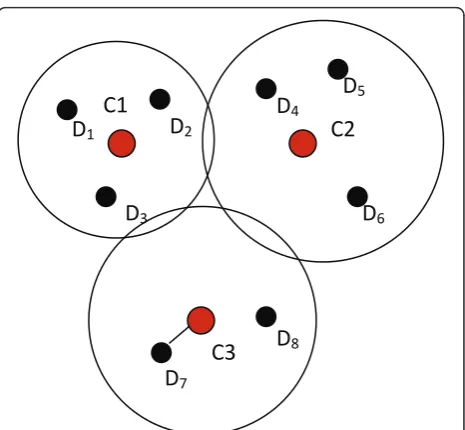
(a1−b1)2+ (a2−b2)2+ ... + (an−bn(2))2 Figure 1 shows an example for the distance between a data sample and its cluster center, where cluster centers are denoted by {Cj|j = 1, 2, 3} and data samples are
denoted by {Di|i = 1,2,...,8}. In this example, data point D7 is assigned to the third cluster (C3) by thek-means
algorithm. As a result, the distance fromD7 to its
intra-cluster center (C3) is determined by the Euclidean
dis-tance fromD7 toC3.
In this article, we will utilize the distance between a data sample and its intra-cluster center as a new feature,
called Feature 1. Given a datumDibelonging toCj, its
Feature 1 is given by
Feature 1 =dis(Di,Cj) (3)
where dis(Di, Cj) denotes the Euclidean distance from DitoCj.
3.4. Distances from extra-cluster center
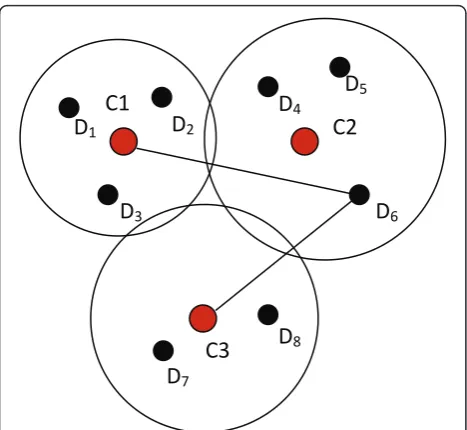
On the other hand, we also calculate the sum of the dis-tances between the data sample and its extra-cluster centers and use them as the second features. Let us look at the graphical example shown in Figure 2, where clus-ter cenclus-ters are denoted by {Cj|j= 1, 2, 3} and data
sam-ples are denoted by {Di|i = 1,2,...,8}. Since the datumD6
is assigned to the second cluster (C2) by the k-means
algorithm, the distance between D6 and its extra-cluster
centers include dis(D6,C1) and dis(D6,C3).
Here, we define another new feature, called Feature 2, as the sum of the distances between a data sample and its extra-cluster centers. Given a datumDi belonging to Cj, its Feature 2 is given by
Feature2 =
k
j=1
dis(Di,Cj)−Feature 1 (4)
wherekis the number of clusters identified, dis(Di, Cj)
denotes the Euclidean distance fromDitoCj.
3.5. Theoretical analysis
To justify the use of the distance-based features, it is necessary to analyze their impacts on classification
C1
C2
C3
D1
D2
D3
D4
D5
D6
D7
D8
accuracy. For the sake of simplicity, let us consider the results when the proposed features are applied to two-category classification problems. The generalization of these results to multi-category cases is straightforward, though much more involved. The classification accuracy can readily be evaluated if the class-conditional densities
p(x|Ck) 2
k=1 are multivariate normal with identical
covariance matrices, i.e.,
p(x|Ck)∼N(μ(k),), (5) wherex is a d-dimensional feature vector,μ(k)is the mean vector associated with class k, and∑ is the covar-iance matrix. If the prior probabilities are equal, it fol-lows that the Bayes error rate is given by
P(e)= √1 2π
∞
r/2
e−u2/2du, (6)
whereris the Mahalanobis distance:
r=μ(1)−μ(2) T−1μ(1)−μ(2) . (7) In cased features are conditionally independent, the Mahalanobis distance between two means can be simpli-fied to
r=
d
i=1
μ(1)
i −μ
(2)
i 2
σ2
i
, (8)
whereμ(ik)denotes the mean of theith feature belong-ing to class k, and σ2
i denotes the variance of theith feature. This shows that adding a new feature, whose mean values for two categories are different, can help to reduce error rate.
Now we can calculate the expected values of the pro-posed features and see what the implications of this result are for the classification performance. We know that Feature 1 is defined as the distance between each data point and its class mean, i.e.,
Feature 1 =
x−µ(k)
T x−µ(k)
=
d
i=1
xi−μ(ik) 2
.
(9)
Thus, the mean of Feature 1 is given by
E[Feature 1]=
d
i=1
E
xi−μ(ik) 2
=Tr(k).
(10)
This reveals that the mean value of Feature 1 is deter-mined by the trace of the covariance matrix associated with each category. In practical applications, the covar-iance matrices are generally different for each category. Naturally, one can expect to improve classification accu-racy by augmenting Feature 1 to the raw data. If the class-conditional densities are distributed more differ-ently, then the Feature 1 will contribute more to redu-cing error rate.
Similarly, Feature 2 is defined as the sum of the dis-tances from a data point to the centroids of other cate-gories. Given a data point x belonging to class k, we obtain
Feature 2 =
=k
x−μ()Tx−μ()
=
=k
x−μ(k)+μ(k)−μ()Tx−μ(k)+μ(k)−μ()
=
=k
x−μ(k)Tx−μ(k)+ 2x−μ(k)Tμ(k)−μ()
+
μ(k)−μ()Tμ(k)−μ()
(11)
This allows us to write the mean of Feature 2 as
E[Feature 2]=(K−1)Tr
(k)+
=k
μ(k)−μ()2,
(12)
where K denotes the number of categories and ||·||
denotes the L2 norm. As mentioned before, the first
term in Equation 12 usually differs for each category. On the other hand, the distances between class means
C1
C2
C3
D1
D2
D3
D4
D5
D6
D7
D8
are unlikely to be identical in real-world applications and thus the second term in Equation 12 tends to be different for different classes. So, we may conclude that Feature 2 also contributes to reducing the probability of classification error.
4. Experiments 4.1. Experimental setup 4.1.1. The datasets
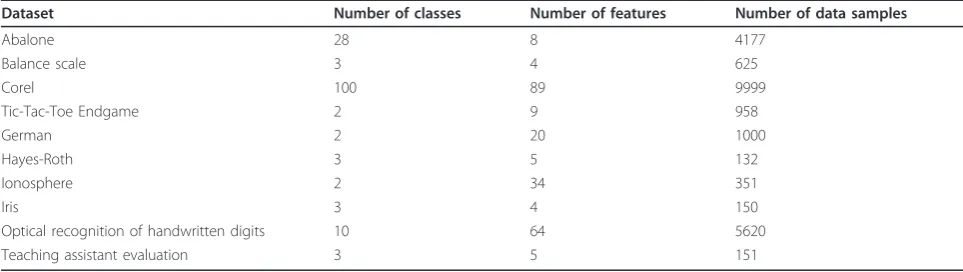
To evaluate the effectiveness of the proposed distance-based features, ten different datasets from UCI Machine Learning Repository http://archive.ics.uci.edu/ml/index. html are considered for the following experiments. They are Abalone, Balance Scale, Corel, Tic-Tac-Toe End-game, German, Hayes-Roth, Ionosphere, Iris, Optical Recognition of Handwritten Digits, and Teaching Assis-tant Evaluation. More details regarding the downloaded datasets, including the number of classes, the number of data samples, and the dimensionality of feature vectors, are summarized in Table 1.
4.1.2. The classifiers
For pattern classification, three popular classification
algorithms are applied, which are SVM, k-NN, naïve
Bayes. These classifiers are trained and tested by tenfold cross validation. One research objective is to investigate whether different classification approaches could yield consistent results. It is worth noting that the parameter values associated with each classifier have a direct impact on the classification accuracy. To perform a fair comparison, one should carefully choose appropriate parameter values to construct a classifier. The selection of the optimum parameter value for these classifiers is described below.
For SVM, we utilized the LibSVM package [23]. It has been documented in the literature that radial basis func-tion (RBF) achieves good classificafunc-tion performances in a wide range of applications. For this reason, RBF is used as the kernel function to construct the SVM classi-fier. In RBF, five gamma (’g’) values, i.e., 0, 0.1, 0.3, 0.5, and 1 are examined, so that the best SVM classifier,
which provides the highest classification accuracy, can be identified.
For the k-NN classifier, the choice of k is a critical step. In this article, the kvalues from 1 to 15 are exam-ined. Similar to SVM, the value of k with the highest classification accuracy is used to compare with SVM and naïve Bayes.
Finally, the parameter values of naïve Bayes, i.e., mean and covariance of Gaussian distribution, are estimated by maximum likelihood estimators.
4.2. Pre-test analyses
4.2.1. Principal component analysis
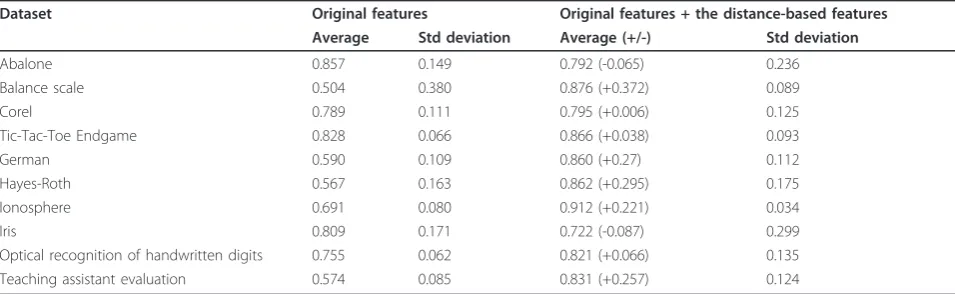
Before examining the classification performance, PCA [24] is used to analyze the level of variance (i.e., discri-mination power) of the proposed distance-based fea-tures. In particular, the communality, which is the output of PCA, is used to analyze and compare the dis-crimination power of the distance-based features (also called variables here). The communality measures the percent of variance in a given variable explained by all the factors jointly and may be interpreted as the reliabil-ity of the indicator. In this experiment, we use the Eucli-dean distance to calculate the distance-based features. Table 2 shows the analysis result.
Regarding Table 2, adding the distance-based features can improve the discrimination power over most of the chosen datasets, i.e., the average of communalities of using the distance-based features is higher than the one of using the original features alone. In addition, using the distance-based features can provide above 0.7 for the average of communalities.
On the other hand, as the PCA result of Feature 1 is lower than the one of Features, on average standard deviation using distance-based features is slightly higher than using the original features alone. However, since using the two distance-based features can provide a higher level of variance over most of the datasets, they are all together considered in this article as the main research focus.
Table 1 Information of the ten datasets
Dataset Number of classes Number of features Number of data samples
Abalone 28 8 4177
Balance scale 3 4 625
Corel 100 89 9999
Tic-Tac-Toe Endgame 2 9 958
German 2 20 1000
Hayes-Roth 3 5 132
Ionosphere 2 34 351
Iris 3 4 150
Optical recognition of handwritten digits 10 64 5620
4.2.2. Class separability
Furthermore, class separability [25] is considered before examining the classification performance. The class separability is given by
Tr{S−W1SB} (13)
where
SW = k
j=1
i∈Cj
(Di−Dj)(Di−Dj)T (14)
andNjis the number of samples in class Cj, C is the
mean of the total dataset. The class separability is large when the between-class scatter is large and the within-class scatter is small. Therefore, it can be regarded as a reasonable indicator of classification performances.
Besides examining the impact of the proposed dis-tance-based features using the Euclidean distance on the classification performance, the chi-squared and Mahala-nobis distances are considered. This is because they have quite natural and useful interpretation in discrimi-nant analysis. Consequently, we will calculate the pro-posed distance-based features by utilizing the three distance metrics for the analysis.
For the chi-squared distance, givenn-dimensional
vec-tors a and b, the chi-squared distance between them
can be defined as
disx2 1(a,b) =
(a1−b1)2
a1
+ ... +(an−bn) 2
an
(16)
or
disx2 2(a,b) =
(a1−b1)2
a1+b1
+ ... +(an−bn) 2
an+bn
(17)
On the other hand, the Mahalanobis distance fromDi
toCjis given by
disMah(Di,Cj) =
(Di−Cj)T −1
j (Di−Cj) (18) where∑jis the covariance matrix of thejth cluster. It
is particularly useful when each cluster has an asym-metric distribution.
In Table 3, the effect of using different distance-based features is rated in terms of class separability. It is noted that for the high-dimensional datasets, we encounter the small sample size problem and it results in the singular-ity of the within-class scatter matrixSW [26]. For this
reason, we cannot calculate the class separability from
Table 2 The average of communalities of the original and distance-based features
Dataset Original features Original features + the distance-based features Average Std deviation Average (+/-) Std deviation
Abalone 0.857 0.149 0.792 (-0.065) 0.236
Balance scale 0.504 0.380 0.876 (+0.372) 0.089
Corel 0.789 0.111 0.795 (+0.006) 0.125
Tic-Tac-Toe Endgame 0.828 0.066 0.866 (+0.038) 0.093
German 0.590 0.109 0.860 (+0.27) 0.112
Hayes-Roth 0.567 0.163 0.862 (+0.295) 0.175
Ionosphere 0.691 0.080 0.912 (+0.221) 0.034
Iris 0.809 0.171 0.722 (-0.087) 0.299
Optical recognition of handwritten digits 0.755 0.062 0.821 (+0.066) 0.135
Teaching assistant evaluation 0.574 0.085 0.831 (+0.257) 0.124
Table 3 Results of class separability
Dataset Original ’+2D’(Euclidean) ’+2D’(chi-square 1) ’+2D’(chi-square 2) ’+2D’(Mahalanobis)
Abalone 2.5273 2.8020 3.1738 3.7065 N/A*
Balance Scale 2.0935 2.1123 2.1140 2.1368 2.8583
Tic-Tac-Toe Endgame 0.0664 1.1179 9.4688 12.8428 9.0126
German 0.3159 0.4273 0.3343 0.4196 1.6975
Hayes-Roth 1.6091 1.6979 1.7319 1.6982 2.7219
Ionosphere 1.6315 2.2597 2.7730 1.6441 N/A*
Iris 32.5495 48.2439 49.7429 53.8480 54.1035
Teaching assistant evaluation 0.3049 0.3447 0.3683 0.3798 0.6067
*Covariance matrix is singular.
the high-dimensional datasets.‘Original’denotes the ori-ginal feature vectors provided by the UCI Machine Learning Repository.‘+2D’means that we add Features 1 and 2 to the original feature.
As shown in Table 3, the class separability is consis-tently improved over that in the original space by add-ing the Euclidean distance-based features. For the chi-squared distance metric, the results of using disx2
1 and disx2
2 are denoted by ‘chi-square 1’ and ‘chi-square 2’, respectively. Evidently, the classification performance can always be further enhanced by replacing the Eucli-dean distance with one of the chi-squared distances. Moreover, reliable improvement can be achieved by augmenting the Mahalanobis distance-based feature to the original data.
4.3. Classification results 4.3.1. Classification accuracy
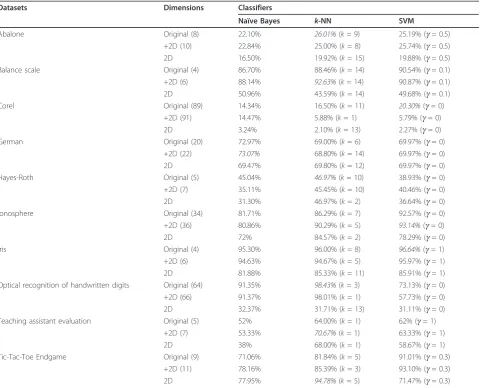
Table 4 shows the classification performance of naïve Bayes,k-NN, and SVM based on the original features, the
combined original and distance based features, and the dis-tance-based features alone, respectively, over the ten data-sets. The distance-based features are calculated using the Euclidean distance. It is noted that in Table 4,‘2D’denotes that the two distance-based features are used alone for clas-sifier training and testing. For the column of dimensions, the numbers in the parentheses mean the dimensionality of the feature vectors utilized in a particular experiment.
Regarding Table 4, we observe that using the distance-based features alone yields the worst results. In other words, classification accuracy cannot be improved by utilizing the two new features and discarding the origi-nal features. However, when the origiorigi-nal features are concatenated with the new distance-based features, on average the rate of classification accuracy is improved. It is worth noting that the improvement is observed across different classifiers. Overall, these experimental results agree well with our expectation, i.e., classification accu-racy can be effectively improved by including the new distance-based features into the original features.
Table 4 Classification accuracy of naïve Bayes,k-NN, and SVM over the ten datasets
Datasets Dimensions Classifiers
Naïve Bayes k-NN SVM
Abalone Original (8) 22.10% 26.01%(k= 9) 25.19% (g= 0.5)
+2D (10) 22.84% 25.00% (k= 8) 25.74% (g= 0.5)
2D 16.50% 19.92% (k= 15) 19.88% (g= 0.5)
Balance scale Original (4) 86.70% 88.46% (k= 14) 90.54% (g= 0.1)
+2D (6) 88.14% 92.63%(k= 14) 90.87% (g= 0.1)
2D 50.96% 43.59% (k= 14) 49.68% (g= 0.1)
Corel Original (89) 14.34% 16.50% (k= 11) 20.30%(g= 0)
+2D (91) 14.47% 5.88% (k= 1) 5.79% (g= 0)
2D 3.24% 2.10% (k= 13) 2.27% (g= 0)
German Original (20) 72.97% 69.00% (k= 6) 69.97% (g= 0)
+2D (22) 73.07% 68.80% (k= 14) 69.97% (g= 0)
2D 69.47% 69.80% (k= 12) 69.97% (g= 0)
Hayes-Roth Original (5) 45.04% 46.97%(k= 10) 38.93% (g= 0)
+2D (7) 35.11% 45.45% (k= 10) 40.46% (g= 0)
2D 31.30% 46.97% (k= 2) 36.64% (g= 0)
Ionosphere Original (34) 81.71% 86.29% (k= 7) 92.57% (g= 0)
+2D (36) 80.86% 90.29% (k= 5) 93.14%(g= 0)
2D 72% 84.57% (k= 2) 78.29% (g= 0)
Iris Original (4) 95.30% 96.00% (k= 8) 96.64%(g= 1)
+2D (6) 94.63% 94.67% (k= 5) 95.97% (g= 1)
2D 81.88% 85.33% (k= 11) 85.91% (g= 1)
Optical recognition of handwritten digits Original (64) 91.35% 98.43%(k= 3) 73.13% (g= 0)
+2D (66) 91.37% 98.01% (k= 1) 57.73% (g= 0)
2D 32.37% 31.71% (k= 13) 31.11% (g= 0)
Teaching assistant evaluation Original (5) 52% 64.00% (k= 1) 62% (g= 1)
+2D (7) 53.33% 70.67%(k= 1) 63.33% (g= 1)
2D 38% 68.00% (k= 1) 58.67% (g= 1)
Tic-Tac-Toe Endgame Original (9) 71.06% 81.84% (k= 5) 91.01% (g= 0.3)
+2D (11) 78.16% 85.39% (k= 3) 93.10% (g= 0.3)
2D 77.95% 94.78%(k= 5) 71.47% (g= 0.3)
In addition, the results indicate that the distance-based features do not perform well in high-dimensional image-related datasets, such the Corel, Iris, and Optical Recog-nition of Handwritten Digits datasets. This is primarily due to the curse of dimensionality [15]. In particular, the demand for the amount of training samples grows exponentially with the dimensionality of feature space. Therefore, adding new features beyond a certain limit would have the consequence of insufficient training. As a result, we have worse rather than better performance on the high-dimensional data sets.
4.3.2. Comparisons and discussions
Table 5 compares different classification performances using the original features and the combined original and distance-based features. It is noted that the classifi-cation accuracy by the original features is the baseline for the comparison. This result clearly shows that con-sidering the distance-based features can provide some level of performance improvements over the chosen datasets except the high-dimensional ones.
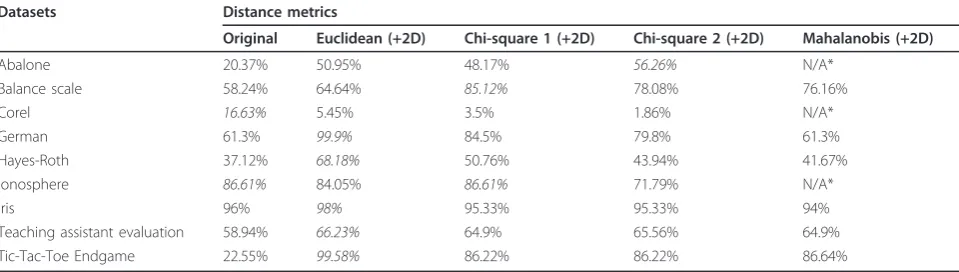
We also calculate the proposed features using different distance metrics. By choosing a fixed classifier (1-NN),
we can evaluate the classification performance of differ-ent distance metrics over differdiffer-ent datasets. The results are summarized in Table 6. Once again, we observe that the classification accuracy is generally improved by con-catenating the distance-based features to the original feature. In some cases, e.g., Abalone, Balance Scale, Ger-man, and Hayes-Roth, the proposed features have led to significant improvements in classification accuracy.
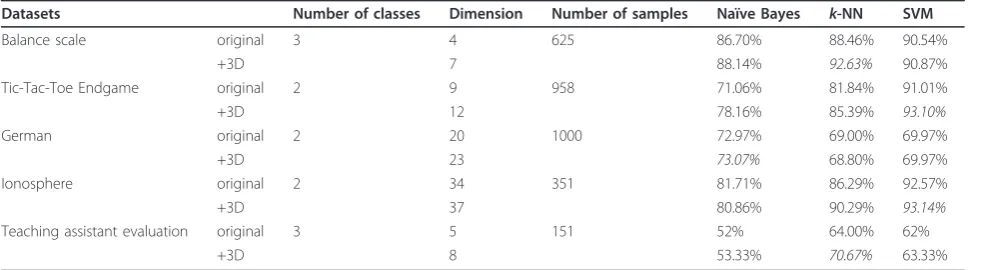
Since we observe consistent improvement across three different classifiers over five datasets, which are the Bal-ance Scale, German, Ionosphere, Teaching Assistant Evaluation, and Tic-Tac-Toe Endgame datasets, the rela-tionship between classification accuracy and these data-sets’characteristics is examined. Table 7 shows the five datasets, which yield classification improvements using the distance-based features. Here, another new feature is obtained by adding the two distance-based features together. Thus, we use‘+3D’to denote that the original feature has been augmented with the two distance-based features and their sum. It is noted that the distance-based features are calculated using the Euclidean distance.
Table 5 Comparisons between the‘original’feature and the‘+2D’features
Datasets Classifiers
naïve Bayes k-NN SVM
Abalone +0.74% -1.01% +0.55%
Balance Scale +1.44% +4.17% +0.33%
Corel +0.13% -10.62% -14.51%
German +0.1% -0.2% +0%
Hayes-Roth -9.93% -1.52% +1.53%
Ionosphere -0.85% +4% +0.57%
Iris -0.67% -1.33% -0.67%
Optical recognition of handwritten digits +0.02% -0.42% -15.4%
Teaching assistant evaluation +1.33% +6.67% +1.33%
Tic-Tac-Toe Endgame +7.1% +3.55% +2.09%
Table 6 Comparison of classification accuracies obtained using different distance metrics
Datasets Distance metrics
Original Euclidean (+2D) Chi-square 1 (+2D) Chi-square 2 (+2D) Mahalanobis (+2D)
Abalone 20.37% 50.95% 48.17% 56.26% N/A*
Balance scale 58.24% 64.64% 85.12% 78.08% 76.16%
Corel 16.63% 5.45% 3.5% 1.86% N/A*
German 61.3% 99.9% 84.5% 79.8% 61.3%
Hayes-Roth 37.12% 68.18% 50.76% 43.94% 41.67%
Ionosphere 86.61% 84.05% 86.61% 71.79% N/A*
Iris 96% 98% 95.33% 95.33% 94%
Teaching assistant evaluation 58.94% 66.23% 64.9% 65.56% 64.9%
Tic-Tac-Toe Endgame 22.55% 99.58% 86.22% 86.22% 86.64%
*Covariance matrix is singular.
Among these five datasets, the number of classes is smaller than or equal to 3; the dimension of the original features is smaller than or equal to 34; and the number of samples is smaller than or equal to 1,000. Therefore, this indicates that the proposed distance-based features are suitable for the datasets whose numbers of classes, numbers of samples, and the dimensionality of features are relatively small.
4.4. Further validations
Based on our observation in the previous section, two datasets are further used to verify our conjecture, which have similar characteristics to these five datasets. These two datasets are the Australian and Japanese datasets, which are also available from the UCI Machine Reposi-tory. Table 8 shows the information of these two datasets.
Table 9 shows the rate of classification accuracy obtained by naïve Bayes,k-NN, and SVM using the‘ ori-ginal’ and ‘+2D’ features, respectively. Similar to the finding in the previous sections, classification accuracy is improved by concatenating the original features to the distance-based features.
5. Conclusion
Pattern classification is one of the most important research topics in the fields of data mining and machine learning. In addition, to improve classification, accuracy is the major research objective. Since feature extraction and representation have a direct and significant impact on the classification performance, we introduce novel distance-based features to improve classification accu-racy over various domain datasets. In particular, the
novel features are based on the distances between the data and its intra- and extra-cluster centers.
First of all, we show the discrimination power of the distance-based features by the analyses of PCA and class separability. Then, the experiments using naïve Bayes,k -NN, and SVM classifiers over ten various domain data-sets show that concatenating the original features with the distance-based features can provide some level of classification improvements over the chosen datasets except high-dimensional image related datasets. In addi-tion, the datasets, which produce higher rates of classifi-cation accuracy using the distance-based features, have smaller numbers of data samples, smaller numbers of classes, and lower dimensionalities. Two validation data-sets, which have similar characteristics, are further used and the result is consistent with this finding.
To sum up, the experimental results (see Table 7) have shown the applicability of our method to several real-world problems, especially when the dataset sizes are certainly small. In other words, our method is very useful for the problems whose datasets contain about 4-34 features and 150-1000 data samples, e.g., bankruptcy prediction and credit scoring. However, it is the fact that many other problems contain very large numbers of features and data samples, e.g., text classification. Our proposed method can be applied after performing fea-ture selection and instance selection to reduce their dimensionalities and data samples, respectively. In other words, this issue will be considered for our future study. For example, given a large-scale dataset some feature selection method, such as genetic algorithms, can be employed to reduce its dimensionality. When more representative features are selected, the next stage is to
Table 7 Classification accuracy versus the dataset’s characteristics
Datasets Number of classes Dimension Number of samples Naïve Bayes k-NN SVM
Balance scale original 3 4 625 86.70% 88.46% 90.54%
+3D 7 88.14% 92.63% 90.87%
Tic-Tac-Toe Endgame original 2 9 958 71.06% 81.84% 91.01%
+3D 12 78.16% 85.39% 93.10%
German original 2 20 1000 72.97% 69.00% 69.97%
+3D 23 73.07% 68.80% 69.97%
Ionosphere original 2 34 351 81.71% 86.29% 92.57%
+3D 37 80.86% 90.29% 93.14%
Teaching assistant evaluation original 3 5 151 52% 64.00% 62%
+3D 8 53.33% 70.67% 63.33%
The best result for each dataset is highlighted in italic.
Table 8 Information of the Australian and Japanese datasets
Dataset Number of classes Number of features Number of data samples
Australian 2 14 690
extract the proposed distance-based features from these selected features. Then, the classification performances can be examined using the original dataset, the dataset with feature selection, and the dataset with the combi-nation of feature selection, and our method.
Acknowledgements
The authors have been partially supported by the National Science Council, Taiwan (Grant No. 98-2221-E-194-039-MY3 and 99-2410-H-008-033-MY2).
Author details
1Department of Information Management, National Central University,
Chung-Li, Taiwan2Department of Computer Science and Information
Engineering, National Chung Cheng University, Min-Hsiung Chia-Yi, Taiwan
Competing interests
The authors declare that they have no competing interests.
Received: 10 February 2011 Accepted: 18 September 2011 Published: 18 September 2011
References
1. UM Fayyad, SG Piatesky, P Smyth, From data mining to knowledge discovery in databases. AI Mag.17(3), 37–54 (1996)
2. WJ Frawley, GS Piatetsky-Shapiro, CJ Matheus, inKnowledge Discovery in Databases: An Overview. Knowledge Discovery in Database(AAAI Press, Menlo Park, CA, 1991), pp. 1–27
3. VN Vapnik, The Nature of Statistical Learning Theory(Springer, New York, 1995)
4. S Keerthi, O Chapelle, D DeCoste, Building support vector machines with reducing classifier complexity. J Mach Learn Res.7, 1493–1515 (2006) 5. A Cardoso-Cachopo, A Oliveira, Semi-supervised single-label text
categorization using centroid-based classifiers, inProceedings of the ACM Symposium on Applied Computing, 844–851 (2007)
6. H Liu, H Motoda, Feature Selection for Knowledge Discovery and Data Mining
(Kluwer Academic Publishers, Boston, 1998)
7. A Blum, P Langley, Selection of relevant features and examples in machine learning. Artif Intell.97(1-2), 245–271 (1997). doi:10.1016/S0004-3702(97) 00063-5
8. D Koller, M Sahami, Toward optimal feature selection, inProceedings of the Thirteenth International Conference on Machine Learning, 284–292 (1996) 9. JH Yand, V Honavar, Feature subset selection using a genetic algorithm.
IEEE Intell Syst.13(2), 44–49 (1998). doi:10.1109/5254.671091 10. AK Jain, RPW Duin, J Mao, Statistical pattern recognition: a review. IEEE
Trans Pattern Anal Mach Intell.22(1), 4–37 (2000). doi:10.1109/34.824819 11. S Canbas, A Cabuk, SB Kilic, Prediction of commercial bank failure via
multivariate statistical analysis of financial structures: the Turkish case. Eur J Oper Res.166, 528–546 (2005). doi:10.1016/j.ejor.2004.03.023
12. SH Min, J Lee, I Han, Hybrid genetic algorithms and support vector machines for bankruptcy prediction. Exp Syst Appl.31, 652–660 (2006). doi:10.1016/j.eswa.2005.09.070
13. C-F Tsai, Feature selection in bankruptcy prediction. Knowledge Based Syst. 22(2), 120–127 (2009). doi:10.1016/j.knosys.2008.08.002
14. K Pearson, On lines and planes of closest fit to system of points in space. Philos Mag.2, 559–572 (1901)
15. RO Duda, PE Hart, DG Stork, Pattern Classification, 2nd edn. (Wiley, New York, 2001)
16. J Han, M Kamber,Data Mining: Concepts and Techniques, 2nd edn. (Morgan Kaufmann Publishers, USA, 2001)
17. E Baralis, S Chiusano, Essential classification rule sets. ACM Trans Database Syst (TODS)29(4), 635–674 (2004). doi:10.1145/1042046.1042048 18. CF Tsai, CY Lin, A triangle area based nearest neighbors approach to
intrusion detection. Pattern Recog.43, 222–229 (2010). doi:10.1016/j. patcog.2009.05.017
19. J-S Lin, CANN: combining cluster centers and nearest neighbors for intrusion detection systems, Master’s Thesis, National Chung Cheng University, Taiwan, (2009)
20. W Zeng, XX Meng, CL Yang, L Huang, Feature extraction for online handwritten characters using Delaunay triangulation. Comput Graph.30, 779–786 (2006). doi:10.1016/j.cag.2006.07.007
21. Z Xue, SZ Li, EK Teoh, Bayesian shape model for facial feature extraction and recognition. Pattern Recogn.36, 2819–2833 (2003). doi:10.1016/S0031-3203(03)00181-X
22. E Choi, C Lee, Feature extraction based on the Bhattacharyya distance. Pattern Recogn.36, 1703–1709 (2003). doi:10.1016/S0031-3203(03)00035-9 23. CC Chang, CJ Lin, LIBSVM: a library for support vector machines, http://
www.csie.ntu.edu.tw/~cjlin/libsvm (2001)
24. H Hotelling, Analysis of a complex of statistical variables into principal components. J Educ Psychol.24, 498–520 (1933)
25. K Fukunaga,Introduction to statistical pattern recognition(Academic Press, 1990)
26. R Huang, Q Liu, H Lu, S Ma, Solving the small sample size problem of LDA, inInternational Conference on Pattern Recognition3, 30029 (2002)
doi:10.1186/1687-6180-2011-62
Cite this article as:Tsaiet al.:Distance-based features in pattern classification.EURASIP Journal on Advances in Signal Processing2011
2011:62.
Submit your manuscript to a
journal and benefi t from:
7Convenient online submission
7Rigorous peer review
7Immediate publication on acceptance
7Open access: articles freely available online
7High visibility within the fi eld
7Retaining the copyright to your article
Submit your next manuscript at 7 springeropen.com
Table 9 Classification accuracy of naïve Bayes,k-NN, and SVM over the Australian and Japanese datasets
Datasets Number. of classes Dimension Number of samples Naïve Bayes k-NN SVM
Australian Original 2 14 690 67.34% 71.59% (k= 9) 55.73% (g= 0)
+2D 16 65.02% 72.75%(k= 7) 56.02% (g= 0)
2D 2 62.12% 71.88% (k= 14) 62.70% (g= 0)
Japanese Original 2 15 653 67.18% 69.02% (k= 5) 55.83% (g= 0)
+2D 17 64.88% 69.63%(k= 5) 55.52% (g= 0)
2D 2 61.81% 68.40% (k= 9) 62.58% (g= 0)