Volume 2006, Article ID 12093, Pages1–10 DOI 10.1155/ASP/2006/12093
Fast and Accurate Ground Truth Generation for
Skew-Tolerance Evaluation of Page
Segmentation Algorithms
Oleg Okun and Matti Pietik ¨ainen
Infotech Oulu and Department of Electrical and Information Engineering, Machine Vision Group, University of Oulu, P.O.Box 4500, FI-90014, Finland
Received 15 February 2005; Revised 30 May 2005; Accepted 12 July 2005
Many image segmentation algorithms are known, but often there is an inherent obstacle in the unbiased evaluation of segmentation quality: the absence or lack of a common objective representation for segmentation results. Such a representation, known as the ground truth, is a description of what one should obtain as the result of ideal segmentation, independently of the segmentation algorithm used. The creation of ground truth is a laborious process and therefore any degree of automation is always welcome. Document image analysis is one of the areas where ground truths are employed. In this paper, we describe an automated tool called GROTTO intended to generate ground truths for skewed document images, which can be used for the performance evaluation of page segmentation algorithms. Some of these algorithms are claimed to be insensitive to skew (tilt of text lines). However, this fact is usually supported only by a visual comparison of what one obtains and what one should obtain since ground truths are mostly available for upright images, that is, those without skew. As a result, the evaluation is both subjective; that is, prone to errors, and tedious. Our tool allows users to quickly and easily produce many sufficiently accurate ground truths that can be employed in practice and therefore it facilitates automatic performance evaluation. The main idea is to utilize the ground truths available for upright images and the concept of the representative square [9] in order to produce the ground truths for skewed images. The usefulness of our tool is demonstrated through a number of experiments with real-document images of complex layout.
Copyright © 2006 Hindawi Publishing Corporation. All rights reserved.
1. INTRODUCTION
Segmentation is an important step in image analysis since it detects homogeneous regions whose characteristics can then be computed and analyzed, for example, for discriminating between different classes of objects such as faces and non-faces. However, the unbiased evaluation of segmentation re-sults is difficult because it requires an ideal description of what one should obtain as the result of segmentation of a certain image regardless of the segmentation algorithm. This ideal description, known as the ground truth, can be utilized for judging whether segmentation is correct or not, and how well a given image is segmented. The generation of ground truths is laborious and often prone to errors, especially if done manually. Thus, any degree of automation brought to this procedure is typically welcome.
Document page segmentation is one of the areas of im-age analysis where ground truths are to be employed. Pim-age segmentation divides an image of a certain document, such as a newspaper article or advertisement, into homogeneous regions, each containing data of a particular type such as text,
graphics, or picture. The accuracy of page segmentation is of great importance since segmentation results will be an input for higher-level operations, and errors in segmentation can lead to those in character recognition. Performance evalua-tion of page segmentaevalua-tion algorithms is therefore necessary because it can help to identify errors inherent to a given al-gorithm and to understand their reasons. The performance is typically assessed either visually by a human or by using ground truths.
The first approach consists of visually checking the ob-tained results and making conclusions about their correct-ness. This approach is subjective (thus unreliable) and te-dious. That is why researchers have normally used a small or relatively moderate number of images in testing page seg-mentation algorithms.
region) a polygon or rectangle surrounding the region to-gether with the type of data constituting the region (types are text, graphics, picture), which is compared to the results obtained after applying the page segmentation algorithm un-der consiun-deration. It is worthy to mention that several diff er-ent correct segmer-entations of the same image are sometimes possible, and it is often difficult (or may be even hardly pos-sible) to define the term “best or ideal segmentation”, which all other segmentations can be compared to.
In this paper, we describe an experimental tool called GROTTO (ground truthing tool) to generate many ground truths in an automatic and computationally cheap manner when page skew (tilt of text lines) is present.1 To our best knowledge, no existing ground truthing method [2,5,7,8,
12] explicitlyaims at this task. Its importance is, however, motivated by the following reasons. A majority of the existing GTs were created for upright images, that is, for those with-out skew, because their creation is usually quite time con-suming. To be able to use them when skew is present, one typically needs to scan the skewed page and then to com-pensate for the skew. In this case, it will be difficult to judge the skew tolerance of a given page segmentation algorithm because segmentation will be done when there is no skew. Errors in skew estimation are also possible, which can dete-riorate the whole process.
Keeping this in mind, GROTTO attempts to reduce the cost of GT creation by making some of the most laborious operations more automatic. The main idea is to use the GTs for upright images in order to generate those for skewed im-ages. We consider that the rotation transformation applied to the upright image is sufficient to produce the skewed image for any angle. Such an assumption gives us two advantages. Firstly, we know the skew angle and secondly, we exclude the scaling and translation, that is, we avoid a sophisticated, time consuming and not always accurate document registration procedure.2In fact, neither printing nor scanning of the orig-inal document is necessary in our approach. All that we need is the GT for the corresponding upright image. In the next section, modern approaches to ground truth generation are briefly reviewed.
2. BRIEF OVERVIEW OF GROUND TRUTHING STRATEGIES
Because our interest in this paper is the GT generation for skew-tolerance evaluation, we will not consider methods aiming at pure text images, where the task is mostly to cor-rectly place bounding rectangles around each character (for details, see [5,6,8,10]).
When using GTs, there are two different approaches to the performance evaluation of page segmentation
algo-1We concentrate in our article on this type of degradation and do not
con-sider other possible types such as scaling, which typically less frequently occur for page images.
2Document registration may be able to solve a more complex and general
task than we consider but at the expense of higher complexity and as a result, of higher chances for failures. In contrast, we aim at a simpler so-lution while sacrificing some generality.
rithms. In the first approach, the judgment about segmen-tation quality is based on OCR results [4,7,10]. In this case, the GT is often a simple sequence of correct characters. It is sometimes assumed that the OCR errors do not result from segmentation errors [7], so that the number of operations (manipulations with characters and text blocks) needed to convert the OCR output into the correct result can be used to evaluate the segmentation performance. This approach may hide the reason for error when both types of error appear in the same place and it does not make the segmentation evalu-ation independent of the whole document analysis system.
In the second approach, the segmentation results are di-rectly compared with the corresponding GTs without using OCR [2,3,11,12]. In this case, the GTs contain region de-scriptions as sets of pixels [11,12], rectangular zones [3], or isothetic polygons whose edges are only horizontal or vertical [2].
When ground truthing is done at the pixel level [11,12], it provides the finest possible details and can represent re-gions of arbitrary shape. However, as reported in [3], there can be more than 15 million pixels per page digitized at 400 dpi. That is why it usually takes much time to verify and edit such GTs. The evaluation of the segmentation quality is achieved by testing the overlap between sets of pixels. It consists of computing the number of splittings and mergings needed to obtain correct segmentation.
The representation of regions as rectangular zones takes less memory than the pixel-based one, but it is less efficient because it is only suitable for representing constrained lay-outs, where all regions have a rectangular shape and no adja-cent bounding rectangles are overlapped. The segmentation performance is evaluated by the overlap and alignment of zones in the GT and those obtained after segmentation [3]. No calculation of how zones were split, merged, missed, or inserted is done by suggesting that this information is diffi -cult to derive and therefore it will be quite difficult to make the right conclusions based on it. It is important to notice that the method [3] only checks the spatial correspondence of zones by ignoring their class labels (text, graphics, back-ground) so that the obtained GTs do not contain complete information about segmentation errors.
polygonsautomaticallyfrom images with color and textured background (the authors in [2] claim that it is possible, but no examples were given). The method [1] that is used to con-struct such polygons, exploits the concept of white tiles (or white background spaces) surrounding document regions. In the case of color images, for example, the background may not be white or it may not have a single color for all regions and it may not be uniform.
3. OUR APPROACH TO THE PROBLEM
As one can see from the brief discussion of various ground truthing strategies, one of the first tasks is to choose a proper representation for page regions. The region representation affects the method of comparing a GT and segmented image. To summarize, there are three main alternatives: set of pixels, rectangular zone, and polygon. When a region is de-scribed as a set of pixels [12], it will take a lot of memory to keep this representation and a lot of time to manipulate it. Rectangular zones [3] represent regions in a more compact manner than pixels, but they cannot accurately enough de-scribe complex-shaped nonrectangular regions and they are not suitable when skew is present. Polygons can deal with both problems mentioned, but they are not flexible enough when it is necessary to access the data inside them (it will usually take much more time than when using rectangles). One exception is isothetic polygons [2], but they need to be partitioned into a number of rectangles before being really convenient to use, and it seems that this representation is re-stricted to binary images only.
Since no representation scheme has clear advantages over the others and there are no established standards, we intro-duce our own representation based on image partitioning into small nonoverlapping blocks ofN×Npixels, whereN depends on the image resolution and is determined by the formulaN≤2·(res/25), where res is the resolution in dots per inch (dpi), res/25 is the resolution in dots per mm, and 2 means two mm. We assume that in any case the correspond-ing block on the paper should not occupy an area larger than 2×2 mm2. For example, the maximum value ofNis equal to 24 for a resolution of 300 dpi. In our opinion, the block par-titioning combines advantages of other representations such as compactness, easiness and direct access to data, applicabil-ity to different image types (binary, grayscale, and color) and various document layouts (rectangular and arbitrary), and tolerance to skew. It is also widely used in image compres-sion.
The block-based GT can be defined as a 2D array of num-bers, each of which is a block label associated with the follow-ing classes: text (T), background (B), binary graphics (G), and grayscale or colored image (I). If a block contains data of several classes, it has a composite label including the labels of all classes. That is, 11 composite labels are possible in addi-tion to 4 noncomposite ones. Given thatnrow×ncolare sizes of the original image, sizes of the block-based GT associated with this image are much smaller (nrow/N+ 0.5 × ncol/N+ 0.5), where·means the smallest integer closest to a given number; 0.5 is introduced to deal with image sizes that are
Figure1: Direct approach to SGT generation.
not multiples ofN.
Based on such a definition of the GT, the correspondence between the GT and segmentation results can be found in a straightforward way—by computing the difference of class labels of the blocks. Difference statistics, found for each of the 11 cases, fully quantify and qualify segmentation results. It is also quite easy to convert the pixel-, zone-, and even some polygon-based (such as composed of a set of rectangles) GTs to the block-based format.
4. CONCEPT OF THE REPRESENTATIVE SQUARE
Let us suppose that a block-based GT for an upright image (UGT) is available (we will show how to generate it below). By having this GT and by knowing the skew angleαandN, the problem now is how to obtain the GT for the skewed image (SGT). A straightforward solution could be to par-tition the skewed image intoN×N pixel blocks, to rotate the corner points of each block in that image by−αaround the image center, and finally to match the rotated block and blocks in the upright image in order to determine a label of the block in question. We call this the direct approach. How-ever, labeling may not be simple, especially if one would like to assign labels based on the intersection area of blocks (see
Figure 1) because those areas are polygons rather than rect-angles.
Because of this reason, we employ the concept of the rep-resentative square [9].
Definition 1. The representative square (RS) of a given block in the skewed image is a square slanted by angle α (α ∈ [−90◦, +90◦]) and placed inside the block so that its corner points lie on block sides (seeFigure 2).
The angle by which the RS is slanted is equal to the de-sired skew angle for which the GT needs to be created.
The following proposition is true for any RS (proof is given in [9]).
Proposition 1. Let ABCDand ABCD be a block in the skewed image and its RS, respectively. In this case, the ratio r=SRS/SBlock≥0.5, whereSRSandSBlockare theRSand block areas, respectively.
A A
B
D
B
D
C C
α=25◦
Figure2: Representative squareABCDof the blockABCD.
of the corresponding block (i.e., why it is called representa-tive) without loosing much data.
Notice that all that is necessary to do is to model the doc-ument skew. However, we neither scan the skewed page nor rotate the upright image, but use the GT for the upright im-age andthe concept of the representative square in order to generate the GTs for the skewed images. As will be shown, this leads to very fast processing, while the results are still ac-curate to apply our technique in practice.
5. SGT GENERATION METHOD
Given a skew angleα(we assume that positive (negative) an-gles correspond to clockwise (counterclockwise) rotation), N, and the corresponding block-based UGT, then the SGT generation, using the concept of the representative square, consists of the following steps.
(1) Given the width and height of the upright image, com-pute the width and height for the skewed image. (2) Partition the skewed image into nonoverlapping
blocks ofN×Npixels. Each block can be considered as one big pixel so that it is possible to speak about rows and columns of blocks.
(3) Compute coordinates of the pointA(seeFigure 2) for the upper-left block in the skewed image and coordi-nates of this point and the pointCin the upright im-age when rotating both points about the imim-age center by−α.
(4) Scan the blocks from left to right, top to bottom. For each block, find the position of the rotated (about the center of the skewed image by−α) RS in the up-right image and classify the corresponding block in question based on the labels of the UGT blocks it crosses.
GivenH andW (height and width of the upright im-age), the correspondingHandWof the skewed image are computed asW =H|sinα|+WcosαandH=Hcosα+ W|sinα|.
From the proof ofProposition 1, RS width (height)dRS is equal to N/(|sinα|+ cosα). Coordinates of the point A of the upper-left block in the skewed image are (here
and further we assume that the upper-left image corner has coordinates (1,1))
xskewed A =
⎧ ⎨ ⎩
dRSsinα ifα≥0,
1 otherwise,
yAskewed =
⎧ ⎨ ⎩
1 ifα≥0,
dRS|sinα| otherwise.
(1)
When rotatingAabout the center of the skewed image by−α, we obtain that its coordinates in the upright image are determined forα≥0 as
xuprightA =xuprightcenter +
1−xskewedcenter
cosα+1−ycenterskewed
sinα
+dRSsinαcosα,
yuprightA =ycenterupright−
1−xskewed center
sinα+1−yskewed center
cosα
−dRSsinαsinα,
(2)
and forα <0 they are
xuprightA =xcenterupright+
1−xskewed center
cosα+1−yskewed center
sinα
+dRS|sinα|sinα,
yAupright =ycenterupright−
1−xskewed center
sinα+1−yskewed center
cosα
+dRS|sinα|cosα.
(3)
Coordinates ofCin the upright image are trivial to com-pute because the rotation transformation preserves distances, that is,xuprightC =xuprightA +dRSandyCupright =yAupright +dRS.
By knowingxuprightA ,yAupright ,xuprightC ,yCupright computed for
the upper-left block in the skewed image, it is now very easy to find these coordinates for the other blocks without any rotation. Thus this will speed up SGT generation because the number of floating point operations is greatly reduced. It is easy to verify that the following formulas are correct for two adjacent blockspreviousandnextin the same row:
xuprightA (next)=xuprightA (previous) +Ncosα,
yuprightA (next)=yAupright (previous)−Nsinα,
xuprightC (next)=xuprightA (next) +dRS,
yuprightC (next)=yAupright (next) +dRS.
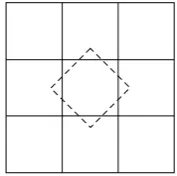
Figure3: Four cases of intersection of a rotated RS (shown dashed) and blocks in the upright image.
For two adjacent blockspreviousandnextlocated in the same column, the formulas are
xuprightA (next)=xuprightA (previous) +Nsinα,
yAupright (next)=yAupright (previous) +Ncosα,
xuprightC (next)=xuprightA (next) +dRS,
yCupright (next)=yAupright (next) +dRS.
(5)
After the coordinates ofAandCin the upright image have been computed, the task is to label blocks in the skewed image. Four cases are only possible as shown in Figure 3. Four corner points of each RS are checked to determine which UGT blocks they belong to. Initially all blocks in the skewed image are labelled as background. Blocks whose RSs lie completely inside the zone of class T change their labels to T, while blocks whose RSs cross the border between two zones with different labels obtain both labels.
6. GROTTO
Having described the theory behind block-based ground truth generation, GROTTO is introduced in detail in this sec-tion. Its main modes of operation are the following.
(i) Given a raw image (either upright or skewed), that is, one without GT, generate a block-based GT.
(ii) Given a block-based GT for an upright image, generate one or several block-based GTs for the specified skew angle and range of skew angles.
(iii) Given a block-based GT for an upright or skewed im-age, verify the accuracy of generation for this GT.
6.1. Mode 1: GT generation for raw images
With this mode, the input image has no GT and the task is to generate a block-based GT. After opening the image and setting two parameters (image resolution in dpi and block size in pixels), a user should manually detect page regions ei-ther as rectangles or as arbitrary polygons and assign a class label to each detected region. Rectangles can be nested in other rectangles or polygons but polygons cannot. Further-more, the user can edit regions by resizing rectangles, chang-ing region class labels, deletchang-ing polygons or rectangles, and
partitioning polygons into rectangles. The last operation is done automatically and it is mandatory because we need to have a zone-based representation of regions before GT gen-eration. This representation is also useful to obtain because there are many other GTs based on it. It is worthy to say that many known ground truthing methods rely on manual gion extraction before GT generation. This is because the re-gions should be extracted very accurately, otherwise ground truthing is meaningless. The manual extraction can guaran-tee this if done carefully, while there is no page segmentation method that can outperform all the others and not be prone to errors.
Polygon partitioning is done with a split-and-merge type procedure. First, the bounding box of the polygon in ques-tion is divided intoN×Npixels blocks and the center of each block is checked to determine whether this block belongs to the polygon or not. When doing this, each block gets one of the labels (0:background; 1:block belongs to the polygon in question; and 2:block belongs to another polygon or rectan-gle). After that, the polygon’s bounding box recursively splits into smaller rectangles in alternating horizontal and vertical directions until a given rectangle contains all 1’s or/and 0’s or its size is smaller than one block. After each split step, all rectangles obtained by then are checked for possible merging. A criterion for merging is that two rectangles should have the same length of their common border. Rectangles contain-ing only 0’s or/and 2’s are eliminated from further processcontain-ing and excluded from the list of rectangles. The representation obtained after polygon partitioning is called azone-based GT. Examples of polygon partitioning are given inFigure 4.
To obtain a UGT, we analyze zones one-by-one by super-imposing each on a block-based partitioned upright image. For each zone, all blocks located completely inside or cross-ing it get a class label of that zone. In the first case, blocks are not further processed, while in the second case, the area of intersection between the zone and each block is computed and accumulated in the 12 most significant bits of a 16- bits value associated with a block (the 4 least significant bits are used as a class label).
500 1000 1500 2000 2500 3000
500 1000 1500 2000
500 1000 1500 2000 2500 3000
500 1000 1500 2000
500 1000 1500
2000 2500 3000
500 1000 1500 2000
500 1000 1500 2000
2500 3000
500 1000 1500 2000 500 1000
1500
2000
2500 3000
500 1000 1500 2000 500 1000
1500
2000
2500 3000
500 1000 1500 2000
Figure4: Results of manual region detection and automatic polygon partitioning into rectangles. Yellow, green, and blue rectangles and polygons enclose image, text, and graphics regions, respectively.
than 24 for 300 dpi and 32 for 400 dpi, which are the most wide-spread image resolutions, 12 bits are quite enough to represent values of the intersection area in many real cases.
6.2. Mode 2: GT generation for skewed images
By having a zone-based region representation, the user can automatically and quicklygenerate SGTs for a specified range of skew angles or just for a single angle. The process of SGT generation is described in Section 5 in detail and it needs a UGT. The basic operations are the same as they are for Mode 1.
6.3. Mode 3: verification of GT generation
Having a generated SGT, one may ask whether it was accu-rately generated based on the respective UGT or not. An-other question would be how accurate this generation was. To answer to these questions, GROTTO allows a user to au-tomatically verify the quality of an SGT by comparing the generated SGT and the so-calledidealGT (IGT). This com-parison definesthe absolute performance of a system. In other words, it means a comparison between the performance of our method of GT generation and that of the ideal one.
Though the IGT is also block-based, its generation em-ploys different principles. First, a list of adjacency is created that includes IDs of the zones in a UGT that either overlap or have a common border. For such zones, if a block con-tains data from two zones, one does not need to add a ground label. It is quite trivial to determine whether back-ground space is between two zones or not.
There is no background between zones, that is, two zones are adjacent, only if the following conditions are both satisfied:
W1+W2≥max
xur
2 −x1ul+ 1,x1ur−xul2 + 1
,
H1+H2≥max
yll
2−yul1 + 1,y1ll−yul2 + 1
, (6)
where Wi (Hi) (i = 1, 2) stands for width (height) of the ith zone, (xuli ,xiur) means x-coordinates of the upper-left and upper-right corners of theith zone, and (yiul,yill) means y-coordinates of the upper-left and lower-left corners of theith zone.
corner points is checked to determine which zones it belongs to. A class label of that zone is then assigned to the block in question. If two corner points belong to different zones, we look at the list of adjacency. If IDs of zones are absent in this list, a background label is added to other labels.
The IGT generation is quite slow because we match every corner point to every zone in order to have as accurate and complete information as possible. We assume that this pro-cedure can give the most accurate result at the block level.
The comparison of SGT and IGT is very simple and it consists of matching the class labels of the blocks in two GTs. To do this, we created a special look-up table containing complete coverage of all possible cases.
7. EXPERIMENTS
GROTTO was implemented in MATLAB for Windows with no part of the code written in C. Our experiments with GROTTO included SGT generation for different skew an-gles from−90◦to +90◦in 1◦steps and accuracy verification for the obtained SGTs as described inSection 6.3. The value ofNwas set to 24 pixels because the original images had a resolution of 300 dpi. The test set consisted of 30 color images of advertisements and magazine articles. We will use three of them to demonstrate experimental results.
The original upright images did not have ground truths so we manually extracted regions, labeled them, and auto-matically partitioned polygons into rectangular zones. Re-sults of region detection and polygon partitioning are shown inFigure 4. The last image does not have any regions detected as polygons, therefore no polygon partitioning was done.
Once the zone-based GT was available, the block-based UGT and SGT were automatically created, given N and the skew angle or range of angles. The accuracy of the ob-tained SGT was verified by comparing this ground truth to the block-based IGT. This operation provides us infor-mation about errors in the SGT generation process. Several SGTs, IGTs, and the so-called difference maps highlighting the blocks having different labels in an SGT and IGT are shown inFigure 5for the images inFigure 4.
To create a difference map, a special look-up table was used to match IGTs and SGTs. In this table, the first row cor-responds to class labels of blocks in an IGT, while the first column represents class labels of blocks in an SGT. An in-tersection of thenth row and themth column gives a spe-cific value for a certain case, for example, one class missing or added. There are 11 cases as follows: (1) one class label is missing; (2) two class labels are missing; (3) three class labels are missing; (4) one class label is added; (5) one class label is wrong, but other class labels are correct; (6) one class label is missing and one class label is wrong, but at least one class label is correctly assigned; (7) two class labels are added; (8) one class label is added and one class label is wrong, but at least one class label is correctly assigned; (9) three class labels are added; (10) all class labels are correctly assigned pletely correct result); (11) all class labels are wrong (com-pletely wrong result).
It can be seen inFigure 5that composite labels in SGTs/ IGTs, that is, those including multiple classes, occur only in the borders of different classes. Because an IGT provides a more accurate way to generate ground truth than an SGT, the number of composite blocks in an IGT is smaller than that in an SGT for a certain skew angle and block size (red lines in
Figure 5are thicker for SGTs than for IGTs). As for difference maps, three to four cases clearly dominate over others. They are cases 1, 4, 7, and 10, with case 10 (completely correct la-beling) far exceeding the others.
To proceed from visual to quantitative estimation of SGT generation, we computed the number of blocks falling un-der each case as a percentage of the total number of blocks for every pair of SGT and IGT. It turned out that on aver-age more than 90 percent of the blocks in each SGT obtained correct labels (seeFigure 6for an accumulated statistics over all tested images). Due to the cautious way of GT genera-tion when blocks can rather obtain several labels than only one label in ambiguous situations, case 4 was more frequent than case 1. Because of the background spaces between re-gions and domination of these two cases, we concluded that the background was missing or added. This factor, in our opinion, does not significantly degrade the SGT generation accuracy because the background does not contain much useful information. Cases 1 and 4 correspond to the miss-ing rate and false alarm rate, respectively, and in Figure 6, the missing rate is five times smaller than the false alarm rate! This manifests high accuracy of ground truth genera-tion with GROTTO.
Finally, Figure 7 provides the distributions over the whole angle range from−90◦ to +90◦ in 1◦ steps for cases 1, 4, and 10. For angles of 0,−90, and 90 degrees, IGTs and SGTs completely coincide so that the percentage of case 10 is equal to 100.
By analyzing plots in Figure 7, we can say that all the distributions have a “two-arcs” shape. We observed similar “two-arcs” distributions for all images so that our method of SGT generation produces quite stable results. It is possible to explain why these distributions have such a shape. This is related to the area of the representative square. For angles be-tween−90◦and 0◦, this area reaches a maximum at extreme values of this range and it is minimal at−45◦, that is, the plot of the area versus angle is concave. For angles between 0◦and +90◦, this plot has the same shape because of symmetry with maxima at extreme values and a minimum at +45◦. As a re-sult, when the area of the representative square is small, that is, it does not cover a significant part of the block it repre-sents, the chance to miss a class label is high and the chance to add an extra label is low. When the area is large, the chance to miss is low and the chance to add is high. It is also easy to see that there is an inverse dependence between the occur-rence of cases 1 and 4. That is, when the number of case 1 is large for a particular angle, that of case 4 is small for the same angle, and vice versa.
20 40 60 80 100 120 140
20 40 60 80 100 20 40 60 80 100 120 140
20 40 60 80 100 20 40 60 80 100 120 140
20 40 60 80 100 1 2 3 4 5 6 7 8 9 10 11 Cor re sp o n d en ce b et w ee n d i ff er ent cases and co lors 20 40 60 80 100 120
20 40 60 80 100 20 40 60 80 100 120
20 40 60 80 100 20 40 60 80 100 120
20 40 60 80 100 1 2 3 4 5 6 7 8 9 10 11 Cor re sp o n d en ce b et w ee n d i ff er ent cases and co lors 20 40 60 80 100 120 140
20 40 60 80 100 20 40 60 80 100 120 140
20 40 60 80 100 20 40 60 80 100 120 140
20 40 60 80 100
1 2 3 4 5 6 7 8 9 10 11 Cor re sp o n d en ce b et w ee n d i ff er ent cases and co lors
Figure5: SGT, IGT, and their difference for the images inFigure 4. Skew angles are +5◦,−3◦, and +10◦, respectively. In each row there are: SGT (left image), IGT (center image), and difference map (right image). For images displaying SGTs and IGTs, red color points to a composite label of a block, while yellow, green, and blue colors correspond to pure image, text, and graphics labels. In difference maps, each of the 11 cases is displayed by distinct color with colorbar shown under each map.
obtain an IGT. A major time-consuming operation was re-gion detection that took up to several minutes per image, de-pending on the image complexity and the number of regions. The time for IGT generation greatly depended on the num-ber of rectangular zones manually detected or/and resulting from polygon partitioning. As block sizes grew smaller, the accuracy of SGT generation for a certain image resolution also increased, as indicated by the verification procedure in
Section 6.3, but at the expense of much higher processing time.
8. DISCUSSION AND CONCLUSION
7
6
5
4
3
2
1
0
Case
o
ccur
renc
e
1 2 3 4 5 6 7 8 9 10 11
Case number
0.92 0.00 5.02 0.01 0.26 0.00 93.79 ×10⁶
Figure6: Accumulated statistics for all tested images. Figures over each bar correspond to frequency of occurrence for a given case in percent.
evaluate the skew tolerance of page segmentation algorithms. This opinion is based on the sufficiently high accuracy rate (more than 90%) and low missing rate (around 1%) as well as the small time (less than 0.5 s) needed for ground truth generation.
Though the current version of GROTTO does not yet al-low users to compare a generated GT and results of a certain page segmentation algorithm, we describe possible scenarios where GROTTO can be useful.
Suppose that one has a certain page segmentation algo-rithm and a set of upright images. The task is to verify the skew-invariance of page segmentation carried out by this al-gorithm. In this case, a possible scenario can be as follows.
(1) SetNand skew angleα. (2) Produce a UGT.
(3) Rotate the original upright image around its center by αand segment it into homogeneous regions, using a given page segmentation algorithm.
(4) Transform the segmentation results into the block-based format.
(5) Knowingα, generate an SGT and if necessary, IGT. (6) Match the results of page segmentation and the SGT as
well as the SGT and IGT to obtain descriptive statistics.
When the skew angle is unknown, it needs to be pre-computed before GROTTO can be applied. Having deter-mined this angle, the use of GROTTO is quite similar to that described above.
Now let us consider the task of image segmentation in general. Suppose that we have a collection of face images and the task is to separate faces from the background, that is, to detect faces in the images. To produce ground truths for this kind of images, an operator manually detects a rectangular area containing face and labels it. After that, a UGT is quickly produced, which is then compared with results of the face
10 9 8 7 6 5 4 3 2 1 0
Case
1
(%)
−80 −60 −40 −20 0 20 40 60 80 Angle value (degrees)
(a)
20 18 16 14 12 10 8 6 4 2 0
Case
4
(%)
−80 −60 −40 −20 0 20 40 60 80 Angle value (degrees)
(b)
100 98 96 94 92 90 88 86 84 82 80
Case
10
(%)
−80 −60 −40 −20 0 20 40 60 80 Angle value (degrees)
(c)
detection algorithm in question. This algorithm does not have to be block-based, but its result must be converted into the block-based representation used in GTs.
ACKNOWLEDGMENT
The authors are thankful to the reviewers for valuable com-ments that helped to significantly improve the paper.
REFERENCES
[1] A. Antonacopoulos, “Page segmentation using the description of the background,”Computer Vision and Image Understand-ing, vol. 70, no. 3, pp. 350–369, 1998.
[2] A. Antonacopoulos and A. Brough, “Methodology for flexible and efficient analysis of the performance of page segmentation algorithms,” inProc. 5th International Conference on Document Analysis and Recognition (ICDAR ’99), pp. 451–454, Banga-lore, India, September 1999.
[3] M. D. Garris, “Evaluating spatial correspondence of zones in document recognition systems,” inProc. International Confer-ence on Image Processing (ICIP ’95), vol. 3, pp. 304–307, Wash-ington, DC, USA, October 1995.
[4] M. D. Garris, S. A. Janet, and W. W. Klein, “Federal register document image database,” inDocument Recognition and Re-trieval VI, D. P. Lopresti and J. Zhou, Eds., vol. 3651 of Proceed-ings of SPIE, pp. 97–108, San Jose, Calif, USA, January 1999. [5] J. D. Hobby, “Matching document images with ground truth,”
International Journal on Document Analysis and Recognition, vol. 1, no. 1, pp. 52–61, 1998.
[6] J. J. Hull, “Performance evaluation for document analysis,” In-ternational Journal of Imaging Systems and Technology, vol. 7, no. 4, pp. 357–362, 1996.
[7] J. Kanai, S. V. Rice, T. A. Nartker, and G. Nagy, “Automated evaluation of OCR zoning,”IEEE Trans. Pattern Anal. Machine Intell., vol. 17, no. 1, pp. 86–90, 1995.
[8] T. Kanungo and R. M. Haralick, “An automatic closed-loop methodology for generating character groundtruth for scanned documents,”IEEE Trans. Pattern Anal. Machine In-tell., vol. 21, no. 2, pp. 179–183, 1999.
[9] O. Okun and M. Pietik¨ainen, “Automatic ground-truth gener-ation for skew-tolerance evalugener-ation of document layout analy-sis methods,” inProc. 15th International Conference on Pattern Recognition (ICPR ’00), vol. 4, pp. 376–379, Barcelona, Spain, September 2000.
[10] I. T. Phillips, J. Ha, R. M. Haralick, and D. Dori, “The im-plementation methodology for a CD-ROM English document database,” inProc. 2nd International Conference on Document Analysis and Recognition (ICDAR ’93), pp. 484–487, Tsukuba Science City, Japan, October 1993.
[11] S. Randriamasy and L. Vincent, “Benchmarking page segmen-tation algorithms,” inProc. IEEE Computer Society Conference on Computer Vision and Pattern Recognition (CVPR ’94), pp. 411–416, Seattle, Wash, USA, June 1994.
[12] B. A. Yanikoglu and L. Vincent, “Pink Panther: a complete environment for ground-truthing and benchmarking docu-ment page segdocu-mentation,”Pattern Recognition, vol. 31, no. 9, pp. 1191–1204, 1998.
Oleg Okun received his Candidate of Sciences (Ph.D.) degree from the Insti-tute of Engineering Cybernetics, Belarusian Academy of Sciences, in 1996. Since 1998, he joined the Machine Vision Group of In-fotech Oulu, Finland. Currently, he is a Se-nior Scientist and Docent (SeSe-nior Lecturer) in the University of Oulu, Finland. His cur-rent research focuses on image processing and recognition, artificial intelligence,
ma-chine learning, data mining, and their applications, especially in bioinformatics. He has authored more than 50 papers in interna-tional journals and conference proceedings. He has also served on committees of several international conferences.
Matti Pietik¨ainen received his Doctor of Technology degree in electrical engineering from the University of Oulu, Finland, in 1982. In 1981, he established the Machine Vision Group at the University of Oulu. The research results of his group have been widely exploited in industry. Currently, he is a Professor of Information Engineering, the Scientific Director of Infotech Oulu re-search center, and the Leader of Machine