Implementation of the partograph in
India
’
s JSY cash transfer programme for
facility births: a mixed methods study
in Madhya Pradesh province
Sarika Chaturvedi,1,2 Sourabh Upadhyay,1Ayesha De Costa,2Joanna Raven3
To cite:Chaturvedi S, Upadhyay S, De Costa A, et al. Implementation of the partograph in India’s JSY cash transfer programme for facility births: a mixed methods study in Madhya Pradesh province.BMJ Open 2015;5:e006211.
doi:10.1136/bmjopen-2014-006211
▸ Prepublication history and additional material is available. To view please visit the journal (http://dx.doi.org/ 10.1136/bmjopen-2014-006211).
Received 24 July 2014 Revised 23 January 2015 Accepted 24 January 2015
1Department of Public Health and Environment, R D Gardi Medical College, Ujjain, India 2Department of Public Health Sciences, Karolinska Institutet, Stockholm, Sweden
3Department of International Public Health, Liverpool School of Tropical Medicine, Liverpool, UK
Correspondence to Dr Sarika Chaturvedi; [email protected]
ABSTRACT
Objectives:To study implementation of partograph use to monitor labour in facilities providing the JSY (Janani Suraksha Yojana) cash transfer programme for facility births in India by determining (1) adherence to partograph use, (2) staff abilities at partograph use and (3) staff responsiveness to the policy on partograph use. Design:A mixed methods study using Carroll’s framework for implementation fidelity. Methods include (1) obstetric case record review, (2) a vignette-based survey among nurse midwives and (3) interviews with staff.
Setting:Routine use of the partograph is
recommended to monitor progress of labour in most low-and middle-income countries (LMICs), including India, although currently available evidence in this regard is insufficient. This study was conducted in the context of the highly successful JSY programme in three districts of Madhya Pradesh province. Participants:73 different level JSY programme facilities participated in the record review, 233 nurse midwives at these facilities participated in the vignette survey and a total of 11 doctors and midwives participated in the interviews.
Results:The partograph was used in 6% of the 1466 records reviewed. The staff obtained a median score of 1.08 (maximum of 10) at competence in plotting a partograph. Three themes emerged from the qualitative data: (1) partographs are used rarely and
retrospectively; (2) training does not support correct use of the partograph; and (3) partographs can be useful but are not feasible.
Conclusions:Implementation fidelity of partograph use in the JSY programme is low. Successful implementation of the partograph can result in improved quality of care in the JSY programme only if potential moderators to its adherence, such as training, supervision, staff‘buy in’and practice environment are addressed so that staff find a conducive practice environment in which to use the partograph and women find it beneficial to present early in labour.
INTRODUCTION
Skilled attendance at birth is central among strategies to reduce perinatal mortality and
morbidity. Quality of care at childbirth is a critical determinant of outcomes of care. Coverage of skilled attendance at birth has received much attention especially since the articulation of the Millennium Development Goals (MDGs), however, the quality of obstet-ric care provided remains a neglected area, specifically in resource poor contexts.1 2The lack of appropriate and feasible indicators3 makes it difficult to meaningfully measure and compare quality of obstetric care across settings. The most commonly used measures today are the UN indicators for monitoring emergency obstetric care.4 These focus on
Strengths and limitations of this study
▪ This is the first report of a detailed assessment of partograph use in facilities in a low-and middle-income country (LMIC) outside the African region.
▪ Use of an analytical framework to study imple-mentation fidelity of partograph use increases relevance of the results to other LMICs strug-gling to promote partograph use and to reduce perinatal mortality.
▪ Use of mixed methods and multiple data sources provides a comprehensive exploration of issues with partograph use.
▪ The findings provide insights to consider when recommending for or against routine use of the partograph in resource constrained settings. ▪ This work offers an important contribution to the
literature on quality of obstetric care in the context of a large cash transfer programme. ▪ Our results on adherence to partograph use are
based on a record review. We were limited by the quality of clinical records and unable to determine the proportion of women who arrived late in labour.
the availability and density of facilities able to provide care for life-threatening obstetric complications as indi-cators of service provision, and of responsiveness of the health system. Recently, Gabrysch et al5 highlighted the limitations of these popular indicators specifying that they do not reflect the quality of routine care for normal labour, which is equally important. They propose additional indicators for this purpose that include use of the partograph as routine for childbirth care. The World Health Organization has recom-mended, based on thefindings of a large study in South East Asia, that the partograph be used in all labour wards.6 However, a recent Cochrane review7 identified that there was insufficient evidence to support the routine use of the partograph as standard part of labour management and care. The authors concluded that decisions regarding whether or not to use a partograph and which one to use should be locally determined. Nevertheless, many facilities in resource rich/poor set-tings currently use a partograph and have reported ben-efits in terms of ease of recording, provision of pictorial overview of progress, auditing of care, training of clini-cians and transferring of care.8–10However, reports from low-resource settings show low usage of the partograph and indicate challenges to its routine use, such as insuffi -cient knowledge, non-availability of preprinted parto-graphs and workload pressure.11 Other scholars have questioned the utility of its routine use, particularly in high-income settings, where competent individual clin-ical judgement is given more weight.12 13
India contributes to about a fourth of the global mater-nal death burden.14 Hence India’s success at improving these outcomes significantly influences global improve-ments in maternal health. India has made remarkable progress in increasing the proportion of births occurring in health institutions—from 39% in 2007 to 73% in 2012.15 This was facilitated by the launch of the Janani Suraksha Yojana ( JSY)16 cash transfer programme in 2005, which pays women to deliver in public institutions and in accredited private health facilities. The JSY aims to promote access to skilled attendance at birth by increas-ing facility births and so reduce perinatal mortality. With the JSY, the Indian Government also launched strategies to promote the use of the partograph to improve the quality of care during labour. Prominent among these is the 3-week residential skilled birth attendant17 (SBA) training where nursing staff from public sector facilities, who are already expected to be trained in partograph use during basic nursing education, are given skill-building opportunities. Since 2005, there have been other invest-ments in maternal health services that complement the JSY programme, including easily accessible free emer-gency transportation for pregnant women. However, maternal mortality reduction in India has shown a secular trend since the beginning of the last decade. A number of scientific reports have failed to detect an effect of the JSY on reduction in maternal mortality18 19 despite its clear success with sharply rising institutional
delivery proportions. This situation indicates possible deficiencies in quality of care provided under the pro-gramme that merit investigation.20 21
The use of the partograph has been recommended as an important indicator to monitor routine intrapartum care. We report on the use of the partograph as an indica-tor of intrapartum care in the JSY programme. Given that partograph use is actively promoted by the Indian govern-ment, and the required training and supplies are pro-vided, questions pertaining to its implementation in the context of the JSY programme need to be answered. The degree to which an intervention is implemented as intended is termed as ‘implementation fidelity’, and its study is important to determine why and how interven-tions work, and possibilities of improved outcomes from its use.22In this paper, we apply the framework for imple-mentation fidelity proposed by Carroll et al.23 The spe-cific aspects we aimed to explore are adherence, ability and responsiveness to partograph use by answering the questions: ‘What is the extent of use of the partograph during labour in JSY programme facilities (adherence)?’ and ‘Can it be used appropriately (ability) and do the nurse-midwives working in the programme‘buy in’to the policy of routine partograph use (responsiveness)?’.
This mixed methods study on implementation of par-tograph use has global relevance as it fills important gaps in knowledge specifically from low-income settings. Second, the JSY is the world’s largest cash transfer pro-gramme; these results are of interest to those focusing on quality of provision of care in the context of cash transfer programmes for maternal mortality reduction.
METHODS Study framework
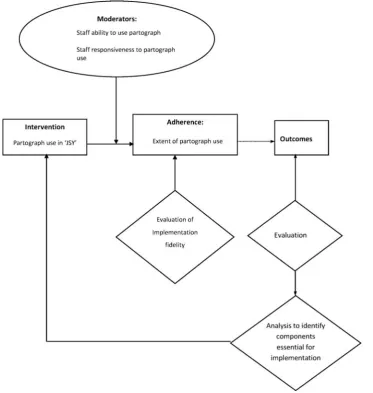
In this study, we use the implementation framework developed by Carroll et al.23 This framework, unlike others, includes moderating factors that are likely to influence the degree of fidelity in implementation, and recognises the complex relationships between these factors. The strength of the framework lies in its ability to draw pragmatic solutions to improve outcomes from the intervention by consideration of the moderating factors and components essential to improve implementation.
responsiveness, and coverage subcategory of adherence, having considered feasibility and data availability. The study framework adapted from Carroll et al’s framework for implementationfidelity is shown infigure 1.
Settings
The study was conducted in the large, central Indian province of Madhya Pradesh (MP). Two-thirds of MP’s 72 million population are rural24 and one-third live below the poverty line. MP has poorer health indicators relative to Indian averages. Infant mortality stands at 67/ 1000 births,25 which is the highest in India, and mater-nal mortality ratio (MMR) is 277 matermater-nal deaths/ 100 000 births.26 The public health sector is the domin-ant provider of obstetric services in the province; the private health sector is small, concentrated in urban areas and unaffordable for the majority. In MP, the JSY programme has functioned largely through public sector facilities. The public health system has a three tiered network of facilities: each district in the province has a tertiary level district hospital (DH) providing care for obstetric complications as well as normal birth to
women either arriving directly or referred from commu-nity health centres (CHCs) that are secondary care facil-ities within districts. CHCs in turn cater to women arriving directly or referred from primary health centres (PHCs) in the periphery. All pregnant women in MP are eligible for JSY participation. The JSY provides a cash transfer of about US$31 to rural mothers and US$22 to urban mothers. During implementation of the JSY in MP, the institutional birth proportion has increased from 31% in 2007 to 72% in 2012,15 benefiting seven million women so far.27
Study districts and facilities
As an administrative unit within a province, each district has a population between 1 and 1.5 million. Of the 50 districts in MP, three heterogeneous districts were selected for this study based on their geographic loca-tion and differing socioeconomic level of development (as indicated by human development indices). Public facilities that reported at least 10 deliveries a month in the past 6 months were selected for the study.
Study design
This was a mixed methods study using quantitative as well as qualitative methods. We performed (1) a record review of intrapartum case records to assess the extent of partograph use across a range of public facilities implementing the JSY programme, (2) a vignette-based survey to assess competence of staff providing care in the programme at using the partograph and (3) semi-structured interviews with staff to explore the‘why’ ques-tions triggered from the quantitativefindings.
The study was conducted between February 2012 and April 2013.
Data collection
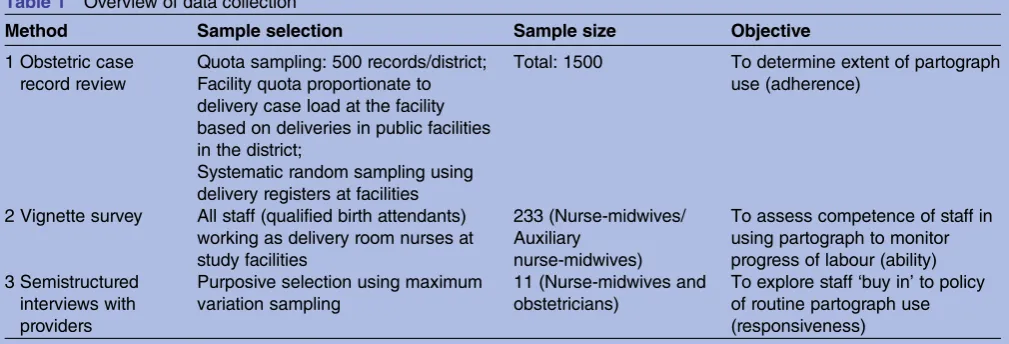
Details of data collection additional to the overview in
table 1are described below.
Record review
Trained researchers selected the obstetric records from the delivery register in each facility. Thefirst record was randomly selected from the last 1 year, while subsequent ones were selected using a sampling interval (calculated by dividing the total deliveries at the facility in the last 1 year by the desired sample size for the facility). The records were hand-written case sheets located in store rooms, as unorganised piles of papers or records bundled by month. Where a record was missing, it was replaced by the next record for the same date in the delivery register.
Each selected record was screened to identify if it con-tained a partograph. Our initial plan was to assess the partograph against a list of criteria. However, in our pilot study, conducted in a neighbouring district using a sample of 20 records, we observed that details such as time of admission, clinical condition on arrival and sub-sequent vaginal examinationfindings were generally not recorded, and this did not allow us to assess if the parto-graph was used appropriately. We therefore limited our study to documenting if any attempt to use a partograph was made and considered one as filled if at least one
clinicalfinding was recorded on the graph that plots cer-vical dilation against time.
Vignette-based survey
The model for construction of case vignettes proposed by Heverlyet al28was used to guide the vignette develop-ment process. Three vignettes were developed for this study: (1) normal progress of labour, (2) slow progress with signs of fetal distress and (3) non progress of labour. Each case description in the vignette provided clinical findings on cervical dilatation, frequency and duration of uterine contractions, pulse, blood pressure, temperature and fetal heart rate with time. Content val-idity of the vignettes and scoring method was established before the survey by expert opinion while face validity was assessed by discussion with delivery room nurses from all levels of facilities. The standard responses were developed based on the recommended practices for SBAs in India.29 The maximum possible score for a respondent was 10. The vignettes and scoring system are in the online supplementary file 1. A pilot test (n=20) was conducted in a neighbouring district, not included in this study, to test feasibility of administering the vignette survey. All nurse-midwives who are routinely deployed in the delivery room or their supervisors in the selected facilities were invited to participate in the survey, as they conduct the majority of births in the JSY programme and are expected to monitor progress of labour. The interviewer explained that the survey aimed to assess the overall competence of nursing staff provid-ing obstetric care in the JSY programme and was not an individual assessment. On average, respondents took 10 min to complete the survey while on the ward. The response sheet did not include names or personal identifiers.
Each respondent was presented with one vignette asking her to plot the findings on the simplified WHO partograph—which is routinely provided in public facil-ities. Following the plotting, respondents were asked to answer an open-ended question seeking decisions
Table 1 Overview of data collection
Method Sample selection Sample size Objective
1 Obstetric case record review
Quota sampling: 500 records/district; Facility quota proportionate to delivery case load at the facility based on deliveries in public facilities in the district;
Systematic random sampling using delivery registers at facilities
Total: 1500 To determine extent of partograph use (adherence)
2 Vignette survey All staff (qualified birth attendants) working as delivery room nurses at study facilities
233 (Nurse-midwives/ Auxiliary
nurse-midwives)
To assess competence of staff in using partograph to monitor progress of labour (ability) 3 Semistructured
interviews with providers
Purposive selection using maximum variation sampling
11 (Nurse-midwives and obstetricians)
regarding care of the labouring woman presented in the vignette.
The first two authors independently marked the parti-cipants’responses against the standard responses.
Semistructured interviews with providers
Eleven interviews were conducted with nurse-midwives (9) and obstetricians (2) who work in labour rooms in a range of the study facilities of two districts. Length of experience and qualification were considered to ensure a range of responses. Using a topic guide, their experi-ences and perceptions of using the partograph, includ-ing any barriers to use and any traininclud-ing received, were explored. The lead author conducted the interviews in a location chosen by the respondent within the health facilities. They were conducted in the local language, were audiotaped with permission of the respondent and lasted for approximately 40 min.
Analysis
Data from the record review were entered in REDCAP software and the scores from the vignette survey were entered into Excel spread sheets. STATA V.10 was used for analysis. Agreement between competence scores by the two raters was assessed using intra class correlation. Results are presented using descriptive statistics.
Audiotapes from the interviews were transcribed ver-batim and then translated into English. Transcripts were read several times to develop a coding framework, which was finalised through consensus among coauthors. A thematic framework analysis approach was used.30The coding framework was applied to all data, the coded data were segregated, compared across cases and con-trasted with other codes to identify patterns and rela-tions in the data, and develop explanarela-tions. The OPENCODE31software was used for data management.
RESULTS
Characteristics of study facilities and participants
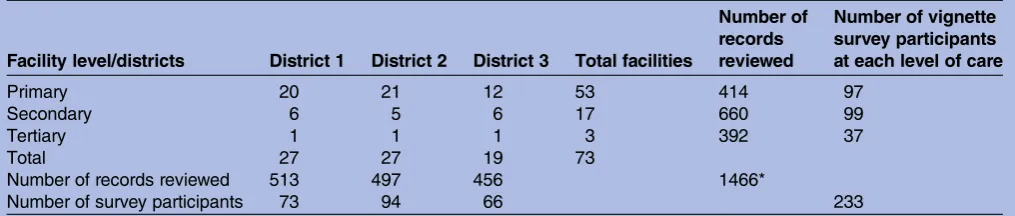
The study districts had 73 facilities eligible for the study and all were included. Table 2presents the distribution of the study facilities by districts and by levels of care,
the number of case records reviewed and number of participants for the vignette survey at each level.
Participants: Of the 256 birth attendants who were eli-gible for the vignette survey, 91% participated. Only one potential participant refused, the other non-participants were away on training or on leave.
The birth attendants either hold an 18-month auxil-iary nurse midwife (ANM) qualification, or have under-gone 3-year training in general nursing and midwifery (GNM) or 4-year training to qualify with Bachelors of Science (BSc) in nursing. Two-thirds of ANMs in our study were at primary care facilities, though some were also posted at higher level facilities. GNMs and BSc nurses were mostly at secondary and tertiary care facil-ities. This distribution was similar across the three dis-tricts. The characteristics of participants are described in
table 3.
Among the participants for the semistructured inter-views, both obstetricians were based at DHs and had more than 5 years’ experience while of the nine nurses (including 2 ANMs) three were based at DHs and six were working at CHCs. Seven of the nurses had over 5 years’ experience and six of them were working as head nurses.
Adherence to partograph use—results from the record review
The review of case records showed very low use of parto-graphs. Of the 1466 records reviewed, 6% records had a partograph with at least one assessment of cervical dila-tation plotted against time. Most case records where a partograph was used were found at DHs, while none was found at the PHCs.
Ability to use a partograph—competence scores from the vignette-based survey
The reliability coefficient for inter rater reliability of scores assigned by two raters was 0.97 (95% CI 0.95 to 0.99), indicating strong agreement.
The scores for competence in plotting a partograph ranged between 0 and 9 (of 10) with a mean score of 1.08, which approximated to 11% of the maximum
Table 2 Distribution of study facilities, of records reviewed, and survey participants by facility levels and districts
Facility level/districts District 1 District 2 District 3 Total facilities
Number of records reviewed
Number of vignette survey participants at each level of care
Primary 20 21 12 53 414 97
Secondary 6 5 6 17 660 99
Tertiary 1 1 1 3 392 37
Total 27 27 19 73
Number of records reviewed 513 497 456 1466*
Number of survey participants 73 94 66 233
*Although the intended sample size was 1500, we reviewed 1466 records; since there were some PHCs where no clinical case records were maintained, only a register was used for recording patient information.
score. Figure 2 shows clustering of the scores to the lower end of the histogram. Of all participants, 75% scored below 15% of the maximum possible score and only 3.4% scored above 50% of it. Despite an inability to plot findings on the partograph, 27.5% participants were able to arrive at a correct clinical decision regard-ingfirst line care for the condition presented.
Responsiveness to partograph use—findings from interviews on staff‘buy in’
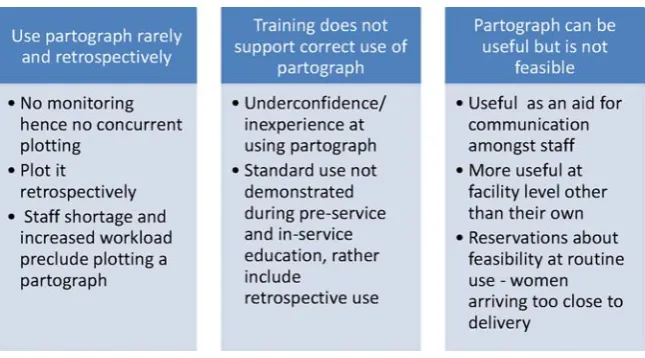
Three themes emerged from the interviews: use parto-graphs rarely and retrospectively; training does not support correct use of partographs; and partographs can be useful but are not feasible. These themes are illu-strated in figure 3 and in the following sections, sup-ported by direct quotations from the participants.
Use partographs rarely and retrospectively
Most staff reported that it was not possible to plot a par-tograph for each woman during labour. Many respon-dents reported an increased workload since the JSY began; there was a shortage of staff relative to workload and therefore time constraints. This high workload and time constraint precluded frequent and timely
monitoring, and led to partographs being often filled incompletely, since the findings on maternal and fetal parameters that needed to be assessed were left blank.
I am mostly alone on duty and many women come for delivery nowadays, so how can Ifill the partograph at that time. Ifill it up later. (Head nurse)
We don’t fill the main things (clinical parameters), we just fill the name, address on the first page and then whether it was a boy or a girl born; that’s all. (Head nurse)
How could you think it is feasible in our kind of facilities with so much delivery load? (Obstetrician)
Respondents reported that they filled the partograph retrospectively at times, to ensure the record was com-plete. A head nurse pointed out that as a supervisor, she was aware this was not appropriate but indicated they were in a way compelled to do so since the use of parto-graphs was monitored by authorities, and inspectors briefly looked through records to see if the partographs werefilled. Others said that it was an unwritten norm to complete partographs when expecting such an inspec-tion visit.
Actually it should befilled earlier, what we are doing is wrong but occasionally some director or someone will come and ask about it, we have to show them that we are filling it, so we are implementing it this way here. (Head nurse)
A head nurse claimed that she had instructed staff at her facility to use the partograph appropriately but they had refused.
...If I tell them tofill it during delivery, they reply we will fill it after the delivery. What can I do? (Head nurse)
Respondents described that at facilities where nurses conduct multiple consecutive deliveries, they forgetfi nd-ings before they can be entered in a partograph. This appeared more common at DHs where nurses switch between delivery tables to cater to many women simul-taneously. In addition, respondents reported that some nurses continuously conducted deliveries while others wrote the case records including the partograph and they seldom had any communication about the clinical findings.
We are two sisters (nurses) here, so onefills the parto-graph and the various records and the other one con-ducts the deliveries. (Head nurse)
Few respondents reported irregular supply of printed partographs as a reason for not using the partograph routinely.
Table 3 Characteristics of participants in the vignette survey (n=233)
Characteristic
Median (range)/ percentage
Age 36 (21–65) years
Total experience 10 (0.5–40) years
Experience in obstetrics 5 (0–39) years Average deliveries per month 15 (0–300)
Proportion SBA trained 56%
Proportion women 100%
Qualification
Auxiliary nurse midwife (ANM) 66% General nurse and midwife (GNM) 28% Bachelor of science (nursing) 6%
Training does not support correct use of the partograph The poor competence at using the partograph was found rooted in the poor training staff received. Respondents reported that they were not confident in using one after their training. Although it was manda-tory for every student to complete 10 partographs as part of their practical training, staff recollected that these were generallyfilled post-facto after observing the delivery rather than during labour at the bedside.
We had a casebook with the graph, there were so many of us (students) so we could not do anything there (in the delivery room); we just watched; we used to fill it up later, after going to the hostel. (Head nurse)
I feel afraid that I might fill it incorrectly (and then someone could point it out), so I never fill it. (Auxiliary nurse)
A similar gap in training was reported about the in-service SBA training. The nurses recollected that as in-service trainees, they examined women and reported thefindings to senior nurses, who then filled the graph. One participant recollected a session on parto-graph use during the SBA training:
They had explained it in class but they didn’t explain it at bed side. (Head nurse)
Partographs can be useful but are not feasible
The partograph was seen as a useful tool theoretically, but staff doubted its practical utility. It was seen as an aid to communication about progress of labour among staff in the facility and also between facilities in case of refer-ral. With regard to referral it was seen to be useful for staff either at sending or at receiving facility level, responses invariably pointing to usefulness at facilities other than their own.
People at CHCs, PHCs and small hospitals should fill it because they have to refer women, but we have a doctor available 24 hours here (at DH), we can call her and
immediately show her the patient directly (so for us it is not needed as much as for them). (Head nurse)
It is good for high risk cases and those we have to refer from here (CHC). It is useful for the staff at DH (where the woman is referred). (Head nurse)
Many respondents reported that use of the partograph ensures important parameters such as blood pressure and fetal heart rate are examined in a timely manner. An obstetrician described an incident of a stillbirth where she felt that use of the partograph could have been lifesaving.
I saw the patient at 11.30 pm, she was 4 cm dilated with leaking membranes. Next morning I asked my duty doctor about her progress. She told me the same fi nd-ings as in the night. I felt if the duty doctor had plotted her partograph she would have at least called me earlier. (Obstetrician)
A minority of respondents explained that the parto-graph could be useful as an aid for safety of staff in the event of a legal issue around care during labour and delivery.
Although staff did not deny the utility of the parto-graph as an aid in monitoring progress of labour, they felt this was only possible under ideal conditions. They had reservations as to the feasibility of its routine use in everyday settings, particularly because women generally arrive close to delivery, leaving no opportunity for the use of a partograph while staff shortages prevail.
If we have 10 women coming, 5 will come in full dilata-tion, so we can’tfill the partograph. (Head nurse)
DISCUSSION
This study adds to the knowledge regarding implementa-tion of the partograph in low-resource settings. It uses the implementation fidelity framework and a mixed methods approach to provide a deeper understanding into the current implementation scenario, and identifies
bottlenecks to partograph use in the JSY programme for in-facility births in India. Application of the analytical framework for implementationfidelity enables generalis-ability of study results. The findings provide insights to consider when recommending for or against routine use of the partograph in the context of the cash transfer programme in India and in resource-constrained settings generally.
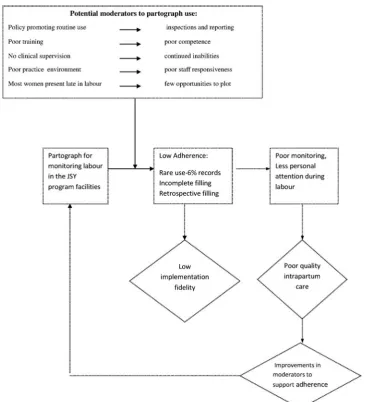
The interpretation of our results, in light of Carroll’s framework, to study implementationfidelity, is presented infigure 4. By studying aspects of implementation such as adherence, abilities and responsiveness to partograph use the studyfinds a low implementation fidelity of par-tograph use. It identifies provider training, supervision, practice environment, including user compliance, as potential moderators of partograph use that influence adherence and hence the intended outcomes from par-tograph use. The results indicate high potential to improve quality of care in the JSY programme by
improving the potential moderators to adherence that this study identifies.
The moderator ‘practice environment’ that this study identifies is in agreement with Hassonet al32who applied Carroll’s framework to study complex health interven-tions and suggested ‘context’ as a potential moderator. Given that implementationfidelity is dependent on inter-relationships between moderators, overall, our findings call for consideration of the context of partograph use in the JSY programme by taking into account the factors related to organisational culture that affect practice envir-onment and hence the implementation.
Partograph use in the JSY is low, but low use is not unique to India
Ourfindings of low use of the partograph are consistent with another study from Southern India,33 which reported partograph was used at 3.8% births observed. Studies from other low income and high maternal
mortality countries such as Ethiopia,34–36 Ghana37and Tanzania,38 have also reported low knowledge and util-isation of the partograph. Similar reasons surrounding training and poor ‘buy-in’ were reported by a study in Malawi, where only 3.9% of health workers could plot the partograph correctly. Our findings indicate pro-blems with pre-service education as well as with in-service training leading to poor competence and non-use of the partograph. Given these inadequacies in training, it may be unrealistic to expect staff to be com-petent at using the partograph. Student midwives in Kenya experienced similar lack of hands on partograph training in the labour ward.39 The other two common reasons for not routinely using the partograph in our study were staff shortages and late arrival of women in labour. The issue of staff shortages is a long standing challenge in many low-and middle-income countries including India.40Currently 33% of nursing staff posts at non-DHs in MP were vacant.41 Hulton et al,42 in their framework to assess quality of institutional delivery care, consider late arrival of women as a sign of poor quality of care, indicating women delay going to facilities due to perceived discomfort and rude behaviour of staff.
Partograph use requires better training and a conducive work environment
Retrospective completion of partographs mainly for inspections, as seen in this study, is indicative of poor supervisory mechanisms. Such bureaucratic use of the partograph is also reported from Brazil.43 The parto-graph use found in this study, although low, was highest in the DHs where the availability of obstetricians may render it relatively less useful at suspecting abnormal pro-gress of labour than at peripheral centres. It is unlikely that staff value completing a partograph when they do not use it to make decisions on interventions during labour. Popular use of partographs would require a clin-ical environment where decision-making is systematic and evidence based. This is not always the case in the study settings, where decision-making is rarely protocol based, as documented by our observational study of deliv-ery care under the programme.44Difficulties with under-standing the application of the partograph in practice have been reported from other low-income settings as well and demand innovative ways of improving training in partograph use.45 Overall, the poor ‘buy in’ to parto-graph use that this study reports is not surprising. We would rather argue that the facility environment charac-terised by staff shortage, high work load and routines where monitoring of labour is not usually practiced (or feasible because of women coming very close to or in the second stage) does not encourage the use of a parto-graph among staff. It is important to note that previous studies9 46 47 that have reported an association between partograph use and positive labour outcomes were neces-sarily coupled with proper case management protocols, and show that partograph use needs continuous reinfor-cements and quality assurance.46
We therefore conclude that the structures, circum-stances and work culture in the study facilities are not conducive to routine use of the partograph. Our fi nd-ings add criticality of the practice environment to the commonly known challenges to routine use of parto-graph reported from other contexts, such as insufficient knowledge and workload pressure.11
Routine partograph use as an indicator of quality of normal delivery care
The JSY was launched in the context of a larger health system reform in India—the National Rural Health Mission. As part of the Mission’s attempts to improve monitoring processes in the health system, facilities under the JSY were required to report the proportion of women in labour who were monitored using the parto-graph. We were unable to find literature or anecdotal evidence about how these data are being used. Ourfi nd-ings not only suggest a low use of the partograph but, importantly, reveal the realities concerning the way the partograph is currently used—in retrospect and more for bureaucratic reasons. Therefore, measuring the routine use of partographs in the current conditions would seem a poor choice of indicator of quality of normal delivery care. It is unlikely to support quality improvement, unless the conditions for routine use of the partograph are met and it is used for monitoring labour as intended. It is also important to consider that the majority of women arrive in the second stage; hence frequency of partograph use cannot be a useful indica-tor, as reported by other studies.48 Although there have been suggestions for the routine use of the partograph as a new indicator of quality of care for normal delivery,5 our findings suggest caution with using it in the current context.
Partograph use in the JSY context: considerations and potential way forward
programme are conducted by nurse midwives who have limited competence in midwifery,50 and care is not always under supervision of obstetricians. In such a context, routine use of the partograph could greatly improve care and prevent adverse outcomes. This would require building competence, providing supportive supervision, ensuring SBAs understand the importance of monitoring of labour, and creating a conducive envir-onment by addressing staff shortages and ensuring women arrive at facilities in the first stage of labour. Findings from recent research by Underwood,51 demon-strating the use of digital pen technology to address training barriers to partograph use at a Kenyan hospital, offer innovative solutions that could be considered in other developing country contexts.
Limitations: First, although we report a low use of par-tographs, we were unable to conclude from the records if partograph use was recommended in all cases studied. There may be cases where actions other than parto-graph use, such as immediate referral or caesarean section, should be followed. Although a possibility, this number is likely to be small, thus not affecting the trend of our results. We were limited by the quality of clinical records and unable to determine the proportion of women who arrived late in labour. Second, our study is restricted to public facilities in MP and our findings may not be generalisable to public facilities in other pro-vinces or to private facilities.
CONCLUSIONS
Study of implementation fidelity of an intervention can provide useful information to guide improvement in out-comes intended from the intervention. This study finds low utilisation of partographs for monitoring labour in the JSY programme and limited abilities of staff to use this tool in an environment where staff show poor buy-in to routine use of the partograph. Creating a policy to promote routine use of the partograph is not enough to ensure its implementation; other potential moderators to its adherence such as training, supervision, staff ‘buy in’and user compliance need attention. Partograph use can result in improved quality of care and health out-comes in the JSY programme, only if the issues of work overload, staff shortages, training and supervision are addressed, so that staff finds a conducive work environ-ment to use the partograph and women find it benefi -cial to present early in labour.
AcknowledgementsThe authors thank Dr Manish Singh for assistance during data collection. The authors thank Dr B Subha Sri, Dr Snehal Deshmukh, Dr P R Tekwani and Dr M B Swamy for technical advice. The authors are grateful to all study participants and to the MATIND study team for their cooperation. The authors acknowledge support from the National Rural Health Mission, Government of Madhya Pradesh.
Contributors SC, ADC and JR conceptualised and designed the study. SC and SU acquired and analysed the data. SC wrote the first draft. SU contributed to revising the draft. ADC and JR participated in interpretation of results and revised the draft. All authors read and approved the final version.
Funding This research was funded by the EU FP7 grant to project MATIND.
Competing interests None declared.
Ethics approval Approval to conduct this study was granted by the Institutional Ethics Committee of the R D Gardi Medical College, Ujjain, India.
Provenance and peer review Not commissioned; externally peer reviewed.
Data sharing statement No additional data are available.
Open Access This is an Open Access article distributed in accordance with the Creative Commons Attribution Non Commercial (CC BY-NC 4.0) license, which permits others to distribute, remix, adapt, build upon this work non-commercially, and license their derivative works on different terms, provided the original work is properly cited and the use is non-commercial. See: http:// creativecommons.org/licenses/by-nc/4.0/
REFERENCES
1. Graham WJ, McCaw-Binns A, Munjanja S. Translating coverage gains into health gains for all women and children: the quality care opportunity.PLoS Med2013;10:e1001368.
2. Van den Broek NR, Graham WJ. Quality of care for maternal and newborn health: the neglected agenda.BJOG2009;116(Suppl 1): 18–21.
3. Graham WJ, Campbell OM. Maternal health and the measurement trap.Soc Sci Med1992;35:967–77.
4. World Health Organization.Monitoring emergency obstetric care: a handbook. Geneva: World Health Organization, 2009.
5. Gabrysch S, Civitelli G, Edmond KM,et al. New signal functions to measure the ability of health facilities to provide routine and emergency newborn care.PLoS Med2012;9:e1001340. 6. World Health Organization. WHO partograph in management of
labour.Lancet1994;343:1399–404.
7. Lavender T, Hart A, Smyth RM. Effect of partogram use on outcomes for women in spontaneous labour at term.Cochrane Database Syst Rev2013;(7):CD005461.
8. Fawole AO, Hunyinbo KI, Adekanle DA. Knowledge and Utilization of the Partograph among obstetric care givers in South West Nigeria. Afr J Reprod Health2008;12:22–9.
9. Bosse G, Massawe S, Jahn A. The partograph in daily practice: it’s quality that matters.Int J Gynecol Obstet2002;77:243–4.
10. Lavender T, Lugina H, Smith H. The partograph: a life-saving tool for African midwives.Trop Doct2007;37:191–2.
11. Mathai M. The partograph for the prevention of obstructed labor. Clin Obstet Gynecol2009;52:256–69.
12. Groeschel N, Glover P. The partograph: used daily but rarely questioned.Aust J Midwifery2002;14:22–7.
13. Lavender T; Malcolmson L. Is the partogram a help or a hindrance? An exploratory study of midwives’views.Pract Midwife1999;2:23–7. 14. World Health Organization.Trends in maternal mortality: 1990 to
2013. Estimates by WHO, UNICEF, UNFPA, the world bank, and the United Nations population division. Geneva: World Health
Organization, 2014.
15. Registrar General of India.Maternal mortality ratio estimates, sample registration system 2010–12. New Delhi: Government of India, 2012. 16. Ministry of Health and Family Welfare.Janani SurakshaYojana:
revised guidelines for implementation 2006. New Delhi: Government of India, 2006.
17. Ministry of Health and Family Welfare.Guidelines for antenatal care and skilled attendance at birth by ANMs and LHVs 2005. New Delhi: Government of India, 2005.
18. Lim SS, Dandona L, Hoisington JA,et al. India’s Janani Suraksha Yojana, a conditional cash transfer programme to increase births in health facilities: an impact evaluation.Lancet2010;375:2009–23. 19. Randive B, Diwan V, De Costa A. India’s conditional cash transfer
programme (the JSY) to promote institutional birth: is there an association between institutional birth proportion and maternal mortality?PLoS ONE2013;8:e67452.
20. Sri BS, Naidu S, Khanna R. An investigation of maternal deaths following public protests in a tribal district of Madhya Pradesh, Central India.Reprod Health Matters2012;(39):11–20.
21. Chaturvedi S, Randive B, Diwan V,et al. Quality of obstetric referral services in India’s JSY cash transfer programme for institutional births: a study from Madhya Pradesh Province.PLoS ONE2014;9: e96773.
23. Carroll C, Patterson M, Wood S,et al. A conceptual framework for implementation fidelity.Implement Sci2007;2:1–9.
24. Registrar General of India.Census of India 2011. New Delhi: Government of India, 2012.
25. Registrar General of India.Sample registration System 2011. New Delhi: Government of India, 2011.
26. Registrar General of India.Annual Health Survey of India 2012. New Delhi: Government of India, 2012.
27. Ministry of Health and Family Welfare.Analysis of Health Management Information System data. New Delhi: National Health Systems Resource Centre, 2013–2014.
28. Heverly MA, Fitt DX, Newman FL. The construction of case vignettes for evaluating clinical judgement: an empirical model. Eval Program Plann1984;7:45–55.
29. Ministry of Health and Family Welfare.Skilled birth attendance-a handbook for auxiliary nurse midwives/lady health visitors and staff nurses 2010. New Delhi: Government of India, 2010.
30. Ritchie J, Spencer L, O’Connor W. Carrying out qualitative analysis. In: Ritchie J, Lewis J, eds.Qualitative research practice: a guide for social science students and researchers. London: Sage
Publications, 2003:219–62.
31. OPENCODE. http://www.phmed.umu.se/english/divisions/ epidemiology/research/open-code/ (accessed 5 Jul 2014). 32. Hasson H. Systematic evaluation of implementation fidelity of complex
interventions in health and social care.Implement Sci2010;5:67. 33. Spector JM, Agarwal P, Kodkany B,et al. Improving quality of care
for maternal and newborn health: prospective pilot study of the WHO safe childbirth checklist program.PLoS ONE2012;7:e35151. 34. Yisma E, Dessalegn B, Astaktie A,et al. Knowledge and utilization of
partograph among obstetric care givers in public health institutions of Addis Ababa, Ethiopia.BMC Pregnancy Childbirth2013;13:17. 35. Abebe F, Birhanu D, Awoke W,et al. Assessment of knowledge and
utilization of the partograph among health professionals in Amhara region, Ethiopia.Sci J Clin Med2013;2:26–42.
36. Yisma E, Dessalegn B, Astatkie A,et al. Completion of the modified World Health Organization (WHO) partograph during labour in public health institutions of Addis Ababa, Ethiopia.Reprod Health 2013;10:23.
37. Gans-Lartey F, O’Brien BA, Gyekye FO,et al. The relationship between the use of the partograph and birth outcomes at Korle-Bu teaching hospital.Midwifery2013;29:461–7.
38. Duysburgh E, Zhang WH, Ye M,et al. Quality of antenatal and childbirth care in selected rural health facilities in Burkina Faso,
Ghana and Tanzania: similar finding.Trop Med Int Health 2013;18:534–47.
39. Lavender T, Omoni G, Lee K,et al. Students’experiences of using the partograph in Kenyan labour wards.Afr J Midwifery Womens Health2011;5:117–22.
40. Rao M, Rao KD, Kumar AK,et al. Human resources for health in India.Lancet2011;377:587–98.
41. Rural Health Statistics. https://nrhm-mis.nic.in/UI/RHS/RHS% 202011/RHS%20-March%202011-%20Tables-%20Final%209.4. 2012.pdf (accessed 18 Feb 2014).
42. Hulton L, Matthews Z, Stones RW. Applying a framework for assessing the quality of maternal health services in urban India.Soc Sci Med2007;64:2083–95.
43. AzevedoAguiar C, Gonçalves R,et al. Use of the partogram in labor: analysis of its application in different care models.Open J Obstet Gynecol2013;3:1.
44. Chaturvedi S, De Costa A, Raven J. Increased institutional birth coveragedoes not mean improved skilled birth attendance: Study of intra-partum care in JSY cash transfer program in Madhya Pradesh, India.(Abstract) Third Global Symposium in Health Systems Research; Cape Town, October 2014.
45. Lavender T, Dame G, Omoni K,et al. A pilot quasi-experimental study to determine the feasibility of implementing a partograph e-learning tool for student midwife training in Nairobi.Midwifery 2013;29:876–84.
46. Fahdhy M, Chongsuvivatwong V. Evaluation of World Health Organization partograph implementation by midwives for maternity home birth in Medan, Indonesia.Midwifery2005;21:301–10. 47. Fawole AO, Fadare O. Audit of use of the partograph at the
University College Hospital, Ibadan.Afr J Med Sci2007;36:273–8. 48. Kwast B, Poovan P, Vera E,et al. The modified WHO partograph:
do we need a latent phase?Afr J Midwifery Womens Health 2008;2:143–8.
49. Registrar General of India.Special Bulletin on maternal mortality in India 2007-09. New Delhi: Government of India, 2011.
50. Chaturvedi S, Upadhyay S, De Costa A. Competence of nurse birth attendants in Indias’s JSY conditional cash transfer program to promote institutional births: an assessment using case vignettes in Madhya Pradesh province.BMC Pregnancy Child Birth 2014;14:174.
Pradesh province
births: a mixed methods study in Madhya
JSY cash transfer programme for facility
Implementation of the partograph in India's
Raven
Sarika Chaturvedi, Sourabh Upadhyay, Ayesha De Costa and Joanna
doi: 10.1136/bmjopen-2014-006211
2015 5:BMJ Open
http://bmjopen.bmj.com/content/5/4/e006211
Updated information and services can be found at:
These include:
Material
Supplementary
211.DC1.html
http://bmjopen.bmj.com/content/suppl/2015/04/28/bmjopen-2014-006
Supplementary material can be found at:
References
#BIBL
http://bmjopen.bmj.com/content/5/4/e006211
This article cites 32 articles, 2 of which you can access for free at:
Open Access
http://creativecommons.org/licenses/by-nc/4.0/
non-commercial. See:
provided the original work is properly cited and the use is
non-commercially, and license their derivative works on different terms, permits others to distribute, remix, adapt, build upon this work
Commons Attribution Non Commercial (CC BY-NC 4.0) license, which This is an Open Access article distributed in accordance with the Creative
service
Email alerting
box at the top right corner of the online article.
Receive free email alerts when new articles cite this article. Sign up in the
Collections
Topic
Articles on similar topics can be found in the following collections(1062)
Public health
(166)
Obgyn
(641)
Health services research
(319)
Health policy
(230)
Global health
Notes
http://group.bmj.com/group/rights-licensing/permissions
To request permissions go to:
http://journals.bmj.com/cgi/reprintform
To order reprints go to:
http://group.bmj.com/subscribe/