Volume 2006, Article ID 49084, Pages1–11 DOI 10.1155/ASP/2006/49084
Seamless Bit-Stream Switching in Multirate-Based Video
Streaming Systems
Wei Zhang and Bing Zeng
Department of Electrical and Electronic Engineering, The Hong Kong University of Science and Technology, Clear Water Bay, Kowloon, Hong Kong
Received 15 August 2005; Revised 18 December 2005; Accepted 15 March 2006
This paper presents an efficient switching method amongnon-scalablebit-streams in a multirate-based video streaming system. This method not only takes advantage of the high coding efficiency of non-scalable coding schemes (compared with scalable ones), but also allows a high flexibility in streaming services to accommodate the heterogeneity of real-world networks. One unique feature of our method is that, at every preselected switching point, the reconstructed frame at each rate or two reconstructed frames at different rates will go through an independent or a joint processing in the wavelet domain, using an SPIHT-type coding algorithm. Another important step in our method is that we will apply a novel bit allocation strategy over all hierarchical trees that are generated after the wavelet decomposition so as to achieve a significantly improved coding quality. Compared with other existing methods, our method can achieve theseamlessswitching at each preselected switching point with a better rate-distortion performance.
Copyright © 2006 Hindawi Publishing Corporation. All rights reserved.
1. INTRODUCTION
Due to the rapid growth and wide coverage of the Internet in recent years, there is a great increase of demand on vari-ous video services over the Internet, especially the real-time video streaming service. In contrast with the download mode where a video session is downloaded entirely to a user before it can be played, real-time video streaming enables users to enjoy the video service right after a very small portion of the whole video session is received. However, the Internet is an inherently heterogeneous and dynamic network, that is, the connecting bandwidth between the server and each user is varying with time. Under such circumstance of vary-ing bandwidth, how to maintain a robust quality of service (QoS) is perhaps the most challenging requirement during each service session. In response to this challenge, two diff er-ent source coding approaches have been developed in recer-ent years, which are briefly outlined in the following.
1.1. Multirate non-scalable coding scheme versus scalable coding scheme
One straightforward solution to the challenge mentioned above is to perform a multiple bit-rate (MBR) representa-tion, that is, to encode each source video into multiple non-scalablebit-streams, each at a preselected bit-rate. At each
time-slot during the streaming service, an appropriate bit-stream is selected according to the available bandwidth and then transmitted to the user. Clearly, each bit-stream gener-ated here can be encoded optimally at the chosen bit-rate. On the other hand, however, it is also clear that we cannot make the best use of the available bandwidth when it is between two preselected rates.
High Critical bit-rates
Low Coding quality Good
Moderate
Bad
Non-scalable, optimized at a single rate FGS
Rate-distortion curve, optimized at all rates continuously
Multirate representation Channel bit-rate
Figure1: Performance comparison of various video coding schemes.
based on the coded base-layer will generally yield a big resid-ual signal, which would cost more bits to represent at the en-hancement layer. Experimental results showed that FGS is of-ten 3–5 dB worse than the corresponding non-scalable cod-ing at the same bit-rate [2,3].
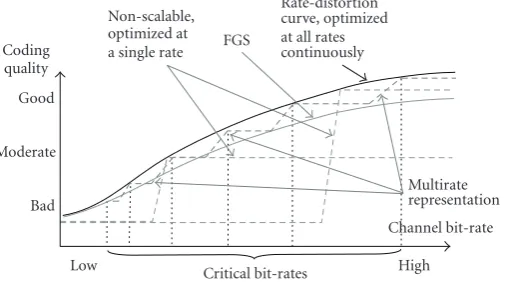
Figure 1 shows conceptually the performances of four
coding schemes: the optimal R-D coding (obtained by op-timally encoding the source video at every bit-rate continu-ously), FGS, non-scalable coding (optimized at a single bit-rate), and the MBR representation. The goal of designing an MBR representation is to get as close to the R-D curve as pos-sible at each preselected bit-rate, while maintaining a con-stant performance between two neighboring rates. It can be seen fromFigure 1that the overall performance of an MBR representation could be better than that of the FGS scheme.
In practice, the MBR representation has been adopted in a number of commercial streaming systems such as Windows Media Services, RealSystem, and QuickTime [4–6]. One very striking feature of the MBR method is that not only all source coding tasks but also all channel coding tasks have been com-pleted before the streaming service. As a result, each stream-ing service is extremely simple: just get the correspondstream-ing packets based on the available bandwidth (which determines a bit-rate) and throw them onto networks. On the other hand, a scalable video coding (SVC) scheme (including FGS and the most recent 3D wavelet-based SVC) very likely needs to handle the channel coding (protection, interleaving, pack-etization, etc.) in a real-time and on-line fashion, which may become a bottleneck problem when a large number of users are served simultaneously.
1.2. Switching among multiple non-scalable bit-streams
There are many issues in the MBR representation of a source video, such as how many bit-rates should be used, how to se-lect these critical rates, how to encode a source video at each selected rate (jointly with other rates or independently), and so forth. However, we believe that the most important issue is that an MBR-based streaming system must be equipped with a mechanism that allows effective switching between diff
er-ent bit-streams when a bandwidth change is detected. In this scenario, let us useF(t) to denote the frame of a video se-quence at frame numbert, andFi(t) to represent the cor-responding reconstructed frame at rateri(i =1, 2,. . .,M). All bits generated after the coding ofF(t) at bit-rateri are grouped into a set Zi(t), and Ci(t) is used to count how many bits are included in this set. Clearly, Ci(t) of an in-tra (I) frame will be much larger than that of a predic-tive (P) frame because of the motion compensation used in all P-frames. Suppose that a bandwidth change is detected at frame number t0 (corresponding to a P-frame) and a
switching fromFi(·) toFj(·) is needed right att0. The
sim-plest and most straightforward way is to perform the so-called direct switching with the transmitted bit sets being
{. . .,Zi(t0−1),Zj(t0),Zj(t0+ 1),. . .}. However, since there
exists mismatching betweenFi(t0−1) andFj(t0−1), errors
will occur whenFi(t0−1) (instead ofFj(t0−1)) is used to
perform the motion compensation forFj(t0). More seriously,
such errors will propagate into all subsequent frames until the next I-frame is received—causing the drifting errors that are often too large to be accepted, especially in the low quality to high quality switching case.
In order to achieve seamless (i.e., no drifting errors) switching, some non-predictive frames can be inserted pe-riodically into each non-scalable bit-stream as key frames, and switching is performed by correctly selecting the non-scalable bit-stream according to the available channel band-width and delivering the corresponding key frame to the client [4–6]. To achieve more flexible bandwidth adaptation, more key frame insertion points are needed. However, fre-quently inserting key frames into a non-scalable bit-stream will seriously degrade the coding efficiency because no tem-poral correlation is exploited in the coding of a key frame.
of overhead bits, while the negative impact is that bothFi(·) andFj(·) will be changed at each switching point, thus pos-sibly leading to some quality drop. Furthermore, the coding quality of all subsequent frames before the next I-frame is very likely to drop also.
So far, there have been a few works on how to mod-ify Fi(·) and Fj(·) so as to achieve the best tradeoff be-tween the number of overhead bits and the quality drop [7– 10]. The so-called SP/SI frames developed for this purpose have been included in the most recent video coding stan-dards H.264/MPEG-4 Part 10 [11] and their R-D perfor-mance under various networking conditions has been stud-ied in [12,13]. The SP-frame idea has also been applied to achieve seamless switching among scalable bit-streams [14]. One common feature of these works is that the extra process-ing at each switchprocess-ing point is performed in the DCT coeffi -cient domain. The intrinsic reason lies on the fact that the underlying codec used there is a DCT-based scheme. At this present time, we feel that the compromise achieved so far is still not very satisfactory. For instance, several tens of kilobits are usually needed for each secondary SP-frame of QCIF for-mat and the quality drop is controlled within about 0.5 dB in the low-to-high switching case [9]. Furthermore, there are many secondary SP-frames at each switching point that need to be generated and stored at server to support arbitrary switching among multiple (more than two) bit-streams.
In our work, we attempt to develop a more effective switching mechanism for multiple non-scalable video bit-streams that can be made seamless at a better R-D perfor-mance as compared to those existing schemes. The unique feature of our scheme is that the extra processing at each switching point is performed in a wavelet domain.
The rest of this paper is organized as follows.Section 2 explains how the reconstructed frame Fi(·) at each prese-lected switching point is further processed in the wavelet domain, with emphasis on the optimal bit allocation and the impact on the coding of all subsequent frames. Then, a trivial switching mechanism is presented inSection 3, which is based on independent wavelet processing of the recon-structed frameFi(·) for each rateri.Section 4presents a joint wavelet processing of two reconstructed frames Fi(·) and Fj(·) so as to potentially achieve a better rate-distortion
per-formance. Switching among multiple (more than two) bit-streams is studied inSection 5. Some experimental results are given inSection 6. Finally,Section 7presents the conclusions of this paper.
2. WAVELET-DOMAIN PROCESSING OF RECONSTRUCTED FRAMES
To achieve a seamless switching, the reconstructed frame at each switching point need undergo through some extra pro-cessing. For instance, such processing is performed in the DCT domain in [7–10,12–15]. In our work, we propose to perform this extra processing in the wavelet domain. To this end, we apply a wavelet decomposition to the reconstructed frame at each preselected switching points and then perform a lossy coding at a given bit budget. The reason we choose a
wavelet coding is twofold: (1) a lot of previous studies proved that the wavelet coding is better than the DCT-based cod-ing; and (2) the wavelet coding can be made scalable eas-ily, which is essential in our MBR-based streaming system to control the overhead budget that is needed at each switching point.
The wavelet coding we have chosen in this paper is the SPIHT algorithm [16]. SPIHT itself is simple and straight-forward. The only critical issue here is how to allocate the given bit budget over individual hierarchical trees that are formed after the wavelet decomposition, as discussed in the following.
2.1. Optimal bit allocation
The simplest strategy is to average the total budget over all hierarchical trees. However, we know that, due to the spatial location and intrinsic characteristics of individual trees, they play a role with different importance among a whole frame. For example, one can pay more attention to the center of a frame instead of its boundary; while a block that has larger variation tends to be more important toward the overall cod-ing quality. Therefore, a bit allocation optimization is neces-sary.
Following the SPIHT principle, we know that a num-ber of hierarchical trees, denoted asT(k), k = 1, 2,. . .,K, are generated after the wavelet decomposition of the recon-structed frame at a switching point. Each tree can be repre-sented into an embedded bit-stream that can be truncated at any position,nk. The contribution ofT(k) after truncat-ing atnktoward the overall distortion is denoted asDk(nk). The goal of our optimal bit allocation is to select the trunca-tion positrunca-tion in the embedded bit-stream of each hierarchi-cal tree, that is,{nk|k=1, 2,. . .,K}, so as to minimize the
overall distortionD =Dk(nk) subject to the total budget
B, that is,nk≤B.
To achieve this goal, one may construct a Lagrangian-type problem and try to solve it. However, since we cannot derive the exact expression of Dk(nk) in terms of nk, this problem is not solvable analytically. In our work, we develop the following method: for thelth bit-plane of thekth hierar-chical tree, we define aunit coding contribution(UCC) as the ratio of the distortion reduction and the number of bits used to code losslessly the entire bit-plane (using SPIHT), denoted asSl(k).
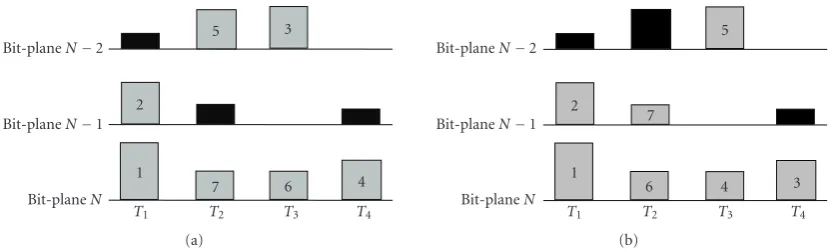
After computing allSl(k)’s, we rank them from the largest to the smallest. Then, the SPIHT coding always starts with the bit-plane with the largest UCC, continues on the second largest one, and so on. For example,Figure 2(a)shows the coding sequence where 4 hierarchical trees are included and each tree has 3 bit-planes. It is seen from this figure that there are 7 bit-planes totally to be selected/coded for transmission. However, it is easy to see that such arrangement will run into problem in practice. As the bit-planeN−1 ofT2is not
selected, all bits received for the bit-planeN−2 ofT2are not
decodable. Similarly, as the bit-planeN−2 is selected before the bit-planeN inT3, all bits in the bit-planeN−2 of T3
Bit-planeN−2
Bit-planeN−1
Bit-planeN
T1 T2 T3 T4
5 3
2
1
7 6 4
(a)
Bit-planeN−2
Bit-planeN−1
Bit-planeN
T1 T2 T3 T4 5
2
1
7
6 4 3
(b)
Figure2: (a) Coding sequence of one example with 4 trees. (b) Adjusted coding sequence of the same example.
bit-planeNofT3are not sent. Some adjustments are
there-fore necessary. For this example, the correct coding sequence after the adjustment is shown inFigure 2(b).
In practice, we need to computeSl(k), for each rateri, from the reconstructed frameFi(·) at each switching point. Once the coding sequence is determined, we start the SPIHT coding until the given budgetB is used up. In this way,B
is unevenly allocated over all hierarchical trees. The follow-ing matrix shows the actual bit allocation (with the total budgetB= 60 kilobits) for the video sequence “Akiyo” (Y -component) at frame #15 (the original video sequence of CIF format is coded using H.264 withQP=34 and the 9/7 filter bank is used in the wavelet decomposition of 5 levels): it is seen that the allocation is very uneven:
[BAM]=b(u,v)U×V=
⎡ ⎢ ⎢ ⎢ ⎢ ⎢ ⎢ ⎢ ⎢ ⎢ ⎢ ⎢ ⎢ ⎢ ⎢ ⎢ ⎢ ⎢ ⎣
226 216 203 164 43 51 155 171 70 135 342
228 286 129 204 798 991 848 305 588 414 398
120 256 149 200 881 1138 835 448 469 352 405
87 184 181 158 2171 1504 1225 817 109 187 406
256 277 303 187 1592 1659 1191 609 90 171 385
129 139 381 834 1420 1261 1306 1060 674 148 329
145 129 1394 270 614 1633 1091 844 453 938 399
232 638 588 238 231 1602 1156 1033 330 1451 307 101 770 622 263 163 1208 3032 1340 1626 941 569 ⎤ ⎥ ⎥ ⎥ ⎥ ⎥ ⎥ ⎥ ⎥ ⎥ ⎥ ⎥ ⎥ ⎥ ⎥ ⎥ ⎥ ⎥ ⎦
, (1)
withb(u,v)=B.
Based on UCC, one bit allocation map [BAM]i can be derived for eachriat a switching point. It is easy to see that about 1 kilobit (12 bits for each element) is needed to loss-lessly represent this map. It will be seen later on that [BAM]i may need to be sent (as overhead) during the switching from one bit-stream to another.
2.2. Influence on coding of subsequent frames
What is the most important to us is that this SPIHT-based processing of the reconstructed frame at each switching point will unavoidably result in a different frame, and thus may cause some quality drop. More severely, this might influence the coding of all subsequent frames (up to the next I-frame).1
1It is important to notice that the same impact also happens in the SP-frame coding scheme in H.264 when comparing against the coding with-out SP-frames.
To understand how big this impact could be, we did many ex-periments, with some results presented in the following (the original video sequence is coded using H.264 with a QP value specified in each figure).
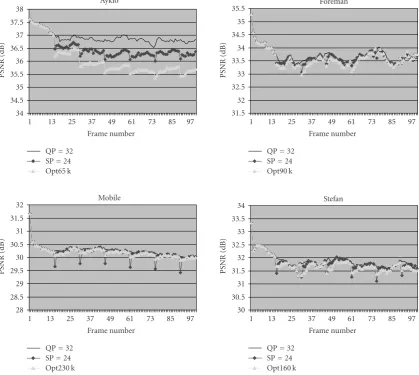
Figure 3 shows some results where there are 6 frames
(one for every 15 frames) specified as switching frames among 100 frames of the “Akiyo,” “Foreman,” “Stefan,” and “Mobile” sequences (all of CIF format and at 30 frames/ second), respectively. At each switching point, the recon-structed frame after the H.264 coding is further processed by SPIHT atB=53 + 6 + 6 kilobits (forY,U, andV com-ponents, resp.) for “Akiyo,” B = 70 + 10 + 10 kilobits for “Foreman,”B=140 + 10 + 10 kilobits for “Stefan,” andB=
200 + 15 + 15 kilobits for “Mobile,” respectively. The optimal bit allocation strategy developed above is used in each SPIHT processing, and the SPIHT processed frames at all switching points are used in the coding of all subsequent frames.
97 85 73 61 49 37 25 13 1
Frame number 34
34.5 35 35.5 36 36.5 37 37.5 38
PSNR
(dB)
Aykio
QP=32 SP=24 Opt65 k
97 85 73 61 49 37 25 13 1
Frame number 31.5
32 32.5 33 33.5 34 34.5 35 35.5
PSNR
(dB)
Foreman
QP=32 SP=24 Opt90 k
97 85 73 61 49 37 25 13 1
Frame number 28
28.5 29 29.5 30 30.5 31 31.5 32
PSNR
(dB)
Mobile
QP=32 SP=24 Opt230 k
97 85 73 61 49 37 25 13 1
Frame number 30
30.5 31 31.5 32 32.5 33 33.5 34
PSNR
(dB)
Stefan
QP=32 SP=24 Opt160 k
Figure3: Coding quality deviations after six reconstructed frames are further coded using SPIHT.
(the white colored curves with small-triangle markers) do ex-perience certain quality drop, compared to the correspond-ing curves (the black curves without any markers) where all frames (except for the first one) are coded as P-frames. While the drop in “Akiyo” is quite noticeable (more than 1 dB), it is well-controlled within 0.5 dB for other three sequences. An-other interesting observation fromFigure 3is that the coding quality drop at one switching point does not seem to add up with others at all switching points thereafter for “Foreman,” “Stefan,” and “Mobile,” whereas this adding-up effect seems to be existing slightly in “Akiyo.”
Figure 3also includes the corresponding results (the dark
grey colored curves with small-diamond markers) obtained by doing a requantization in the DCT domain—the same as was used in H.264 to generate the primary SP-frames [7– 10], where the requantization factor SPQP is set at 24. It is clear that the SP-frame scheme yields results that are better than our results for the “Akiyo” sequence, about the same for the “Foreman” sequence, but slightly worse for the “Ste-fan” and “Mobile” sequences. In the meantime, it is worth to
point out that the coding quality drop shown inFigure 3is much smaller when comparing with what is experienced in the FGS coding (i.e., usually 3 dB). A comparison between the bit budget used in the SPIHT processing and the size of each secondary SP-frame generated in H.264 will be pre-sented in the next section.
3. A TRIVIAL SWITCHING ARRANGEMENT
After the switching frameFi(t0) is further processed using
the SPIHT algorithm for each rateriso as to obtain the mod-ified version ¯Fi(t0), a trivial switching mechanism between
two bit-streams can be arranged as inFigure 4.
Suppose that the bit-stream at rate ri is currently streamed and a switching to the raterj is needed right at the preselected pointt0. Then, the transmitted video frames
around the switching point are {Fi(t0 −1), ¯Fj(t0),Fj(t0 +
1)}. From our earlier analysis, we can see that the number of bits used for representing ¯Fj(t0) is about 1 kilobit +Bj,
rj
ri
I P P P
· · ·
· · ·
· · ·
· · · Fi(t0−1) Fi(t0) Fi(t0) Fi(t0+ 1)
Figure4: A trivial switching arrangement between two bit-streams.
point to SPIHT-codeFj(t0) into ¯Fj(t0), and about 1 kilobit
is needed to represent [BAM]j (asFj(t0) is not available at
the switching point—we need to know [BAM]j so that all received bits for representing ¯Fj(t0) can be correctly
parti-tioned among all hierarchical trees). On the other hand, the transmitted frames are{Fi(t0−1),Fi(t0)/F¯i(t0),Fi(t0+ 1)}if
no switching happens att0. It is important to notice that the
SPIHT processing onFi(t0) so as to generate ¯Fi(t0) does not
require any extra bits to be sent, because the same processing can be done at the receiver side.
Comparing with the SP-frame switching method in H.264, we see that the frame ¯Fj(t0) plays the role of an
SP-frame at the switching point when a switching from ri to rj indeed happens. Furthermore, it is interesting to notice
that ¯Fj(t0) also plays the role of an SI-frame for the
pur-pose of splicing and random access/browsing. According to our earlier analysis, the bit count for a switching frame is about 1 kilobit plus the selected budget. For all test sequences used above, we have run H.264 to generate all secondary SP-frames under the same configuration as used in Figure 3,
andTable 1presents the sizes of these secondary SP-frames
at each preselected switching point for switching between QP =28 andQP =36, withSPQP =24. In fact, we have referred to the bit-counts listed inTable 1to choose the bud-getBused above in the SPIHT processing of each switching frame so thatB is always significantly (15%–30%) smaller than the size of the corresponding secondary SP-frame.
In the direct switching scheme, the frames to be trans-mitted for the switching fromritorjat the switching point t0 is {Fi(t0−1),Fj(t0),Fj(t0+ 1)}. Thus, the bit setZj(t0)
needs to be sent right at the switching point t0. In most
coding applications,Cj(t0)—the bit count in Zj(t0) would
be much smaller thanBj. For instance, the typical value of Cj(t0) is about 2–4 kilobits in the coding of video sources of
30 frames/second at 128 kilobits/second, whereasBj is usu-ally several tens of kilobits.
Another feature of this trivial switching arrangement is that two reconstructed frames are independently processed (using SPIHT) according to their individual budgets. In real-ity, however, we know that there typically exists a strong sim-ilarity between these two reconstructed frames so that a joint processing seems more appropriate. Such a joint processing will be presented in the next section.
4. JOINT PROCESSING OF SWITCHING FRAMES AT TWO BIT-RATES
We only consider the switching between two non-scalable bit-streams in this section, while the extension to multiple (more than two) bit-streams is discussed later inSection 5. In this scenario, we feed both reconstructed frames at each preselected switching point into a joint SPIHT-type process-ing, as shown inFigure 5.
The upper part outlined by the dash-line box is the non-scalable coding of a source video at the higher bit-raterH, and the corresponding coding at the lower bit-raterL is shown in the bottom part. After the reconstruction, however, two coded versions at bit-rates rH andrLare fed into the joint SPIHT box for some extra processing, as outlined in the fol-lowing.
Step 1. Both FH(t0) and FL(t0) at a preselected switching
pointt0 undergo the same wavelet decomposition with the
maximum depth (e.g., 5 levels are needed in the CIF format) to generate all hierarchical treesTH(u,v) andTL(u,v) (e.g., there are totally 9×11 = 99 hierarchical trees in the CIF format).
Step 2. The SPIHT coding is performed onFH(t0) andFL(t0),
respectively, according to their bit allocation maps [BAM]H
and [BAM]Lthat can be derived from the allowed total bud-getsBH andBL. After the SPIHT coding, each hierarchical tree is denoted as ¯TH(u,v) or ¯TL(u,v), with lengthbH(u,v) orbL(u,v), respectively.
Step 3. We start a joint processing on two coded hierarchical trees ¯TH(u,v) and ¯TL(u,v) (for each (u,v)) by representing the difference between them.
Some explanations are in order. First of all, the coding of all subsequent frames after a switching pointt0is based
on the modified versions ofFH(t0) andFL(t0), that is, ¯FH(t0)
and ¯FL(t0), as shown inFigure 5, no matter whether a
switch-ing indeed happens or not att0during streaming. This
usu-ally will cause some quality drop. From our study presented
inSection 2, such quality drop has been controlled within a
small level. Secondly, when no switching happens at timet0,
the frameFH(t0) orFL(t0) reconstructed at the decoder side
has to undergo the same (as what is done at the encoder side) wavelet compression so as to generate ¯FH(t0) or ¯FL(t0) (for
synchronizing the encoder and the decoder). In practice, this is doable as we know the budgetBHorBLat the decoder side so that the same [BAM]H or [BAM]Lcan be derived. Thus, zero overhead bits are needed if no switching happens att0.
Thirdly, all bits representing the difference between ¯FH(t0)
and ¯FL(t0) need to be sent as overhead when a switching
be-tweenrLandrHdoes happen att0.
The block diagram of representing the difference between ¯
FH(t0) and ¯FL(t0) (during the SPIHT coding process of
Table1: Bit counts of the secondary SP frames in various test sequences.
Sequence Switching direction Switching #1 Switching #2 Switching #3 Switching #4 Switching #5 Switching #6
Akiyo QP: 28→36 72, 600 73, 688 73, 656 73, 336 74, 848 73, 416
QP: 36→28 74, 376 75, 440 75, 384 75, 152 76, 696 75, 216
Foreman QP: 28→36 112, 600 111, 240 107, 496 113, 408 107, 2484 117, 392
QP: 36→28 117, 448 115, 600 111, 632 117, 872 111, 776 123, 304
Stefan QP: 28→36 199, 288 196, 504 199, 240 194, 160 194, 520 203, 424
QP: 36→28 207, 176 203, 688 208, 816 205, 504 207, 120 216, 504
Mobile QP: 28→36 254, 584 251, 600 254, 784 257, 600 265, 888 272, 720
QP: 36→28 275, 456 272, 768 274, 432 280, 352 288, 888 296, 200
Bit-stream at raterH
Bit-stream at raterL
I P SF P P
Joint SPIHT
Extra bit-stream
I P SF P P
FH(t0) FH(t0)
FL(t0) FL(t0)
Figure5: Joint SPIHT processing of two reconstructed frames at each switching point.
bits of ¯TH(u,v) and ¯TL(u,v) are also the same (e.g., the first 5 bits of ¯TH(u,v) and ¯TL(u,v), shown by the concatenated squares inFigure 6); and (2) as long as we observe that the corresponding bits of ¯TH(u,v) and ¯TL(u,v) are not the same for the first time, all remaining bits of ¯TH(u,v) (the white col-ored horizontal bar shown inFigure 6) are recorded into the box denoted as “extra bit-stream for switching up” (i.e., from rLtorH); while all remaining bits of ¯TL(u,v) (the gray colored
horizontal bar shown inFigure 6) are recorded into the box denoted as “extra bit-stream for switching down” (i.e., from rHtorL).
Because bothFL(t0) andFH(t0) are coded from the same
original frameF(t0), there exists a high degree of similarity
between them. Thus, a lot of leading bits in the coding of two corresponding hierarchical treesTH(u,v) andTL(u,v) would be the same for each (u,v). In practice, instead of sending these leading 0 bits (as deleted by a big cross inFigure 6), we use an integer N(u,v) to represent the runlength so as to achieve a much higher efficiency. In our simulations, we observed that the number of these same leading bits is often quite large, with the maximum and average being about 250 and 60, respectively, which thus can be fully covered by 8 bits. No matter a switching betweenrL andrH indeed hap-pens or not att0during the practical streaming service, we
always send the bit setZL(t0) orZH(t0) (needingCL(t0) or CH(t0) bits, resp.) so that we know either FL(t0) or FH(t0)
at this switching point. Obviously, zero overhead bits are needed if no switching happens att0. However, we need to
Extra bit-stream for switching up
Extra bit-stream for switching
down
B
it/sy
mbol
co
m
p
ar
is
o
n
TH(u,v)−→FH(t0) bH(u,v)
bL(u,v)
TL(u,v)
−→FL(t0)
= N(u,v)
Figure 6: Block diagram for the joint SPIHT processing of two coded frames at a switching point.
use the reconstructed FL(t0) or FH(t0) to compute the bit
allocation map [BAM]L or [BAM]H according to the given total budgetBLorBH (as discussed inSection 2), and then FL(t0) orFH(t0) needs to go through the SPIHT processing
so as to generate ¯FL(t0) or ¯FH(t0).
On the other hand, if a switching does happen att0, we
still can compute one bit allocation map [BAM]Lor [BAM]H (as eitherFL(t0) orFH(t0) is also available), while the other
map needs about 1 kilobit (as overhead) to represent.2Then, FL(t0) orFH(t0) goes through the SPIHT processing
accord-ing to the computed bit allocation map. However, we only keep the first N(u,v) bits during the SPIHT coding of its (u,v)th hierarchical tree. According to our earlier discus-sion, these first N(u,v) bits are the same in the coding of the (u,v)th hierarchical tree of bothFL(t0) andFH(t0), while N(u,v) itself needs 8 bits to represent. Therefore, we can de-rive that the total number of bits to be sent for a switching is
H→L(orL→H)=E+BL(orH)+CH(orL)
t0
+ 8·(U×V)−N(u,v), (2)
whereEdenotes the number of bits used to represent the
r3
r2
r1
· · ·
· · ·
· · ·
· · ·
· · ·
· · ·
Fi(t0)−→Fi(t0)
Figure 7: Switching among three bit-streams at the preselected point.
ference between [BAM]Land [BAM]H(which is now smaller than 1 kilobit for the CIF format), andU =9 andV =11 for the CIF format. It is clear that this new switching ar-rangement becomes more efficient than the trivial switch-ing mechanism presented inSection 3as long asN(u,v)> E+CH(orL)(t0) + 8·(U×V)−1 kilobit.
5. SWITCHING AMONG MULTIPLE BIT-STREAMS
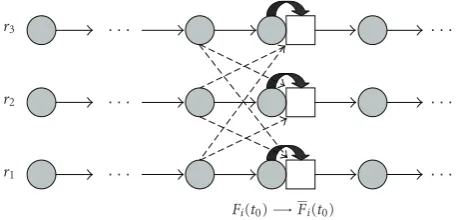
For switching among more than two bit-streams coded at ratesri,i=1, 2,. . .,M, each reconstructed frameFi(t0) at the
switching pointt0is coded using SPIHT at the selected
bud-getBiso as to generate ¯Fi(t0). Then, the trivial switching
ar-rangement developed inSection 3can be extended readily to this multiple bit-rate case, seeFigure 7for an example where M=3 and only one switching point is included. Clearly, this arrangement allows any arbitrary switching, that is, between rateri and raterj for all j = i. As discussed inSection 3, the total number of bits to be sent is about 1 kilobit +Biif a switching from any rate toriindeed happens at a preselected switching point t0. As discussed in Section 4, this number
could be further reduced by using the joint SPIHT processing betweenriandrj. Therefore, the joint processing will be en-forced at a switching point only when it can reduce the count of overhead bits that needs to be sent. On the other hand, no overhead bits are sent if no switching happens att0: only
the bit setZi(t0) needs to be sent, whereas the
correspond-ing SPIHT needs to be performed at the decoder side so as to generate ¯Fi(t0).
It is clear fromFigure 7that we need to store a number of Mextra frames ¯Fi(t0),i=1, 2,. . .,M, at the video server, to
support any arbitrary switching betweenriandrjfor all j=
i. On the other hand, there are totallyM·(M−1) secondary SP-frames that need to be generated and stored at the server in the SP-frame switching scheme to support any arbitrary switching—which is obviously very disadvantageous.
Compared to the scheme proposed in [15] where a new bit-stream (called the S-stream) is generated at each switch-ing point and it will be selected when a switchswitch-ing indeed happens at this point, each switching frame in our method is generated in the intra-coding manner. As a result, each switching frame generated in our method serves both the
switching task and the purpose of random access and brows-ing. Furthermore, it has been demonstrated in [9] that each S-stream is less efficient than the corresponding SP-frame switching, whereas some results will be presented in the next section to show that our switching scheme provides a bet-ter rate-distortion performance than the SP-frame switch-ing.
In principle, we should select different bit budget Bi for different rateriin the implementation of our switching scheme. In reality, however, it is rather difficult to establish an accurate relationship between them. For instance, it is not necessarily true that a smaller budget should be used for a smaller rate. In our H.264-based experiments, we observed that, in the switching-down case, the size of the secondary SP-frame for switching from the maximum rate to the min-imum rate is actually larger than that of the corresponding secondary SP-frame for switching from the same maximum rate to any of other lower rates (not the minimum one). This result seems to be rather absurd: more overhead bits need to be sent when a bigger bandwidth drop is detected! In fact, how to handle this problem is left over as one of our future works.
For simplicity, we choose the budget Bi for each rate based on the sizes of the corresponding secondary SP-frames. For example, forri, there areM−1 switching-in cases (from rjfor all j=i) at each switching point. Then, we run H.264
with a selected SPQP to obtain the sizes of allM −1 sec-ondary SP-frames, and chooseBiat a number that is slightly smaller than the minimum size. In general, for eachri, this will result in differentBiat different switching points. In our simulations, however, we try to ignore this variation and thus use the sameBiat all switching points.
6. EXPERIMENTAL RESULTS AND ANALYSIS
In this section, we provide some experimental results to illustrate the coding efficiency of our proposed switching method. In our simulations, 5 bit-streams are generated by using H.264 at different QP factors:QP5 = 24,QP4 =28, QP3 = 32,QP2 = 36, andQP1 = 40, respectively. Over-all, 100 frames are encoded, with the first frame as I-frame and the rest of them as P-frames. Then, six switching points are selected at #15, #30, #45, #60, #75, and #90, respectively. The switching arrangement is similar to the one shown in
Figure 7, while the 9/7 filter bank is used to perform the
wavelet decomposition of 5 levels.
Figure 8shows the results in terms of luminance PSNR
for the “Foreman” and “Stefan” sequences, while Table 2 lists the bit budgets used to obtain these results in which 20 kilobits are used for theUandVcomponents and the re-maining is for theY component. It should be pointed out that these budgets are determined by referring to the sizes of the corresponding secondary SP-frames obtained in running H.264 with a fixed SPQP at 24 for all rates (see the discus-sions at the end ofSection 5). Thus, different budgets may be used if other SPQP values are used to generate SP-frames.
96 86 76 66 56 46 36 26 16 6 Frame number 27 29 31 33 35 37 39 41 PSNR (dB) Foreman
QP=40 QP=36 QP=32 QP=28
QP=24 Switchup SP=24
96 86 76 66 56 46 36 26 16 6 Frame number 27 29 31 33 35 37 39 41 PSNR (dB) Foreman
QP=40 QP=36 QP=32 QP=28
QP=24 Switchdown SP=24
96 86 76 66 56 46 36 26 16 6 Frame number 27 29 31 33 35 37 39 41 PSNR (dB) Foreman
QP=40 QP=36 QP=32 QP=28
QP=24 Alternate SP=24
96 86 76 66 56 46 36 26 16 6 Frame number 27 29 31 33 35 37 39 41 PSNR (dB) Foreman
QP=40 QP=36 QP=32 QP=28
QP=24 Random SP=24
96 86 76 66 56 46 36 26 16 6 Frame number 25 27 29 31 33 35 37 39 PSNR (dB) Stefan
QP=40 QP=36 QP=32 QP=28
QP=24 Switchup SP=24
96 86 76 66 56 46 36 26 16 6 Frame number 25 27 29 31 33 35 37 39 PSNR (dB) Stefan
QP=40 QP=36 QP=32 QP=28
QP=24 Switchdown SP=24
96 86 76 66 56 46 36 26 16 6 Frame number 25 27 29 31 33 35 37 39 PSNR (dB) Stefan
QP=40 QP=36 QP=32 QP=28
QP=24 Alternate SP=24
96 86 76 66 56 46 36 26 16 6 Frame number 25 27 29 31 33 35 37 39 PSNR (dB) Stefan
QP=40 QP=36 QP=32 QP=28
QP=24 Random SP=24
Table2: Budgets (in kilobits) used in our simulations—same at all switching points.
Sequence QP=40 QP=36 QP=32 QP=28 QP=24
Foreman 75 + 10 + 10 75 + 10 + 10 70 + 10 + 10 60 + 10 + 10 65 + 10 + 10
Stefan 170 + 10 + 10 160 + 10 + 10 120 + 10 + 10 120 + 10 + 10 130 + 10 + 10
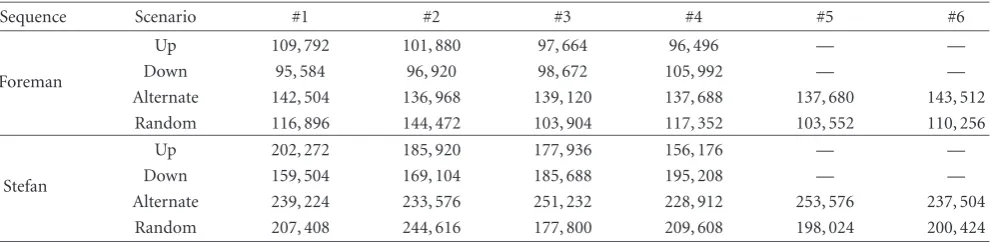
Table3: Sizes of secondary SP-frames to be sent at each switching point (in bits).
Sequence Scenario #1 #2 #3 #4 #5 #6
Foreman
Up 109, 792 101, 880 97, 664 96, 496 — —
Down 95, 584 96, 920 98, 672 105, 992 — —
Alternate 142, 504 136, 968 139, 120 137, 688 137, 680 143, 512
Random 116, 896 144, 472 103, 904 117, 352 103, 552 110, 256
Stefan
Up 202, 272 185, 920 177, 936 156, 176 — —
Down 159, 504 169, 104 185, 688 195, 208 — —
Alternate 239, 224 233, 576 251, 232 228, 912 253, 576 237, 504
Random 207, 408 244, 616 177, 800 209, 608 198, 024 200, 424
monotonic switching-down scenario, the third one shows the alternate switching scenario between the minimum rate and the maximum rate, and the fourth one shows a sce-nario of random switching (both up and down). Five black or white curves without markers in Figure 8represent the H.264-coded results with all frames (except for the first one) coded as P-frames. Therefore, it is expected that the qual-ity curve after inserting some switching points will always be (slightly) worse. However, it is seen from Figure 8that the results achieved in our switching scheme (the white curves with small cross markers) are nearly perfect at all switching points for both sequences.
Figure 8also presents the results obtained by using the
SP-frame switching scheme (the dark grey curves with small triangle markers), and Table 3summarizes the sizes of the corresponding secondary SP-frames that need to be sent at each switching point. It is seen that while the resulting qual-ity curves are nearly the same as our results, the SP-frame switching scheme requires many more bits to be sent at each switching point.
7. CONCLUSIONS AND FUTURE WORKS
Multirate representation seems to be one efficient solution to the video streaming service over heterogeneous and dynamic networks. In this paper, we developed an effective method that allows seamless switching among different bit-streams in multirate based streaming systems when a channel band-width change is detected. The unique feature of our method is that, at a preselected switching point, the reconstructed frame at each rate or two reconstructed frames at diff er-ent rates need undergo through an independer-ent or a joint SPIHT-type processing in the wavelet domain in which an optimal bit allocation over all hierarchical trees has been ap-plied. Compared with the SP-frame switching scheme, our method proves to be able to achieve the seamless switching at a better rate-distortion performance.
Our future works will be focusing on how to handle the switching-down case more effectively so that much fewer bits need to be sent in this scenario. On the other hand, we know that the SPIHT coding plays a critical role in our switching scheme. Although SPIHT itself is quite efficient, trying to fur-ther increase the coding efficiency is also one of our future works. In the meantime, we will also consider other popu-lar ways to accommodate possible bandwidth changes, such as frame-skipping and down-sizing, so as to facilitate a more practical streaming system.
ACKNOWLEDGMENTS
This work has been supported partly by a DAG research grant from HKUST and a RGC research grant from HKSAR. We would like to thank Dr. Xiaoyan Sun of Microsoft Research Asia for helping us get the bit-counts listed in Tables1,2, and3.
REFERENCES
[1] ISO/IEC 14496-2, “Coding of audio-visual objects, part-2: vi-sual,” December 1998.
[2] W. Li, “Overview of fine granularity scalability in MPEG-4 video standard,”IEEE Transactions on Circuits and Systems for Video Technology, vol. 11, no. 3, pp. 301–317, 2001.
[3] F. Wu, S. Li, and Y.-Q. Zhang, “A framework for efficient pro-gressive fine granularity scalable video coding,”IEEE Trans-actions on Circuits and Systems for Video Technology, vol. 11, no. 3, pp. 332–344, 2001.
[4] D. Wu, Y. T. Hou, W. Zhu, Y.-Q. Zhang, and J. M. Peha, “Streaming video over the internet: approaches and direc-tions,” IEEE Transactions on Circuits and Systems for Video Technology, vol. 11, no. 3, pp. 282–300, 2001.
[6] J. Lu, “Signal processing for internet video streaming: a re-view,” in Image and Video Communications and Processing, vol. 3974 ofProceedings of SPIE, pp. 246–259, San Jose, Calif, USA, January 2000.
[7] M. Karczewicz and R. Kurceren, “A proposal for SP-frames,” in ITU-T Video Coding Experts Group Meeting, Eibsee, Germany, January 2001, Doc. VCEG-L-27.
[8] M. Karczewicz and R. Kurceren, “Improved SP-frame encod-ing,” inITU-T Video Coding Experts Group Meeting, Austin, Tex, USA, April 2001, Doc. VCEG-M-73.
[9] M. Karczewicz and R. Kurceren, “The SP- and SI-frames de-sign for H.264/AVC,”IEEE Transactions on Circuits and Sys-tems for Video Technology, vol. 13, no. 7, pp. 637–644, 2003. [10] X. Sun, S. Li, F. Wu, G. Shen, and W. Gao, “Efficient and
flex-ible drift-free video bitstream switching at predictive frames,” inProceedings of IEEE International Conference on Multimedia and Expo (ICME ’02), Lausanne, Switzerland, August 2002. [11] ITU-T Rec. H.264 | ISO/IEC 14496-10 (AVC), “Advanced
video coding for generic audiovisual services”, March 2005. [12] E. Setton and B. Girod, “Video streaming with SP and
SI frames,” inVisual Communications and Image Processing (VCIP ’05), vol. 5960 ofProceedings of SPIE, pp. 2204–2211, Beijing, China, July 2005.
[13] E. Setton, P. Ramanathan, and B. Girod, “Rate-distortion anal-ysis of SP and SI frames,” in Proceedings of IEEE Interna-tional Conference on Image Processing (ICIP ’05), Genova, Italy, September 2005.
[14] X. Sun, F. Wu, S. Li, W. Gao, and Y.-Q. Zhang, “Seamless switching of scalable video bitstreams for efficient streaming,” IEEE Transactions on Multimedia, vol. 6, no. 2, pp. 291–303, 2004.
[15] N. Farber and B. Girod, “Robutst H.263 compatible video transmission for mobile access to video servers,” in Proceed-ings of IEEE International Conference on Image Processing (ICIP ’97), Santa Barbara, Calif, USA, October 1997. [16] A. A. Said and W. A. Pearlman, “New, fast, and efficient
im-age codec based on set partitioning in hierarchical trees,” IEEE Transactions on Circuits and Systems for Video Technol-ogy, vol. 6, no. 3, pp. 243–250, 1996.
Wei Zhangreceived the B.Eng. and M.Phil. degrees in electronic engineering from Hong Kong University of Science and Tech-nology, Hong Kong, in 2003 and 2006, re-spectively. Her research interests include video/image coding and video streaming.
Bing Zeng joined the Hong Kong Uni-versity of Science and Technology in 1993 and is currently an Associate Professor at the Department of Electrical and Electronic Engineering. His general research interests include digital signal and image process-ing, linear and nonlinear filter design, and image/video coding and transmission. His most recent research focus is on some fun-damental issues in image/video coding such
as directional transform, truly optimal rate allocation, and smart motion estimation/compensation, as well as various solutions for real-time video streaming applications over the Internet and