Exploring menstrual products: a systematic review and meta-analysis of menstrual cups
for public health internationally
Authors
Anna Maria van Eijk, PhD1
Garazi Zulaika, MPH1
Madeline Lenchner, MSc2
Linda Mason, PhD1
Muthusamy Sivakami, PhD3
Elizabeth Nyothach, MSc4
Holger Unger, PhD5
Kayla Laserson, ScD6
Penelope A. Phillips-Howard, PhD1
Affiliations
1 Department of Clinical Sciences, Liverpool School of Tropical Medicine, Liverpool L3 5QA,
United Kingdom
2 Departments of Biology and Health: Science, Society, and Policy, Brandeis University,
Waltham, MA 02453, USA
3 Centre for Health and Social Sciences, School of Health Systems Studies, Tata Institute of
Social Sciences, Mumbai, Maharashtra 400088, India
4 Centre for Global Health Research, Kenya Medical Research Institute (KEMRI), Kisumu,
Kenya
5 Department of Obstetrics and Gynaecology, Edinburgh Royal Infirmary, Edinburgh EH16
Tropical Medicine, Liverpool L3 5QA, United Kingdom
6 Bill and Melinda Gates Foundation, India Country Office, New Delhi, India
aCorrespondence
Dr. Penelope Phillips-Howard, Liverpool School of Tropical Medicine, Pembroke Place, Liverpool L3
5QA, UK. Tel: +44(0)7985431005 (UK); +254 702126188 (Kenya). Email:
Short title: A systematic review of menstrual cups
Abbreviations
HIC: High income countries
LMIC: Low and middle-income countries
MC: Menstrual cup
TSS: Toxic shock syndrome
Abstract
Background
Girls and women need effective, safe, and affordable menstrual products. Single-use products are
regularly selected by agencies for resource-poor settings. The menstrual cup (MC) is a less-known
alternative. We reviewed international studies on MC leakage, acceptability, and safety and explored
MC availability to inform programmes.
Methods
We searched ten databases through 14 May 2019 for quantitative or qualitative studies on
experiences and leakage associated with MCs, and adverse event reports. Results were tabulated or
combined using forest plots (random-effects meta-analysis). Global availability and inclusion of MCs
in international websites on menarche were explored.
Findings
Of 436 records, 43 studies were included (3319 participants). The main outcome of leakage was
reported in four studies (293 women) only and was similar or lower for MCs compared with
disposable pads or tampons. The adoption of MC required a familiarisation phase over cycles (four
studies); peer support improved uptake (two studies in developing countries). In 15 studies, 73%
(pooled estimate) of participants (95% CI 59-84%, I2 96%, N=1144) wished to continue use at study
completion. MC-use showed no adverse effects on the vaginal flora (4 studies, 507 women). We
identified five cases/reports within studies of severe pain/vaginal lesions, six reports of allergies,
nine of urinary tract complaints (three with hydronephrosis), and five of toxic shock syndrome
following MC-use, with one in a woman with an intra-uterine device (IUD). IUD-dislodgment was
reported among 13 MC-users (8 case-reports, 5 in one study) between 1 week and 13 months of
cup users and two vaginal cup users. We identified 199 brands of MCs, and availability in 99
countries with prices ranging from US$ 0.72-46.72 (median 23.3, 145 brands). The overall quality of
studies was low.
Interpretation
Evidence indicates that MCs are a safe option for menstruation management and are being used
internationally. The review was limited by the lack of high-quality studies.
Research in context
Evidence before this study
A lack of affordable and effective menstrual products can result in leakage and chaffing in
menstruating girls and women and can impact their health and education. There has been a recent
increase in programmes to provide menstrual products to assist women and girls. The menstrual cup
(MC), a receptacle used to collect blood flow has received limited attention. This in part may reflect
concerns about insertable products as either culturally unacceptable or due to prior public health
alerts such as toxic shock syndrome associated with highly absorbent tampons. Information about
leakage, acceptability, and safety of MCs is needed to support organizations to make informed
decisions and provide more comprehensive menstrual health education for girls and women. We
searched PubMed, Cochrane library, Web of Science, Popline, Cinahl, Global Health database,
Emerald, Science.gov, WorldWideScience and Google Scholar with the keywords “(Menstrual Cup)
AND Review” on 24 November 2018 to determine if a review of MCs was available with information
on leakage, acceptability, and safety. No review was identified, but a literature review by van
Leeuwen and Torondel (2018) on menstrual management in emergency contexts noted a lack of
empirical evidence examining the introduction and testing of MCs in humanitarian settings.
Added value of this study
To our knowledge, this is the first systematic review and meta-analysis examining girls and women’s
experiences of MCs, aggregating outcomes from 43 studies and 3319 participants asked about their
use or willingness to use MCs. We provide information on leakage compared to other products, a
listing of known adverse events, other uses of the MC, and quantitative and qualitative information
on acceptability in both high and low/middle income countries. Information is provided on
availability and prices of MCs. Serious adverse events were not common, with five reported cases of
toxic shock syndrome (TSS). However, the number of MC-users is unknown, so comparisons of TSS
manufactured and available globally they are not commonly mentioned in puberty education
materials for girls.
Implications of all the available evidence
The available evidence suggests that MCs seem an effective and safe alternative to other menstrual
products. Further research globally can provide more information on acceptability. Information on
MCs should be provided in puberty education materials. Policy makers and programmes can
consider this product as an option in menstrual health programmes. More research is needed to
monitor adverse events and evaluate best practice to shorten the familiarisation phase required for
Introduction
Girls and women need effective, safe, and affordable menstrual products. Globally, an estimated 1.9
billion women – around 26% of the world population – were of menstruating age in 2017, spending
on average 65 days in the year dealing with menstrual blood flow.1 Menstruation is a normal body
function and a sign of reproductive health.2 Few solutions are available to manage menstruation;
additionally, ignorance, prejudice, costs or safety fears can impede girls and women from testing the
full range of products available. A lack of affordable and effective menstrual products can result in
leakage and chaffing in menstruating girls and women and can impact their health.3,4 Use of
poor-quality materials has been shown to predispose women to an increased risk of urogenital infections
including bacterial vaginosis.5-7 In some situations, mostly researched in low- and middle-income
countries (LMIC), menses can affect girls’ schooling,8 can make women and girls a target of sexual
violence or coercion,9,10 and can affect employment and work experience of women.11,12 In LMIC, a
lack of water, sanitation, and hygiene (WASH), inadequate education, and poor disposal facilities,
raise public health concerns, particularly among schoolgirls.8,13 In high income countries (HIC) and
LMIC, there is an increase in policy-led initiatives and donations to provide menstrual products, e.g.
to keep girls in school. To allow such organisations to make informed decisions, information is
needed on the range of menstrual products.
The menstrual cup (MC) is not commonly known, despite its long history
(https://en.wikipedia.org/wiki/Menstrual_cup ; appendix page 2).14 Like tampons, MCs are inserted
into the vagina, but the blood is collected in the receptacle which can hold 10-38 ml of blood. MC
emptying occurs 4-12 hours depending on menstrual flow and type of cup. Currently, there are two;
a vaginal cup, which is generally bell-shaped and placed in the vagina, and a cervical cup which, like a
diaphragm for contraception, is placed around the cervix high in the vagina. MCs are made of
medical grade silicone, rubber, latex or elastomer and can last up to 10 years; disposable single-use
We conducted a systematic review of the medical and grey literature to summarize current
knowledge about leakage, safety, and acceptability of MCs and compared where available with other
menstrual products. Information on global availability and costs of MCs were compiled, preliminary
estimates on costs and waste savings were made, and guidance materials on menarche in selected
regions of the world were examined for reference to MC as a product option.
Methods
Search strategy and selection criteria
This analysis complies with the Preferred Reporting Items for Systematic reviews and Meta-Analyses
statement (appendix 2). The protocol was registered in the International Prospective Register of
Systematic Reviews (CRD42016047845). To be eligible for inclusion in the review, the material
needed to have information on leakage, acceptability or safety of MCs. Quantitative, qualitative, or
mixed design studies were included. Animal studies, and studies using MCs to collect vaginal fluids
without participants’ reported experiences during menstruation were ineligible.
Identification of studies
The search only included material in English; keywords included “(Menstrual AND Cup) OR (Menses
AND cup) OR (Menstruation AND Cup) OR (Vaginal AND Cup)”. The following databases were
searched: PubMed, Cochrane library, Web of Science, Popline, Cinahl, Global Health database,
Emerald, Google Scholar, Science.gov and WorldWideScience. Studies were eligible from the
inception of the databases used; the last search was conducted on 14 May 2019. We screened the
Manufacturer and User Facility Device Experience (MAUDE) database from the U.S. Food and Drug
Administration for menstrual cup related events (10-year limit, last search 28 May 2019).15 For
information on costs and availability, we screened websites of MC manufacturers using different
Data collection and study appraisal
Study eligibility, data extraction and risk-of-bias assessment were performed independently by two
reviewers (AMvE & ML for quantitative and LM & GZ for qualitative studies); differences were
discussed until agreement was reached. The main outcome was menstrual blood leakage when using
the MC. Information on acceptability of MC-use included difficulty with insertion or removal,
comfort of wearing, and future use. Safety included serious adverse events, such as toxic shock
syndrome (TSS), vaginal abrasions and effect on vaginal microflora (e.g. vaginal discharge,
infections), effects on the reproductive, digestive or urinary tract, and safety in poor sanitary
conditions. Other safety issues identified only during the review (e.g., retention requiring clinical
assistance) were documented, and all material was re-reviewed to ensure completeness of the
safety assessment. The Cochrane tool for trials was used for quality assessment, and an adaptation
of the Newcastle-Ottawa tool (appendix page 5) was used for observational studies.16,17 The Critical
Appraisal Skills Programme tool was used to examine the quality of qualitative studies.18 For
estimations on costs of disposable pads and tampons, we explored prices for commonly used
products in six countries (USA, UK, India, Spain, China and Canada) and calculated average costs per
product; extrapolating information on content and weight of menstrual products,19 we estimated
waste and costs for a range of 9-25 units per product per month and compared these to consistent
MC-use of one MC for 10 years.Additional information on methods used to assess MC information,
availability and prices, qualitative studies, and costs and waste and additional information on data
extraction are available in the appendix (page 3-5).
Synthesis of quantitative and qualitative studies
Results were tabulated as a narrative synthesis. If trials or studies presented sufficiently
homogeneous data in terms of design, we pooled results (proportions) using meta-analyses and a
statistic (appendix page 3). We integrated the quantitative and qualitative analyses for the
acceptability of MC-use. Sensitivity analysis was performed using the quality assessment (low versus
moderate-to-good quality study). We used two-tailed p-values of <0.05 to indicate statistical
significance.
Role of the funding source
The funders had no role in study design, data collection, data analysis, data-interpretation or writing
of the report. The corresponding author had full access to all of the data and had final responsibility
to submit for publication.
Results
Characteristics
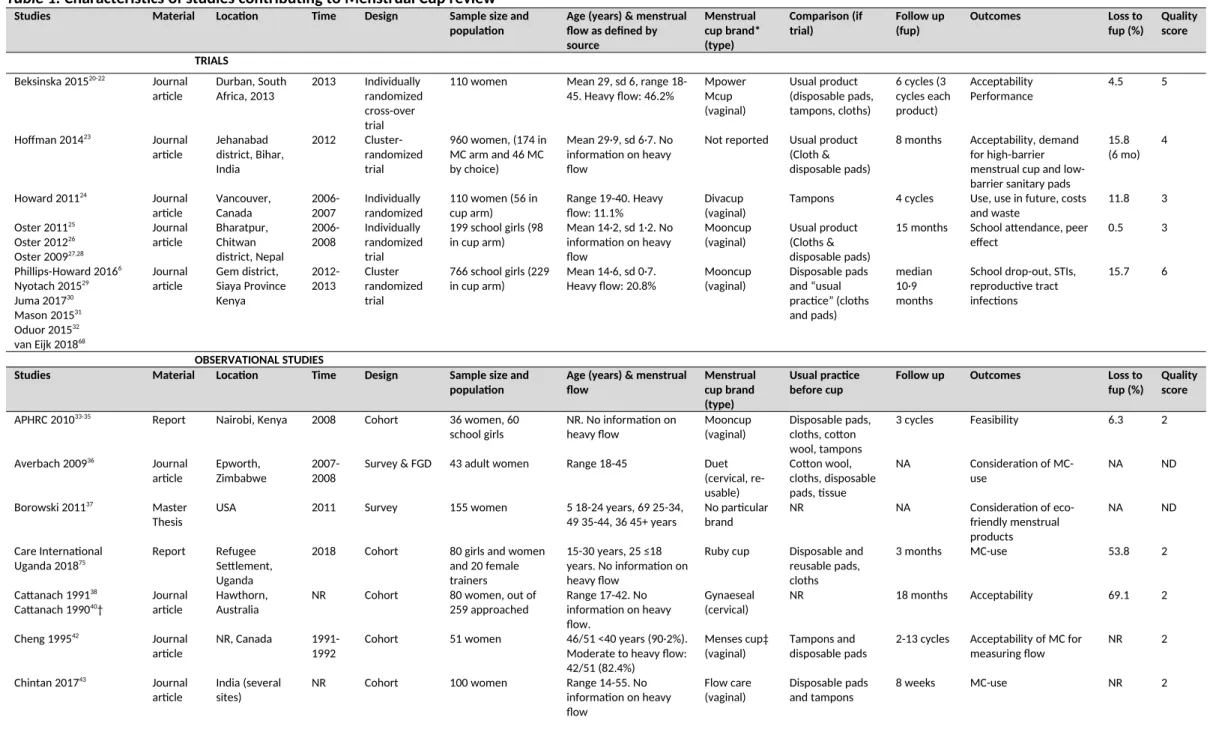
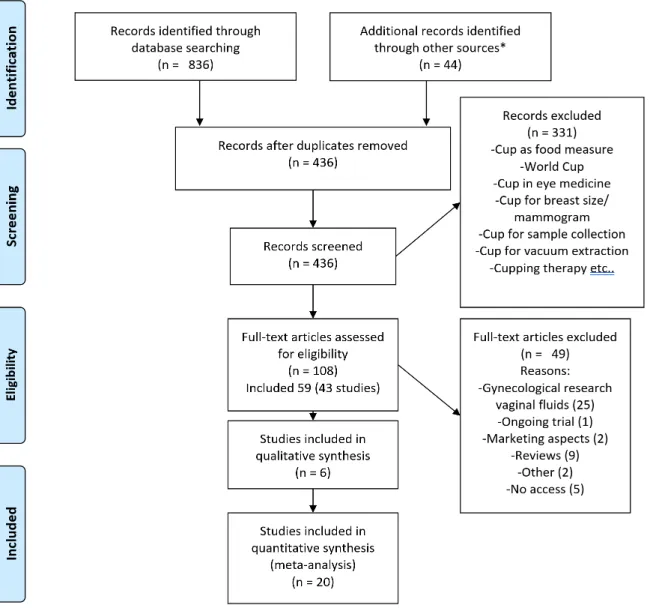
Of 436 unique records identified (appendix page 6), 59 were relevant (figure 1), and 43 studies were
eligible (table 1), comprising 3319 participants who used or were asked about the MC.6,14,15,20-74 Seven
studies were among schoolgirls in LMIC (647 participants or 19·5%).6,28,33,44,54,57 Three studies were
conducted in the early 1960s, six in the late 1980s, and most in the past decade (26); 15 were from
LMICs. Most studies reported on vaginal cups (63%) and were journal articles (81.4%). At least seven
described MCs that are no longer available (Tassette, Tassaway and Gynaeseal). The quality of
quantitative studies was low, with only three of moderate-to-high quality (table 1; appendix page
7-8). Observational studies were not clear on the source of participants, or participants were not
representative of the community. Six studies, all from LMICs, provided qualitative information
(appendix page 10).
Only four studies made direct comparisons between MCs and usual products; the outcomes
examined were different, but leakage was similar in three and significantly less among MCs for one
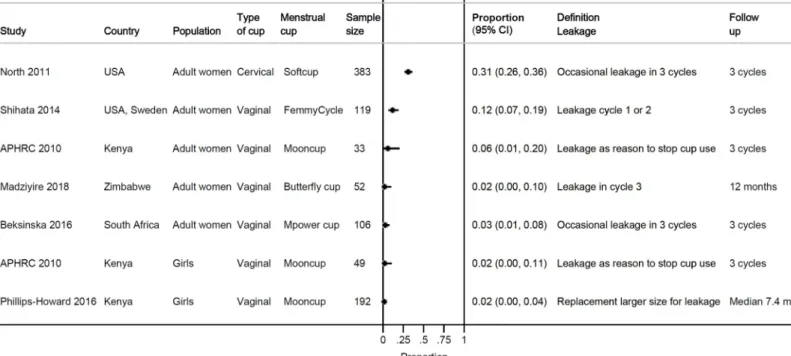
study (figure 2).24 In studies using MCs which are still marketed, the proportion of leakage ranged
from 2-31% for a wide range of definitions. Some factors mentioned in association with leakage by
study authors included menorrhagia,47 unusual anatomy of the uterus,51 need of a larger MC size,6
and incorrect MC placement or filled to capacity.38,51
Adverse events and side-effects
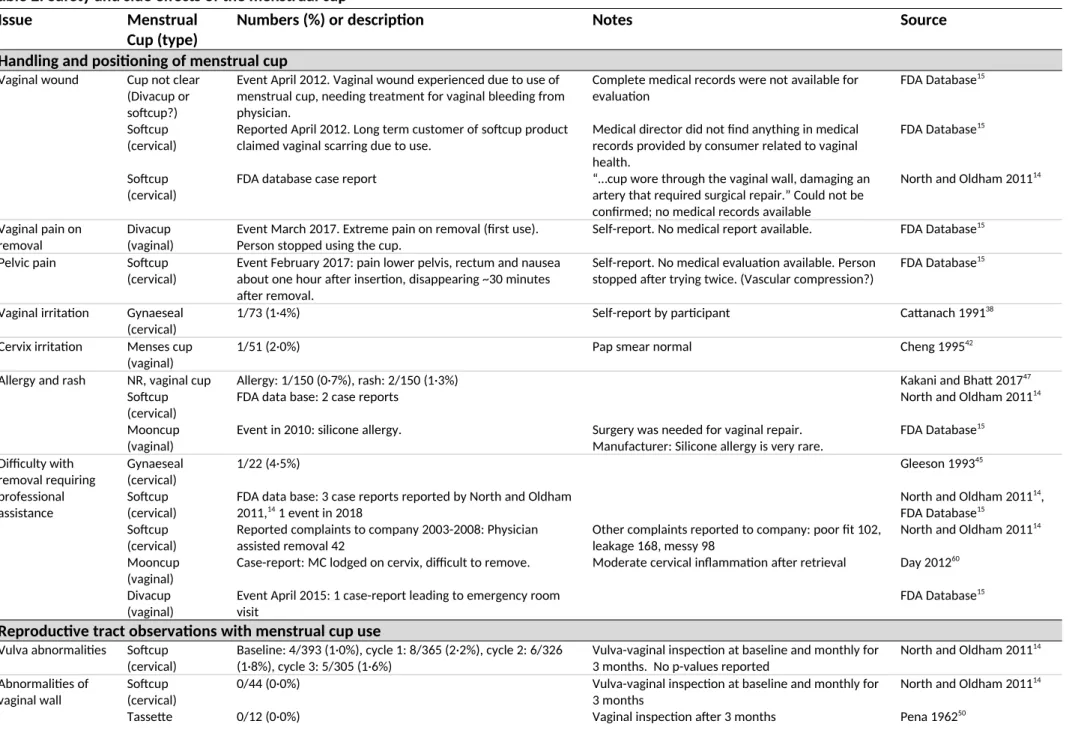
MC-use was not associated with abnormalities in the vagina or cervix in three studies with vaginal
examinations (n=370, table 2).14,50,65 Three MC-users reported vaginal wounds in case-reports, which
could not be confirmed with medical records. There was one case-report (self-report) on pain on
removal and one on pain when wearing the MC (self-report),15 and two reports from cohort-studies
on vaginal or cervical irritation without clinical consequences.38,42 Three adverse events from
cohort-studies and three case-reports were possibly related to an allergy; one case of silicone allergy
necessitating reconstructive vaginal surgery was reported.14,15,47 Difficulty with removal requiring
professional assistance was reported 47 times for cervical cups and twice for vaginal cups (one from
cohort-study and 46 case-reports).14,15,45,60
There was no increased infection risk (reproductive tract or systemic infection) associated with
MC-use among European,52,53 North American, and African women and girls,6,20 compared with other
menstrual products. A decrease in candidiasis was reported with MC-use in two of four studies; one
found no candidiasis infections at follow up (0/18, 0.0%) and the other, a randomised feasibility pilot
among school girls in Kenya comparing MCs, sanitary pads and usual practice (cloth, pads, tissue, or
other makeshift materials), showed no difference in candidiasis by study arm (MC: 11/144, pads:
19/200, usual item 13/156, p=0.68 and 0.87 for MC vs. pads and MC vs. usual item,
tampons or pads (not further specified), and a randomized pilot study in Kenya reported lower
bacterial vaginosis among MC-users enrolled for ≥9 months (MC: 13/101, pads: 29/143, usual item
20/104, p=0.018 and 0.074 for MC vs. pads and MC vs. usual item, respectively).6,65 TSS was
identified in five case-reports;14,15,62 microbiological confirmation was available with cultures from
MC and blood showing streptococcus for one case. In two cases, concomitant conditions were
present (intra-uterine device [IUD] in situ; an immunodeficiency disease).15,62 The prevalence of
vaginal Staphylococcus aureus was examined among Kenyan schoolgirls participating in a
randomized pilot study; no difference was seen between MC, pads and ‘usual practice’ arms.30 No
toxic shock syndrome toxin (TSST-1) was found expressed in S. aureus positive samples of MC-users30
In-vitro studies of TSST-1 production in the presence of MC-material showed conflicting results.66,67
In a MC-IUD case-report and a case series (7 women), dislodgements of an IUD during removal of the
MC were described between 1 week and 13 months of IUD insertion;15,73 a retrospective chart survey
did not find an increased risk for IUD expulsion within 6-8 weeks after insertion among MC-users
(5/135, 3.7%), compared to users of tampons (11/469, 2.4%) or pads (7/169, 4.1%).56
One case-report suggested MC-use may have been associated with the development of
endometriosis;64 however, this was not considered plausible by the regulatory authority and no
further reports were published on this possible association. There were three case-reports of
hydronephrosis and one of incontinence when using the MC; symptoms disappeared after MC
removal.15,58,59 (For other uses of MCs, see appendix page 9.)
Menstrual cup uptake and acceptability: qualitative and quantitative analyses
All six qualitative studies were from LMIC (appendix page 10-13),31,33,34,54,55,57,75 while studies with
quantitative information on uptake and acceptability were from both LMIC and HIC (appendix page
pads, cotton wool, tissue paper or other items; leakage and chaffing is a common concern.31,33,34,54,76
All studies involved used some form of education and training on the MC. Girls and women
expressed initial concerns in qualitative studies, noting the size of the MC.31 Many were concerned it
could cause pain (and noted it often did so at first) or worried about reproductive harms (e.g.
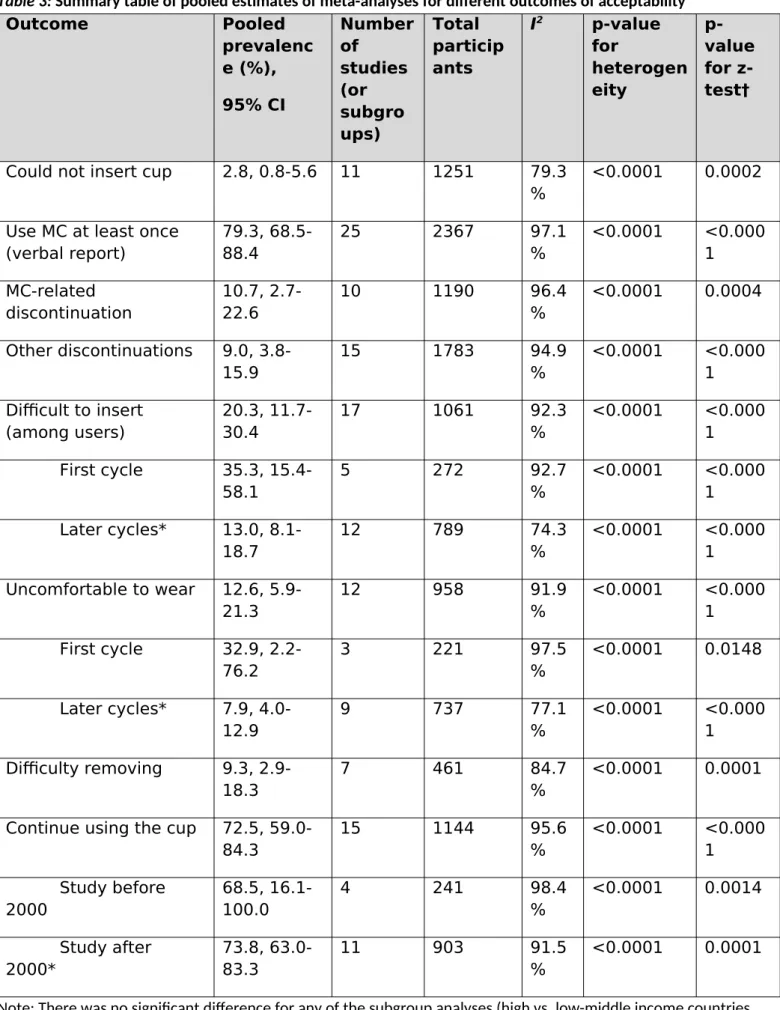
infertility). In quantitative studies, three percent (pooled estimate) of participants reported they
could not insert the MC (95% CI 1-6%, 11 studies, I2 79·3%, 1251 women) and 11% (3-27%, 10
studies, I2 96·4%, 1190 women) reported MC-related discontinuation (table 3). Pain on insertion was
reported among 10/106 (9·4%) for MC-use versus 0/104 (0·0%) when continuing their usual method
at 3 months follow-up in a South African cross-over trial (p-value not reported).20 Initial discomfort
on insertion was reported by 20% of participants (pooled estimate, 95% CI 12-30%, 17 studies, I2
92·3%, 1061 women, appendix page 20). All qualitative studies described user-familiarisation with
the MC over time, with practice, peer support and training key to success.31,33,34,54,57,75 Longitudinal
quantitative studies in LMIC demonstrated a learning curve of 2-5 months (appendix page 22); use of
MC-colour-change as an objective measure suggested usage increased throughout the first year
among Kenyan school-girls.68 The Nepalese study noted that self-reported increased usage two
months after distribution was associated with the presence of friends who successfully used the
MC.26 In India and Tanzania, the uptake of MCs was significantly slower than pads (appendix page
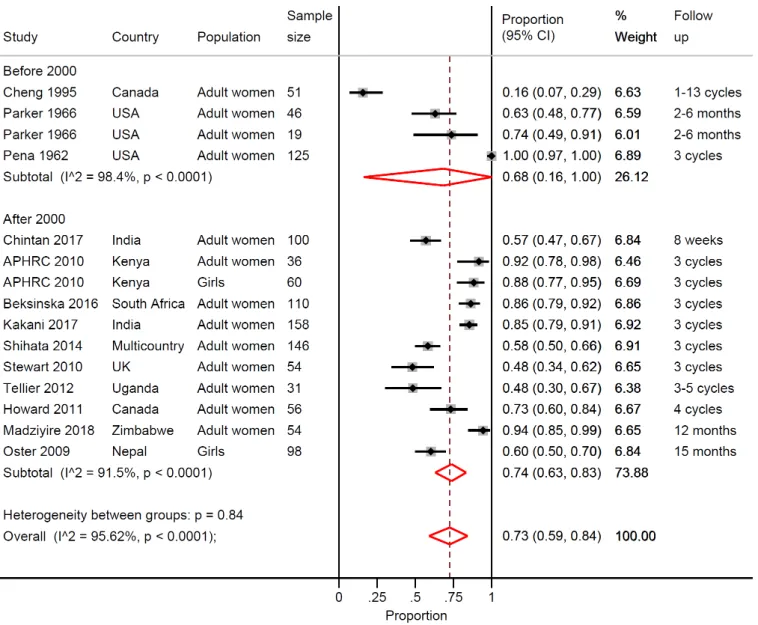
24).23,44 In 15 studies with information, 73% (59-84%, pooled estimate, I2 96%, 1144 women) reported
willingness to continue MC-use after the study (figure 3). All qualitative and some quantitative
studies reported a positive effect of MC-use on participants’ lives, reduced stress concerning staining
and leakage, and improvements in mobility.14,49,51 Challenges described included difficulties with MC
cleaning and storage in LMIC.34,54 Other challenges related to emptying the MC in school or public
toilets,29,34,54 which was also reported by HIC-participants.37 MCs were associated with a reduction in
average number of changes per cycle in a UK study compared to tampons or sanitary pads.52 Three
qualitative studies implied that school attendance, concentration and performance improved after
products were reported (appendix page 24).6,28,34 A study in Nepal noted a significant reduction in
time spent doing laundry when comparing MC-users to users of product-as-usual.28 The economic
advantage of an MC emerged in qualitative studies, with participants (and families) citing monthly
cost-savings from not needing to purchase pads or soap for washing cloths. Two qualitative studies
included participant quotes illustrating that MCs may reduce the need for transactional sex to
purchase pads.34,75 This may be corroborated by the results from a randomised controlled study
among schoolgirls which noted a significantly lower prevalence of sexually transmitted infections
among participants who were provided by the study with either MCs or disposable pads versus
controls (using usual products), citing lower exposure to transactional sex as a likely reason (table 2;
appendix page 24).6 There was considerable heterogeneity in the pooled meta-analyses (I2≥74%,
table 3).
Use of menstrual cups in challenging sanitary conditions
A study among school girls in Kenya in an area with poor WASH77 reported on dropping of menstrual
products during changing/emptying.32 The frequency was similar for MCs and sanitary pads. Factors
involved included young age, lack of time, and privacy; MC-dropping decreased with increasing
experience (approximately 23% in the first three months and 10% in 12+ months). This was
associated with E. coli isolated in cultures from MC swabs, which was higher in new users compared
to experienced users (table 2).30 A verbal report of handwashing before MC-change was 95% in
Kenya, 70% in Uganda, and 94% in a refugee camp.29,55,75 When facing a lack of water in toilets, some
participants reported carrying a bottle of water for when they emptied their MC.29 Others said they
had to empty the MC only twice a day, so they could avoid emptying in public places.75 In two
studies, women reported that MCs saved water, because there was less leaking and washing of
cloths.33,75 Privacy was mainly mentioned as a problem when boiling or storing MCs.55,75
In three studies in HIC, only 11-33% of the women interviewed (n=375) were aware about MCs
(appendix page 25).37,46,53 In 69 websites with educational materials on menarche from 27 countries,
disposable pads, tampons, MCs, and reusable pads were mentioned by 76·8%, 65·2%, 30.4% and
21.7%, respectively (appendix page 26-28). We identified 199 brands of MCs, and availability in 99
countries with prices ranging from US$ 0.72-46.72 (median 23.3, 145 brands) (appendix page 29-34).
Using accumulated estimates over 10 years, purchase costs and waste from consistent MC-use
(vaginal cup) would be a small fraction of the purchase costs and waste of pads or tampons: e.g. if
compared to using 12 pads or tampons per period, MC-use would comprise 5% and 7% of the
purchase costs and 0·4% and 6% of the plastic waste respectively (appendix page 35-37).
Discussion
Women, girls and transgender people require hygienic menstrual products monthly to lead healthy
and productive lives. In this review we evaluate the MC, combining information from medical and
grey literature to inform choice and strengthen the evidence-base for programmes supporting
menstrual health, such as for schoolgirls in LMIC or among refugees. Leakage was similar or less
when using the MC compared with disposable pads and tampons. The adoption of MC required a
familiarisation phase and peer support seemed important for their uptake in LMIC; challenges in
resource constrained settings (lack of sanitation, hygiene and privacy) did not stop women from
using them, and advantages were reported. Around 70% of participants in 13 studies declared
wanting to continue use. There were incidental case-reports on vaginal damage or toxic shock
syndrome or urinary tract complaints following MC-use, and difficulty in retrieving the MC can occur.
MC-use has been described as a factor for IUD dislodgement. MCs were infrequently mentioned in
puberty education for adolescent girls; the lack of information appears global. Brands of MCs were
In studies which examined the vagina and cervix during follow up, no mechanical harm was evident
from MC-use.14,50,65 There did not seem to be an increased infection risk, and, compared to pads and
tampons, some studies indicated a decreased infection risk.6,14,65 The study in Kenya that detected
lower bacterial vaginosis compared with sanitary pads, postulated that the inert material of MCs
may assist in maintaining a healthy vaginal pH and microbiome.6 Reported pain may relate to
variations in the pelvic anatomy or wrong positioning of the MC leading to internal pressure. This
could account for case-reports of hydronephrosis or urinary incontinence. Allergies to the materials
used in MCs are not common, but women should be aware of the possibility and keep this in mind
when starting use; however, it may be difficult for women who start MC-use to discriminate
between discomfort as part of the normal learning curve or pathology. Laboratory studies have
shown contradicting results on the possibility of TSST-1 development in the presence of MCs but
clinical data in humans using cups have so far not shown reason for concern. The reported risk of TSS
with MC-use seems low, with five cases in the literature. While aggregated data on the number of
MCs sold or used is unavailable, we anticipate the number of girls and women using 199 different
brands globally is likely to be thousands. In the USA, the rate of all types of TSS was around 0·8-3·4
per 100,000 population, while menstrual TSS was reported in 6-12 per 100,000 users of high
absorbency tampons in 1980. Similarly, among women using female barrier methods, which also
uses medical grade silicone or latex products, TSS is low (~2·25 cases per 100 000 users per year).78
The combination of IUD and MC-use may need further study, given the growing number of case-
reports of dislodging of IUD following MC removal; it is possible that IUD-users may need to consider
alternative options for either family planning or menstrual flow. Given the limited number of
case-reports and studies thus far, we cannot yet exclude other issues with MC-use. There were only a
limited number of studies which directly compared MCs and usual methods for leakage; however,
current data do not suggest the MC is less effective than other sanitary products. MCs can collect
The studies reviewed report that under challenging conditions e.g. with limited water supply or
privacy, MCs can be used. Alternatives to MCs and disposable sanitary pads include reusable pads,
so far evaluated in few studies.79-82 In Uganda, privacy to dry these pads was a challenge, suggesting
additional packs would be needed to ensure effective laundering.83
Limitations
We used leakage as a primary outcome in this review; however, the outcomes identified in the
reports reviewed varied by different time points and designs, prohibiting combination of results
when directly comparing MCs versus “other item”. The quality of studies was a limitation, with only
two assessed to be of good quality and this will potentially have contributed to bias in the
meta-analyses. Part of the information was from older studies when reporting requirements were less
stringent or with MCs that are not available anymore, from reports not published in peer-reviewed
journals, and from studies using the MC to evaluate other topics. Recruitment for observational
studies was not representative or clear. Studies mostly depended on self-reporting, which may have
overestimated MC-use. One study comparing self-reporting against a conservative but objective
measure of MC-colour-change found MC-use was slower, e.g. by 4 months 75% of recipients stated
they had started using it, whereas only by 10 months, 75% of MCs showed cup-colour change.68
Denominators on total MC-users were unavailable as brands guard consumer marketing data.
Countries where MCs were available may be underestimated because MC-producers in LMIC may
not always have websites. Our search was in English, and thus lacked information from many
countries e.g. Russia or China. The heterogeneity was high in the pooled meta-analyses (I2≥74%,
table 3), indicating there is inconsistency in findings across studies. Given the high variability in study
design and period, study population, and products examined, this might not be unexpected. It is
unknown what proportion of adverse events are under-reported; we did not identify many (one case
of TSS) when exploring the internet (appendix page 38-39). The MAUDE database only allows web
account the combined use of menstrual products during a period (e.g. panty liners for light days), or
inflation and production costs.
Conclusion
This review of international experiences shows MCs can be an acceptable and safe option for
menstrual hygiene in HIC and LMIC but are not well known and can inform policy makers and
programmes that MCs can be an alternative to disposable sanitary products, even where water and
sanitation facilities are poor. However, provision of information and training and follow-up on
correct use may be needed. Further studies are needed on cost-effectiveness and environmental
impact comparing menstrual products, and to examine facilitators of MC-use, with monitoring
systems in place to document any adverse outcomes.
Contributors: AMvE & PAPH led the conception and design of the study. AMve, GZ, ML & LM led the
development of the data collection instrument, data collection and quality assessment. AMvE, GZ,
ML, & LM conducted the statistical analysis, interpreted the data, and wrote and revised the
manuscript. MS, EN, HU, & KL contributed to study design, assisted in data interpretation, and
revised the manuscript. All authors contributed to data interpretation and revised the intellectual
content of the manuscript.
Acknowledgements: This study was funded by the UK-Medical Research Council/Department for
International Development/Wellcome Trust (Joint Global Health Trials scheme; award
MR/N006046/1). We are grateful to Obsidian for the set-up and maintenance of the Menstrual Cup
Master List. This paper is published with the permission of KEMRI Director.
Declaration of interests:AMvE, GZ, ML, LM, MS, EN, HU, KL and PAPH declare no competing
References
1. United Nations DESA / Population division. World Population Prospects 2017.
https://esa.un.org/unpd/wpp/ (accessed May 28, 2019).
2. Akinboye DO, Okonofue CC, Awodele O, et al. The influence of malaria on some
haematological parameters in pregnancy. Nigerian Journal of Parasitology 2011; 32: 187-91. 3. Mason L, Nyothach E, Alexander K, et al. 'We keep it secret so no one should know' - a
qualitative study to explore young schoolgirls attitudes and experiences with menstruation in rural Western kenya. PLoS One 2013; 8: e79132.
4. Sebert Kuhlmann A, Peters Bergquist E, Danjoint D, Wall LL. Unmet Menstrual Hygiene Needs Among Low-Income Women. Obstet Gynecol 2019; 133: 238-44.
5. Das P, Baker KK, Dutta A, et al. Menstrual hygiene practices, WASH access and the risk of urogenital infection in women from Odisha, India. PLoS One 2015; 10: e0130777.
6. Phillips-Howard PA, Nyothach E, Ter Kuile FO, et al. Menstrual cups and sanitary pads to reduce school attrition, and sexually transmitted and reproductive tract infections: a cluster randomised controlled feasibility study in rural Western Kenya. BMJ Open 2016; 6: e013229. 7. Torondel B, Sinha S, Mohanty JR, et al. Association between unhygienic menstrual
management practices and prevalence of lower reproductive tract infections: a hospital-based cross-sectional study in Odisha, India. BMC Infect Dis 2018; 18: 473.
8. Sommer M, Caruso BA, Sahin M, et al. A Time for Global Action: Addressing Girls' Menstrual Hygiene Management Needs in Schools. PLoS Med 2016; 13: e1001962.
9. Phillips-Howard P, Olilo G, Burmen B, et al. Menstrual needs and associations with sexual and reproductive risks in rural Kenyan females: a cross-sectional behavioural survey linked with HIV prevalence. J Womens Health 2015; 24: 801-11.
10. Sommer M. Where the education system and women's bodies collide: The social and health impact of girls' experiences of menstruation and schooling in Tanzania. J Adolesc 2010; 33: 521-9.
11. Sommer M, Chandraratna S, Cavill S, Mahon T, Phillips-Howard P. Managing menstruation in the workplace: an overlooked issue in low- and middle-income countries. Int J Equity Health 2016; 15: 86.
12. Cote I, Jacobs P, Cumming D. Work loss associated with increased menstrual loss in the United States. Obstet Gynecol 2002; 100: 683-7.
13. van Eijk AM, Sivakami M, Thakkar MB, et al. Menstrual hygiene management among
adolescent girls in India: a systematic review and meta-analysis. BMJ Open 2016; 6: e010290. 14. North B, Oldham M. Preclinical, Clinical, and Over-the-Counter Postmarketing Experience
with a New Vaginal Cup: Menstrual Collection. J Womens Health 2011; 20: 303-11. 15. U.S. Food & Drug Administration. Manufacturer and User Facility Device Experience
Database (MAUDE). 2018.
https://www.fda.gov/medicaldevices/deviceregulationandguidance/postmarketrequirement s/reportingadverseevents/ucm127891.htm (accessed May 28, 2019).
16. Higgins JP, Altman DG, Gotzsche PC, et al. The Cochrane Collaboration's tool for assessing risk of bias in randomised trials. BMJ 2011; 343: d5928.
17. Wells G, Shea B, O'Connell D, et al. The Newcastle-Ottawa Scale (NOS) for assessing the quality of nonrandomised studies in meta-analyses. 2014.
http://www.ohri.ca/programs/clinical_epidemiology/oxford.asp (accessed May 28, 2019). 18. Critical Appraisal Skills Programme (CASP). CASP Checklists. 2017.
19. Mazgaj M, Yaramenka K, Malovana O. Comparative life cycle assessment of sanitary pads and tampons. 2006. http://docplayer.net/39797321-Comparative-life-cycle-assessment-of-sanitary-pads-and-tampons.html (accessed May 28, 2019).
20. Beksinska ME, Smit J, Greener R, et al. Acceptability and performance of the menstrual cup in South Africa: a randomized crossover trial comparing the menstrual cup to tampons or sanitary pads. J Womens Health 2015; 24: 151-8.
21. Beksinska M, Smit J, Greener R, et al. `It gets easier with practice'. A randomised cross-over trial comparing the menstrual cup to tampons or sanitary pads in a low resource setting. Eur J Contracept Reprod Health Care 2016; 21: 138.
22. Beksinska M, Smit J, Greener R, Maphumulo V, Mabude Z. Better menstrual management options for adolescents needed in South Africa: What about the menstrual cup? S Afr Med J 2015; 105: 331.
23. Hoffmann V, Adelman S, Sebastian A. Learning by doing something else: Experience with alternatives and adoption of a high-barrier menstrual hygiene technology. 2014.
https://docplayer.net/41533102-Learning-by-doing-something-else-experience-with-alternatives-and-adoption-of-a-high-barrier-menstrual-hygiene-technology.html (accessed May 28, 2019).
24. Howard C, Rose CL, Trouton K, et al. FLOW (finding lasting options for women): multicentre randomized controlled trial comparing tampons with menstrual cups. Can Fam Physician 2011; 57: e208-15.
25. Oster E, Thornton R. Menstruation, sanitary products, and school attendance: evidence from a randomized evaluation. Am Econ J Appl Econ 2011; 3: 91-100.
26. Oster E, Thornton R. Determinants of technology adoption: Peer effects in menstrual cup up-take. J Eur Econ Assoc 2012; 10: 1263-93.
27. Oster E, Thornton R. Determinants of Technology Adoption: Private Value and Peer Effects in Menstrual Cup Take-Up 2009. http://www.nber.org/papers/w14828 (accessed May 28, 2019).
28. Oster E, Thornton R. Menstruation and Education in Nepal. 2009.
http://www.nber.org/papers/w14853 (accessed May 28, 2019).
29. Nyothach E, Alexander KT, Oduor C, et al. Handwashing for menstrual hygiene management among primary schoolgirls in rural Western Kenya. Waterlines 2015; 34: 279-95.
30. Juma J, Nyothach E, Laserson KF, et al. Examining the safety of menstrual cups among rural primary school girls in western Kenya: observational studies nested in a randomised controlled feasibility study. BMJ Open 2017; 7: e015429.
31. Mason L, Laserson K, Oruko K, et al. Adolescent schoolgirls’ experiences of menstrual cups and pads in rural western Kenya: a qualitative study. Waterlines 2015; 34: 15-30.
32. Oduor C, Alexander KT, Oruko K, et al. Schoolgirls' experiences of changing and disposal of menstrual hygiene items and inferences for Wash in schools. Waterlines 2015; 34: 397-411. 33. African Population and Health Research Center. Attitudes towards, and acceptability of,
menstrual cups as a method for managing menstruation: experiences of women and school girls in Nairobi, Kenya. 2010. http://www.susana.org/_resources/documents/default/2-984-policy-brief-no-21-2010-attitudes-and-acceptability.pdf (accessed May 28, 2019).
34. African Population and Health Research Center. Use of menstrual cup by adolescent girls and women: potential benefits and key challenges. 2010.
https://www.susana.org/en/knowledge-hub/resources-and-publications/library/details/985
(accessed May 28, 2019).
35. African Population and Health Research Center. Experiences and problems with menstruation among poor women and schoolgirls in Nairobi, Kenya. 2010.
36. Averbach S, Sahin-Hodoglugil N, Musara P, Chipato T, van der Straten A. Duet for menstrual protection: a feasibility study in Zimbabwe. Contracept 2009; 79: 463-8.
37. Borowski A. Are American women turning to reusable and greener menstrual products due to health and environmental pollution concerns? 2011.
http://scholarworks.rit.edu/theses/544/ (accessed May 28, 2019).
38. Cattanach JF. A diaphragm tampon applied to an ovulation method in a birth control system. Contracept 1991; 44: 607-21.
39. Cattanach J. A new type of sanitary tampon, (Gynaeseal) that can also be used as an alternative diaphragm has been developed. Aust N Z J Obstet Gynaecol 1989; 29: 275. 40. Cattanach JF. The Gynaeseal diaphragm tampon. Med J Aust 1990; 152: 52-3.
41. Cattanach JF. The Gynaeseal diaphragm tampon. Aust Fam Physician 1988; 17: 867-9. 42. Cheng M, Kung R, Hannah M, Wilansky D, Shime J. Menses cup evaluation study. Fertil Steril
1995; 64: 661-3.
43. Chintan S, Dipesh P, Maitri P. Use of Flow care Menstrual Cups over conventional menstrual products in India. Int J Adv Res Dev 2017; 2: 78-82.
44. Femme International. Monitoring & Evaluation Report Kilimanjaro Region 2017: Successes and lessons learned from the Thaweza program. 2017.
https://www.femmeinternational.org/wp-content/uploads/2018/09/Femme-International-ME-Report-2017.pdf (accessed May 28, 2019).
45. Gleeson N, Devitt M, Buggy F, Bonnar J. Menstrual blood loss measurement with gynaeseal. Aust N Z J Obstet Gynaecol 1993; 33: 79-80.
46. Grose RG, Grabe S. Sociocultural attitudes surrounding menstruation and alternative menstrual products: the explanatory role of self-objectification. Health Care Women Int 2014; 35: 677-94.
47. Kakani CR, Bhatt JK. Study of adaptability and efficacy of menstrual cup in managing menstrual health and hygiene. Int J Reprod Contracept Obstet Gynecol 2017; 6: 3045-53. 48. Madziyire MG, Magure TM, Madziwa CF. Menstrual cups as a menstrual management
method for low socioeconomic status women and girls in Zimbabwe: a pilot study. Women's Reprod Health 2018; 5: 59-65.
49. Parker J, Bushell RW, Behrman SJ. Hygienic control of menorrhagia: use of rubber menstrual cup. Int J Fertil 1966; 9: 619-21.
50. Pena EF. Menstrual protection. Advantages of the menstrual cup. Obstet Gynecol 1962; 19: 684-7.
51. Shihata A, Brody S. An innovative, reusable menstrual cup that enhances the quality of women's lives during menstruation. Br J Med Med Res 2014; 4: 3581-90.
52. Stewart K, Greer R, Powell M. Women's experience of using the Mooncup. J Obstet Gynaecol 2010; 30: 285-7.
53. Stewart K, Powell M, Greer R. An alternative to conventional sanitary protection: would women use a menstrual cup? J Obstet Gynaecol 2009; 29: 49-52.
54. Hyttel M, Thomsen CF, Luff B, Storrusten H, Nyakato VN, Tellier M. Drivers and challenges to use of menstrual cups among schoolgirls in rural Uganda: a qualitative study. Waterlines 2017; 36: 109-24.
55. Tellier M, Hyttel M, Gad M. Assessing acceptability and hygienic safety of menstrual cups as a menstrual management method for vulnerable young women in Uganda Red Cross
Society's Life Planning Skills Project 2012. http://womena.dk/wp-content/uploads/2015/11/ Menstrual-Cups-_-WoMena-_-Uganda-Pilot-Study-Report-Dec-2012-new-version.pdf
(accessed May 28, 2019).
57. Sundqvist J. A cup of freedom? A study of menstrual cup's impact on girls' capabilities. 2015.
http://www.diva-portal.org/smash/record.jsf?pid=diva2%3A783661&dswid=-5356 (accessed May 28, 2019).
58. Adedokun BO. Hydronephrosis associated with the use of menstrual cup. Eur Urol 2017; 16: e2865.
59. Nunes-Carneiro D, Couto T, Cavadas V. Is the menstrual cup harmless? A case report of an unusual cause of renal colic. Int J Surg Case Rep 2018; 46: 28–30.
60. Day S. A retained menstrual cup. Int J STD AIDS 2012; 23: 367-8.
61. Goldberg L, Elsamra S, Hutchinson-Colas J, Segal S. Delayed Diagnosis of Vesicouterine Fistula After Treatment for Mixed Urinary Incontinence: Menstrual Cup Management and Diagnosis. Female Pelvic Med Reconstr Surg 2016; 22: e29-31.
62. Mitchell MA, Bisch S, Arntfield S, Hosseini-Moghaddam SM. A confirmed case of toxic shock syndrome associated with the use of a menstrual cup. Can J Infect Dis Med Microbiol 2015; 26: 218-20.
63. Russell KW, Robinson RE, Mone MC, Scaife CL. Enterovaginal or Vesicovaginal Fistula Control Using a Silicone Cup. Obstet Gynecol 2016; 128: 1365-8.
64. Spechler S, Nieman LK, Premkumar A, Stratton P. The Keeper, a menstrual collection device, as a potential cause of endometriosis and adenomyosis. Gynecol Obstet Invest 2003; 56: 35-7.
65. Karnaky KJ. Internal menstrual protection with the rubber menstrual cup. Obstet Gynecol 1962; 19: 688-91.
66. Tierno PM, Hanna BA. Propensity of tampons and barrier contraceptives to amplify
Staphylococcus aureusToxic shock syndrome toxin-I. Infect Dis Obstet Gynecol 1994; 2: 140-5.
67. Nonfoux L, Chiaruzzi M, Badiou C, et al. Impact of currently marketed tampons and menstrual cups on Staphylococcus aureus growth and TSST-1 production in vitro. Appl Environ Microbiol 2018; 84: e0035-18.
68. van Eijk AM, Laserson KF, Nyothach E, et al. Use of menstrual cups among school girls: longitudinal observations nested in a randomised controlled feasibility study in rural Western Kenya. Reprod Health 2018; 15: 139.
69. Madziyire MG, Magure TM, Madziwa CF. The safety of menstrual cups in women of low socio-economic status in Zimbabwe: pilot study. Cent Afr J Med 2018; 64: 59-65.
70. Ganyaglo GYK, Ryan N, Park J, Lassey AT. Feasibility and acceptability of the menstrual cup for non-surgical management of vesicovaginal fistula among women at a health facility in Ghana. Plos One 2018; 13: e0207925.
71. Ryan N. Feasibility, acceptability, and appropriateness of the vaginal menstrual cup for short term non-surgical management of vesicovaginal fistula (VVF) among potential users and stakeholders. Implement Sci 2018; 13: S80.
72. Stolz A, Meuwly JY, Roussel A, Nicodeme Paulin E. An improperly positioned menstrual cup complicated by hydronephrosis: A case report. Case Rep Womens Health 2019; 22: e00108. 73. Seale R, Powers L, Guiahi M, Coleman-Minahan K. Unintentional IUD expulsion with
concomitant menstrual cup use: a case series. Contraception 2019.
74. Tierno PM, Jr., Hanna BA. Ecology of toxic shock syndrome: amplification of toxic shock syndrome toxin 1 by materials of medical interest. Rev Infect Dis 1989; 11 Suppl 1: S182-6; discussion S6-7.
75. Care International Uganda. Ruby Cups: Girls in Imvepi Refugee Settlement Taking Control. 2018. http://womena.dk/ruby-cups-girls-in-imvepi-refugee-settlement-taking-control/
(accessed May 28, 2019).
77. Alexander K, Oduor C, Nyothach E, et al. Water, Sanitation and Hygiene Conditions in Kenyan Rural Schools: Are Schools Meeting the Needs of Menstruating Girls? Water 2014; 6: 1453-66.
78. Schwartz B, Gaventa S, Broome CV, et al. Nonmenstrual toxic shock syndrome associated with barrier contraceptives: report of a case-control study. Rev Infect Dis 1989; 11 Suppl 1: S43–8; discussion S8–9.
79. Mucherah W, Thomas K. Reducing barriers to primary school education for girls in rural Kenya: reusable pads' intervention. Int J Adolesc Med Health 2017.
80. Montgomery P, Hennegan J, Dolan C, Wu M, Steinfield L, Scott L. Menstruation and the Cycle of Poverty: A Cluster Quasi-Randomised Control Trial of Sanitary Pad and Puberty Education Provision in Uganda. PLoS One 2016; 11: e0166122.
81. Montgomery P, Ryus CR, Dolan CS, Dopson S, Scott LM. Sanitary pad interventions for girls' education in Ghana: a pilot study. PLoS One 2012; 7: e48274.
82. Crofts T, Fisher J. Menstrual hygiene in Ugandan schools: An investigation of low-cost sanitary pads. J Water Sanit Hyg Dev 2012; 2: 50-8.
83. Hennegan J, Dolan C, Wu M, Scott L, Montgomery P. Measuring the prevalence and impact of poor menstrual hygiene management: a quantitative survey of schoolgirls in rural Uganda. BMJ Open 2016; 6: e012596.
Table 1:Characteristics of studies contributing to Menstrual Cup review
Studies Material Location Time Design Sample size and population
Age (years) & menstrual flow as defined by source Menstrual cup brand* (type) Comparison (if trial) Follow up (fup)
Outcomes Loss to
fup (%)
Quality score
TRIALS
Beksinska 201520-22 Journal
article Durban, South Africa, 2013 2013 Individually randomized cross-over trial
110 women Mean 29, sd 6, range
18-45. Heavy flow: 46.2%
Mpower Mcup (vaginal) Usual product (disposable pads, tampons, cloths)
6 cycles (3 cycles each product)
Acceptability Performance
4.5 5
Hoffman 201423 Journal
article Jehanabad district, Bihar, India 2012 Cluster-randomized trial
960 women, (174 in MC arm and 46 MC by choice)
Mean 29·9, sd 6·7. No information on heavy flow
Not reported Usual product (Cloth & disposable pads)
8 months Acceptability, demand for high-barrier menstrual cup and low-barrier sanitary pads
15.8 (6 mo)
4
Howard 201124 Journal
article Vancouver, Canada 2006-2007 Individually randomized
110 women (56 in cup arm)
Range 19-40. Heavy flow: 11.1%
Divacup (vaginal)
Tampons 4 cycles Use, use in future, costs
and waste
11.8 3
Oster 201125
Oster 201226
Oster 200927,28
Journal article Bharatpur, Chitwan district, Nepal 2006-2008 Individually randomized trial
199 school girls (98 in cup arm)
Mean 14·2, sd 1·2. No information on heavy flow Mooncup (vaginal) Usual product (Cloths & disposable pads)
15 months School attendance, peer effect
0.5 3
Phillips-Howard 20166
Nyotach 201529
Juma 201730
Mason 201531
Oduor 201532
van Eijk 201868
Journal article Gem district, Siaya Province Kenya 2012-2013 Cluster randomized trial
766 school girls (229 in cup arm)
Mean 14·6, sd 0·7. Heavy flow: 20.8%
Mooncup (vaginal) Disposable pads and “usual practice” (cloths and pads) median 10·9 months
School drop-out, STIs, reproductive tract infections
15.7 6
OBSERVATIONAL STUDIES
Studies Material Location Time Design Sample size and population
Age (years) & menstrual flow Menstrual cup brand (type) Usual practice before cup
Follow up Outcomes Loss to fup (%)
Quality score
APHRC 201033-35 Report Nairobi, Kenya 2008 Cohort 36 women, 60
school girls
NR. No information on heavy flow Mooncup (vaginal) Disposable pads, cloths, cotton wool, tampons
3 cycles Feasibility 6.3 2
Averbach 200936 Journal
article
Epworth, Zimbabwe
2007-2008
Survey & FGD 43 adult women Range 18-45 Duet
(cervical, re-usable)
Cotton wool, cloths, disposable pads, tissue
NA Consideration of MC-
use
NA ND
Borowski 201137
Master Thesis
USA 2011 Survey 155 women 5 18-24 years, 69 25-34,
49 35-44, 36 45+ years
No particular brand
NR NA Consideration of
eco-friendly menstrual products
NA ND
Care International Uganda 201875
Report Refugee
Settlement, Uganda
2018 Cohort 80 girls and women
and 20 female trainers
15-30 years, 25 ≤18 years. No information on heavy flow
Ruby cup Disposable and
reusable pads, cloths
3 months MC-use 53.8 2
Cattanach 199138
Cattanach 199040†
Journal article
Hawthorn, Australia
NR Cohort 80 women, out of
259 approached
Range 17-42. No information on heavy flow.
Gynaeseal (cervical)
NR 18 months Acceptability 69.1 2
Cheng 199542 Journal
article
NR, Canada
1991-1992
Cohort 51 women 46/51 <40 years (90·2%).
Moderate to heavy flow: 42/51 (82.4%)
Menses cup‡ (vaginal)
Tampons and disposable pads
2-13 cycles Acceptability of MC for measuring flow
NR 2
Chintan 201743 Journal
article
India (several sites)
NR Cohort 100 women Range 14-55. No
information on heavy
Flow care (vaginal)
Disposable pads and tampons
Femme International 201744 §
Report Kilamanjaro
region Tanzania
2016-2017
Cohort 184 adolescents, 38
women
Range 12-54. No information on heavy flow
Ruby cup (vaginal)
NR 6-12
months
MC-use 37-88 2
Ganyaglo 201970
Ryan 201871
Journal article & abstract
Ghana 2016 With/without
trial
11 adult women Mean 43.6, sd 12.3.
MC-use for fistula
Diva cup Pads 4 hours MC-use for vesicovaginal
fistula
0 5
Gleeson 199345 Journal
article
Dublin, Ireland NR Cohort 22 women NR. 12 (54.5%) women
with menorrhagia
Gynaeseal (cervical)
Tampons 1 cycle Leakage, ease, use for
measuring flow
0 3
Grose 201446 Journal
article
California, USA NR Survey 151
under-graduates
Range 18-23. Brand not
reported
NR NA Consideration of
menstrual cup
NA ND
Kakani 201747 Journal
article
Dharpur, Gujarat, India
NR Cohort 158 women Mean 31, sd 6·1, range
21-50. Heavy flow: 20/150 (13.3)
NR: 44 mm diameter, thin walled silicon ‖
Cloths, disposable pads, tampons
3 cycles Acceptability and efficacy
5.1 3
Madziyire 201848,69 § Journal
article
Epworth, Zimbabwe
2016-2017
Cohort 54 women Range 18-45. No
information on heavy flow.
Butterfly (vaginal)
NR 3 cycles
1 year
Acceptability, leakage 3.7 3
North 201114 Journal
article
USA (7 centres) NR Cohort 406 women Range 18-55. No
information on heavy flow. Soft cup¶ (disposable cervical) Disposable pads and/or tampons
3 cycles Safety, effectiveness and acceptability
24.1 3
Parker 196649 Journal
article
Ann Arbor, USA NR Cohort 46 women with
menorrhagia, 19 with normal flow
NR. 46 women with menorrhagia, 19 with normal flow
Tassette (vaginal)
Tampons and disposable pads
2-6 months Acceptability 15.2 3
Pena 196250 Journal
article
Florida, USA NR Cohort 125 women (100
with normal flow and 25 with vaginal infections)
Range 20-45. All “Normal flow”
Tassette (vaginal)
Tampons and disposable pads
3 cycles Not clear NR 2
Shihata 201451 Journal
article
Sweden, USA, Mexico, Brazil, Colombia
2013 Cohort 146 women Range 18-40. No
information on heavy flow. FemmyCycle (One size, vaginal) ** Disposable pads, tampons
3 cycles Leakage, acceptability 28.1 2
Stewart 201052 Journal
article
Nottingham, UK
2008-2009
Cohort 54 women Mean 22·5, sd NR. No
information on heavy flow.
Mooncup (vaginal)
Tampons and disposable pads
6 cycles (3 with cup)
Leakage, acceptability 61.1 2
Stewart 200953 Journal
article
Nottingham, UK NR Survey 69 clinic patients 18 <30, 21 30-40, 30 40+
yrs. No information on heavy flow.
Mooncup (vaginal)
Tampons and disposable pads
NA Consideration of MC NA ND
Tellier 201255 Report Kitgum, Uganda NR Cohort 31 women Mean 24, sd NR. No
information on heavy flow.
Ruby cup (vaginal)
Cloths, gauze, disposable pads
3-5 cycles Acceptability, safety 51.6 3
Wiebe 201256 Journal
article
Vancouver, Canada
2009 Retrospective
chart survey
930 women, 96 used MCs
59% <30 years. No information on heavy flow.
No particular brand or type
NA 6 weeks IUD expulsion within 6
weeks after placement by menstrual product used
NA ND
STUDIES WITH ONLY QUALITATIVE INFORMATION
Studies Material Location Time Design Sample size and population
Age (years) & menstrual flow
Menstrual cup brand (type) Follow up (fup)
Outcomes Quality
score
Hyttel 201754 Journal
article
Bungatira, Gulu, Uganda
2013 2 focus group
discussions & 6
semi-36 school girls (purposely selected)
Mean 14·6, sd 0·7, range 13-17
Ruby Cup (vaginal)
3 cycles Willingness and ability to use ††
NA Mediu
interviews
Sundqvist 201557 Thesis Msiriwa,
Tanzania
2014 In-depth
interviews
15 school girls 14-15 Lady cup
(vaginal)
NR Effect of menstrual cup
use on education and social interactions
NA Strong
CASE REPORTS
Studies Material Location Time Design Sample size and population
Information age participants
Menstrual cup brand (type) Follow up (fup)
Outcomes Quality
score
Adedokun 201758 abstract Brno, Czech
Republic
NR Case Report 1 adult woman 30 NR NR Hydronephrosis NA ND
Nunes-Carneiro 201859 Journal
article
Porto, Portugal NR Case Report 1 adult woman 26 NR 5 days Uretero-hydronephrosis NA ND
Stolz 201972 Journal
article
France or Switzerland
NR Case Report 1 adult woman 47 NR “couple of
weeks”
Hydronephrosis NA ND
Day 201260 Journal
article
London, UK NR Case Report 1 adult woman 20 Mooncup (vaginal) NR MC retention NA ND
U. S. FDA Maude database15 Results database search USA 1950-June 2018
Case reports 12 women NR Mooncup, Diva cup, Femmy cycle,
Softcup (vaginal and cervical)
Variable See adverse events table NA ND
Seale 201973 Journal
article
USA NR Case Series 7 women 16 years: 1,
22-25 years: 6
NR 2-12
months
IUD expulsion NA ND
Goldberg 201661 Journal
article
New Brunswick, Canada
2013 Case Report 1 adult woman 39 NR (vaginal) NR Use as diagnostic aid of
vesicouterine fistula
NA ND
Mitchell 201562 Journal
article
Ontario, Canada NR Case Report 1 adult woman 37 DivaCup (vaginal) Two weeks
post-admission
Possible Toxic Shock Syndrome
NA ND
Russell 201663 Journal
article
Utah, USA NR Case Reports 3 adult women 54, 60 and 68 NR (vaginal) NR Use as enterovaginal or
vesicovaginal fistula control
NA ND
Spechler 200364 Journal
article
Bethesda, USA NR Case Report 1 adult woman 41 Keeper (vaginal) 2 years
post- surgery
Adenomyosis and endometriosis
NA ND
OTHER TYPE OF STUDIES WITH RELEVANT INFORMATION Studies Material Location Time Design Sample size and
population
Age (years) Menstrual cup brand (type) Follow up (fup)
Outcomes Quality
score
Cattanach 198939† Journal
article Hawthorn, Australia 1986-1988 Vaginal samples
5 women Range 19-32 Gynaeseal* (cervical) 3-22
months
MC safety: Effect on vaginal flora
NA ND
Karnaky 196265 Journal
article
USA NR Vaginal
observations and samples
variable (20, 50 & 97 women)
NR Tassette (vaginal) 1 time-
point
MC safety: Effects on vagina
NA ND
Tierno 198974 Journal
article
New York, USA NR In-vitro study 16 menstrual cups NA NR NA Ability to induce TSST-1
production by TSS-associated strains of Staphylococcus aureus
NA ND
Tierno 199466 Journal
article
New York, USA NR in-vitro study 6 menstrual cups NA Tassaway (vaginal) NA Ability to induce TSS
toxin-1 by a TSS strain of Staphylococcus aureus MN8
NA ND
Nonfoux 201867 Journal
article
France NR in-vitro study 4 menstrual cups NA 2 be’Cup® and 2 MeLuna® (vaginal) NA Effect on Staphylococcus
aureus growth and
modified sac method
Abbreviations: IUD=intra-uterine device. Fu=follow-up. MC=menstrual cup. Mo=month. NA=not applicable. ND=Not done (these studies were not assessed for quality). NR= not reported. Sd=standard deviation. STIs=sexually transmitted infections. TSS=Toxic shock syndrome. TSST-1=toxic shock syndrome toxin 1. Cloths=pieces of material (clothing, blankets, socks) which are used for menstruation and can be reused after washing or disposed of after use.
*For manufacturing company, city, country and website where available, see table S4 in the appendix (page 7).
† Gynaeseal: disposable cup covering the cervix. This type of cup can also be worn during intercourse. The study author was the developer of Gynaeseal. We assumed the articles from 1990 and 1991 described the same study and used the publication with the larger sample size (1991).
‡ From Shanghai Newasia Medical Rubber Factory, Shanghai, China. This type of cup has a drainage tube that can be opened to let menstrual fluids pass. § Additional information obtained from internal report or author.
‖ Description in article is like a cervix-covering cup (“The device- the menstrual cup we utilized for the study is an internally worn device with a pliable rim 44mm in diameter and a thin-walled reservoir to collect and hold the menstrual fluid. It was designed to minimize bulk in order to facilitate insertion and removal. Once inserted; it opens to an oval shape, positioned between the posterior fornix and the notch behind the pubic bone, covering the cervix. Removal is accomplished by hooking a finger over the rim behind the pubic bone. It is made up of health grade non-toxic non- allergic silicon”), but image is of a low vaginal cup.
¶ Instead Softcup (Instead, Inc., San Diego, CA): disposable cup covering the cervix. This type of cup can also be worn during intercourse. ** Author has patent on this menstrual cup.80
Table 2: Safety and side effects of the menstrual cup
Issue Menstrual
Cup (type)
Numbers (%) or description Notes Source
Handling and positioning of menstrual cup
Vaginal wound Cup not clear (Divacup or softcup?)
Event April 2012. Vaginal wound experienced due to use of menstrual cup, needing treatment for vaginal bleeding from physician.
Complete medical records were not available for evaluation
FDA Database15
Softcup (cervical)
Reported April 2012. Long term customer of softcup product claimed vaginal scarring due to use.
Medical director did not find anything in medical records provided by consumer related to vaginal health.
FDA Database15
Softcup (cervical)
FDA database case report “…cup wore through the vaginal wall, damaging an artery that required surgical repair.” Could not be confirmed; no medical records available
North and Oldham 201114
Vaginal pain on removal
Divacup (vaginal)
Event March 2017. Extreme pain on removal (first use). Person stopped using the cup.
Self-report. No medical report available. FDA Database15
Pelvic pain Softcup (cervical)
Event February 2017: pain lower pelvis, rectum and nausea about one hour after insertion, disappearing ~30 minutes after removal.
Self-report. No medical evaluation available. Person stopped after trying twice. (Vascular compression?)
FDA Database15
Vaginal irritation Gynaeseal (cervical)
1/73 (1·4%) Self-report by participant Cattanach 199138
Cervix irritation Menses cup (vaginal)
1/51 (2·0%) Pap smear normal Cheng 199542
Allergy and rash NR, vaginal cup Allergy: 1/150 (0·7%), rash: 2/150 (1·3%) Kakani and Bhatt 201747
Softcup (cervical)
FDA data base: 2 case reports North and Oldham 201114
Mooncup (vaginal)
Event in 2010: silicone allergy. Surgery was needed for vaginal repair. Manufacturer: Silicone allergy is very rare.
FDA Database15
Difficulty with removal requiring professional assistance Gynaeseal (cervical)
1/22 (4·5%) Gleeson 199345
Softcup (cervical)
FDA data base: 3 case reports reported by North and Oldham 2011,14
1 event in 2018
North and Oldham 201114,
FDA Database15
Softcup (cervical)
Reported complaints to company 2003-2008: Physician assisted removal 42
Other complaints reported to company: poor fit 102, leakage 168, messy 98
North and Oldham 201114
Mooncup (vaginal)
Case-report: MC lodged on cervix, difficult to remove. Moderate cervical inflammation after retrieval Day 201260
Divacup (vaginal)
Event April 2015: 1 case-report leading to emergency room visit
FDA Database15
Reproductive tract observations with menstrual cup use
Vulva abnormalities Softcup (cervical)
Baseline: 4/393 (1·0%), cycle 1: 8/365 (2·2%), cycle 2: 6/326 (1·8%), cycle 3: 5/305 (1·6%)
Vulva-vaginal inspection at baseline and monthly for 3 months. No p-values reported
North and Oldham 201114
Abnormalities of vaginal wall
Softcup (cervical)
0/44 (0·0%) Vulva-vaginal inspection at baseline and monthly for 3 months
(vaginal) Tassette (vaginal)
0/50 (0·0%) Vaginal inspection conducted: timing of inspection not clear
Karnaky 196265
Abnormalities cervix Softcup (cervical)
Baseline: 23/390 (5·9%), cycle 1: 10/345 (2·9%), cycle 2: 6/326 (1·8%), cycle 3: 4/300 (1·3%)
Inspection of cervix. No p-values reported for differences
North and Oldham 201114
Softcup (cervical)
Abnormal pap test: baseline: 1/406 (0·2%), cycle 1: 1/368 (0·3%), cycle 2: 2/329 (0·6%), cycle 3: 0/308 (0·0)
Abnormal Pap test results were exclusion criteria at admission, and a reason for discontinuation of the study. No p-values reported for differences
North and Oldham 201114
Condition of vaginal and cervical epithelium
Softcup (cervical)
“The Softcup caused no alteration or disruption
in vaginal or cervical epithelium, as assessed by colposcopy and cervical cytology”
44 women examined at baseline, 37 at 2-3 months, and 25 at 5-6 months
North and Oldham 201114
Vaginal flora and infections with menstrual cup use
Ph changes of vagina
Tassette (vaginal)
0/50 (0·0%) No abnormalities: vaginal areas where menstrual cup was placed were more acid66
Karnaky 196265
Softcup (cervical)
Mean pH: baseline 4·6 (n=400), cycle 1 4·6 (n=368), cycle 2 4·6 (n=329), cycle 3 4·5 (n=308)
No p-values reported North and Oldham 201114
Clue cells (vaginal smear)
Softcup (cervical)
Baseline: 6, cycle 1: 6, cycle 2: 5, cycle 3: 4 Sample sizes not reported. No significant changes according to authors
North and Oldham 201114
Lactobaccilus Softcup (cervical)
“…before, during, and after use of the cup, vaginal
Lactobacillus (normal vaginal flora) was maintained at normal levels.”
Data in Figure 3 in publication, can’t be extracted. No significant changes according to authors
North and Oldham 201114
Gardnerella vaginalis
Softcup (cervical)
According to authors, no significant changes from baseline-cycle 3
Data in Figure 3 in publication, can’t be extracted. North and Oldham 201114
Bacterial vaginosis Softcup (cervical)
According to authors, no significant changes from baseline-cycle 3
Data in Figure 3 in publication, can’t be extracted. North and Oldham 201114
Mooncup (vaginal)
Endline survey: cups 21/144 (14·6%), pads 40/202 (19·8%) and usual item (control) 32/156 (20·5%), cups vs. control: p=0·11, cup vs. pads p=0.13. Among girls enrolled for ≥9 months: cup 13/101 (12·9%), pads 29/143 (20·3%), usual item 20/104 (19·2%); cups vs. control: p=0·07, cup vs. pads p=0.018 (p-values from source article)
Cluster-randomized trial (schools). Median follow-up 11 months, range 3-15 months.
Phillips-Howard 20166
Candidiasis Softcup (cervical)
Baseline: 6, cycle 1: 6, cycle 2: 3, cycle 3: 6 Sample sizes not reported. According to the authors there was a significant decrease in yeast from month 1 to 2.
North and Oldham 201114
Ruby cup (vaginal)
0/18 vaginal candidiasis at follow up (3-5 months) Tellier 201255
Tassette (vaginal)
C. albicans decreased with the use of the cup Data not reported Karnaky 196265
Mooncup (vaginal)
Endline survey: cups 11/143 (7·7%), pads 19/200 (9·5%), usual item (control) 13/156 (8·8%). MC vs. control: p=0·87, MC vs. pads p=0.68, p-values from source article
Cluster-randomized trial (schools). Median follow-up 11 months, range 3-15 months.
Phillips-Howard 20166
Group B
Streptococcus
Softcup (cervical)
No differences between baseline and cycle 1-cycle 3 Data in Figure 3 in publication, can’t be extracted. No significant changes according to authors