Volume 2007, Article ID 43953,11pages doi:10.1155/2007/43953
Research Article
Performance Evaluation of Super-Resolution Reconstruction
Methods on Real-World Data
A. W. M. van Eekeren,1K. Schutte,1O. R. Oudegeest,2and L. J. van Vliet2
1Electro-Optics Group, TNO Defence, Security and Safety, P.O. Box 96864, 2509 JG The Hague, The Netherlands 2Quantitative Imaging Group, Department of Imaging Science and Technology, Faculty of Applied Sciences,
Delft University of Technology, Lorentzweg 1, 2628 CJ Delft, The Netherlands
Received 19 September 2006; Accepted 16 April 2007
Recommended by Russell C. Hardie
The performance of a super-resolution (SR) reconstruction method on real-world data is not easy to measure, especially as a ground-truth (GT) is often not available. In this paper, a quantitative performance measure is used, based on triangle orientation discrimination (TOD). The TOD measure, simulating a real-observer task, is capable of determining the performance of a specific SR reconstruction method under varying conditions of the input data. It is shown that the performance of an SR reconstruction method on real-world data can be predicted accurately by measuring its performance on simulated data. This prediction of the performance on real-world data enables the optimization of the complete chain of a vision system; from camera setup and SR reconstruction up to image detection/recognition/identification. Furthermore, different SR reconstruction methods are compared to show that the TOD method is a useful tool to select a specific SR reconstruction method according to the imaging conditions (camera’s fill-factor, optical point-spread-function (PSF), signal-to-noise ratio (SNR)).
Copyright © 2007 A. W. M. van Eekeren et al. This is an open access article distributed under the Creative Commons Attribution License, which permits unrestricted use, distribution, and reproduction in any medium, provided the original work is properly cited.
1. INTRODUCTION
During the last decade, numerous super-resolution (SR) re-construction methods have been reported in the literature.
Reviews can be found in [1, 2]. SR reconstruction is the
process of combining a set of undersampled (aliased) low-resolution (LR) images to construct a high-low-resolution (HR) image or image sequence. A typical solution for SR recon-struction of an image sequence involves two subtasks: reg-istration and fusion. Occasionally, an additional deblurring step is performed afterwards. First, the LR images are reg-istered against a common reference with subpixel accuracy. During the fusion, an image at a higher resolution is con-structed from the scattered input samples. Nonlinear deblur-ring is needed to extend the frequency spectrum beyond the
cut-offlimit of the imaging sensor.
Although SR reconstruction has received significant at-tention over the past few years, not much work has been done in the field of performance (limits) of SR. Relevant
works are reported in [3, 4]. Both study the problem of
SR from an algebraic point of view. Robinson and
Milan-far [5] recently analyzed the performance limits from
sta-tistical first principles using Cram´er-Rao inequalities. This
analysis has the advantage that the performance bottlenecks can be related to the subtask level of an SR reconstruction method.
This paper discusses the performance of an SR recon-struction method under different conditions such as number of input frames and signal-to-noise ratio (SNR), for a spe-cific vision task, using the characteristics of modern infrared (IR) imagers. This vision task is the discrimination of small objects/details in an image and is measured quantitatively
us-ing triangle orientation discrimination (TOD) [6,7]. TOD is
a task-based evaluation method, which measures the ability to discriminate the orientation of an equilateral triangle un-der a specific condition.
The paper is organized as follows. InSection 2, the reg-istration of the real-world and simulated data is discussed. In Section 3, the different SR reconstruction methods are
discussed. In Section 4, the TOD method is explained and
the setup of the measurements is given. The results are
pre-sented inSection 5and finally conclusions will be provided
inSection 6.
2. REGISTRATION
The scenes (real-world and simulated) in our experiments are static and captured with a moving camera. Therefore, the scene movement between two frames can be described with a single shift. All LR frames of an image sequence are regis-tered to a reference frame, which is typically the first frame of the image sequence. The registration of the LR frames is
per-formed with an iterative gradient-based shift estimator [8].
A gradient-based shift estimator [9] finds the displacement
txbetween two shifted signals as the least squares solution of
MSE= 1
N
R
s2(x)−s1(x)−tx∂s1
∂x
2
(1)
withs2a shifted version ofs1,xthe sample positions, andN
the number of samples in supported regionR.
The solution of (1) is biased, which is corrected in an
iter-ative way. In the first iteration,s2is shifted with the estimated
subpixel displacement, which is accumulated in the next
it-eration with the estimated displacement betweens2(shifted
s2) ands1. This schema is iterated until convergence, finally
resulting in a very precise (σdisp ≈ 0.01 pixel for noise free
data) unbiased registration, which approaches the
Cram´er-Rao bound [10].
In our experiments, the set of registered LR frames is processed by each of the SR fusion/deblurring methods de-scribed in the following section. It is important to note that all methods use the same set of registered LR frames. This
implies that differences in overall performance are not due
to differences in registration.
3. SUPER-RESOLUTION FUSION/DEBLURRING METHODS
This section briefly describes the different SR reconstruction methods used in the performance evaluation. The first three methods perform only fusion, whereas the last three methods also incorporate deblurring.
3.1. Elad’s shift and add method
After registration of all LR frames, Elad’s [11] reconstruction
method assigns each LR sample to the nearest HR grid point. When this is done for all LR samples, the mean is taken of all LR samples on each HR grid point. Note that the shift and add method is only a fusion method and does not incorpo-rate deblurring.
3.2. Lertrattanapanich’s triangulation-based method
In [12], Lertrattanapanich proposes a triangle-based surface
interpolation method for irregular sampling. First, a Delau-nay triangulation of all registered LR samples is performed, followed by an approximation of each triangle surface with a
bicubic polynomial function. The pixel valuez(x,y) at a new
HR grid location (x,y) is expressed as in (2):
z(x,y)=c1+c2x+c3y+c4x2+c5y2+c6x3+c7x2y+c8xy2+c9y3. (2)
Note that the monomialxy is omitted to maintain the
geometric isotropy. The nine parameters ci can be solved
with three vertices (LR samples) and their corresponding
estimated gradients along x and y directions.
Lertrattana-panich’s triangulation-based method performs fusion only.
3.3. Kaltenbacher’s least-squares method
without regularization
This method [13] is based on the idea of estimating the
“underlying” unaliased frequency spectrum from multiple, aliased spectra. For sake of clarity, the 1D case will be ex-plained below. With the shift property, the Fourier transform
Fiof a shifted frameibefore sampling is
Fi(ω)=F(ω)ejδiω, (3)
whereδiis the shift of frameiandF(ω) is the Fourier
trans-form of the original image. After sampling by the camera the
transform in (3) converts to
Fi(n)= 1
S
∞
m=−∞Fi
2π
NSn−mωs
. (4)
Here,Fi(n) is the discrete Fourier transform of LR input
framei=1,. . .,P.Sis the sampling period andωs=2π/Sis
the sampling frequency,Nis the amount of samples per LR
frame, andn=1,. . .,Nis the sample index (hereS=1 and
ωs=2π).
If the sampling frequency is increased by a factor K
(zoom factor) such thatKωs > 2ωc (cutofffrequency), the
limits in the summation of (4) can be changed to−K/2+ 1
andK/2. When all shiftsδiare known andKis chosen, for
each samplena set of equations can be written:
Gn=ΦnFn, (5)
whereGnis a column vector with thenth Fourier component
of each LR frame,
Gn(i)=Fi(n), (6)
andΦnis the (P×K) transformation matrix defined by
Φn(i,k)=ej2πδi(n/N+(K/2−k)). (7)
Fnis the column vector with theK-target Fourier
com-ponents dependent onn. This method needs at least 2KLR
input frames. When more than 2Kframes are used, a
least-squares solution of the target Fourier components is
ob-tained by the Moore-Penrose inverse ofΦn:
Fn=
ΦT nΦn
−1ΦT
3.4. Hardie’s method using a regularized inverse observation model
Hardie et al. [14] employ a discrete observation model that
relates the ideally sampled imagezand the observed frames
y:
ym= H
r=1
wm,rzr+ηm, (9)
wherewm,r represents the contribution of therth HR pixel
inzto themth LR pixel iny. This contribution depends on
the frame-to-frame motion and on the blurring of the point
spread function (PSF).ηmdenotes additive noise.
The HR image estimatezis defined as thezthat
mini-mizes
Cz=
L
m=1
ym− H
r=1
wm,rzr 2
+λ
H
i=1 H
j=1
αi,jzj 2
(10)
withLthe number of LR samples andHthe number of HR
grid points.
The cost function in (10) balances two types of errors.
The left term is minimized when a candidate z, projected
through the observation model (9), matches the observed
data. The right term is a regularization term, which is nec-essary as directly minimizing the first term is an ill posed
problem. The parametersαi,j(11) are selected to perform a
Laplacian operation onzand ensure that the regularization
term is minimized whenzis smooth:
αi,j= ⎧ ⎪ ⎪ ⎨ ⎪ ⎪ ⎩
1 fori=j
−1
4 forj:zjis a cardinal neighbor ofzi.
(11)
3.5. Farsiu’s robust method
In comparison with Hardie’s method, the reconstruction
method proposed by Farsiu et al. [15] separates the fusion
and deblurring processes of an SR reconstruction method: (1) the LR frames are fused with median shift and add
(sim-ilar as described inSection 3.1, but now the median, rather
than the mean, is taken of the samples at each HR grid point),
(2) the fusion resultz0is deblurred using an iterative
mini-mization method. The cost function that must be minimized
to obtain the SR imagezfrom fusion resultz0 is shown in
(12):
Cz=A
Gz−z01+λ P
l=0 P
m=0
αm+lz−SlhSmvz1. (12)
Here, matrixAis a diagonal matrix with diagonal
val-ues equal to the square root of the number of measurements
that contributed to make each element ofz0. Therefore,
un-defined pixels inz0will have no influence on the SR estimate
z. MatrixGis a blur matrix that models the PSF of the
cam-era system. The regularization term on the right-hand side is
based on the bilateral total variation (TV) criterion [15].
Ma-tricesSlhandSmv shiftzbylandmpixels in horizontal and
ver-tical directions, respectively. The scalar weightα, 0< α < 1,
is applied to give a spatial decaying effect.
3.6. Pham’s structure-adaptive and robust method
Pham et al. [16] recently proposed an SR reconstruction
method using adaptive normalized convolution (NC). NC
[17] is a technique for local signal modeling from projections
onto a set of basis functions. Pham uses a first-order polyno-mial basis as shown:
fs,s0=p0
s0+p1
s0x+p2
s0y, (13)
where fis the approximated intensity value at sample s,
(x,y) are the local coordinates ofswith respect to the
cen-ter of analysis,s0 and pi are the projection coefficients. In
contrast with a polynomial expansion like the Haralick facet
model [18], NC uses (1) an applicability function to
local-ize the polynomial fit and (2) allows each input sample to have its own certainty value. To determine the projection
co-efficients at an output positions0, the approximation error
is minimized over the extent of an applicability functiona
centered ats0:
εs0= f(s)−fs,s02c(s)as−s0ds, (14)
withathe applicability function andcthe certainty of each
sample within the extent. A schematic overview of Pham’s
method is depicted inFigure 1.
After registration of the LR samples, the first step of the fusion process consists of estimating an initial polynomial expansion (using a flat model at a locally weighted median
level), which results inIHR0. Next, NC using a robust
cer-tainty (15) is performed, which results in a better estimate
IHR1and two corresponding derivativesIHRxandIHRy,
cs,s0=exp −f(s)−f
s,s02
2σ2
r
. (15)
Here, the photometric spread σr defines an acceptable
range of the residual error|f −f|. The derivatives are used
in the last fusion step to construct anisotropic applicability functions for adaptive NC. Such an applicability function is an anisotropic Gaussian function whose main axis is rotated to align with the local dominant orientation. Deblurring is done with bilateral TV regularization (as in Farsiu’s method).
4. PERFORMANCE EVALUATION EXPERIMENTS
To measure the performance of SR reconstruction, several quantitative measures such as mean squared error (MSE) and modulation transfer function (MTF) are often used. How-ever, we use the triangle orientation discrimination (TOD)
measure as proposed in [6]. The TOD method determines
ILR0
ILR. 1
. . ILRn
Registration ILRi δi
Weighted median
IHR0 Robust
NC IHR1
IHRx
IHRy
Adaptive NC
IHR2
Deblur ISR Robust and adaptive fusion
Figure1: Flow diagram of Pham’s structure-adaptive and robust SR reconstruction method.
Up (a)
Right (b)
Down (c)
Left (d)
Figure2: The four different stimuli used in the TOD method.
over methods like MSE and MTF because (1) the measure-ment is done in the spatial domain and is well localized, and (2) it employs a specific vision task. This vision task is di-rectly related to the acquisition of real targets, which was first
shown by Johnson [19]. Such a relationship is relevant for
determining the limitations of your camera system including the image processing for recognition purposes. The MSE and MTF are neither localized nor task related. The MTF method is also not suited for evaluating nonlinear algorithms, which most SR reconstruction methods are.
4.1. TOD method
The TOD method is an evaluation method designed for sys-tem performance of a broad range of imaging syssys-tems. It is based on the observer task to discriminate four different
ori-ented equilateral triangles (seeFigure 2).
The observer task is a four-alternative forced choice, in which the observer has to indicate which of the four orien-tations is perceived, even when he is not sure. In the experi-ments, an automatic observer is used which makes its choice
θbased on the minimum MSE between the triangle in the SR
resultIHRand a triangle modelM:
θ=min θ,s
1
N
x
IHR
x;θf,sf
−Mx;θ,s2
. (16)
Here,θ indicates the orientation,sindicates the size of
the triangle,xare the sample positions, andNis the number
of samples. Note thatθis limited to the four different
orien-tations andsis quantized in steps of 4/17th of the LR pixel
pitch. The subscript f denotes one member of these sets.
Al-though (16) is minimized forθands, only the estimated
ori-entationθis used as a result. Note that triangle modelMcan
also incorporate a gain and offset parameter.
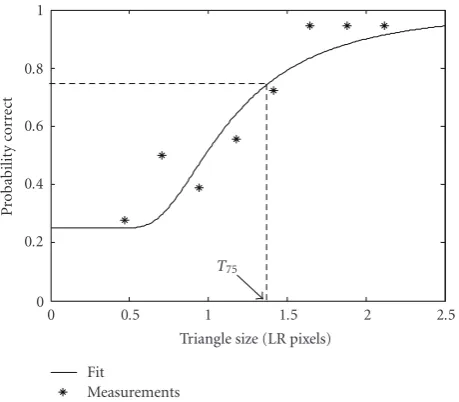
The probability of a correct observer response increases
with the triangle size. In [6] it is shown that this increase can
be described with a Weibull distribution:
pc(x)=0.25 + 0.75
1.5(α/x)β, (17)
where α is x at 0.75 probability correct and β defines the
steepness of the transition. Such a Weibull distribution can be fitted to a number of observations for different triangle
sizes as depicted in Figure 3. From this fit the triangle size
that corresponds with an 0.75 probability correct response
(T75) is determined.T75(in LR pixels) is a performance
mea-sure, where a smaller T75 indicates a better performance.
When for different conditions, for example, SNR, T75s are
determined, a performance curve can be plotted. Such curves
will be used inSection 5to show the results.
4.2. Real-world data experiment
In this experiment the performance of an SR reconstruction method on real-world data is measured.
4.2.1. Setup
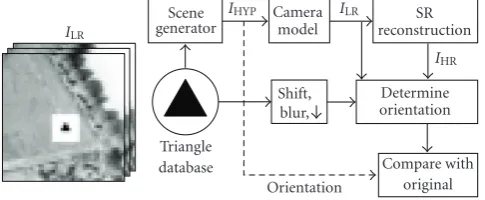
The setup of the experiment (including TOD) is depicted in Figure 4. The LR dataILRcomes from a real-world thermal IR camera (FLIR SC2000) with a rotating mirror in front of the lens. In the scene a thermal camera acuity tester (T-CAT
[20]) is present as depicted in the left-hand side ofFigure 4.
This apparatus contains an aluminium plate with 5 rows of 4 equilateral triangle shaped cutouts. A black body plate is placed 3 cm behind this plate. Between the plates several
tem-perature differences can be created. By controlling the
tem-perature difference, different contrast levels (SNRs) are ob-tained. Although the triangle shaped cutouts on the plate vary in size, more size variation can be obtained by changing the distance from the apparatus to the camera. Real-world
data sequences (40 frames) are processed with three different
SR reconstruction methods with optimized parameter set-tings: Elad’s method, Hardie’s method, and Pham’s method.
From both the ILR data and the reconstructed IHR
data the orientation of the triangles is determined. This is
done using (16) with gain and offset estimation in
trian-gle model M. The triangle model M is implemented with
shifted, blurred, and downsampled triangles in the triangle database. The triangle database contains equilateral triangles
with sides 12, 16,. . ., 280 pixels. In our evaluation each
0 0.5 1 1.5 2 2.5 Triangle size (LR pixels)
0 0.2 0.4 0.6 0.8 1
P
robabilit
y
cor
re
ct
T75
Fit
Measurements
Figure3: Example of a possible Weibull distribution of probability correct observer response.
downsampled (S= 17) resulting in 25 realizations for each
triangle. Here the blurring with σ = 0.9 ×S is chosen
such that these reference triangles will have a right balance
between residual aliasing and high-frequency content [21].
The orientation of the triangle obtained from the triangle database that results in the smallest mean-square error with the triangle in the data is selected. In the final step of the ex-periment setup the obtained orientation in the previous step is compared with the known ground-truth (GT) orientation of the triangle in the original real-world data.
4.2.2. Measurements on real-world data
To validate the performance on real-world data of the SR re-construction methods with simulations, some measurements are needed of the real-world data: (1) SNR, (2) point-spread-function (PSF) of the lens, and (3) fill factor (ff), which is the percentage of photo-sensitive area of the pixels on the focal plane array sensor.
The real-world data was recorded with three different temperature differences of the T-CAT, which results in three SNRs. Here, the SNR dB is defined as
SNR=20 log10 ITR−IBG
σBG
, (18)
withITRis the triangle intensity,IBGthe background intensity
on the T-CAT plate, andσBG the standard deviation ofIBG.
Our measurements resulted in SNRs 7 dB, 30 dB, and 48 dB.
The parameters of the camera (PSF andff) are obtained
by estimating the overall blur (LR pixels),σtot, in the
real-world data by fitting an erf model to several edges in the data (with highest SNR). Measurements on edges of large
trian-gles resulted in an overall blur of σtot ≈ 0.7, whereas on
medium-sized triangles an overall blur ofσtot≈0.5 was
mea-sured. When comparing these measurements with the spec-ifications of the camera (FLIR SC2000), the smallest overall
Infrared camera
Shift, blur,
ILR
Determine orientation IHR
Compare with original
SR reconstruction
Orientation Triangle
database ILR
Figure4: Left: example of real-world dataILR. Right: flow diagram of the real-world data experiment.
IHYPi Translation PSF
blurring S·δi G(S·σPSF) U(S·
√ ff)
Fill factor Downsample S Σ
Noise ILRi
Camera model
Figure5: Camera model used in the experiments.
blur seems more likely. Given the camera model as depicted inFigure 5, the PSF blur can be determined from the overall blur for a certain fill factor. In modern infrared cameras a
re-alistic fill factor is approximately 80% [22, page 101]. Given
aσtot=0.5 the blurring of the lens isσPSF=0.4.
4.3. Simulated data experiment 1
Based on the estimates of the camera’s parameters, simulated data sets have been generated. After processing the simulated data sets with the same SR reconstruction methods as in the previous experiment an indication can be obtained of the predictability of the real-world performance of these algo-rithms.
4.3.1. Camera model
A data set is simulated with a camera model as depicted in Figure 5, whereIHYPi is a discrete representation of a scene
sampled at the Nyquist rate with anS×smaller sampling
dis-tance than the observed framesILRi.δirepresents the
trans-lation of the camera, the PSF of the lens is modeled with a
2D Gaussian functionGwith standard deviationS·σPSFand
the fill factor are modeled with a uniform filterUwith width
S·√ff. The overall noise in the camera model is assumed to
be Gaussian distributed.
In this experiment two simulated data setsILRare
gener-ated: (1)σPSF =0.3,ff=0.8, which results in a less-blurred
data set as derived inSection 4.2.2and (2)σPSF=0.55,ff=
0.8, which results in a more-blurred data set. The
downsam-pling factor is chosen asS=17. The shift vectorsS·δiare
Scene generator
IHYP Camera model
Shift, blur,
ILR
Determine orientation IHR
Compare with original
SR reconstruction
Orientation Triangle
database ILR
Figure6: Left: example of simulated dataILR. Right: flow diagram of the simulated data experiment.
4.3.2. Setup
The setup of the experiment on simulated data is depicted in Figure 6. The scene generator produces HY scenesIHYP con-taining different triangle sizes and orientations from the
tri-angle database. The camera model converts theIHYPdata to
ILRdata in such a way that for each triangle size 16
realiza-tions are present in the data set. Note that the number of real-izations determines the statistical validity of the experiment.
TheILRdata, of which an example is shown in the left-hand
side ofFigure 6, is the input for the SR reconstruction
meth-ods. Note that the settings of these methods are the same as
for processing the real-world data. From both the ILR data
and the reconstructedIHRdata the triangle orientation is
de-termined using (16). Note that for this experiment no gain
and offset estimation is used in the triangle modelM.
4.4. Simulated data experiment 2
This experiment is done to show that the TOD method is a useful tool to select a specific SR reconstruction method ac-cording to the imaging conditions (camera’s fill factor,
opti-cal PSF, SNR). Here, camera model parameters (σPSF =0.2,
ff=1) that result in a more-aliased data set than the previous
simulated data sets are chosen. These parameters are cho-sen to enhance the differences between the SR reconstruction methods. To measure the performance of each method, the same setup is used as in “simulated data experiment 1” (see Figure 6). The performance of the SR reconstruction meth-ods is measured for the following conditions
(1) Different number of frames. (2) Different SNRs.
(3) Different zoom factors.
Note that the first two conditions are determined by the sim-ulated data and the last one (ratio between resulting HR grid and original LR grid) is determined by the algorithm. Only Hardie’s, Farsiu’s, and Pham’s methods are tuned to perform optimally under the varying conditions. For all three
meth-ods the parameterλis tuned. The tuning criterium is to
ob-tain a smallestT75triangle size under the condition at hand.
Note that the parameterλin Hardie’s method has a slightly
different meaning than in the other two methods. The
pa-rameter σ, which is the standard deviation of a Gaussian
function and represents both the PSF due to the optics and the sensor blur due to the fill factor, is chosen in such a way that it fitted best to the blurring of our used camera model.
The results of all experiments are discussed in the follow-ing section.
4.5. TOD versus MSE
An alternative measure to TOD is the MSE:
MSE= 1
N
x
IHR(x;θf,sf
−Mx;θf,sf 2
. (19)
To show the difference between both measures, the fol-lowing experiment is performed. Simulated LR data (varying SNR) is processed with the Hardie SR reconstruction method
with different settings (varyingλand number of frames).
The resulting images are first scored with the TOD method and subsequently the MSE is calculated between the
SR results and a triangle modelMof sizesf closest to the
tri-angle threshold (T75) found. Contour plots of both measures
are depicted inFigure 7.
It is clear fromFigure 7that the profiles of the TOD
mea-sure differ from the corresponding MSE profiles. Analyzing
the profiles for a fixed frame number shows that the
“opti-mal”λresulting in the lowestT75is significantly smaller than
the “optimal”λresulting in the lowest MSE: 10−2and 1,
re-spectively. The corresponding SR results (not depicted in this
paper) show that a smallλresult in steep edges with some
ringing at the boundary of the triangles. Note that TOD and thereby correct identification does not solely depend on the
lowest MSE found, but rather on the separability (=expected
difference in MSE between the observation and the correct assignment and the MSE between the observation and an incorrect assignment divided by the variance of the MSE). Hence, the ringing imposes a positive influence on this mea-sure of separability.
5. RESULTS
All results of the experiments can be found at the end of this paper. Note that the vertical axis in the plots indicate the tri-angle threshold size at 75% probability correct. A smaller
triangle threshold size (T75) corresponds with a better
per-formance, hence the lower the curve, the better the perfor-mance.
5.1. Results of real-world data and simulated
data experiment 1
The results of the “real-world data experiment” and the
“sim-ulated data experiment 1” can be seen in Figure 8. These
graphs show that the performance on real-world data can be approximated by the performance of a simulated data set. The depicted performance of the two simulated data sets
form aperformancelower bound (σPSF =0.55 andff=0.8,
resulting in an “overall”σtot≈0.6) and aperformanceupper
bound (σPSF = 0.3 andff= 0.8, resulting inσtot ≈ 0.4) on
the real-world performance. Note that in Figure 8the
4 16 64 Frame number
T75, Hardie, zoom 2,σ=0.37, SNR=42 dB
10−4 10−3 10−2 10−1 100 101
λ
1 1.5 2 2.5 3
(a)
4 16 64
Frame number
T75, Hardie, zoom 2,σ=0.37, SNR=24 dB
10−4 10−3 10−2 10−1 100 101
λ
1 1.5 2 2.5 3
(b)
4 16 64
Frame number
MSE, Hardie, zoom 2,σ=0.37, SNR=42 dB
10−4 10−3 10−2 10−1 100 101
λ
0 50 100 150 200 250 300
(c)
4 16 64
Frame number
MSE, Hardie, zoom 2,σ=0.37, SNR=24 dB
10−4 10−3 10−2 10−1 100 101
λ
0 200 400 600 800 1000 1200 1400
(d)
Figure7: (a) Contour plotT75, SNR=42 dB, (b) contour plotT75, SNR=24 dB, (c) contour plot MSE, SNR=42 dB, (d) contour plot MSE, SNR=24 dB.
performancelower bound is visually an upper bound. Elad’s
method shows that for all SNRs the performance on the
real-world data is close to the performance upper bound. For
Hardie’s method we see the opposite for high SNRs: here
the real-world performance is equal to theperformancelower
bound. Furthermore, it can be seen that the performance on real-world data of the three algorithms is similar for low and medium SNR, whereas for high SNR Pham’s and Hardie’s methods perform slightly better.
5.2. Results of simulated data experiment 2
InFigure 9the performance of all SR reconstruction meth-ods with zoom factor 2 for different number of LR input frames is compared. Here the black line indicates the
0 10 20 30 40 50 SNR (dB)
0 1 2 3 4 5 6
T75
(LR
pix
els)
LR, real data Real data
Simulated data (σ=0.55) Simulated data (σ=0.3) Real versus simulated data, Elad’s method, zoom 2, 40 frames
(a)
0 10 20 30 40 50
SNR (dB) 0
1 2 3 4 5 6
T75
(LR
pix
els)
LR, real data Real data
Simulated data (σ=0.55) Simulated data (σ=0.3) Real versus simulated data, Hardie’s method, zoom 2, 40 frames
(b)
0 10 20 30 40 50
SNR (dB) 0
1 2 3 4 5 6
T75
(LR
pix
els)
LR, real data Real data
Simulated data (σ=0.55) Simulated data (σ=0.3) Real versus simulated data, Pham’s method, zoom 2, 40 frames
(c)
Figure8: Performance measurements on real-world and simulated data (40 frames). Blue line: simulated data created withσPSF=0.55 andff=80%, green line: simulated data created withσPSF =0.3 andff=80%. (a) Elad, (b) Hardie (σ =0.55,λ=0.01), (c) Pham (σ=1,λ=10−3,β=10). All data is processed with zoom factor 2.
0 0.5 1 1.5 2 2.5 3 3.5 4
T75
(LR
pix
els)
0 10 20 30 40 50
SNR (dB) LR
Elad
Lertrattanapanich Kaltenbacher
Hardie Farsiu Pham 4 frames
(a)
0 0.5 1 1.5 2 2.5 3 3.5 4
T75
(LR
pix
els)
0 10 20 30 40 50
SNR (dB) LR
Elad
Lertrattanapanich Kaltenbacher
Hardie Farsiu Pham 16 frames
(b)
0 0.5 1 1.5 2 2.5 3 3.5 4
T75
(LR
pix
els)
0 10 20 30 40 50
SNR (dB) LR
Elad
Lertrattanapanich Kaltenbacher
Hardie Farsiu Pham 64 frames
(c)
0 0.5 1 1.5 2 2.5 3 3.5 4
T75
(LR
pix
els)
0 10 20 30 40 50
SNR (dB) LR
Zoom 1
Zoom 2 Zoom 4 Elad’s method, 64 frames
(a)
0 0.5 1 1.5 2 2.5 3 3.5 4
T75
(LR
pix
els)
0 10 20 30 40 50
SNR (dB) LR=zoom 1 Zoom 2
Zoom 4 Lertrattanapanich’s method, 64 frames
(b)
0 0.5 1 1.5 2 2.5 3 3.5 4
T75
(LR
pix
els)
0 10 20 30 40 50
SNR (dB) LR
Zoom 2
Zoom 4 Kaltenbacher’s method, 64 frames
(c)
0 0.5 1 1.5 2 2.5 3 3.5 4
T75
(LR
pix
els)
0 10 20 30 40 50
SNR (dB) LR
Zoom 1
Zoom 2 Zoom 4 Hradie’s method, 64 frames
(d)
0 0.5 1 1.5 2 2.5 3 3.5 4
T75
(LR
pix
els)
0 10 20 30 40 50
SNR (dB) LR
Zoom 1
Zoom 2 Zoom 4 Farsiu’s method, 64 frames
(e)
0 0.5 1 1.5 2 2.5 3 3.5 4
T75
(LR
pix
els)
0 10 20 30 40 50
SNR (dB) LR
Zoom 1
Zoom 2 Zoom 4 Pham’s method, 64 frames
(f)
To illustrate the effect of an increasing zoom factor, Figure 10shows performance curves of all SR reconstruction methods for zoom factors 1, 2, and 4. All methods processed
the same 64 LR frames (σPSF = 0.2 andff =100%). From
Figure 10it is clear that the performance of zoom factors 2 and 4 for most methods (except for Kaltenbacher’s method and Farsiu’s method) is comparable. For low SNRs the per-formance of each method (for all zoom factors) is signifi-cantly better compared to LR performance. Here, the tem-poral noise reduction is visible. For high SNRs the results show an improvement of a factor 2, which approximately equals the amount of aliasing in the LR data. This explains why zoom factor 4 does not yield a significant better per-formance. Note that the bad performance of Kaltenbacher with zoom factor 4 compared with zoom factor 2 can be ex-plained by the fact that this method has no regularization and hence becomes ill posed. Furthermore, an improvement by a factor 2 (between zoom factor 1 and zoom factors 2 and 4) is not obtained for low SNRs. Here, the temporal noise reduction is more relevant than the antialiasing. The perfor-mance of some SR reconstruction methods, when processed with zoom factor 1 under high SNR, is slightly worse com-pared to baseline LR performance. This could be explained by blurring in the fusion process and/or blurring as a result of registration errors.
6. CONCLUSIONS
From the results in the previous section, the following con-clusions can be derived.
(1) From the results of the real-world data experiment it
can be concluded that the performance of different
SR reconstruction methods on real-world data can be predicted accurately by measuring the performance on simulated data, if a proper estimate of the parameters of the real-world camera system is available.
(2) With the ability to predict the performance of an SR re-construction method on real-world data, it is possible to optimize the complete chain of a vision system. The parameters of the camera and the algorithm must be chosen such that the performance of the vision task is optimized.
(3) It is shown that with the TOD method the perfor-mance of SR reconstruction methods can be compared for a specific condition of the LR input data. Consid-ering the imaging conditions (camera’s fill factor, op-tical PSF, SNR) the TOD method enables an objective choice on which SR reconstruction method to use. (4) Comparing the performance of the unregularized
Kaltenbacher’s method with the regularized methods
of Hardie, Farsiu, and Pham (see Figure 9), it can
be concluded that in general regularization is not re-quired for good performance when many input frames are available.
(5) The relative performance of the various methods change a little as a function of SNR.
(6) The results presented inFigure 10show that a larger
zoom factor does not yield a better performance. This can be explained by the fact that sensors with high fill factors exert an amount of blurring on the LR in-put frames and therefore limit the resolution gain and hence the maximum achievable resolution gain. For high SNRs the resolution gain is approximately equal to the amount of aliasing in the LR data and for low SNRs the resolution gain is minor compared with the temporal noise reduction.
ACKNOWLEDGMENTS
The authors would like to thank T. Q. Pham for the imple-mentation of several of the used SR reconstruction methods and thank P. Bijl for providing the infrared data.
REFERENCES
[1] S. C. Park, M. K. Park, and M. G. Kang, “Super-resolution im-age reconstruction: a technical overview,”IEEE Signal Process-ing Magazine, vol. 20, no. 3, pp. 21–36, 2003.
[2] S. Farsiu, M. D. Robinson, M. Elad, and P. Milanfar, “Advances and challenges in super-resolution,”International Journal of Imaging Systems and Technology, vol. 14, no. 2, pp. 47–57, 2004.
[3] S. Baker and T. Kanade, “Limits on super-resolution and how to break them,”IEEE Transactions on Pattern Analysis and Ma-chine Intelligence, vol. 24, no. 9, pp. 1167–1183, 2002. [4] Z. Lin and H.-Y. Shum, “Fundamental limits of
reconstruction-based superresolution algorithms under local translation,”IEEE Transactions on Pattern Analysis and Machine Intelligence, vol. 26, no. 1, pp. 83–97, 2004.
[5] M. D. Robinson and P. Milanfar, “Statistical performance anal-ysis of super-resolution,”IEEE Transactions on Image Process-ing, vol. 15, no. 6, pp. 1413–1428, 2006.
[6] P. Bijl and J. M. Valeton, “Triangle orientation discrimina-tion: the alternative to minimum resolvable temperature dif-ference and minimum resolvable contrast,”Optical Engineer-ing, vol. 37, no. 7, pp. 1976–1983, 1998.
[7] P. Bijl, K. Schutte, and M. A. Hogervorst, “Applicability of TOD, MTDP, MRT and DMRT for dynamic image enhance-ment techniques,” inInfrared Imaging Systems: Design, Anal-ysis, Modeling, and Testing XVII, vol. 6207 ofProceedings of SPIE, pp. 1–12, Kissimmee, Fla, USA, April 2006.
[8] T. Q. Pham, M. Bezuijen, L. J. van Vliet, K. Schutte, and C. L. Luengo Hendriks, “Performance of optimal registration es-timators,” inVisual Information Processing XIV, vol. 5817 of
Proceedings of SPIE, pp. 133–144, Orlando, Fla, USA, March 2005.
[9] B. D. Lucas and T. Kanade, “An iterative image registration technique with an application to stereo vision,” inProceedings of the DARPA Image Understanding Workshop, pp. 121–130, Washington, DC, USA, April 1981.
[10] S. M. Kay,Fundamentals of Statistical Signal Processing: Esti-mation Theory, Prentice-Hall, Upper Saddle River, NJ, USA, 1993.
space-invariant blur,”IEEE Transactions on Image Processing, vol. 10, no. 8, pp. 1187–1193, 2001.
[12] S. Lertrattanapanich and N. K. Bose, “High resolution im-age formation from low resolution frames using Delaunay tri-angulation,” IEEE Transactions on Image Processing, vol. 11, no. 12, pp. 1427–1441, 2002.
[13] E. Kaltenbacher and R. C. Hardie, “High resolution infrared image reconstruction using multiple, low resolution, aliased frames,” inProceedings of IEEE National Aerospace and Elec-tronics Conference (NAECON ’96), vol. 2, pp. 702–709, Day-ton, Ky, USA, May 1996.
[14] R. C. Hardie, K. J. Barnard, J. G. Bognar, E. E. Armstrong, and E. A. Watson, “High-resolution image reconstruction from a sequence of rotated and translated frames and its application to an infrared imaging system,”Optical Engineering, vol. 37, no. 1, pp. 247–260, 1998.
[15] S. Farsiu, M. D. Robinson, M. Elad, and P. Milanfar, “Fast and robust multiframe super resolution,”IEEE Transactions on Im-age Processing, vol. 13, no. 10, pp. 1327–1344, 2004.
[16] T. Q. Pham, L. J. van Vliet, and K. Schutte, “Robust fusion of irregularly sampled data using adaptive normalized convolu-tion,”EURASIP Journal on Applied Signal Processing, vol. 2006, Article ID 83268, 12 pages, 2006.
[17] H. Knutsson and C.-F. Westin, “Normalized and diff eren-tial convolution,” inProceedings of IEEE Society Conference on Computer Vision and Pattern Recognition (CVPR ’93), pp. 515– 523, New York, NY, USA, June 1993.
[18] R. M. Haralick and L. Watson, “A facet model for image data,”
Computer Graphics and Image Processing, vol. 15, no. 2, pp. 113–129, 1981.
[19] J. Johnson, “Analysis of image forming systems,” inProceedings of Image Intensifier Symposium, pp. 249–273, Fort Belvoir, Va, USA, October 1958.
[20] J. M. Valeton, P. Bijl, E. Agterhuis, and S. Kriekaard, “T-CAT, a new thermal camera acuity tester,” inInfrared Imaging Systems: Design, Analysis, Modelling, and Testing XI, vol. 4030 of Pro-ceedings of SPIE, pp. 232–238, Orlando, Fla, USA, April 2000. [21] L. J. van Vliet and P. W. Verbeek, “Better geometric
measure-ments based on photometric information,” inProceedings of IEEE Instrumentation and Measurement Technology Conference (IMTC ’94), vol. 3, pp. 1357–1360, Hamamatsu, Japan, May 1994.
[22] T. Q. Pham,Spatiotonal adaptivity in super-resolution of under-sampled image sequences, Ph.D. thesis, Quantitative Imaging Group, TU Delft, Delft, The Netherlands, 2006.
A. W. M. van Eekerenwas born in 1977. He received his M.S. degree in 2002 from the department of Electrical Engineering at the Eindhoven University of Technology. He did his graduation project within Philips Medical Systems on the topic of image en-hancement. Subsequently he worked one year at the Philips Research Laboratory on image segmentation using level sets. In 2004 he started his Ph.D. project entitled
“super-resolution on small moving objects” at the Electro-Optics group within TNO in collaboration with the Quantitative Imaging group at the Delft University of Technology. His research interests include image restoration, super resolution, image quality assessment, and object detection.
K. Schutte received his M.S. degree in Physics in 1989 from University of Ams-terdam and received his Ph.D. degree in 1994 from University of Twente on his the-sis “knowledge-based recognition of man-made objects.” Subsequently he had a post-doctoral position with the Delft University of Technology’s Pattern Recognition (now Quantitative Imaging) group. Since 1996 he is employed by TNO, currently as Senior
Research Scientist Electro-Optics within the Business Unit Obser-vation Systems. Within TNO he has actively led multiple projects in areas of signal and image processing. Recently he has led many projects including super-resolution reconstruction for both inter-national industries and governments, resulting in super-resolution reconstruction-based products in active service. His research inter-ests include pattern recognition, sensor fusion, image analysis and image restoration. He is Secretary of the NVBHPV, the Netherlands branch of the IAPR.
O. R. Oudegeestreceived his B.S. degree in applied physics at Delft University of Tech-nology in 2004. His B.S. thesis was titled: “alternatives for CT scanning in the diag-nosis of endovascular aneurysm stent-graft migration.” In 2007 he received his M.S. degree in applied physics at Delft Univer-sity of Technology on the subject of “super-resolution on and classification of small moving objects.” His research interests
in-clude super resolution, tracking, and pattern recognition.
L. J. van Vlietis a Full Professor in multi-dimensional image processing and analy-sis at Delft University of Technology. He studied applied physics at Delft University of Technology and received his Ph.D. de-gree cum laude in 1993. His thesis enti-tled “grey-scale measurements in multidi-mensional digitized images” presents novel methods for sampling-error-free measure-ments of geometric object features. He has