Volume 2007, Article ID 83526,10pages doi:10.1155/2007/83526
Research Article
A Learning State-Space Model for Image Retrieval
Cheng-Chieh Chiang,1, 2Yi-Ping Hung,3and Greg C. Lee4
1Department of Information and Computer Education, College of Education, National Taiwan Normal University,
Taipei 106, Taiwan
2Department of Information Technology, Takming College, Taipei 114, Taiwan
3Graduate Institute of Networking and Multimedia, College of Electrical Engineering and Computer Science,
National Taiwan University, Taipei 106, Taiwan
4Department of Computer Science and Information Engineering, College of Science, National Taiwan Normal University,
Taipei 106, Taiwan
Received 30 August 2006; Accepted 12 March 2007
Recommended by Ebroul Izquierdo
This paper proposes an approach based on a state-space model for learning the user concepts in image retrieval. We first design a scheme of region-based image representation based on concept units, which are integrated with different types of feature spaces and with different region scales of image segmentation. The design of the concept units aims at describing similar characteristics at a certain perspective among relevant images. We present the details of our proposed approach based on a state-space model for interactive image retrieval, including likelihood and transition models, and we also describe some experiments that show the efficacy of our proposed model. This work demonstrates the feasibility of using a state-space model to estimate the user intuition in image retrieval.
Copyright © 2007 Cheng-Chieh Chiang et al. This is an open access article distributed under the Creative Commons Attribution License, which permits unrestricted use, distribution, and reproduction in any medium, provided the original work is properly cited.
1. INTRODUCTION
Image retrieval has become a very active research area since the 1990s due to the rapid increase in the use of digital im-ages [1,2]. Estimating the user concepts is one of the most difficult tasks in image retrieval. Feature extraction involves extracting only low-level features such as color, texture, and shape from an image. However, people understand an im-age semantically, rather than via the low-level visual features, and there is a large gap between the low-level features and the high-level concepts in image understanding [3].
The relevance feedback approach [4,5] is widely used for bridging this semantic gap. In each iteration of a retrieval task, the user assigns some relevant and irrelevant examples according to their concepts, from which the system learns to estimate what the user actually wants. Many types of learn-ing models have been applied in relevance feedback for image retrieval, such as Bayesian framework [6–8], SVM [9], and active learning [10]. Goh et al. also proposed several quanti-tative measures to model concept complexity in the learning of relevance feedback [10].
Image representation is another important issue that needs to be addressed when solving the above problem. It
is necessary to design good units for image representation even if a perfect learning approach is applied to image re-trieval. Many recent studies have adopted the region-based approach [9,11,12] for image representation, because re-gion features can be more representative for user requests than global image features. Constructing a set of visual words [13,14] that collects similar region features to be a represen-tative unit is appropriate for region-based image representa-tion. Image annotation [15,16] is another method that labels an image with high-level information. Some researchers have attempted to build a semantic space for describing the high-level concepts in images [17,18].
track the behaviors of the user concepts of relevance feed-backs in image retrieval using a state-space model [19–21]. The state-space model has been well defined and widely ap-plied to dynamic systems. However, we did not find studies in the literature that have applied the state-space model to the learning problem in relevance feedback. Our work aims at demonstrating the feasibility of solving the retrieval prob-lem using a state-space model.
This paper is organized as follows. Section 2 intro-duces the motivation and the idea behind our proposed approach. Section 3 describes the proposed concept units used in region-based image representation, and the proposed learning model based on a state-space model is shown in
Section 4.Section 5presents the image ranking method used to determine the similarity of two images.Section 6describes a strategy for handling negative examples.Section 7details some experiments that applied our approach, andSection 8
draws conclusions and discusses future work.
2. MOTIVATION
We consider the problem of category search in image re-trieval. This involves grouping images into the same category that the user perceives to be semantically relevant. For ex-ample, the image set from Corel Photo, a set of image data widely used in many researches, contains many types of se-mantic categories. Hence we consider a user called “Corel Photo” who chooses relevant images to form these categories. Note that different users may assign different semantic cate-gories in the same image set. The main challenge for category search is to estimate the user concepts, for example, Corel Photo, from the interaction of the retrieval.
Let a query session comprise the first query and corre-sponding relevance feedbacks. We assume that the user does not change the requesting concepts, that is, the semantic con-cepts in a query session are constant. Ideally, we can view the process of obtaining relevance feedbacks as tracing the path from the first query to the retrieval goals, from which we can estimate the user concepts in a retrieval task.
During a retrieval task, the user could have a semantic goal but could be unable to describe it explicitly—the re-trieval target exists but is not explicit in the beginning of the retrieval. For example, the user may want to retrieve images of flowers but will be unable to describe their types wanted until she/he looks at relevant images. For this scenario, we can model the tracing path of the user concepts as
X1=IM·Xt−1+ηt−1, (1)
whereXtmeans the user state at thetth iteration,IMis the identical matrix, andηt−1 is the noise term (i.e., variations
of user concepts in relevance feedbacks). We estimate each stage of the tracing path using the stateXt, which is deter-mined from the previous estimated states and various types of feedbacks specified by the user.
Figure 1illustrates our idea that tracks the relevant re-gion features in the feature space to estimate the user con-cepts in image retrieval. Figures1(a)and1(b)show the two sets of relevant images that are specified by the user at tth
(a) Relevant examples at the
tth iteration
(b) Relevant examples at the (t+ 1)th iteration
(c) Region features at thetth iteration
(d) Tracking the movement of region features fromtth iteration to (t+ 1)th iteration
Figure1: An illustration of tracking the movement of region fea-tures in relevance feedbacks.
and (t+ 1)th iterations, respectively. Figures1(c) and1(d)
describe the process of tracking the movement of relevant regions in a visual feature space. At tth iteration, it is as-sumed that the relevant region features involve three com-ponents shown inFigure 1(c). Hence we can depict these re-gion features using the centroids (i.e., means) of the three components. At the next iteration, the estimation of the state starts with the previous centroids, drawn as blue dots in
Figure 1(d), and moves to the current relevant regions. In this work, we aim at solving (1) to estimate the user concepts relevant to image retrieval. We assume that stateXt
can be modeled using a Gaussian mixture [22] with means
μt and variancesσt, whereμtrepresent the user concepts in stateXt−1, andσt are the variances of the user feedbacks in
an iteration. Solving meansμtand variancesσtrequires two major tasks: representation and estimation for the state.
We first have to design a scheme for representing the state, which intuitively handles the semantic gap between vi-sual features and user concepts. We do not try to directly construct a semantic space for image retrieval because it is impossible to explicitly describe what the user wants before requests are made. In this work, we design a flexible scheme using concept units that are based on combinations of dif-ferent types of region features and different scales of image segmentation. Any two images that are designated as relevant by the user should be similar from a certain perspective. The concept units are designated to represent unknown perspec-tives of relevant images based on the user perceptions.
We next design an iterative approach for learning and es-timating the user state. The idea of eses-timating the tracing path of relevance feedbacks motivated us to design a state-space model of the user state described in (1). The state-space model has been widely applied to analyze and infer dy-namic systems according to information on time sequences. In our proposed model, the time sequence for the state-space model is associated with the iteration process of relevance feedbacks, and the training data for learning or inferring the system is extracted from positive examples in the relevance feedbacks. Moreover, we design a simple strategy for han-dling negative examples in order to eliminate false alarms in retrieval results.
3. CONCEPT UNITS FOR REGION AND IMAGE REPRESENTATION
3.1. Image segmentation and feature extraction
Region-based approach is widely used to the analysis of im-age contents. To extract regions, the first task is to partition an image into multiple regions using image segmentation. The most intuitive method for image segmentation is to seg-ment objects (or foreground subjects) for region-based im-age matching [9,11–13]. However, this is very difficult, and the segmentation results greatly affect the performance of region-based tasks. Hence, some researchers have divided an image into rectangular girds [15] or a large number of over-lapping circular regions [23].
Generally speaking, image segmentation may not be con-sistent with human perception. Our proposal is not to gener-ate the perfect regions with segmentation, but rather to de-termine useful ones. We use the well-known watershed seg-mentation [24], which is an efficient, automatic, and unsu-pervised segmentation method for gray-level images, to par-tition an image into nonoverlapping regions. A color image is first converted to a gray image and then partitioned by the watershed segmentation. A watershed region is often homo-geneous in the intensity space, and that means that pixels in a watershed region are not very diverse. Hence, the water-shed regions are appropriate for representing the region units of an image. Wang proposed a multiscale approach for wa-tershed segmentation in order to overcome the problem of oversegmentation [24], which is the major drawback of the
original method of watershed segmentation, by controlling the scaling parameters. Different scaling parameters result in different numbers of regions being segmented in the same image.
Assume that the database containsNimages, denoted as
{I1,. . .,IN}, and thatvscales, denoted asS= {s1,. . .,sv}, are
used for watershed segmentation. Given a scalesq, we assume there arenq regions to be partitioned for all images in the database. Thus, we can annotate the set of regions as
rsq
1,. . .,r sq
nq
. (2)
Let the set of featuresF= {f1,. . .,fu}containudifferent
types of visual features. Given a feature type fp, the feature vector extracted from regionrsq
i is written as fp(r sq
i ). Thus,
given a feature type fpand a scalesq, we have a set of feature vectors, denote that asRqp, with respect to the set of watershed
regions in (2):
Rqp= nq
i=1 fprsq
i
, 1≤p≤u, 1≤q≤v. (3)
Note that the region representation described above is independent of selecting visual features and segmentation methods. We collect different scales and different features of regions for an image in order to represent unknown perspec-tives of relevant images. Using more types of visual features and more scales of regions covers a wider range of the image contents, but makes the computational complexity excessive. In this work, four types of visual features (i.e.,u = 4) are used: (i) color histogram, (ii) color moments (both color fea-tures are in HSV space), (iii) cooccurrence texture, and (iv) Gabor texture. Moreover, we setv=2, that is, two types of region scales, in the watershed segmentation.
3.2. Concept units
Since it is impossible to predict the best way to represent an image, for example, which type of features or which scale for image segmentation is better for image representation, be-fore the user makes the query, we first collect different types of region representation, and then estimate which is best for characterizing the user’s perceptions in relevance feedbacks.
Rqp, in (3), represents the collection of visual features of
wa-tershed regions that are observed using different scales and different features, hence giving a total ofu×vtypes of re-gion features withvscaling parameters andutypes of visual features.
Given the feature type fp and the scaling parameter sq, we apply theK-means algorithm [22] to cluster the feature vectorsRqp. That is, we partition the feature space intoK
ar-eas. SupposeCqp(1),. . .,Cqp(K) are the clusters for all regions
with respect tosqand fq. Collecting all of the region features yields the clusters:
p,q k
k=1
x1 xt−1 xt
z1 zt−1 zt
· · ·
· · ·
p(zt|xt) p(xt|xt−1)
Figure2: The probabilistic structure of the state-space model.
Theseu×v×K clusters are the concept units for all 1≤ p ≤ u, 1≤ q ≤ v, and 1≤ k ≤ K representing images in the entire image database with different scalings and dif-ferent features. The definition of concept units is a variant of the so-called visual word [13,14], which draws the process-ing units in the space of the visual features. The generation of the concept units with different types of feature spaces and with different region scales provides more possibilities to fit the different characteristics of the image contents for seman-tically relevant images. In our experiments, we setKat 400, hence givingu×v×K=4×2×400=3 200 concept units.
3.3. Region-based image representation
We can build the concept units in (4) for all images in the database in order to represent the types of contents that the user retrieves. Therefore, we design a region-based im-age representation based on the concept units. LetI be an image in the database. For each concept unitCqp(k), where
1≤p≤u, 1≤q≤v, and 1≤k≤K, let the weightwqp(k) be
the ratio of the number of regions belonging toCqp(k) to the
number of regions in imageI. Thus, we collect all weights,
wqp(k), to from a (u×v×K)-dimensional vector for
repre-senting image
wqp(k)|1≤p≤u, 1≤q≤v, 1≤k≤K
. (5)
4. LEARNING MODEL BASED ON A STATE-SPACE MODEL
4.1. State-space model
The state-space approach has been widely applied to the analysis of dynamic systems, which involve estimating the state of a system which changes over time from a sequence of noisy measurements [19]. Many papers have detailed state-space models [19–21], and hence here we only provide a brief summary of how the posterior probability of a state-space model is inferred.
Figure 2 depicts the probabilistic structure of the Bayesian network of a state-space model, which contains two types of nodes at timet: (i)xtfor the system state and (ii)zt
for the observation measurement. At timet, the dynamic sys-tem receives inputszt, for which we want to estimate the pos-terior probability of the system statextgiven the past obser-vations; this is denoted asp(xt|z1,...,t), wherez1...trepresents
the collection of observationsz1tozt. Two assumptions are
generally applied to a state-space model for simplicity. The first is the first-order Markov property, given by
pxt|x1,...,t−1=pxt|xt−1, (6)
wherex1,...,t−1 represents the collection of statesx1 to xt−1.
The second is that the observations are mutually indepen-dent:
pzt|xt,z1...,t−1=pzt|xt, (7)
wherez1,...,t−1means the collection of the observationsz1to zt−1. By using the above two assumptions and Bayes’ rule, the posterior probability of statext given the past observa-tions can be inferred as
pxt|z1,...,t
= p
zt|xtpxt|z1,...,t−1
pzt|z1,...,t−1 , (8)
where
pxt|z1,...,t−1=
xt−1
pxt |xt−1pxt−1|z1,...,t−1. (9)
Thus, we can infer the posterior probability as
pxt|z1,...,t
= p
zt|xt pzt|z1,...,t−1
xt−1
pxt|xt−1pxt−1|z1,...,t−1
∝pzt|xt xt−1
pxt|xt−1pxt−1|z1,...,t−1.
(10)
In (10), the posterior probability p(xt |z1,...,t) in a
state-space model is recursively based on two factors: (i) a system modelp(xt |xt−1) which describes the evolution of the state
over time (called thetransition function), and (ii) a measure-ment model p(zt | xt) which relates the observation and noise to the state (called theobservation function). It is also necessary to define the prior probability of statep(x1) at the
beginning of the recursion.
4.2. The proposed learning model
mixture model. However, this makes the model very com-plex, and also we do not have a huge training data set for learning and inferring the model because the number of pos-itive examples is not large in a query session. Hence, it is nec-essary to simplify the design of the state-space model for im-age retrieval.
In this work, we simplify the definition of the state vector in two ways. The first is to ignore the variancesσt. The def-inition of concept units covers some variances because they are defined as clusters in the feature space. Ignoring the vari-ancesσt in defining the state vector means that we assume that the variance of concepts is limited to the radius of the concept units. The second is to define a single concept unit which is viewed as a greedy method instead of multiple con-cept units in the state vector. Considering thetth iteration in a query session, letxtbe the most representative concept unit for the user concepts that we want to estimate, and letz1,...,t
be the collection of positive examples of relevance feedbacks. Thus, we want to find the maximal posterior estimation of statextgiven the past positive examples (observationsz1,...,t)
in relevance feedbacks:
xt∗=arg maxp
xt|z1,...,t
. (11)
The user concepts in the query session generally comprise multiple rather than single factors, and hence we take the first
Hhighest probabilities ofx∗t to represent the user concepts.
Below we define the state vector, observation function, and transition function that are used to construct the state-space model.
State vector
We define the state as the most representative concept unit for the query session. The definition of concept unitCqp(k)
is associated with feature typep, region scaleq, and cluster
k, and thus we define the state vector as a three-dimensional vector denoted as (p,q,k), where 1≤p≤u, 1≤p≤v, and 1≤k≤K.
Observation function
Let the positive images of relevance feedbacks be the obser-vations of the state-space model. We define the observation functionp(zt|xt) as the likelihood of the observation given each state,
pzt|xt
=no. of computed concept units in positive images
no. of all concept units in positive images . (12)
Let us consider an example in which there are 100 regions in relevant images at an iteration of a query session. There-fore, these observations contain 100 concept units because each region feature belongs to a concept unit. If 35 regions fall in the same concept unit, its observation measurement is 35/100=0.35.
Transition function
The transition model p(xt | xt−1) is designed to model the
variations of concept units representing the user concepts in iterations of relevance feedbacks. The transition func-tion must record the changing cost between any two con-cept units. Given two state vectors v1 = (p1,q1,k1) and v2=(p2,q2,k2) withp1 =p2, this means that the two units
are from different feature spaces. Because different types of features capture different characteristics in images, it is inap-propriate to estimate the state cross-different features. Hence we set the transition function Trans(v1,v2) to 0 if p1 = p2.
We next consider the case in which concept units are in the same feature space, that is, p1 = p2. Thus, we can
com-pute the meaningful distance between these two concept units either with or without the same region scale. How-ever, the transition measurement of concept units crossing different scales should be less than that in the same scale. Let
M(p1,q1,p2,q2) be aK×K matrix in which each element Mi jis the Euclidean distance between concept units (p1,q1,i)
and (p2,q2,j). Note thatMi j corresponds to the Euclidean
distance between the means of clustersCq1
p1(i) andC q2 p2(j). We then define the transition function as
Transv1
p1,q1,k1
,v2
p2,q2,k2 = ⎧ ⎪ ⎪ ⎪ ⎪ ⎪ ⎪ ⎨ ⎪ ⎪ ⎪ ⎪ ⎪ ⎪ ⎩
2·exp−Mk1k2
yexp
−Mk1y
ifp1=p2,q1=q2,
α·2·exp
−Mk1k2
yexp
−Mk1y
ifp1=p2,q1=q2,
0 ifp1=p2,
(13)
whereαis a scaling factor with 0≤α≤1. Note thatα=0.5 in our implementation.
Prior distribution
All of the prior probabilities of the states are set equal. This means that the tracking of the model starts at all concept units.
At the beginning of the iterations, all concept units have equal probabilities for representing the query concepts. Dur-ing the process of relevance feedbacks in the query session, representative concept units from observations will have higher probabilities based on the inference of the state-space model using (10). We take firstHconcept units with maxi-mal posterior probabilities to represent the user concepts at each iteration.
d
r
Negative hole
Regions of positive images Regions of negative images Untested regions
Figure3: An illustration of the negative holes,d: distance to the nearest positive region,r: the radius of the negative hole,d/2.
5. IMAGE RANKING
The proposed learning model usesHconcept units to largely represent the concepts the user retrieves in a query session. A similarity measure between the retrieval concepts and an image in the database is used for image matching and rank-ing. Without loss of generality, let the firstH concept units with maximal posterior probabilities at thetth iteration be denoted byvτ(i), where 1≤i≤H. The posterior
probabili-ties of theseHconcepts are described by
pt(i)=pxtvτ(i)
|zt, 1≤i≤H, (14)
whereτ(i) is the index of concept units, andxt(vτ(i)) is the
state with concept unitvτ(i)at thetth iteration.
The idea of designing the similarity measure is to find im-ages containing most of theHconcept units in (14). Since an imageIin the database can be represented as (5), we design a dissimilarity measure between the retrieval concepts of the query session and the imageIat thetth iteration as follows:
DisSim(I,t)=
M
i=1
wτ(i)−pt(i) 21/2
(15)
6. STRATEGY FOR HANDLING NEGATIVE EXAMPLES
The previous sections only use positive examples of feed-backs for learning the concepts that the user wants to re-trieve. While negative examples could be applied in the learn-ing model to decrease the rate of false retrieval results, han-dling them is difficult because they are diverse either in fea-ture spaces or in semantic concepts. In our opinion, a nega-tive example only removes some of the false retrieval results in a localized area. In this work, we adopt the strategy follow-ing from [27] for handling negative examples. The basic idea is to excavate a “negative hole” in the feature space around the regions of each negative example.Figure 3illustrates an
example of negative holes. The center of a negative hole is a region feature of a negative image, and its radius is half the distance from the negative region to the nearest positive one. Each iteration of relevance feedbacks involves the generation of many negative holes associated with regions of negative examples. A region of a test image in the database is neglected in computing weightswqp(k) in (5) if it falls in a negative hole.
7. EXPERIMENTAL RESULTS AND DISCUSSION
7.1. Dataset
In our experiments, we used three datasets (denoted as DI, DII, and DIII) where DI and DII contain photo images col-lected from Corel Photo and DIII is Caltech-101 Object Cat-egories [28].
Dataset DI
DI contains 20 categories and each category consists of 100 photo images. All images can be partitioned into over 70 000 regions with two scales of image segmentation. These images contain a wide range of contents, such as landscapes, ani-mals, plants, and buildings. These data categories are classi-fied according to human concepts such as “beautiful rose,” “autumn,” and “doors in Paris,” and hence even images in the same category may have had diverse contents. However, all images in the same category are viewed as relevant to each other.
Dataset DII
We extended DI to the larger dataset DII which contains 50 categories, each consisting of 100 photo images, giving a to-tal of 5 000 images. All images can be partitioned into over 200 000 regions with two scales of image segmentation. For each category in DI and DII, we randomly choose 10 images as the query, so the size of the query set is 200 and 500 im-ages, respectively. Moreover, 10 iterations are performed for each query.
Dataset DIII
We took the Caltech-101 Object Categories [28] as the third dataset that is publicly available and involves 101 categories of objects with over 8 000 images. The number of images in each category is different. Over 300 000 regions are seg-mented with two scales of image segmentation. We randomly chose 10 images as the query for the larger categories which contain more than 80 images, giving a total of 240 query im-ages.
7.2. Evaluation and discussion
The precision and the recall are commonly used to evalu-ate the performance of a retrieval system. Note that precision
Table1: The detailed precisions using DI without handling negative examples.
Cat ID t=1 t=2 t=3 t=4 t=5 t=6 t=7 t=8 t=9 t=10
0 0.354 0.497 0.549 0.556 0.557 0.558 0.559 0.559 0.559 0.559
1 0.134 0.251 0.305 0.332 0.349 0.352 0.355 0.355 0.355 0.355
2 0.154 0.302 0.398 0.432 0.443 0.447 0.453 0.457 0.457 0.457
3 0.156 0.273 0.381 0.446 0.479 0.491 0.493 0.495 0.496 0.496
4 0.177 0.268 0.378 0.485 0.531 0.548 0.553 0.554 0.554 0.554
5 0.241 0.475 0.633 0.713 0.752 0.754 0.758 0.758 0.758 0.758
6 0.247 0.404 0.548 0.651 0.705 0.722 0.724 0.725 0.726 0.726
7 0.156 0.266 0.386 0.484 0.538 0.555 0.555 0.555 0.556 0.565
8 0.245 0.428 0.547 0.583 0.606 0.607 0.608 0.609 0.613 0.634
9 0.415 0.644 0.782 0.849 0.883 0.884 0.884 0.884 0.884 0.884
10 0.221 0.395 0.497 0.533 0.543 0.545 0.546 0.562 0.641 0.709
11 0.285 0.548 0.657 0.672 0.673 0.673 0.673 0.693 0.810 0.859
12 0.205 0.352 0.455 0.504 0.521 0.524 0.539 0.556 0.730 0.788
13 0.223 0.375 0.464 0.513 0.523 0.531 0.563 0.701 0.760 0.798
14 0.238 0.358 0.496 0.593 0.643 0.667 0.724 0.823 0.895 0.919
15 0.297 0.484 0.576 0.592 0.633 0.743 0.876 0.893 0.893 0.893
16 0.450 0.611 0.752 0.847 0.888 0.912 0.959 0.967 0.968 0.968
17 0.216 0.386 0.537 0.612 0.712 0.833 0.888 0.888 0.888 0.888
18 0.283 0.461 0.602 0.668 0.736 0.851 0.883 0.887 0.890 0.890
19 0.197 0.312 0.444 0.568 0.695 0.838 0.874 0.888 0.888 0.889
AVG 0.245 0.404 0.519 0.582 0.620 0.652 0.673 0.690 0.716 0.730
(C = 100 in DI and DII). We setB = 100 in our system, hence precision=recall in datasets DI and DII. Moreover, some of the categories contain more than 100 images in dataset DIII. Thus, we employ the recall instead of the pre-cision to evaluate the performance of the proposed method in our experiments.
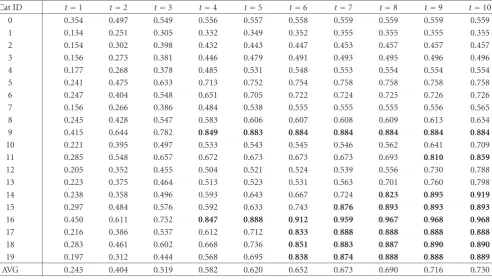
Figure 4shows the average recalls at each iteration of rele-vance feedbacks in five cases: only using DI without handling negative examples, and using DII and DIII with/without handling negative examples. DI-pos exhibits the highest re-calls because the size of DI is smaller than that of DII and DIII. However, the performances of DII-pos+neg and DIII-pos+neg indicate that handling negative example can signif-icantly improve the retrieval.
Table 1lists the detailed recalls of all categories of DI of relevance feedbacks using our proposed model without neg-ative examples. The first row inTable 1denotes the iteration of relevance, and the last row indicates the average precisions of all image categories. Note that precisions larger than 0.8 are shown in boldface.
BothFigure 4andTable 1indicate that the retrieval per-formances are bad at the beginning of the retrieval. The rea-son is that only few positive feedbacks at the beginning are available, and hence the training data are insufficient for ac-curately estimating the states. After several iterations, the ef-ficacy of the proposed model is more manifest.
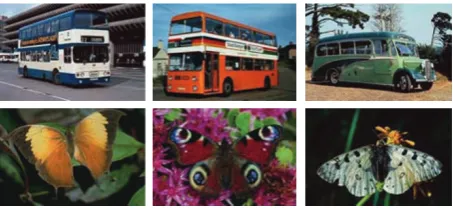
We now discuss the experiments in detail. Figures 5
and6(b)illustrate two cases that correspond to better and worse retrieval results, respectively, using DII without
han-1 2 3 4 5 6 7 8 9 10
Iteration 0
0.1 0.2 0.3 0.4 0.5 0.6 0.7 0.8 0.9 1
Re
ca
ll
DI-pos DII-pos DII-pos+neg
DIII-pos DIII-pos+neg
Figure4: Average recalls for the three datasets DI-pos, DII-pos, and DIII-pos: using these datasets without handling negative examples; DII-pos+neg, and DIII-pos+neg: using the two datasets with han-dling negative examples.
(a) The first and second rows are examples of categories “bus” and “butterfly,” respectively
Cat. 1 2 3 4 5 6 7 8 9 10
Bus 0.179 0.316 0.437 0.543 0.658 0.758 0.824 0.863 0.878 0.896 Butt. 0.067 0.122 0.175 0.222 0.39 0.704 0.782 0.81 0.938 0.969
(b) The detailed precisions of the categories “bus” and “butterfly,” respectively
Figure5: Illustrations of better results using DII without handling negative examples.
(a) The first and second rows are examples of categories “in desert” and “snow mountain,” respectively
Cat. 1 2 3 4 5 6 7 8 9 10
Des. 0.057 0.09 0.118 0.151 0.178 0.19 0.193 0.194 0.194 0.194 Snow 0.048 0.09 0.116 0.146 0.151 0.17 0.18 0.186 0.188 0.188
(b) The detailed precisions of the categories “in desert” and “snow mountain,” respectively
Figure6: Illustrations for worse results using DII without handling negative examples.
“in desert” and “snow mountain” that have worse results, and
Figure 6(b)shows their average precisions. In the better cases ofFigure 5, images in the same category have the same se-mantic concepts but still look quite different. This shows the feasibility of using the proposed approach to model images with similar semantic concepts but diverse visual features. However, huge variations either in visual features or seman-tic concepts are still very difficult to model. For example, the “snow mountain” images inFigure 6are easily confused with those in other landscape categories.
Basically, our approach is appropriate for image retrieval with relevance feedbacks. The time sequences in the state-space model can be easily associated with the iterations of relevance feedbacks. The proposed model does not only in-volve the likelihoods of positive images, but also considers
potential in image retrieval if the retrieval task focuses on an application domain. After defining the transition model of the structure for the knowledge domain, our proposed model can consider both the low-level features (likelihood model) and high-level concepts (transition model) for bridging the semantic gap problem in image retrieval.
8. CONCLUSIONS AND FUTURE WORK
This work demonstrates the feasibility of solving the problem of the semantic gap for image retrieval using a state-space model. We design concept units, which integrate with diff er-ent types of visual features and with different scales of image segmentation, for image representation. We also propose a state-space model for estimating the user concepts in a query session. Our approach involves both the likelihood model of positive examples and the transition model among concept units in image retrieval. Moreover, we have presented a strat-egy for handling negative feedbacks for refining the retrieval results in this paper.
Some future tasks are required to extend this work. The first is to define a long-term learning strategy for solving the problem of a small training set at the beginning iterations of relevance feedbacks. The second is to integrate the knowledge structure for a domain application with the transition model in our proposed approach. Moreover, the design of con-cept units could be revised to contain higher-level informa-tion rather than visual features. Other methods of machine learning, such as active leaning or boosting, could be inte-grated with the state-space model for image retrieval.
ACKNOWLEDGMENTS
This work was supported in part by the Ministry of Eco-nomic Affairs, Taiwan, under Grant 95-EC-17-A-02-S1-032 and by the Excellent Research Projects of National Taiwan University under Grant 95R0062-AE00-02.
REFERENCES
[1] R. Datta, J. Li, and J. Z. Wang, “Content-based image retrieval: approaches and trends of the new age,” inProceedings of the 7th ACM SIGMM International Workshop on Multimedia
Informa-tion Retrieval (MIR ’05), pp. 253–262, Singapore, November
2005.
[2] M. S. Lew, N. Sebe, C. Djeraba, and R. Jain, “Content-based multimedia information retrieval: state of the art and chal-lenges,”ACM Transactions on Multimedia Computing, Com-munications and Applications, vol. 2, no. 1, pp. 1–19, 2006. [3] K. Goh, B. Li, and E. Y. Chang, “Semantics and feature
dis-covery via confidence-based ensemble,”ACM Transactions on
Multimedia Computing, Communications, and Applications,
vol. 1, no. 2, pp. 168–189, 2005.
[4] Y. Rui, T. S. Huang, M. Ortega, and S. Mehrotra, “Relevance feedback: a power tool for interactive content-based image re-trieval,”IEEE Transactions on Circuits and Systems for Video Technology, vol. 8, no. 5, pp. 644–655, 1998.
[5] X. S. Zhou and T. S. Huang, “Relevance feedback in image re-trieval: a comprehensive review,”Multimedia Systems, vol. 8, no. 6, pp. 536–544, 2003.
[6] I. J. Cox, M. L. Miller, T. P. Minka, T. V. Papathomas, and P. N. Yianilos, “The Bayesian image retrieval system, PicHunter: theory, implementation, and psychophysical experiments,”
IEEE Transactions on Image Processing, vol. 9, no. 1, pp. 20–37, 2000.
[7] Z. Su, H. Zhang, S. Li, and S. Ma, “Relevance feedback in content-based image retrieval: Bayesian framework, feature subspaces, and progressive learning,”IEEE Transactions on Im-age Processing, vol. 12, no. 8, pp. 924–937, 2003.
[8] N. Vasconcelos and A. Lippman, “Learning from user feed-back in image retrieval systems,” inProceedings of Advances in Neural Information Processing Systems (NIPS ’99), pp. 977– 986, Denver, Colo, USA, November-December 1999. [9] F. Jing, M. Li, H.-J. Zhang, and B. Zhang, “An efficient and
ef-fective region-based image retrieval framework,”IEEE Trans-actions on Image Processing, vol. 13, no. 5, pp. 699–709, 2004. [10] K.-S. Goh, E. Y. Chang, and W.-C. Lai, “Multimodal
concept-dependent active learning for image retrieval,” inProceedings of the 12th Annual ACM International Conference on Multime-dia, pp. 564–571, New York, NY, USA, October 2004. [11] C. Carson, M. Thomas, S. Belongie, J. M. Hellerstein, and J.
Malik, “Blobworld: a system for region-based image index-ing and retrieval,” inProceedings of the 3rd International Con-ference on Visual Information and Information Systems
(VI-SUAL ’99), pp. 509–516, Amsterdam, The Netherlands, June
1999.
[12] J. Z. Wang, J. Li, and G. Wiederhold, “SIMPLIcity: semantics-sensitive integrated matching for picture libraries,” IEEE
Transactions on Pattern Analysis and Machine Intelligence,
vol. 23, no. 9, pp. 947–963, 2001.
[13] K. Barnard and D. Forsyth, “Learning the semantics of words and pictures,” inProceedings of the 8th IEEE International
Con-ference on Computer Vision (ICCV ’01), vol. 2, pp. 408–415,
Vancouver, BC, Canada, July 2001.
[14] L. Fei-Fei and P. Perona, “A Bayesian hierarchical model for learning natural scene categories,” inProceedings of the IEEE Computer Society Conference on Computer Vision and Pattern Recognition (CVPR ’05), vol. 2, pp. 524–531, San Diego, Calif, USA, June 2005.
[15] S. L. Feng, R. Manmatha, and V. Lavrenko, “Multiple Bernoulli relevance models for image and video annotation,” in Pro-ceedings of the IEEE Computer Society Conference on Computer
Vision and Pattern Recognition (CVPR ’04), vol. 2, pp. 1002–
1009, Washington, DC, USA, June-July 2004.
[16] J. Jeon, V. Lavrenko, and R. Manmatha, “Automatic image an-notation and retrieval using cross-media relevance models,” in
Proceedings of the 26th Annual International ACM SIGIR Con-ference on Research and Development in Information Retrieval
(SIGIR ’03), pp. 119–126, Toronto, Ont, Canada, July-August
2003.
[17] D. R. Heisterkamp, “Building a latent semantic index of an im-age database from patterns of relevance feedback,” in Proceed-ings of the 16th International Conference on Pattern Recognition (ICPR ’02), vol. 4, pp. 134–137, Quebec, Canada, August 2002. [18] A. Shah-Hosseini and G. M. Knapp, “Learning image se-mantics from users relevance feedback,” inProceedings of the
12th Annual ACM International Conference on Multimedia, pp.
452–455, New York, NY, USA, October 2004.
[20] Z. Ghahramani, “An introduction to hidden Markov models and Bayesian networks,”International Journal of Pattern Recog-nition and Artificial Intelligence, vol. 15, no. 1, pp. 9–42, 2001. [21] K. P. Murphy,Dynamic Bayesian networks: representation,
in-ference and learning, Ph.D. thesis, University of California, Berkeley, Calif, USA, 2002.
[22] R. O. Duda, P. E. Hart, and D. G. Stork,Pattern Classification, John Wiley & Sons, New York, NY, USA, 2nd edition, 2001. [23] R. Fergus, L. Fei-Fei, P. Perona, and A. Zisserman, “Learning
object categories from Google’s image search,” inProceedings of the 10th IEEE International Conference on Computer Vision
(ICCV ’05), vol. 2, pp. 1816–1823, Beijing, China, October
2005.
[24] D. Wang, “A multiscale gradient algorithm for image segmen-tation using watersheds,”Pattern Recognition, vol. 30, no. 12, pp. 2043–2052, 1997.
[25] V. Mezaris, I. Kompatsiaris, and M. G. Strintzis, “An ontology approach to object-based image retrieval,” inProceedings of IEEE International Conference on Image Processing (ICIP ’03), vol. 2, pp. 511–514, Barcelona, Spain, September 2003. [26] M. Srikanth, J. Varner, M. Bowden, and D. I. Moldovan,
“Exploiting ontologies for automatic image annotation,” in
Proceedings of the 28th Annual International ACM SIGIR Conference on Research and Development in Information Re-trieval (SIGIR ’05), pp. 552–558, Salvador, Brazil, August 2005. [27] I. Atmosukarto, W. K. Leow, and Z. Huang, “Feature combi-nation and relevance feedback for 3D model retrieval,” in Pro-ceedings of the 11th International Multimedia Modelling
Con-ference (MMM ’05), pp. 334–339, Melbourne, Australia,
Jan-uary 2005.
[28] L. Fei-Fei, R. Fergus, and P. Perona, “Learning generative visual models from few training examples: an incremental Bayesian approach tested on 101 object categories,” in Proceed-ings of IEEE CVPR Workshop of Generative Model Based Vision
(WGMBV ’04), Washington, DC, USA, June 2004.
Cheng-Chieh Chiangreceived his B.S. de-gree in applied mathematics from Tatung University, Taipei, Taiwan, in 1991, and his M.S. degree in computer science from Na-tional Chiao Tung University, Hsinchu, Tai-wan, in 1993. He is currently working to-wards the Ph.D. degree in Department of Information and Computer Education, Na-tional Taiwan Normal University, Taipei, Taiwan. His research interests include
mul-timedia information indexing and retrieval, pattern recognition, machine learning, and computer vision.
Yi-Ping Hungreceived his B.S. degree in electrical engineering from the National Taiwan University in 1982. He received his M.S. degree from the Division of Engineer-ing, his M.S. degree from the Division of Applied Mathematics, and his Ph.D. de-gree from the Division of Engineering, all at Brown University, in 1987, 1988, and 1990, respectively. He is currently a Professor in the Graduate Institute of Networking and
Multimedia, and in the Department of Computer Science and In-formation Engineering, both at the National Taiwan University. From 1990 to 2002, he was with the Institute of Information
Science, Academia Sinica, Taiwan, where he became a Tenured Re-search Fellow in 1997 and is now an Adjunct ReRe-search Fellow. He served as a Deputy Director of the Institute of Information Science from 1996 to 1997, and received the Young Researcher Publication Award from Academia Sinica in 1997. He has served as the Pro-gram Cochair of ACCV’00 and ICAT’00, as the Workshop Cochair of ICCV’03, and as a member in the editorial board of the Interna-tional Journal of Computer Vision since 2004. His current research interests include computer vision, pattern recognition, image pro-cessing, virtual reality, multimedia, and human-computer interac-tion.
Greg C. Leereceived his B.S. degree from Louisiana State University in 1985, and his M.S. and Ph.D. degrees from Michigan State University in 1988 and 1992, respectively, all in computer science. Since 1992, he has been with the National Taiwan Normal Uni-versity where he is currently a Professor at the Department of Computer Science and Information Engineering. His research in-terests are in the areas of image processing,