INCREASING WINE SALES VIA THE
WINE-FOOD PAIRING
Does visual or textual representation of the wine-food
pairing and congruency of the information influence wine
sales?
Student
H. Huttenhuis
s1028561
Communication Studies
Supervisors
First supervisor
S. E. Bialkova, PhD
A: Images used in pre-test 1 ... 40
B: Images used in pre-test 2 ... 43
C: Sample question pre test 2 ... 46
D: Shelf tags used in the experiment ... 47
E: Main experiment execution scheme ... 48
F: Analyses of general sales variation during the experiment ... 49
Abstract
flavour and sometimes even a food pairing suggestion. Together with taste, the pairing with food is the most important motivating factor for drinking wine (Charters & Pettigrew, 2008). One may argue that the wine-food pairing suggestions on the shelf may influence the wine sales. Indeed, Corsi, Mueller and Lockshin (2012) acknowledge that pairing with food can influence consumers to buy more expensive alternatives. In the Netherlands, the majority of the supermarkets have use wine food pairing suggestions. These wine-food pairing suggestions consists of textual notes that are added to the wine shelf. However, it is curious that these suggestions are offered in a textual manner, as literature shows that visual messages are more effective than textual messages. Furthermore, Townsend and Kahn (2014) state that images are processed by consumers in a manner that is faster, less deliberate and easier, compared to texts. Besides, consumer prefer visual information over textual information.
combined, this effect is even stronger. Furthermore, congruency of information and wine also influences sales, in the sense that congruent wine-food pairings lead to higher sales than incongruent wine-food pairings.
Explorative marketing research
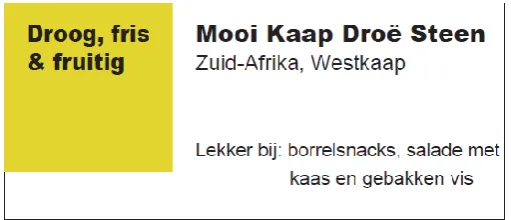
Before the empirical research could start, it was important to first investigate the current situation by exploring how supermarkets currently use shelf tags. In order to do so, the researcher visited all A-brand supermarkets in Enschede. It was not necessary to visit the same supermarkets in other cities, because these supermarkets use standard formulas, implying that all supermarkets in the Netherlands use the same shelf tags. Four supermarkets were visited (Albert Heijn, Coop, Emté and Jumbo). Based on these visits, it can be concluded that all A-brand supermarkets use shelf tags of wine to provide wine-food pairing suggestions. Furthermore, all these wine-food pairings were presented in a textual form. An example of a shelf tag with a food-pairing suggestion can be found in Figure 2.
Figure 2. Example of current shelf tag.
Empirical section
In order to find suitable wine-food pairings for the main experiment, two pre-tests were conducted. The first pre-test was carried out to determine which images of the dishes were considered attractive according to consumers. It is important to use attractive images of dishes, as the aim was to imitate the real life situation as good as possible. It is likely that supermarkets also use attractive images to persuade people. During this pre-test, no attention was paid to wine-food pairings. The second pre-test was conducted to investigate the congruency of wine-food pairings, as there was no scientific evidence available for this aim.
Selection of dishes (pre-test 1)
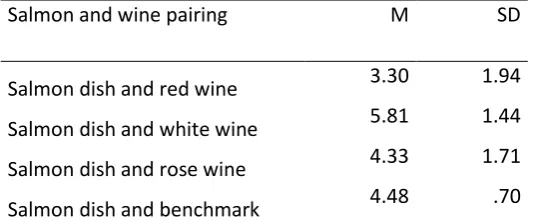
Salmon and wine pairing M SD
Salmon dish and red wine 3.30 1.94
Salmon dish and white wine 5.81 1.44 Salmon dish and rose wine 4.33 1.71
Salmon dish and benchmark 4.48 .70
Table 3. Means and standard deviation for salmon dish and wine pairings.
A notable result is that there was no wine-food pairing in which rose wine was found to be congruent with the dish. Therefore Popular media source were advised to find a congruent food for rose wine. Popular media view the pairing of rose with a salmon dish as a good combination, for this reason the salmon dish will also be used as the preferred dish for rose wine.
Main experiment
This chapter consists of three sections. First, the design of the experiment is introduced. Second, the stimuli that were used in the experiment are described and presented. The third section will elaborate on the procedure of the experiment.
For this experiment, data was obtained from scan data of the cash registers. Besides the sales rates, no further information was collected from the participants. What is known about the participants, is that they bought a total of 793 bottles of wine during the course of the experiment.
Design
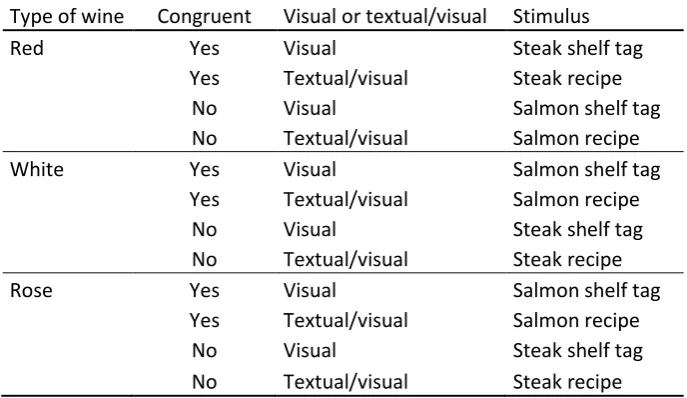
The main experiment used a 2 (visual information vs. textual and visual information) x 2 (congruent vs. incongruent) x 3 (red wine vs. white wine vs. rose wine) design with a textual control group. The control group consists of the wine sales of three weeks prior the experiment. Measurements of the control group examined sales the current situation, e.g., the wine-food pairing suggestions presented in textual form.
Stimuli
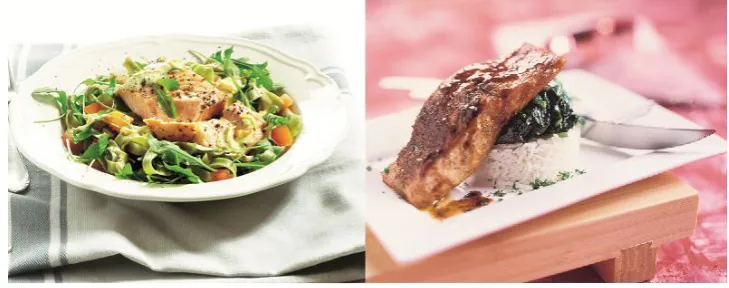
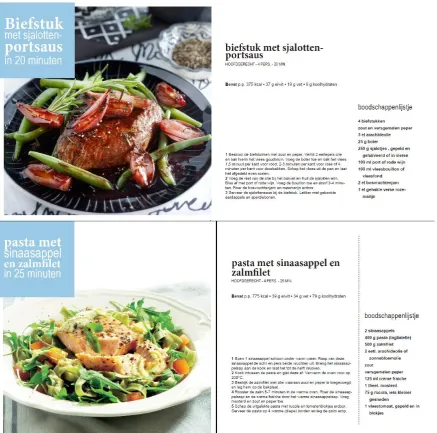
Figure 4. Shelf tags: The stimuli for the visual condition, a steak dish (left image) and a salmon dish (right image).
Recipes (Textual and visual combination)
Figure 5. Recipes: The stimuli for the textual\visual combination condition, a steak recipe (top) and a salmon recipe (bottom).
Wine selection
could occur. The price of the selected wine was € 2.69 per bottle, which is considered as relatively cheap, as most wines cost around € 6.00 per bottle, while some can cost € 15.00 per bottle.
Procedure
The main experiment was executed in an A-brand supermarket in the city suburbs of Enschede in the Netherlands. The course of the experiment lasted four weeks. During these weeks, each day a single condition was tested. Every four days, all conditions were tested once. For all three wine sorts, the same condition was tested, on one day. The experiment ran all day during weekdays and on Saturday. Opening hours of the store were 8:00 a.m. till 8:00 p.m. on Monday through Thursday and on Saturday 8:00 a.m. till 9:00 p.m. on Friday. On Sunday the experiment was halted due to the limited opening hours in comparison to the other days (16:00 p.m. till 19.00 p.m.). Conditions were adjusted every day, within 10 minutes after the store opened. See Appendix E for the full experiment execution scheme.
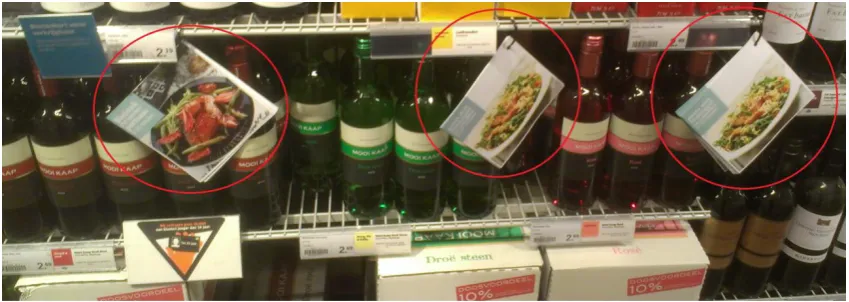
The shelf tags were placed over the original shelf tag using an plastic holder (as can be seen in the red circles in Figure 6). The size of such a shelf tag is not uncommon in this supermarket.
Figure 6. Shelf tags during the experiment.
Conclusions
Townsend, C., & Kahn, B. (2014) The “Visual Preference Heuristic”: The influence of visual versus verbal depiction on assortment processing, perceived variety, and choice overload, Journal of consumer research, 40, 993-1015.
Yeoh, J, P, S., & North, A, C. (2010). The effects of musical fit on choice between two competing foods. Musicae Scientiae, 14, 165-180.
Appendix
A: Images used in pre-test 1
For the first pre-test there were 9 pairs of images for each the participants had to choose the most attractive dish or indicate that neither was attractive.
Pair 1: Salad
Pair 2: Beef stew
Pair 4: Casserole
Pair 5: Salmon dish
Pair 6: Steak
Pair 8: Pasta
B: Images used in pre-test 2
For the second pre-test the 9 dishes preferred in the first pre-test where used to create wine-food pairings.
Dish 1: Steak
Dish 2: Chicken
Dish 4: Stir-fry
Dish 5: Salad
Dish 6: Beef stew
Dish 8: Casserole
C: Sample question pre test 2
D: Shelf tags used in the experiment
G: Analyses of sales variation during congruent and incongruent test days
A pair sample T-test has been performed to analyse whether the general sales on days that congruent conditions where tested varies from the days that the incongruent conditions were tested. This has been done for all wine sold in the supermarket and additionally for three wines that are similar to the wine used in the experiment, tested independently and together. As can be seen in the tables none of the moments of measurement varied significantly from the other.
Mean Std.
Deviation
Congruent 3 wines 17,22 4,91
Incongruent 3 wines 19,78 8,72
All wines congruent 103,06 41,96
All wines incongruent 109,00 39,89
t df p (2-tailed)
Pair 1 Congruent 3 wines - Incongruent 3
wines -0,90 17,00 0,38
Pair 2 All wines congruent - All wines