DOI : https://doi.org/10.32628/CSEIT1952203
Analysis of Test Management, Functional and Load Testing Tools
Prachi A. Sasankar
Department of Computer Science, Sadabai Raisoni Womens College Nagpur, Maharashtra, India
ABSTRACT
Software testing is one of the most important phases in software development lifecycle (SDLC). Software testing is the process of evaluating the software product with the intent to find whether it satisfies the user requirements or not. It involves identifying bug, error, or defect in a software product without correcting it. There are various automated tools, which help as to test the software products with accuracy. This paper analyses some of the test management, functional and load testing tools.
Keywords : Functional Tools, Load Testing Tools, Software Testing, Test Automation, Test Management Tools.
I. INTRODUCTION
Software testing is the process of detecting defects/bugs in the product during execution. It acts as a part of quality assurance. It assists software developers in delivering a defect-free product. It also helps invalidating a product against a client’s specifications/ requirements.
Software development lifecycle (SDLC) explains the process involved in developing Software by the software industry. Mainly there are five phases. They are Analysis, Design, Implementation, Testing and Maintenance. Software development, begins with customer specification of requirements and then it will progress through Analysis, Design, Implementation, Testing and ongoing support of the completed software. Theoretically, it is understood that the testing phase will start once implementation is completed[9]. However, in practical, testing is the parallel process that begins at requirement elicitation itself. Once project requirements are identified, that has to be parallel checked. Suppose if there is any error, that can be identified at an early stage instead of identifying after implementation. This will help to reduce rework.
The objective of testing is to find errors/bugs in the system. Best and successful test cases can be used to find even the undiscovered and uncovered errors with high probability [9]. In a project, testing is the most important and expensive process. It is mandatory to spend 40% of the effort for testing. However, 100% bug-free software is not always possible. If there is any defect in the delivered product, then the testing team has to take responsibility. Therefore, the testers have the mandatory role in delivering the bug-free software. The tester must possess the following qualities like operability, observability, controllability, decomposability, simplicity, stability and understandability [9].
II. TESTING AND ITS ACTIVITIES
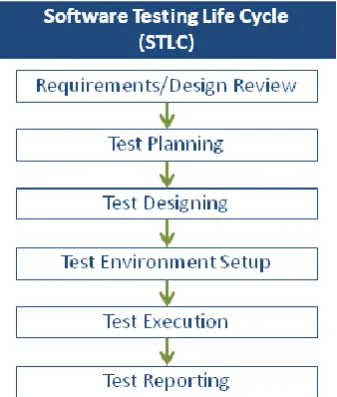
etc. Then the executionof the test case will happen according to the testing schedule in test plan. Test result contains thesummary of testing activities and information about whether the test cases are pass or fail. The various activities involved in the process of software testing are shown in Figure 1.
Figure 1. Software Testing Life cycle
There are two types of testing, they are static and dynamic. Static testing means identify the error before executing the program. Techniques used for static testing are code inspections and review. It identifies logical, standard and control errors. Dynamic testing means identify the error after executing the program. It is further classified into two types, Functional testing (Black box) and Structural testing (white box). Functional testing will test the entire functionality of the system by comparing expected output with actual output. It will not focus on the internal design of the program. Whereas Structural testing will mainly focus on the internal design of the program like path coverage, statement coverage, control structure and program complexity etc. Thereby improving the design and usability.
III.METHODS OF SOFTWARE TESTING
Testing can be done in two ways. They are Manual Testing and Automation Testing.
Manual Testing: In manual testing, testers will initially prepare the test plan and test cases based on the requirement specifications. Test cases will contain the information about the input to be given to the system and the corresponding output. Quality of testing depends on how far the test cases have covered the requirements. Test cases should also cover the incorrect scenario to detect how the system is responding for the particular scenario. One main drawback of manual testing is it requires more time and resources.
Automation Testing: In automation testing tester writes scripts and feed to another software to test the products. It improves the test coverage, accuracy and save time and memory. Automation testing tools falls under three different categories. They are Test Management tools, Functional Testing Tools and Load Testing Tools.
IV.TOOLS USED IN SOFTWARE TESTING
This section discusses about the various software testing tools, whichis focused on Test Management, Functionality and load.
A. Open Source Tools:
✓ TET (Test Environment Toolkit):The goal behind creating the Test Environment Toolkit (TET) was to produce a test drive for check functionality and interfaces [7].
✓ TETware:TETware is the supported version of the Test Environment Toolkit, offering additional platform support and capabilities. It provides an easy-to-use multi-platform uniform test framework into which local, remote, distributed and real time test suites can be incorporated[7]. ✓ Test Manager:It is used to facilitate regular
Software Development activities, automate & manage the testing activities [7].
✓ RTH (Requirements and Testing Hub):It provides the bug tracking facilities [7].
B. Commercial Tools:
✓ HP Quality Center/ALM: It is a set of software tools for application development and testing. It includes tools for requirements management, test planning and functional testing, performance testing, developer management, and defect management [7].
✓ QAComplete: Manage, organize, and report all your testing efforts in a central place using QAComplete. Centrally store your manual and automated testing assets to promote reusability. Allow your testing teams to communicate more effectively, while staying organized and keeping a track of changes with proper version control [7]. ✓ T-Plan Professional: Test Process management
tool, Test ANY system. As automation runs at the GUI level, the tool can automate most applications [8].
✓ Automated Test Designer (ATD): ATD is a unique tool for creating Test Cases based on Functional Requirements. It uses an advanced and rigorous Neural Network Optimization algorithm and reduction methods, in order to
generate the minimum number of test cases to certify 100% of the Requirements rules [8]. ✓ Testuff:Testuff test management is an on-demand
service for managing and executing manual software tests and for reporting defects. This test management suite includes: Requirements management, test cases, test planning and execution, defect reporting, video recorder and player, time management, integration to all bug trackers and automation tools and much more [8].
✓ SMARTS: Assurance Suite, delivers critical data centre management insights that empower IToperations teams to deliver service assurance for applications and services. SMARTS monitors the availability and performance of physical and virtual networks, storage environments, and servers [9].
✓ QAS.TCS (Test Case Studio): QAS.TCS provides a central platform for the entire test team, with functionality extending to test case planning, definition, parameterizing, and even automated test execution at your option [7][10].
✓ PractiTest: PractiTest is an end-to-end QA and Test management solution, designed to help users control their testing and development process, focusing on how to manage their project and its information, and how to communicate testing outcomes to all the relevant stakeholders. It also supports a new type of test that encourages Exploratory and Session Based Testing practices [8].
✓ SpiraTest:SpiraTest provides a complete Quality Assurance solution that manages requirements, tests, bugs and issues in one environment, with complete traceability from inception to completion. Highly intuitive web application that provides a complete picture of a project’s status and health yet requires only a web-browser [8]. ✓ TestLog:TestLog is an integrated test case
The test log provides the overall test run summary, indicates passed and failed tests and contains detailed information about each test operation, including the reasons of failed operations [8].
✓ ApTest Manager: ApTest Manager provides affordable test management for QA projects. It improves consistency, organization, and control throughout the testing process [8].
✓ DevTest: DevTest helps to create and manage release and test cycles, plan and assign test tasks tothe testing teams, execute test coverage, and submit product defects all from within a single application [8].
Functional Testing Tools: Functional testing is a type of testing which verifies that each function of the software application operates in conformance with the requirement specification. This testing involves checking of User Interface, APIs, Database, security, client/server applications and functionality of the Application under Test. The testing can be done either manually or using automation. Different vendors provide different set of tools under these categories. Both Open source and Commercialtesting tools are available. Here we have listed some of the testing tools under different categories.
It mainly concentrates on:
✓ Mainline functions: Testing the main functions of an application
✓ Basic Usability: It involves basic usability testing of the system. It checks whether a user can freely navigate through the screens without any difficulties.
✓ Accessibility: Checks the accessibility of the system for the user.
✓ Error Conditions: Usage of testing techniques to check for error conditions. It checks whethersuitable error messages are displayed.
✓ Open Source Tools:
✓ Selenium: Selenium is a portable software testing framework for web applications. Seleniumprovides a record/playback tool for authoring tests without learning a test scripting language (Selenium IDE) [7] [8].
✓ SoapUI: SoapUI is an open-source web service testing application for service-orientedarchitectures (SOA) and representational state transfer (REST). Its functionality covers web service inspection, invoking, development, simulation and mocking, functional testing, load and compliance testing [8] [11].
✓ Watir: It is an open-source (BSD) family of Ruby libraries for automating web browsers. It is simple and flexible. It supports multiple browsers on different platforms [8] [12].
✓ HTTP Recorder: It is a browser-independent recorder that records interactions with web sitesand produces scripts for automated playback[8] [13].
✓ Webcorder: This is a free GUI software testing tool developed in VB to allow for simple end-user web testing [8] [16].
✓ Solex: Solex is a web application testing tool built as a plug-in for the Eclipse IDE. It provides functions to record a client session, adjust it according to various parameters and replay it later typically in order to ensure non regression of the application's behavior [8].
✓ Imprimatur: It is a web application testing tool. The tests are described in a simple XML file. Along with the standard GET and POST actions, Imprimatur handles HTTP sessions and file uploads. The responses can be validated using regular expressions and response code checks [8]. ✓ SAMIE-Simple Automated Module For Internet
need to run tests for their browser applications [8][18].
✓ WET: Framework for Web automation testing. It has many features like multiple parameterbased object identification for more reliable recognition, support for XML object repository, better popup handling, HTML results, Precondition Support, Teardown support, Parameterization of the scripts, Parameterization of the objects, External Library support and more[8].
A. Commercial Tools:
✓ QuickTest Pro: provides functional and regression test automation for software applications and environments. It supports keyword and scripting interfaces and features a graphical user interface. It also allows developers to test from a single console all three layers of a program's operations: the interface, the service layer and the database layer[7].
✓ QuickTest Professional (QTP): An automated regression testing tool to identify any gaps, errors/defects in contrary to the actual/desired results of the application under test[7] [8].
✓ Rational Robot: [1] Rational Robot is an automated functional, regression-testing tool. Itprovides test cases for common objects such as menus, lists, bitmaps and specialized test casesfor objects specific to the development environment. ✓ Sahi: [2] Sahi is automation and testing tool for
web applications coming in an open-source and aproprietary version.
✓ Soap Test: Automated tool for testing Web services. SOAP test facilitates server functionaltesting by automatically creating a test suite from a WSDL document that tests every operationassociated with that document [7]. ✓ Badboy: [3] Badboy is a powerful tool designed to
aid in testing and development of complex dynamic applications. Badboy makes web testing
and development easier with dozens of features including a simple yet comprehensive capture/replay interface, powerful load testing support, detailed reports, graphs etc.,
✓ TestComplete: [4] TestComplete is a functional automated testing platform. Tests can be recorded, scripted or manually created with keyword driven operations and used for automated playback and error logging. TestComplete is broken out into three modules: Desktop, Web, Mobile. Each module contains functionality for creating automated tests on that specific platform.
✓ QAWizard: [5] QA Wizard Pro automates the functional and regression testing of web,Windows, and Java applications, and load testing of web applications. Using a single application to perform both functional and load tests.
✓ liSA: No-code, enterprise-strength automated testing solution for J2EE applications, websites and web services. liSA uses "inline testing" technology to talk to every component within your infrastructure. New one-click wizards enable even non-developers to connect to, analyze and interact with live EJBs, databases, messaging layers and web services/SOAP objects[7].
✓ Load Testing Tools: Load testing is the process of putting demand on a software system or computing device and measuring its response. Load testing is performed to determine a system's behaviour under both normal and anticipated peak load conditions.
Open Source Tools:
✓ Jmeter: Java desktop application designed to load test functional behaviour and measureperformance [7].
Commercial Tools:
✓ WebLOAD Professional: a tool for load testing Internet and Intranet applications. It aims to beeasy to use and providing near real-time performance measurements of the application under test.This is particularly useful when you are doing optimization as you can see the impact of your changes almost immediately [7].
✓ HP LoadRunner: It is used to test applications, measuring system behaviour and performanceunder load. HPE LoadRunner can simulate thousands of users concurrently using applicationsoftware, recording and later analyzing the performance of key components of the application [7][8].
✓ LoadStorm: The easy and cost effective load testing tool for web and mobile applications. StormRunner Load is Software as a Service (SaaS) solution for Web and mobileapplication performance and cloud testing, for both internal and external applications [7].
✓ NeoLoad: Simulates hundreds of virtual users on your web site, getting performance statisticsand revealing errors under stress [7].
✓ Loadtracer: GUI-based tool for load/Performance /Stress/ Scalability testing of webapplications. Using this tool more number of virtual clients can be generated to hit the web serverat a specific time. It simulates multiple instances of web client accessing a Web Server based onthe simulating information obtained from one web client during a session with a web server [7].
✓ Forecast: Suite of tools for system load testing, performance measurement and multi-userfunctional testing [7].
✓ ANTS – Advanced .NET Testing System: Load and scalability testing of .NET web servicesand applications[7]
✓ vPerformer: vPerformer is a cloud enabled web performance and load testing tool that can beused to assess the performance and scalability of the
web applications. vPerformer allows you to evaluate the response of your web application when it is concurrently accessed by a large numberof virtual users[7] [8].
✓ Webserver Stress Tool: Stress testing tool that provides a consistent and cost-effective way oftesting web sites, web servers, and intranet applications with web interfaces. It is a powerfulHTTP-client/server test application designed to pinpoint critical performance issues in your website or web server that may prevent optimal experience for your site's visitors [6]. ✓ Load Impact: Performance testing for DevOps.
Websites, web apps, API or mobile apps can betested with up to 1.2 million concurrent users. The important feature of Load Impact is the clearand easy to use dashboard. Results take only a few minutes and metrics are charted in a colour coded graph. Perform real-time testing with 25 virtual users for 5 minutes in free account whichgenerates usage report of CPU, Memory, Disk I/O, Network I/O[7] [8].
V. CONCLUSION
Software Testing plays a vital role in the development process as it adopts the customer’s reliability andsatisfaction. It also ensures the Quality of the Product / Project being developed. This paper deals withvarious automation tools involved in the process of software testing and a study on each of them. Depending on the various scripting language used and execution environment, a suitable tool can bechosen. This paper portrays the survey of different automated tools and its pros and cons.
VI.REFERENCES
[1].
http://www.softwaretestinghelp.com/learning- basics-of-rational-robot-ibm-test-automation-tool/
[2]. https://en.wikipedia.org/wiki/Sahi_(software)
[4]. http://www.qatestingtools.com/testing-tool/qa_wizard_pro
[5]. https://www.paessler.com/tools/webstress
[6]. http://www.aptest.com/resources.html
[7]. http://www.qatestingtools.com/opensource_testin
g_tools
[8].
https://www.emc.com/it-management/smarts/index.htm
[9].
http://www-304.ibm.com/partnerworld/gsd/solutiondetails.do ?solution=26992&expand=true&lc=en
[10]. https://www.soapui.org/
[11]. https://watir.com/
[12]. http://www.perl.com/pub/2004/06/04/recorder.ht
ml
[13]. http://watin.org/
Cite this article as :
Prachi Sasankar, "Analysis of Test Management, Functional and Load Testing Tools", International Journal of Scientific Research in Computer Science, Engineering and Information Technology (IJSRCSEIT), ISSN : 2456-3307, Volume 5 Issue 2, pp. 804-810, March-April 2019. Available at doi : https://doi.org/10.32628/CSEIT1952203