Consumer-Deployable Network Intrusion
Detection in Public Clouds
Master Thesis
Sem J.S. Spenkelink
University of Twente
Department of Computer Science
Design and Analysis of Communication Systems Research Group
Cyber Security Master’s Track
Supervisors:
Prof. dr. ir. Aiko Pras, Professor at the University of Twente
Dr. Jair Santanna, Assistant Professor at the University of Twente
Dr. Anna Sperotto, Assistant Professor at the University of Twente
Ir. Mark Borst, Principal Cyber Security Consultant at Northwave
Abstract
The cloud has become a widely used platform that is ever growing. Cloud users vary from single host consumers to multinationals that are settled all over the globe. Unfortunately, where ordinary crowds move amass, so do their adversaries. Evidently, security is an important factor in any system, the cloud being no exception. While most cloud providers have a fair amount of security mechanisms available for purchase, there is no easy way for cloud consumers to monitor their own network. Cloud service providers will not provide a copy of data on a shared network, let alone allowing John Doe into their physical datacenter.
This thesis provides insight in several methods to accomplish network intrusion detection in cloud systems. The contribution is twofold. Firstly, it provides an extensive overview of the cloud landscape and the corresponding requirements to monitor the network component properly. Secondly, the thesis revises existing and novel methods to perform network intrusion detection in the public cloud environment. This research yields the most feasible option for public cloud consumers to monitor their network.
Before introducing a method to accomplish network intrusion detection in public clouds, it is fundamental to provide a well-founded set of requirements. The requirements are established based on obligatory aspects within cloud systems and requirements for traditional network intru-sion detection systems. The requirements also take into account usability for the cloud consumer. Subsequently, exhaustive research regarding intrusion detection methods that ought to be applic-able in public clouds was conducted. Each of these methods were thoroughly analysed and mapped onto the requirements. The most promising methods were compared in detail.
In the end, this research resulted in the most feasible method to perform network intrusion detection on a cloud environment without requiring the cloud service provider’s interference. The network intrusion detection solution suggested in this thesis abides by all the requirements. The solution comes in form of an inline intrusion detection agent that taps the host’s interfaces. The incident information is then aggregated and correlated in a central server. Because an agent is deployed per server, the solution scales excellently with the dynamic cloud environment. The agent can be implemented in any given (public) cloud infrastructure.
Contents
Contents ii
1 Introduction 1
1.1 The Cloud. . . 1
1.1.1 Service Models . . . 2
1.1.2 Deployment Models . . . 3
1.2 Intrusion Detection Systems . . . 3
1.2.1 Host Based Intrusion Detection . . . 3
1.2.2 Network Based Intrusion Detection. . . 3
1.2.3 Detection Methods . . . 4
1.2.4 HIDS and NIDS in the Public Cloud . . . 4
1.2.5 Log Monitoring and Analysis . . . 4
1.3 Problem Statement . . . 4
1.4 Research Goal. . . 5
1.5 Research Questions . . . 5
1.5.1 Subquestion 1. . . 5
1.5.2 Subquestion 2. . . 5
1.5.3 Subquestion 3. . . 5
1.6 Approach . . . 5
1.7 Thesis Road Map . . . 7
2 Literature 8 2.1 Cloud Service Providers . . . 8
2.1.1 Amazon Web Services . . . 8
2.1.2 Microsoft Azure . . . 9
2.1.3 Google Cloud . . . 9
2.1.4 Comparison . . . 9
2.2 Attack Landscape . . . 10
2.2.1 Reconnaissance, Scanning & Sniffing . . . 11
2.2.2 Network Based Attacks . . . 11
2.2.3 Denial of Service . . . 11
2.2.4 Worms. . . 11
2.2.5 Phishing. . . 11
2.2.6 Lateral Movement . . . 11
2.3 Summary . . . 12
3 Challenges 13 3.1 Critical Areas for Cloud Computing . . . 13
CONTENTS
6.5.3 Impact Analysis . . . 45
6.6 Conclusion . . . 45
7 Conclusions 47
7.1 Conclusion . . . 47
7.2 Limitations & Future Work . . . 49
Bibliography 50
Appendix 52
Chapter 1
Introduction
Over the past decades, the internet has become a vital part of our present-day infrastructure. People rely on the internet for their daily routine. The concept of being able to access internet services on-demand is extremely popular. Research from Eurostat shows that in 2014 over 25% of inhabitants of the European Union, aged between 16 and 74, actively used internet services and 21% have used the cloud to store files [42]. Moreover, in addition to individual cloud users, 21% of European enterprises used cloud computing in 2016 [17]. From those firms, 51% used cloud computing to run advanced computing services, business applications, or management software. This article also shows a steep increase of cloud usage in enterprises, of over 10%, since 2014. Interestingly, enterprises seem to rely on public clouds (e.g., hosted by Amazon or Microsoft) twice as often as its private alternative (hosted by the enterprise itself).
From the above data, we gather that cloud usage is becoming more and more popular among individuals as well as enterprises. It has to be taken into account that relatively new platforms such as the cloud allow new challenges to arise. Nevertheless, the Dutch Central Bureau for Statistics (CBS) found that cloud users are significantly less worried about their internet security than regular internet users (38% opposed to 53%) [7]. It is worrisome that a novel platform without apparent security assurances provides a safer perception.
The combination of a growing novel environment in combination with unaware cloud consumers yields an interesting attack surface for intruders. To combat this, we feel like there is a need to reassess the capabilities of cloud consumers to monitor their environment. To identify where possible cloud security issues might arise, we first dive into the concept of the cloud (section
1.1). Then we introduce the concept of intrusion detection to identify how cloud consumers can monitor the cloud (section1.2). These introductory paragraphs sketch a broader problem, which we address in the problem statement (section 1.3). In turn, this problem yields a research goal. Section 1.5 will cover the research questions to accomplish this goal. The approach to answer these questions is addressed in section1.6. Finally, we present the road map containing an outline of the remainder of this research (section1.7).
1.1
The Cloud
CHAPTER 1. INTRODUCTION
caters to the desirable functionality for the consumer to only pay for utilised resources. The rented cloud space can be scaled either on demand or automatically. Lastly, cloud systems should be able to measure resource usage. Together with the rapid elasticity, this defines the pay-per-use cloud model. For example, higher bandwidth usage results in a higher invoice.
The characteristics provide organisations with an appealing business model to migrate to the cloud. The cloud comes in different shapes and forms, which will be discussed in the upcoming section. Each of these forms has some kind of novel security challenge. To counter this, consumers should be able to apply security monitoring on their own systems. In a traditional setting this is, among other things, accomplished by deploying intrusion detection systems (IDS). However, from a consumer perspective, the cloud moves physical access of hardware to an inaccessible logical version, which yields new challenges. To stay in line with the on-demand self-service aspect of the cloud, it is desirable for consumers to deploy independently configurable and verifiable security measures. This entails that it should be possible for the CSP, consumer and possibly the managed security service provider (MSSP) to verify that certain security measures are in place.
1.1.1
Service Models
In the cloud there are different service models. Each of these models provide the customer with certain capabilities. The upcoming sections outline the three service models as described by the NISTs [32].
Software as a Service (SaaS)
SaaS is focused on providing the consumer with an application running in the cloud. Therefore, the application is accessible from various client devices through a client or program interface. The consumer has no control or management tasks over the underlying infrastructure, such as the operating systems, network, storage, servers or application capabilities. Since SaaS is all about an application, consumer security is mainly focused on identity access management. The CSP dictates the security measures of the inaccessible infrastructure listed above.
Platform as a Service (PaaS)
In PaaS, customers gain the ability to deploy consumer created or acquired applications on the platform. These applications can be created and managed with programming languages, libraries and tools that are supported by the CSP. PaaS delivers the consumer with a computing platform and solution stack in forms of a service. Other than with SaaS, the consumer now has control over deployed applications and possibly some configuration settings for the hosting environment. The underlying infrastructure remains inaccessible. PaaS is situated lower down the stack, consequently the consumer is responsible for implementing and managing more security features. On top of the SaaS responsibilities, the consumer should also take data, storage and application security into account.
Infrastructure as a Service (IaaS)
CHAPTER 1. INTRODUCTION
1.1.2
Deployment Models
The cloud has several deployment models. Firstly, the private cloud. This model is supplied for the private use of an organization, implying that it is a separate internal environment that is not susceptible to multi-tenancy problems. In this setting, only authorized users can access the resources. Still the private cloud does not necessarily have to be on the client’s premises. The management and operating of the private cloud may as well be done by a third party.
On the other hand, public cloud provides services for public usage via the network. The underlying infrastructure resides completely on the CSP’s premises. The CSP in turn caters its services to the client in an on-demand pay-per-use manner. Using hardware virtualization (to hide underlying physical characteristics) the CSP allows multiple users to run their own services simultaneously on the same underlying system (multi-tenancy). The allocation of client resources in a pooling manner allows, among other things, for better pricing, maintenance and elasticity. Therefore, the public cloud is particularly appealing for small and medium-sized organizations.
An alternative deployment model is the hybrid cloud, where multiple instances of the above are used simultaneously. It might be clever to split critical intellectual property and other data over public and private cloud servers. Lastly, there are community clouds where a cloud is used to serve a shared purpose. For example, when multiple businesses work on joint ventures.
Since private clouds are not vulnerable to novel security challenges such as multi-tenancy, we scope our research down to the more versatile public cloud. In the next sections we identify key features and security challenges.
1.2
Intrusion Detection Systems
Without taking into account any hybrid or distributed combinations, there are two types of intru-sion detection systems; host based intruintru-sion detection systems (HIDS) and network based intruintru-sion detection systems (NIDS). For completeness of this research, we also take into account additional log sources that can be analysed. For example, one might use firewall logs as alternative source to verify intrusions on the network boundary. This is relevant in the cloud setting as CSPs might provision certain infrastructural, activity, diagnostic or application logs. HIDS and NIDS are usually interleaved. HIDS catches intrusions the NIDS misses out on and vice versa.
1.2.1
Host Based Intrusion Detection
As the name indicates, HIDS monitors a host. In general, it accomplishes this by monitoring a list of objects (e.g., the files from the file system). HIDS then checks logs and activity occurring on these objects for unwanted modifications, memory and data integrity, system calls and more.
1.2.2
Network Based Intrusion Detection
CHAPTER 1. INTRODUCTION
1.2.3
Detection Methods
For both HIDS and NIDS the detection comes in two main principles. An IDS either looks for behaviour that diverges from normal activity, or it matches incoming data against known patterns and signatures. These two methods are called anomaly based detection and signature (or misuse) based detection. Evidently, the latter method only works against known attacks. On the other hand, anomaly detection tends to generate more false positives than its signature based counterpart. In practice, signature and anomaly based detection are often used in conjunction.
1.2.4
HIDS and NIDS in the Public Cloud
Either two of the above detection methods have their own advantages and disadvantages. Es-sentially, they supplement each other. As established, HIDS is deployed on the host itself. In a cloud setting this is no different. Whether the host is a traditional physical device or a virtual machine, implementing a HIDS remains identical in the cloud. NIDS, on the other hand, proves an issue. NIDS sensors require access to the network layer, to place a tap or configure mirroring on a switch. In a public cloud setting, this is infeasible, since the underlying infrastructure of CPSs like Microsoft or Amazon are inaccessible. Even if data mirroring was possible, it would still be unfavourable due to the multi-tenancy characteristic of the cloud.
1.2.5
Log Monitoring and Analysis
Event and log correlation from different detection units is often performed in a centralised machine. This so called SIEM (security information and event monitoring) is essentially an extra layer on top of all security controls. Besides IDSs and other security devices, a SIEM can also collect logs from most sources within your environment. In the cloud there are a lot of SaaS, PaaS and even IaaS instances that generate logs. These logs range from system and application logs to active directory, user activity, virtual machine (VM) or cloud security appliance related logs. Essentially, cloud providers provide security of their own, so in light of this research it is definitely something to take into account on top of IDS.
1.3
Problem Statement
In this introductory chapter, we defined and elaborated on the different cloud spectrums and intrusion detection. The initial section of this thesis shows the lack of security awareness among public cloud consumers, making this an interesting field of study. Furthermore, section1.2.4shows that network intrusion detection is complicated in a cloud setting. The combination of three factors - the troublesome public cloud security setting, unaware end users, and NIDS possibilities - has motivated us to look into a consumer deployable NIDS for public clouds.
CHAPTER 1. INTRODUCTION
1.4
Research Goal
The goal of this research is to find a network intrusion detection method that is deployable in public cloud settings. The method should be a general concept that is applicable in any public cloud. The goal is to achieve a method that can be implemented from a consumer perspective, so it is not prone to cloud vendor restrictions. Lastly, the devised method should comply with cloud and traditional NIDS requirements.
1.5
Research Questions
As established, the research goal is to find a NIDS method for public clouds that the consumer can deploy themselves. This leads to the following research question:
What is the most effective way of accomplishing consumer-deployable network intrusion detec-tion in public clouds?
However, this question is difficult to interpret on its own. Therefore, we divide it into three subquestions.
1.5.1
Subquestion 1
Firstly, we need to identify what characteristics belong to the cloud and to a NIDS. Based on these findings we will determine requirements that should hold for a public cloud NIDS. These requirements will also include usability requirements that are relevant for the cloud consumer. This leads to the following subquestion:
What are the requirements for deploying a consumer-deployable NIDS for public clouds?
1.5.2
Subquestion 2
Once we have identified requirements, we will dive into literature to find different NIDS methods and revise them, taking into account subquestion1.5.1. This leads to the following subquestion:
Based on these requirements, what are the theoretically most promising consumer-deployable NIDS methods for public clouds?
1.5.3
Subquestion 3
Lastly, when we have identified what method works best based on our revision, we will implement this method. Consequently, the implementation is tested and its performance will be verified based on an identical server without our implemented solution. This leads to the last subquestion:
How does the theoretically most promising method perform in a heuristic experiment, taking all requirements into account?
1.6
Approach
CHAPTER 1. INTRODUCTION
Approach Plan Subquestion 1
The first subquestion can broadly be divided into three components: consumer utilities, network intrusion detection system and public clouds. Based on these aspects we need to determine requirements that should be covered in the implementation of a consumer deployable NIDS for public clouds. We tackle this problem by delving into literature based on public clouds and intrusion detection systems. The requirements will be derived from academic and well-regarded sources.
Approach Plan Subquestion 2
Taking into account the problem statement and the research questions, we have to identify some core matter regarding the subject. Therefore, it will be necessary to acquire information about the following topics:
(a) What attack scenarios are relevant for network or cloud based adversaries?
(b) What academic research is available to implement NIDS in public clouds?
(c) In what way can traditional NIDS be tweaked for it to work in public clouds?
(d) What alternative techniques are available to cover network based attacks, other than NIDS?
(e) What are present-day cloud service providers doing to procure their customers with logging?
(f) What are present-day MSSPs and security providers doing to protect public cloud customers?
(g) What are the pros and cons for each of the identified techniques?
For a large part, these questions will be covered in the literature study. In section2.2 attack landscape will be introduced to get an overview of what consumers should be able to protect themselves against. For a final verdict about best NIDS deployment and techniques in the cloud, we will have to take into account network attacks that should be detected. It also allows us to find security gaps in each of the detection techniques discussed in section2.2.
Furthermore, for topics (b), (c) and (d), a broad overview of relevant intrusion detection methods will be investigated. The techniques that will be evaluated, will be described in sections
5.3and5.2. What CSPs and MSSPs put into practice (topics(e)and(f)) is also shortly touched on in the literature chapter (section2.1).
The key aspect of this subquestion lies in identifying possible ways to achieve proper network intrusion detection possibilities in the public cloud. Once we have accumulated an exhaustive list of methodologies, we will compile all positive and negative aspects for all of these methods. In this process we will emphasise on the requirements defined in subquestion 1. Once we have accumulated all necessary information, an extensive theoretical review will be conducted for each of the methods gathered from literature. The review will include as many pros and cons as we can find from literature and logical evaluation. This includes aspects like detection performance (false-positives and false-negatives), overhead, response time and ease of use (deployment and editing configurations). To verify the necessity of a good network intrusion detection method for public clouds, we also cross-reference this with what present-day CSPs, Cloud MSSPs or Cloud IDS providers do to protect their customers.
The process described above will lead to a critical revision of the theoretically most promising methods that are gathered from literature. In this revision the methods are classified in terms of pros and cons based on the predefined requirements.
Approach Plan Subquestion 3
CHAPTER 1. INTRODUCTION
enhance the positive aspects of each technique. For the experiment, we will set up a cloud net-working test environment. In this environment we deploy the NIDS or NIDS alternative. The implemented method will be tested with ingress, egress and local traffic that will include, but not be limited to, relevant attack scenarios. In the end it should be possible to verify in what way the new method contributes to intrusion detection in comparison with the capabilities that CPSs deploy natively.
1.7
Thesis Road Map
The remainder of this thesis will be structured as follows:
• Chapter 2 - Literature. This chapter contains background information regarding cloud service providers. To develop a public cloud NIDS, we first need to familiarise ourselves with the public cloud infrastructure and what services it offers. Furthermore, this section includes information about the attack landscape surrounding the cloud. The presence of vulnerabilities to network based attacks provides insight regarding what a public cloud NIDS should be capable of.
• Chapter 3- Challenges. As with all research, there are some challenges to overcome. In chapter3 we define what challenges a consumer-deployable NIDS in the public cloud faces. This chapter defines the problems to overcome, which will aid us when defining requirements.
• Chapter 4 - RQ1: Requirements. Now that we have determined the challenges and landscape of our research, we start off by defining requirements the NIDS should comply with. Defining requirements is fundamental in the process of answering research questions two and three.
• Chapter 5- RQ2: Public Cloud NIDS Revision. This chapter contains an extensive revision of different cloud NIDS methodologies. We formulate pros and cons based on the requirements that were defined in chapter 4.
• Chapter 6 - RQ3: Experiment. From our findings in research question 2, we devise the theoretically best NIDS in the cloud and implement it in a major public cloud platform. The final research question provides us with a measure in quantitative performance of the NIDS, based on the requirements defined earlier.
Chapter 2
Literature
In the previous chapter, we defined the two main aspects of this thesis; the cloud model and intrusion detection systems. Based on these two topics, background information was gathered. For cloud services, we look at the leading three cloud service providers according to Gartner [30]. Section 2.1 is dedicated to identifying what security mechanisms are already in place for the different providers. This allows us to identify whether NIDS is already covered within the scope of currently deployed services within cloud platforms. In section2.2we define relevant attacks in public cloud environments. This background information provides reasoning why NIDS is useful in the cloud.
2.1
Cloud Service Providers
To protect their own property as well as their customers’, cloud service providers apply security of their own. The level of security provided in cloud systems is an indication of how important it is to monitor network traffic for consumers. Therefore, it is interesting to see what features major CSPs have deployed. In this section we scope down to the IaaS service model, as this requires and facilitates the most consumer based security measures.
2.1.1
Amazon Web Services
Present day, Amazon is probably the leading CSP on the market. The Amazon Web Services (AWS) platform [3] offers a large variety of cloud services of which Elastic Compute Cloud (EC2) is their main IaaS product. Out of the box, AWS utilizes a variety of cloud-network monitoring systems. These should provide protection against several of the traditional network based attacks. AWS claim to protect against: 1) Distributed denial of service attacks (DDoS), due to ‘world class infrastructure, proprietary DDOS mitigation techniques and homing across a number of providers’, 2) Man-in-the-middle attacks (MITM), due to SSL-encrypted endpoints, 3) IP Spoofing, due to the infrastructural design of hosts not being able to send traffic with source other than its own, 4) Port Scanning, due to all ports being closed by default and 5) Packet Sniffing, due to the hypervisor not allowing VMs running in promiscuous mode to sniff traffic that is intended for another VM [4]. Furthermore, AWS provides monitoring and logging via their Cloudtrail1 and Cloudwatch2 services. Cloudtrail logs any API activity including SDKs and command line tools.
With Cloudwatch it is possible to import any type of logging to process. These can be logs from applications, systems, networks or even services like Cloudtrail. Log analysis from systems can be used to search, among other things, for malicious logins or DDOS attacks. Additionally, AWS uses security groups that can be assigned to any instance or group of instances to administer what traffic can flow to which places. AWS also provides a web application firewall (WAF) service which
1https://aws.amazon.com/cloudtrail/ 2
CHAPTER 2. LITERATURE
both would provide marginal benefits. However, AWS has an additional web application firewall, which adds some IDS capabilities from regular attack patterns. This is not natively possible in Azure or GC. Furthermore, AWS’s security groups have the advantage that they can employ a different security group as a (partial) rule source for another. Azure’s NSGs, on the other hand, are completely static.
Networking
All three CSPs allow for virtual networking. Google Cloud has one extra addition, that networks can exceed the resources, which allows deployment across multiple regions. This reduces demand for complex VPN configurations. Similarly, a single subnet is not bound to the address space of the parent network, allowing different subnets to be deployed on different IP ranges within the same network.
Monitoring
In terms of monitoring, it is hard to say what differences exist. In all three environments, there are over 1000 metrics that can be monitored.
Disaster Recovery
While all parties have some documentation on disaster recovery. Azure is the only provider that has a service to automatically perform disaster recovery.
Penetration Testing
In Google Cloud, consumers are allowed to perform penetration tests on their cloud to test its security. The other vendors require some kind of authorization process.
Marketplace
While this is not in the scope of what CSPs provide themselves, it is worth mentioning that in terms of marketplaces, there is a major difference between the three providers. AWS has by far the most third party appliances, followed by Azure. The Google Cloud marketplace is still somewhat limited.
2.2
Attack Landscape
CHAPTER 2. LITERATURE
2.2.1
Reconnaissance, Scanning & Sniffing
Traffic-heavy reconnaissance attacks like most scanning attacks are trivial regarding their detec-tion. NIDS should easily be able to detect the vast amount of data flow that differ from regular data flows. In a similar manner, HIDS can also detect scans across the entire environment. How-ever, a single HIDS can only detect a scan to the host itself. When correlating attacks across the entire network, it is also possible to detect distributed scans. On the other hand, (passive) sniffing - the concept of copying or reading packets that flow across the network - is near impossible to detect with intrusion detection tools.
2.2.2
Network Based Attacks
In the taxonomy of Hansman et. al. a wide variety of network attacks is defined [23]. In their taxonomy we find: spoofing, session hijacking, wireless attacks, web application attacks, parameter tampering, cookie poisoning, database attacks and hidden field manipulation. While some of these attack vectors can be covered with hosts or firewall logs, the majority of these attacks are usually detected on the network. Especially web application attacks like XSS and CSRF are detected while they traverse through the network [25] [26]. The same goes for most spoofing attempts [36].
2.2.3
Denial of Service
Denial of Service (DoS) attacks come in many forms; most noticeably flooding attacks with differ-ent protocols such as TCP, UDP or ICMP floods. The distributed version (DDoS) is particularly popular. Cloud services are mainly vulnerable to network based DoS attacks, making this an in-teresting attack scenario. Evidently, the network itself it the place to detect these network based DoS attacks. Detecting denial of service on host level will often not suffice, as the goal is to flood the host.
2.2.4
Worms
Worms are standalone viruses that can replicate themselves between machines, rather than staying within a single infected machine. In order to spread, a worm often uses a computer network. Therefore, it is very much a network attack that is relevant for our research.
2.2.5
Phishing
Phishing is an attack that tries to mislead the target by disguising itself as a trustworthy entity. Typically phishing attacks use mail spoofing or instant messaging. There are many degrees of phishing. Some adversaries send mass phishing attacks under the assumption that some people will fall for it anyhow. Others specifically target certain instances or people with more sophisticated phishing attacks (spear phishing). There are also phishing attacks that forge entire websites, make use of phone calls, or social engineering. While there are advanced techniques that detect phishing attacks going over the network [40], a NIDS usually detects phishing attempts fairly simple. Firstly, phishing campaigns are often tracked with network based signatures. Additionally, when phishing is successful, credentials often traverse over the network in plaintext, which is easily tracked by NIDS.
2.2.6
Lateral Movement
CHAPTER 2. LITERATURE
guests, underlying operating systems and physical infrastructure [43]. Detecting lateral movement attacks with a network analysis tool has already been researched and shown feasible [47].
2.3
Summary
Chapter 3
Challenges
The literature review has shown us that there are plenty network based attacks that are not covered by CSP countermeasures, HIDS or other log sources. There is no universal method that allows consumers to monitor their systems for network intrusions in an efficient, non reliant and complete manner. Now that we have sketched the defender and attacker landscape, we observe the challenges attached to the setting. The goal of this chapter is twofold. Firstly, the challenges brought up in this section will yield a proper motivation to conduct this research. Secondly, it helps identifying hazardous challenges that may arise during the research, so we can adapt our solution and tailor it to omit these challenges. The concept of a consumer deployable network intrusion detection system for public clouds surfaces challenges. Some of these emerge from the cloud platform, others from network intrusion detection, and most of them from the combination we intend to investigate. Therefore, this chapter is divided into two sections. In section3.1, the critical aspects of cloud computing are identified. These aspects will be taken into account when they are deemed to be relevant in the network intrusion detection scope.
3.1
Critical Areas for Cloud Computing
Before looking into network intrusion detection, we need to examine the critical areas of cloud computing that require monitoring. The trusted computing group (TCG) identifies six areas for security concern in cloud computing that cloud consumers should take into account [22].
1. Data at rest. Any data stored on a cloud server
2. Data in transit. The data traversing through the network as well as ingress and egress traffic.
3. Authentication. Access control and corresponding policies
4. Separation of customers. One of the more novel security concerns is the separation of customers. In a cloud setting separation is logical (e.g., through VM(M)s). How is security accomplished and verified in this setting?
5. Cloud legal and regulatory issues. Policies and practices applied by the CSP. Part of the IaaS model is the outsourcing of your infrastructure. It is important to know what the CSP does on the infrastructure’s end. This goes hand in hand with compliance, audit, legal actions and security policies.
6. Incident response. What happens when your cloud environment is breached?
Chapter 4
Requirements
In order to determine which NIDS deployment technique would perform best, we first need to define what would be required from a given technique. Since this research is devoted to finding a consumer deployable network intrusion detection system for public clouds, there are three major concerns which we can base requirements on; public clouds, NIDS and consumers.
4.1
Methodology
As described above, there are three major aspects in our research. Each of them has its own requirements. In order to define clear requirements, we address recommendations by authorities in cloud and IDS fields. To answer this research question, we define step-by-step prerequisites for public clouds, NIDS and consumers. Since the final product of this thesis should be a network in-trusion detection technique, the requirements are based on the NIDS but tailored to the cloud and its users. First, we define cloud requirements for the NIDS. These are based on cloud character-istics. Secondly, we define NIDS requirements. These are mostly measures and recommendations that apply to traditional NIDSs. Lastly, we define utility requirements that cover management and cost aspects that are relevant for the consumer.
4.2
Public Cloud IaaS Aspects
The novel aspect of this research is migrating an existing solution (NIDS) to a public cloud setting. Consequently, it is desirable to incorporate the characteristics of the cloud in the new NIDS implementation. In section 1.1 it was established that cloud services require five aspects that differentiate them from traditional computing services. Therefore, the public cloud NIDS should also be able to cope with these characteristics.
• On-Demand Self-Service. Since consumers can provision any public cloud instance them-selves, the IDS should be able to deal with newly deployed or removed instances.
• Broad Network Access. Standard access via the network does not demand particular capabilities from a NIDS service. However, it has to be taken into account that access control in the network layer is a vital aspect when abundant client platforms and services should be able to connect to the network. Furthermore, employing NIDS based on anomalous flows or states might be difficult when connecting devices vary a lot.
CHAPTER 4. REQUIREMENTS
of a NIDS. However, it is possible to stress the NIDS with maximum throughput and stability tests. To do this we consult NSSLabs, an organisation with expertise in testing security solu-tions. The test that aligns most with NIDS is their next generation intrusion prevention system methodology [37] for network security.
Combining this test methodology with the NIST’s recommendations, we can look at the number of packets per second that the NIDS can process while maintaining high level security capabilities. The test can be executed with different protocols, packet sizes and packet amounts. Furthermore, the test is dependent on the deployed technique. For inline NIDS we are interested in the latency of processing typical and extreme workloads. For out of band NIDS we are interested in the time between event occurrence and reporting.
Stability
An important factor of a properly performing NIDS is the stability of the system. In this notion, stability has nothing to do with raw performance. However, a performance test can affect stability, and therefore also reliability, of the NIDS. For example, the NIDS’s detection capabilities should remain functional under high loads.
4.4
Utility Aspects
Utility aspects are those factors that are important for the cloud consumer. These are mostly covered by performance and management. Since the cloud usually provides a pay-per-use service, we also take into account life cycle costs.
4.4.1
Management
For process continuity it is vital that the deployment of our IDS solution does not hinder the consumer in a disruptive manner. To deal with this, the NIDS should be implemented in abidance of the following aspects:
• Failover Process. When there is an issue within the consumers environment, whether that is in our NIDS or on a server, the entire infrastructure should not be affected. For our NIDS it is important to think about design; are there redundant services or is there a single point of failure?
• Easy to Deploy. Since our solution requires implementation at consumer level, it should be relatively easy to configure and maintain. If the NIDS is susceptible to configuration failure, or requires a total overhaul of the network, it will be infeasible to work with.
• Load Balancing. NIDS can be a computationally heavy process as it scales with the amount of data traversing the consumer’s network. When all the data has to be processed by a single IDS machine, it might get overloaded.
• NIDS’s Security. The NIDS should not be susceptible to attacks. Therefore, the design should take into account aspects like attack resistance, access control, evasion attempts and data protection.
4.4.2
Life Cycle Costs
One aspect that remains an important factor for organisations is the cost of implementation and maintenance. In a cloud setting you usually pay per use. Requiring a lot of instances or a lot of data-transfer will add up to the monthly costs of the NIDS service.
CHAPTER 4. REQUIREMENTS
• Instance Costs. The costs to keep the solution up and running. In the cloud you need to think about the size of an instance (scalable) and data transfers. The more processing required on an instance, the larger is has to be, the more it costs. The same goes for data storage. Similarly, ingress and egress data transfers usually come with a pay-per-use model.
4.5
Requirements
In the previous section, we identified all the important characteristics a consumer deployable public cloud NIDS comprises. This section maps these characteristics on measurable or arguable requirements.
4.5.1
Cloud Requirements
For the cloud we have five characteristics: on-demand self-service, broad network access, resource pooling, rapid elasticity and measured service. We already defined that measured service and resource pooling provide no additional characteristics. For on-demand self service, we need our NIDS to monitor any new instance deployed by the consumer. For broad network access, we need to be able to monitor any device connecting to any cloud instance. The rapid elasticity characteristic entails that the consumer’s environment can scale in real time, this means that our solution should scale with this environment to not get overloaded with data. This provides the following three requirements:
1. The NIDS should monitor newly configured instances.
2. The NIDS should be able to scale with the environment and data throughput.
3. The NIDS should work across the entire (cloud) environment.
4.5.2
NIDS Requirements
For NIDS requirements we consulted guidelines regarding traditional NIDS systems. Guidelines are not direct requirements, as per definition they only provide the consumer direction. Nonetheless, well-founded sources like the NIST are proper foundation as to what a NIDS should abide to. We divided the NIDS characteristics in three subsections; security capabilities, performance and stability. From these categories we extracted the following requirements:
1. The NIDS should be able to process legitimate traffic while under attack.
2. The NIDS should not allow malicious traffic to pass through (false-negative).1
3. False-positives should be as low as possible.1
4. The NIDS should be able to cope with high throughput without losing speed or security capabilities.
5. Latency of the NIDS should be as low as possible.
6. The NIDS should affect the (other) host(s) as little as possible.
7. The NIDS itself should be resistant against attacks and evasions.1
CHAPTER 4. REQUIREMENTS
4.5.3
Utility Requirements
Lastly, this research is relevant for consumers whom want to apply security while embracing the benefits of a cloud system. However, this also means we cannot expect a complex approach that involves a lot of manual engineering. The utility characteristics are divided in costs and management requirements:
1. The NIDS should be easy to deploy and configure for a cloud consumer.
2. The NIDS should be easy to integrate without network redesign.
3. Deployment and maintenance costs should be as low as possible.
4.6
Summary
First, we investigated the important characteristics of public clouds, NIDS and the utilities sur-rounding this setting. Qualitative and quantitative requirements were defined conform those characteristics. The cloud and utility characteristics yielded qualitative requirements. These qualitative requirements can be scored directly while analysing them theoretically. This will be accomplished in chapter 5, which corresponds with research question two of section 1.5.2. The quantitative requirements lead to quantitative questions that need to be measured and verified in a heuristic experiment. The experiment will be conducted based on the best theoretical method from chapter5. The experiment is described in chapter6and corresponds with research question 3 of section1.5.3.
4.7
Conclusion
Chapter 5
Theoretical Analysis of Cloud
NIDS Methods
5.1
Methodology
Research question two is dedicated to finding the theoretically best method for performing network intrusion detection in a public cloud setting. We dive into academic literature to find approaches towards public cloud network intrusion detection. To simplify the approach, the research is di-vided into three sections. Firstly, we look at some intuitive IDS concepts. These are generic implementations that migrate NIDS capabilities that traditionally run on taps or switches to the cloud. Secondly, we really dive into academic papers to find methods for intrusion detection in cloud systems. Each of these methods is evaluated based on the requirements defined in chapter
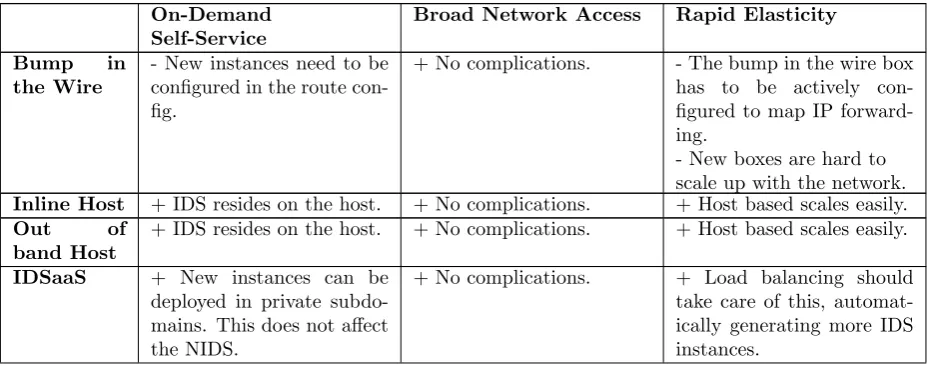
4. Sections5.2and5.3describe each method along with key pros and cons. A full enumeration of pros and cons is displayed in tables5.1,5.2and5.3. Within these tables entries annotated with a plus sign are pros, entries with a minus sign are cons and entries with a plus-minus sign are minor pros, cons or conditional statements. Based on these findings we will conduct an extensive review that allows us to compare the methods and decide on a theoretically best method. Hence, we will conclude this chapter with a quantitative review of the best choices based on what is required from a public cloud NIDS.
5.2
Conceptual Approaches
This section covers conceptual approaches that could be used to implement NIDS on different architectural levels as opposed to a traditional on premises setting. The methods are intuitive and not abstracted from literature on cloud IDSs.
5.2.1
Bump in the Wire
CHAPTER 5. THEORETICAL ANALYSIS OF CLOUD NIDS METHODS
Main Pros
1. Suitable for the pay-per-use model
Main Cons
1. Requires network/route reconfigurations
2. Single point of failure
3. Does not scale with the network
5.2.2
Host based network intrusion detection
NIDS sensors are traditionally deployed in network switches or hubs. Since there is no direct access to the network and infrastructure for consumers in public clouds, an alternative would be to deploy NIDS functionality on every host in the network. Since the end user utilises decrypted data and is not part of an encrypted tunnel, this method could compensate for the encryption challenge that NIDS usually faces.
Main Pros
1. Distributed
2. IDS scales with the environment
3. Easy to deploy
Main Cons
1. CPU intensive process on every host
2. Cannot easily correlate data from different servers
5.2.3
Host based network traffic replication
This method is similar to the one above. NIDS functionality would once again be performed on the end-host. However, this time the end-host forwards the data to another dedicated IDS host. Depending on the implementation, these IDS hosts could be rolled out dynamically, creating a scalable structure.
Main Pros
1. Distributed
2. IDS scales with the environment
Main Cons
1. Increase in network traffic
2. Requires secure tunnels or a dedicated environment to transmit packet captures
5.3
State of the Art Approaches
CHAPTER 5. THEORETICAL ANALYSIS OF CLOUD NIDS METHODS
5.3.1
IDSaaS
Intrusion Detection System as a Service [2] in public clouds is one of the concepts that covers the goal of this thesis. The method provides a highly elastic method for cloud consumers to deploy IDS capabilities in their public cloud environment. This is accomplished by employing the private networking capabilities that public cloud IaaS providers often offer. In this particular case, the research aimed at a construction tailored for Amazon’s AWS. The researchers deployed a Virtual Private Cloud (VPC) on top of their AWS public cloud infrastructure. Within this cloud a public and a private subnet were created. All inbound traffic flows through the internet gateway into the public subnet. The public subnet consists of a dynamic amount of identical IDS servers, which are controlled by the IDSaaS manager. The manager service is used as access point to configure other VMs in both public an private subnets. A load balancer makes sure the inbound traffic is distributed over multiple IDS servers. Only if the traffic is clear, it is forwarded to its destination in the private subnet. In the public subnet the consumers protected property, such as web and database servers, is stationed. Any outbound traffic from the private subnet is then routed through network address translation (NAT). The security is enhanced by deploying security groups for each deployed instance in the VPC. In a sense this method is a variant of the bump in the wire concept mentioned in section 5.2.1. However, the method has its own dedicated environment that does not require alteration of the existing network.
Main Pros
1. Dynamic/Elastic amount of instances/compute power
2. Uses native services that (all) major CSPs offer
3. Easy to deploy and configure
4. Complies with pay-per-use
Main Cons
1. IDS functions on the network boundary
2. Does not function in a distributed environment
3. Requires redesign of the overall network architecture
5.3.2
Nested Virtualization
CHAPTER 5. THEORETICAL ANALYSIS OF CLOUD NIDS METHODS
5.3.3
Cloud based Intrusion Detection Service (CBIDS)
Cloud based Intrusion Detection Service (CBIDS) [48] is a framework that can be deployed as a service. It employs a user data collector (UDC) that is integrated in the client’s cloud as an independent secured proxy-server. The UDC collects data via virtual SPAN ports in virtual switches that connect to end-host virtual machines. Only the mirror ports from virtual switches are allowed to access the proxy. The UDC then tunnels the data over a secure VPN connection to the Cloud IDS. In the separate Cloud IDS a service component is in charge of analysing and validating inbound traffic to find external intrusions before deciding to forward it to the actual IDS component or to delete it. This method might be interesting, because the externally hosted cloud IDS might as well be hosted by the consumer or a third party of their choice.
Main Pros
1. The Cloud IDS can be hosted on premises
2. Detection works similar to on premises
Main Cons
1. Lots of traffic replication
2. Proxy-bottleneck
3. Nested virtualization needed
5.3.4
Cloud Intrusion Detection System Service (CIDSS)
CIDSS [50] is designed around the software as a service model for cloud users. It consists of multiple lightweight IDS agents that are deployed in the user’s network. These agents are grouped based on rulesets and thresholds to improve efficiency and protection flexibility. The data can then be collected, for example by virtual taps, as in the CBIDS paper [48]. The group based structure can provide flexibility to support high bandwidth networks. Furthermore, smart packet filtering is applied to reduce the workload of the underlying service components, allowing near real-time intrusion detection.
Main Pros
1. Agent Grouping to distribute load
2. IDS service works across different network segments
Main Cons
1. Complex for large infrastructure
2. Lack of Scalability
3. Nested virtualization needed
5.3.5
Distributed IDS with Mobile Agents
CHAPTER 5. THEORETICAL ANALYSIS OF CLOUD NIDS METHODS
deploys these mobile agents to aforementioned agencies. The mobile agents collect, correlate and carry the information back to the control center. The control center will perform intrusion matching to generate alarms. Subsequently, it will store new or updated intrusion data in its database. The peer-to-peer aspect creates an IDS environment that covers multiple subnets. Furthermore, the agents promote a symmetrical distribution of the network load and allow for more attack resistibility, as there is no single point of failure within the IDS. Another important aspect is that the system is highly scalable and can easily be relocated between cloud environments.
Main Pros
1. Scalable
2. Sandboxed IDS environment
3. Application specific detection (limiting required computation power)
4. Peer-to-peer model to connect IDSs between subnets
Main Cons
1. No central IDS learning or knowledge
2. Intensive process on every host
3. Heartbeats can be spoofed
5.3.6
NICE
NICE [8] is a multiphase distributed NIDS and NIPS (prevention) framework which was designed for a XEN virtualization environment. Its aim is to capture and inspect cloud traffic that is suspicious. NICE incorporates software switches to quarantine suspicious VMs. It accomplishes this by deploying a NICE-A IDS engine in Dom0 (CSP Reliant) or DomU of each cloud server. Since this research is dedicated to finding a public cloud solution, the Dom0 aspect will be taken out. For the DomU, the engine will sniff a mirroring port on each virtual bridge in the Open vSwitch (a multilayer virtual switch). The IDS capabilities of NICE-A rely on the IDS engine. Furthermore, NICE uses attack graphs [39] to detect and prevent attacks by correlating attack behaviour. Lastly, NICE includes implementation optimisation to minimise resource consumption in comparison to other proxy based NIDS. These features are desirable for a fully consumer reliant NIDS.
Main Pros
1. Minimized resource consumption
2. Distributed
Main Cons
1. Dependant on underlying infrastructure
2. Full implementation requires Dom0 access
3. Benign CSP assumed
CHAPTER 5. THEORETICAL ANALYSIS OF CLOUD NIDS METHODS
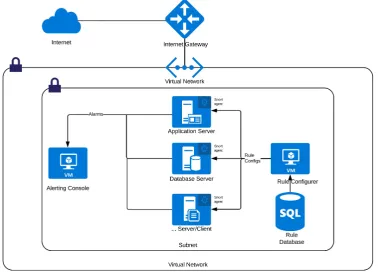
console where an analyst can review the alarms. Furthermore, it is possible to correlate the alarms to detect distributed attacks. Note that this is not the same as correlating events between different hosts. The diagram in figure5.1shows what an implementation of the above would look like.
Figure 5.1: Inline Host NIDS
Out of Band
In contrast to the inline variant, the out of band version of this implementation has a central IDS host where all forwarded data is correlated. On every host a packet dump agent is deployed. These packet dumps are forwarded through secure tunnels, so the IDS VM is able to discriminate between different machines. If not, the engine would be vulnerable to spoofed packets. Replicating all the data at the host entails that the IDS does not scale with the environment. Therefore, we place a load balancer before the IDS instance. Consequently, the IDS capabilities can be scaled up or down with the amount of traffic flowing through the balancer. The diagram in figure5.2
shows what an implementation of the above would look like.
5.5.2
Comparison
CHAPTER 5. THEORETICAL ANALYSIS OF CLOUD NIDS METHODS
Figure 5.2: Out of band Host NIDS
running an entire IDS agent can consume quite some resources. The main counter-argument for a solution that consumes resources of production systems is that it might impede the processes that run on that particular host. However, we feel like this can be countered quite easily by assigning a limited amount of resources to the IDS agent. Additionally, out of band configurations require additional instances that need to be deployed for the IDS host. Evidently, this will introduce costs as the IDS does not automatically scale with the introduction of new hosts. The above findings have been documented in table 5.5. When comparing the implementations designs, taking into account our comparison, we find that inline host based NIDS is the most promising solution for a consumer deployable NIDS for public clouds.
Table 5.5: Inline and Out of Band Comparison
Inline Out of Band
CPU Load High Low
Network Load Minimal High
Correlation Only on alarms and within one host Correlation possible on all data
Deployment Easy
Tunnels between all hosts and the load balances; a lot of network interfaces required
Costs Only one machine for alerting and
configuring
CHAPTER 5. THEORETICAL ANALYSIS OF CLOUD NIDS METHODS
5.6
Conclusion
Chapter 6
Implementation
In the previous chapter we identified that a host based solution would be the best option to accom-plish a public cloud NIDS. Two host based solutions complied with the qualitative requirements from section4.6; inline and out of band. After we constructed implementation schemes for both these methods, we found that the inline variant looks most promising.
6.1
Introduction
While answering the previous research question, we managed to pin down the qualitative require-ments of public cloud network intrusion detection. However, the true performance of such a NIDS has yet to be tested. In this section we will implement the inline host based solution and test it based on the quantitative requirements defined in section4.6:
1. How many packets per second can the NIDS process before dropping security capabilities (e.g., in the form of dropping packets)?
2. How much latency does the NIDS introduce under normal and stressed behaviour?
3. How much impact does the IDS process have on the (other) host(s) in the network?
6.2
Methodology
The aim of our testing methodology is to quantify and test the performance of the NIDS. To accomplish this, we set up a test environment. As platform for the public cloud NIDS implement-ation, Microsoft’s Azure was used. The choice of platform was arbitrary, as our comparison in section 2.1.4showed that there was very little difference between the popular CSPs. Especially regarding the functionality used within our solution. The host based NIDS does not require any special features and is designed to work in any public cloud setting.
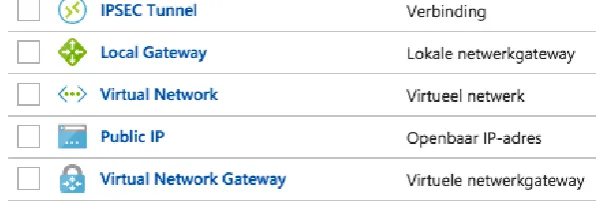
On our Azure platform we created an IPSEC tunnel between our local firewall and the Azure gateway. Within the Azure platform we created a virtual network in which a subnet was placed. The subnet has a virtual gateway with a public IP to be resolved through the IPSEC tunnel, so we can remotely access hosts within that subnet (figure6.1).
CHAPTER 6. IMPLEMENTATION
Figure 6.1: Network Setup
be allocated for larger consumers. Secondly, there is no necessity to run large CPU and network extensive programs, because CPU load can be simulated and the amount of network traffic is proportional with the analysis component. Meaning, if on a relatively quiet host our IDS solution will use 20% of the total CPU, it will need a similar percentage on a large system (that system just requires more resources).
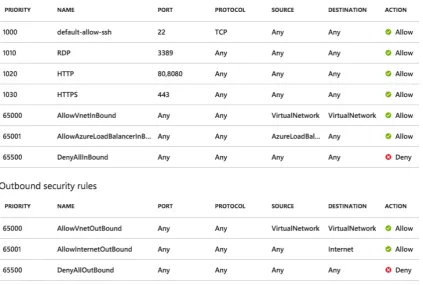
The reason we chose for a minimum of two cores, is that we can bind our IDS agent to a single core, where it will take priority over regular processes. This way, other processes running on the server can consume resources of this core when our agent does not require them, but not the other way around. Functioning and workload of the IDS will differ per system, but they will remain proportional for similar systems of different sizes. Both servers share the same security group. For simplicity we have enabled some standard protocols to access the hosts remotely (figure6.3). This does not serve security issues for our research, as the IPSEC tunnel disallows external connections. Full specifications of the hardware and software can be found in appendixA.
The virtual server hosting the IDS solution runs a Snort [31] agent as detector. Snort is configured to log alerts as unified2, which is much faster compared to, for example, ASCII format. To increase performance and efficiency, we have also deployed Barnyard2 [15], which writes unified2 logs to a mysql database as a separate process, allowing the IDS agent to fully focus on processing network traffic. For our experiment, we installed the default Snort image with all default Talos [45], Emerging Threat [13] and Community rules enabled. We disabled the checksum verification, as this collided with the bigFlows datastream, generating a lot of alarms. By tuning the ruleset and defining analysis components that are relevant for the environment, the consumer could easily double the performance of the agent.
CHAPTER 6. IMPLEMENTATION
Figure 6.3: Security Rules
6.3
Experiment
As described at the beginning of this chapter, our experiment should verify whether our public cloud NIDS solution functions conform performance requirements. Therefore we will test the latency the agent introduces, its security performance, and the impact it has on the (other) host(s).
The network connection to the server is tested with iPerf [27]. To find the limitations of our server we consecutively sent 100 Mbps of TCP and UDP traffic over the interface for 10 seconds. The maximum throughput averaged at 61Mbps of UDP traffic and 52Mbps of TCP traffic. This means that testing with transmissions rates that exceed roughly 50Mbps, the interface will start dropping, rather than our IDS solution.
All three experiments require us to stress the host with different streams of data. For our experiment we will use a clean - malware free - dataset1 that will be ran through both servers. The dataset is sent over the server’s interface with Appneta’s tcpreplay [14], which is running software from the University of California, Berkeley and the Lawrence Berkeley Laboratory.
The dataset contains five minutes of realtime data on a busy private network (averaging at 9Mbps), which provides a proper benchmark for a single host. Note that this is data flowing over an entire private network with multiple servers and clients. In our implementation all these servers would only have to perform intrusion detection on the data that flows over their interfaces. However, to stress our system we feed the entire dataset to our server’s interface.
CHAPTER 6. IMPLEMENTATION
6.3.1
Latency Experiment
In this experiment we test how much latency the NIDS introduces under normal and stressed behaviour. The purpose of this experiment is to test how the IDS performs under certain loads. We accomplish this by passing different loads of network traffic over the network to our IDS server. Then, we record the mean latency and the corresponding standard deviation for each test. The idea of this test is to stress test the performance of the IDS with high network performance while maintaining low latency.
6.3.2
Security Experiment
The second experiment is dedicated to finding out how many packets per second the NIDS can process before significantly dropping security capabilities (e.g., in the form of dropping packets). An important aspect of an IDS is that it actually tries to match all traffic for malicious content. If the IDS agent is unable to analyse all packets properly, it will be unreliable. As described in section
6.2, we installed an untuned agent to test the lower bound security performance of our system. To test the default capabilities we run traffic over the monitored interface. This experiment was conducted in a similar manner as the latency experiment (section 6.3.1). First, traffic was sent over the interface in a realtime manner. After this we will increase the transfer rates relative to the initial throughput. We will keep increasing the rate until a substantial amount (10% or more) of packet drops occurs. Note that packet drops is not the same as actual network packet loss (of which you should never want more than 1%). The packet drops we measure in this experiment are packets that are dropped by the NIDS agent, not by the network interface card (NIC). This can occur either because its packet buffer is full or because it cannot process the packet for any other reason (discarding the packet). Meanwhile, the packets are still going over the interface and reaching their actual destination.
6.3.3
Impact Experiment
In this final experiment, we test the impact of the NIDS process on the (other) host(s). In an arbitrary network it is vital that an IDS does not affect other hosts in the network in a significantly negative way. However, this requirement is not applicable in our setup as every server will have its own internal IDS agent. The only way our host could impact the performance of another host is if it would somehow introduce a significant amount of latency. However, this is already being covered in the latency experiment.
Every server has its own IDS agent, which is not allowed to disrupt other processes that run on that particular server. This is accomplished by binding the agent to a single core. All other processes run on another or multiple other cores. However, when there is little traffic over the interface, other processes can consume CPU power from the agent’s core, never the other way around. This was accomplished with the cpulimit package [44].
6.4
Results
This section will contain results of the experiment. As with the methodology, we have split up the results into their corresponding subsections. First, we will display the latency related experiment, followed by the security and impact experiments.
6.4.1
Latency Results
CHAPTER 6. IMPLEMENTATION
card. During the second test we sent traffic out over the interface at a steady rate. The results of both test are displayed in table6.1. The columns indicated with (r) show the latency when data was sent out at realtime speed. Columns with (s) show the latency when the data was put onto the interface at a static rate. The last two columns show the difference in latency between the server with the IDS agent (NIDS) and the regular server (Reg).
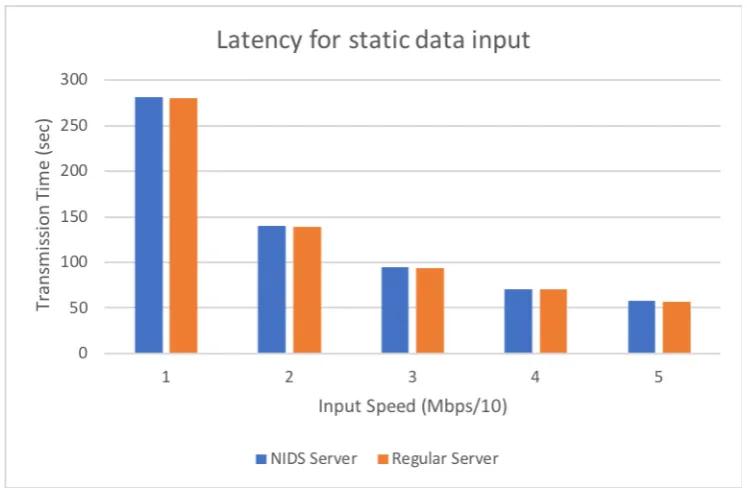
Figure 6.4 shows the total latency of sending the bigFlow packet capture over the interface. The first column shows the latency when data is replayed at its original speed. The latter columns multiply that speed relative to the original transmission rates. The rates have been increased until the interfaces started dropping. From that moment, measuring latency is nonsensical. Figure6.5
is constructed similarly. The discrepancy being that the data is sent out at static rates, which can be found on the x-axis. Error bars have been left out of the graphic, as the error was too small to visualise (table6.2). Lastly, we have mapped the differences in latency between the NIDS server and the regular server in figure6.6. A positive difference means the regular server was faster than the NIDS server. In this figure, we see that in every experiment run the latency in our NIDS server was a higher than the regular server. There was a single exception in the 40Mbps run, where the differences between the means indicate that the NIDS server managed to perform 0.02 seconds faster.
Table 6.1: Results Latency Experiment
Mean NIDS (r) Mean Reg (r) Mean NIDS (s) Mean Reg (s) Diff (r) Diff (s)
307.5 306.54 281.74 279.8 0.96 1.94 156.19 155.09 140.51 138.58 1.10 1.93 104.93 103.94 94.62 93.95 0.99 0.66 78.87 78.67 70.62 70.64 0.19 -0.02
65.05 63.22 57.41 57.28 1.82 0.13
Table 6.2: Standard Deviation Latency Experiment
Stdev NIDS (r) Stdev Reg (r) Stdev NIDS (s) Stdev Reg (s)
0.97 0.68 0.91 1.35
0.72 0.53 0.07 0.22
0.37 0.36 0.33 0.25
0.25 0.28 0.38 0.32
CHAPTER 6. IMPLEMENTATION
Figure 6.4: Results Realtime Latency Experiment
CHAPTER 6. IMPLEMENTATION
Figure 6.6: Difference in Latency
6.4.2
Security Results
In the security experiment we kept increasing the transfer rates of the bigFlow packet capture. For every test, we replayed the capture three times to check for unexpected outliers. For each of these runs, we calculated the mean percentage of packet drops as well as the corresponding standard deviation. The results of the experiment are displayed in table 6.3 and visualised in figure 6.7. When we increased the transmission rate to five times the original speed, the packet loss grew over 18%, at which point the NIDS was deemed significantly unreliable.
Table 6.3: Mean and Standard Deviation of Packet Drops
PPS Mean Pktdrop% Stdev Pktdrop%
CHAPTER 6. IMPLEMENTATION
Figure 6.7: Results Security Experiment
6.4.3
Impact Results
As discussed previously, impact comes in two forms. Firstly, we find impact on other hosts, when our NIDS agent would impede on other hosts in the network. This could happen when our IDS server introduces a significant amount of latency. We will not discuss latency any further, as this was already covered in the latency experiment above.
In addition to impediment on other hosts, the NIDS agent running on our NIDS server can also hinder other processes running on the server itself. In our implementation we already assured that the IDS agent cannot occupy more than one CPU core, so the other native services have at least one or more cores to run on. However, CPU power on the NIDS server could very well be used by another process, when our NIDS agent suddenly requires it. This will affect that process at that time.
Table6.4shows the results of this experiment. During the experiment a few outliers occurred, where the CPU suddenly read 0%. This behaviour is defined as erroneous as the machine was working continuously. We expect this to be a tooling error. Therefore these outliers were removed. The first row of table6.4shows a typical heavy load for a private network. The network throughput is then increased by a factor two every next run. At the fifth run we observed a mean CPU usage of 93.37%, hitting 100% CPU for over a third of the run. At this point the NIDS agent could not obstruct any more processes as it had reached its limitations.
Table 6.4: Mean and Standard Deviation of CPU Percentages
Mean Stdev
CHAPTER 6. IMPLEMENTATION
Figure 6.8: Result Impact Experiment
6.5
Analysis
In this section we analyse the results of our experiment. This is done in the same manner as before; each experiment will have an associated analysis section.
6.5.1
Latency Analysis
Across the two experiments, the regular server was faster than the server that hosted our NIDS agent in almost every run. Nevertheless these differences are rather small. The largest difference was measured at 1.94 seconds, while across all experiments the additional latency averages at 0.97 second. Except for the run at five times realtime speed, all the experiments stay within an additional latency of 1%. Each of these runs contained 791615 packets (355417784 bytes), indicating an average additional latency of 0.97sec/791615pkts= 1.22534µs/pkt. Since a network, especially one with shared resources, is susceptible to a lot of external factors the additional latency of 1% is ought to be negligible.
6.5.2
Security Analysis
CHAPTER 6. IMPLEMENTATION
6.5.3
Impact Analysis
When observing figure 6.8, we find a linear relationship between the data throughput and the CPU usage of our IDS agent. Evidently, the available resources for other processes have a reversed relation. Once again the impact on resources using CPU cycles could be decreased with similar solutions as the ones suggested in our security analysis.
6.6
Conclusion
In this chapter we answered our last research question: How does the theoretically most promising method perform in a heuristic experiment, taking all requirements into account?
Most importantly, we wanted to verify that our solution is feasible in terms of performance. This was accomplished with a ternary of experiments. First, we tested additional latency that our IDS solution introduces. From a series of tests this turned out to be 1% additional latency on average. Even though this is a small amount of additional latency, it was observed in almost every test that the NIDS server was indeed processing packets marginally slower.
Secondly, we tested the security capabilities of our solution by transmitting high dataloads over the server’s network interfaces. The minimal solution endured properly for an adequate load. It must be noted that for a minimal solution, high loads can cause our NIDS agent to discard packets when its queue is full.
Lastly, we tested the relation between load and impact on the host. This is a linear relationship, which proves to be feasible for a small server. Servers that process large loads of data, will require additional resources. However, due to the limitation of the IDS process, the impact on other processes (which is probably the core business) will remain negligible.
Furthermore, we shortly want to touch on the other requirements of chapter4. We have shown that from a theoretical perspective, our method meets all these requirements. However, we have not touched on whether or not our minimal solution meets the requirements as well.
1. The NIDS should monitor newly configured instances. As long as newly configured instances (automatically) also run the installation process of our IDS agent, this requirement should be met. It would even be possible to predefine machine images that already have the agen