Proceedings of the 27th International Conference on Computational Linguistics, pages 1508–1520 1508
Cross-lingual Knowledge Projection
Using Machine Translation and Target-side Knowledge Base Completion
Naoki Otani∗
Carnegie Mellon University
Hirokazu Kiyomaru
Kyoto University
Daisuke Kawahara
Kyoto University
Sadao Kurohashi
Kyoto University
Abstract
Considerable effort has been devoted to building commonsense knowledge bases. However, they are not available in many languages because the construction of KBs is expensive. To bridge the gap between languages, this paper addresses the problem of projecting the knowledge in English, a resource-rich language, into other languages, where the main challenge lies in projection ambi-guity. This ambiguity is partially solved by machine translation and target-side knowledge base completion, but neither of them is adequately reliable by itself. We show their combination can project English commonsense knowledge into Japanese and Chinese with high precision. Our method also achieves a top-10 accuracy of 90% on the crowdsourced English–Japanese bench-mark. Furthermore, we use our method to obtain 18,747 facts of accurate Japanese commonsense within a very short period.
1 Introduction
Commonsense has been considered to play a vital role in language understanding (LoBue and Yates, 2011), and considerable effort has been devoted to building knowledge bases (KBs) that organize com-monsense (Zang et al., 2013). The largest multi-lingual comcom-monsense KB is ConceptNet (Liu and Singh, 2004b). ConceptNet maintains knowledge as a triple of two concepts and relationship between them, which we callfact. The characteristic of ConceptNet is that concepts are represented in undisambiguated forms of words or phrases, which facilitates commonsense acquisition and inference in practice (Liu and Singh, 2004a) and recently has proven useful for building word representations (Speer et al., 2017; Camacho-Collados et al., 2017). We target ConceptNet in this paper.
A major problem lies in a large gap of quantity and quality between languages. The latest release (v5.5.0) of ConceptNet has 2,828,394 unique English facts1, but the number of Japanese facts in Con-ceptNet is only 69,902 (≈ 2.5%) even though Japanese knowledge takes up the eighth-largest portion of the database. This problem is not specific to ConceptNet. English KBs are typically larger and of higher quality than other languages. Although an adequate amount of knowledge of named entities is often available in many languages thanks to semi-structured text on the web such as Wikipedia in-fobox (Lehmann et al., 2014), commonsense is hard to obtain due to the lack of tractable and objective information (Gordon and Van Durme, 2013).
It is not realistic to develop large knowledge resources in every language from scratch because of cost constraints. Instead, this paper focuses on cross-lingual knowledge projection. We translate English commonsense facts into a target language, aiming to gain large commonsense resources in the target language efficiently.
The main challenge is projection ambiguity. For example, consider translating (bat, CapableOf, fly) shown in Figure 1. Bat has four Japanese translations such as koumori [bat (animal)] and batto [bat (stick)]. Fly has 27 translations such as tobu [fly (verb)] and hae [fly (insect)]. Thus, (bat, Capa-bleOf, fly) results in4×27 = 108Japanese translation candidates in total, and even after filtering them This work is licensed under a Creative Commons Attribution 4.0 International License. License details: http:// creativecommons.org/licenses/by/4.0/
∗
This work was conducted while the first author was at Kyoto University.
Relation e1 e2 English Japanese Chinese
AtLocation NP NP You are likely to finde1ine2. e2dee1wo miru koto ga aru. Ni keyi zaie2zhaodaoe1.
CapableOf NP VP e1cane2 e1wae2koto ga dekiru . e1huie1.
MadeOf NP NP e1is made ofe2. e1wae2kara tsukurareru. e1keyi yonge2zhi cheng.
UsedFor NP VP You can usee1toe2. e1wae2tame ni tsukawareru. e2 de shihou keneng hui
yong daoe1.
Table 1: Examples of templates for converting facts into sentences. Constraints of part-of-speech on e1 and e2 (Speer and Havasi, 2012) are also presented. Some templates were developed by the
ConceptNet organizers. The rest of the templates can be found in the released code.
knowledge projection.
Klein et al. (2017) and Chen et al. (2017) represented concepts in multiple languages in a unified vector space, and built knowledge base completion models based on vector representations. Their methods ensure a concept in the source language has a similar vector representation to its target-side counterpart, assuming each concept in the source language corresponds to exactly one concept in the target language. There is a rich body of work on sense embedding, which allows one surface form of a word to have sense-specific vectors (Neelakantan et al., 2014; Iacobacci et al., 2015). However, to the best of our knowledge, previous studies in this field do not target sense vectors of concepts for cross-lingual knowl-edge projection.
Several studies proposed methods for one-to-one projection of facts (Kuo and Hsu, 2010; Feng et al., 2016). The work by Feng et al. (2016) is the most related to our study. Their model learns mappings between English and Chinese facts by manually annotated alignments. Their experimental result showed the model successfully resolved the projection ambiguity. Their experiment was, however, limited to a narrow domain due to the cost of manual annotations, indicating the difficulty of obtaining sufficient resources for learning a model.
Various types of commonsense is vital to understanding languages in a wide range of tasks such as recognizing textual entailment (LoBue and Yates, 2011). Researchers have compiled resources to maintain such knowledge. Cyc (Lenat, 1995) is a seminal big project that aims to organize commonsense in logical forms. Logical forms are suitable for disambiguating the meaning of language, but we need high expertise to acquire or utilize them. In contrast, ConceptNet (Liu and Singh, 2004b; Speer et al., 2017) adopted natural language expressions such as words and phrases that may have ambiguities to represent knowledge, which made it possible to collect millions of commonsense facts in multiple languages via crowdsourcing.
3 Problem Setting
Suppose we project a factfsin a source language into a target language. We obtainncandidate trans-lations by following inter-language links. In ConceptNet, the links are built from data sources such as Wiktionary and WordNet. We denote these candidates asft
1,· · ·, fnt.
Our goal is to estimate a projection scoreh(fit|fs), and find the most appropriate target-side fact that maximizes the score.
ˆ
ft= argmax
ft i
h(fit|fs) (1)
4 Method
We propose two methods to combine MT and target-side KBC models for estimating projection scores.
4.1 Machine Translation (MT)
= 𝑃 koumori A bat ⋯ . × 𝑃 wa koumori, A bat ⋯ . × ⋯ × 𝑃 . dekiru, ⋯ , koumori, A bat ⋯ .
1 7
𝑥𝑀𝑇 𝑘𝑜𝑢𝑚𝑜𝑟𝑖,CapableOf, tobu | bat,CapableOf,fly
= 𝑃 koumori wa tobu koto ga dekiru . | A bat can fly .
1 7 𝒆𝟏wa𝒆𝟐koto ga dekiru . 𝒆𝟏can𝒆𝟐.
Figure 2: Calculating a translation probability of a fact using an MT model. For simplicity, this example does not use subword units. In addition, we omit special symbols that represent the beginning and end of a sentence in this figure.
mita.” [I saw a bat (animal) in the zoo.] than to “doubutsuen de batto wo mita.” [I saw a bat (stick) in the zoo.]
In contrast to our problem, typical MT focuses on plain texts, and only unstructured parallel texts are normally available for training MT models. Thus, we convert facts into natural language expressions be-forehand. We use a rule-based approach to generate an expression for each fact, for example, “e1cane2”
corresponding to (e1,CapableOf,e2). Fortunately, some facts in ConceptNet already have such language
expressions (Speer and Havasi, 2012). For the rest of the facts, we develop simple templates based on the existing expressions. Table 1 shows examples of templates in English, Japanese and Chinese.3 We refer to part-of-speech tags of concepts to generate natural-sounding sentences.
Using sentences of facts, we define a score from the MT model as a translation probability of the language expression normalized by the target-side lengthm.
xMT(ft|fs) = P(Wt|Ws) 1/m
, (2)
whereWtandWsare sentences offtandfs, respectively. To define P(Wt|Ws), we employ an off-the-shelf sequence-to-sequence model with an attention mechanism (Bahdanau et al., 2014), which is one of the recent successful MT models.
Figure 2 illustrates the translation probability of a Japanese fact (koumori,CapableOf, tobu) given an English fact (bat,CapableOf, fly). We first obtain language expressions of the facts using hand-crafted templates and compute a translation probability with the translation model.
4.2 Knowledge Base Completion (KBC)
KBC models evaluate the plausibility of a given fact based on existing information on the KB. For example, if we already know many animals with wings can fly and bats have wings, we can imagine that bats also can fly. We train a KBC model on the target-side KB.
We use a bilinear model used in several previous studies (e.g., (Li et al., 2016)) as a component of our model, where concepts and relations are represented as vectors and matrices, respectively. This component can also be replaced with other KBC models.4
Given a factft= (e1, r, e2), the bilinear model outputs the value of plausibility as follows.
xKBC(ft) =σ(uT1Mru2), (3)
where σ is a sigmoid function, ui ∈ Rd (i = 1,2) corresponds to vectors of concepts e1 and e2,
Mr ∈ Rd×d corresponds to a matrix of relationr, and dis a hyper parameter. We construct concept
vectors by averaging pre-trainedd0-dimensional word embeddings as several previous studies did to boost the predictive performance (Socher et al., 2013; Li et al., 2016). The following nonlinear transformation reduces the dimensionality for computational efficiency.
ui =tanh(W vi+b), (4)
3
We provide the templates in the released code.
wherevi ∈Rd 0
(i= 1,2)is a pre-trained concept vector, andW ∈Rd×d0
is a weight,b∈Rd(d < d0)
is a bias term. The model parameters are learned to minimize a cross-entropy function on training facts.
4.3 Combination of Scores
We combine the two scores explained above to generate a score for each pair offt
i andfs. Our model
htakesx(fit|fs) = xKBC(fit), xMT(fit|fs)
as an input (for simplicity, we omitfitandfs, hereafter), and calculates a projection score, wherexKBCandxMTare normalized before calculation.
We first describe two options forh(x), (1) a linear transformation and (2) a multi-layer perceptron, and next explain the inference procedure of parameters below.
Linear Transformation: First, alinear transformation(LIN) model combinesxKBCandxMTlinearly. The model has a different weight vector and a bias term for each relation because the accuracy of KBC and MT varies for different relation types.
h(x) =wTrx+br wr ∈R2, br∈R. (5)
Multi-layer Perceptron:LIN is a very simple model and may cause underfitting. Thus, we introduce a multi-layer perceptron(MLP) model with one hidden layer to increase the model capacity. The model has an input layer, one hidden layer, and an output layer. MLP calculatesh(x)by the equation below.
h(x) =w(2)r Tz(x) +b(2)r (6)
z(x) =tanh
W(1)Tx+b(1)
(7)
W(1) ∈R2×c,b(1)∈Rc,wr(2)∈Rc, b(2)r ∈R.
Note that the common weight matrix and bias are used across relations in Equation (7) in order to capture the global intermediate representations of projections.
Inference: Given training instances of fact-to-fact projection, we estimate the model parameters that compute high scores to correct translations and low scores to incorrect translations. The training data consists of a correct translation set T+ and an incorrect translation setT−. T−(x+) denotes a set of
incorrect translations that have the same English fact asx+∈T+.
For eachx+ ∈T+, we define the following margin-based loss function.
loss(x+) =max(0,1 +h(x+)−h(x−)), (8)
wherex−is randomly extracted fromT−(x+). We sum this loss function overT+, and obtain the model
parametersΘby minimizing the summed loss function.
ˆ
Θ = argmin Θ
X
x+∈T+
loss(x+) (9)
5 Experiments
We conducted two experiments to compare our method with baseline methods.
5.1 Data
We use automatically and manually constructed datasets for evaluating knowledge projection methods. Throughout the experiments, facts are obtained from ConceptNet version 5.5.0.5
5.1.1 Automatically Built Datasets
The first experiment used semi-automatically built datasets of English–Japanese and English-Chinese projection. We call these AUTO datasets. The English–Japanese AUTO dataset was constructed in three steps:
Fact (unique) Translation Language ft fs T+ T−
En→Ja 22,508 2,767,450 33,724 5,612,716 En→Zh 2,294 11,648 2,861 12,348
(a) AUTO
Fact (unique) Translation
ft fs T+ T−
13194 200 832 12,365
(b) MANUAL (En→Ja)
Table 2:Statistics of dataset.
1. We translated each English factfsinto Japanese factsf1t, f2t,· · · with inter-language links in Con-ceptNet. Those that violated part of speech constraints (Speer and Havasi, 2012) were discarded. 2. If a translated factfitalready existed in Japanese ConceptNet, we considered the pair of the English
and Japanese facts to be a positive projection,i.e.,(fs, fit)∈T+. Otherwise, we include the pair in
a set of negative projectionT−.
3. The previous step resulted in millions of obvious negative projection, which is often directed to rare Japanese words. To reduce such projection, we counted co-occurrences of all pairs of concepts in 200 million Japanese web sentences and discarded Japanese facts whose concepts do not occur together.
We applied the same procedure to Chinese facts, where we used the Chinese Gigaword Fifth Edition6 in step 3. The size of the AUTO dataset is reported in Table 2(a). The English–Japanese dataset is larger than the English–Chinese dataset because the number of English–Japanese inter-language links in ConceptNet is four times larger than English–Chinese links. We can gain data by harvesting links from lexical resources such as dictionaries and multi-lingual WordNet, which is left as future work.
We conducted five-fold cross validation by splitting the datasets into training (60%), validation (20%) and test (20%) sets.
5.1.2 Manually Built Dataset
The AUTO datasets are large but may not be accurate enough to test methods because the target KBs were small by nature, and many true Japanese facts were not identified as correct projection in step 2. Thus, we next built an accurate but small testing dataset annotated by humans. We call this dataset MANUAL. Due to the cost constraint, this dataset was only built for English–Japanese projection.
We used crowdsourcing to annotate the data. Human workers were gathered in a Japanese crowd-sourcing platform Yahoo! Crowdcrowd-sourcing7.
1. We extracted the 200 most confident English facts based on the scores in ConceptNet. We only used English concepts with fewer than 20 inter-language links.8 In addition, we removed facts containing dirty words.9
2. We projected the English facts into Japanese with inter-language links as we did in step 1 of the AUTO datasets.
3. Crowd workers annotated the Japanese facts with five-level labels: (1) ”false, or does not make sense”, (2) ”true only in a few contexts”, (3) ”true in several contexts”, (4) ”true in many contexts”, and (5) ”true”. Each Japanese fact was judged by five workers.
4. We aggregated the collected judgments by taking median.
The size of the resulting dataset is reported in Table 2(b). An English fact had 66 translations on average. We used this dataset only for evaluation. To conduct this evaluation, we trained our models on the whole AUTO datasets.
6
The LDC catalog number is LDC2011T13.
7http://crowdsourcing.yahoo.co.jp 8
We found a few concepts had extremely many links (e.g.,/c/en/person), and most of the links are inappropriate.
MRR Acc@1 Acc@10
PPMI .183 .081 .406 MT .306 .190 .546 KBC .352 .232 .610 MTransE .185 .097 .372
LIN (EQ) .363† .233 .626†
LIN .363† .230 .633†
MLP .370† .234 .644†
(a) En→Ja
MRR Acc@1 Acc@10
PPMI .667 .466 .980 MT .742 .585 .982 KBC .673 .480 .975 MTransE .762 .626 .976
LIN (EQ) .768 .624 .986 LIN .766 .620 .985 MLP .772 .629 .988†
(b) En→Zh
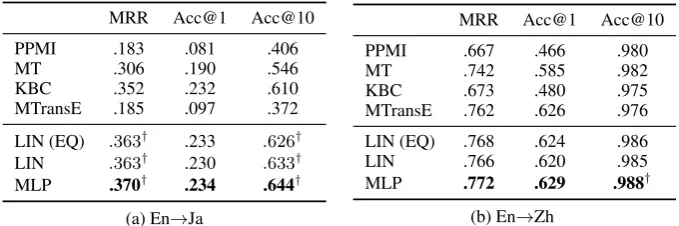
Table 3: Results on the AUTO dataset. † denotes LIN (EQ), LIN and MLP outperformed all the baselines significantly (paired t-test withα= 0.05.)
5.2 Baselines and Proposed Methods
We compare the performance of our proposed methods with the following baselines.
• PPMI:Positive pointwise mutual information of two concepts consisting of a target-side factft. We count the co-occurrence of the concepts in the 200 million web sentences for Japanese, and in the Chinese Gigaword Fifth Edition for Chinese concepts.
• MT:The neural MT model with an attention mechanism, which computes xMT in the proposed methods. We used an implementation by Neubig (2015) and train a model on 3.25M (en-ja) and 2.97M (en-zh) sentence pairs from dictionaries and newswire corpora. BPE (Sennrich et al., 2016) was used to reduce the vocabulary size.
• KBC:The target-side bilinear KBC model which was used as the component to producexKBC. The Japanese and Chinese models were trained on 59,274 and 318,361 facts, respectively.
• MTransE: The multi-lingual translation-based KBC model (Chen et al., 2017) which learns TransE (Bordes et al., 2013) and concept-to-concept alignment jointly. Chen et al. (2017) proposed five different alignment models and reported the fourth variant performed best in their experiments. Thus we use the variant in our experiments.
The proposed methodsLINandMLPuse estimates of MT and KBC models above. We also include
LIN (EQ), a variant of LIN, which equally combines scores from MT and KBC after normalizing each score to a[0,1]-range. We use the Adam optimizer (Kingma and Ba, 2014) for training models. We provide implementation details and hyperparameter settings in the appendix.
5.3 Results
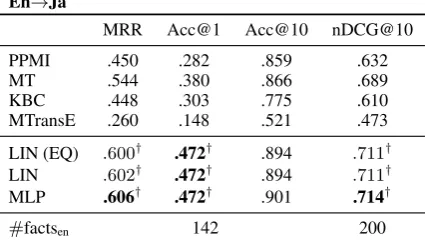
We report mean reciprocal rank (MRR), top-1 and -10 accuracy (Acc@1 and Acc@10) on the test set.10 To calculate these metrics on the MANUAL dataset with five-way labels, we binarized the labels by con-sidering (5) true label as positive and the others as negative because we aim to find the most appropriate projection for each English fact. We removed English facts which only had positive/negative Japanese translations when calculating MRR and accuracy. Besides, we also report nDCG (normalized discounted cumulated gain) using the five-way labels.
5.3.1 AUTO
Table 3 shows MRR, Acc@10 and Acc@1 on the test datasets for English–Japanese and English– Chinese projection. LIN (EQ), LIN and MLP outperformed MT and KBC in most cases, indicating combining them helped find correct translations. LIN (EQ) performed on par with LIN even though LIN (EQ) does not learn combination weights from the training data. This result could be attributed to the limited capacity of a linear model and motivates us to use MLP.
MTransE achieved high precision on the English–Chinese dataset, but failed to yield correct predic-tions on the English–Japanese dataset. The essential difference between the two language pairs is in
En→Ja
MRR Acc@1 Acc@10 nDCG@10
PPMI .450 .282 .859 .632 MT .544 .380 .866 .689 KBC .448 .303 .775 .610 MTransE .260 .148 .521 .473
LIN (EQ) .600† .472† .894 .711†
LIN .602† .472† .894 .711†
MLP .606† .472† .901 .714†
#factsen 142 200
Table 4: Result on the MANUAL dataset. †denotes LIN (EQ), LIN and MLP outperformed all the baselines significantly (paired t-test withα= 0.05.)
Rank Concepts
MLP MT KBC e1 e2 Label
1 6 8 ao [blue] shikisai [color] true
2 9 4 heki [blue] shikisai [color] true
3 2 35 brˆu [blue] shikisai [color] true
(a) (blue, RelatedTo, color)
MLP MT KBC e1 e2 Label
1 5 1 rokku [rock (music)] myˆujikku [music] true
2 9 2 rokku [rock (music)] ongaku [music] true
3 25 5 rokku [rock (music)] fumen [music score] true in several contexts
· · · ·
15 1 49 iwa [rock (stone)] myˆujikku [music] false
(b) (rock, IsA, music)
Table 5:Improved examples. Top ranked projections by MLP are reported with labels and ranks given by MT and KBC.
the degree of the ambiguity, that is, the English–Chinese projection is not as ambiguous as the English– Japanese projection on our dataset because of the lack of English–Chinese links in ConceptNet v5.5.0. This characteristic boosted the performance of MTransE, which assumes one-to-one projection of con-cepts.
We observed the performance of the baselines varied across relations. MT was inaccurate at lexical relations such asAntonymandSynonymbut outperformed KBC onHasFirstSubevent,HasLastSubevent, andUsedFor. MLP outpeformed single MT and KBC for the most of the relations by combining them.
5.3.2 MANUAL
Table 4 shows the result on the MANUAL dataset. The differences between the proposed methods and the baselines are statistically significant except for Acc@10 (paired t-test withα = 0.05.) All the methods resulted in better scores on this dataset than on the AUTO dataset. Although PPMI appears to be accurate, in fact it failed to provide valid scores to 8,894 out of 13,197 examples as the co-occurrences of their concepts were not observed in the corpus. Likewise, the MANUAL dataset had many concepts that were not in the training data for MTransE, which seriously degraded its performance.
7 Conclusion and Future Work
We proposed a method to project knowledge stored in English into other languages. We focused on commonsense knowledge that is required to understand human communications. The main challenge of cross-lingual knowledge projection is the ambiguity of projection. To resolve this ambiguity, our method combines MT and target-side KBC models. Experiments showed the proposed method outperformed baseline methods by large margins consistently. We projected 10,000 English into Japanese and obtained 18,747 accurate facts using our method and crowdsourcing. There are still more than 450,000 English facts with inter-language links to Japanese, and we are planning to project them into Japanese by our proposed method and crowdsourcing refinement. We will release the resulting resources to research communities in order to facilitate research in many languages.
Acknowledgments
We thank anonymous reviewers for their valuable suggestions. This work was partially supported by Yahoo Japan Corporation.
References
Dzmitry Bahdanau, Kyunghyun Cho, and Yoshua Bengio. 2014. Neural machine translation by jointly learning to align and translate. CoRR, abs/1409.0473:1–15.
Francis Bond and Ryan Foster. 2013. Linking and extending an Open Multilingual Wordnet. InProceedings of the 51st Annual Meeting of the Association for Computational Linguistics (ACL), pages 1352–1362, Sofia, Bulgaria. Association for Computational Linguistics.
Antoine Bordes, Nicolas Usunier, Alberto Garcia-Duran, Jason Weston, and Oksana Yakhnenko. 2013. Translat-ing embeddTranslat-ings for modelTranslat-ing multi-relational data. InAdvances in Neural Information Processing Systems 26 (NIPS), pages 2787–2795.
Jose Camacho-Collados, Mohammad Taher Pilehvar, Nigel Collier, and Roberto Navigli. 2017. SemEval-2017 Task 2: Multilingual and Cross-lingual Semantic Word Similarity. InProceedings of the 11th International Workshop on Semantic Evaluation (SemEval), pages 15–26, Vancouver, Canada, August. Association for Com-putational Linguistics.
Muhao Chen, Yingtao Tian, Mohan Yang, and Carlo Zaniolo. 2017. Multi-lingual knowledge graph embeddings for cross-lingual knowledge alignment. InProceedings of the 26th International Joint Conference on Artificial Intelligence (IJCAI), Melbourne, Australia, November.
Xiaocheng Feng, Duyu Tang, Bing Qin, and Ting Liu. 2016. English-chinese knowledge base translation with neural network. InProceedings of the 26th International Conference on Computational Linguistics: (COLING), pages 2935–2944. The COLING 2016 Organizing Committee, December.
Jonathan Gordon and Benjamin Van Durme. 2013. Reporting bias and knowledge acquisition. InProceedings of The 3rd Workshop on Automated Knowledge Base Construction (AKBC). ACM Press, October.
Ignacio Iacobacci, Mohammad Taher Pilehvar, and Roberto Navigli. 2015. SensEmbed: Learning sense embed-dings for word and relational similarity. In Proceedings of the 53rd Annual Meeting of the Association for Computational Linguistics and the 7th International Joint Conference on Natural Language Processing (ACL-IJCNLP), pages 95–105, Beijing, China, July. Association for Computational Linguistics.
Diederik P. Kingma and Jimmy Ba. 2014. Adam: A Method for Stochastic Optimization. CoRR, abs/1412.6, December.
Patrick Klein, Simone Paolo Ponzetto, and Goran Glavaˇs. 2017. Improving neural knowledge base completion with cross-lingual projections. InProceedings of the 15th Conference of the European Chapter of the Associa-tion for ComputaAssocia-tional Linguistics (EACL), pages 516–522. Association for Computational Linguistics, April.
Jens Lehmann, Robert Isele, Max Jakob, Anja Jentzsch, Dimitris Kontokostas, Pablo Mendes, Sebastian Hellmann, Mohamed Morsey, Patrick van Kleef, S¨oren Auer, and Chris Bizer. 2014. DBpedia – A large-scale, multilingual knowledge base extracted from wikipedia. Semantic Web Journal.
Douglas B. Lenat. 1995. Cyc: a large-scale investment in knowledge infrastructure.Communications of the ACM, 38(11):33–38.
Xiang Li, Aynaz Taheri, Lifu Tu, and Kevin Gimpel. 2016. Commonsense knowledge base completion. In
Proceedings of the 54th Annual Meeting of the Association for Computational Linguistics (ACL), pages 1445– 1455, Berlin, Germany, August. Association for Computational Linguistics.
Hugo Liu and Push Singh. 2004a. Commonsense Reasoning in and Over Natural Language. InProceedings of the 8th International Conference on Knowledge-Based Intelligent Information and Engineering Systems (KES), pages 293–306, Wellington, New Zealand. Springer, Berlin, Heidelberg.
Hugo Liu and Push Singh. 2004b. ConceptNet A practical commonsense reasoning tool-kit. BT Technology Journal, 22(4):211–226.
Peter LoBue and Alexander Yates. 2011. Types of Common-Sense Knowledge Needed for Recognizing Textual Entailment. In Proceedings of the 49th Annual Meeting of the Association for Computational Linguistics: Human Language Technologies (ACL-HLT), pages 329–334, Portland, Oregon, USA, June. Association for Computational Linguistics.
Hajime Morita, Daisuke Kawahara, and Sadao Kurohashi. 2015. Morphological analysis for unsegmented lan-guages using recurrent neural network language model. InProceedings of the 2015 Conference on Empirical Methods in Natural Language Processing (EMNLP), pages 2292–2297. Association for Computational Linguis-tics, sep.
Arvind Neelakantan, Jeevan Shankar, Alexandre Passos, and Andrew McCallum. 2014. Efficient non-parametric estimation of multiple embeddings per word in vector space. InProceedings of the 2014 Conference on Empir-ical Methods in Natural Language Processing (EMNLP), pages 1059–1069, Doha, Qatar, October. Association for Computational Linguistics.
Graham Neubig. 2015. lamtram: A toolkit for language and translation modeling using neural networks. http://www.github.com/neubig/lamtram.
Rico Sennrich, Barry Haddow, and Alexandra Birch. 2016. Improving neural machine translation models with monolingual data. InProceedings of the 54th Annual Meeting of the Association for Computational Linguistics (ACL), pages 86–96, Berlin, Germany, August. Association for Computational Linguistics.
Richard Socher, Danqi Chen, Christopher D. Manning, and Andrew Y. Ng. 2013. Reasoning with neural tensor networks for knowledge base completion. InAdvances in Neural Information Processing Systems 26 (NIPS), pages 926–934. Stateline, Nevada, USA.
Robert Speer and Catherine Havasi. 2012. Representing general relational knowledge in ConceptNet 5. In
Proceedings of the Eighth International Conference on Language Resources and Evaluation (LREC), pages 3679–3686, Istanbul, Turkey, May. European Language Resources Association.
Robert Speer, Joshua Chin, and Catherine Havasi. 2017. ConceptNet 5.5: An open multilingual graph of general knowledge. InProceedings of the Thirty-First AAAI Conference on Artificial Intelligence (AAAI), pages 4444– 4451, San Francisco, California, USA, February. AAAI Press.
Masao Utiyama and Hitoshi Isahara. 2003. Reliable measures for aligning japanese-english news articles and sentences. InProceedings of the 41st Annual Meeting of the Association for Computational Linguistics (ACL), pages 72–79, Sapporo, Japan, July. Association for Computational Linguistics.
Quan Wang, Zhendong Mao, Bin Wang, and Li Guo. 2017. Knowledge Graph Embedding: A Survey of Ap-proaches and Applications. IEEE Transactions on Knowledge and Data Engineering, 29(12):2724–2743, De-cember.
A Experimental Setup
In experiments (Section 5), we built the baselines and our combination methods (Section 4) in the fol-lowing procedures. Facts are from ConceptNet version 5.5.0. Japanese words in concepts are normalized using the morphological analyzer JUMAN++ (Morita et al., 2015). We used the Adam (Kingma and Ba, 2014) for training models. Initial learning ratesαare described below.
A.1 MT Model
We built the neural MT model with lamtram (Neubig, 2015). The English–Japanese parallel corpora included 3,253,923 sentence pairs from dictionaries and newswire:
• JEC Basic Sentence Data13
• EDICT14
• Eijiro15
• Tatoeba Project16
• Open Multilingual WordNet (Bond and Foster, 2013)
• JENAAD (Utiyama and Isahara, 2003)
We extracted 2,965,845 English–Chinese sentence pairs from LDC17. We segmented words by byte-pair encoding (BPE) with vocabulary size 8,003 for each language. This vocabulary includes three special symbols indicating the beginning and the end of the sentence, and the out-of-vocabulary word. We trained the BPE model (Sennrich et al., 2016) on the training set with sentencepiece18. Hyper param-eters were tuned based on perplexity on randomly selected 1,000 sentence pairs. The best setting was the encoder/decoder of LSTM with 512 hidden nodes, dropout of rate 0.25, and learning rateα= 0.001
for the both language pairs.
A.2 KBC Model
A bilinear model (Section 4.2) was trained on 59,274 Japanese and 317,161 Chinese facts in ConceptNet. They are already sorted by a confidence score. We excluded facts in the training and evaluation datasets for knowledge projection (Section 5.1.)
Following Li et al. (2016), we define concept vectors by taking an average of predefined word embed-dings. Japanese word embeddings of 256 dimensions were trained on 200 million sentences from the web. Chinese word embeddings of 300 dimensions were obtained from the CoNLL 2016 data.19 We normalized concept vectors using the mean and variance calculated on the training set.
In hyper parameter tuning, the most confident 600 facts were used for evaluation, the second most confident 600 facts were used for early stopping in training, and the remaining facts were used for training. These facts were treated as positive examples, and we generated negative examples by randomly swapping one component of each fact. Once the best parameters were determined, the most confident 600 facts were used for early stopping, and the other facts were used to train a model.
We removed positive examples with out-of-vocabulary (OOV) words from the datasets. Instead, we added facts with a OOV vector as negative examples to the training data because rare words are often incorrect.
We selected dimensionalityd∈ {100,150}, regularization coefficients forMrand the other
parame-tersλ1, λ2 ∈ {0.001,0.0001,0.00001}, learning rateα ∈ {0.1,0.01}, and batch sizeβ ∈200,400,800. 13http://nlp.ist.i.kyoto-u.ac.jp/EN/index.php?JEC\%20Basic\%20Sentence\%20Data 14
http://www.edrdg.org/jmdict/edict.html 15ISBN: 978-4757428126
16https://tatoeba.org 17
The catalog numbers are LDC2002L27, LDC2002T01, LDC2003T17, LDC2004T07, LDC2004T08, LDC2005T10, LDC2005T34, LDC2006T04, LDC2007T02, LDC2012T16, LDC2012T20, and LDC2012T24.
18
https://github.com/google/sentencepiece
19CoNLL 2016 Shared Task Multilingual Shallow Discourse Parsing,
The resulting parameters for the Japanese facts wered= 150,λ1 = 0.00001, λ2 = 0.001, α= 0.1, and
β = 200. Those for the Chinese facts wered= 100,λ1 = 0.001,λ2 = 0.0001,α= 0.1, andβ= 400.
A.3 MTransE
MTransE (Chen et al., 2017) was trained with the implementation provided by Chen et al. (2017). We set batch size 100 to speed up training although the original code adopted online learning (i.e., batch size is 1). We empirically found mini batch learning did not impair the performance. We enumerated all combinations reported by Chen et al. (2017) for tuning dimensionalityd, weight of the alignment model
γ, norm l, learning rateα. The resulting parameters for the English–Japanese dataset ared = 100,
γ = 2.5,l =L2, andα = 0.5. Those for the English–Chinese dataset ared= 100,γ = 2.5,l =L2, andα= 0.1.
A.4 LIN and MLP
The proposed methods were trained using estimates of KBC and MT described above. The valida-tion set was used for early stopping in training, and selecting the best hyper parameters. We con-ducted a grid search for learning rate α ∈ {0.5,0.25,0.125,0.0625,0.03125} and dimensionality
d∈ {8,16,32,64,128}(only for MLP). The resulting configurations are reported below.
• LIN:α= 0.125for the English–Japanese dataset, andα= 0.5for the English–Chinese dataset