THREE-DIMENSIONAL SELF-ASSEMBLY OF BRUSH BLOCK
COPOLYMERS TO PHOTONIC CRYSTALS
Thesis by
Melody Morris
In Partial Fulfillment of the Requirements
For the Degree of
Bachelor of Science in Chemical Engineering
California Institute of Technology
Pasadena, California
ii
Copyright © 2013 Melody Ann Morris
iv
Wang, and Christopher Lam, has helped me to decide on a direction for life after Caltech and to
enjoy my time here even more.
Obviously, my parents’ love and support through my entire journey through Caltech has
been invaluable. From paying my tuition to being on the other end of the phone whenever I
needed to talk, my mom and dad have gone light-years beyond their duties as parents. I look
forward to being closer to home and seeing them more often in the coming years. My friends at
Caltech have helped me tremendously to become the person I am today. I came to Caltech naïve
and excited; I leave much more mature and focused and I know that I am a better person through
this process. These changes are largely due to the relationships and friendships I made while a
student here. I do not think there are any words to adequately express the gratitude to my parents
and friends as those who have shaped my life so well. Thank you for everything.
v
Abstract
The development of Ring Opening Metathesis Polymerization has allowed the world of
block copolymers to expand into brush block copolymers. Brush block copolymers consist of a
polymer backbone with polymeric side chains, forcing the backbone to hold a stretched
conformation and giving it a worm-like shape. These brush block copolymers have a number of
advantages over tradition block copolymers, including faster self-assembly behavior, larger
domain sizes, and much less entanglement. This makes them an ideal candidate in the
development of a bottom-up approach to forming photonic crystals. Photonic crystals are
periodic nanostructures that transmit and reflect only certain wavelengths of light, forming a
band gap. These are used in a number of coatings and other optical uses. One and two
dimensional photonic crystals are commercially available, though are often expensive and
difficult to manufacture. Previous work has focused on the creation of one dimensional photonic
crystals from brush block copolymers. In this thesis, I will focus on the synthesis and
characterization of asymmetric brush block copolymers for self-assembly into two and three
dimensional photonic crystals. Three series of brush block copolymers were made and
characterized by Gel Permeation Chromatography and Nuclear Magnetic Resonance
spectroscopy. They were then made into films through compressive thermal annealing and
characterized by UV-Vis Spectroscopy and Scanning Electron Microscopy. Evidence of
non-lamellar structures were seen, indicating the first reported creation of two or three dimensional
vi
Table of Contents
ACKNOWLEDGMENTS iii
ABSTRACT v
INTRODUCTION 1
BRUSH POLYMERS 1
PHOTONIC CRYSTALS 2
BLOCK COPOLYMERS FOR PHOTONIC CRYSTALS 4
RESULTS 7
ACCESSING MORPHOLOGIES BY CHANGING VOLUME FRACTIONS OF MACROMONOMERS 7
INCREASING DEGREE OF POLYMERIZATION WITH 85:15VOLUME FRACTIONS 11
INCREASING DEGREE OF POLYMERIZATION WITH 70:30VOLUME FRACTIONS 15
CONCLUSIONS AND FUTURE WORK 18
MATERIALS AND METHODS 20
MATERIALS 20
GENERAL INFORMATION 20
SYNTHESIS 21
6
predicted that we will see these previously unseen morphologies in photonic crystals made from
7
Results
Accessing Morphologies by Changing Volume Fractions of Macromonomers
The first main step to see if self-assembly of three dimensional photonic crystals from
brush block copolymers was a possibility was to increase the volume fraction of one of the
macromonomers. The two macromonomers were first synthesized; both the lactide (L) and
styrene (S) macromonomers (MM) were synthesized in a series of steps using an exo-norbornene
functionalized initiator. The norbornene allows for the ROMP step, creating the backbone of the
brush block copolymer. The L-MM was synthesized using ring opening polymerization of 3,6-dimethyl-1,4-dioxane-2,5-dione, while the S-MM used atom transfer radical polymerization (ATRP). Once these were made and characterized by Nuclear Magnetic Resonance and Gel
Permeation Chromatography, they were used to create various samples of brush block
copolymers. Due to the ease of synthesis, L-MM, the polylactic acid macromonomer, was chosen to be the larger block. These reactions were run such that each macromonomer was
added in the equivalency desired in the final copolymer. For example, for a brush block
copolymer with total degree of polymerization of 100 and a 85:15 ratio of L-MM:S-MM
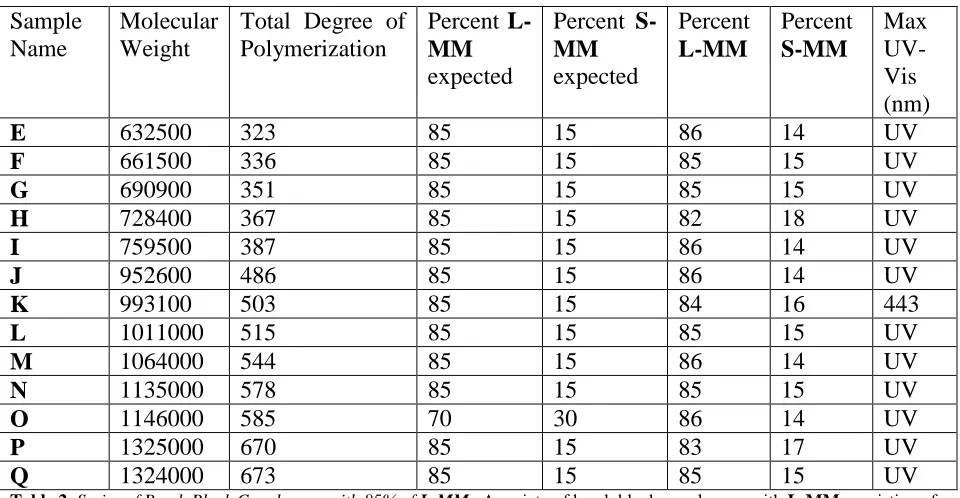
respectively, 85 equivalents of L-MM and 15 equivalents of S-MM would be used with 1 equivalent of catalyst. Five experiments were done aiming at 350 total degree of polymerization
9
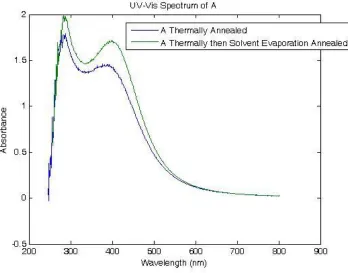
Figure 1. UV-Vis Spectroscopy of A. The UV-Vis spectrum shows a strong peak in the UV part of the spectrum as is seen in all the samples, but also a secondary peak in the visible, indicative of the well-ordered films. This secondary peak becomes stronger after solvent evaporation annealing.
It is expected that as volume fractions increase, there will be a morphology shift from
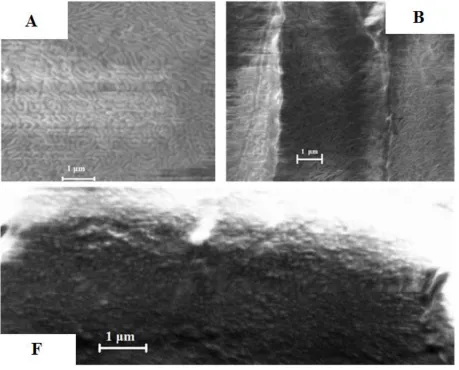
lamellae to cylinders to spheres. Morphology was examined with scanning electron microscopy
10
Figure 2. Scanning Electron Microscopy of Brush Block Copolymers of Different Volume Fractions. A and B assemble into lamellae as is clearly visible; these samples have between 63 and 70 percent L-MM in them. F has approximately 85% L-MM and shows some sort of rounded shape. This is likely either cylinders or spheres, though it is difficult to tell with SEM.
From the SEM images, it is apparent that there is a change between 63 and 85% L-MM
volume fractions. In A, the long alternating light and dark patterns are indicative of lamellae. It is a very similar pattern to what is seen in Grubbs et al. for brush block copolymers with equal
amounts of each macromonomer.7 B shows similar patterns as well. However, F does not have this same morphology. Rather than long, skinny stripes, there are round bumps. This is
indicative of one of the rounded geometries, either spheres or cylinders. Unfortunately, as SEM
can only capture a two dimensional image, it is difficult to tell these phases apart. To confirm
11
(TEM), Small Angle X-Ray Scattering (SAXS), or Atomic Force Microscopy (AFM) could help
to resolve the differences between spheres and cylinders. Nonetheless, this initial work suggests
that three dimensional photonic crystals are possible; in addition, it has begun to help to
construct the brush block copolymer phase diagram. However, it is clear that additional
processing is needed to improve the quality of these films so that they show better assembly
behavior.
Increasing Degree of Polymerization with 85:15 Volume Fractions
As discussed in the prior section, it is expected that at very uneven volume fractions of
polymers, the morphology of the sample will be spheres. This appeared to be valid as shown in
the series with increasing volume fractions. Thus, the next step that was taken was to develop a
series of increasing molecular weight with constant volume fraction of 85% L-MM. We anticipate an increase in the maximum wavelength of the samples as the molecular weight
increased as had been seen in the lamellar phase.
Brush block copolymers were synthesized in the same way as described in earlier
13
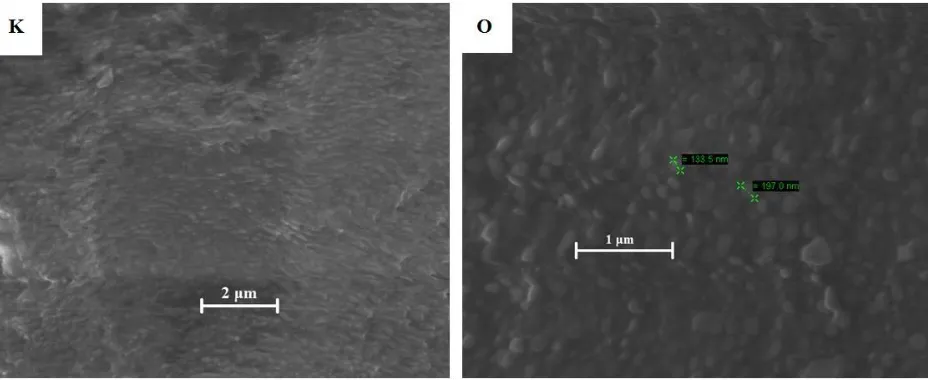
Figure 3. Scanning Electron Microscopy of Brush Block Copolymers Consisting of 85% L-MM. From these images, it is clear that these are self-assembling into non-lamellar nanostructures. The round morphology is found to be about 133.5 nm across in the second sample, which has a total degree of polymerization of 583.
Both of these samples show clear circular patterns, indicating either cylinder or sphere
morphology. In K, many small, rather regular circles are seen. In the more zoomed in O, it is possible to see the circles; some are similar in size, though others are slightly larger or smaller.
One of the circular features is found to be about 133.5 nm across. As discussed earlier, it is not
really possible to differentiate between spheres and cylinders through SEM as it is a two
dimensional image. Further testing through SAXS, TEM, or AFM will be necessary to fully
characterize these systems. However, this study has shown that a two or three dimensional
morphology is possible in brush block copolymers. Furthermore, as these reflect visible light,
brush block copolymers with this morphology can serve as two or three dimensional photonic
crystals.
One problem that needs to be looked into in the future is better annealing techniques.
These samples were thermally annealed under compression for about 15 minutes each, producing
a vibrant color when removed from the oven. However, when SEM was performed, some
14
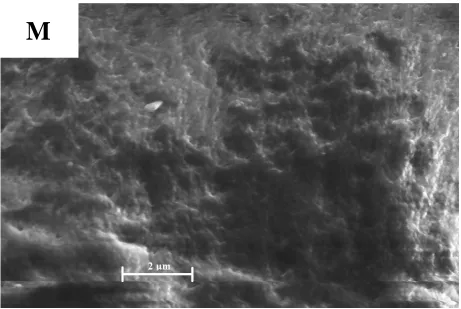
pictures. Processing seems to be a key limiting factor in the creation of these. For example, see
Figure 4 of sample M.
Figure 4. Sample M Thermally Annealed for 10 Minutes. It is clear that this sample did not fully form into an ordered morphology. It would be expected that it would form some sort of circular morphology as the samples with molecular weights slightly above and below it did.
It appears that there is some order in this sample with some portions showing circles, but
it is much less conclusive than some of the samples shown earlier. Further testing must be done
with other annealing conditions to produce better ordered samples. Solvent evaporation was
briefly tested, producing mediocre results to the naked eye, but it may be worth retesting.
Another possibility is longer heating times to allow the polymers more time to reach their
self-assembled positions. After heating, it is also possible to expose the sample to vapor for an
extended period of time. This would increase chain mobility, giving them more opportunity to
15
assemble. Due to time restrictions, it was not possible to attempt these, allowing more room in
this project for improvements.
Increasing Degree of Polymerization with 70:30 Volume Fractions
At volume fractions between where spherical and lamellar morphologies are seen, we
expect to see mainly cylindrical morphologies. There is often a gyroidal phase as well, but it
tends to be much smaller on the phase diagram, making it much harder to see. In block
copolymer systems of polylactic acid and polystyrene, the cylindrical phase is very prevalent
when one volume fraction composes about 70% of the total weight of the sample.23 In the series
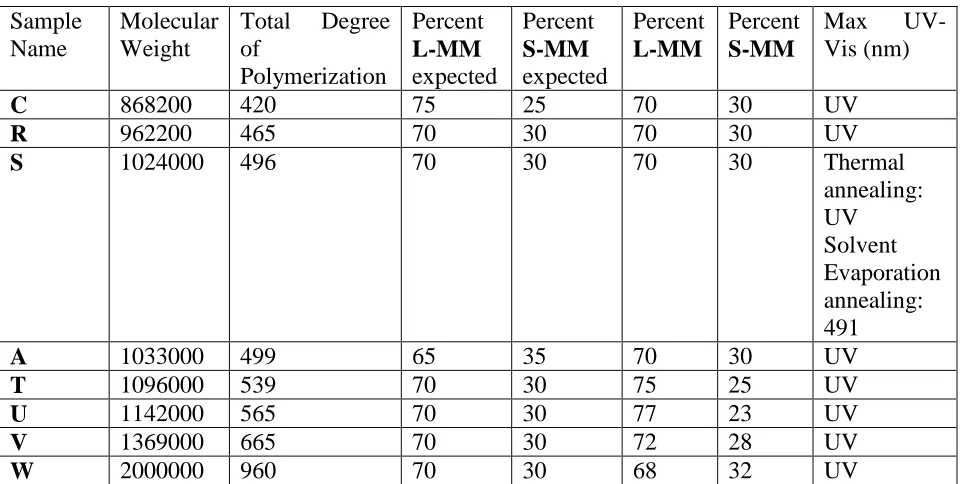
where volume fractions were increased (A-F), the A and C samples both contained about 70%
L-MM and appeared to assemble into lamellar nanostructures. However, as SEM only shows a two dimensional representation, it is possible that simply the wrong orientation was being
captured and that these were indeed cylinders, just tipped on their side. It is anticipated as well
that as the degree of polymerization and molecular weight increase that the wavelength reflected
will also increase.
A series of brush block copolymers was synthesized with increasing molecular weight
17
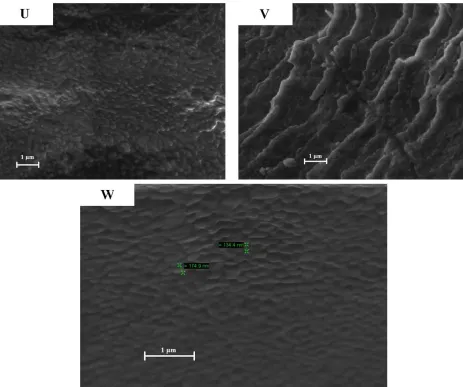
Figure 5. Scanning Electron Microscopy of Brush Block Copolymers with 70% L-MM. Clear circular morphology is shown by SEM. In particular, circles of diameter of 134.6 nm and 174.9 nm were measured by SEM in W.
The expected circular shape is present in each of these samples. This indicates
self-assembly into either cylindrical or spherical morphologies, which is indistinguishable in SEM.
W had measurable circles of 134.6 nm and 174.9 nm. This indicates that the circular
morphology is not fully regular. This could partially explain the rather broad UV-Vis peak seen
18
Figure 6. UV-Visible Spectrometry on W Thermally Annealed Film. This is a much broader peak than shown with previously produced lamellar films. This effect could be due to either the morphology or processing.
If different parts of the structure are restricting certain wavelengths, it will absorb more
wavelengths but each wavelength’s absorption will be weaker. Further testing on more
processing techniques are needed to more fully determine the cause of these broad peaks.
Conclusions and Future Work
Three series of brush block copolymers were synthesized to test for the capability of
self-assembly into two and three dimensional photonic crystals. The samples were characterized by
Gel Permeation Chromatography and Nuclear Magnetic Resonance spectroscopy to determine
molecular weight and relative percentages of each macromonomer. They were then made into
19
Microscopy. This showed a few samples that assembled into lamellae, but many that had some
sort of circular morphology. This could be either cylindrical or spherical, which cannot be
concluded without some form of three dimensional imaging. Each sample was also
characterized by Ultraviolet-Visible spectroscopy to suggest where the peaks of reflection in the
sample would be.
In future work, a more advanced imaging or scattering technique such as Atomic Force
Microscopy, Small Angle X-Ray Scattering, or Transmission Electron Microscopy will be used
to show the actual morphology. Without this information, it is not possible to determine whether
the circular morphologies that are being seen are spheres or cylinders. In addition, exploring
other processing techniques, such as solvent annealing and longer thermal annealing times,
possibly followed by exposure to solvent will be tested to look for more complete self-assembly
behavior. These will give the chains more time to segregate, hopefully giving better final results
and images. One additional idea is to etch out the L-MM blocks after it is assembled into a film and look into the leftover S-MM blocks as an imaging technique as these should have the spherical or cylindrical shape in the film. These are extremely promising initial results for the
demonstration of two and three dimensional photonic crystals made from brush block
20
Materials and Methods
Materials
(H2IMes)(pyr)2(Cl)2RuCHPh24 and
N-(hydroxyethanyl)-cis-5-norbornene-exo-2,3-dicarboximide25 were prepared as described previously. Solvents were all purchased from VWR
or Sigma-Alrich. Ruthenium-based metathesis catalyst was from Materia Inc. and stored in
drybox. Other chemicals were purchased from Sigma-Aldrich. Dry solvents were purified with
solvent purification columns. 3,6-dimehtyl-1,4-dioxane-2,5-dione was purified by sublimation
under vacuum. All other solvents and chemicals were used without purification unless stated
elsewhere.
General Information
NMR spectra were taken at room temperature on a Varian Inova 500 at 500 MHz. NMR
spectra were analyzed with MestReNova software and reported relative to the deuterated
chloroform peak (δ 7.26). NMR abbreviations: s=singlet, d=doublet, t=triplet, m=multiplet,
br=broad. Gel Permeation Chromatography (GPC) was done in THF on two Plgel 10 μm
mixed-B LS columns (Polymer Laboratories) connected in series with a miniDAWN TREOS
multiangle laser light scattering (MALLS) detector, a ViscoStar viscometer and Optilab rex
differential refractometer (all from Wyatt Technology). The dn/dc values used for polylactide
and polystyrene macromonomers were 0.050 and 0.180 respectively. dn/dc values for the brush
block copolymers were done assuming 100% mass elusion from the columns. Scattering
Electron Microscopy (SEM) was performed on a ZEISS 1550 VP Field Emission SEM.
21
Synthesis
Norbornene-Polylactide (L-MM)
A Schlenck tube was first flame-dried and then charged with 1 (640.5 mg, 3.13 mmol), 3,6-dimethyl-1,4-dioxane-2,5-dione (8.9994 g, 62.5 mmol), and 2 drops of tin (II)
2-ethylhexanoate (about 2 mg, 5 μmol). The mixture was run through three vacuum-argon cycles
and then added to an oil bath at 130° C to stir. After allowing the reaction to proceed for 2.5
hours, the solution was removed from the oil bath and allowed to cool to room temperature. The
product was then dissolved in dichloromethane. It was filtered through celite to remove excess
catalyst and precipitated into cold methanol. 1H NMR (500 MHz, CDCl3): δ (ppm) 6.28 (br t,
2H), 5.31-5.00 (m, 46 H), 4.42-4.23 (m, 3H), 3.84-3.69 (m, 2H), 3.30-3.26 (s, 2H), 2.70 (m, 2H),
1.73-1.39 (m, 167 H), 1.24 (br d, J = 10 Hz, 1H).
Norbornene-Polystyrene (S-MM)
Styrene (52.2 mL, 0.454 mol) was passed through basic aluminum oxide and added into
an oven-dried Schlenk tube with a septum. The styrene was then put through three
freeze-pump-thaw cycles and was refrozen. CuBr (169.4 mg, 1.18 mmol) was added to the frozen styrene
22
melt under argon. PMDETA (238 μL, 4.14 mmol) was added to the Schlenck tube by syringe
and the mixture was stirred for five minutes. The initiator 2 (1.4458 g, 4.054 mmol), prepared as in Grubbs et al., was then added to the Schlenk tube by syringe and the reaction mixture was
stirred at 100° C.7 After 4 hours, the reaction was stopped by cooling it with dry ice to cool it to
room temperature and then adding THF to the mixture. The mixture was then passed through
neutral aluminum oxide to remove catalyst and precipitated into methanol. Purification was
carried out through repeated reprecipitations until no remaining styrene was observed by NMR.
Further purification was done by silicia gel chromatography in dichloromethane until the
macromonomer was able to undergo successful ROMP. 1H NMR (500 MHz, CDCl3): δ (ppm)
7.25-6.29 (br m, 213 H), 6.28 (br s, 2H), 4.59-4.35 (m, 1H), 3.65-3.32 (m, 4H), 3.22 (br s, 2H),
2.62 (br d, J = 7.4 Hz, 2 H), 2.56-1.55 (br m, 36 H), 0.99-0.83 (m, 6H).
Block Copolymerization of Two Macromonomers via ROMP (A-L)
In a typical experiment, about 200 mg total of macromonomers were added to separate
vials in the desired ratio. The desired amount of catalyst was added in a third vial. These vials
were then brought into a dry box and the macromonomers were dissolved in THF to
approximately 0.05 M concentration. The catalyst was dissolved in 1.00 mL of THF. The
23
macromonomer was completed according to previously derived kinetics data. This solution was
allowed to stir for an additional 1.5 to 2 hours. The reaction was taken out of the dry box,
dichloromethane was added to lower the viscosity of the liquid, and the reaction was isolated by
precipitation into methanol. To separate the product completely, it was centrifuged at
approximately 20,000xg for 5-10 minutes and excess solvent was decanted. Conversion was
100% based on RI traces from GPC and isolated yields were typically over 85%.
Annealing by Slow Evaporation
Approximately 20 mg of solid polymer was put in a vial and dissolved in about 5 mL of
dichloromethane. A glass substrate was subsequently added vertically and the solvent was
allowed to evaporate at room temperature, depositing the polymer on the glass substrate.
Thermal Annealing between Two Glass Substrates
About 10 mg of solid polymer was sandwiched between two glass substrates and
compressed with a clamp. The substrates with clamps were then put into an oven at 140° C for
15 minutes.
Secondary Solvent Evaporation Annealing
After compressive thermal annealing, the samples were placed into a jar containing a
beaker filled with THF. They were allowed to sit on top of the beaker with the jar closed for
about ten minutes.
SEM sample preparation