Text Categorization for Authorship based on
the Features of Lingual Conceptual Expression
*Quan Zhang a, Yun-liang Zhang a,b, and Yi Yuan a a
The Institute of Acoustics, CAS, Beijing 100080, P. R. China b
Institute of Scientific & Technical Information of China, Beijing 100038, P. R. China {zhq, yuan}@mail.ioa.ac.cn
Abstract. The text categorization is an important field for the automatic text information processing. Moreover, the authorship identification of a text can be treated as a special text categorization. This paper adopts the conceptual primitives’ expression based on the Hierarchical Network of Concepts (HNC) theory, which can describe the words meaning in hierarchical symbols, in order to avoid the sparse data shortcoming that is aroused by the natural language surface features in text categorization. The KNN algorithm is used as computing classification element. Then, the experiment has been done on the Chinese text authorship identification. The experiment result gives out that the processing mode that is put forward in this paper achieves high correct rate, so it is feasible for the text authorship identification.
Keywords: Lingual Conceptual Space, Hierarchical Network of Concepts (HNC) theory, Text Categorization, KNN Algorithm, Authorship of a text.
1.
Introduction
Along with the progress of social information industry, especially with the Internet development, more and more documents exist in the electronical form. It provides convenience for information automatic processing. The text categorization is the basic work for the automatic processing, and it is the foundation for the information retrieval, information mining, and question-answer system too.
In some applications, it is need to identify the text authorship. The identification need use the documents written by the author as reference. Since the literary style of an author is relatively steady in some time, if we can mine the style character of the author then the identification is realized. Of course, the more documents which are gathered, the better result which is achieved. In many cases, the text authorship identification is treated as text categorization as the researchers can accomplish the work according the text categorization way. In this way, the frequency of glossary, punctuation, n-Gram string, syntax feature, average sentence length, the length of paragraph, and so on, are be used as the features to identify the author of a text
*
The paper is supported by the National Fundamental Research Project (973 Project) (Grant No. 2004CB318104) and The Knowledge Innovation Engineering Project of The Institute of Acoustics, CAS (Grant No. 0654091431).
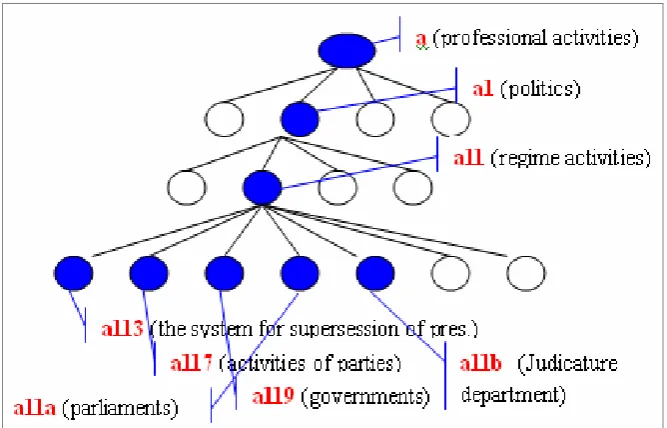
(value), and r (effect); two elements for the concrete concepts: w (matter) and p (people); and one element between the abstract and concrete concept: x (quality). These elements are called “classification of concept”. They are also primitives, and need to combine to express a word denotative function.
Figure 1: A branch of the conceptual tree.
Table 1:Chinese word in HNC primitives expression.
Word Classification Conceptual
meaing
哀愁
Sad and worry
v,g v7132+v7200e72
巡警
Cop
p pa41+va11
诱发
Arouse
v ((va71,v9441)#(v900;v80))
We will adopt the classification of concept as categorization feature. The basic condition of the categorization feature is that the concepts which belong to one classification must not be too few, and the distinguish ability between the classifications is enough. Then we use the 12 kinds classification as feature.
Table 2:The 12 kinds classification for the feature.
No.
Name
The symbol of the classification of
concept
1
Abstract noun
g/r/ xr / gr
2
Concrete noun
p/w
3 Entity
f
4 Verb
v/vv
5 Attribute
and
quality
u/ug/gu/x/ jx/px /gx / rx
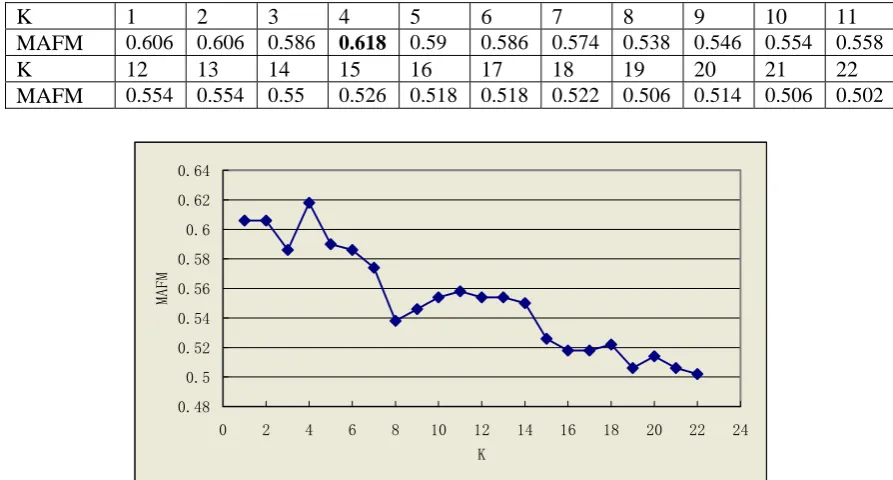
K 1 2 3 4 5 6 7 8 9 10 11 MAFM 0.606 0.606 0.586 0.618 0.59 0.586 0.574 0.538 0.546 0.554 0.558
K 12 13 14 15 16 17 18 19 20 21 22
MAFM 0.554 0.554 0.55 0.526 0.518 0.518 0.522 0.506 0.514 0.506 0.502
0.48 0.5 0.52 0.54 0.56 0.58 0.6 0.62 0.64
0 2 4 6 8 10 12 14 16 18 20 22 24
K
MAFM
Figure 3: The result of Concrete noun feature
Table 6:The results of 12 kinds features
The Classification of the concepts MAFMmax The best K
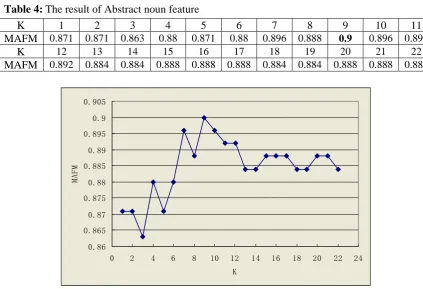
Abstract noun 0.9 9
Verb 0.88 6
Adverb 0.819 4
Attribute and quality 0.731 10 or 11 or 14 or 15
Entity 0.655 8
Syntax structural words 0.655 4
Concrete noun 0.618 4
Time 0.582 10
Quantifier 0.546 27
conjunction 0.534 14 or 15
Space 0.526 4 or 7
Idiom 0.502 8
5.
Discussion
We adopt the simple KNN algorithm as the computing tool, and the HNC conceptual primitives as the features carrier that can express the word meaning, then we contracture a mode to identify the text authorship. The experiment result indicates that this mode can work well, and achieves high correct rate. It means that the HNC conceptual primitives are suitable to express the text feature in text authorship identification.
Meanwhile, comparing with the natural language words as text feature, there are also some advantages when take the HNC conceptual primitives to express the text feature:
2. The conceptual primitives are hierarchical symbols; they are suitable to compute the correlation. It is easy to reduce the dimension by merging the low frequency concept into a high frequency concept, according the correlation among concepts.
3. The HNC conceptual primitives are a kind of artificial semantic symbol, their meaning is well defined, and the natural language words always have ambiguous meaning. It is hard to get the clear meaning, and the HNC conceptual primitives provide the convenience: we can obtain the word meaning in the HNC conceptual primitives form after sentence analysis according the HNC processing.
References
Baayen R. H., H. van Halteren, and Tweedie F J. 1996. Outside the cave of shadows: using syntactic annotation to enhance authorship attribution. Literary and Linguistic Computing, 11(3):121-131.
Burrows J. F.. 1987. Word patterns and story shapes: the statistical analysis of narrative style.Literary and Linguistic Computing, 2:61-70.
David I Holmes. 1997. Stylometry:its origins, development and aspirations. Joint international conference of the association for computers and the humanities and the association for literary and linguistic computing. Norway: University of Bergen, 98-103.
Jian-bin Ma. 2004. The Study on the Authorship Mining for Chinese E-mail documents based on SVM, Master's Dissertation, Hebei Agriculture University.
Olivier de Vel, A. Anderson, M. Corney, and G. Mohay. 2001. Mining E-mail Content for Author Identification Forensics. SIGMOD:Special Section on Data Mining for Intrusion Detection and Threat Analysis, 55-64.
Shu-hui Chang. 2005. The Study on the Authorship Identification for Chinese E-mail documents Based on the Literary Style, Master's Dissertation, Hebei Agriculture University.
Xiao-chun Wu, Xuan-jing Huang, and Li-de Wu. 2006. Authorship Identification Based on Semantic Analysis. Journal of Chinese Information Processing, 20(6):61-68.
Yi-jian Jin, Xiao-ming Sun, and Shao-ping Ma. 2003. Stylistics based Writer Identify on Internet. Journal of Guangxi Normal University (Natuarl Science Edition), 21(3):62-66. Yun-liang Zhang, and Quan Zhang. 2006. A Text Classifier Based on Sentence Category VSM.
Proceedings of the 20th Pacific Asia Conference on Language, Information and Computation, 244~249. Wuhan.
Yuta Tsuboi. 2002. Authorship Identification for Heterogeneous Documents. Master's Thesis,
Nara Institute of Science and Technology.
Zengyang Huang. 1998. The Hierarchical Network of Concepts theory. Tsinghua University Press, Beijing .