Identifying Correction Rules for Auto Editing
An-Ta Huang
Department of Computer Science and Information Engineering National Taiwan University
Tsung-Ting Kuo
Department of Computer Science and Information Engineering National Taiwan University
Ying-Chun Lai
School of Applied Foreign Languages Chung-Shan Medical University
Shou-de Lin
Department of Computer Science and Information Engineering National Taiwan University
Abstract
This paper describes a framework to extract the effective correction rules from the sentence-aligned corpus and show a practical application: auto-editing using the found rules. The framework exploits the methodology of finding Levenshtein distance between sentences to identify the key parts of the rules and then use the editing corpus to filter, condense and refine the rules. We produce the rule candidates of such form, A => B, where A stands for the erroneous pattern and B is the correct pattern.
Our framework is language independent, therefore can be applied to other languages easily. The evaluation of the discovered rules reveals that 67.2% of the top 1500 ranked rules are annotated as correct or mostly correct by experts. Based on the rules, we create an online auto-editing system for demo on http://mslab.csie.ntu.edu.tw/~kw/new_demo.html.
knowledge bases which cover general information about analyzing grammar structure and specific information of a user’s learning history [2]. Besides, Emily M. Bender present a tutorial system based on computational grammar augmented with mal-rules for analysis, error diagnosis, and semantics-centered generation of correct forms [3]. However, the manually designed rules consume labor and time and require language experts to do that, which limits the generalization of such method and cannot be easily applied to different languages.
2.2 Statistical Techniques
As discussed in Section 2.1, rule-based methods have some apparent shortcomings. Rather than asking experts to annotate corpus, some papers propose statistical models to identify erroneous patterns. An unsupervised method to detect grammatical errors by inferring negative evidences reaches 80% precision and 20% recall but their system is only effective in recognizing certain grammatical errors and detect only about one-fifth as many errors as a human judge does [4]. Some other papers focus on detecting particular errors, such as preposition errors [5], disagreement on the quantifier and the noun [6]. Others treat the detection of erroneous sentences as a binary classification problem and propose a new feature called “Labeled Sequential Patterns (LSP)” which is compared to the other four features including two scores produced by toolkit, lexical collocation [11], and function word density. The average accuracy of LSP is 79.63% and beats the other four features. Furthermore, the existence of time word and function word in a sentence is proven to be important. While in this way, one can only know whether a sentence is correct and would not have a clue about how to correct errors [7]. Finally, some researchers treat detecting erroneous patterns as a statistical machine translation problem. They believe the erroneous sentences and the correct sentences are two different languages. However, error correction is intrinsically different from translation and there is no apparent evidence till now whether the existing machine translation techniques are suitable for such purpose [8][9].
3
Methodology
3.1
Overview
Our framework consists of
refining the rules.
3.2
Corpus Description
We retrieve 310967 parallel
sentence from an online-editing website
people to write diaries in their second language and the diaries
mistakes) would be edited by some
corresponding language. Besides, the edited part in a
sentence (not cross sentences)
easily from the website.
Figure 1. System Overview
framework consists of two parts. First it produces the rules and next it focuses on
Description
parallel pairs of sentences, one erroneous sentence and one correct editing website Lang-8 (http://lang-8.com/). The website allow people to write diaries in their second language and the diaries (which may
be edited by some volunteer members who
corresponding language. Besides, the edited part in an article is restricted
(not cross sentences). Consequently, we can retrieve the sentence
and next it focuses on
one erroneous sentence and one correct
. The website allows
which may contain some
who are native in the
n article is restricted a single
In the following chapters, we use Wi to represent the erroneous sentence of the i-th pair
of sentence in the corpus and Ci represents the corresponding correct sentence to Wi.
Besides, S+ is defined as a collection of all correct sentences in the corpus, while S- is
defined as a collection of all erroneous sentences.
3.3
Producing Rules
Before describing our method, we would like to provide some formal definitions for erroneous and correct patterns, rules, applying rules, and frequency of patterns:
Definition of (erroneous and correct) patterns: A pattern is a series of consecutive words
(or characters) which belong to a subsequence of a sentence. An erroneous pattern
represents such sequence that is believed to be wrong, and a correct pattern is the one
that is believed to be correct.
Definition of rule: A rule K can be written as KL => KR. The left-hand side of the arrow,
KL, is the erroneous pattern and the right-hand side of the arrow, KR, is correct pattern
which KL should be transformed to.
Definition of applying a rule to a sentence: Given a rule K : KL => KR, and a sentence T,
if KL exist in the T, we replace the KL in T to KR. Such process is considered as applying
rule K to sentence T.
Definition of freS+(KL): the occurrence frequency of a pattern KL in S+
To discover a rule A B from the editing corpus, we need to first identify the plausible left and right hand side of the rule. This is by no means a trivial task, and the fact that there could be multiple choices of such rule can only make such tasks even harder. One intuitive method is to compare the word set existing in Wi and Ci and create the patterns
using the difference among them. However, such the intuitive method suffers certain deficiency such as provided by the following examples.
Erroneous : “Open the light”
Correct : “Turn the light on ”
Erroneous : “I with him had dinner”
Correct : “I had dinner with him”
The difference set between the first pairs are {open, turn, on} while that of the second pairs is an empty set {} since the order is not considered. It is not clear how such difference set can lead to both erroneous and correct patterns.
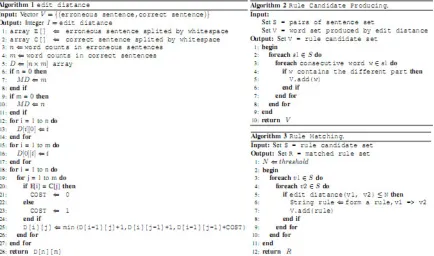
Figure 2. pseudo code of producing rules
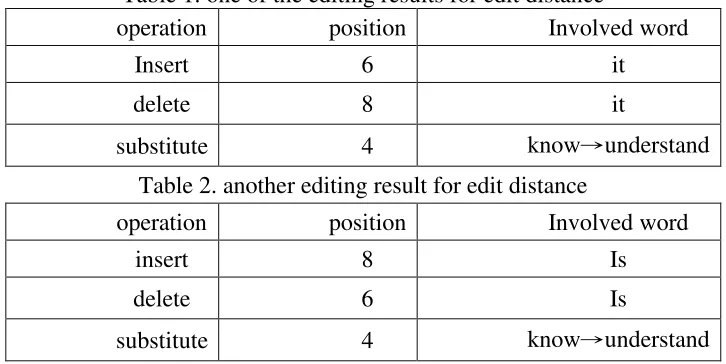
After applying the modified Levenshtein distance algorithm, it is possible to obtain a set of involving words Ri as follows.
} know , understand ,
it , is { R i=
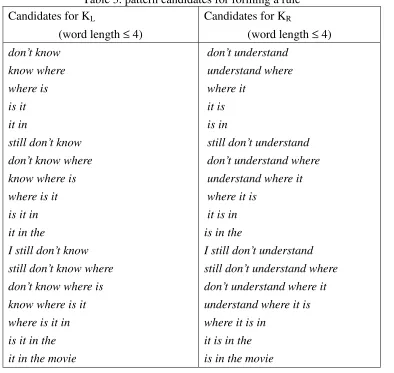
However, to form a reasonable pattern, the words in set Ri is not sufficient. They should be combined with other terms. Ideally KL and KR must consist of some words from Ri
and some from the rest of the sentence. Therefore for each pair of Wi and Ci in the corpus,
we retrieve consecutive word patterns in which at least one word is from Ri. For example,
Table 4. observation on the frequency
pattern freS+ pattern freS+
erroneous went to shopping 10 Erroneous am so exciting 0
correct went shopping 205 Correct am so excited 71
We believe the erroneous patterns KL should not occur in the correct sentences too
frequently (otherwise it shall have been replaced by the correct one KR), therefore
consider freS+ as a property metric to evaluate the quality of a rule. According to the real
experiment shown in Table 4, the frequency of the erroneous patterns seems to occur less frequently in the correct corpus, freS+, comparing to the correct ones.
Next, we condense the rules according to their freS+. The condensed rule is shorter than
the original one and is supposed to be more general (i.e. can cover more sentences). For example, in the following sentences, the condensed rule is more general and reasonable since the subject ‘I’ has nothing to do with the erroneous pattern.
Erroneous : “I went to shopping and had dinner with my friend yesterday.”
Correct : “I went shopping and had dinner with my friend yesterday.”
Rule : “I went to shopping” => “I went shopping”
Condensed Rule : “went to shopping” => “went shopping”
To obtain the shortest possible rules for auto-editing, we propose a simple idea to check if the left hand side KL can be condensed to a shorter one, without boosting its freS+
significantly. If yes, then it implies we have found a shorter erroneous pattern which also occurs rarely in the correct corpus. For example, for the erroneous pattern “I went to shopping”, table 5 shows the frequency of each possible subsequence in the correct corpus. Apparently “am worry about” is the most condensed rule without occurring more than four times in the correct corpus.
Table 5. example for condensing a rule
sentence segment worry worry about am worry am worry about
I am worry about
frequency 1446 225 206 3 1
we will accept it as a condensed erroneous pattern. We remove the same words from the KR to produce the corresponding correct pattern. The condense process repeats until any
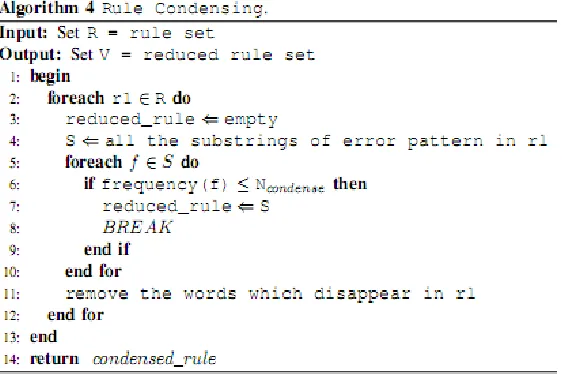
of the word to be removed in KL does not occur in the KR. The pseudo code of
condensing rules is shown in Figuire 3.
Figure 3. pseudo code of condensing rules
The final step of the refinement is to rank the rules based on their qualities. We propose two plausible strategies to rank the rules. First, it is possible to rank the rules according to its freS+ from low to high. That says, a rule is less likely to be correct something right
into something wrong if its freS+ is low. Second, it is possible to rank the rules according
to the number of sentences in the corpus that can be applied using it. The first strategy is similar to the definition of precision while the second is closer to the meaning of recall.
4
Experiments
We retrieve 310967 pairs of English sentences from the “Lang-8” as our parallel corpus and the system finally produces 110567 rules. In the evaluation, we invite three people major in English to annotate our rules. Then we demonstrate an auto-editing system to show how such rules can be applied.
4.1
Evaluation
We rank all rules according to its freS+ and four English-major people are invited to
Figure 4. rule distribution
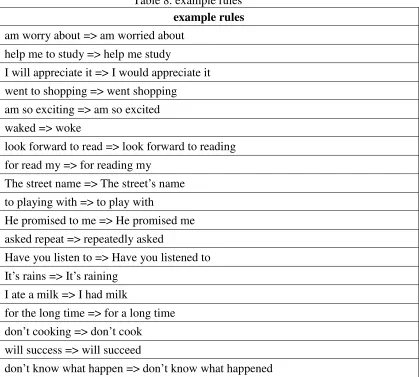
The following are some example rules discovered by our system. Such errors can hardly be corrected by Microsoft Word 2007 grammar checker.
Table 8. example rules example rules
am worry about => am worried about
help me to study => help me study
I will appreciate it => I would appreciate it
went to shopping => went shopping
am so exciting => am so excited
waked => woke
look forward to read => look forward to reading
for read my => for reading my
The street name => The street’s name
to playing with => to play with
He promised to me => He promised me
asked repeat => repeatedly asked
Have you listen to => Have you listened to
It’s rains => It’s raining I ate a milk => I had milk
for the long time => for a long time
don’t cooking => don’t cook
will success => will succeed
don’t know what happen => don’t know what happened
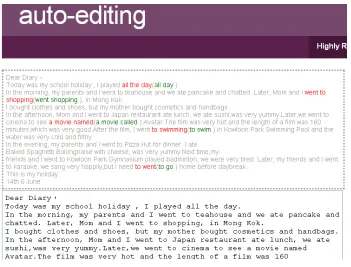
We construct an online, real-time auto-editing system to demonstrate the usefulness of our rules to provide editorial assistance. We first try to test whether a part of the real-time typing sentence can match with the erroneous patterns. If yes (it will be marked in red), then we apply the correction rule to suggest replacing it with the correct pattern. The users can click the correct part (marked in green) to tell the system such correction is accepted. The link of our system is: http://mslab.csie.ntu.edu.tw/~kw/new_demo.html
Figure 5. screenshot of demo system
The above screenshot is the entire system view. Two kinds of rules are provided. “Highly-ranked Rules” exploits only higher ranked rules and ignore lower-ranked one. “All Rules” utilizes every rule but suffers the risk of using incorrect ones.
Figure 6. screenshot of auto-editing
suggested correction will appear on the above area in green. If the users agree with the corrections, they can click on the green word and the sentence will be edited accordingly.
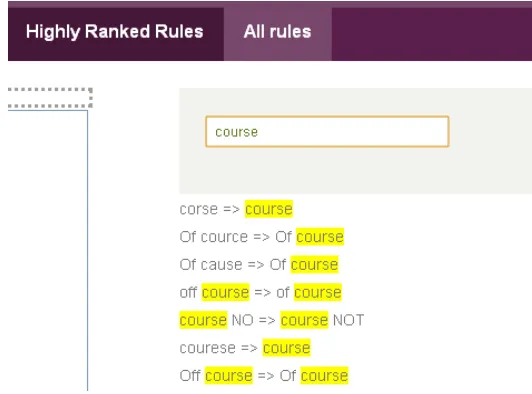
Figure 7. screenshot of keywords search in rule database
On the right hand side is a search engine for the related rules. Given a keyword (e.g. course), the system will return all rules that contains such word.
5
Conclusion and Future Work
In this work, we propose a language-universal framework that is capable of producing effective editing rules given a parallel editing corpus. The quality of rules can be assessed using one of our ranking strategies. Moreover, we have demonstrated the practical usage of the rules by constructing an Auto-Editing System to provide editorial assistance for language learners. In this paper, we produce correction rules without considering syntactic structure and POS (Part-of-Speech). In the future, we would like to make use of both of the two features. The syntactic structure retrieved by a parser can potentially make the rule more feasible since we then do not have to worry about splitting phrases into parts. On the other hand, substituting words in a rule into its POS creates more general rules that can be applied to more sentences.
6
References
[1] George E. Heidon. “Intelligent Writing Assistance.Handbook of Natural Language Processing.” Robert Dale, Hermann Moisi, and Harold Somers (ed.). Marcel Dekker.
[2] Lisa N. Michaud, Kathleen F. McCoy, and Christopher A. Pennington. “An Intelligent Tutoring System for Deaf Learners of Written English.” In Proceeding of
Fourth International ACM Conference on Assistive Technologies, 2000
Baldwin. “Arboretum: Using a precision grammar for grammar checking in call.” In
Proceedings of the InSTIL/ICALL Symposium: NLP and Speech Technologies in
Advanced Language Learning Systems, 2004.
[4] Chodorow and Leacock, “An Unsupervised Method for Detecting Grammatical Errors.” Proceedings of the 1st North American chapter of the Association for
Computational Linguistics conference, pp. 140-147, 2000.
[5] Matthieu Hermet, and Alain Désilets. “Using First and Second Language Models to Correct Preposition Errors in Second Language Authoring.” Proceedings of the
Fourth Workshop on Innovative Use of NLP for Building Educational Applications,
pp. 64-72, 2009.
[6] Chris Brocket, William B. Dolan, and Michael Gamon. “Correcting ESL errors using phrasal SMT techniques.” Proceedings of the 21st International Conference
on Computational Linguistics and the 44th annual meeting of the Association for
Computational Linguistics, 2006.
[7] Sun,G. Liu, X. Cong, G. Zhou, M. Xiong,Z. Lin, C.-Y., and Lee,J. ”Detecting Erroneous Sentences Using Automatically Mined Sequential Patterns. In Association of Computational Linguistics, 2007.
[8] Guihua Sun, Gao Cong, Xiaohua Liu, Chin-Yew Lin, and Ming Zhou. “Mining Sequential Patterns and Tree Patterns to Detect Erroneous Sentences.” Proceedings
of the 22nd national conference on Artificial intelligence - Volume 1, 2007.
[9] Shi,Y.,andZhou,L. “Error Detection Using Linguistic Features.” Human Language
Technology Conference and Conference on Empirical Methods in Natural Language
Processing, 2005[10] V. I. Levenshtein. “Binary codes capable of correcting
deletions, insertions and reversals”. Doklady Akademii Nauk SSSR 163(4) p845-848, 1965,also Soviet Physics Doklady 10(8) p707-710, Feb 1966 [11] Yajuan L¨ u and Ming Zhou., “Collocation translation acquisition using