Two Phase Evaluation for Selecting Machine Translation Services
Chunqi Shi, Donghui Lin, Masahiko Shimada, Toru Ishida
Department of Social Informatics, Kyoto University Yoshida-Honmachi,Sakyo-Ku, Kyoto, 606-8501, Japan {shi,mshimada}@ai.soc.i.kyoto-u.ac.jp,{lindh,ishida}@i.kyoto-u.ac.jp
Abstract
An increased number of machine translation services are now available. Unfortunately, none of them can provide adequate translation quality for all input sources. This forces the user to select from among the services according to his needs. However, it is tedious and time consuming to perform this manual selection. Our solution, proposed here, is an automatic mechanism that can select the most appropriate machine translation service. Although evaluation methods are available, such as BLEU, NIST, WER, etc., their evaluation results are not unanimous regardless of the translation sources. We proposed a two-phase architecture for selecting translation services. The first phase uses a data-driven classification to allow the most appropriate evaluation method to be selected according to each translation source. The second phase selects the most appropriate machine translation result by the selected evaluation method. We describe the architecture, detail the algorithm, and construct a prototype. Tests show that the proposal yields better translation quality than employing just one machine translation service.
Keywords:Machine Translation, Evaluation, Service Selection
1.
Introduction
Due to online access and instant availability, machine trans-lation (MT) services are becoming more popular. One ex-ample is the online Google translation service. These MT services, in most cases, do not provide perfect accuracy or fluency. When multiple MT services are available, the user is confused about which service is more accurate for the task at hand. Manual service selection is tedious and error prone. Thus, it is necessary to create a mechanism that can select the most appropriate MT service.
Many functional equivalent MT services have become available. Language Grid (Ishida, 2011) is a service-oriented intelligence platform for language services. It pro-vides many language translation services by wrapping non-networked language resources and software. With stan-dard interfaces, functional equivalent translation services are formalized and made available for both end-users and community translation developers. The types of language services include machine translation services, dictionary services, parallel text services, and morphological analyzer services. Moreover, composite translation services could be generated based on these types of language services (Mu-rakami et al., 2010). For example, Language Grid provides a multi-hop composite service. It combines a machine translation service and in-domain dictionary services, so as to provide a higher quality MT service for a desired do-main. Many composite MT services can be created by gen-erating different combination (Bramantoro et al., 2010). Given this multiplicity of translation services available, it is difficult for the user to select the MT service that best suits the current task.
Several evaluation methods can be used to evaluate trans-lation results automatically, such as BLEU (Papineni et al., 2002), NIST (Doddington, 2002), WER (Nieen et al., 2000), etc. However, their evaluation results are not unan-imous (Och, 2003; Cer et al., 2010). Moreover, the effi-ciency of the evaluation method will affect the selection
of the MT service. It must be noted that these evaluation methods have incompatible metrics, and their results can have different distribution ranges.
The purpose of this paper is to provide MT service selec-tion for end-users and community translaselec-tion developers of Language Grid (Ishida, 2011). Community translation de-velopers as well as end-users require assistance selecting the proper translation according to the translation quality, as well as other properties like time. The selection of a service according to the general quality of service (QoS) properties, such as time, cost, etc, has been well researched (Tian et al., 2004; Serhani et al., 2005). Thus, our research focuses on how to use these evaluation methods to calculate and rank MT services according to the translation quality, a domain-specific QoS property.
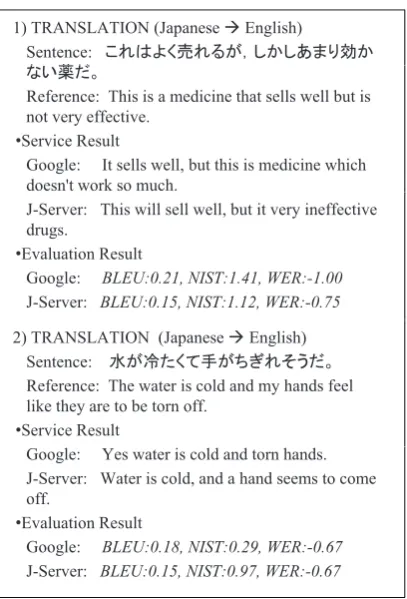
For the example of Japanese-English translation, there are two candidate services, Google Translate and J-Server, and three candidate evaluation methods, BLUE, NIST, and WER (see Figure 1). The evaluation results and translation results of two source sentences are given below. For the first sentence, Google gets higher evaluation results than J-Server, thus it will be selected by BLEU or NIST, while WER will select J-Server. The evaluation results of these evaluation methods do not agree with each other. For the second sentence, WER generates same evaluation results for Google and J-Server, BLEU generates only a slight dif-ferent evaluation result, while NIST indicates a disparity between them. Here, we face the problem of how to make use of these evaluation methods to generate an evaluation result for machine translation service selection.
1) TRANSLATION (Japanese English)
Sentence: 䛣䜜䛿䜘䛟䜜䜛䛜䠈䛧䛛䛧䛒䜎䜚ຠ䛛
䛺 ⸆䛰 䛺䛔⸆䛰䚹
Reference: This is a medicine that sells well but is not very effective.
•Service Result
Google: It sells well, but this is medicine which doesn't work so much.
J-Server: This will sell well, but it very ineffective drugs.
•Evaluation Result
Google: BLEU:0.21, NIST:1.41, WER:-1.00
J-Server: BLEU:0.15, NIST:1.12, WER:-0.75
2) TRANSLATION (Japanese English)
Sentence: Ỉ䛜෭䛯䛟䛶ᡭ䛜䛱䛞䜜䛭䛖䛰䚹
Reference: The water is cold and my hands feel like they are to be torn off.
•Service Result
Google: Yes water is cold and torn hands. J-Server: Water is cold, and a hand seems to come off.
•Evaluation Result
Google: BLEU:0.18, NIST:0.29, WER:-0.67
J-Server: BLEU:0 15 NIST:0 97 WER:-0 67
J Server: BLEU:0.15, NIST:0.97, WER: 0.67
Figure 1: An example of two translation services (Google
and J-Server) evaluated by three evaluation methods (BLEU,NIST, andWER)
available, thus, to achieve the goal of selecting a proper MT service, two main issues should be considered. (1) How to make use of multiple evaluation methods? We pro-vide a two-phase architecture for service selection, which is an extension of the Web service broker for service se-lection. In the first phase, a proper evaluation method is selected. In the second phase, based on the selected eval-uation method, the most appropriate machine translation service is selected. (2) How to realize service selection? To achieve this goal, we introduce a ranking algorithm It dynamically selects the appropriate evaluation method for each input translation source. We use data-driven classifi-cation for selecting the evaluation method. The machine translation service with the highest evaluation result as in-dicated by the selected evaluation is chosen.
2.
Translation Service Selection
Architecture
We extend the broker for Web service selection (see Fig-ure 2) to create a two-phase architectFig-ure for MT service se-lection. For selecting Web service according to QoS prop-erties, a Web service broker is flexible and trustworthy ar-chitecture for realizing the management of QoS properties for providers and users of Web services (Tian et al., 2004; Serhani et al., 2005). It receives request from and makes a response to Web service requestor. Meanwhile, it regis-ters services from Web service providers, and verifies and certificates the properties said by Web services. A broker
is also a Web service that can be published to and be found in a Web service registry; this makes it readily available to both end-users and new service developers. The broker ar-chitecture usually has a built-in evaluation method for each QoS property.
However, for MT service selection, it is not proper to adopt just one evaluation method to evaluate all translation ser-vices. Instead, the most appropriate evaluation method is to be selected for each input translation source. Thus, we propose a two-phase architecture for MT service selection.
W b S i Web Service
Registry
Web Service
publish broker
find broker
register service submit a
t
Web Service Requestor
Web Service Provider Broker for
Service Selection verify and certificate properties request
make a response
Requestor Provider
Figure 2: The Web service broker for service selection
2.1. Architecture
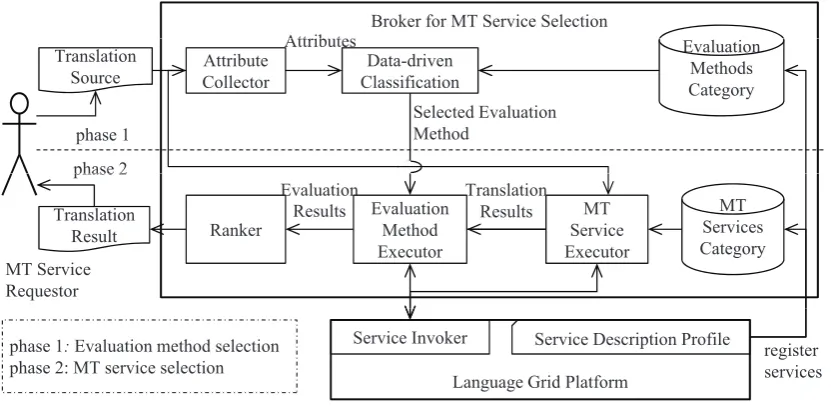
Firstly, we present an overview of our two-phase architec-ture (see Figure 3). The broker for MT service receives a request with translation source from and returns a response (translation result) to the MT service requestor. The exten-sion is to register both MT services and evaluation methods for selection. Meanwhile, in addition to MT service selec-tion, it first has to select the evaluation method. Several considerations are presented below before more details is given.
• Wrapping existent software of evaluation methods into services: Due to ongoing research into MT evaluation, new evaluation methods will emerge, and their soft-ware will be published. To provide an open-ended interface for integrating additional evaluation meth-ods, it is useful to provide a self-describing Web ser-vice interface, wrapping existent software of evalua-tion methods into flexible online services (Eck et al., 2006). It is easily realized by the service wrapper function provided by the Language Grid platform.
• Regarding Language Grid as service provider: The Language Grid service-oriented platform successfully solves various service issues, such as creation, reg-istration, and management. Due to the service de-scription profiles of Language Grid, MT services cat-egory and evaluation methods catcat-egory can be regis-tered conveniently. Thus, Language Grid is an excel-lent provider for MT services and evaluation methods.
Broker for MT Service Selection
Attrib tes Evaluation
Methods Category Data-driven
Classification
phase 2 phase 1
Attribute Collector
Selected Evaluation Method
Attributes Translation
Source
MT Service Requestor
phase 2
MT Service Executor Evaluation
Method Executor Ranker
Translation Result
MT Services Category Translation
Results Evaluation
Results
phase 1:Evaluation method selection phase 2: MT service selection
Language Grid Platform
Service Invoker Service Description Profile
register services
Figure 3: Two-phase architecture for machine translation (MT) service selection
Data-driven classification is suitable for this task. First, no experience is available for such classifica-tion. Second, because the attributes of sentences vary dynamically, the data-driven approach is more exten-sible. Data-driven classification builds a classification function dynamically from a training set. This set can be collected from human selection cases.
To realize data-driven classification, we adopt the decision tree approach. First, it offers quick training and classifica-tion, which is very user-friendly. Second, it is easy to trans-form a decision tree into decision rules, which is well sup-ports manual verification. C4.5 algorithm (Quinlan, 1993), one of the most frequently used decision tree, is used in the evaluation method selection. It has several merits includ-ing handlinclud-ing missinclud-ing values, allowinclud-ing presence of noise, and realizing the categorization of continuous attributes. It should be noted that we view C4.5 as a ’black box’ for the classification task; its original functionality was preserved.
The two-phase architecture of machine translation service selection (see Figure 3) is based on the above considera-tions. The broker for MT service selection divides its func-tions into the evaluation method selection phase and the MT service selection phase. Evaluation methods are han-dled in the former phase, and the output is the appropriate evaluation method. MT services are handled in the sec-ond phase, and the result of a translation service is selected in this phase. The main components of the broker include Attribute Collector, Data-driven Classification, Evaluation Methods Category, MT Services Category, MT Service Ex-ecutor, Evaluation Method ExEx-ecutor, and Ranker (see Fig-ure 3). Then, we describe the processes of two phases be-low.
• Evaluation method selection phase: A translation source from MT service requestor is analyzed by the attribute collector component, and the analyzed at-tributes are sent to data-driven classification compo-nent. According to the attributes of the translation source, an evaluation method is selected from
meth-ods in evaluation methmeth-ods category component by the data-driven classification.
• MT Service selection phase: The translation source is send to the MT service executor component, which invokes the MT services from services in MT service category component. The translation results are sent to the evaluation method executor component, which in-vokes the selected evaluation method identified in the earlier phase. The evaluation results of the translation are sent to the ranker component, and the best transla-tion result is send to the MT service requestor.
2.2. Deployment
We realized a prototype that implemented the above com-ponent functions as detailed below.
1) Evaluation method selection phase:
• Evaluation Methods Category: It is a simple MySQL1 database holding stored service name, the URL, operation names and types, parame-ter names and types, and preset parameparame-ter val-ues. There are three evaluation methods, BLEU,
NIST, andWERmethods, which are from Stanford Phrasal Evaluation project (Cer et al., 2010), and are wrapped into services by Language Grid plat-form.
• Attribute Collector: Two simple attributes are col-lected, the length of translation source and the source and target languages. The length of trans-lation source is calculated as the number of words in the translation source.
• Data-driven Classification: J48 software, a Java implementation of C4.5 algorithm from Weka data mining tool2, is used for classification. Its input is the attribute-value pairs output by the attribute
1
collector component, and its output is the name of evaluation method, according to which, the de-tails of evaluation method can be retrieved from the evaluation methods category component.
2) MT service selection phase:
• MT Services Category: It is similar to evalua-tion methods category component. Three services, Google, J-Server, and Translution services from Language Grid platform, are registered.
• MT Service Executor and Evaluation Method Ex-ecutor: They are implemented based on JAX-RPC 3 service client, which makes it easy to in-voke a Web service according to the name space, operation name and type, and parameter name and type.
• Ranker: A ranking algorithm is designed and im-plemented in Java. The input of this algorithm is the evaluation results of the selected evaluation method. The output of the algorithm is a selected translation result of highest QoS value of transla-tion quality. The detail of this new algorithm will be explained in the following section.
The above two-phase architecture and components deploy-ment, makes it convenient to realize the proposed broker for MT service selection.
3.
Translation Selection Algorithm
After that, we illustrate the strategy of selecting the most appropriate MT service. To explain the selection algorithm in detail, a formal description is given as follows.
3.1. Selection
For a translation user, n translation services
S={s1, s2, . . . , sn} are available, along with m
eval-uation methods E={e1, e2, . . . , em}. For each request
translation source r, a proper evaluation methodek is to be selected. According to this selected evaluation method ek, a QoS value of translation qualityqos(ek, si)is to be generated for each servicesi. Ranking these QoS values will determine the translation servicesselectto be selected.
Whileqji, an evaluation result, is the result of applying the jth evaluation methodejto the translation result ofith MT servicesi. However, these evaluation results are likely to conflict with each other, since they are generated by dif-ferent evaluation methods. We need to select an evaluation method before we can select the service.
We use a decision tree to select the target evaluation method, ek. For the request translation source r, the at-tribute collector collects c attribute values by the set of functions F={f1, f2, . . . , fc}. If the decision tree is not
trained, the decision rules are not generated. First, a train-ing set is required, which are a set of translation sources, and for each translation source, a proper evaluation method is given. The attributes of these translation sources will be analyzed and used for training. Once the decision tree is
3http://java.net/projects/jax-rpc/
trained, it easily generates the decision rules. Each deci-sion rule can be described as follows:
(θ1low< f1(r)< θ
up
1 )∧. . .∧(θ
low
t < ft(r)< θ
up
t )
∧. . .∧(θclow< fc(r)< θcup)→ek
(1)
Here,θlowt andθtupare the lower and upper boundaries of tth collected attribute valueft(r)(1 ≤t ≤c). When at-tributes are collected from the request translation source, each decision rule is test until the target evaluation method ek is satisfied. Then, it will be sent to the next phase for execution.
After appropriate evaluation method ek is selected, the translation quality of a servicesiisqos(ek, si) =qki. The translation quality values of all the MT services can then be ranked, and target servicesselectcan be selected as follows.
sselect= arg max
si
qos(ek, si) (2)
Thus, the algorithm will select an evaluation methodek in the first. Then, based on the evaluation values, it will get QoS value (translation quality) for each servicesi. Finally, the QoS values will be ranked, and the target MT service
sselectwill be selected.
In addition, we design a normalization of evaluation result qki, which are probably in different metrics, due to differ-ent evaluation methods. The result of normalizationq0kiis given below, which is a relative value of the average trans-lation quality values of whole MT services and average of MT services exceptsi.
qki0 =
P jqkj/n
(P
jqkj−qki)/(n−1)
(3)
If evaluation results are positive, normalization of transla-tion qualityqos0(ek, si) = q0ki, otherwise,qos0(ek, si) = 1/q0ki. Getting a unitary measure is required for commu-nity translation developers to aggregate translation quality with other QoS properties such as time and cost.
3.2. Algorithm
We describe the algorithm that works in the broker for MT service selection, see Algorithm 1. It includes two-phase execution. In the first phase, if no decision rules exist, we need to train the decision tree, and generate decision rules. Next, we calculate attributes {f1(r), f2(r), . . . , fc(r)}
from request translation source r by attribute collector functions, then the attributes values are checked by decision rules. If decision rules exists, we can select a target evalua-tion methodselected evaluation, which completes the first phase.
In the second phase, it invokes the MT servicesSfor trans-lation results, evaluate transtrans-lation results by the evaluation methodselected evaluationfor evaluation results, and get evaluation scoresq(ek, si)from evaluation results. Then it is easy to rank for the target resultsselect.
manually rank them, evaluate them by the multiple evalua-tion methods, and choose the evaluaevalua-tion method which best matches manually-generated ranking. With the target eval-uation method, we calculate the attributes, train J48 with these attribute-data pairs, and generate decision rules from trained J48.
We use the example in Figure 1 to explain the MT-Service-Selectalgorithm. The input evaluation methods areBLEU,
NIST, andWER. The input MT services areGoogleand J-Server. There are two Japanese sentences are the request translation sources. The attribute collector has one func-tion, which counts the translation-length, the number of words in the translation source.
Algorithm 1:MT-Service-Select(E,S,r,F)
Input: E={e1, e2, . . . , em}: themevaluation methods;
S={s1, s2, . . . , sn}: thenMT services;
r: the request translation source ;
F={f1, f2, . . . , fc}: thecattribute collectors ;
1 /* phase 1: Evaluation method selection */
2 ifdecision rulesnot existthen
3 train decision tree by J48, and generate decision rules.
4 /* collect attribute values */
5 process translation sourcerby{f1, f2, . . . , fc}, and get
{f1(r), f2(r), . . . , fc(r)};
6 /* check decision rules, and select evaluation method */
7 selected evaluation← {ek|(θ1low< f1(r)<
θ1up)∧. . .∧(θlow
c < fc(r)< θupc )→ek};
8 /* phase 2: MT service selection */
9 max←0;
10 /* evaluate MT results */
11 foreachsi ∈Sdo
12 translaterby execute servicesi, and get translation result;
13 evaluate translation result byselected evaluation, and getqki;
14 qos(ek, si)←qki;
15 /* rank best service */
16 foreachi∈ {1,2, . . . , n}do 17 /* select max quality score */
18 ifmax < qos(ek, si)then
19 max←qos(ek, si)sselect←si;
20 returnsselect;
In the first phase, it is assumed that the decision rules exist (see Section 4.1.). Thetranslation-lengthof the first sen-tence is21. Then each decision rule is checked and the last decision rule,translation-length>20→BLEU, matches. Thus, theBLEUevaluation method is selected for the first sentence. While thetranslation-lengthof the second sen-tence is14, so the theNISTevaluation method is selected for it. Thus, for the first sentence, theBLUEis sent to the next phase, while for the second sentence,NIST is sent to the next phase.
In the second phase, for the first sentence, the MT services
GoogleandJ-Serverare executed, and the service results are generated. Then the selected evaluation methodBLEU
is executed to evaluate the translation results, and the scores are 9.21for Google, while 0.15for J-Server. The results are compared, and the maximum is selected. Thus, for the first sentence, the translation result of Googleis selected. For the second sentence, the translation result ofJ-Server
is selected as perNIST.
Thus, our algorithm selects Google for the first sentence andJ-Serverfor the second sentence.
4.
Experiment
The experience analyzed the increase in translation quality and the efficiency of service selection offered by our pro-posal.
4.1. Preparation
The prototype was tested on three Japanese-English paral-lel text corpus, a NTT Communication Science Lab cor-pus (NTT), a medical corcor-pus is used (Medical), and Tanaka corpus4(Tanaka). From 3,715 NTT corpus, 2,001 Medical corpus, and 150,127 Tanaka corpus. We sampled out 100 sentence pairs from NTT, Medical, and Tanaka, each, sep-arately. The request data tested consisted of 300 sentences.
We randomly divided 300 sentences into six groups, each with 50 pairs. We trained the J48 decision tree using 60 additional pairs, that were sampled out in a similar manner. The training sets were selected through manual MT service results assessment. Only translation-lengthwas gathered by the attribute collector. This length impacts evaluation method selection according to Och (Och, 2003). Finally, the generated decision rules were generated as following.
• translation-length<12→WER
• 12<translation-length<20→NIST
• translation-length>20→BLEU
Two considerations of this experiment are given below.
• Parallel texts are used as translation source. One sentence of a parallel text pair is used as translation source, and the other is used as standard reference for evaluation. Evaluation methods, such asBLEU,NIST
andWER, can generate more accurate evaluation re-sults from the standard reference, so that the evalua-tion result will not be affected by reference quality.
• Human assessment following the manual method from DARPA TIDES projects5at University of Pennsylva-nia were used as the standard quality. It yields five-level scores for fluency and adequacy,{5:All , 4:Most , 3:Much, 2:Little 1:None}. The mean of fluency and adequacy score is used as the human assessment score of translation quality, which is used to assess the trans-lation quality of selected transtrans-lation results.
4.2. Analysis
Once the translation sources are submitted, the transla-tion result of MT services is selected. Bases on the
hu-4
http://www.edrdg.org/wiki/index.php/Tanaka Corpus
man assessment, aHit Rate is used to evaluate how well the output of the proposed mechanism matches the man-ual selection. Average Scoreis used to evaluate the trans-lation quality of the output of the proposed mechanism. We explain this by the following example; a user sub-mits 2 translation sources {r1, r2}, which are translated
by two MT services {sa, sb}. The corresponding human assessment scores are {score(r1, sa):1, score(r1, sb):4,
score(r2, sa):2, score(r2, sb):5}. Because servicesbgets
larger scores for bothr1andr2, it is selected. Assuming
that the proposed service selection works as intended, ser-vicesafor sourcer1andsb forr2 are selected. Their
hu-man assessment scores are{score(r1, sa), score(r2, sb)},
as the Average Score of the proposed mechanism is
average score = (score(r1, sa) +score(r2, sb))/2 =
(1 + 5)/2 = 3. TheHit Rateof the proposed mechanism is
hit rate= (0 + 1)/2 = 50%, because for the first source
r1, the proposed mechanism selectssawhile the human se-lectssb, which are different. For the second sourcer2, they
both selectsb. Thus, they have one common selection for two translation sources. The hit rate represents how well the proposed service selection follows manual selection.
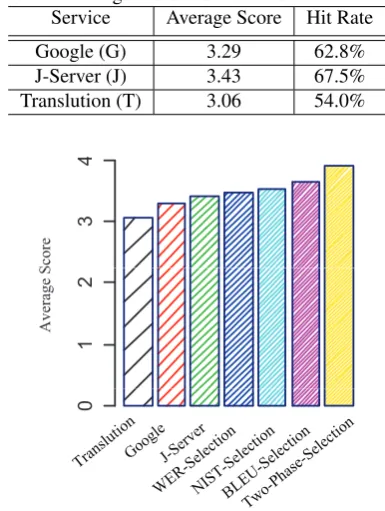
The results achieved when no service selection is per-formed are shown in Table 1. Google received average hu-man score of 3.37, J-Server got 3.43, and Translution got 3.06. Manual selection on the three sets of translation re-sults yielded 116 sentence by Google, 143 by J-Server, and 41 by Translution. Compared to manual selection, the hit rate of Google is 62.8%, J-Server is 67.5%, and Translu-tion is 54.0%. J-Server has highest average and hit rate for this Japanese-English translation task. From the hit rate, we find that no MT service dominates the other services (otherwise its hit rate will be 100%).
Table 1: Average score and hit rate of MT services Service Average Score Hit Rate
Google (G) 3.29 62.8%
J-Server (J) 3.43 67.5%
Translution (T) 3.06 54.0%
3
4
S
co
re
1
2
A
v
er
ag
e
S
0
Figure 4: Comparison of Average Score
The results achieved when service selection is performed,
are shown in Table 2. We compare the use of only one evaluation method and the proposed two-phase selection, which selects from among the evaluation methods avail-able. Using just only one evaluation method, WER, the average score and hit rate are 3.47 and 72.0%, which is a little better than J-Server. BLEU has heigher average score and hit rate than WER and NIST: 3.56 and 76.2%. While using the proposed two-phase selection mechanism, the av-erage score and hit rate of MT service selection are 3.81 and 81.7%. From the comparison of Average Score (see Figure 4) andHit Rate(see Figure 5), we find that the pro-posed two-phase selection raises the translation quality re-ceived by users.
Compared to BLEU selection in Table 2, the proposed two-phase selection has higher hit rate and 7% promotion on average score. Moreover, compared to only one service in Table 1, like just J-Server, the two-phase type selection mechanism offers an 11.1% increase in average score.
e 0
.6
0
.8
H
it
R
a
te
0
.2
0
.4
0
.0
Figure 5: Comparison of Hit Rate
4.3. Discussion
Some limitations of the proposed two-phase evaluation for MT service selection are considered. First, the existing evaluation methods limit the gains possible with the pro-posed mechanism. The mechanism is not intended to es-tablish a new evaluation method, but to make better use of existing methods. Creating a superior evaluation method is one of the hardest issues in machine translation and natu-ral language processing. Thus, it is meaningful to achieve progress through better utilization of existing evaluation methods. Note that it is easy to import newly created eval-uation methods into the proposed mechanism.
Second, data driven classification needs a large training set, which involves time consuming manul effort. Mining users logs to build more training sets will be very helpful. If we tell a MT service user that his feedback will help to promote translation quality, he will be more willing to generate use-ful MT service usage logs. Moreover, we already trying to integrate human activities into composite service (Lin et al., 2010). Success in this are will make it easier to prepare large training sets.
Table 2: Comparing average score and hit rate of two selection types
MT Selection Type Selected Translation Results of MT Services (total 300) Average Score Hit Rate
WER selection 122 from Google, 127 from J-Server, 51 from Translution 3.47 72.0% NIST selection 127 from Google, 125 from J-Server, 48 from Translution 3.53 74.5% BLEU selection 134 from Google, 122 from J-Server, 44 from Translution 3.56 76.2% Two-phase selection 115 from Google, 146 from J-Server, 39 from Translution 3.81 81.7%
community translation developers was not presented in de-tail. Because the proposed broker for MT service selection, is itself is a Web service, after it is published in Web service registry, and the translation quality value of unitary mea-surement is given (see Section 3.1.). Thus, it can be treated as a single MT service.
5.
Related Work
First, automatic evaluation methods have been proposed on many mechanisms, includes string-based comparison, syn-tactic mechanism, and semantic mechanism. String-based comparison compares the translation result to standard ref-erences, and it is currently the most popular mechanism. There are several ways to compare the similarity, including lexical distance, and n-gram precision. Two common lexi-cal distances are length of least common sub-string, such as ROUGE-L (Lin, 2004), and ROUGE-W (Lin, 2004), and edit distance, such as WER (Nieen et al., 2000) and TER (Snover et al., 2006b). N-gram precision has also been extensively studied, such as BLEU (Papineni et al., 2002), NIST (Doddington, 2002), METEOR (Banerjee and Lavie, 2005), and ROUGE-N (Lin, 2004). The syntactic mech-anism analyzes whether the translation result is in accor-dance with the syntax of target language, such as linguis-tic error classification (Farrs et al., 2012). The semanlinguis-tic mechanism checks whether the translation result semanti-cally agrees with the translation source, such as the lex-ical semantic similarity integration (Wong, 2010). When software of these evaluation methods have been prepared for sharing they can be wrapped into services by Language Grid platform, which makes our proposal more powerful.
Next, human evaluation is important to confirm any auto-matic evaluation method using norms such fluency and ad-equacy. Semi-automatic evaluation has also received a lot of attention, such as the evaluation method HTER (Snover et al., 2006a), which requires human editing. The proposed mechanism also requires human assessment for preparing training set, which builds up the data-driven classification.
Last, making evaluation methods easier to access is becom-ing a strong demand. There are some research on how to prepare references for these evaluation methods. Cur-rently, there is no powerful way to utilize unsupervised ref-erences. Though many studies have pointed out that round-trip translation is not adequate, others treat round-round-trip trans-lation as the easy approach with the lowest costs (Hu, 2009). Research is progressing on ways to provide stan-dardized interface (Cer et al., 2010) or even evaluation ser-vices (Eck et al., 2006), so that these functions can be uti-lized by more people. The proposed mechanism has bene-fited a lot from such existing research.
6.
Conclusion
We proposed a two-phase evaluation for MT service selec-tion that suits for both end-users and community translaselec-tion developers. Because of increased the number of MT ser-vices, we face the problem of selecting, for the given trans-lation source, the best MT service. Considering ease of im-plementation and extendibility, we designed two-phase ar-chitecture for selecting MT services. In the first phase, we import multiple evaluation methods, analyze attributes of the translation source, and select the most appropriate eval-uation method using the decision tree approach. This data-driven classification enables one among multiple evaluation methods to be selected dynamically, and voids the deficien-cies raised by employing just one evaluation method. In the second phase, the MT services are executed based on the Language Grid platform. The results of MT services are evaluated by the selected evaluation method. The trans-lation quality values are generated and ranked yielding the best translation result. We designed an algorithm for this MT service selection.
Finally, we implemented and tested a prototype based on the proposed mechanism. The results showed that the pro-posed mechanism offers better translation quality than em-ploying just one MT service. Our proposal raises the trans-lation quality by 7% compared to the approach which em-ploys just one evaluation method, and at least 11.1% pro-motion than employing just one MT service.
Acknowledgement
This research was partially supported by Service Science, Solutions and Foundation Integrated Research Program from JST RISTEX.
7.
References
S. Banerjee and A. Lavie. 2005. Meteor: An automatic metric for mt evaluation with improved correlation with human judgments. In Proceedings of the 43rd Annual Meeting of the Association of Computational Linguistics (ACL-2005), pages 65–72.
Arif Bramantoro, Ulrich Schfer, and Toru Ishida. 2010. Towards an integrated architecture for composite lan-guage servicesand multiple linguistic processing compo-nents. InLREC 10, pages 3506–3511.
George Doddington. 2002. Automatic evaluation of ma-chine translation quality using n-gram co-occurrence statistics. In Human Language Technology conference (HLT-2002), page 128132.
Matthias Eck, Stephan Vogel, and Alex Waibel. 2006. A flexible online server for machine translation evaluation. InProceedings of EAMT 2006, Oslo, Norway.
Mireia Farrs, Marta R. Costa-Juss, and Maja Popovic Morse. 2012. Study and correlation analysis of linguis-tic, perceptual, and automatic machine translation evalu-ations. InJASIST, pages 174–184.
Chang Hu. 2009. Collaborative translation by monolingual users. InProceedings of the 27th international confer-ence extended abstracts on Human factors in computing systems, CHI EA ’09, pages 3105–3108, New York, NY, USA. ACM.
Toru Ishida. 2011. The Language Grid: Service-Oriented Collective Intelligence for Language Resource Interop-erability. Springer.
Donghui Lin, Yoshiaki Murakami, Toru Ishida, Yohei Mu-rakami, and Masahiro Tanaka. 2010. Composing human and machine translation services: Language grid for im-proving localization processes. InLREC 10, pages 500– 506.
Chin-Yew Lin. 2004. Rouge: a package for automatic eval-uation of summaries. Inthe Workshop on Text Summa-rization Branches Out (WAS 2004), pages 25–26. Yohei Murakami, Donghui Lin, Masahiro Tanaka, Tako
Nakaguchi, and Toru Ishida. 2010. Language service management with the language grid. In LREC, pages 3526–3531.
Sonja Nieen, Franz Josef Och, Gregor Leusch, and Her-mann Ney. 2000. An evaluation tool for machine trans-lation: Fast evaluation for mt research. InProceedings of the 2nd International Conference on Language Re-sources and Evaluation (LREC), pages 39–45.
Franz Josef Och. 2003. Minimum error rate training in sta-tistical machine translation. InProceedings of the 41st ACL, pages 160–167, Stroudsburg, PA, USA.
Kishore Papineni, Slim Roukos, Todd Ward, and Wei-Jing Zhu. 2002. Bleu:a method for automatic evaluation of machine translations. In 40th Annual Meeting of the Association for Computational Linguistics(ACL-2002), pages 311–318.
J. Ross Quinlan. 1993.C4.5: programs for machine learn-ing. Morgan Kaufmann Publishers Inc., San Francisco, CA, USA.
M. Adel Serhani, Rachida Dssouli, Abdelhakim Hafid, and Houari Sahraoui. 2005. A qos broker based ar-chitecture for efficient web services selection. InProc. 2005 IEEE International Conference on Web Services (ICWS05, pages 113–120. IEEE Computer Society. M. Snover, Dorr B., R. Schwartz, L. Micciulla, and
J. Makhoul. 2006a. A study of translation edit rate with targeted human annotation. InProceedings of Associa-tion for Machine TranslaAssocia-tion, page 223231.
Mathew Snover, Bonnie Dorr, Richard Schwartz, John Makhoul, and Linnea Micciula. 2006b. A study of trans-lation error rate with targeted human annotation. In
Pro-ceedings of the Association for Machine Translation in the Americas Conference 2006, pages 223–231.
M. Tian, A. Gramm, H. Ritter, and J. Schiller. 2004. Effi-cient selection and monitoring of qos-aware web services with the ws-qos framework. In in Proceedings of the IEEE/WIC/ACM International Conference on Web Intel-ligence, pages 152–158.