Using models to enhance the intellectual content of
learning in developmental biology
JOHN C. MCLACHLAN*
Peninsula Medical School, Tamar Science Park, Plymouth, UK
ABSTRACT Models have been particularly useful in developmental biology over the last 30 years. At first, underlying control mechanisms were poorly understood, but over time a wealth of detailed information became available to provide an increasingly detailed knowledge of underlying mecha-nisms, at levels from genes through cells to organs, organisms and populations. Models are also of great value in teaching developmental biology, as they allow students to explore phenomena hard to perceive directly because of their scale, accessibility, expense or other considerations. A model may allow students to “experiment” in ways which would be impractical in real life, as well as give them a deep understanding of competing hypotheses of development. Lastly, students can be challenged to produce models of their own, whereas only rarely are they able to carry out original experiments. I discuss two main kinds of models and their uses in generating, testing and expounding hypotheses and point out dangers in the use of models in education. Models may draw upon and reflect the consensus paradigm in the field: a researcher may be able to appreciate that models are interim conditional statements of probability and use them to generate new knowledge. A student may be less able to do so and may fail to appreciate where new knowledge will come from. And unlike physics, biology is stochastic and contingent and can never be entirely deduced from first principles, implying that models can never be as perfect in any biological field as they can be in some other fields.
KEY WORDS:
mathematical modelling, hypothesis, practical, structural, process
0214-6282/2003/$25.00 © UBC Press
Printed in Spain
www.ijdb.ehu.es
*Address correspondence to: Dr. John C. McLachlan. Peninsula Medical School, Tamar Science Park, Plymouth PL6 8BX, U.K. Fax: +44-1752-238-001. e-mail: [email protected]
Background Information
Scholarly Interests of the Author
The author’s interests include both the philosophy of develop-mental biology and the philosophy of education, particularly as-sessment. In rather more practical terms, I have worked exten-sively with the development of models, both process and structural! Structural models include three-dimensional computer-based re-constructions of embryonic and adult structures. With embryonic models, it has proved possible to display gene expression patterns and animate changes in time. Animation is a powerful support to understanding, both for novices and for experts.
More generally, my interests include mechanisms which lead to morphogenesis but which are not specified by the genome. These include physical and mathematical constraints, specification by use, complex interactions between tissues, and, most especially, self-establishing patterns of the kind foreseen by Alan Turing. In recent times, a Science/Art collaboration with the internationally renowned artist Helen Storey has proved fruitful in promoting creative thinking.
Representative Publications
MCLACHLAN, J.C. (1999). The use of models and metaphors in developmental biology. Endeavour. 23: 51-55.
MCLACHLAN, J.C. (1999). Morphologies not directly specified by the genome within the individual. In Spatio-Temporal Patterns in Biology (Eds. Chaplain, M., McLachlan, J.C. and Singh, G.) John Wiley and Sons, Cambridge. pp. 157-172.
WHITEN, S., SMART, S.D., MCLACHLAN, J.C. and AITON, J.F. (1998). Computer aided interactive 3D reconstruction of the embryonic human heart. J. Anat. 193: 337-346.
General Teaching Philosophy
junior students should be given different answers to experienced students; visual learners should be given different answers to text learners; and so on. And an answer is best understood when the question has been clearly posed and thoroughly explored before-hand.
What are Models?
Definitions
We can draw a clear distinction between models and hypoth-eses. A hypothesis is a proposed explanation that accounts for observed phenomena or known facts, and that can be used to guide further investigation. It is a general statement deduced from particular circumstances. A model is commonly used in develop-mental biology to describe particular circumstances which may be derived from general principles. The Concise Oxford Dictionary offers the following definitions of “model”:
1) representation in three dimensions of a proposed structure 2) working model: imitating movements of the machine it
repre-sents
3) to give shape to an (argument) 4) to display (garment) by wearing it
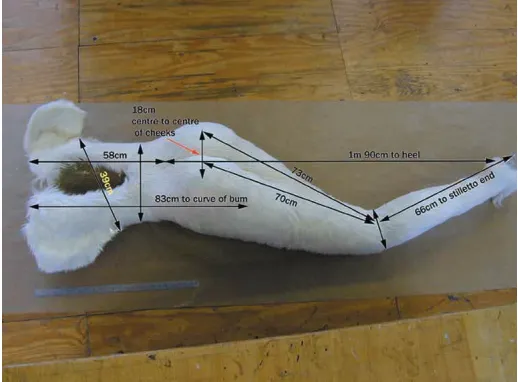
As the fourth of these conditions indicates, the word “model” has irresistible connotations of the fashion industry, and this might seem quite remote from developmental biology. However, the fashion designer Helen Storey, working with her sister, the respected devel-opmental biologist Kate Storey, produced an exhibition called “Primi-tive Streak,” in which embryo structures were made visible as artistic artefacts. Subsequent to this, the author and Helen Storey collabo-rated on an exhibition called “Mental,” which has appeared in Copenhagen and at the Institute of Contemporary Arts in London (www.helenstoreyfoundation.org/). This quite literally “models” bio-logical phenomena in a responsive way (Fig. 1).
Kinds of Model
I have previously argued (McLachlan, 1999) that models in developmental biology can be of two main kinds.
They may be representations of a structure. These may be physical, mathematical or computer-generated forms, among many others. A structure model need not be static, of course. A computer model can change with time, and a mathematical model can include variables. Such structure models enable us to visualise the inaccessible. They may enable us to “see” a structure which is too large, too small, too hot, and so on. A structure model ought to represent the phenomenon under investigation as closely as possible. The act of making the model may force the modeller to think about the underlying processes involved, but the model is not deduced from these processes.
Alternatively, models may be representations of a process. Again, these may take a variety of forms. It is easy to imagine mathematical or computer simulations of process models. How-ever, it is also perfectly possible to make a physical process model. For instance, Peter Lawrence famously made “sand-box” models of potential gradients in insect development (Lawrence, 1966). In these models, sand flowed from different levels as barriers were removed to construct a variety of gradient forms.
Process models are deduced from proposed first principles, and may generate forms which are quite unlike the real world if the underlying theories are wrong. A useful role of process models is to rule out possibilities as having impossible consequences. A process model allows us to experiment on the inaccessible, to explore consequences of changes or manipulations which in the real world may not be possible for practical or ethical reasons.
Structure models help us see how something is made, while process models help us understand how something works. Struc-ture models empower thinking by analogy, while process models empower thinking by analysis. However, despite these appar-ently profound differences, the two kinds of model are only formally distinct: in practice, they may coincide. In some ways, they represent ends of a continuous spectrum rather than a true opposition of categories. It would be perfectly possible for both a function model and a process model to be constructed for a given phenomenon, and for these to work towards each other, so that true understanding came when they met. Equally, it would be possible for a single model to feature aspects of both process and structure.
An instructive illustration is found in physics. The radiation emitted by a “black body” was known from observation. However, the classical physics process model, deduced from what was known at the time, produced an impossible result—the “ultraviolet catastrophe.” Planck constructed an apparently trivial structure model by fitting a curve to the observed radiation value, and subsequently realised that the mathematical assumptions he had made (involving small discrete packages of energy) actually provided a process explanation.
Purposes of Models
Models, of whatever kind, fulfil three main purposes. These correspond to different stages of the discovery process applied to scientific phenomena.
First, when the causes of some phenomenon are entirely mysterious, then a model may help generate hypotheses for subsequent testing.
A
B
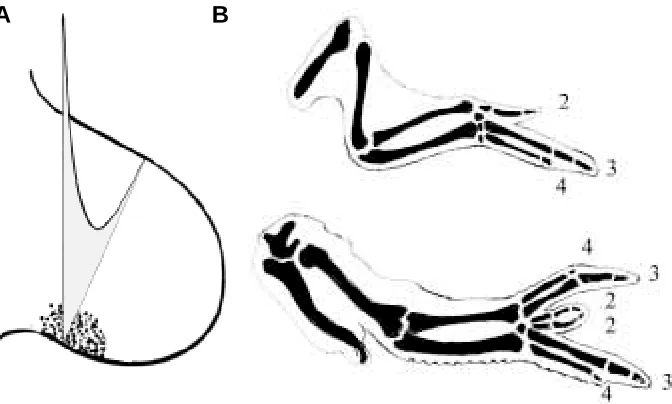
Fig. 2. Gradient models of limb development. In (A), the putative gradient of a signalling substance across an early chick limb bud from the proposed special signalling region postulated by Wolpert and others is shown. In (B), a normal embryonic chick wing is shown above and a reduplicated limb following a graft of posterior limb tissue to the anterior margin is shown below, with the digital formula marked according to the normal convention. The gradient model can predict this, but so can the polar co-ordinate model.
exploring its implications, and even, if they are equipped with sufficient creativity, of develop-ing new models. Modelldevelop-ing therefore repre-sents a unique opportunity to “learn by doing” in the style approved by learning theorists.
Identifying Hypotheses
Alan Turing famously argued that order could arise from homogenous steady states under particular mathematical conditions (Tur-ing, 1954). Information-rich states could there-fore arise from information-poor states. In the real world, this would require the purchase of information at the cost of energy.
As this is a way of creating pattern indepen-dent of the twin biological dogmas of inherit-ance of pattern or imposition of an external pattern from the environment, it has naturally attracted the attention of, aptly named, math-ematical modellers. A variety of models of this kind have therefore been constructed (Meinhardt, 1982). These are particularly in-structive for teaching processes.
A particular example is in modelling coat pigmentation and other colour patterns (Murray,
Second, when competing biological explanations are available, a model may help discriminate between hypotheses.
Third, when a well-established hypothesis is available, models may facilitate use of the hypothesis.
Examples of each of these are given below. First, however, it is necessary to point out that models in any biological field are rather different from models in the physical and mathematical sciences. There are two reasons for this. The first is that biology is innately variable. The charge on a sub-atomic particle is consistent from particle to particle of that class. The weight of a dog varies widely from animal to animal, and from time to time. The second is that biology is heavily dependent on past accidents of evolution. The consequence of this is that biology is never entirely deducible from first principles.
Information Transfer – Models in Teaching
There are a variety of theories of learning which currently influence teaching. These include Andragogy (Knowles, 1980), Social Constructivism (Vygotsky, 1978), Social Cognitive Theory (Bandura, 1986) the “Reflective Practitioner” (Schön, 1983, 1987), Transformative Learning, (Mezirow, 1994), Self Directed Learn-ing (Candy, 1991) and Experiential LearnLearn-ing (Kolb, 1984). Al-though they are of varied kinds, they all emphasise the value of previous experiences and contextual learning. But how can information be given contextual value when it is truly novel— when it lies outside all previous conceptions and even outside our range of perceptual contexts? The answer is through analogy— by saying that the novel thought is “like” some other observed or demonstrated phenomenon—in other words by a model or meta-phor. This has explanatory power, but rather uniquely, it also has exploratory power for the beginner. Where novices can only rarely access the technology to carry out innovative research, they all have the option of reflecting on a model or hypothesis, of
1988). Here are found mathematical models which are unashamedly structure models. They aim to represent the patterns which arise in nature, but, initially at least, make no gesture at all towards biological phenomena. The observation that they can nonetheless model patterns observed in nature gives students a chance to reflect on what they might suggest as possible process models. An example of how this can happen is in a further model proposed by Murray and co-workers (Cruywagen and Murray, 1992; Murray and Swanson, 1999), in which cell properties are used to generate interactions which show the same properties as the mathematical equations underlying descriptions of this kind. Predictions could be made as to the necessary boundary conditions which might be required of a biology which supported the mathematics—diffusion rates, dimen-sions over which pattern forming can take place, the existence of autocatalytic properties and so on.
Students could usefully focus on the pigmentation patterns of mollusc shells which currently have no biological explanation—many are found in species living in cryptic environments and hence have no adaptive value. This might be taken to imply that they are trivial— but equally it could be concluded that they represent underlying mechanisms of particular profundity, since they become apparent for no obvious cause. Similar patterns to those on mollusc shells can be generated by mathematically derived models (Meinhardt, 1998). The same process models can be applied to aspects of plant morphology (Meinhardt et al., 1998), which is pleasing, since botanical develop-ment is rarely given its due importance.
Such process models offer even novices the opportunity to speculate on underlying biological mechanisms. In part, the value of these models is just that they lie outside existing paradigms, and therefore can serve to challenge and stimulate students.
Distinguishing between Hypotheses
regen-eration. Two schools of thought arose with regard to these obviously related phenomena. The first came from studies of limb development, in the chick embryo, and emphasised gradient signalling from heterogeneous tissues (Fig. 2; see also Tickle et al., 1975; Wolpert, 1978). The second arose from studies of regeneration in insect limbs and embryonic disks prior to meta-morphosis and of amphibian limbs, and emphasised local interac-tions within equivalent regions - the polar co-ordinate theory (Fig. 3; see also French et al., 1976; Bryant et al., 1977). Each proved capable of extension outside their original area —gradient theo-ries to regeneration and polar co-ordinate theotheo-ries to initial development.
For a time these two, quite incompatible classes of model occu-pied apparently identical ground (Muneoka and Bryant, 1982). Devising a critical test proved by no means straightforward, espe-cially in the face of the ingenuity of modellers in preserving their models by auxiliary hypotheses. However, eventually (in the view of the author, but not necessarily all those involved!), the original polar co-ordinate model was demonstrated to be incompatible with new observations (Holder and Weekes, 1984), and, therefore, had to be modified in a way which diluted its power to predict (Bryant et al., 1981). However, as Richard Feynman (1964, quoted in Taubes, 1998, p. 903) indicated, “you cannot prove a vague theory wrong. . . . If the process of computing the consequences is indefinite, then with a little skill any experimental results can be made to look like the expected consequences.”
The gradient model also received support from novel studies of gene expression patterns (Riddle et al., 1993), studies in part provoked by the clash of models which had identified the need for critical experiments and suggested their nature.
This unusually clear clash of models is a gift to the teacher. Students can become sufficiently familiar with the techniques in-volved from reading the papers to suggest experiments themselves, and can instructively be invited to act as advocates for one of the two possibilities. This lends a degree of philosophical sophistication to the arguments which could never be achieve by commencing with the molecular histology of the gene expression patterns themselves. It is a truism that answers are best appreciated after a through understanding of the problem has first been gained.
Exploiting Hypotheses
Examples of models which help utilise or explain a well-estab-lished hypothesis are common. These correspond to the common usage of a “simulation,” and often find applications in teaching. Indeed, teachers have used physical models for many generations. Models of human and animal embryos at different stages were one of the first examples of 3-D modelling, built up laboriously to give students an appreciation of proportions and relationships in struc-tures too small, or too homogenous, to allow students to appreciate these considerations in the original. Equally 3-D technology and animation now allow students to observe models in an interactive way, quite unlike anything that was ever possible before (McLachlan et al., 1997).
Models based on well-supported hypotheses allow students to carry out “experiments”—manipulations of test variables under a number of conditions—and to “observe” the consequences. Such uses of models are extremely valuable: they may be less expensive or pose fewer ethical dilemmas than use of live material. More importantly, they can usually be relied on to “work” and not to go wrong for all the myriad reasons that affect real tissues. They work best when the predictions of the underlying hypotheses are clear, but their action in combination is too complex to be intuited. A number of commercial simulations of physiology and pharmacology are avail-able, but I don’t know of any that model developmental processes in this way. Teratology might offer a potentially instructive example.
One good example of this kind of model in developmental biology is the gene network model proposed by Kaufman (1993). He considered a rather simple system in which each “gene” was regulated by two others. However, he applied this to a model genome of 10,000 genes, and discovered that there were only 100 stable states out of over 200,000 possible states. Each of the stable states
A
B
in principle could correspond to a differentiated cell type, and these tend to remain stable even in the face of perturbation by mutation, a counter-intuitive observation which is very striking.
Dangers of Modelling in Teaching
Science has two allowable “lies.” The first is that of retrospective justification. Once a programme of research has recorded a result, it is written up as if the discovery had been intended all along. The second is that of the elimination of uncomfortable observations in teaching. Theories are virtually always internally consistent, and this is achieved by disregarding those pieces of evidence which do not fit. Researchers may be subliminally aware of these pieces of informa-tion, and when the opportunity comes along to present a new hypothesis, the “junk facts” are revived to fit in with the new model. Novices rarely have access to the junked facts, and therefore theories can remain perfectly convincing. An example would be the discovery of genetic imprinting. Many developmental biologists “knew” that embryos, particularly human embryos, which had two copies of the maternal or paternal genome would develop very abnormally. However, since this could not be accounted for by known genetic mechanisms, it was ignored. One might expect that observa-tions incompatible with an existing model would have a particularly high profile: the reverse is in fact the case. Novices may therefore be presented with arrays of evidence entirely consistent with a particular model, and be unable as a result to interpret the facts in any other way.
Even if students are presented with discordant facts, the impact of an initial model can be so overwhelming that it makes a long-lasting impression. Having experienced the “actuality” of a model may make learners believe that they have experienced the actuality of reality. Use of models in developmental biology teaching is therefore full of promise and also full of danger.
Conclusions
Models in developmental biology fulfil different functions at differ-ent stages in the unravelling of any particular problem. A model is not necessarily most useful when it subsequently proves to be “right.” On the contrary, a model may prove to be most useful by being wrong - by generating predictions from proposed first principles which prove not to be in accord with observations. In general, models serve to generate testable hypotheses and are therefore a stimulus to creativity.
Acknowledgements
Grateful thanks to Helen Storey for permission to use Fig. 1. Reprinted material from Endeavour Vol. 23, McLachlan, J.C. The use of models and metaphors in developmental biology. pp 51-55, Copyright Year 1999 is used with permission from Elsevier Science.
References
BANDURA, A. (1986). Social Foundations of Thought and Action: A Social Cognitive Theory. Prentice-Hall, Inc., Englewood Cliffs, New Jersey.
BRYANT, P.J., BRYANT, S.V. and FRENCH, V. (1977). Biological regeneration and pattern formation. Sci. Am. 237 (July): 66-81.
BRYANT, S.V., FRENCH, V. and BRYANT, P.J. (1981). Distal regeneration and symmetry. Science 212: 993-1002.
CANDY, P.C. (1991). Self-Direction in Lifelong Learning. Jossey Bass, San Francisco, California.
CRUYWAGEN, G.C. and MURRAY, J.D. (1992). On a tissue interaction model for skin pattern formation. J. Nonlinear Sci. 2: 217-240.
FRENCH, V., BRYANT, P.J. and BRYANT, S.V. (1976). Pattern regulation in epimorphic fields. Science. 193: 969-981.
HOLDER, N. and WEEKES, C. (1984). Regeneration of surgically created mixed-handed axolotl forelimbs: pattern formation in the dorsal-ventral axis. J. Embryol. Exp. Morph. 82: 217-239.
KAUFMAN, S.A. (1993). Origins of Order. Oxford University Press, Oxford. KNOWLES, M.S. (1980). The Modern Practice of Adult Education: From Pedagogy to
Andragogy 2nd edn. Cambridge Books, New York.
KOLB, D.A. (1984). Experiential Learning: Experience as the Source of Leaning and Development. Prentice Hall, New Jersey.
LAWRENCE, P.A. (1966). Gradients in the insect segment: the orientation of hairs in the milkweed bug. Oncopeltus fasciatus. J. Exp. Biol. 44: 407-420.
MCLACHLAN, J.C. (1999). The use of models and metaphors in developmental biology. Endeavour. 23: 51-55.
MCLACHLAN, J.C., AITON, J.F., WHITEN, S.C. and SMART, S.D. (1997). 3-D modelling of human embryo morphology using QuickTime VR™. In Molecular Genetics of Early Human Development. (Eds. Strachan, T., Lindsay, S. and Wilson, D.). Bios Scientific Publishers Ltd, Oxford, pp 227-237.
MEINHARDT, H. (1982). Models of Biological Pattern Formation. Academic Press, London.
MEINHARDT, H. (1998). The algorithmic beauty of sea shells, 2nd edn. Springer, New York.
MEINHARDT, H., KOCH, A.J. and BERNASCONI, G. (1998). Models of pattern formation applied to plant development. In Symmetry in Plants. (Eds. Barabe, D. and Jean, R.V.). World Scientific, Singapore, pp 723-758.
MEZIROW, J. (1994). Understanding transformation theory. Adult Educ. Quarterly 44(4): 222-244.
MUNEOKA, K. and BRYANT, S.V. (1982). Evidence that patterning mechanisms in developing and regenerating limbs are the same. Nature 298: 369-371. MURRAY, J.D. (1988). How the leopard gets its spots. Sci. Am. 259 (March): 62-69. MURRAY, J.D. AND SWANSON, K.R. (1999). On the mechanochemical theory of
biological pattern formation with applications to wound healing and angiogenesis. In Spatio-Temporal Patterns in Biology. (Eds Chaplain, M., McLachlan, J.C. and Singh, G.). John Wiley and Sons, Cambridge, pp. 251-285.
RIDDLE, R.D., JOHNSON, R.L., LAUFER, E. and TABIN, C. (1993). Sonic Hedgehog mediates the polarising activity of the ZPA. Cell 75: 1401-1416.
SCHÖN, D.A. (1983). The Reflective Practitioner: How Professionals Think in Action. Basic Books, Inc., New York, pp. 57-60.
SCHÖN, D.A. (1987). Educating the Reflective Practitioner: Towards a New Design for Teaching and Learning in the Professions. Basic Books, Inc., New York, pp. 57-60. TICKLE, C., SUMMERBELL, D. and WOLPERT, L. (1975). Positional signalling and
specification of digits in morphogenesis. Nature 254: 199-202.
TURING, A.M. (1954). The chemical basis of morphogenesis. Phil. Trans. Roy. Soc. Lond. Ser. B 237: 37-72.
WOLPERT, L. (1978). Pattern formation in biological development. Sci. Am. 239 (October): 159-164.