VALIDATION STUDY OF STEROIDAL DRUGS (DEXAMETHASONE AND BETAMETHASONE) BY
U.V. SPECTROPHOTOMETRIC METHOD
Assistant Professor, Institute of Forensic Science, Gujarat Forensic Sciences University, Gandhinagar – 382 007, Gujarat, India. Email: [email protected]
Received: 26 September 2018, Revised and Accepted: 04 June 2018 ABSTRACT
Objective: The present investigation involves development and validation of ultraviolet (UV) spectroscopic method for estimation of dexamethasone and betamethasone in a pharmaceutical dosage as per International Council for Harmonisation of Technical Requirements for Pharmaceuticals for Human Use (ICH) guidelines.
Method: Betamethasone and dexamethasone were dissolved in 50 mL Methanol: water (1:2) and 50 mL distilled water, respectively. The method was validated for accuracy, precision, linearity, ruggedness, and robustness to check its consistency.
Result: The λmax or the absorption maxima of both the drugs was found to be 241 nm. A linear response was observed in the range of 10–20 μg/mL.
Conclusion: The method could be applied for the analysis of marketed tablets and also can be used for the routine analysis of dexamethasone and betamethasone in bulk formulations using UV method. It is suitable for the intended purpose especially in forensic science laboratories and other laboratories involved in the pharmaceutical analysis.
Keywords: Dexamethasone, Betamethasone, Method validation, Ultraviolet spectroscopy, Accuracy, Precision.
INTRODUCTION
Spectroscopy [1] is the branch of science which deals with the study of the interaction of electromagnetic radiation with matter. In such type of interaction, energy is absorbed or emitted by the matter in discrete amounts known as quanta. The absorption or emission processes take place ranging from the gamma region to the radio region throughout the electromagnetic spectrum. The data that are obtained from this technique are called a spectrum. A spectrum is generally a plot of the intensity of energy that is detected versus the wavelength or mass or momentum or frequency, etc., of the energy.
A spectrum is used to obtain information about atomic and molecular energy levels, molecular geometries, chemical bonds, interactions of molecules, and related processes. Often, spectra are used for qualitative assessment of components present in a sample, or it may also be used to quantify the amount of material in a sample.
Analytical method validation [1] establishes scientific evidence that a process is capable of consistently delivering quality products by the collection and evaluation of data, from the process design stage throughout production.
Validation [1] is an act of proving that any procedure, process, equipment, material, activity, or system performs in a manner as it is expected to under given set of conditions and is also responsible for the required accuracy, precision, sensitivity, ruggedness, etc.
When the same is extended to an analytical procedure, depending on the application, it means that a method works reproducibly, when carried out by same or different persons, in same or different laboratories, using different reagents and different equipments.
Dexamethasone is a type of steroid medication. It is used in the treatment of rheumatic problems, a number of skin diseases, severe allergies,
asthma, chronic obstructive lung disease, croup, brain swelling, and in tuberculosis along with antibiotics, and among others. In adrenocortical insufficiency, it should be used together with a medication that has greater mineralocorticoid effects such as fludrocortisone. In preterm labor, it may be used to improve outcomes for the baby. It may be taken by mouth, as an injection into a muscle, or intravenously.
The effects of dexamethasone are frequently seen within a day and last for about 3 days. Dexamethasone was first made in 1957. It is in the World Health Organization (WHO) model list of essential medicines, the most important medications needed in a basic health system. Various reports have been found for quantitative determination of dexamethasone in real samples with different matrices. They include spectrophotometry [2], liquid chromatography [3,4], liquid chromatography-mass spectrometry [5,7], and electrochemical methods [8]. The methods have limitations such as high cost and hard operation [3-7] and low repeatability.
Betamethasone is the most potent glucocorticoid steroid with anti-inflammatory and immunosuppressive properties. Unlike other drugs with similar effects, betamethasone does not cause water retention. It is applied as a topical cream, ointment, foam, or lotion to treat itching. Betamethasone sodium phosphate is sometimes prescribed as an intramuscular injection in itching from various ailments, including allergic reactions from poison ivy and similar plants. It is also in the WHO List of essential medicines.
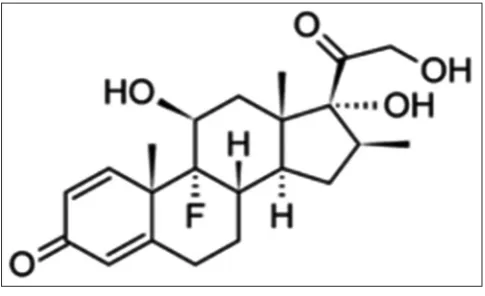
Several analytical methods have been used for the analysis of betamethasone such as spectrophotometry [9,10], high-performance liquid chromatography [11-15], and liquid chromatography-mass spectroscopy [16]. We have made an effort to develop simple, cost-effective and robust method for the analysis of dexamethasone and betamethasone and the same was validated which could be used in the forensic and other analytical laboratories without much complication (Figs. 1 and 2)
© 2018 The Authors. Published by Innovare Academic Sciences Pvt Ltd. This is an open access article under the CC BY license (http://creativecommons. org/licenses/by/4. 0/) DOI: http://dx.doi.org/10.22159/ajpcr.2018.v11i7.22794
Research Article
Since dexamethasone and betamethasone are important steroidal drugs and can be adulterated in various herbal formulations, and there is no simple method available till date for testing it; thus, the study presented here can be used in various forensic sciences laboratories and other laboratories to test for the presence of these drugs.
MATERIALS AND METHODS Experimental apparatus
Ultraviolet (UV)-visible double beam spectrophotometer of Shimadzu with 1 cm stopper of quartz cells was used for the absorbance measurements.
Materials
Analytical reagent grade methanol, betamethasone sodium phosphate, and dexamethasone of Sigma were used. All other reagents and solvents used were of analytical grade.
Analysis of tablets
Betamethasone: For the preparation of the stock solution, 4 tablets of Betamethasone were weighed and transferred to a 100 mL volumetric flask containing 50 ml MeOH: water (1:2). The flask was shaken, and the volume was made up to the mark with the same solution. The mixture from the flask was filtered through Whatman filter paper to get a clear solution and was again made up to the mark. This would give a solution containing 20 μg/mL betamethasone.
Dexamethasone: For the preparation of the stock solution, 4 tablets of dexamethasone were weighed and transferred to a 100 mL volumetric
flask containing 50 mL distilled water equivalent to a pure form of dexamethasone. The flask was shaken, and the volume was made up to the mark with distilled water. The mixture from the flask was filtered through Whatman filter paper to get a clear solution and was again made up to the mark. This will give a solution containing 20 μg/mL Dexamethasone.
Preparation of dilutions
Betamethasone
From stock solution of drug, serial dilutions ranging from 5, 6, 7, 8, 9, and 10 mL were transferred in series of 10 mL volumetric flask followed by making volume up to 10 mL with MeOH: water (1:2) which gives concentration of betamethasone 10, 12, 14, 16, 18, and 20 µg/mL, respectively.
Dexamethasone
From stock solution of drug, serial volume ranges from 5, 6, 7, 8, 9, and 10 mL were transferred in series of 10 mL volumetric flask followed by making volume up to 10 mL with distilled water which gives concentration of Dexamethasone 10, 12, 14, 16, 18, and 20 µg/mL, respectively.
Validation of the method
The method analytical performance was validated by evaluation of the following parameters: Linearity, limit of detection (LOD), limit of quantitation (LOQ), intraday and interday precision and accuracy, selectivity and specificity, according to ICH guidelines [17-19].
Linearity
Different levels of standard solution were prepared by diluting known volumes of stock solution (20 ppm) with the diluents to get the required analyte concentrations in the range of 10–20 μg/mL for betamethasone and dexamethasone. A graph of concentration (μg/mL) versus absorbance was plotted, and the regression coefficient “r2”, y-intercept,
and slope of the regression were calculated.
LOD
It is defined as the lowest amount of analyte in a sample that can be detected but not necessarily quantitated under the stated experimental condition. LOD can be calculated using following equation as per the ICH guideline.
LOD = 3.3 * N/S
Where N is the standard deviation of the response of drug and S is the slope of the corresponding calibration curve.
LOQ
It is the lowest concentration of an analyte in a sample that can be quantitated with the acceptable precision and accuracy under stated experimental condition. LOQ can be calculated using following equation as per the ICH guideline.
LOQ = 10 * N/S
Where N is the standard deviation of the response of drug and S is the slope of the corresponding calibration curve.
Precision
Intraday precision
Intraday precision was assessed by analyzing the solutions on same days. The percentage assay and percentage relative standard deviation (RSD) were calculated.
Interday precision
Interday precision was assessed by analyzing the solutions on different days. The percentage assay and percentage RSD were calculated.
Fig. 1: Chemical structure of dexamethasone
Selectivity and specificity
Selectivity of a method can be understood in terms of the extent to which it can determine particular analyte(s) in a complex mixture without interference from other components present in the mixture. The International Union of Pure and Applied Chemistry has expressed the view that “Specificity is the ultimate of Selectivity.” The selectivity of the analytical method must be demonstrated by providing data that show the absence of interference peaks with regard to degradation products, synthetic impurities, and the matrix (excipients present in the formulated product at their expected levels).
RESULTS Linearity
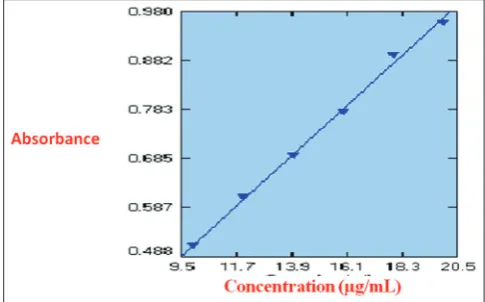
A linear relationship was evaluated across the range of the analytical procedure. It was demonstrated directly on the drug substance (by dilution of a standard stock solution) and using the proposed procedure. This method obeys the Beer- Lambert’s law in the concentration range of 10–20 µg/mL for Dexamethasone and Betamethasone, respectively, as given in Tables 1 and 2 and Figs. 3 and 4.
Accuracy
Accuracy was established across the specified range of the analytical procedure. Accuracy is the closeness of the test results obtained by the method to the true value. To study the accuracy, 10 tablets were weighed and powdered, and analysis of the same was carried out. Recovery studies were carried out by addition of the standard drug to the sample at four different concentration levels taking into consideration, percentage purity of added bulk drug samples. The results of determination of accuracy are given in Table 3.
The LOD and LOQ of dexamethasone and betamethasone were calculated with the standard deviation and slope, which were as given in Table 4.
Repeatability
Standard solutions of dexamethasone (10, 12, 14, 16, 18, and 20 µg/ml) were prepared, and a spectrum was obtained. Absorbance was measured
at 241 nm taking distilled water and methanol and water (1:2) as the blank for dexamethasone and betamethasone, respectively. The absorbance of the same concentration solution was measured 6 times, and RSD was calculated. Repeatability data for Dexamethasone and Betamethasone are recorded in Tables 5 and 6.
Specificity and selectivity
Dexamethasone and Betamethasone are specific and selective as given in Table 7.
Reproducibility
Reproducibility is assessed by means of an inter-laboratory trial. The absorbance readings were measured at 241 nm at the different laboratory using another spectrophotometer and the values obtained were evaluated using t-test to verify their reproducibility. Reproducibility data for Dexamethasone and Betamethasone at 241 nm are recorded in Table 8.
Precision
Variation of results within the day (Intraday) and variation of results between days (interday) were analyzed. Intraday precision was determined by analyzing dexamethasone and betamethasone for 2 times on the same day at 241 nm. Interday precision was determined
Table 1: Linearity of dexamethasone
Sr. No. Conc. (µg/mL) Abs. at 241.00 nm
1 10 0.511
2 12 0.608
3 14 0.691
4 16 0.778
5 18 0.893
6 20 0.958
Table 2: Linearity of betamethasone
Sr. No. Conc. (µg/mL) Abs. at 241.00 nm
1 10 0.450
2 12 0.533
3 14 0.603
4 16 0.675
5 18 0.735
6 20 0.844
Table 3: Accuracy data of dexamethasone
Amount of sample dexamethasone
(µg/mL) Amount of added standard drug (µg/mL) Amount of drug recovered (µg/mL) % recovery of dexamethasone (%)
10 2 1.98 99
10 4 3.96 99
10 6 5.93 98.83
10 8 7.89 98.63
Fig. 3: Calibration curve of dexamethasone
by analyzing the drugs on different days for 6 days at 241 nm. Precision data (Intraday) for dexamethasone and betamethasone at 246 nm are given in Table 9 and 10.
Coefficient of variation
Robustness
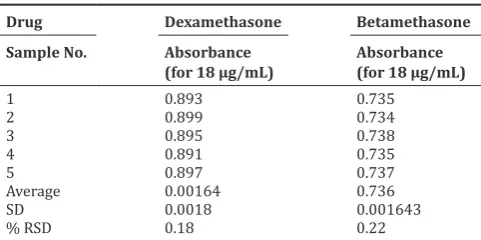
Robustness of proposed method was studied to find out the effect of a small change in method parameters. The result in Table 11 shows that the assay value of the test preparation solution was not affected during various conditions and it was in accordance with that of the actual.
System stability parameters were also found satisfactory, and hence the analytical method would be concluded as robust.
DISCUSSION
The present study involved a simple, rapid, and less environmental toxic method to assay dexamethasone and betamethasone in tablets by UV spectrometry. As per the study, good linearity was found for
both the drugs over the range of 10–20 µg/mL. Moreover, LOQ was found to be 0.2512 µg/mL and 0.3014 µg/mL as compared to earlier studies which resulted 1.56 µg/mL [20] and 0.295 µg/mL [21] value for dexamethasone and betamethasone, respectively. Beside this, LOD was found to be 0.08289 µg/mL and 0.09945 µg/mL as compared to 0.52µg/mL [20] and 0.088 µg/mL [21] for dexamethasone and betamethasone, respectively. RSD value for dexamethasone was found to be <0.3% as compared to 2.0% [20].
CONCLUSION
The results obtained in this study demonstrate that the UV method described in the protocol is valid for the determination and assay of dexamethasone and betamethasone. Therefore, the method is suitable for its intended use. The present study describes a highly sensitive, accurate and reproducible UV method for determination of dexamethasone and betamethasone. This method involves simple, rapid, and inexpensive sample preparation method.
Hence, it can be concluded that the proposed method could be successfully applied for the analysis of marketed tablets and also can be used for the routine analysis of dexamethasone and betamethasone in bulk formulations using UV method.
ACKNOWLEDGMENT
The authors are thankful to the Institute of Forensic Sciences for providing the necessary infrastructures and facility for successfully completing the research work.
Table 4: LOD and LOQ data of dexamethasone and betamethasone
Drug LOD LOQ
Dexamethasone 0.08289 0.2512
Betamethasone 0.09945 0.3014
LOD: Limit of detection, LOQ: Limit of quantitation
Table 5: Repeatability data of dexamethasone
Conc. (µg/mL) 10 12 14 16 18 20
Absorption 0.511 0.608 0.691 0.778 0.893 0.958
0.514 0.61 0.695 0.772 0.899 0.955
0.512 0.612 0.699 0.776 0.895 0.959
0.512 0.611 0.692 0.774 0.891 0.961
0.515 0.609 0.696 0.779 0.896 0.954
Mean±SD 0.513±0.00114 0.61±0.00114 0.695±0.00167 0.777±0.00187 0.897±0.00164 0.957±0.00152
Coefficient variation 0.0022 0.0019 0.0024 0.0024 0.0018 0.0016
% RSD 0.22 0.19 0.24 0.24 0.18 0.16
RSD: Relative standard deviation, SD: Standard deviation
Table 6: Repeatability data of betamethasone
Conc. (µg/mL) 10 12 14 16 18 20
Absorption 0.450 0.533 0.603 0.675 0.735 0.844
0.448 0.532 0.602 0.674 0.734 0.841
0.449 0.530 0.602 0.671 0.738 0.844
0.447 0.532 0.606 0.674 0.735 0.843
0.449 0.531 0.604 0.671 0.737 0.841
Mean±SD 0.449±0.001140 0.532±0.001140 0.603±0.001673 0.673±0.001871 0.736±0.001643 0.843±0.001517
Coefficient variation 0.0025 0.0021 0.0028 0.0028 0.0022 0.0018
% RSD 0.25 0.21 0.28 0.28 0.22 0.18
RSD: Relative standard deviation, SD: Standard deviation
Table 7: Selectivity and specificity of betamethasone and dexamethasone
Drug Specificity Selectivity
Dexamethasone Specific Selective
Betamethasone Specific Selective
Table 8: Reproducibility data of dexamethasone and betamethasone
Drug Instrument 1 LABINDIA Instrument 2 SHIMADZU Results of T‑Test Inference
Dexamethasone 0.511±0.002 0.510±0.002 0.9980 No significant difference
FINANCIAL SUPPORT AND SPONSORSHIP Nil.
CONFLICTS OF INTEREST
The authors do not have any conflicts of interest.
REFERENCES
1. Susmitha A, Kalarani DH, Venkatesh P1, Reddy KR. Analytical method development and validation of aceclofenac in pharmaceutical dosage dorm by uv spectroscopy technique. Int J Pharm Pharm Sci 2013;5:975-1491.
2. Chen Q, Zielinski D, Chen J, Koski A, Werst D, Nowak S, et al.
Avalidated, stability-indicating HPLC method for the determination of dexamethasone related substances on dexamethasone-coated drug-eluting stents. J Pharm Biomed Anal 2008;48:732-8.
3. Liu H, Chen X, Zhang S, Qu L, Zhao Y, Liu H, et al. Separation and determination of dexamethasone sodium phosphate in cochlear perilymph fluid by liquid chromatography with ultraviolet monitoring and electrospray ionization mass spectrometry characterization. J Chromatogr B Analyt Technol Biomed Life Sci 2004;805:255-60. 4. Zurbonsen K, Bressolle F, Solassol I, Aragon PJ, Culine S, Pinguet F,
et al. Simultaneous determination of dexamethasone and 6
beta-hydroxydexamethasone in urine using solid-phase extraction and liquid chromatography: Applications to in vivo measurement of cytochrome
P450 3A4 activity. J Chromatogr B Analyt Technol Biomed Life Sci 2004;804:421-9.
5. Zhang M, Moore GA, Jensen BP, Begg EJ, Bird PA. Determination of dexamethasone and dexamethasone sodium phosphate in human plasma and cochlear perilymph by liquid chromatography/tandem mass spectrometry. J Chromatogr B Analyt Technol Biomed Life Sci 2011;879:17-24.
6. Earla R, Boddu SH, Cholkar K, Hariharan S, Jwala J, Mitra AK, et al.
Development and validation of a fast and sensitive bioanalytical method for the quantitative determination of glucocorticoids – quantitative measurement of dexamethasone in rabbit ocular matrices by liquid chromatography tandem mass spectrometry. J Pharm Biomed Anal 2010;52:525-33.
7. Li C, Wu Y, Yang T, Zhang Y. Rapid simultaneous determination of dexamethasone and betamethasone in milk by liquid chromatography tandem mass spectrometry with isotope dilution. J Chromatogr A 2010;1217:411-4.
8. Oliveira TM, Ribeiro FW, Soares JE, de Lima-Neto P, Correia AN. Square-wave adsorptive voltammetry of dexamethasone: Redox mechanism, kinetic properties, and electroanalytical determinations in multicomponent formulations. Anal Biochem 2011;413:148-56. 9. Amin AS, Issa YM. Extraction-spectrophotometric method for the
determination of betamethasone in pure form and in pharmaceutical formulations. Analyst Lett 1997;1:69-78.
10. Bahlul ZA, Nagiat TH, Babu RC, Sreekanth N, Prakash K. Development and validation of a new spectrophotometric method for the determination of betamethasone in bulk and pharmaceutical dosage forms. Int J Pharm Biomed Res 2010;1:87-9.
11. Ankam R, Mukkanti K, Durgaprasad S, Khan M. Simultaneous HPLC determination of butenafine hydrochloride and betamethasone in a cream formulation. Indian J Pharm Sci 2009;71:547-51.
12. Xiao KP, Xiong Y, Rustum AM. Quantitation of trace betamethasone or dexamethasone in dexamethasone or betamethasone active pharmaceutical ingredients by reversed-phase high-performance liquid chromatography. J Chromatogr Sci 2008;46:15-22.
13. Wang L, Yang YY, Chung TS, Chen XQ. Determination of betamethasone disodium phosphate in the in vitro media of PLGA microspheres by high-performance liquid chromatography. J Pharm Biomed Anal 2002;28:629-35.
14. González L, Yuln G, Volonté MG. Determination of cyanocobalamin, betamethasone, and diclofenac sodium in pharmaceutical formulations, by high performance liquid chromatography. J Pharm Biomed Anal 1999;20:487-92.
15. Maron N, Cristi EA, Ramos AA. Determination of betamethasone 17-benzoate in lipophylic vehicles by reversed-phase high-performance liquid chromatography. J Pharm Sci 1988;77:638-9.
16. Li M, Lin M, Rustum A. Application of LC-MS(n) in conjunction with mechanism-based stress studies in the elucidation of drug impurity structure: Rapid identification of a process impurity in betamethasone 17-valerate drug substance. J Pharm Biomed Anal 2008;48:1451-6. 17. ICH harmonized Tripartie Guideline. Text on Validation of Analytical
Procedures. Q2A and Q2B; 1995. p. 1-7.
18. Manjunath S, Chouhan V, Sandeep S. Spectrophotomeric estimation of levosulpiride in bulk and formulations. Int J Pharm Pharm Sci 2011;3:135-7.
19. Wamorkar V, Manjunath SY, Verma MM. Development and validation of UV spectroscopic method for determination of metoclopramide hydrochloride in bulk and tablet formulation. Int J Pharm Pharm Sci 2011;3:171-4.
20. Friedrich RB, Ravanello A, Cichota LC, Rolim CM, Beck RC. Validation of a simple and rapid UV spectrophotometric method for dexamethasone assay in tablets. Química Nova 2009;32:1052-4. 21. Mustarichie R, Levitaa J, Musfiroha I. Spectrophotometric validation
method of dexchlorpheniramine maleat and betamethasone. Int J Res Dev Pharm Life 2014;3:1096-105.
Table 9: Intraday precision data for dexamethasone
Conc. (µg/mL) Intraday (n=2) CV %RSD
12 0.608±0.002 0.0019 0.19
16 0.778±0.003 0.0024 0.24
20 0.958±0.003 0.0016 0.16
RSD: Relative standard deviation, CV: Coefficient of variation
Table 10: Intraday precision data for betamethasone
Conc. (µg/mL) Intraday (n=2) CV %RSD
12 0.533±0.003 0.0021 0.21
16 0.675±0.004 0.0028 0.28
20 0.844±0.002 0.0018 0.18
RSD: Relative standard deviation, CV: Coefficient of variation
Table 11: System stability data for dexamethasone and betamethasone
Drug Dexamethasone Betamethasone
Sample No. Absorbance
(for 18 µg/mL) Absorbance (for 18 µg/mL)