CSEIT172530 | Received : 10 Sep 2017 | Accepted : 17 Sep 2017 | September-October-2017 [(2)4: 210-216]
International Journal of Scientific Research in Computer Science, Engineering and Information Technology © 2017 IJSRCSEIT | Volume 2 | Issue 5 | ISSN : 2456-3307
210
A Study on Histogram Equalization Techniques for Underwater
Image Enhancement
Althaf SK
1,
John Basha SK
1,
Munwar Ali Shaik
21B.Tech Student, Department of ECE, ESWAR college of Engineering , Narasaraopet, Andhra Pradesh, India 2Assistant Professor, Department of ECE, ESWAR college of Engineering , Narasaraopet , Andhra Pradesh, India
ABSTRACT
The Most important attributes to acquire and extract more information from underwater images are color and contrast. But most of the underwater images are suffered from poor illumination due to ocean depth and color degradation. This paper mainly focus on brief study of different Histogram based equalization techniques for improving the color and contrast of underwater images. In this paper we have studied Histogram equalization (HE), Adaptive Histogram equalization (AHE), Contrast limited adaptive histogram equalization (CLAHE) techniques. Finally by comparing the experimental results the CLAHE technique give better results.
Keywords : Underwater Images, Image Enhancement, Histogram Of Color Images
I.
INTRODUCTION
Underwater image processing is one of the major area in Digital image processing which is applied in various fields. Such as marine habitats monitoring. It also simplifies inspection of piping in the field of engineering. Underwater imaging is very challenging field because of the physical properties of underwater environment. Mainly related to diffusion and absorption of light.
Underwater images lose contrast and suffering from degradation mainly due to poor visibility conditions and effects such as light absorption, light reflection, bending and scaterring of light . In latest research work Underwater image processing becomes an effective field of the digital image processing. The methods for underwater image enhancement are briefly discussed in the next section. The balance of the paper managed as different Histogram equalization techniques, performance analysis of different Histogram equalization techniques, experimental results respectively.
II.
METHODS AND MATERIAL
Histogram Based Techniques
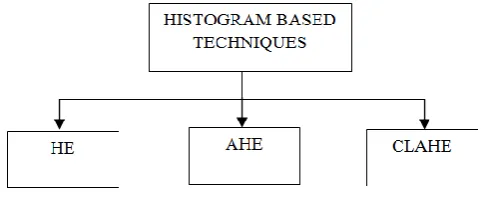
Underwater image enhancement by using histogram based techniques
Figure 1. Histogram Based Techniques
A. Histogram Equalization (HE):
The histogram is a graph which shows the frequency of occurring of data in the whole data set. It plots the number of pixels for each tonal value. Consider an image with M total possible intensity levels. Then, the histogram of the image in [0, M-1] is defined as a discrete function:
P(rk )=nk/n
Where,
rk is the kth intensity level in the interval.
nk is the number of pixels in the image whose intensity level is rk.
n is the total number of pixels in the image.
Histogram equalization is an image enhancement technique which enhances the contrast of an image by spreading the intensity values over the entire available dynamic range. This is achieved through a transformation function T(r), which can be defined by the Cumulative Distribution Function (CDF) of a given Probability Density Function (PDF) of gray levels in an image.
CONTINUOUS CASE: This is for intensity levels that are continuous quantities normalized to the range [0, 1].
Let, Pr(r) is the PDF of the intensity levels.
Then, the required transformation on the input levels to obtain the output level S is:
The above transformation generates an image whose intensity levels are equally likely and also, it covers the entire range [0, 1].
This intensity level equalization process results in an image with increased dynamic range with a tendency to
have higher contrast.
DISCRETE CASE: In the case of discrete quantities, we deal with summations and hence, the equalization transformation becomes:
(3)
where Sk is the intensity value of the output image corresponding to value rk in the input image.
B. Adaptive Histogram Equalization (AHE):
It is different from ordinary histogram equalization in the sense that it is not global and it computes many histograms corresponding to different sections of an image . So, it is possible to enhance the local contrast of an image through AHE.
With AHE, the information of all intensity ranges of an image can be viewed simultaneously and thereby solving the problem of many ordinary devices which are unable to depict the full dynamic intensity range. Here, first, a contextual region is defined for every pixel in the image. The contextual region is the region centered about that particular pixel. Then, the intensity values for this region are used to find the histogram equalization mapping function. The mapping function thereby obtained is applied to the pixel being processed in the region and hence, the resultant image produced after each pixel in the image is mapping differently.
This results in the local distribution of intensities and final enhancing are based on local area rather than the entire global area of the image. This is the main advantage of AHE. But, sometimes, AHE tends to over enhance the noise content that may exist in some homogeneous local block of the image by mapping a short range of pixels to a wide one.
C. Contrast Limited Adaptive Histogram Equalization (CLAHE):
histogram equalization(CLAHE) is contrast limiting. The CLAHE produces clipping limit for histogram to overcome the noise amplification problem. The CLAHE method divides the image in to relative regions and applies the histogram equalization process to each region. CLAHE has two parameters clip limit(CL) and block size which are mainly control image enhancement quality. By increasing the clip limit the image brightness will be increased. Similarly by increasing block size the range becomes larger due to these the image contrast also increases. CLAHE is one of the most widely and established method for the successful enhancement of low-contrast images.
The CLAHE method consists the following 7 steps 1) Dividing the original intensity image into
non-overlapping contextual regions. The total number of image tiles is equal to MXN , and 8X8 is a good value to preserve the image chromatic data.
2) Calculating the histogram of each contextual region according to gray levels present in the array image. 3) Calculating the contrast limited histogram of the
contextual region by clipping limit value.
4) Redistribute the remain pixels until the remaining pixels have been all distributed.
5) Enhancing intensity values in each region by Rayleigh distribution.
6) Reducing abruptly changing effect
7) Calculating the new gray level assignment of pixels within a sub-matrix contextual region by using a bi-linear interpolation between four different mappings in order to eliminate boundary artifacts.
D. Histogram Stretching And Clip-Limit Process:
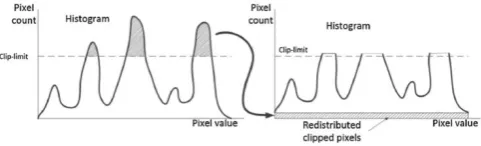
Under- and over-contrast occur in an underwater image whereas the amount of pixels is cumulatively concentrated at low and high intensity levels. Hence, stretching and clip-limit processes are applied to the image histogram of respective regions to prevent under- and over-contrast effects. For this purpose, the histogram of a region from the previous step is generated and the LUT is built. The clip-limit visual process is shown in Fig. 2, in which the spikes in the histogram higher than the clip limit will be cut off. The excessive numbers of pixels are equally distributed to all intensity levels, thereby increasing the number of pixels at all intensity levels. In this case, a normalized value of the clip limit is set at 0.01.
Figure 2.Applying clip limit to the histogram of image.
E. Rayleigh Distribution
The linear stretching is given by
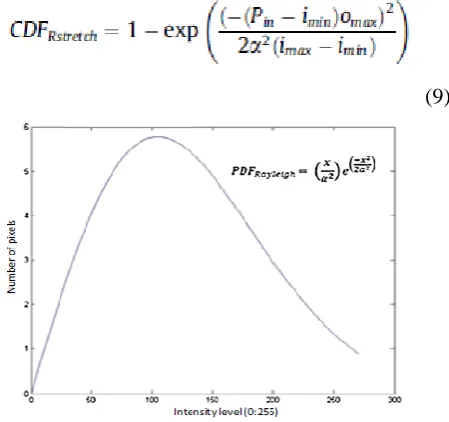
(4) Rayleigh Distribution is the most appropriate distribution for underwater imaging. It refers to the bell-shaped histogram distribution in which most of the pixels are concentrated at the middle of the intensity level. The pixel number at the minimum and maximum sides of the distribution is the lowest to minimize the pixel amount from having too low or too high intensity values. Therefore, RD reduces the pixel number of under- and over-contrasted areas that may be produced in the resultant image. Fig. 3 illustrates the RD in which most of the pixels are concentrated around the middle intensity values. The clip-limit process is applied to the image histogram to reduce excessive pixels for the dominant intensity level. Image histogram reflecting the PDF and CDF is then mapped with the RD. The PDF and CDF of the RD is given by Eqs. (5) and (6), respectively
(5)
(6)
where x refers to the input data while a indicates the RD parameter. In this study, a value is set at 0.4 . To obtain the PDF of Rayleigh-stretched distribution, PDFRstretch, Eq. (4) is integrated with Eq. (5) to obtain Eq. (7). The stretching process of the output histogram occupied is from 0 to 255; thus, the value of omin can be substituted with 0 to derive Eq. (8).
(7)
Therefore, the CDF of Rayleigh-stretched distribution, CDFRstretch; is given by
(9)
Figure 3.RD with most of the pixels concentrated at the middle intensity values.
III.
RESULTS AND DISCUSSION
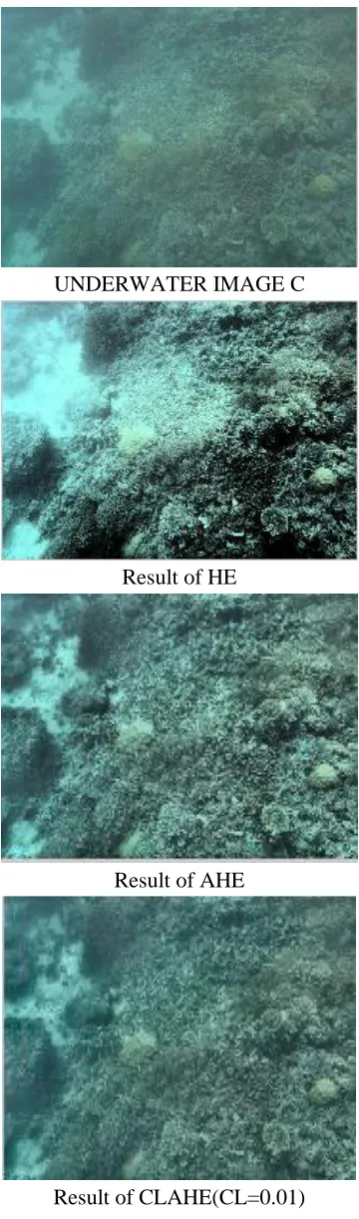
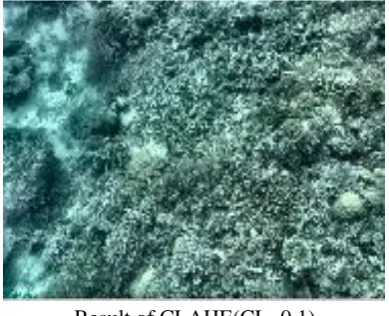
The work is executed on MATLAB Software with various images. The underwater images are of size 512x512, Taken from the internet source. First the different Histogram based techniques mentioned in the previous section are applied to the images and then the performance of Histogram based techniques are Analyzed.
A. Underwater Image A
UNDERWATER IMAGE A
Result of HE
Result of AHE
Result of CLAHE(CL=0.01)
Result of CLAHE(CL=0.1)
B. Underwater Image B
UNDERWATER IMAGE B
Result of HE
Result of AHE
Result of CLAHE(CL=0.01)
Result of CLAHE(CL=0.1)
Figure 5. Performance of HE, AHE, CLAHE on Underwater image B
C. Underwater Image C
UNDERWATER IMAGE C
Result of HE
Result of AHE
Result of CLAHE(CL=0.1)
Figure 6. Performance of HE, AHE, CLAHE on Underwater image C
IV.CONCLUSION
In this Work Different Histogram based techniques are applied on different Underwater images. It was clearly observed that Contrast limited adaptive histogram equalization (CLAHE) technique produce better results compare to Histogram equalization (HE), Adaptive Histogram equalization (AHE) techniques. Future work focus on extending the algorithms by using advanced methods to improve the results.
V.
REFERENCES
[1]. Abdul Ghani, A.S., Mat Isa, N.A., 2015. Enhancement of low quality underwater image through integrated global and local contrast correction. Appl. Soft Comput. 37, 332-344. [2]. Li, Y., Lu, H., Li. J., Li, X., Serikawa, S., 2015.
Underwater image enhancement using inherent optical properties. In: Proceeding of the 2015 IEEE, International Conference on Information and Automation. Lijiang, China. August 2015.
pp. 419-422.
http://dx.doi.org/10.1109/ICInfA.2015.7279324. [3]. Shamsudin, N., Ahmad, W.F.W., Baharudin, B.,
Rajuddin, M.K.M., Mohd, F., 2012. Significance level of image enhancement techniques for underwater images. In: International Conference on Computer & Information Sciences (ICCIS), 12-14 June 2012, Kuala Lumpur, vol. 1, pp. 490-494..
[4]. Muhammad Suzuri Hitam and Ezmahamrul Afreen Awalludin, "Mixture Contrast Limited Adaptive Histogram Equalization for Underwater Image Enhancement", 2013.
[5]. Pooja Sahu,Neelesh Gupta and neetu Sharma, "A Survey on Underwater Image Enhancement Techniques", Volume 87 - No.13, February 2014. [6]. Ghada S. Karam, Ziad M. Abood and Rafal N.
Saleh," Enhancement of Underwater Image using Fuzzy Histogram Equalization", International Journal of Applied Information Systems (IJAIS) - ISSN : 2249-0868 Foundation of Computer Science FCS, New York, USA Volume 6- No. 6, December 2013
[7]. Raimondo Schettini and Silvia Corchs, "Underwater Image Processing: State of the Art of Restoration and Image Enhancement Methods", EURASIP Journal on Advances in Signal Processing,2010
[8]. R. C. Gonzalez and R. E. Woods. "Digital Image Processing". 2nd ed. Prentice Hall, 2002.
[9]. Iqbal, K.; Odetayo, M.; James, A.; Salam, R.A.; Talib, A.Z.H. October 10-13 2010. Enhancing the low quality images using Unsupervised Colour Correction Method. IEEE International Conference on Systems Man and Cybernetics (SMC), pp.1703-1709.
[10]. Achant R, Susstrunk S. Saliency detection using maximum symmetric surround. 17th IEEE International Conference on Image Processing (ICIP); 2010. p. 2653-6. Crossref
[11]. Wynn RB. Autonomous Underwater Vehicles (AUVs): Their past present and future contributions to the advancement of marine geo science. Marine Geology. 2014; 352:451-68. Crossref
[12]. Jaffe JS. Underwater Optical Imaging: Status and Prospects.2001. p. 66-76.
[13]. Yang HY. Low complexity underwater image enhancement based on dark channel prior. IEEE 2nd International Conference on Innovations in Bio-inspired Computing and Applications (IBICA); 2011. p. 17-20.
Authors:
ESWAR college of engineering Narasaraopet, Andhra Pradesh ,India. Althaf research interests include Digital Signal Processing and Digital image processing.
John Basha Shaik is presently studying final year B.tech in Electronics and Communication engineering in ESWAR college of engineering Narasaraopet, Andhra Pradesh ,India. John Basha research interests include Digital Signal Processing and Digital image processing.