© 2018 IJSRCSEIT | Volume 3 | Issue 3 | ISSN : 2456-3307
Unique Sense : A Smart Computing Prototype 2
Vijaykumar Selvam*1, Dr. M. Balamurugan2, A.Nancy3, Saravanakumar S. G.4
1Research Scholar, School of Computer Science and Engineering, Bharathidasan University, Trichy, Tamil
Nadu, India
2Professor and Head, School of Computer Science and Engineering, Bharathidasan University, Trichy, Tamil
Nadu, India
3Research Scholar, School of Computer Science and Engineering, Bharathidasan University, Trichy, Tamil
Nadu, India
4Member technical staff,6TH SENSE, An Advanced Research and Scientific Experiment Foundation, Tamil Nadu,
India
ABSTRACT
There is numerous emergent happens in various fields demands various computing solution for diversified problems. Unique sense initiation is to develop a frugal computing solution for diversified problems from its smart computing features. This research work is continuity of unique sense prototype 1 for delivering the compatibility to deal the Big Data problem along with Fault tolerance and reliable process and to deliver a solution for various computing requirements and real-time needs. As a part of unique sense work, we made a trial on ARM Architecture that prolonging with compact single board computer. It can be capable of delivering provisioning for high-level data management and parallel processing with dynamic customization, reusability, eco-friendliness for next generation demands with environment concern.
Keywords: Smart computing, computing, Big Data, Industry 4.0., RISC, HPC.
I.
INTRODUCTION
Today modern science delivers different forms of computing such as Mainframes, HPC, Cloud, etc. However, most of them exclusively created for some specific purpose. Therefore, they are adopting those for every fields and nature of Business. The Primary focus of this research work is to design a new computing model towards findings of future computation needs. The system focuses towards multi-disciplinary of the problem and economic level of organization. Which includes dynamic environment unlike the HPC system lacks to support in dynamic infrastructure at an affordable price. Extend to that to deliver not only Eco-friendly solution towards silicon valley also ensures that it should blossom the tech era everywhere to construct the economic friendly digital world. Data plays a
more important role in deciding the demands of future systems. As a result, its size grows every day.
of users report that their implementation is meeting their needs. 89% of users believe that the Big Data will revolutionize the same way as the internet did. The vast majority 92% of all users report that they are satisfied with business outcomes and 94% feel their Big Data implementation meets their need. Based on the needs and demands of this civic need we initiate this research to provide better computing to with low power multi Block infrastructure. For analyzing Big Data from multiple Dimension one such common needs. Also, it should support for common demands and computing needs in day-to-day life. To satisfying those, the below-mentioned technologies stack deployed to deliver computing solution in frugal manner.
A. ARM
The ARM is also an instruction set architectures used by processors depend on RISC architecture. Represent three cortex profiling for Application, Real-time, Microcontroller known as Cortex A, Cortex R, and Cortex M. Mainly Raspberry pi comes with ARM1176JZ-F undefined series, but most of the properties are as same as ARM 11. Which is 32 bit ARM architecture, ARMv6 Architecture core. Especially those architectures are emitting reduced heat when compared with other complex systems and lower heat risk and most compactable for the real-time process. Most often mobile phones are using this architecture. Series 1176 especially having security extensions. [9]
B. Hadoop
Hadoop is a platform that provides both distributed storage and computational capabilities. It brings support in two dimensions viz., HDFS for storage and map reduce for computational capabilities [7].
C. MAP REDUCE
MapReduce is a Programming model and an associated implementation for processing and generating large data sets [4]. Users specify the computation regarding a map and a reduce function,
and the underlying runtime system automatically parallelizes the computation across large-scale clusters of machines, handles machine failures, and schedules inter-machine communication to make efficient use of the network and disks. Programmers find the system easy to use: more than ten thousand distinct MapReduce programs have been implemented internally at Google over the past four years, and an average of one hundred thousand MapReduce jobs are executed on Google‟s clusters every day, processing a total of more than twenty petabytes of data per day[6][4].
II.
PROBLEM STATEMENT
The scientists and other users, who works on the complex problems, perform a daily operation with the large and complex dataset and on the other side the data not adequate under existing tools and techniques. This large data set creates a huge load on the server. Even the supercomputer encounters difficulty when it involves large dataset in vertical scaling. There is numerous computing Technology emerge to deliver a solution for different needs however it majorly not affordable for everyone.
III.
METHODS AND MATERIAL
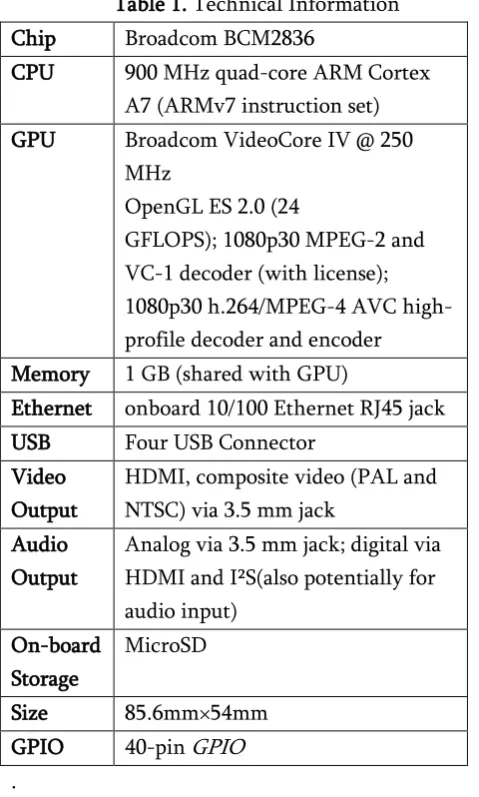
Table 1. Technical Information Chip Broadcom BCM2836
CPU 900 MHz quad-core ARM Cortex A7 (ARMv7 instruction set) GPU Broadcom VideoCore IV @ 250
MHz
OpenGL ES 2.0 (24
GFLOPS); 1080p30 MPEG-2 and VC-1 decoder (with license); 1080p30 h.264/MPEG-4 AVC high-profile decoder and encoder Memory 1 GB (shared with GPU)
Ethernet onboard 10/100 Ethernet RJ45 jack USB Four USB Connector
Video Output
HDMI, composite video (PAL and NTSC) via 3.5 mm jack
Audio Output
Analog via 3.5 mm jack; digital via HDMI and I²S(also potentially for audio input)
On-board Storage
MicroSD
Size 85.6mm×54mm GPIO 40-pin GPIO
.
A. JAVA
Java deployed to create containers with it virtual machine deployed within the physical nodes. Therefore, the individual nodes can act as more than one nodes via virtualization to achieve parallelism. For this prototype Java version “1.7.0_60” is used for achieving it.
hduser@raspberrypi:/usr/local/hadoop $ java -version java version "1.7.0_60"
Java(TM) SE Runtime Environment (build 1.7.0_60-b19)
Java HotSpot(TM) Client VM (build 24.60-b09, mixed mode)
B. HADOOP
Hadoop 1.1.2 is the common standard version, which is already used, in a unique sense: smart computing prototype 1. To achieving similar properties here, Hadoop 1.1.2 deployed on the architecture from that
computing achieves distributed storage and parallel processing.
hduser@raspberrypi:/usr/local/hadoop $ hadoop version
Hadoop 1.1.2 Subversion
https://svn.apache.org/repos/asf/hadoop/common/bra nches/branch-1.1 -r 1440782
Compiled by hortonfo on Thu Jan 31 02:03:24 UTC 2013
From source with checksum
c720ddcf4b926991de7467d253a79b8b
IV.
RESULTS AND DISCUSSION
After various configuration and SSH connection establishment the services are started as deployed [19]. In Unique sense: Smart computing prototype 2 tested with to find the value of Pi
A. Result
hduser@raspberrypi:/usr/local/hadoop $ hadoop jar hadoop-examples-1.1.2.jar pi 5 50
Number of Maps = 5 Samples per Map = 50 Wrote input for Map #0 Wrote input for Map #1 Wrote input for Map #2 Wrote input for Map #3 Wrote input for Map #4 Starting Job
17/12/18 22:47:53 WARN util.NativeCodeLoader: Unable to load native-hadoop library for your platform... using builtin-java classes where applicable 17/12/18 22:47:54 INFO mapred.FileInputFormat: Total input paths to process : 5
17/12/18 22:47:55 INFO mapred.JobClient: Running job: job_local_0001
17/12/18 22:47:55 INFO util.ProcessTree: setsid exited with exit code 0
org.apache.hadoop.util.LinuxResourceCalculatorPlug in@502ca
17/12/18 22:47:55 INFO mapred.MapTask: numReduceTasks: 1
17/12/18 22:47:55 INFO mapred.MapTask: io.sort.mb = 100
17/12/18 22:47:56 INFO mapred.JobClient: map 0% reduce 0%
17/12/18 22:47:56 INFO mapred.MapTask: data buffer = 79691776/99614720
17/12/18 22:47:56 INFO mapred.MapTask: record buffer = 262144/327680
17/12/18 22:47:56 INFO mapred.MapTask: Starting flush of map output
17/12/18 22:47:56 INFO mapred.MapTask: Finished spill 0
17/12/18 22:47:56 INFO mapred.Task: Task:attempt_local_0001_m_000000_0 is done. And is in the process of commiting
17/12/18 22:47:56 INFO mapred.LocalJobRunner: hdfs://localhost:54310/user/hduser/PiEstimator_TMP _3_141592654/in/part0:0+118
17/12/18 22:47:56 INFO mapred.Task: Task 'attempt_local_0001_m_000000_0' done.
17/12/18 22:47:56 INFO mapred.Task: Using ResourceCalculatorPlugin : org.apache.hadoop.util.LinuxResourceCalculatorPlug in@1f04078
17/12/18 22:47:56 INFO mapred.MapTask: numReduceTasks: 1
17/12/18 22:47:56 INFO mapred.MapTask: io.sort.mb = 100
17/12/18 22:47:56 INFO mapred.MapTask: data buffer = 79691776/99614720
17/12/18 22:47:56 INFO mapred.MapTask: record buffer = 262144/327680
17/12/18 22:47:56 INFO mapred.MapTask: Starting flush of map output
17/12/18 22:47:57 INFO mapred.MapTask: Finished spill 0
17/12/18 22:47:57 INFO mapred.Task: Task:attempt_local_0001_m_000001_0 is done. And is in the process of commiting
17/12/18 22:47:57 INFO mapred.LocalJobRunner: hdfs://localhost:54310/user/hduser/PiEstimator_TMP _3_141592654/in/part1:0+118
17/12/18 22:47:57 INFO mapred.Task: Task 'attempt_local_0001_m_000001_0' done.
17/12/18 22:47:57 INFO mapred.Task: Using ResourceCalculatorPlugin : org.apache.hadoop.util.LinuxResourceCalculatorPlug in@15321fc
17/12/18 22:47:57 INFO mapred.MapTask: numReduceTasks: 1
17/12/18 22:47:57 INFO mapred.MapTask: io.sort.mb = 100
17/12/18 22:47:57 INFO mapred.JobClient: map 100% reduce 0%
17/12/18 22:47:57 INFO mapred.MapTask: data buffer = 79691776/99614720
17/12/18 22:47:57 INFO mapred.MapTask: record buffer = 262144/327680
17/12/18 22:47:57 INFO mapred.MapTask: Starting flush of map output
17/12/18 22:47:57 INFO mapred.MapTask: Finished spill 0
17/12/18 22:47:57 INFO mapred.Task: Task:attempt_local_0001_m_000002_0 is done. And is in the process of commiting
17/12/18 22:47:57 INFO mapred.LocalJobRunner: hdfs://localhost:54310/user/hduser/PiEstimator_TMP _3_141592654/in/part2:0+118
17/12/18 22:47:57 INFO mapred.Task: Task 'attempt_local_0001_m_000002_0' done.
17/12/18 22:47:57 INFO mapred.Task: Using ResourceCalculatorPlugin : org.apache.hadoop.util.LinuxResourceCalculatorPlug in@c8b5a6
17/12/18 22:47:57 INFO mapred.MapTask: numReduceTasks: 1
17/12/18 22:47:57 INFO mapred.MapTask: io.sort.mb = 100
17/12/18 22:47:57 INFO mapred.MapTask: data buffer = 79691776/99614720
17/12/18 22:47:57 INFO mapred.MapTask: Starting flush of map output
17/12/18 22:47:57 INFO mapred.MapTask: Finished spill 0
17/12/18 22:47:58 INFO mapred.Task: Task:attempt_local_0001_m_000003_0 is done. And is in the process of commiting
17/12/18 22:47:58 INFO mapred.LocalJobRunner: hdfs://localhost:54310/user/hduser/PiEstimator_TMP _3_141592654/in/part3:0+118
17/12/18 22:47:58 INFO mapred.Task: Task 'attempt_local_0001_m_000003_0' done.
17/12/18 22:47:58 INFO mapred.Task: Using ResourceCalculatorPlugin : org.apache.hadoop.util.LinuxResourceCalculatorPlug in@664e93
17/12/18 22:47:58 INFO mapred.MapTask: numReduceTasks: 1
17/12/18 22:47:58 INFO mapred.MapTask: io.sort.mb = 100
17/12/18 22:47:58 INFO mapred.MapTask: data buffer = 79691776/99614720
17/12/18 22:47:58 INFO mapred.MapTask: record buffer = 262144/327680
17/12/18 22:47:58 INFO mapred.MapTask: Starting flush of map output
17/12/18 22:47:58 INFO mapred.MapTask: Finished spill 0
17/12/18 22:47:58 INFO mapred.Task: Task:attempt_local_0001_m_000004_0 is done. And is in the process of commiting
17/12/18 22:47:58 INFO mapred.LocalJobRunner: hdfs://localhost:54310/user/hduser/PiEstimator_TMP _3_141592654/in/part4:0+118
17/12/18 22:47:58 INFO mapred.Task: Task 'attempt_local_0001_m_000004_0' done.
17/12/18 22:47:58 INFO mapred.Task: Using ResourceCalculatorPlugin : org.apache.hadoop.util.LinuxResourceCalculatorPlug in@1b46468
17/12/18 22:47:58 INFO mapred.LocalJobRunner: 17/12/18 22:47:58 INFO mapred.Merger: Merging 5 sorted segments
17/12/18 22:47:58 INFO mapred.Merger: Down to the last merge-pass, with 5 segments left of total size: 120 bytes
17/12/18 22:47:58 INFO mapred.LocalJobRunner: 17/12/18 22:47:59 INFO mapred.Task: Task:attempt_local_0001_r_000000_0 is done. And is in the process of commiting
17/12/18 22:47:59 INFO mapred.LocalJobRunner: 17/12/18 22:47:59 INFO mapred.Task: Task attempt_local_0001_r_000000_0 is allowed to commit now
17/12/18 22:47:59 INFO mapred.FileOutputCommitter: Saved output of task 'attempt_local_0001_r_000000_0' to hdfs://localhost:54310/user/hduser/PiEstimator_TMP _3_141592654/out
17/12/18 22:47:59 INFO mapred.LocalJobRunner: reduce > reduce
17/12/18 22:47:59 INFO mapred.Task: Task 'attempt_local_0001_r_000000_0' done.
17/12/18 22:47:59 INFO mapred.JobClient: map 100% reduce 100%
17/12/18 22:47:59 INFO mapred.JobClient: Job complete: job_local_0001
17/12/18 22:47:59 INFO mapred.JobClient: Counters: 23
17/12/18 22:47:59 INFO mapred.JobClient: File Input Format Counters
17/12/18 22:47:59 INFO mapred.JobClient: Bytes Read=590
17/12/18 22:47:59 INFO mapred.JobClient: File Output Format Counters
17/12/18 22:47:59 INFO mapred.JobClient: Bytes Written=97
17/12/18 22:47:59 INFO mapred.JobClient: FileSystemCounters
17/12/18 22:47:59 INFO mapred.JobClient: FILE_BYTES_READ=868336
17/12/18 22:47:59 INFO mapred.JobClient: HDFS_BYTES_READ=2360
17/12/18 22:47:59 INFO mapred.JobClient: HDFS_BYTES_WRITTEN=3755
17/12/18 22:47:59 INFO mapred.JobClient: Map-Reduce Framework
17/12/18 22:47:59 INFO mapred.JobClient: Map output materialized bytes=140
17/12/18 22:47:59 INFO mapred.JobClient: Map input records=5
17/12/18 22:47:59 INFO mapred.JobClient: Reduce shuffle bytes=0
17/12/18 22:47:59 INFO mapred.JobClient: Spilled Records=20
17/12/18 22:47:59 INFO mapred.JobClient: Map output bytes=90
17/12/18 22:47:59 INFO mapred.JobClient: Total committed heap usage (bytes)=1017749504
17/12/18 22:47:59 INFO mapred.JobClient: CPU time spent (ms)=0
17/12/18 22:47:59 INFO mapred.JobClient: Map input bytes=120
17/12/18 22:47:59 INFO mapred.JobClient: SPLIT_RAW_BYTES=620
17/12/18 22:47:59 INFO mapred.JobClient: Combine input records=0
17/12/18 22:47:59 INFO mapred.JobClient: Reduce input records=10
17/12/18 22:47:59 INFO mapred.JobClient: Reduce input groups=10
17/12/18 22:47:59 INFO mapred.JobClient: Combine output records=0
17/12/18 22:47:59 INFO mapred.JobClient: Physical memory (bytes) snapshot=0
17/12/18 22:47:59 INFO mapred.JobClient: Reduce output records=0
17/12/18 22:47:59 INFO mapred.JobClient: Virtual memory (bytes) snapshot=0
17/12/18 22:47:59 INFO mapred.JobClient: Map output records=10
Job Finished in 5.745 seconds
Estimated value of Pi is 3.16800000000000000000
B. Discussion
A Reduced Instruction Set Computer (RISC) simplifies its number of instruction set, and it
instructs the processor to implement the instructions that are small, highly optimized instructions through user programs, There is a wrong assumption has been spread across in the design world that RISC design approach reduces the number of instructions set from the CPU design, but it actually uses the highly optimized instruction set rather using more versatile set of instructions to achieve better execution time1.The term „reduced‟ denotes it reduces the number of execution step which is executed by the single instruction by executing in the single cycle rather executing in multiple execution cycles like CISC. In this design approach, the performance of the executing is purely based on the quality of the code it is executing. RISC design is mainly used in smartphones and other small-scale electronic devices. If any complex instructions need to be executed then the algorithm needs to split each instruction into small pieces as input for the RISC to achieve the better execution results. In RISC architecture the number of the register used is huge when compared to other architecture to avoid direct memory interactions[19]. From those advancement ARM is utilized for research without optimization pi task is executed result obtained in the total duration of 758.142 seconds[28]. Also, the same job executed in a unique sense: smart computing prototype 2. It finishes the job in 5.745 seconds, which is much faster than the previous architecture. Therefore, it delivers more hope by this result to trial and giving the opportunity to explore and optimize the system for a different spectrum of usage.
V.
CONCLUSIONcomputing Technology 99.2422% efficient than the previous deployed Unique sense: smart computing prototype 1[28]. From the result and discussion, the system is efficient for general processing and clustered Big Data processing to satisfy the needs of emerging trends and demands of computing.
VI.
REFERENCES
[1]. Jeffrey Dean and Sanjay Ghemawat, "MapReduce: Simplified Data Processing on Large Clusters", OSDI 2004.
[2]. Accenture, "Big Success with Big Data" April 2014Available at URL:
http://www.accenture.com/us-en/Pages/insight-big-success-big-data.aspx. [3]. Jeffrey Dean and Sanjay Ghemawat,
"MapReduce: Simplified Data Processing on Large Clusters". Communications Of The Acm January 2008/Vol. 51, No. 1.
[4]. Alex Holmes, "Hadoop in Practice‟. Publisher: Manning, Shelter Island. Year: 2012. ISBN: 9781617290237.
[5]. Debian Operating system. URL: https://www.debian.org/releases/stable/.
[6]. ARM Architecture. URL: http://arm.com/. [7]. Java, JVM, JSP. URL:
https://docs.oracle.com/javase/7/docs/technotes /tools/share/jps.html.
[8]. Raspberry PI Foundation. URL: http://www.raspberrypi.org/.
[9]. Design and Implementation of a Web Service-Oriented Gateway to Facilitate Environmental Modeling using HPC Resources by Ahmet Artu Yıldırım, David Tarboton, Pabitra Dash and Dan Watson.
[10]. Evaluating and Improving the Performance and Scheduling of HPC Applications in Cloud by Abhishek Gupta, Paolo Faraboschi, Fellow, IEEE, Filippo Gioachin, Laxmikant V. Kale, Fellow, IEEE, Richard Kaufmann, Bu-Sung Lee, Verdi March, Dejan Milojicic, Fellow, IEEE, and Chun Hui Suen.
[11]. TibidaboI: Making the Case for an ARM-Based HPC System by Nikola Rajovica,b,_, Alejandro Ricoa,b, Nikola Puzovica, Chris Adeniyi-Jonesc, Alex Ramireza,b.
[12]. Enhancing High-Performance Computing Clusters with Parallel File Systems by Dell Power Solutions, May 2005.
[13]. EFFICIENT SUPPORT FOR PARALLEL FILE ACCESS IN JAVA HPC by Ammar Ahmad Awan.
[14]. http://java.dzone.com/articles/hadoop-and-high-performance.
[15].
http://www.admin- magazine.com/HPC/Articles/Is-Hadoop-the-New-HPC.
[16]. https://www.scss.tcd.ie/~waldroj/3d1/arm_arm. pdf - Refence manual
[17]. Vijay Kumar S, Saravanakumar S.G., Revealing of NOSQL Secrets. CiiT Journal.vol2,no10 (Oct.2010),
310314.URL=http://www.ciitresearch.org/dmk eoctober2010.html.
[18]. AMULET3: a high-performance self-timed ARM microprocessor ISSN :1063-6404 S. B. Furber ; J. D. Garside ; D. A. Gilbert
[19]. S Vijaykumar, M. Balamurugan, K Ranjani, "Big Data: Hadoop Cluster Deployment on ARM Architecture", International Journal of Advanced Research in Computer and Communication Engineering (IJARCCE), vol. 4, no. 1, June 2015.
[20]. ARM System-on-Chip Architecture. Addison-Wesley, 2nd edition, 2000.
[21]. Dr.M. Balamurugan and A. Nancy, and S. Vijaykumar, "Alzheimer's Disease Diagnosis by using Dimensionality Reduction Based on KNN Classifier", Biomedical & Pharmacology Journal, Vol.10, Issue 4, December 2017, pp. 1823-1830,
http://dx.doi.org/10.13005/bpj/1299.
architecture. IEEE Computer, 38(7):42–50, 2005
[23]. Performance from architecture: comparing a RISC and a CISC with similar hardware organization by Authors:Dileep Bhandarkar Douglas W. Clark Proceeding ASPLOS IV Proceedings of the fourth international conference on Architectural support for programming languages and operating systems, 310-319. ACM New York, NY, USA ©1991 table of contents ISBN:0-89791-380-9
[24]. Migrating a CISC computer family onto RISC via object code translation Authors:Kristy Andrews Duane Sand Proceeding: ASPLOS V Proceedings of the fifth international conference on Architectural support for programming languages and operating systems. Pages 213-222
[25]. A. Nancy, Dr. M. Balamurugan, and S. Vijaykumar, "A Comparative Analysis of Cognitive Architecture", International Journal of Advanced Research Trends in Engineering and Technology (IJARTET), Vol.3, Special Issue 20, April 2016, Pg. 152-155, ISSN (P): 2394-3777, ISSN (O): 2394-3785.
[26]. Power struggles: Revisiting the RISC vs. CISC debate on contemporary ARM and x86 architectures by E. Blem ; Univ. of Wisconsin - Madison, Madison, WI, USA ; J. Menon ; K. Sankaralingam Published in: High Performance Computer Architecture (HPCA2013), 2013 IEEE 19th International Symposium on Date of Conference: 23-27 Feb. 2013 Page(s): 1 – 12. ISSN: 1530-0897. Print ISBN:978-1-4673-5585-8
[27]. George AD. An overview of RISC vs CISC. Proceedings of the 22nd Southeastern Symposium on System Theory; 1990. p. 436–8. DOI: 10.1109/SSST.1990.138185.
[28]. S. Vijaykumar, M. Balamurugan, S.G.
Saravanakumar, "Unique Sense: Smart Computing Prototype", Procedia Computer Science, vol. 50, pp. 223-228, 2015.
BIOGRAPHY
Mr. Vijaykumar Selvam is working on smart computing and Big Data Analytics. His educational background includes Master of Philosophy, Master of Computer Applications, Bachelor of Computer Science, Post Graduate Diploma in Information and Communication Laws, and Postgraduate Diploma in NGO Management from reputed institutions/universities of India. In additive to that, he has obtained more than seven international certificates on various courses. He has to his credit more than 60 + research publications in various reputed International/National journals and conferences and has authored two Books. He is also a reviewer for various international journals and reviewed more than 600 Articles.
Dr. M. Balamurugan is currently working as Professor and Head in the Department of Computer Science of Bharathidasan University, Trichy, India. He has credits of 20 + international and national conferences Publications. He has published 30+ research papers in national and international journals. His research interests are mainly focused on the area of Data Science. He has supervised several research scholars in these areas.