A French Human Reference Corpus for Multi-Document
Summarization and Sentence Compression
Claude de Loupy
(1), Marie Guégan
(1), Christelle Ayache
(1),
Somara Seng
(1), Juan-Manuel Torres Moreno
(2, 3)(1) Syllabs
15 rue Jean-Baptiste Berlier, 75013 Paris, France {loupy, guegan, ayache, seng}@syllabs.com
(2) Laboratoire Informatique d’Avignon (UAPV)
F-84911 Avignon, France [email protected]
(3) Ecole Polytechnique de Montréal
C.P. 6079, succ. Centre-ville, Montréal (Québec) Canada
Abstract
This paper presents two corpora produced within the RPM2 project: a multi-document summarization corpus and a sentence compression corpus. Both corpora are in French. The first one is the only one we know in this language. It contains 20 topics with 20 documents each. A first set of 10 documents per topic is summarized and then the second set is used to produce an update summarization (new information). 4 annotators were involved and produced a total of 160 abstracts. The second corpus contains all the sentences of the first one. 4 annotators were asked to compress the 8432 sentences. This is the biggest corpus of compressed sentences we know, whatever the language. The paper provides some figures in order to compare the different annotators: compression rates, number of tokens per sentence, percentage of tokens kept according to their POS, position of dropped tokens in the sentence compression phase, etc. These figures show important differences from an annotator to the other. Another point is the different strategies of compression used according to the length of the sentence.
1.
Introduction
Since the “Road Map for Summarization Research” (Baldwin et al., 2000), several corpora dedicated to the evaluation of multi-document summarization have been compiled: DUC evaluations (from 2001 to 2007) followed by the TAC evaluations (2008-2009) (Dang & Owczarzak, 2008) or some specific developments (Sekine & Nobata, 2003). Automatic multi-document summarization has been explored using various techniques. For example, methods based on the Rhetorical Structure Theory (Mann and Thompson, 1988) consist in deleting the less important textual units by using the discursive structure of a text. These methods (Ono, Sumita and Miike, 1994; Marcu, 1997) use the rhetorical structure trees of a text and compute different node scores. Each node corresponds to a segment of the text. The scores allow determining the segments to select or to cut in order to generate the summary.
There also exist sentence compression-dedicated corpora (Knight & Marcu, 2000; Clarke & Lapata, 2008). Sentence compression consists in removing lexical units that are not important enough in the sentence to change or distort its main meaning. The compressed sentence must be grammatically well-formed and must not be rewritten using new words.
Most of these corpora are in English and we think it is necessary to build such corpora for other languages since the performances of the different methods are likely to change from one language to another.
The RPM2 project1 is an exploratory industrial research project whose purpose is the development of automatic methods for multi-document summarization including text, audio and video. In order to evaluate our work on textual compression, we developed our own corpora for French2.
The multi-document summarization corpus contains 20 topics with 20 documents each. The summaries were built as a two-step process: first, as a classic multi-document summarization on an initial set of 10 documents per topic, then as an update summarization process given the first set of documents on a second set of 10 documents per topic.
The sentence compression corpus was built using the 400 documents of the first one. It contains 8432 sentences, with 4 annotators per sentence. As far as we know, this is significantly more than any other sentence compression corpus, whatever the language. A large sentence corpus both allows a true learning procedure and a reliable evaluation phase.
The second section of this paper presents the creation of the multi-document summarization corpus. A few statistics on this corpus are given in section 2.2. The third section deals with the making of the sentence compression corpus. Statistics for this corpus are given in section 3.3.
1
This research was supported by the ANR (French National Research Agency), ANR RPM2 project grant number: ANR-07-AM-008.
2
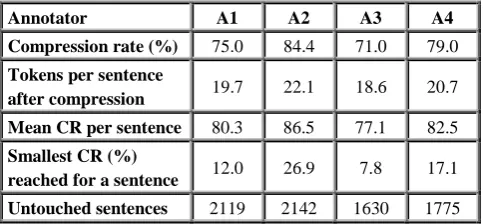
Figure 2 shows the distribution of compression rates for all annotators. A great deal of sentences remained unchanged, about a quarter of them, as depicted in table 4 (Untouched sentences). The compression rate decreases relatively softly to 7.8% for annotator 3.
Figure 2: Distribution of compression rates
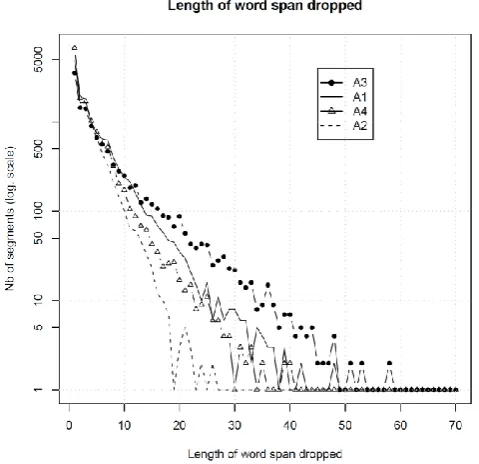
In the distribution of the size of manually deleted segments (see figure 3), we observe an exponential drop, characterized by a large number of single-word deletions. In the corpus, large deletion spans (> 40 words) appeared mostly in the case of enumerations. Annotator 2 deleted much smaller segments, leading to a higher compression rate (see table 4). This annotator was very shy in all respects: highest number of uncompressed sentences, highest mean compression rate per sentence, and highest minimum compression rate on the corpus (a quarter of the sentence).
Figure 3: Length of word span dropped (log scale)
Annotator 3 was much more active at dropping words, followed by annotators 1 and 4. Interestingly, figure 3 is quite different from its equivalent in (Clarke & Lapata, 2006), showing a much softer decrease and only rare deletions of more than 10 consecutive words. Their corpus, Broadcast News, is a set of manually transcribed broadcast news stories. It contains 1370 sentences, with
about 19 words per sentence. Three annotators compressed the sentences down to 73% in average, which was similar to our compression rates. Since sentences were longer in our case, we expected the word spans to be greater too.
Tables 5 and 6 show the correlation and contingency tables between annotators. The correlation was computed using the phi coefficient for two binary variables, in this case equivalent to the Pearson correlation coefficient. Figures were computed considering (a) all tokens and (b) only tokens that were dropped by at least 1 annotator. Correlation over all tokens is low, especially between annotators 2 and 3. Annotators 1 and 4 show the strongest correlation at 0.53. The correlation is especially low when we consider dropped tokens only. Annotator 3, who deleted most tokens, is almost independent from the others. In table 3, we observe that annotators dropped 25% (A1), 15% (A2), 29% (A3) and 21% (A4) of the words. They altogether agreed on 62% of the tokens, 56 % of which were kept and 6% dropped.
Annotators 1 & 2 1 & 3 1 & 4 2 & 3 2 & 4 3 & 4
Phi (a) 0.43 0.43 0.53 0.34 0.44 0.38
Phi (b) 0.16 -0.07 0.24 -0.02 0.21 -0.08
Table 5: Correlation between annotators (Phi coefficient) (a) over all tokens (b) over dropped tokens
A1-A2 Drop Keep Sum A2-A3 Drop Keep Sum
Drop 10,7 14,3 24,9 Drop 10,1 5,5 15,5
Keep 4,9 70,2 75,1 Keep 18,8 65,6 84,5
Sum 15,5 84,5 100 Sum 28,9 71,1 100
A1-A3 Drop Keep Sum A2-A4 Drop Keep Sum
Drop 15,7 9,2 24,9 Drop 9,7 5,8 15,5
Keep 13,2 61,9 75,1 Keep 11,3 73,2 84,5
Sum 28,9 71,1 100 Sum 21,0 79,0 100
A1-A4 Drop Keep Sum A3-A4 Drop Keep Sum
Drop 14,5 10,4 24,9 Drop 13,0 15,9 28,9
Keep 6,4 68,6 75,1 Keep 7,9 63,1 71,1
Sum 21,0 79,0 100 Sum 21,0 79,0 100
Table 6: Contingency table between annotators (%)
3.4.
Linguistic Study
We eventually observed the nature and position of dropped elements in the sentence.
between parentheses were also systematically dropped, except for cases where it appeared inside a quote.
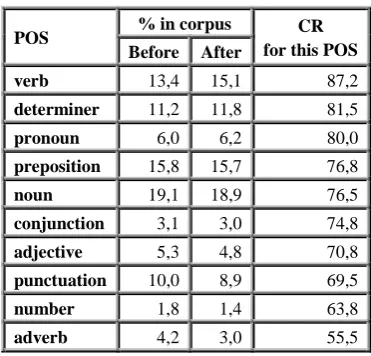
Table 7 shows compression rates for different POS, averaging over all annotators. Sentence tags (“?”, “!”, “.”) and double quotes were almost always kept. About a third of adjectives, punctuation marks (putting aside double quotes and sentence tags), numbers, and adverbs were deleted. In contrast, the percentage of verbs and determiners significantly increased with the compression.
POS % in corpus CR
for this POS Before After
verb 13,4 15,1 87,2
determiner 11,2 11,8 81,5
pronoun 6,0 6,2 80,0
preposition 15,8 15,7 76,8
noun 19,1 18,9 76,5
conjunction 3,1 3,0 74,8
adjective 5,3 4,8 70,8
punctuation 10,0 8,9 69,5
number 1,8 1,4 63,8
adverb 4,2 3,0 55,5
Table 7: Compression rate per POS
Our last figure represents the location of dropped words inside sentences (figure 4). We made a distinction between short (less than 17 tokens), medium-size (between 17 and 31 tokens) and long sentences (more than 31 tokens). Following this definition, the corpus contains approximately the same number of sentences in each category (2804, 2713 and 2915). The horizontal axis represents the relative position of tokens in sentences, where 0 and 100 respectively denote the beginning and ending of the sentence.
First, we notice that all annotators dropped approximately the same number of tokens at the very beginning of the sentence, no matter the size of the sentence. Indeed, news article sentences often begin with introductory words specifying time (“Demain, ...”) or coordinating it to the preceding sentence in the original text (“Cependant...”). In this task, sentences had been made independent from each other with all context removed, which may explain why annotators dropped this type of information.
Then, we notice that deletion profiles differ according to the size of the sentence.
The annotators show very similar profiles for short sentences (fig. 4.a.), dropping words preferably at the beginning of the sentence, uniformly inside the sentence, and systematically keeping the end of the sentence. This can easily be explained by the fact that the end token is the irremovable sentence tag. The same observation can be made in figures 4.b. and 4.c.
Annotator 2 is the only one who seems to have stuck to this strategy for medium-size sentences. The others chose to delete the end of sentences more often.
In the case of long sentences, annotators 1, 2 and 4 show very similar profiles: deletions occurred uniformly across the sentence with a small increase towards the end. In contrast, annotator 3 deleted many more words in the second half of the sentence. Surprisingly, this annotator has almost the same profile as annotator 1 in the first third of the sentences, dropping even less tokens. His drastic compression technique thus seems to rely on deleting the last part of sentences. This annotator took advantage of the fact that news articles often state the relevant information in the first part of the sentence, giving more details at the end.
Figure 4: Position of dropped tokens in the sentence according to its size: (a) short (b) medium (c) long
4.
Conclusion
The sentence compression is not the first French corpus of this type but it is larger than any other similar corpus.
The first corpus was used for a summarization evaluation (Boudin & Torres-Moreno, 2009) and we hope it will be widely used. In particular, we think it is very important to compare the performances of the different methods, across languages.
5.
Acknowledgements
This work has been done in collaboration with Sinequa and a special thank goes to Frederik Cailliau for his support and advice. Juan-Manuel Torres specially thanks Iria da Cunha for the discussion and references over the corpus construction.
6.
References
Baldwin, B., Donaway, R., Hovy, E., Liddy, E., Mani, I., Marcu, D., et al. (2000). An Evaluation Road Map for Summarization Research. doi: 10.1.1.16.4807.
Boudin, F., Torres-Moreno, J. (2009). Résumé automatique multi-document et indépendance de la langue : une première évaluation en français. In Actes de TALN'2009 (Vol. c). Senlis, France.
Clarke, J., Lapata, M. (2006). Models for Sentence Compression: A Comparison across Domains, Training Requirements and Evaluation Measures. In Proceedings of the 21st International Conference on Computational Linguistics and 44th Annual Meeting of the Association for Computational Linguistics, pp. 377--384.
Clarke, J., Lapata, M. (2008). Global Inference for Sentence Compression: An Integer Linear Programming Approach. In Journal of Artificial Intelligence Research, 31, pp. 399--429.
Cohn, T., Lapata, M. (2009). Sentence Compression as Tree Transduction. Journal of Artificial Intelligence Research, Vol. 34, pp. 637--674.
Dang, H. T., Owczarzak, K. (2008). Overview of the TAC 2008 Update Summarization Task. In Proceedings of Text Analysis Conference, pp. 1--16.
Knight, K., Marcu, D. (2000). Statistics-Based Summarization - Step One: Sentence Compression. In Proceedings of the 7th National Conference on Artificial Intelligence and 12th Conference on Innovative Applications of Artificial Intelligence, pp. 703--710. AAAI Press / The MIT Press.
Mann, C., Thompson S. (1988) Rhetorical structure theory: Toward a functional theory of text organization. Text 8(3), pp. 243--281
Marcu, D. (1997) From discourse structures to text summaries. In Proceedings of the ACL’97/EACL’97. Workshop on Intelligent Scalable Text summarization, pp. 82--88. Madrid, Spain
Ono, K., Sumita, and Miike, S. (1994). Abstract generation based on rhetorical structure extraction. In Proceedings of the International Conference on Computational Linguistics (Coling-94), pp. 344--348 Schmid, H. (1994). Probabilistic Part-of-Speech Tagging
Using Decision Trees. In International Conference on
New Methods in Language Processing, pp. 44--49. Manchester, UK.
Sekine, S., Nobata, C. (2003). A survey for multi-document summarization. In Human Language Technology Conference.
Torres-Moreno J-M. (2010). The « Université » human sentences compressed corpus. Technical Report RT-LIA-2010.03.23, Laboratoire Informatique d’Avignon (UAPV), March.