and on the basis of our own experience. The following descriptions illustrate some annotation conventions at different levels:
Morphosyntax
Token:: attributes: orthography content: Lex*
Lex:: attributes: id category lemma rank probabiblity frequency phonemics reference
content: msd
category: {Adjective Determiner Noun Pronoun Adverb Preposition Auxiliary
Verb Conjunction Interjection Ignored Punctuation Particle Filled pause}
Gestures
Head::
attributes:Movement_Type Frequency
Horizontal_Plane Vertical_Plane Side_Type Movement_Type: {Nod, Jerk , Tilt , Turn , Shake , Waggle , Other}
Frequency: {Single , Repeated }
Horizontal_Plane: {Forwards , Backwards , Sideways}
Vertical_Plane: {Up, Down} Sid_Type: {Left , Right}
3.
The annotation platform
Until now, corpus annotation was essentially based on written corpora, the annotation of oral corpora being very limited. Some transcribed oral corpora exist, but they rarely contain other information domains such as phonetics and prosody.
The problem comes from the lack of tools or more precisely, the difficulty in integrating them with a common format. We have developed a platform addressing these questions. It provides help at each step of the process, from raw data to high-level annotations.
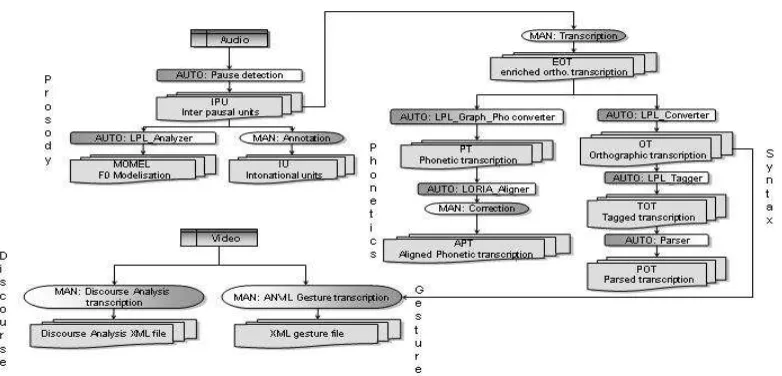
Figure 1: Multimodal annotation process
Figure 1 describes the general process in which the automatic (AUTO) or manual (MAN) treatment at each step is specified.
• Segmentation in Interpausal-Units: Transcriptions are done starting from an automatic pre-segmentation of the speech signal into interpausal-units (IPU) that are blocks of speech bounded by silent pauses of at least 200 ms. IPU segmentation facilitates the transcription, the phonetization and the alignment with the signal. Moreover, speech overlap phases
were extracted from IPU.
- EOT: et c(e) qu(i) était encore plus le choc c’est que en [fait, faiteu]
- Phonologic version: et ce qui était encore plus le choc c’est que en fait
- Pseudo-phonetic version: et c’ qu était encore plus le choc c’est que en faiteu
• Phonetization: This step produces the list of phonemes. After a tokenization, the symbolic phonetizer (see [DiCristo01]) provides a list of tokens and their phonetization labeled in SAMPA. The TOE may sometimes be difficult to use, and a direct phonetic transcription can be, in some cases, simpler for the transcriber; the phonetizer therefore accepts mixed orthographic and SAMPA symbols as an input; SAMPA symbols come out unchanged in the output. The TOE is consequently more precise and standard.
• Alignment: The aligner takes as input the list of the phonemes and the audio signal. It then localizes each phoneme in the signal.
• Prosody : Prosodic annotations essentially encode the prosodic categories (intonation and accentual units) and the intonation patterns associated to them. Such annotations are done by experts exclusively. We also use the INTSINT system (see [Hirst and al. 00]) which does not suppose any a priori knowledge of the phonological system of the language. The interest to have both manual annotations and automatic INTSINT annotations is to improve INTSINT itself, but also the knowledge, which is still very fragmentary, of the prosodic domains in French. This coding is achieved automatically and is naturally integrated in our system. Basic data are temporal series (audio recording, physiological, aerodynamic parameters, etc.). Until these last years, most of these signal corpora were annotated by tabulated label files: a label is a time value associated to a list of attributes and values. These annotations are made by hand (most frequently) and/or automatically.
• Morphosyntax: morphosyntactic annotation, is done
automatically, using a POS–tagger (LPLsuite, cf. [VanRullen05]) that has been adapted to spoken language. The system has been trained with appropriate data, and custom correcting code heuristics has been developed. It is then checked and corrected manually.
• Syntax: We have developed an original statistical parser, adapted for the treatment of spoken data. This has been done in two different phases. The first consisted in parsing a spoken language corpus by means of a symbolic parser (cf. [Blache05]). In a second stage, the output, has been corrected manually, the result being a treebank for spoken language. Finally, the statistical parser has been trained on these data. The tool we obtain is used in order to generate automatically the trees of the corpora to be annotated. This output also has to be checked manually.
4.
A first annotated corpus
The Corpus of Interactional Data (CID, http://crdo.up.univ-aix.fr/) is an audio-video recording of spontaneous spoken French (8 hours, 8 pairs of speakers). If features data recorded in anechoic room and containing 110.000 words. Each speaker of the dialogue is equipped with a headset microphone enabling the recording of the two speakers' voices on two different tracks. This enables the study of speech at a phonemic and prosodic level. It also enables the study of overlapping speech which is frequent in spontaneous interactions but seldom analyzed because of the difficulty to separate the intertwined voices of the two speakers a posteriori. Yet, overlapping speech plays a main role in conversation and requires experimental investigations.
In this corpus, we aimed at collecting useful data for the investigation of all the levels under study: the audio quality is optimum and they have been videotaped with a high quality digital camera. The corpus, described in [Bertrand07a], has been annotated following the different steps described above.
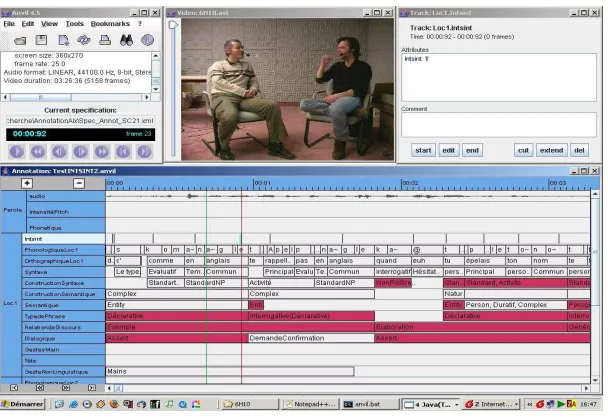
Figure 3: CID annotation board
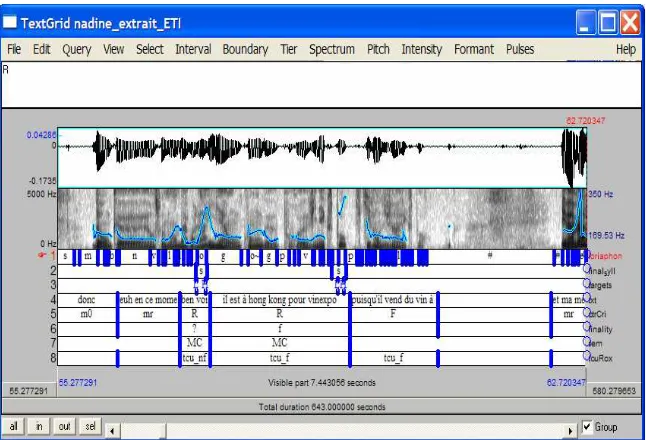
We then aligned the orthographic and phonetic transcription with the signal and added information from different linguistic fields (prosodic units, pitch contours, morphosyntactic categories, syntactic phrases), as illustrated in Figure 2. The tiers bear different information, from the phonetic segmentation (tier 1) to the conversational units (tier 8). This figure illustrates the different pitch contours in their formal and functional aspects (tier 5 and 7). These annotations have been done separately on the audio files and constitute the basis of our present project which consists in the annotation and processing of the corpus from a multimodal perspective.
The annotation of the gestures made by the participants is being done manually using ANVIL as shown in Figure 3.
5.
Some results
5.1 Gestural backchannels
Backchannels are signals produced by the hearer (the co-participant) during a dialogue (mmmh, yes, ok, etc.), cf.
[Bertrand07b] They have different functions such as acknowledgement, assessment, acting the participation to the dialogue, etc. If vocal backchannels are very frequent, gestural ones (head movements, smiles, eyebrow, etc.) also play an important role. The question is to see whether vocal and gestural BCs behave similarly. The following example, taken from the CID corpus, illustrates such phenomena, vocal BCs being represented in italics, and gestural ones in frames.
A ah ouais nous on est rentré à (...) dix heures dix heures et demi je crois du soir (...)
B nod
A et elle a accouché à six heures je crois (...)
B ah quand même ouais
B head tilt / eyebrow raising
A donc c’était ouais c’était quand même assez long quoi (...)
B head tilt
[A] oh yeah we were admitted at 10, 10.30 I think pm
[A] and she had the baby at 6 I think [B] [oh yeah right?]
[A] so it was yeah it was quite long indeed
What we observe is that vocal and gestural BCs show similar behavior, in particular concerning the morphological and discursive production context. They appear after nouns, verbs and adverbs, but not after connectors or linking words between two conversational units. As for prosody, gestural BCs can occur after accentual phrases and intonational phrases (IP) whereas vocal BCs only occur after IPs. Both BCs seem to be favored by rising and flat contours. In conclusion, we can say that vocal and gestural BCs occur in the same kind of environment but gestural BCs seem to be delayed as compared to vocal ones (they occur after the end of the intonational unit). Gestural BCs are also encouraged when the speaker is gazing at the interlocutor. Moreover, BCs are produced after some completion point but not often in places of possible turn change.
5.2 Reinforcing gestures
Some gestures can be produced by the speaker without being prompted by the listener (with phatic eyebrow movements, gaze direction, head movements, etc.), cf.
[Ferré07] Such gestures are intended to reinforce discourse, and play a specific role in the communication process.
elle était SUper stricte elle voulait PAS... tu vois elle interdisait que tu sortes
head nod shake
hands beat
gaze gazes at interlocutor
[A] she [the teacher] was super strict she didn’t want... you see she forbade us to leave
the room [during lessons]
is no correlation with prosodic focalization: reinforcing gestures are not associated with any specific stress type. In the same way, there is no correlation with eyebrow movements. On the contrary, there is a clear link with adverbs and connectors at the beginning of speech turns. In fact, reinforcing gestures plays an important role in discourse planning; they play a syntactic role more than a focusing one. They are in conclusion more discursive than expressive.
6.
Conclusion
Annotated multimodal corpora constitute an essential resource in modern linguistics. The understanding of language mechanisms (both in production and perception) needs to take into account very precisely the interaction between all the different domains or modalities (phonetics, prosody, lexicon, syntax, pragmatics, gestures, etc.). Producing such resources represents however a huge amount of work. It is then necessary to specify a precise framework, identifying the different tasks, the kind of information they have to produce and to what extend they can be automatized. We have presented in this paper an experiment exploiting different tools and shown how they can be integrated in order to provide a platform.
7.
References
Allwood J., L. Cerrato, L. Dybkjaer, & al. (2005). The MUMIN Multimodal Coding Scheme, NorFA
yearbook 2005,
http://www.ling.gu.se/~jens/publications/B%20files/B 70.pdf
Bertrand, R., Blache, P., Espesser, R., & al., « Le CID: Bertrand, R., Blache, P., Espesser, R., & al., (2007a) « Le CID: Corpus of Interactional Data – protocoles, conventions, annotations », TIPA, 25:25-55,.
Bertrand, R., G. Ferré, P. Blache, R. Espesser, and S. Rauzy (2007b) “Backchannels revisited from a multimodal perspective.” Proceedings of Auditory-visual Speech Processing, Hilvarenbeek, The Netherlands., Cederom.
Blanche-Benveniste, C & Jeanjean, C. (1987). Le français parlé, Transcription et édition. Paris: Didier-Erudition/ InaLF, 2e éd.
Carletta J. & Isard A. (1999), The MATE Annotation Workbench: User Requirements, in Proceedings of the ACL Workshop: Towards Standards and Tools for Discourse Tagging, pages 11-17, University of Maryland, June 1999.
Di Cristo, A. & Di Cristo, P. (2001). Syntaix, une approche métrique-autosegmentale de la prosodie. TAL, 42(1), p. 69-111.
Di Cristo A., Auran C., Bertrand R., et al., (2004). Outils prosodiques et analyse du discours », in A.C. Simon, A. Auchlin et A. Grobet (eds), Cahiers de Linguistique de Louvain 30/1-3, Louvain-la-neuve : Peeters, 28, p. 27-84.
Ferré, G., R. Bertrand, P. Blache, R. Espesser, and S. Rauzy. (2007) “Intensive Gestures in French and their Multimodal Correlates.” Proceedings of Interspeech,
Antwerp, Belgium), Cederom.
Hirst, D., Di Cristo, A. & Espesser, R. (2000). Prosody : Theory and Experiment, chapter Levels of description and levels of representation in the analysis of intonation. Kluwer : Dordrecht, Pays-Bas. p. 51-87.
Isard A. (2001). An Xml Architecture For The Hcrc Map Task Corpus. In P. Kuehnlein, H. Rieser, H. Zeevat, Eds, Bi-Dialog 2001.
Kendon A. (2004). Gesture : Visible Action As Utterance. Cambridge: CUP.
Kipp M. (2004). Gesture Generation By Imitation. From Human Behavior To Computer Character Animation. Florida, Boca Raton
(http://www.dfki.de/~Kipp/Dissertation.html)
Krenn B. & Pirker H. (2004). Defining The Gesticon: Language And Gesture Coordination For Interacting Embodied Agents. Aisb-2004 Symposium On Language, Speech And Gesture For Expressive Characters, University Of Leeds, UK.
McNeill D. (2005) Gesture and Thought. Chicago: University of Chicago Press.
Tusnelda (2005). Tübingen collection of reusable, empirical, linguistic data structures. http://www.sfb441.uni-tuebingen.de/tusnelda-engl.htm l