Performance Evaluation of VEnodeb Using Virtualized Radio
Resource Management
Afzal Ahmad1, Mohammad Asif2, Shaikh Rohan Ali3
1M.Tech (CSE), Head of Computer Department Jamia Polytechnic, Akkalkuwa, Maharashtra, India 2M.Tech (CSE) Pursuing, Lecturer Jamia Institute of Engineering & Mgmt. Studies, Akkalkuwa, Maharashtra India
3B.E. (Computer) Pursuing Jamia Institute of Engineering & Mgmt. Studies, Akkalkuwa, Maharashtra India ABSTRACT
With the demand upsurge for high bandwidth services, continuous increase in the number of cellular subscriptions, adoption of Internet of Things (IoT), and marked growth in Machine to Machine (M2M) tract, there is great stress exerted on cellular network infrastructure. The present wire line and wireless networking technologies are rigid in nature and heavily hardware dependent. The embrace of SDN in traditional cellular networks has led to the implementation of vital network functions in the form of software that are deployed in virtualized environments. This approach to move crucial and hardware intensive network functions to virtual environments is collectively referred to as network function virtualization (NFV).we implement a virtualized eNodeB component (Radio Resource Management) to add agility to the network setup and improve performance, which we compare with a traditional resource manager. When combined with dynamic network resource allocation techniques proposed in Elastic Hando. Agnostic approach can achieve a greater reduction in capital and operational expenses through optimal use of network resources and client energy utilization to better handle these agreements under peak network load.
Keywords : Internet of Things, Machine to Machine, Radio Resource Management, Network Function Virtualization, Software Defined Networks, Radio Access Networks, MIMO, eNodeB
I.
INTRODUCTIONIn the last two decades, cellular networks have revolutionized telecommunications and are responsible for connecting more people and devices than ever. The rapid advances in cellular network technologies have solved most connectivity challenges; have handled increase in the number of subscribers and large amounts of data traffic.
At the end of the year 2017, the total number of mobile subscriptions reached 7.8 billion by adding almost 100 million new subscriptions in a span of three months. With the number of subscribers
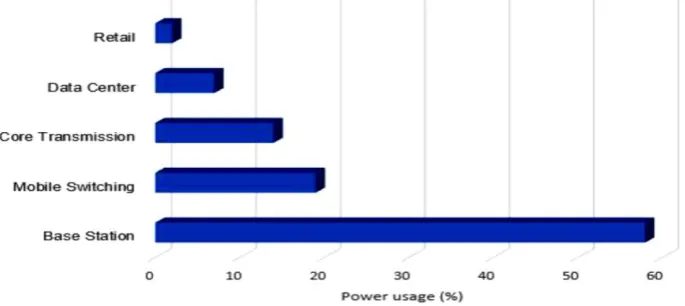
increasing and consumption of multimedia content, in particular video, data traffic rose by as much as 65% [1].The explosive growth in the number of cellular devices results in significant greenhouse emissions due to substantial electricity usage of which up to 90% is consumed by the network infrastructure [2].
Volume 3, Issue 7, September-October-2018 | http:// ijsrcseit.com
Afzal Ahmad et al. Int J S Res CSE & IT. 2018 September-October-2018; 3(7) : 115-122
116
cellular networks through Software DefinedNetworks (SDN), Network Function Virtualization (NFV), and Cloudbased Radio Access Networks (CRAN).
With the increase in the adoption of Internet of things (IoT) and the addition of new users, the struggle for network resource is increasing. Cellular
service providers have depended on procuring more frequency bands and efficient communication techniques such as multiple input, multiple outputs (MIMO), etc. The alone effort can’t solve the problem of increasing cellular network problem. Apart from the challenges, financial resources are invested for procuring new spectrum and operational expenses involved in upgrading specialized hardware.
Figure 1.1. Energy utilization in current cellular network components
The telecom towers, which include the base station alone may consume an estimated 2.5 billion liters of fossil fuel annually, leading to an approximate addition of 6.5 million metric tonnes of CO2 emissions.
II.
LITURATURE SURVEYThe eNodeB which is the base station in the cuttingedge Long Term Evolution (LTE) cellular networking technology handles several key functions such as supporting flexible bandwidth allocation, radiorelated functions, location management, handover functionality, etc.
The contributions of this topic include:
Spectrum Sensing Data Collection: We capture, curate and study spectrum utilization data in the 2.4 GHz ISM band for a period of 30 days. This dataset with 5 million+ data points can be used for future research work.
Analytical Model to Perform Call Admission Control: We propose a model and use proven mathematical approaches to study the state of the network based on three parameters:
i. data rate the network can support, ii. a carrier's cost to service a subscriber, and iii. quality of service.
Implement Virtual RRM: We implement and evaluate our proposed call admission process in a virtualized eNodeB component called Radio Resource Management (RRM) by applying SDN and NVF technologies.
Performance Analysis: We study and compare total network utilization, cost of service and quality of service of our virtual eNodeB implementation against a traditional base station.
1947 by Bell Labs' D.H.Ring and W.R.Young.In 1948, these RCCs operated the first fully automated radiotelephone service, which eliminated the need
for an operator in most cases. Bell system went on to build its first mobile phone technology called Mobile Telephone System (MTS).
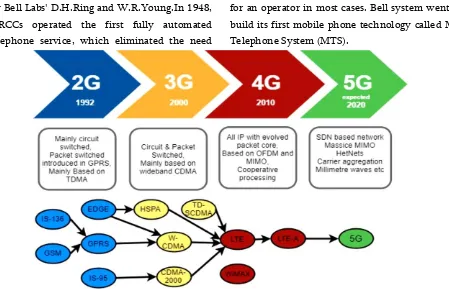
Figure 2. Evolution of Cellular Networks
III.
METHODOLOGY
4G Native IP networks: The 4G systems were originally envisioned by the Defence Advanced Research Projects Agency (DARPA). DARPA selected the distributed architecture and endtoend Internet Protocol (IP),In 4G systems, the circuitswitched infrastructure is abandoned and only a packetswitched network is provided, while 2.5G and 3G systems require both packet switched and circuitswitched network nodes, i.e. two infrastructures in parallel. This implies that in 4G, traditional voice calls are replaced by IP telephony One of the key technologies for 4G and beyond is the Open Wireless Architecture(OWA) which supports
multiple wireless air interfaces in an open architecture platform, one of which is Software Defined Radio (SDR) that promises radio convergence.
Volume 3, Issue 7, September-October-2018 | http:// ijsrcseit.com
Afzal Ahmad et al. Int J S Res CSE & IT. 2018 September-October-2018; 3(7) : 115-122
118
Figure 3.1. 4G (LTE) cellular network architectureOne of the key technologies for 4G and beyond is the Open Wireless Architecture(OWA) which supports multiple wireless air interfaces in an open architecture platform, one of which is Software Defined Radio (SDR) that promises radio convergence.
SDR: SDR offers several compelling benefits to all the stakeholders, some of which are listed below [3]: Implement common platform architecture, allowing for the introduction of new radio technologies as radio “products" in the market. Promote software reusability across radio “products", reducing development costs dramatically.
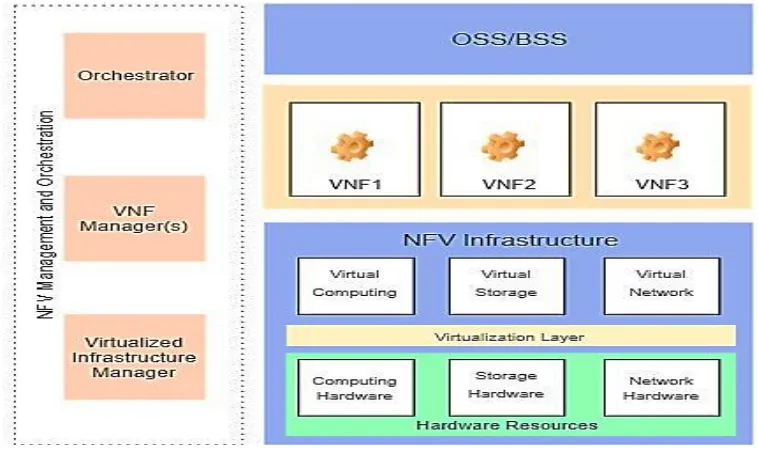
Network Function Virtualization: Network functions virtualization (NFV) is an initiative to virtualized network services traditionally run on proprietary, dedicated hardware. With NFV, functions like routing, load balancing and firewalls are packaged as virtual machines (VMs) on commodity hardware. NFV's mission to use commodity hardware is important as it relinquishes network managers to no longer purchase and manually configure dedicated hardware devices in order to build a service chain that links specific functions in order to achieve a desired result. As NFV virtualizes network function and eliminates functionspecific hardware, network managers can add, move or change network functions at the server level in a simplified provisioning process.
Benefits of NFV: If a service provider's customer requests a new function, for example, NFV enables the service provider to more easily add that service in the form of a virtual machine without upgrading or buying new hardware. In addition, NFV can reduce power consumption and increase physical space, since NFV eliminates most traditional hardware appliances reducing both CAPEX and OPEX.
NFV Challenges: NFV deployment has seen relatively slow progress due to a lack of standards in NFV management, automation and orchestration (MANO). MANO provides the framework for provisioning VNFs and managing NFV infrastructure. It also helps components within NFV infrastructure communicate with existing operational and billing support systems (OSS/BSS). CRAN: CRAN (CloudRAN), sometimes referred to as CentralizedRAN, is a proposed architecture for future cellular networks.
CRAN is a centralized, cloud computingbased architecture for radio access networks that supports 2G, 3G, 4G and future wireless communication standards.
Realtime virtualization ensures the resources in the pool can be allocated dynamically to the base station software stacks, say4G/3G/2G function modules from different vendors according to network load.
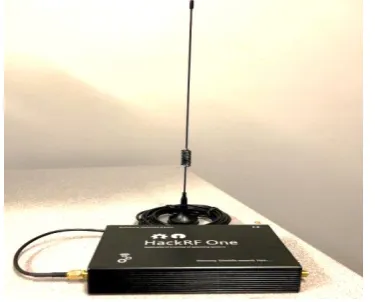
Figure 4.1. Hack RF One| a low cost, open source software defined radio
However, to satisfy the stringent timing requirements of wireless communications systems, the realtime performance for CRAN is in the order of 10s of microseconds, which is two orders of magnitude higher than the millisecond level “realtime" performance usually seen in a cloudcomputing environment.
Research on SDN, NFV and CRAN: The distributed nature of control plane in current cellular networks is not optimal for coherently managing spectrum, radio resources, call hand_, and other essential network functions in a way to manage future network demands. SDNbased approaches present opportunities in making the process of deploying and managing cellular networks that are traditionally not turnkey. These features include seamless mobility through efficient handover procedures [4], [5], load balancing [6], [7], creation of on demand virtual access points (VAPs) [6], [8], downlink scheduling (e.g., an Open Flow switch can do a rate shaping or time division) [8], dynamic spectrum usage [8], enhanced inter cell interference coordination [8], [5], shared wireless infrastructures [9],seamless subscriber mobility and cellular networks [5], QoS and access control policies made feasible and easier [9], [10], and easy deployment of new applications [6],[7], [9]. Some of the recent initiatives in the area of network virtualization, include XBone and Tempes focusing on networking technology; UCLP, VNET, AGAVE and VIOLIN focusing on layers of virtualization; VNRMS, NetScript, Genesis and FEDERICA.
IV.
SIMULATIONS AND RESULTES
we discuss the hardware setup, simulation process, and evaluate the simulation results.
Volume 3, Issue 7, September-October-2018 | http:// ijsrcseit.com
Afzal Ahmad et al. Int J S Res CSE & IT. 2018 September-October-2018; 3(7) : 115-122
119
DARPA. The device can be used as a USB peripheralor programmed for standalone operation, and it is capable of scanning frequencies ranging from 1 MHz to up to 6 GHz.
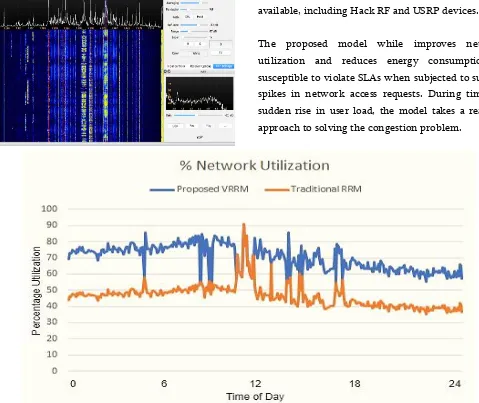
Figure 4.2. Gqrx Application free software application that interfaces with Hack RF One SDR receiver powered by the GNU Radio SDR framework and the Qt graphical toolkit. It is free software and supports many of the SDR hardware available, including Hack RF and USRP devices. The proposed model while improves network utilization and reduces energy consumption is susceptible to violate SLAs when subjected to sudden spikes in network access requests. During times of sudden rise in user load, the model takes a reactive approach to solving the congestion problem.
Figure 4.3. Network Utilization vs. Proposed RRM We evaluate our network model for two broad test
scenarios: network utilization and revenue generation. In addition, we also test for how the proposed approach fares against SLA violations. The RRM by design tries to provide access and service to PS subscribers. However, when there is an unanticipated rise in demand due to a large number of subscribers’s requesting network access, the operator is compelled to drop some users violating SLAs. When the various SLAs and their
corresponding QoS parameters are assigned weights, the goal of the RRM is to minimize the overall violation weight.
V.
FUTURE SCOPE
One possible area for research and extension is using machine learning techniques to perform predictive analysis on the network traffic patterns. This enables RRM to actively monitor traffic patterns and proactively allocate network resources anticipating demand in order to mitigate the occurrence of SLA violations. Finally, virtual RRM can be combined with cognitive cellular networks providing opportunistic network access to the users where they are not limited to be serviced by a single carrier. This could be a great value add in the design of next-generation mobile networks.
VI.
CONCLUSION
In here, we model and implement a virtual eNodeB component- Radio Resource Management (RRM) and analyze the efficiency that can be achieved in the Call Admission Control function of the RRM. We define various service level agreement choices for the implementation and develop a model to allocate consumption due to the elastic nature of the proposed NFV-based eNodeB. Our model leads to an increase in network utilization of as much as 60% compared to 40% when using a traditional RRM. We study the behaviour of the proposed setup under a dynamic pricing model which may generate as much as 27% increase in carrier revenue when compared to fixed access pricing. Finally, we put forth a weighted violation penalty metric to evaluate the model's QoS performance. While our model may help increase carrier profits improves it is prone to violate user agreements during periods of sudden spike in network traffic. This can be attributed to the reactive nature of the elasticity of RRM.
VII.
REFERENCES
[1]. Ericsson, \Ericsson Mobility Report," tech. rep., Ericsson, November 2016.
[2]. Center for Energy-efficient
Telecommunications, \The Power of Wireless Cloud,"tech. rep., Bell Labs and University of Melbourne, April 2012.
[3]. W. I. Forum, \What is software defined radio," wirelessinnovation.org, 2001.
[4]. P. Dely, A. Kassler, and N. Bayer, "Openflow for wireless mesh networks," in 2011 Proceedings of 20th International Conference on Computer Communications and Networks (ICCCN), pp. 1{6, July 2011}.
[5]. L. E. Li, Z. M. Mao, and J. Rexford, "Toward software-defined cellular networks," in Proceedings of the 2012 European Workshop on Software Defined Networking,
[6]. EWSDN '12, (Washington, DC, USA), pp. 7{12, IEEE Computer Society, 2012}. J. Schulz-Zander, L. Suresh, N. Sarrar, A. Feldmann, T. H•uhn, and R. Merz,
[7]. "Programmatic orchestration of wifi networks," in Proceedings of the 2014 USENIX Conference on USENIX Annual Technical Conference, USENIX ATC'14, (Berkeley, CA, USA), pp. 347{358, USENIX Association, 2014.
[8]. J. Schulz-Zander, L. Suresh, N. Sarrar, A.
Feldmann, T. Huhn, and R.
Merz,"Programmatic orchestration of wifi networks," in Proceedings of the 2014,USENIX Conference on USENIX Annual Technical Conference, USENIX ATC'14, (Berkeley, CA, USA), pp. 347{358, USENIX Association, 2014. [9]. Gudipati, D. Perry, L. E. Li, and S. Katti,
Volume 3, Issue 7, September-October-2018 | http:// ijsrcseit.com
Afzal Ahmad et al. Int J S Res CSE & IT. 2018 September-October-2018; 3(7) : 115-122
122
[10]. J. Vestin, P. Dely, A. Kassler, N. Bayer, H.Einsiedler, and C. Peylo, "Cloudmac:Towards software defined wlans," SIGMOBILE Mob. Comput. Commun. Rev.,vol. 16, pp. 42{45, Feb. 2013}.
[11]. K.-K. Yap, R. Sherwood, M. Kobayashi, T.-Y. Huang, M. Chan, N. Handigol, N. McKeown, and G. Parulkar, "Blueprint for introducing innovation into wireless mobile networks," in Proceedings of the Second ACM SIGCOMM Workshop on Virtualized Infrastructure Systems and Architectures, VISA '10, (New York,NY, USA), pp. 25{32, ACM, 2010.