often involves complex processes of communicative goals and emotional behaviors, which not
only are expressed verbally and nonverbally but also are reflected in the inner responses of
humans [4].
We want to use the NNIME database to study the emotion behavior (such as arousal and
valence state) in small duration (like in real time), and to augment a sense of emotional feeling
with visual demonstration.
After all of this, we just wonder how the emotion application can be. Therefore, we think of
the amplification of the emotion in video. There are a lot of video that you would feel awkward
watching it because of its boring and no effect. Moreover, we want to amplify the context in
2.
Dataset Description
2.1 NNIME-Emotion Corpus
The increasing availability of large-scale emotion corpus with advancement in emotion
recognition algorithms have enabled the emergence of next-generation human-machine
interfaces. The database is a result of the collaborative work between engineers and drama
experts. This database includes recordings of 44 subjects engaged in spontaneous dyadic
spoken interactions.
The multimodal data includes approximately 11-hour worth of audio, video, and
electrocardiogram data recorded continuously and synchronously. The database is also
completed with a rich set of emotion annotations of discrete and continuous-in-time annotation
from a total of 49 annotators per subject.
The emotion annotation further includes a diverse perspectives: peer-report, director-report,
self-report, and observer-report. This carefully-engineered data collection and annotation
processes provide an additional valuable resource to quantify and investigate various aspects
of affective phenomenon and human communication. To our best knowledge, the NNIME is
one of the few large-scale Chinese affective dyadic inter-action database that have been
systematic-ally collected, organized, and to be publicly released to the research community.
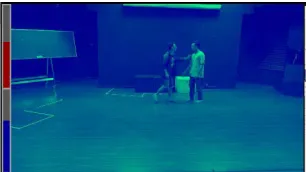
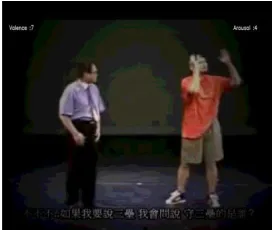
Figure 1. It depicts an actual snapshot of two different recording sessions extracted from the stage front-
2.1 Post-Processing
Each audio file corresponds to data collected from one of the micro-phones for each
session. We manually segmented all audio files (two in every session with each lasted
approximately 3 minutes long) into utterances. This resulted in a total of 6701 utterances.
Further, we marked each utterance as speech, laugh, sigh, sobbing, or dience background noise
in order to enable further studies in understanding the role of non-verbal vocalization in
affective interactions. We also manually completed the transcripts for all of the sessions.
3.
Methodology &Experiment setup
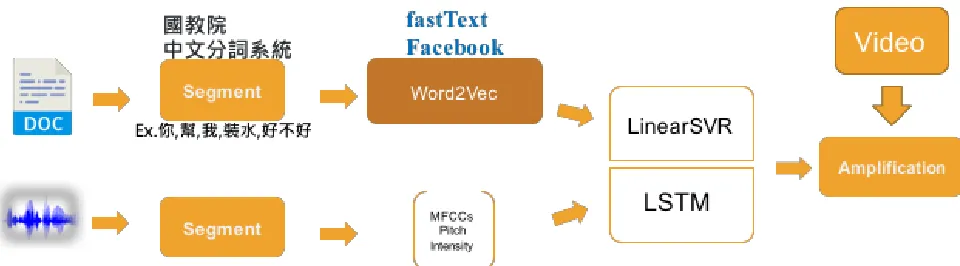
To increase more visual effect on video, we train audio and lexical LSTM model together.
Hope that higher accuracy improved through text feature if we can get video transcript in the
future.
Figure 2. Sample Caption of Audio Frame Work
3.1 Audio
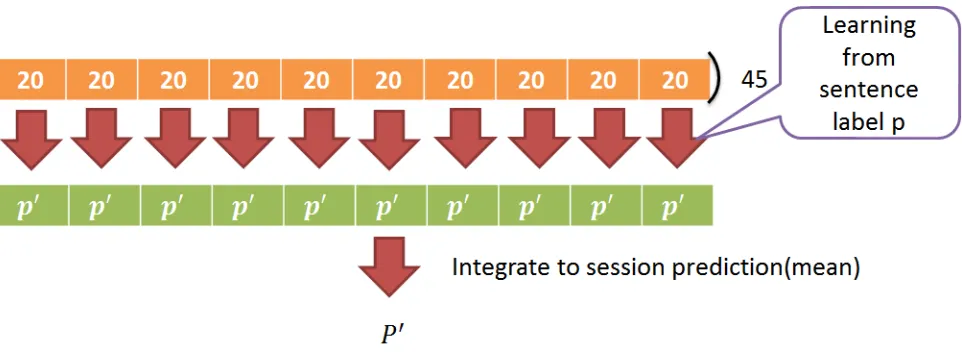
We use OpenSmile [5] to extract 45 LLDs(pitch、intensity、Mfcc(s) and their delta and
delta delta) in the audio feature. Due to the difference of each sentence length, splitting sentence
to the same step size is essential, so we first need to select a good step size to get more better
emotion expression. Accordingly, a complete sentence may be split into a lot of frames, each
frame representing a chunk of voice with the same step size. By this way, machine can see
frame ground truth.
Figure 3. Sample Caption of Text Frame Work
3.2 Text
In Chinese, if we want to make machine understand the meaning in the context, a good
word segmentation is necessary. In our project, we use CKIP[6] developed by Sinica to do that.
For the first step of sentence segmentation, two algorithms are adopted.
The first one is “jieba”, which we have used in the course. We simply change its dictionary to
traditional Chinese and call its API for segmentation. The second one is the segmenter from
the Lab of the instructor; for the convenience, we call it JJ here. Since we call this segmenter
with requests function and it need to implement through Internet, it runs a little lower than jieba.
In addition, according to the results, jieba runs better than JJ. To my observation, it may due to
the fact that JJ sometimes segments a Chinese vocabulary into several individual characters. In
this segmentation approach, it might not be able to show the meanings in this sentence as a
character may have different meanings when it meets other characters. As a consequence, jieba
is eventually chosen to perform for segmentation before feature
transformation.
Word representation is a difficult issue in AI field, because it has the more complicate structure
compared to that more intuitive and lower level behavior signal like audio, and it needs more
higher level Cognit-ive ability to learn text for machine, this field
a major breakthrough in word embedding.
Word2vec is a word embedding method developed by Tomas Mikolov Google[7], it can maps
words into high dimension semantic space so that form more compact relation between word
and word. After using Facebook FastText[8] to train Word2vec, we generate size 300 word
vector and adopt the same method in the audio to split word to the same step size.
3.3 Model
3.3.1 SVR
Support vector regression is used to predict the final results. We can get approximately
30 to 40 percentage of correlation or sometimes even 70 percentage of correlation in the better
situation without fine-tuning. Furthermore, for the purpose of making the result better, we have
once performed feature selection. Nevertheless, perhaps the feature are tuned the best in fast-
text, we found that using all features can perform better than simply using merely some part.
Eventually, we have consider to use other data mining algorithms such as binary tree… etc. in
the future works to show the advantage of our main purpose of LSTM-RNN.
3.3.2 LSTM-RNN
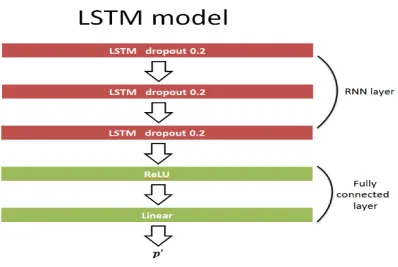
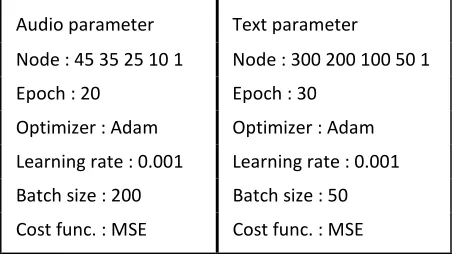
By RNNLM[8], we train two LSTM model for audio and text re spectively, the structure
showed in figure 2, and parameter showed below, integrate the prediction of activation and
valence of each frame to sentence by mean.
when the two values are both high, the lightness will become higher. Considering that it is not
obvious of the color change, we decide to modify the influence of the two values. Fortunately,
for the analysis of the value distribution, almost values are distributed at the range between 0.4
to 0.8. We raise the impact on the values between 0.4 to 0.8, and reduce the influence on the
values out of this range. The adjustment makes it more apparent on visualization that people
can observe the change of the two values simply.
Figure 5. Sad atmosphere
Figure 6. Angry atmosphere
3.4.2. Vignette Version
Vignette version is to change the parameter of the Vignette filter. As the Valence
increases, the bright area of the Vignette would expand to make the frame look brighter. As for
the value of Arousal is more than 5, we make a twinkling effect, which would make the video
switching between the black-and-white frame and the colorful frame. The implement of
Vignette filter is making two dimensional Gaussian distribution. By adjusting the mean and
variance of x-axis and y-axis we could make the central spot light effect with different size of
bright area. While the value of valence is higher, we let the variance of the distribution increase
Figure 7. Example of Vignette
Figure 8. Example of Vignette
4.
Result and analysis
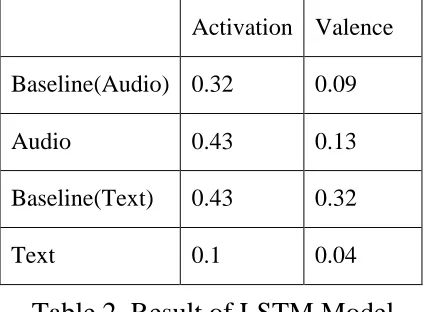
The final result is showed in below audio result is better than baseline about 0.11 in
activation and 0.04 in valence, but text is much worse. We think that maybe when training
Word2vec which need to join more emotion corpus to improve model performance or this
database is not appropriate for text LSTM model. Therefore, in the future, we may do some
improvement in our algorithm or collect more corpus. First of all, we can combine word feature
with audio feature generated from LSTM middle layer by more advanced algorithm. Secondly,
by using python crawler to collect a large amount of corpus about psychology or drama. Finally,
we can introduce more complicated algorithm like bidirectional RNN to try to capture more
Activation Valence
Baseline(Audio) 0.32 0.09
Audio 0.43 0.13
Baseline(Text) 0.43 0.32
Text 0.1 0.04
Table 2. Result of LSTM Model
5.
Conclusion
at all. Therefore, we want to amplify emotions on movie scenes by “Fisheye effect” or “color
about emotions in the future.
We probably know that it’s almost impossible to manifest without emotions. Emotions
give passion to your thoughts, making them “loud” enough to leave an impression. Some
people however have trouble adding emotion – it either isn’t very strong, or there’s no emotion
filters”. Not only enhancing emotion experience but also providing directly emotional clues for
people who have trouble sensing emotions. However, our model doesn’t perform well. Audio
LSTM-RNN model only increases 11% (0.32 to 0.43) on activation evaluation and 4 % (0.09
to 0.13) on valence evaluation than SVR model. Text is not better than SVR model, and it
might be caused by too small Chinese sentence data. We will do more effort on Chinese