DESCRIPTION OF THE TASC SYSTEM USED FOR MUC-7
Terry Patten, Beryl Hoffman, Martin Thurn
TASC
13605 Dulles Technology Drive
Herndon VA 20171
[email protected]
(703) 793-3700 x2580
INTRODUCTION
TASC has recently developed a technology for learning scenario-template-extraction grammars from examples provided by end-users with no special computational or linguistic knowledge. For straightforward scenario-template problems, complete extraction systems can be learned from scratch in a few hours. The learned systems are fast, robust, and as accurate as carefully handcrafted systems. For more complex extraction problems, such as the MUC-7 task, the grammars can still be learned automatically, but some computational-linguistic work may be required for complex template merging and inference.
Although MUC evaluations do not test some of the strengths of the TASC extraction technology—in particular its speed and robustness—the evaluation of recall and precision was valuable. Early anecdotal experience with this grammar-learning technology suggested that the learned grammars performed practical extraction at least as well as manually constructed grammars. MUC-7 provided the opportunity for a more rigorous evaluation, and a comparison with other scenario-template extraction technologies.
SYSTEM OVERVIEW
TASC’s research has focused on the problem of learning the grammatical knowledge required for scenario-template extraction. Only the ST task was performed—off-the-shelf products and well-known techniques were used to handle entity identification and anaphora, and only to the extent necessary for the ST task. IsoQuest’s NetOwl was used to mark up entities as a pre-processing step. NetOwl does a good job of recognizing many categories such as dates, locations, people, and organizations. Although the names of rockets and satellites are not built into the product, they were easily added to its dictionary.
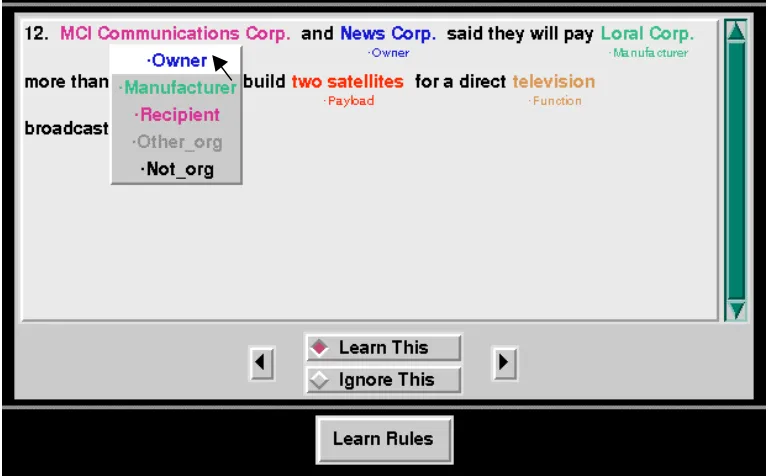
Figure 1: Training the system to extract information about payloads
Additional training efficiency is gained by automatically sorting the training examples. Rather than simply presenting examples sequentially as they appear in the training corpus, the best training examples are displayed first. Choosing the right training examples can allow the system to improve faster in the early stagesand this reduces the human effort because of the bootstrapping process. Learning faster in the early stages also ensures the best results if the user runs out of time or patience and is not able to work through the entire training corpus.
One technique for ordering training examples is to display the examples containing the most ambiguity first. This allows the teacher to provide the most information (in the information-theoretic sense) in the least amount of time. For instance, an organization in the payload extractor could be the owner, the manufacturer, the recipient, or a spurious organization such as the parent of the manufacturer. Obtaining feedback on examples that contain several organizations allows the system to quickly learn how to put organizations in the right slots.
Another ordering technique is to avoid displaying examples if several similar examples have already been presented. There is no point displaying hundreds of similar examplesthe system will learn the relevant grammatical knowledge after the first few. This technique can significantly reduce the required training time and allows the system to benefit from a larger variety of constructions earlier in the training process.
CONCLUSIONS
Being able to learn extraction grammars from examples provided by an end-user greatly increases the practicality of scenario-template-extraction technology. Manually constructing grammars is a slow, laborious, and ultimately expensive process. Largely eliminating this cost produces a huge swing in the cost/benefit ratio—even if some effort by computational linguists is still required for other aspects of the problem.
The benefits of trainable systems can be lost, however, if the training itself is too expensive or requires special skills. TASC has addressed this issue by developing a training scheme that requires no special computational or linguistic knowledge of the teacher, involves an extremely simple graphical interface, uses bootstrapping to automate the creation of training examples, and automatically selects the best training examples. An end-user can train this technology quickly and easily, ensuring the benefits of learning grammars are maximized.
The most significant result here is that automatically learned grammars do not entail a recall/precision sacrifice. The scores achieved using the automatically learned grammars clearly indicate that this new technology can successfully compete with handcrafted grammars, even when faced with complex problems and data ill-suited to learning.