-5 0 5 10 15 20
-0.5 0 0.5 1 1.5 2 2.5 3 3.5 4 4.5 5
GMI
RIDF
terms non-terms
Figure 2: GMI vs. RIDF
-5 0 5 10 15 20
0 1 2 3 4 5 6 7
GMI
IDF
terms non-terms
Figure 3: GMI vs. IDF
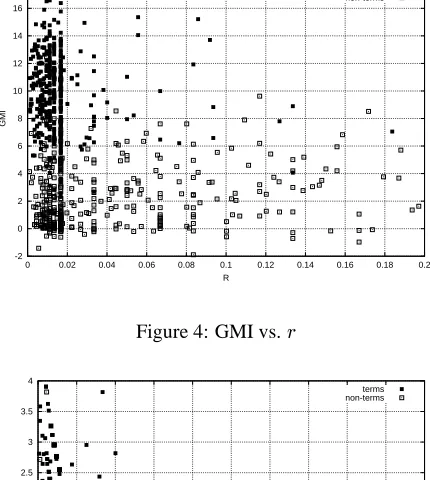
Distribution of -grams in Figs. 5 and 6 are not so clear as in previous cases. These plots represent the most con-fused part of the whole picture. It is doubtful whether these two statistics neatly distribute terms and non-terms but their plotting serves to show that no evident correlation seems to exist for these pairs of dimensions.
5.
Learning to identify term candidates
A supervised machine learning algorithm is used for the task of classifying -grams into terms and non-terms combining their statistical measures. A decision tree is in-duced using C4.5 (Quinlan, 1993) from a classified list of
-grams. A recent similar approach is explained by Vivaldi et al. (2001), who propose a combination of different clas-sifiers using boosting.
An initial training-set was obtained by random sam-pling the entire list of -grams. Preliminary experiments showed that induced trees better classified non-terms be-cause of the unequal distribution of classes (most non-terms and a few terms). Precision on the training-set for terms was only of 50% vs. 90% of non-terms that were correctly classified. Thus, more terms were manually extracted from texts and added (up to 1,740) to the training-set in order to overcome this distribution problem.
Evaluation was carried out on a test-set of 14,777 ex-amples (1,801 terms) not previously seen by the algorithm
-2 0 2 4 6 8 10 12 14 16 18
0 0.02 0.04 0.06 0.08 0.1 0.12 0.14 0.16 0.18 0.2
GMI
R
terms non-terms
Figure 4: GMI vs.)
-0.5 0 0.5 1 1.5 2 2.5 3 3.5 4
0 0.02 0.04 0.06 0.08 0.1 0.12 0.14 0.16 0.18 0.2
RIDF
R
terms non-terms
Figure 5: RIDF vs.)
during the training phase. Experiments were ran 100 times to obtain average figures. Table 2 displays the confusion matrix delivered by C4.5 where predicted terms and non-terms are represented in columns and
, respectively. As usual in evaluating ATR systems, instead of precision (
)/recall (
) (common in IR), we used the comple-mentary measures silence and noise. Silence is a measure of true terms not detected by the system (
), whereas noise is the measure of false terms proposed as term candi-dates (
).
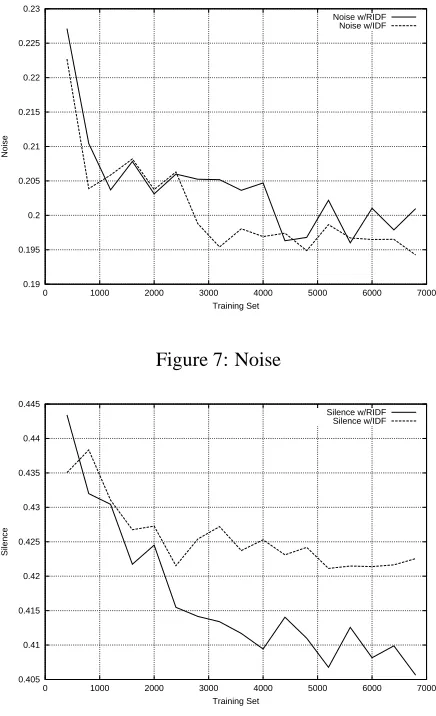
Parallel experimentation for two systems has been car-ried out —one using GMI, RIDF,) and , and another us-ing IDF instead of RIDF. Noise and silence, despite of their variability, have a downward trend as the training-set grows (see Figs. 7 and 8). Slightly better results for noise are achieved with IDF while silence gives worse results with RIDF.
The system was finally trained considering GMI, RIDF,
) , (*
and with all terms (3,541) and 29,000 non-terms. With this training-set distribution, both noise and silence levels, measured on the same training-set plus the rest of non-terms, were similar: noise = 31.54% and silence = 32.54%. The analysis of these errors can be found in(6.
0 1 2 3 4 5 6 7
0 0.02 0.04 0.06 0.08 0.1 0.12 0.14 0.16 0.18 0.2
IDF
R
terms non-terms
Figure 6: IDF vs.)
+
%
Table 2: Confusion matrix
to have the necessary size for reliable CF calculation. In the framework of ATR, these CFs could be interpreted as a
termhood index that can be used to rank term candidates to
be presented to the lexicographers.
5.1. Manually selected candidates vs. dictionary extracted terms
Terms automatically extracted from theDEC(an
upper-intermediate level technical dictionary) provide the algo-rithm with only positive examples. The training set was obtained by random sampling of the list of -grams and then manual classification was carried out by linguists with no special background in science or terminology and no in-struction on what a term is (only very polysemous -grams, usually corresponding to single words, were said to be clas-sified as non-terms).
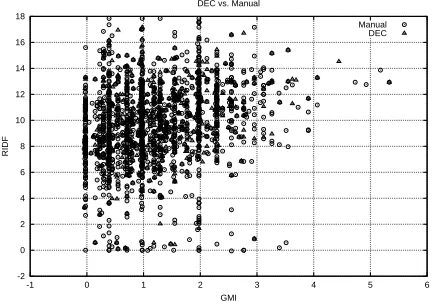
Surprisingly, scatter plots of manually selected candi-dates vs. dictionary extracted ones (Fig. 9) exhibit what we interpret as a strong correlation. Termhood judgments by linguists tend to choose -grams with measures similar to those extracted from theDECand found in the corpus.
6.
Analysis of errors
We have concentrated in the analysis of noise, since it is easier to build a set of trivial filters to reduce it, rather in the reasons for silence. The number of false terms is 1,169, being most of them unigrams (790). Given that the most discriminative dimension (GMI) is missing for unigrams, filters have been tested on the remaining errors (32.4% of noise errors).
The first set of filters exclude term candidates including punctuation (79 are excluded, 20.8% of the remaining noise errors), numbers (72, 19% of the errors), a given stop word at the beginning or end of the candidate (42, 11.1%)4and a given English stop word at the beginning or end of the
4
This filter is built around a couple of dozens of grammatical
0.19 0.195 0.2 0.205 0.21 0.215 0.22 0.225 0.23
0 1000 2000 3000 4000 5000 6000 7000
Noise
Training Set
Noise w/RIDF Noise w/IDF
Figure 7: Noise
0.405 0.41 0.415 0.42 0.425 0.43 0.435 0.44 0.445
0 1000 2000 3000 4000 5000 6000 7000
Silence
Training Set
Silence w/RIDF Silence w/IDF
Figure 8: Silence
candidate (14, 3.7%). The reduction is significant since it falls to 201 of the remaining 379 noise errors.
The second set of filters is based on other linguistic re-quirements expressed as negative constraints. We could have forced the candidates to conform to a given category sequence, as many authors propose (Cabr´e et al., 2001), but then many potentially terminological chunks would have been lost. Thus, the constraints are conservative and are based on observations over term candidates as well as over manually selected terms. All of them try to sharpen the fuzzy border between collocation and term. The first has to do with coordination. Frequently coordinated (IE) terms show a strong lexical relationship, a cohesive force that may better match the notion of collocation than that of termhood, as seen in the variety of relationships, that includes words in ordered series (XVI y XVII, B y C), unordered sets (forma y funci´on, masculino y femenino) or co-hyponyms (lagartos y ser-pientes, ovejas y cabras). None of them are terms but, in some cases, coordinated terms. This is also true for most the manually selected terms including a coor-dinated conjunction. This filter amounts for a 9% reduction
-2 0 2 4 6 8 10 12 14 16 18
-1 0 1 2 3 4 5 6
RIDF
GMI DEC vs. Manual
Manual DEC
Figure 9: DECextracted terms vs. Manually selected can-didates
(18 excluded candidates) of the new 201 error set.
The error list also contains complex verbs, periphrases and control structures that can be easily excluded with a chunker (or even using an exclusion filter with a not so lit-erary bias, since the structures are mainly informal). With this filter, 13 (6.5%) candidates are excluded.
Careful inspection of the rest of noise errors unveils some errors in manual selection. This affects to 29 cases (14.4%), that where considered non-terms by a linguist. This fact highlights the domain dependency of termhood. As Nunan (1993, 30) puts it: ”Collocational patterns will only be perceived by someone who knows something about the subject at hand.”
Overall noise for n-grams (where ) has been reduced to 37.2% with these simple filters. More-over, the rest of false terms include frequent technical collocations (uso masivo,prestigiosa revista,
trabajos pioneros, niveles elevados,alta
radiactividad) and common head-internal argu-ment sequences (tiro un dado, vali´o el
pre-mio, expresan telomerasa, medir
distan-cias,sufren metamorfosis).
7.
Conclusions and future work
This paper presents a language- and domain-independent methodology for ATR based on the com-bination of statistical measures on -grams.
Results of both noise and silence are promising given the paucity of data employed for training. The explored dimensions can be tuned substituting current approxima-tions for unithood by other proven useful statistics like log-likelihood ratio or MI (after generalising their formulae to arbitrary length -grams) and for domainhood by other statistics of dispersion.
Moreover, error analysis on noise reveals that a set of trivial filters significantly reduces noise, thus opening the possibility for new dimensions to be taken into account.
8.
References
Ma. Teresa Cabr´e, Rosa Estop´a, and Jordi Vivaldi. 2001. Automatic term detection: A review of current systems.
In Recent Advances in Computational Terminology, vol-ume 2 of Natural Language Processing, pages 53–87. John Benjamins.
Lee-Feng Chien and Chen Chun-Liang. 2001. Incremen-tal extraction of domain-specific terms from online text resources. In Recent Advances in Computational
Ter-minology, volume 2 of Natural Language Processing,
page 89. John Benjamins.
Kenneth W. Church and William Gale. 1999. Inverse Doc-ument Frecuency (IDF): A Measure of Deviation from Poisson. In Natural Language Processing Using Very
Large Corpora, volume 11 of Text, Speech and Language Technology, pages 283–295. Kluwer Academic
Publish-ers.
Kenneth W. Church and Patrick Hanks. 1991. Mutual In-formation and Lexicography. Computational
Linguis-tics, 16(1):22–29.
´
Angel Mart´ın Municio, Guillermo Rojo, Fernando S´anchez Le´on, and Octavio Pinillos. 2000. Language Resources Development at the Spanish Royal Academy. In Proceedings of the 2
International Conference on Language Resources and Evaluation (LREC 2000),
vol-ume II, pages 1265–1270, Athens, Greece.
David Nunan. 1993. Introducing discourse analysis. Pen-guin.
J. R. Quinlan. 1993. C4.5: Programs for Machine
Learn-ing. Morgan Kaufmann, San Mateo, CA.
Karen Sp¨ark Jones. 1973. A Statistical Interpretation of Term Specificity and its Application in Retrieval.
Jour-nal of Documentation, 28(1):11–21.
Jordi Vivaldi, Lluis M`arquez, and Horacio Rodr´ıguez. 2001. Improving Term Extraction by System Combina-tion using Boosting. In Proceedings of the joint
ECML-PKDD’01 Conference, Freiburg, Germany.
Mikio Yamamoto and Kenneth W. Church. 2001. Using Suffix Arrays to Compute Term Frequency and Docu-ment Frequency for All Substrings in a Corpus.