Yet Another Symmetrical and Real-time Word Alignment Method:
Hierarchical Sub-sentential Alignment using F-measure
Hao Wang, Yves Lepage
Graduate School of Information, Production and Systems
Waseda University
2-7 Hibikino, Wakamatsu-ku, Kitakyushu, Fukuoka, 808-0135, Japan
{
oko ips@ruri.,yves.lepage@
}
waseda.jp
Abstract
Symmetrization of word alignments is the fun-damental issue in statistical machine trans-lation (SMT). In this paper, we describe an novel reformulation of Hierarchical Sub-sentential Alignment (HSSA) method using F-measure. Starting with a soft alignment matrix, we use the F-measure to recursively split the matrix into two soft alignment sub-matrices. A direction is chosen as the same time on the basis of Inversion Transduction Grammar (ITG). In other words, our method simplifies the processing of word alignment as recursive segmentation in a bipartite graph, which is simple and easy to implement. It can be considered as an alternative of grow-diag-final-andheuristic. We show its applica-tion on phrase-based SMT systems combined with the state-of-the-art approaches. In addi-tion, by feeding with word-to-word associa-tions, it also can be a real-time word aligner. Our experiments show that, given a reliable lexicon translation table, this simple method can yield comparable results with state-of-the-art approaches.
1
Introduction
Since most of state-of-the-art Statistical Machine Translation (SMT) approaches require word-to-word aligned data on a parallel corpus, word-to-word align-ment is a fundaalign-mental issue to perform this task rapidly. In order to extract translation fragments for various purposes, e.g., word pairs (Brown et al., 1988), phrase pairs (Koehn et al., 2003), hierar-chical rules (Chiang, 2005), tree-to-tree
correspon-dences (Zhang et al., 2007), reliable and accurate word aligners are essential.
There exist several problems in state-of-the-art methods for word alignment. Present word align-ment approaches are usually based on IBM mod-els (Brown et al., 1993), which parameters are es-timated using the Expectation-Maximization (EM) algorithm. Sometimes, they are augmented with an HMM-based model (Vogel et al., 1996). Since IBM Models is the restriction to one-to-many alignments, some multi-word units cannot be correctly aligned. It is necessary to train models in both directions, and merge the outcome of mono-directional alignments using some symmetrization methods can overcome this deficiency to some degree.
It results, even using the standard open source tool aligner, calledGIZA++1(Och, 2003), which consist of the widely used IBM models and their extensions, still will spend lots of time to obtain word align-ments. A recent development of word alignment approachfast align2 (Dyer et al., 2013), based on the variation of the IBM model 2, has been re-ported faster than baselineGIZA++but with compa-rable results. However, both mentioned approaches generate asymmetric alignments. In order to obtain the symmetrical word alignments, these approaches symmetrize the alignments in both forward and re-verse directions using a symmetrization heuristic called grow-diag-final-and (Och, 2003). Starting with the intersection alignment points that occur in both of the two directional alignments, grow-diag-final-and expands the alignment in the union of
1http://www.statmt.org/moses/giza/
GIZA++.html
2https://github.com/clab/fast align
(X, Y) (X¯,Y)
(X,¯ Y¯) (X,¯ Y¯) (X,Y¯) i,s
,...
,s
m
(m, n)
(X,Y¯)
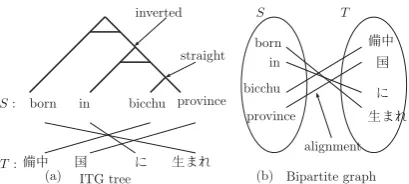
Inverted
Straight
Figure 2: Translation strengths on a logarithmic scale in a English-Japanese sentence pair matrix as a grey graph.
ple and convincing justification using F-measure for this symmetrical word alignment approach.
4
Proposed Method
4.1 Soft alignment matrices
We propose to regard the alignment associations be-tween a source sentence S and a target wordT as a contingency matrix (Matusov et al., 2004; Moore, 2005) as in Figure 2, noted asM(I, J), in whichI is the length of source sentence in words andJ for target side. We define a functionw which measur-ing the strength of the translation link between any source and target pair of words (si, tj). The sym-metric alignment between wordsi and tj presents
a greyed cell (i, j) in this matrix. In this paper, the scorew(si, tj)is defined as the geometric mean of the bidirectional lexical translation probabilities
p(si|tj) and p(tj|si). For a given sub-sentential alignmentA(X, Y)⊆ I ×J, we define the weight of this alignment W(X,Y) as the summation of asso-ciation scores between each source and target words of a block(X, Y)in such a matrix.
W(X, Y) =
s∈X
t∈Y
w(s, t) (6)
Since we have to calculate all cells in the block (X, Y), the time complexity here is inO(I×J).
4.2 Reformulation: from Ncut to F-measure
Ncut can be computed as the following formula same as in (Zha et al., 2001), :
Ncut(X, Y) = cut(X,Y)
cut(X,Y)+2×W(X,Y)+
cut(X,Y) cut(X,Y)+2×W(X,Y)
cut(X, Y) =W(X, Y) +W(X, Y) (7)
Actually, minimizing Ncut(X, Y) is equivalent to maximizing the arithmetic mean of the F-measure (also called F-score) ofXrelatively toY andX¯ rel-atively toY¯. It can be derived as following. In gen-eral, F1-measure (Kim et al., 1999) of block(X, Y) is defined as the harmonic mean of precisionP and recallR:
1
F1(X, Y) = 1 2 ×(
1
P(X, Y)+ 1
R(X, Y)) (8)
To interpret sentence pair matrices as contingency matrices, it suffices to read trans- lation strengths as reflecting the contribution of a source word to a target word and reciprocally. With this interpreta-tion, the precision (P) and the recall (R) for two sub-parts of the source and the target sentences can easily be expressed using the sum of all the transla-tion strengths inside a block. These two measures can thus be defined as following Equations.
P(X, Y) = W(X, Y)
W(X, Y) +W(X, Y) (9)
R(X, Y) = W(X, Y)
GIZA++ + HSSA 43,257 15,209 35.16 45.57 60.31
fast align + HSSA 43,070 14,950 34.71 44.79 60.89
Table 1: Word alignments comparison on Japanese-English data in terms of matches number, precision, recall and alignment error rate (AER). GDFA: an abbreviation ofgrow-diag-final-and. HSSA: an abbreviation of hierarchical sub-sentential alignment.
fast_align + grow-diag-final-and
GIZA++ + grow-diag-final-and
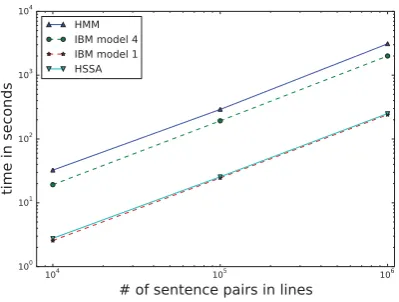
Figure 4: Average word alignment run-time (in seconds) as a function of the size of a corpus (in sentence pairs). Remember that, given the lexical translation probabili-ties, HSSA runs only in one iteration.
10K sentence pairs in the corpus completed in nearly 20 second with the HSSA approach but required more time with the other EM-based approaches.
In Table 1, Precision of our proposed approach are lower than baseline system, but Recall are bet-ter than fast align + GDFA. However, it has been proved (Fraser and Marcu, 2007; Ganchev et al., 2008) that AER does not imply a better transla-tion accuracy (see Table 3).
5.2 Translation Experiments
In this section, we first describe the data used in our experiments. We then perform to extract the lexical translation probabilities. Finally, we con-duct translation experiments using both the baseline system (GIZA++) and the system using HSSA ap-proach combined with to show, given a reliable lex-ical translation table for soft alignment matrix, the effectiveness of our proposed integrated system. We also investigate the time cost and the influence on the SMT frameworks.
In order to evaluate the proposed method, we conducted translation experiments on two corpora: Europarl Corpus and KFTT corpus. For English-Japanese (en-ja) and English-Japanese-English (ja-en), we evaluated on the KFTT corpus. For English-Finnish (en-fi), Spanish-Portuguese (es-pt) and English-French (en-fr), we measure the translation metrics
Train Tune Test Europarl v7 183K 1K 2K
KFTT 330K 1.2K 1.2K
Table 2: Statistics on the parallel corpus used in the ex-periments (K=1,000 lines).
on Europarl Corpus v75. The baseline systems are usingGIZA++to train as generally.
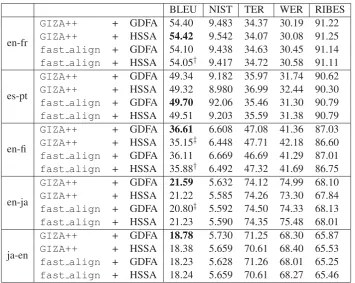
In our experiments, standard phrase-based statis-tical machine translation systems were built by using the Mosestoolkit (Koehn et al., 2007), Minimum Error Rate Training (Och, 2003), and the KenLM language model (Heafield, 2011). Default training pipeline for phrase-based SMT in is adopt with de-fault distortion-limit 6. For the evaluation of ma-chine translation quality, some standard automatic evaluation metrics have been used, like BLEU (Pa-pineni et al., 2002), NIST (Doddington, 2002) and RIBES (Isozaki et al., 2010) in all experiments. When compared with the baseline system (GIZA++ + GDFA), there is no significant difference on the final results of machine translation between using the alignments output by the proposed approach and GIZA++.
6
Conclusion
In this paper, we studied an ITG-based bilingual word alignment method which recursively segments the sentence pair on the basis of a soft alignment ma-trix. There are several advantages in our proposed method. Firstly, when combining the proposed method with word association probabilities (lexical translation table), it is more reasonable to obtain symmetrical alignments using the proposed method rather than grow-diag-final-and. In other words, this method provides an alternative to grow-diag-final-andfor symmetrization of word alignments. It achieves a similar speed compared to the simplest IBM model 1. Second, HSSA points a new way to real-time word alignment. For the tasks of process-ing same domain document, HSSA makes it possi-ble to reuse the pre-built crossing-language informa-tion, likes bilingual lexical translation table. In our experiment, it has demonstrated that our proposed method achieves comparable accuracies compared
5http://www.statmt.org/europarl/
Figure 5: Our proposed approach starts from alignment associations with some probabilities, which is different from the standard phrase-based SMT pipeline.
BLEU NIST TER WER RIBES
en-fr
GIZA++ + GDFA 54.40 9.483 34.37 30.19 91.22
GIZA++ + HSSA 54.42 9.542 34.07 30.08 91.25
fast align + GDFA 54.10 9.438 34.63 30.45 91.14
fast align + HSSA 54.05† 9.417 34.72 30.58 91.11
es-pt
GIZA++ + GDFA 49.34 9.182 35.97 31.74 90.62
GIZA++ + HSSA 49.32 8.980 36.99 32.44 90.30
fast align + GDFA 49.70 92.06 35.46 31.30 90.79
fast align + HSSA 49.51 9.203 35.59 31.38 90.79
en-fi
GIZA++ + GDFA 36.61 6.608 47.08 41.36 87.03
GIZA++ + HSSA 35.15‡ 6.448 47.71 42.18 86.60
fast align + GDFA 36.11 6.669 46.69 41.29 87.01
fast align + HSSA 35.88† 6.492 47.32 41.69 86.75
en-ja
GIZA++ + GDFA 21.59 5.632 74.12 74.99 68.10
GIZA++ + HSSA 21.22 5.585 74.26 73.30 67.84
fast align + GDFA 20.80‡ 5.592 74.50 74.33 68.13
fast align + HSSA 21.23 5.590 74.35 75.48 68.01
ja-en
GIZA++ + GDFA 18.78 5.730 71.25 68.30 65.87
GIZA++ + HSSA 18.38 5.659 70.61 68.40 65.53
fast align + GDFA 18.23 5.628 71.26 68.01 65.25
fast align + HSSA 18.24 5.659 70.61 68.27 65.46
pages 25–32, Atlanta.
Franz Josef Och. 2003. Minimum error rate train-ing in statistical machine translation.. Proceedtrain-ings of the 41st Annual Meeting on Association for Computa-tional Linguistics-Volume 1. Association for Compu-tational Linguistics.
Hua Wu and Haifeng Wang. 2007. Comparative study of word alignment heuristics and phrase-based SMT. Proceedings of the MT Summit XI.
Alexander Fraser and Daniel Marcu. 2007. Measuring word alignment quality for statistical machine transla-tion.Computational Linguistics. 33(3)
Dekai Wu. 1997. Stochastic inversion transduction grammars and bilingual parsing of parallel corpora. Computational linguistics.23.3: pp.377–403.
Jianbo Shi and Jitendra Malik 2000. Normalized cuts and image segmentation. Pattern Analysis and Ma-chine Intelligence, IEEE Transactions on.22.8. IEEE. pp.888–905
Hongyuan Zha, Xiaofeng He, Chris Ding and Horst Si-mon and Ming Gu. 2001. Bipartite graph partitioning and data clustering Proceedings of the tenth interna-tional conference on Information and knowledge man-agement. Association for Computational Linguistics. pp.25–32.
Evgeny Matusov, Richard Zens, and Hermann Ney. 2004. Symmetric word alignments for statistical ma-chine translation. Proceedings of the 20th interna-tional conference on Computainterna-tional Linguistics. As-sociation for Computational Linguistics. pp.219. J. Makhoul, F. Kubala, R. Schwartz and R. Weischedel,.
1999. Performance measures for information extrac-tion. In Proceedings of DARPA broadcast news work-shop. pp. 249-252.
J. Makhoul, F. Kubala, R. Schwartz and R. Weischedel,. 1999. Performance measures for information extrac-tion. In Proceedings of DARPA broadcast news work-shop. pp. 249-252.
Jae Dong Kim, Ralf D. Brown, Peter J. Jansen and Jaime G. Carbonell. 2005. Symmetric probabilistic align-ment for example-based translation. In Proceedings of the Tenth Workshop of the European Assocation for Machine Translation (EAMT-05), May.
Robert C Moore. 2005. Association-based bilingual word alignment. Proceedings of the ACL Workshop on Building and Using Parallel Texts. Association for Computational Linguistics,
Ana Guerberof 2009. Productivity and quality in MT post-editing MT Summit XII-Workshop: Beyond Translation Memories: New Tools for Translators MT.
ods in Natural Language Processing. Association for Computational Linguistics. pp. 944–952.