Event Sequence Model for Semantic Analysis of
Time and Location in Dialogue System
Yasuhiro Noguchi
Faculty of Informatics
Shizuoka University
[email protected]Satoru Kogure
Graduate School of Informatics
Shizuoka University
Makoto Kondo
Graduate School of Informatics
Shizuoka University
Ichiro Kobayashi
Graduate School of Humanities and Sciences,
Ochanomizu University
Hideki Asoh
Intelligent Systems Research Institute,
AIST
Akira Takagi
NLP Research Laboratory
Tatsuhiro Konishi
Graduate School of Informatics
Shizuoka University
Yukihiro Itoh
Shizuoka University
Abstract
It is important for a natural language dia-logue system to interpret relations among event concepts appearing in a dialogue. The more complex a dialog becomes, the more essential it becomes for a natural language dialogue system to perform this kind of in-terpretation. Traditionally, many studies have focused on this problem. Some dia-logue systems supported such semantic analysis by using rules and/or models de-signed for particular scenes involving spe-cific type of dialogue and/or spespe-cific problem solving. However, these frame-works require system developers to recon-struct those rules/models even if a slight change is added to the targeted scene. In many cases, their rules/models heavily de-pend on specific type of dialogue/problem solving, and they do not have high reusabil-ity and modularreusabil-ity. Since those rules/models have scene-depending design, they cannot be used to incrementally construct a bigger rule or model. In this research, we focus on a set of event concepts which are usually expected to occur sequentially. In a dialogue, a spoken event concept enables the listeners to guess a sequence of events. The sequence may sometimes be logically inferred, and it may be understood based on general com-mon sense. We believe that a concept model of sequential events can be designed for each bigger event concept that consists of a series of smaller events. Using the sequentiality of the events in the model, a dialogue system can analyze time and
loca-tion of each event in a dialogue. In this pa-per, we design a structure of the event se-quence model and propose a framework for analyzing time and location of event con-cepts appearing in a dialogue. We imple-mented this framework in a dialogue system, and designed some event sequence models. We confirmed that this system could ana-lyze time and location of sequential events without scene-depending rules.
1
Introduction
Natural language understanding by a NLP sys-tem requires more than generating semantic rep-resentations corresponding to the user's input sentence and adding them into the dialogue con-text information in the system. The system is also required to interpret the semantic representations generated from the user's input sentences by comparing them with the dialogue context, the situation surrounding the user and the system, and common sense knowledge. Through these analyses, the user’s input is correctly/restrictively understood beyond what is explicitly uttered.
In our previous research, we focused on the difficulty for a natural language dialogue system arising from synonymous expressions. The same semantic contents can be conveyed by different expressions with different set of words and dif-ferent syntactic structures. A natural language dialogue system must obtain the same semantic contents from those synonymous expressions irrespective of their differences. The proposed method of semantic analysis allows us to obtain the same semantic contents from a variety of
339
synonymous expressions (Takagi et al. 2006). We also developed a dialogue system based on this semantic analysis and evaluated the system (Noguchi et al. 2008). According to this frame-work, meanings of phrases, clauses and sentenc-es are reprsentenc-esented by sets of attribute-value pairs. A meaning denoted by a head (noun, verb, etc.) and its modifier is represented by a pair of the corresponding attribute and its value. We also prepared concept hierarchies for super-sub rela-tion and whole-part relarela-tion. The concept hierar-chies enable semantic comparison between different attributes, entities, or events. Accord-ingly, the semantic analysis in this framework consists solely of interpretation of attribute-value pairs and comparison of attribute-value pairs, and the dialogue system based on this framework obtains the same semantic contents from various synonymous expressions irrespective of their differences in their words and structures.
Semantic information explicitly conveyed in a dialogue is effectively analyzed by the above method; however, interpretation based on super-sub and whole-part relation is not enough. In this paper, we focus on a set of event concepts which are generally expected to occur sequentially. In a dialogue, a spoken event concept enables the lis-teners to guess a sequence of events. The se-quence may sometimes be logically inferred, and it may be understood based on general common sense. Our purpose is to design a concept model of an event composed of sequential sub-events. We also propose a framework for semantic anal-ysis of time and location based on the sequentiality in the model.
As for related research, Script (Schank and Abelson 1975) is well known for its capability to interpret relations among events involved in a dialogue. In this framework, scene-specific rules are prepared and those rules enable a dialogue system to interpret relations among event con-cepts in the user's input sentences, the dialogue context, the situation surrounding the user and the system, and common sense knowledge. A plan-based dialogue system (e.g. Chu-Carroll and Carberry 1998) employs a framework in which the dialogue system calculates dialogue strategy to solve the user's problem in a dialogue where a goal of the problem-solving is shared by the user and the system. Oku et al. (2004) propose a dia-logue control scheme based on database and top-ic frames whtop-ich include task-dependent knowledge. All the three frameworks require prepared task-dependent knowledge with desig-nated structures in order to interpret semantic
relations among event concepts appearing in the user's input, the dialogue context, the situation surrounding the user and the system, and com-mon sense knowledge. Accordingly, these frameworks require system developers to recon-struct these scripts, plans or frames even if a light change is added to the dialogue situation. It is practically impossible to prepare enough knowledge to deal with every possible dialogue. Fujiki et al. (2003) propose automatic plan gen-eration from a text corpus. Its capability of plan generation is limited, and the problem of low reusability still remains for script-based natural language understanding systems.
Some approaches have been proposed for task-independent semantic analysis (Iida et al. 2003) (Yoshimura et al. 2009) (Hayashibe et al. 2011). Unlike script-based approaches, these ap-proaches do not deal with dialogue structure. A dialogue without a specific goal can be supported by these approaches, but they do not have enough semantic analysis for supporting task-oriented dialogues.
Tamano and Matsumoto (1996) and Noro et al. (2007) focus on time identification and time inference of sequential events based on natural language expressions in the context. These stud-ies did not focus on preparing knowledge de-scription of a set of event concepts which are generally expected to occur sequentially.
In linguistic fields, the discourse representa-tion theory (Partee 1984) (Kamp and Reyle 1993) deals with dialogue structure. These theory organized the roles of tense and aspect forms for discourse representation structures including time representations. However these discourse representation structures are sometimes analyzed by hand. These approaches do not focus their computational realization for supporting task-oriented dialogues.
2
Event Sequence Model
2.1
Basic Concept of Event Sequence ModelAn event concept in natural language input in-vokes a set of event concepts which are generally expected to occur sequentially. In the sequence consisting of a set of event concepts, we often understand time/location of one event by refer-ring to time/location of the preceding or follow-ing event. Such mutual reference between two sequential events goes beyond mutual reference through super-sub/whole-part relation. For ex-ample, consider “I went to Hamamatsu city. I stayed in the Hamamatsu Hotel.”. The “go” and the "stay" are different event concepts and these event concepts do not have super-sub/whole-part relation in a general concept hierarchy. In under-standing these event concepts, however, we need mutual references to semantic information be-tween the “goal” attribute of the “go” event con-cept and the “location” attribute of the “stay” event concept. The mutual reference is explained based on the following knowledge.
A “go” event concept and a “stay” event concept have whole-part relationship with a “trip” event concept when the “go” event and the “stay” event are partial events of the “trip” event.
When the “stay” event occurs after the “go” event, the “goal” attribute of the “go” event concept restricts the “location” attribute of the “stay” event concept and vice versa.
It is necessary for a natural language dialogue system to support the semantic analysis of this sort. In section 2, we discuss how sequential events should be structured and propose a gen-eral event sequence model and twin specific event sequence models based on the general model. Section 3 deals with how to perform se-mantic analysis based on specific event sequence models. Section 4 provides demonstration of our dialog system based on the framework to be pro-posed. The final section summarizes what has been achieved and what remains to be achieved.
2.2
Design Requirement of Event SequenceModel
To discuss the design requirements of the event sequence model, we focus on “trip” event con-cept and its related event concon-cepts. The reason to focus on these event concepts is that “trip”-related tasks are popular in many studies about a dialogue system. In a dialogue with “trip”-related
tasks, the user frequently refers to the time and location of event concepts. The purpose of this research is definitely not to design a specific model for the “trip” event concept. Therefore we should carefully design the structure of the event sequence model so that the model can be applied to a wide variety of event concepts. We should examine if the event sequence model to be pro-posed can be applied to many other event con-cepts than what is discussed in this paper. However, that is beyond the scope of this paper and we leave it for the future work.
We collected dialogue histories of hotel search/reservation dialogue systems, travel re-ports published on web sites, and so on. From the collected contents, we chose 62 contents which involve frequent reference to the time and loca-tion of event concepts. These contents include 399 sentences. We analyzed event concepts in the sentences and confirmed that proper interpre-tation of the contents requires us to assume the existence of a series of events not explicitly con-veyed in the contents. We found some properties of sequential events and restrictions on the event sequence model imposed by those properties. In this section, we summarize the design require-ments and conditions for the event sequence model.
In the collected contents, even events of the same type involve a wide variety of sequential events. For example, it depends on the dialogue situation whether a “trip” event contains a “stay” event as its partial event. Similarly some “trip” events include “taking a hot spring bath” or “vis-iting a tourist place”, and others do not. If a “trip” event contains a “work” event, the “trip” event should be interpreted as a “business-trip” event and not as a “sightseeing-trip” event.
created based on the event concepts appearing in a dialogue.”
In some of the collected contents, the exist-ence of some events are presupposed even if the events are not explicitly expressed in the contents. For example, when “taking a hot spring bath” exists as a part of a “trip” event, a “go” event must exist as a part of the "trip" event, and the value of the “goal” attribute in the implicit “go” event concept must coincide with the “location” attribute of the “hot spring bath” concept. It means “(d) when a whole event concept is con-veyed or when a whole event concept is invoked from some related event concepts, a dialogue system should behave as if other event concepts essential for the explicit event concepts were conveyed in the dialogue context; hence, the structure of the event sequence model is required to define essential event concepts for the whole event concept.”
A whole event concept is sometimes com-posed of multiple occurrences of the same type of event concept. Suppose for example that there are “a trip from A to B.”, “a trip from B to C.” and “a trip from C to D.” in a dialogue. We can refer to each “trip” event concept as a “trip”, and we can also refer to the entire event concept binding up the smaller “trip” event concepts as a “trip” as in “How much is the total cost of the trip?” It means that “(e) an event sequence model for a whole event concept includes the whole event concept itself as a part of the whole event concept.”
Proper interpretation of the collected contents sometimes requires inference of the time/location of an event even if they are not explicitly ex-pressed in the contents. The inference can be drawn from the sequentiality of the event and the preceding/following event. It means that “(f) mu-tual reference to semantic information between two sequential event concepts based on the spatio-temporal sequence should be defined.”
Many of the collected contents contains more than one event concept each of which invokes a different series of partial events. Therefore, “(g) the framework for the event sequence model should determine how to achieve mutual refer-ence to semantic information between different event sequences.”
The discussions above are summarized in the following design requirements and conditions for the event sequence model.
(a) We cannot predefine a set and the order of partial events constituting the event
sequence model in a static manner as in “E0, E1, E2, ..., En”.
(b) A set of possible partial event concepts can be defined for a specific event se-quence model.
(c) An instance of a specific event sequence model should be dynamically created based on the event concepts appearing in a dialogue.
(d) When a whole event concept is conveyed or when a whole event concept is in-voked from some related event concepts, a dialogue system should behave as if other event concepts essential for the ex-plicit event concepts were conveyed in the dialogue context; hence, the structure of the event sequence model is required to define essential event concepts for the whole event concept.
(e) An event sequence model for a whole event concept includes the whole event concept itself as a part of the whole event concept.
(f) Mutual reference to semantic infor-mation between two sequential event concepts based on the spatio-temporal sequence should be defined.
(g) The framework for the event sequence model should determine how to achieve mutual reference to semantic information between different event sequences.
2.3
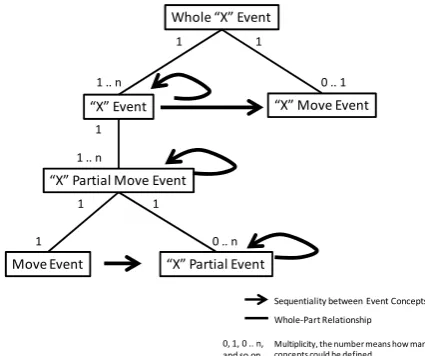
Structure of Event Sequence ModelFigure 1 shows the general structure of event sequence models based on requirements (a-g) discussed in previous section.
Figure 1. General Structure of Event Sequence Model
Whole “X” Event
“X” Event “X” Move Event
Move Event “X” Partial Event
1 1
0 .. 1 1 .. n
1 0 .. n
1 1
“X” Partial Move Event
1 .. n 1
Sequentiality between Event Concepts
Whole‐Part Relationship
Multiplicity, the number means how many concepts could be defined. 0, 1, 0 .. n,
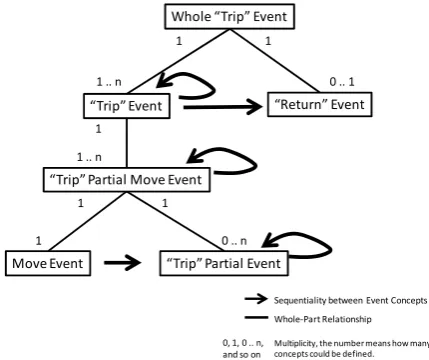
As for the requirement (e), we designed a 4 -layered whole-part relationship tree structure as the general structure of the event sequence model. In this model, the multiplicity definitions at both ends of a whole-part relation line mean how many concepts are possibly defined at the ends. Each event sequence model according to an event is defined based on this general structure by each word concept as Figure 2. “X” in Figure 1 is transferred to the name of each event concept.
In this framework for the requirement (a) and (c), an instance of an event sequence model is dynamically created based on the event concepts appearing in a dialogue. The “X Partial Event” in Figure 1 means that a set of event concepts is possible to be a part of the “X Event”, discussed in requirement (b). For example, a set of “Trip Partial Event” concepts includes “eat”, “sightsee-ing”, “drive”, and so on.
The arrow line in Figure 1 means the sequentiality between two events for the re-quirement (f). For example, the arrow line from ”Move Event” to “X Partial Event” means that an “X Partial Event” will be occurred after the “Move event”. In Figure 2, “Trip Event” has the sequentiality with “Return Event”, and next “Trip Event”.
The general structure of the event sequence model expressly includes the “Move Event” be-cause each event concept, in general, has the “lo-cation” attribute. In this structure, every “X Partial Event” with changing its location accom-panies “Move Event” before it. A “X Partial Move Event” bounds a pair of a “Move Event” and arbitrary number of “X Partial Event” con-cepts. This pair can define a partial event se-quence that arbitrary number of events involved in a set of “X Partial Event” occur after the “Move Event”.
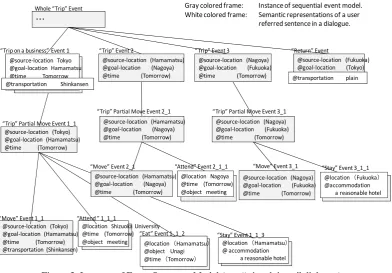
Figure 3 is an example of the instance of the event sequence model for “trip” event in Figure 3. This instance is created by “trip advisory”
dia-logue. As a dialogue continues, an event concept used in the dialogue is judges whether it is capa-ble to join the existing instance of the event se-quence model or not. If the event concept can join to the existing instance, the event concept is joined as a “X Partial Event” in the existing in-stance. If the event concept cannot join to the existing instance, the instance should be extend-ed. For example, as a new “trip” event, the “Trip Event 2”, the “Trip Partial Event 2_1”, the “Move Event 2_1” are created in Figure 4. After that, the “Attend Event” is joined as the “Trip Partial Event” after the “Move Event 2_1”.
The other sequentiality of two event concepts depends on the type of the event concepts. When the event sequence model for an whole event is defined, the sequentiality between the essential partial events for the whole event are expressly defined. In Figure 4, “check-in” and “check-out” events are essential partial events for the “stay” event, and the sequentiality between them are defined.
Figure 2. Example of Event Sequence Model of “trip” Event
Whole “Trip” Event
“Trip” Event “Return” Event
Move Event “Trip” Partial Event
1 1
0 .. 1 1 .. n
1 0 .. n
1 1
Sequentiality between Event Concepts
Whole‐Part Relationship
Multiplicity, the number means how many concepts could be defined. 0, 1, 0 .. n,
and so on
“Trip” Partial Move Event
tion. The value of “location” attribute of “Attend Event 2_1_1” in Figure 3 is restricted based on the value of “location” or “goal-location” attrib-ute of “Trip Partial Event 2_1”. The “Trip Partial Move Event 2_1” is simultaneously restricted based on the “Trip Event 2”. In Figure 3, when the user explicitly expressed his/her business trip to “Hamamatsu” city, the value of the “location” attribute of the “Attend Event 2_1_1” is restrict-ed on the part of “Hamamatsu” city. It enable the dialogue system to identify the location of the meeting, and to presuppose the “attend” event.
Based on the sequentiality between two events in an event sequence model, following references are applied to ensure consistency of time and location in the whole instance of the event sequence model.
The value of the “location” attribute or the attribute “source-location” in an event at the origin of an arrow line is se-mantically restricted by the value of the “location” attribute or the “goal-location” attribute in an event at the end of the ar-row line, regardless of difference of the type of event concepts.
The value of the “time” attribute in an event at the end of an arrow line is se-mantically restricted around the same time or future time of the value of the “time” attribute in an event at the origin of the arrow line.
The sequentiality among the “Trip Event 1”, “Trip Event 2”, “Trip Event 3” and “Return Event” in Figure 3 restricted their “time” attrib-ute and “location” attribattrib-ute. The value of the “goal-location” attribute in the “Trip Event 1” restricted the value of the “location” attribute in the “Trip Event 2”. In the “Trip Event 2”, “Trip Event 3”, “Trip Event 3”, and “Return Event”, same kinds of restrictions are applied.
3.2
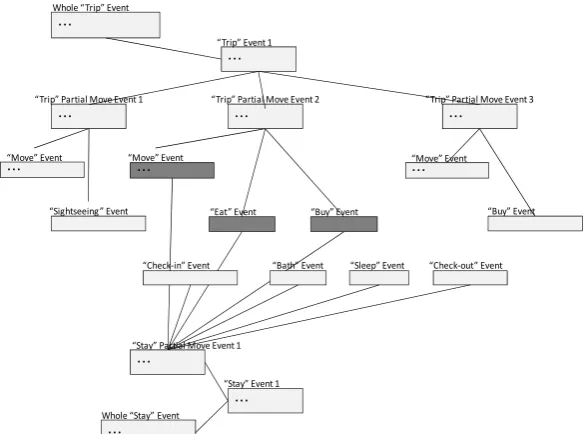
Semantic Analysis between Event Se-quence ModelsIn this section, we explain a semantic analysis method among multiple event sequence models in a dialogue based on the requirement (g) dis-cussed in previous section. The result for analyz-ing collected contents indicated the requirements of following operations as Figure 5 when more than 1 instances of event sequence models in a dialogue.
When some events are shared in among multiple event sequence models, the se-mantic information of these events are
mutual referred from these event se-quence models.
An event is occurred at the point on the event sequence of the other event se-quence model. The sequentiality includ-ing the event is dynamically generated, when the event has enough semantic in-formation to determine the sequence where the event occurs.
When the user expressed an event which is capable to join both event sequence models in a dialogue, in each event sequence model, the rela-tions with the event and the existing event se-quence model are interpreted as section 3.1. The event which joined both event sequence models (as dark gray colored frame in Figure 5) shared the mutual references of semantic information. If the consistency of these event sequence models including the shared event could not be ensured, the capability that the event concept joined into both event sequence models should be rejected. If the consistency of them could be ensured, the events of “Check-in”, “Bath”, “Sleep”, “Eat” and “Buy” have similar sequentiality that these events occurred after “Move Event” and before “Check-out Event”. The sequence of them will be determined by more detailed semantic infor-mation explicitly expressed by the user. It is also important for a dialogue system to tentatively suppose the sequence to decide next system's behavior based on the result of semantic analysis.
There are logically following relationships among the event sequence models defined by the requirement (b).
(A) The instances of event sequence models are subset/superset relationship.
(B) The instances of event sequence models have intersection.
(C) The instances of event sequence models do not have intersection (all instances of an event sequence model are occurred before/after all instances of the other event sequence model).
Figure 5. Model for Semantic Analysis between Event Sequence Models in a Dialogue
4
Demonstration
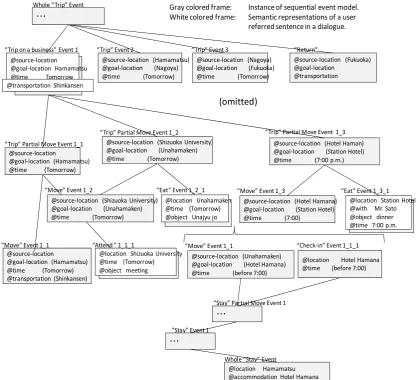
We implemented a framework for a semantic analysis method using event sequence models in a dialogue system. We defined some event se-quence models according to event concepts ap-pearing in “trip advisory” dialogues. Figure 6 shows an example of dialogue with this dialogue system, and Figure 7 shows the extracted part of instances of event sequence models generated in this dialogue.
In the dialogue in Figure 6, “trip” event con-cept and “stay” event concon-cept invoke the instanc-es of thinstanc-ese event sequence models like Figure 5. The underlined system's replies are generated using these models.
When the user would like to eat unagi (cooked eel) in “Unahamaken (a restaurant)”, the instance of “Move Event 1_2” and others are created to keep the consistency of the location which is changed from “Shizuoka University” to “Unahamaken”. So, the dialogue system can identify that the user must be going to move from “Shizuoka University” to “Unahamaken” and can intend to give the travel time from Shizuoka University to “Unahamaken” to the user.
U asu, hamamatsu-ni syucho shimasu.
(I will travel to hamamatsu city tommorrow for business.)
S kashikomari-mashita. goyoken-ha?
(OK. Do you have a requests?)
U “Shizudai”-de uchiawase-wo shimasu. ato, unagi-wo tabe-tai. (I'll have a meeting in Shizuoka University. I want to eat unagi at lunch.)
S “Unahamaken”-ga osusume-desu. Shizudai-kara basu-de 5
fun-de yukemasu. unajyu jo-dato 2,800 yen fun-desu.
(I suggest you “Unahamaken”. You can go there from Shizuoka University for 5 minutes by bus. Unajyu jo is 2,800 yen.)
U wakarimashita. yasui hotel-ni tomaritai no dake-do.
(I see. Could you tell me a reasonable hotel?)
S hamamatsueki-mae-no ippaku 4,800 yen no “Hotel
Hamana”-ha ikagadesu-ka?
(“Hotel Hamana” near Hamamatsu station is 4,800 yen by a day.)
U arigatou. soko-ni tomarimasu. sore-to “Station Hotel”-de
7:00-ni Sato-san-to yusyoku-wo torimasu.
(Thanks. I'll stay there. I'll got dinner with Mr. Sato in Station Hotel.)
S “Hotel Hamana”-kara “Station Hotel”-heha toho-de 5 fun desu.
“Hotel Hamana”-no checkin-ha 6:30-de yoi-desune. (You can go Station Hotel from Hotel Hamana on walk for 5 minutes. The time of check-in in Hotel Hamana is 6:30 p.m., isn't it?)
U arigatou. yokujitsu-ha, nagoya-de kaigi-ni sanka shite-kara,
fukuoka-ni mou ippaku shimasu.
(OK. Next day, I have a meeting in Nagoya city, and stay in Fukuoka city.)
S wakari-mashita. fukuokaeki-mae ippaku 5,600 yen no
“Fukufukutei”-ga osusume desu.
(I see. I suggest “Fukufukutei” on the front of Fukuoka station whose price is 5,600 yen by a day.)
U arigatou.
(Thanks.)
Figure 6. Dialogue Example with Implemented Dialogue System
・・・ “Trip” Event 1 ・・・
Whole “Trip” Event
“Sightseeing” Event ・・・
“Move” Event ・・・
“Trip” Partial Move Event 1
・・・ Whole “Stay” Event
・・・ “Stay” Event 1
“Eat” Event “Buy” Event “Buy” Event ・・・
“Move” Event
・・・ “Move” Event ・・・
“Trip” Partial Move Event 2
・・・
“Trip” Partial Move Event 3
“Stay” Partial Move Event 1
“Check‐in” Event “Bath” Event “Sleep” Event “Check‐out” Event
When the system suggested “Hotel Hamana” to the user, the instance of “stay” event sequence model are created. When the user told the system that the user have an appointment to take dinner with Mr. Sato in the Station Hotel, the “Trip Partial Event 1_3” and its branches are created. The part of the forth layer (bottom layer) in-stances of “stay” model are located between “Eat Event 1_2_1” and “Move Event 1_3”. As anoth-er intanoth-erpretations, the part of the forth layanoth-er in-stances of “stay” model could be located after “Eat Event 1_1_1”. In this case, the former inter-pretations were tentatively adopted by the
sys-tem. These instances are set mutual references based on sequentiality among the “Eat Event 1_2_1”, the “Move Event 1_1”, the “Check-in Event 1_1_1”, the “Move Event 1_3” and the “Eat Event 1_3_1”. The “Move Event 1_3” ena-bles the system to intend to give the travel time from the “Hotel Hamana” to the Station Hotel to the user. The “Check-in Event 1_1_1” enables the system to intend to confirm the user's check-in time to the “Hotel Hamana”.
Figure 7. Extracted Instances of Event Sequence Models on the Dialogue Example
5
Conclusion
This paper described the design of the general event sequence model and two specific event sequence models (“trip” event and “stay” event) based on the general model. We also propose a framework for analyzing time and location of sequential events in a dialogue. We implemented
this framework in a dialogue system, and con-firmed that this system could analyze time and location without scene-specific rules.
We analyzed “trip” event contents to design the general event sequence model. These con-tents were collected from hotel search/reservation dialogues, travel reports on web sites and so on. We think that the high
ap-Whole “Stay” Event @source‐location
@goal‐location Hamamatsu @time Tomorrow @手段 新幹線
“Trip on a business” Event 1
“Trip” Partial Move Event 1_1
@source‐location @goal‐location (Hamamatsu) @time (Tomorrow) @transportation (Shinkansen) “Move” Event 1_1
・・・
Whole “Trip” Event
“Return” Event
@source‐location @goal‐location (Hamamatsu) @time (Tomorrow)
@source‐location (Fukuoka) @goal‐location @transportation
@location Shizuoka University @time (Tomorrow) @object meeting “Attend ” 1_1_1 @transportation Shinkansen
@source‐location (Nagoya) @goal‐location (Fukuoka) @time (Tomorrow) “Trip” Event 3
@source‐location (Hamamatsu) @goal‐location (Nagoya) @time (Tomorrow)
“Trip” Partial Move Event 1_2
@source‐location (Shizuoka University) @goal‐location (Unahamaken) @time (Tomorrow)
@location Unahamaken @time (Tomorrow) @object Unajyu jo “Eat” Event 1_2_1 @source‐location (Shizuoka University)
@goal‐location (Unahamaken) @time (Tomorrow) “Move” Event 1_2
Gray colored frame: Instance of sequential event model. White colored frame: Semantic representations of a user
referred sentence in a dialogue.
“Trip” Event 2
@location Hamamatsu @accommodation Hotel Hamana “Stay” Partial Move Event 1
・・・
@location Hotel Hamana @time (before 7:00) “Check‐in” Event 1_1_1 @source‐location (Unahamaken)
@goal‐location (Hotel Hamana) @time (before 7:00) “Move” Event 1_1
“Stay” Event 1
・・・
“Trip” Partial Move Event 1_3 @source‐location (Hotel Haman) @goal‐location (Station Hotel) @time (7:00 p.m.)
“Eat” Event 1_3_1 “Move” Event 1_3
@location Station Hotel @with Mr. Sato @object dinner @time 7:00 p.m. @source‐location (Hotel Hamana)
@goal‐location (Station Hotel) @time (7:00)
plicability of the suggested event sequence mod-el was not enough to be confirmed. Especially for many event sequence models exist in a dia-logue. In this paper, we demonstrated with “trip” and some other event concepts however the demonstrated event sequence models are sub-set/superset relationship. The instance of event sequence models with intersection and without intersection are not demonstrated. As future works, the applicability of the suggested models with these conditions should be evaluated. Natu-rally, it is necessary to evaluate even more event concepts in many varieties of dialogues.
References
A. Takagi, H. Asoh, Y. Itoh, M. Kondo and I. Koba-yashi. 2006. Semantic Representation for Under-standing Meaning Based on Correspondence between Meanings, Journal of Advanced Computa-tional Intelligence and Intelligent Informatics, 10(6): 876-912.
Y. Noguchi, Y. Ikegaya, S. Kogure, M. Kondo, H. Asoh, I. Kobayashi, T. Konishi, A. Takagi and Y. Itoh. 2008. Construction and Evaluation of a Dia-log System Based on Mapping Sentence Meanings to the Dialog Context, Journal of Japan Society for Fuzzy Theory and Intelligent Informatics, 20(5): 732-756. (in Japanese)
R.C.Schank and R.P.Abelson. 1975. Scripts,
plans, and knowledge, Proceedings of the 4th in-ternational joint conference on Artificial intelli-gence, 1:151-157.
J.Chu-Carroll and S. Carberry. 1998. Collaborative Response Generation in Planning Dialogues, Com-putational Linguistics, 24(3): 355-400.
T. Oku, T. Nishimoto, M. Araki and Y. Niimi. 2004. A task-independent control method for spoken dia-logs, Systems and Computers in Japan, 35(14):87-95. (in Japanese)
E. Yoshimura, S. Tsuchiya and H. Watabe. 2009. A Method of Association Response Based on Com-monsense in Chatting System, Forum on Infor-mation Technology, 8(2):303-306. (in Japanese) R. Iida, K. Inui, H. Takamura and Y. Matsumoto.
2003. Incorporating contextual cues in trainable models for coreference resolution, Proceedings of the 10th EACL Workshop on the Computational Treatment of Anaphora, 23-30. (in Japanese) Y. Hayashibe, M. Komachi and Y. Matusmoto. 2011.
Improving Japanese Inter-sentential Predicate Ar-gument Structure Analysis with Contextual Infor-mation and Similarity between Case Structures, IPSJ SIG-SLP, 2011-SLP-86(10):1-8. (in Japanese) T. Fujiki, H. Nanba and M. Okumura. 2003.
Automat-ic acquisition of script knowledge from a text col-lection, Proceedings of the tenth conference on European chapter of the Association for Computa-tional Linguistics, 2:91-94.
K. Tamano and Y. Matsumoto. 1996. A study of con-straint based description of temporal structure, IPSJ SIG-NL, 115(2):9-14.
T. Noro, K. Inui, H. Takamura and M. Okumura. 2007. Time Period Identification of Events in Text, IPSJ, 48(10):3405-3414. (in Japanese)B. Partee. 1984. Nominal and temporal anaphora, Linguistic and Philosophy, 7, 243-286.