CSEIT1846198 | Published – 08 May 2018 | May-June 2018 [ (4 ) 6 : 1045-1050 ]
National conference on Engineering Innovations and Solutions (NCEIS – 2018)
International Journal of Scientific Research in Computer Science, Engineering and Information Technology
© 2018 IJSRCSEIT | Volume 4 | Issue 6 | ISSN : 2456-3307
1045
Experimental Determination of THD for Different Lighting
loads
Raghavendra L1, Siddiq Ahmed Khan2, Narasimha Murthy2 1
Assosciate professor, Department of Electrical and Electronics Engineering, ATMECE, Mysore, Karnataka, India
2
Student, Department of Electrical and Electronics Engineering, ATMECE, Mysore, Karnataka, India
ABSTRACT
With the advent of power electronic system in generating stations, sub-stations, transmission etc., the power supply are being contaminated in terms of distortion of voltage and/or current waveforms. Distorted waveform introduces harmonics into the system. These harmonics causes overheating for machines, transformer, capacitors and also telephone interference. To mitigate these problems it is necessary to understand the level of harmonic distortion. In this regard, the present work is a basic step to estimate Total Harmonic Distortion (THD) of different lighting loads. An experimental setup was prepared for this purpose and experiments were conducted for four lighting loads that are commonly used in practice. The waveforms of these loads were recorded and Fast Fourier Transform (FFT) has been used to determine Total Harmonic Distortion and Individual Harmonic Components of each load. The results obtained were compared with the standard specifications and found to be acceptable in case of Incandescent lamp and Florescent lamp whereas a considerable deviation was found for Compact Florescent lamp and High Pressure Sodium Vapour lamp.
I.
INTRODUCTION
Power quality is broadly defined as characteristic of power supply necessary for better performance of equipments. Major criteria of specifying good quality power is that “The wave shape should be pure sine wave within allowable limits of distortions”.
With the advent of power electronic systems, such as thyristor converter technology in modern electrical plants, the power supply system are being contaminated as the ideal voltage and current waveforms and getting distorted in turn affecting the equipments in the electrical network.
Due to the waveform distortion, the voltage-time relationship deviates from the pure sine function.
These periodic deviations from the sine wave are known as “Harmonics”.
Harmonics are the havoc created by non-linear loads present in the system. These types of loads draw current in abrupt pulses rather than a smooth sinusoidal manner. This results in waveform distortion where the original 50Hz waveform has numerous additional waveforms superimposed upon it creating multiple frequencies within the normal 50Hz sine wave [1].
Blinking of incandescent lights
Transformer saturation.
Capacitor failure- Harmonic resonance.
Circuit-breaker tripping.
Computer malfunction or lockup- voltage
distortion.
Conductor failure- Inductive heating.
Electronic equipment shutting down- Voltage
distortion.
Flickering of fluorescent light.
The heating effect of harmonic currents can cause destruction of equipment, conductors and fires. Voltage distortions can also lead to overheating of equipment, electronic equipment failure, expensive downtime and maintenance difficulties. Harmonic currents and voltage distortions are becoming the most severe and complex electrical challenge for the electrical industry.
Lighting is one such field, where the artificial light sources, such as Incandescent lamp (GLS), Fluorescent Tube Light (FTL) and High Pressure Sodium Vapour lamps (HPSV) are commonly used in residential, commercial, street lighting and industrial applications. To obtain better ignition and power factor a 33µF capacitor is normally used in HPSV lamps. In recent days Compact Fluorescent lamps (CFL) are used from the point of consumption. HPSV with capacitor and CFL behave almost as non-linear loads because they work on the principle of discharge. These discharge lamps contribute for Harmonic Distortion affecting the quality of the power.
Power Quality and Reliability is the key to successful delivery of quality product and operation of an industry. It is now even more critical to the industry because of increasing application of electronic loads and electronic controllers which are sensitive to the quality of power supplied. These can have serious economic consequences and cost business millions of rupees each year in revenues loss, process improvements, and scrapped product. There is a dire
need for all concerned to discuss the business of power quality and the latest technologies for improving power system efficiency and reliability [2]. In this context, the present work involves the basic experiments to observe/record waveforms of different lighting loads and estimation of Total Harmonic Distortion (THD) using Fast Fourier Transform (FFT).
II.
HARMONICS- A BRIEF REVIEW
A Harmonic is defined as a sinusoidal component of a periodic wave or quantity having a frequency that is integer multiples of the fundamental frequency [3]. Harmonics can be voltage and/or current related and present in an electrical system in multiples of the
fundamental frequency. If the fundamental
frequency is 50Hz, the second harmonics is 100Hz, the third harmonics is 150Hz and so on. Due to harmonic effect, the sinusoidal waveform is no longer stand and it becomes a non- sinusoidal or complex waveform. However, the harmonic is one of the major factors. That disturbs the waveform shape of voltage and current, which in turn causes problems to the system or the components present in the system.
2.1 Harmonics Types
Harmonics of those orders which are always present even under ideal operation-balanced AC Voltages, symmetric three phase network and equidistant
pulses. There are Harmonics in AC side of the order. h= np± 1 ….. (1)
The harmonics in the converter DC side are of the order
h= np…..(2) where p – Pulse number n – Integer
The order of harmonics obtained from above equation is called characteristic harmonics. The harmonics of the order other than the characteristic
harmonic are termed as Non-Characteristic
Imbalance in the operation of two bridges forming a 12 pulse converter.
Firing angle errors.
Unbalance and distortion in AC voltages.
Unequal transformer leakage impedances
The harmonics produced due to. The first cause is termed as residual harmonics. These are mainly due to the difference in the firing angles in the two bridges which lead to unequal cancellation of the harmonics of order 5,7,17,19 etc, [4].
2.2 Harmonic number (n)
Harmonic number (n) refers to the individual frequency elements that comprise a composite
waveform. For example, h = 5 refers to the fifth
harmonic component with a frequency equal to five times the fundamental frequency. If the fundamental frequency is 50 Hz, then the fifth harmonic frequency is 5×50, or 250 Hz. The harmonic number 6 is a component with a frequency of 300 Hz. If the multiple of fundamental frequency is an odd number, it is known as odd harmonic component. For even harmonic component the multiple of fundamental frequency is even number.
2.3 Individual and Total Harmonic Distortion Individual harmonic distortion (IHD) is the ratio between the root mean square (RMS) value of the individual harmonic and the RMS value of the fundamental.
IHDn = (In/I1)*100 …..(3)
The IHD indicates the contribution of each harmonic frequency to the total harmonic distortion describes the net deviation due to all the harmonics. These are both important parameters in order to solve the harmonic problems, it requires information on the composition of the individual distortions so that any treatment may be tailored to suit the problem. Total harmonic distortion (THD) is the square root of sum of all the squares of individual harmonic distortions. The greater the THD the more distortion there is of the 50Hz sine wave. Harmonic distortion
occurs in voltage and current waveforms. Typically voltage THD should not exceed 5% and current THD should not exceed 20% [3].
THD=√(IHD12+IHD22+IHD32…+IHD142) ….
.(4)
The Total Harmonic Distortion, while conveying no information on the harmonic make up, is used to describe the degree of pollution of the power system as for as harmonics are concerned.
The various causes of harmonics are, use of
electronic loads, discharge lamps, energy
conservation devices in both domestic and industrial sectors, solid state power electronic devices, adjustable speed drives etc,.
Harmonics leads to mal-operation of the relays, over heating of transformers; lamp may draw the excess current, flickering lights, reduced system capacity, failure of the capacitors and performance of machines become poor [5].
III.
EXPERIMENTATION
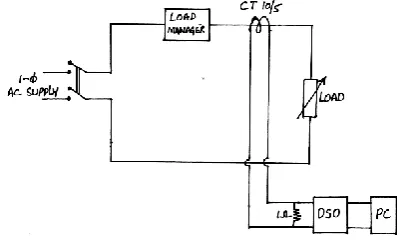
Figure 1. Schematic diagram of experimental set-up
3.1 Experimental setup
3.2 Experimental Procedure
A single phase supply was given to the circuit after connecting the lamp across the load terminal. The readings of voltage, current, power and power factor were noted with the help of load manager. The waveform was observed and stored in DSO. The stored waveform was then converted into data file using ULTRASCOPE software. The data thus obtained is used in origin software and FFT analysis was performed to obtain different harmonic components.
Experiments were repeated for all the loads considered in the study and Table 1 gives the different loads used in the present study with their specifications.
Table 1. Lighting loads used for present work
Type of lamp Rating
Incandescent bulb (GLS) 200W
Fluorescent tube light
( FTL) 40W
Compact fluorescent lamp
(CFL) Spiral 23W
High pressure sodium
vapour lamp (HPSV) 250W, 33µF
IV.
RESULTS AND DISCUSSIONS
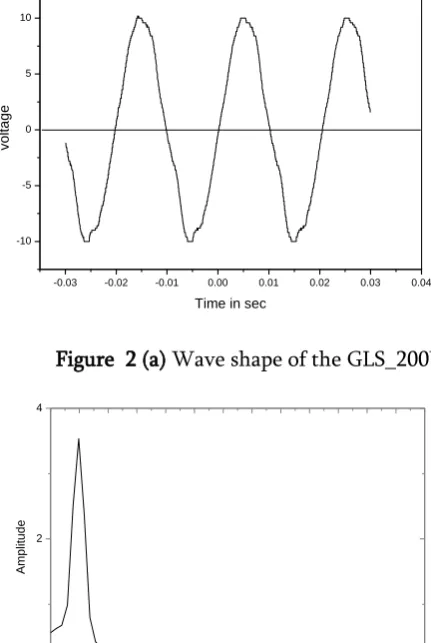
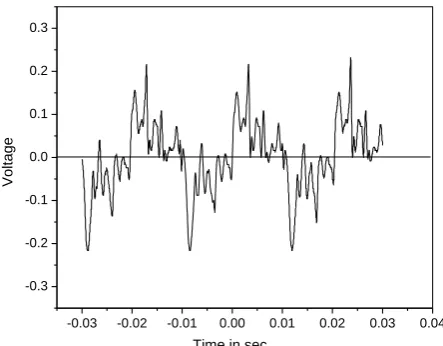
The main aim of the present work was to estimate the Total Harmonic Distortion (THD) and Individual Harmonic Component of lighting loads, namely GLS, FTL, CFL and HPSV. These lamps are used in residential, Street lighting and Industries. The estimation of THD and Individual Harmonic component was accomplished through experiments by storing the waveforms in DSO. Using ULTRASCOPE software the waveform recorded is converted into data file. Further with the help of origin software, FFT analysis has been performed for different lighting loads. The recorded waveform and respective FFT analysis for GLS, FTL, CFL and HPSV are shown in figures 2(a) & 2(b), 3(a) & 3(b), 4(a) & 4(b) and 5(a) & 5(b) respectively.
-0.03 -0.02 -0.01 0.00 0.01 0.02 0.03 0.04 -10 Figure 2 (b) FFT analysis of the GLS_200W
waveform
0 1 2 3 4 5 6 7 8 9 10 11 12 13
-0.03 -0.02 -0.01 0.00 0.01 0.02 0.03 0.04
-0.6
-0.03 -0.02 -0.01 0.00 0.01 0.02 0.03 0.04 -0.3
From figures 2(a) & 3(a) it can be observed that GLS and FTL are showing almost sinusoidal wave thereby giving a THD of 13.02% and 14.17% respectively, when the THD of the input was about 13%. Figures 4(a) & 5(a) shows the highly distorted waveforms for CFL_23W and HPSV, where the THD was found to be 106% and 73.35% with the same input mentioned above. Also, in case of 23W CFL the individual harmonic components are not following the standards.
Table 2 shows the calculated values of THD for the lighting loads considered in the present study.
Table 2. THD for different loads
LAMP %THD
Incandescent bulb (GLS) 13.02
Fluorescent tube light ( FTL) 14.17
Compact fluorescent lamp (Spiral) 106.0
High pressure sodium vapour lamp (HPSV)
73.35
V.
CONCLUSIONS
The main aim of the present work was to estimate Total Harmonic Distortion of different lighting loads namely, Compact Fluorescent Lamp, Sodium Vapour lamp, Fluorescent tube light, and Incandescent lamp. For this purpose a set up was prepared and experiments were performed. From the results the following conclusions can be drawn
GLS and FTL give low THD in which GLS is
the least.
CFL_23W gives highest THD among the loads
considered in the present study.
Individual harmonic component estimated in
case of CFL_23W does not follow the standards. i.e., 3rd, 5th, 7th, 9th harmonic component are significantly high when compared to the percentage of fundamental.
From the results and discussions and the above conclusions it is clear that, while selecting the type of the lighting load care must be given for the harmonic distortion. It is also noted that, in the case of sodium vapour lamp by inclusion of capacitor may improve the striking voltage and power factor but increases the Harmonic distortion. Thus while selecting the value of the capacitance there should be a compromise between power factor, striking voltage and the Total Harmonic Distortion.
VI.
REFERENCES
[1] “An Introduction to Power Quality Concerns” by
Manas Kundu.
[2] “Power quality” by C.Sankaran, CRC Press LLC,
2000.
[3] 519-1992 IEEE Recommended Practices and
Requirements for Harmonic Control in Electrical Power Systems.
[4] “HVDC power transmission systems” Publication
New age international (P) limited. K.R. Padiyar.
[5] “Impact of Harmonic Disturbances on Power