CSEIT1846153 | Published – 08 May 2018 | May-June 2018 [ (4 ) 6 : 811-818 ]
National conference on Engineering Innovations and Solutions (NCEIS – 2018)
International Journal of Scientific Research in Computer Science, Engineering and Information Technology
© 2018 IJSRCSEIT | Volume 4 | Issue 6 | ISSN : 2456-3307
811
A study of Power Quality issues in IEEE 33 bus system and its
mitigation using DSTATCOM
Ankita Biswas
1, Ms. Kusuma Devi G.H
21Power systems Engineering, Department of EEE, Acharya Institute of Technology, Bangalore-560107,
Karnataka, India
2Assistant Professor, Department of EEE, Acharya Institute of Technology, Bangalore-560107,
Karnataka,India
ABSTRACT
The main objective of this project is to determine the Power Quality disturbances at distribution levels. This paper presents the design, modeling and simulation of DSTATCOM to improve the THD and voltage sag in IEEE 33 bus system. Rapidly, increasing the use of non-linear loads has increased the Power Quality problems such as voltage sag, voltage swell, voltage notch, and harmonics. To maintain the power quality regulations and compensation is becoming an important factor. Here, MATLAB/Simulink is used to develop the model. Keywords. Power Quality, Power Quality Problems, DSTATCOM overview, SRF theory, Voltage sag, %THD Simulation model, Matlab Simulation.
I.
INTRODUCTION
Power quality is an essential part of power system engineering. Power Quality is communication between of electrical power with electrical equipments. If the electrical equipment operates correctly, accurately, reliably without being any interruption and damaged, we would say that Quality of Power is good.
The electrical energy is one of the easily used forms of energy. Electrical energy can be converted from one form of energy into another form of energy. Electric energy demand has been greatly increased. Along with this, the techniques of electric power production have greatly improved. The electrical system is effect by various non linear switching devices. In this project, the frequently occurring power quality problem like voltage sag, voltage swell, voltage notch, voltage flicker, harmonic,
voltage variation at distribution level are discussed. This is very important aspect to look for Quality of power before serving the consumers. There are several methods to improve the Power Quality. This project contains design, analysis and simulation of IEEE33 bus by using MATLAB/Simulink. In IEEE33 bus system, the design, simulation and modelling of DSTATCOM has been shown. This paper object is solving voltage sag and THD problems by improving the Power Quality using DSTATCOM.
II.
LITERATURE REVIEW
of sensitive equipment in most of the industrial, commercial, residential and traction applications. These power quality issues can be classified as voltage and current quality problem in distribution system [2]. Power Quality influenced by the several factors like voltage sag caused by fault and disturbances in transmission or distribution level. This Power Quality problem may leads to economic crisis in the industries [1]. Power Quality Problems are categorized as voltage sag, voltage swell, transient, voltage notch, flicker, frequency variation, presence of harmonics etc. So many Facts device are present to mitigate the power quality problems such as custom power devices (CPDs), namely, DSTATCOMs (distribution static compensators), DVRs (dynamic voltage restorers), and UPQCs (unified power quality conditioners). Out of these fact devices CPDs, STATCOM are used to mitigate current based problem such as poor power factor, or poor voltage regulation, unbalanced currents, and increased neutral current. The most effective device is DSTATCOM which is used to reduce current variation and harmonics from the distributed network. DSTATCOM is the best technology for providing reactive power compensation, load balancing and/or neutral current and harmonic current compensation in Ac distribution network. This device is also used to regulate terminal voltage, suppress voltage flicker, and improve voltage balance. The major advantage of DSTATCOM is fast and self-communicating solid-state device [2].The basic structure or design of DSTATCOM is explained by Elango in [8]. DSTATCOM is capable mitigate voltage sags without injecting active power.
According to the Hingorani the custom power devices will increase the quality and reliability of power which is delivered to the customers [3].
Parag Nijhawan and Rajan Sharma [11] presents on improvement of power quality on feeders feeding with nonlinear loads and DTC induction motor drive with DSTATCOM. This paper main objective is to shows the effectiveness of DSTATCOM to
compensate the harmonics, power quality problems and unbalance load in distribution network under various operating and fault conditions is discussed.
Parag Nijhawan et. al. [12] evaluated the performance of a carrier phase shifted pulse-width modulation (PWM) multilevel inverter (five-level)-based distribution static synchronous compensator (DSTATCOM) and compared with a PWM inverter based-DSTATCOM with induction furnace load. This Simulink is used to elaborate the multilevel inverter based DSTATCOM in the load current with induction furnace load in the distribution network to reducing harmonic distortion and power quality problems.
H. Prasad, T. D. Sudhakar [14] presents in the paper, “Power Quality Improvement by Mitigation of Current Harmonics using STATCOM” a STATCOM is connected with PCC to improve the power quality. STATCOM is designed with the VSI and connected with charging capacitor on DC side.
Sabha Raj Arya presents in the paper “Power Quality Improvement in Isolated Distributed Power Generating System Using STATCOM” a three-leg voltage source converter (VSC) based distribution static compensator (DSTATCOM) is implemented for harmonics suppression, load balancing and voltage regulation in three-phase Synchronous Reluctance Generator system with a battery energy storage system (BESS) [4].
III.
POWER QUALITY PROBLEMS
“Power Quality” can be defined as the combination of voltage and current. The terminology of electric Power Quality is mainly used at the level of generation, distribution and utilization to maintain the good quality of the power. Power Quality also maintained the sinusoidal waveform of current and voltage at rated magnitude and frequency. Power Quality disturbances can be classify into voltage sag, voltage swell, transient, harmonic distortion, voltage notch, and flicker.
There are several numbers of reasons for the power quality problems of the AC power system, around 60% problems are natural ones such as lightning, flashover, equipment failures and others 40% problems are forced ones such as voltage distortions and notch. The causes of power quality disturbances are failure of capacitor banks, line faults, transformer energizing, non-linear loads (furnaces, uninterruptable power supply (UPS) , and adjustable speed drives (ASD)), negative sequence current in generators and motors, increased the losses in the distribution system and machines, noise, vibration, over voltages, excessive current due to resonance, rotor heating, dielectric breakdown, relay and breaker failure, false metering, Communication and signal interference and so on. There are various type of definition related to amplitude and duration. It can defined as follows
Voltage sag. Voltage sag or voltage dip can be defined by IEEE 1159-1995 as the decrease in RMS voltage or current 10% to 90% (0.1pu to 0.9pu) of nominal value for durations of half cycle to one minute at the power frequency. Voltage sag can be divided by three categories. They are
1. Instantaneous ( 1/2 cycle to 30 cycles) 2. Momentary (30 cycles to 3 seconds) 3. Temporary (3 seconds to 1 minute)
Voltage Swell. Voltage swell can be defined by IEEE 1159-1995 as the increase in RMS voltage or current 110% to 180% (1.1pu to 1.8pu) of nominal value for
durations of half cycle to one minute at the power frequency.
Notch. Any type of disturbances at the normal power voltage waveform which is lasting less than a 1/2 cycle. Initially, it is opposite polarity of the waveform. It’s subtracted from the normal waveform in terms of the peak value of the disturbance voltage. It includes complete loss of voltage for up to 1/2 cycle.
Flicker. Voltage flicker is a visible sensation in brightness of the lamp or variation in voltage waveforms induced by the fluctuation in voltage or spectral distribution fluctuates with time.
Total Harmonic Distortion (THD). THD is the ratio between the RMS value of harmonic component and the RMS value of fundamental quantities. It is expressed in percentage. % THD = (RMS value of harmonic components) / (RMS value of fundamental quantities)
IV.
DSTATCOM OVERVIEW
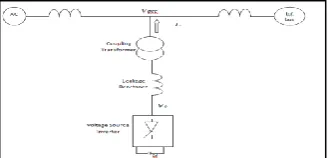
Figure 1.1. Schematic configuration of a DSTATCOM
This Custom power device is extremely used to mitigate the current based Power Quality problems. The current based power quality problems are poor power factor, poor voltage regulation, and unbalanced current and increased neutral current. These disturbances are aggravated in the voltage and current by the presence of harmonics. DSTATCOM providing reactive power compensation, load balancing, neutral current and harmonic current compensation, suppress the voltage flicker in AC distribution networks. Synchronous Reference frame theory (SRF) based algorithms is implemented in this project.
V.
SYNCHRONOUS REFERENCE FRAME
THEORY
Figure 1.2. Synchronous Reference Frame theory of Reference current extraction
Synchronous reference frame theory (SRF) is one of time-domain control algorithms widely used for the control of DSTATCOM. A block diagram of the control algorithms is shown in figure
Figure 1.3. Block diagram of SRF theory based algorithms of DSTATCOM
Step 1. Convert three-phase load current (iLa, iLb, iLc) into the αβ frame using Clark's transformation.
Step 2. Convert αβ0 frame (Clark’s variables) into dqo variables of rotating reference frame theory with frequency w in rad/s. The transformation can be written as follows
Step 3. In this step, low pass filter (LPF) techniques is used extract the fundamental component.
Step 4. Convert dqo to αβ frame using inverse transformation.
Step 5. Convert αβ (Clark’s variables) into the abc variables.
VI.
SIMULATION MODEL
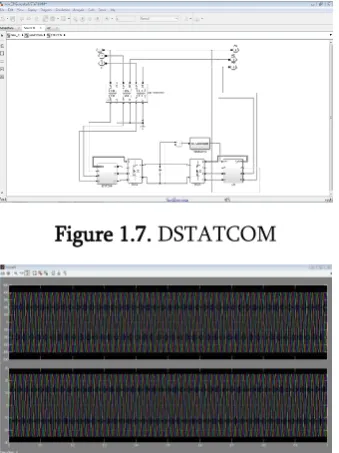
The simulation models were developed by using MATLAB/Simulink. It is used to simulate various types of power quality disturbances and observe how it distorts the sinusoidal waveforms of the system. Simulation model includes IEEE33 bus system, DSTATCOM model. The DSTATCOM modelled with Synchronous reference frame (SRF) control techniques. Here, supply voltage is 500 and 60Hz and R=0.02 ohm, L=0.06 H and C=0.0528 F. DC voltage is 300V.
Table 1. LOAD FLOW RESULT
Figure 1.5. Bus 1 and Bus 2 circuit of IEEE 33 bus system
Figure 1.6. Placement of DSTATCOM at Bus 1(gen5)
Figure 1.7. DSTATCOM
Figure 1.8. Bus 1 Voltage and current waveform
Figure 1.9. Bus 1 voltage magnitude and phase angle
Figure 1.10. Bus 1 active and reactive power waveforms
Figure 1.11. Bus 2 voltage and current waveforms
Figure 1.13. Bus 2 active and reactive power waveforms
Figure 1.14. Voltage sag at Bus 1(25% voltage sag)
Figure 1.15. Voltage waveform after connecting DSTATCOM
Figure 1.16. FFT analysis of current in Phase A before filtering
Figure 1.17. FFT analysis of current in Phase B before filtering
Figure 1.18. FFT analysis of current in Phase C before filtering
Figure 1.19. FFT analysis of current in Phase A after filtering
Figure 1.20. FFT analysis of current in Phase B after filtering
Figure 1.21. FFT analysis of current in Phase C after filtering
Figure 1.23 FFT analysis of voltage in Phase B before filtering
Figure 1.24. FFT analysis of voltage in Phase C before filtering
Figure 1.25 FFT analysis of voltage in Phase A after filtering
Figure 1.26 FFT analysis of voltage in Phase B after filtering
Figure 1.27 FFT analysis of voltage in Phase C after filtering
Table 2. Current and voltage THD value before and after filtering
Signals
THD before filtering (%)
THD after filtering (%)
Current
Pha
se A 23.01 1.92
Pha
se B 22.99 1.88
Pha
se C 22.63 2.00
Voltage
Pha
se A 17.84 0.88
Pha
se B 20.74 0.92
Pha
se C 18.25 0.90
VII.
CONCLUSION
compensation. In the figure 1.15 shown that the current waveform is being compensated after 0.25 sec. %THD is being reduced due to compensation provided which is shown in table 2.
VIII.
REFERENCES
1. McGranaghan M, Roettger B (2002) Economic Evaluation of Power Quality, IEEE Power Engineering Review, 22. 8-12.
2. Bhim Singh Ambrish Chandra Kamal Al-Haddad, “Power Quality Problems and Mitigation Techniques” Wiley 2015.
3. Hingorani, “Introducing Custom Power” IEEE Spectrum, Vol.32, No.6, pp. 41-48, June 1995. 4. Sabha Raj Arya, Ram Niwas, Krishan Kant
Bhalla, Bhim Singh, Ambrish Chandra, and Kamal Al-Haddad, “Power Quality Improvement in Isolated Distributed Power Generating System Using DSTATCOM” IEEE Transactions on Industry Applications, vol. 51, issue. 6, Nov-Dec 2015.
5. Kong Shuhong, Yin Zhongdong, Shan Renzhong, Shang Weidong, "A Survey on the Principle and Control of Dynamic Voltage Restorer," Energy and Environment Technology, 2009. ICEET '09. International Conference on, vol.2, no., pp.57, 60, 16-18 Oct. 2009.
6. Sabha Raj Arya, Bhim Singh, Ram Niwas, Ambrish Chandra, and Kamal Al-Haddad, “Power Quality Enhancement Using DSTATCOM in Distributed Power Generation System” IEEE Transactions on Industry Applications, Volume. 52, Issues. 6, Nov.-Dec. 2016
7. Kantaria, R. A.; Joshi, S.K.; Siddhapura, K. R., "A novel technique for mitigation of voltage sag/swell by Dynamic Voltage Restorer (DVR)," Electro/Information Technology (EIT), 2010 IEEE International Conference on , vol., no., pp.1,4, 20-22 May 2010.
8. Elango, S.; Chandra Sekaran, E., "Mitigation of Voltage Sag by Using Distribution Static Compensator (D-STATCOM)," Process
Automation, Control and Computing (PACC). 2011 International Conference on, vol., no., pp.1, 6, 20-22 July 2011.
9. Haque, M. H., "Compensation of distribution system voltage sag by DVR and DSTATCOM, "Power Tech Proceedings, 2001 IEEE Porto, vol.1, no., pp.5 pp.vol.1,, 2001.
10. Mr. Sharad S. Pawar, Mr. A. P. Deshpande, Mrs. MeeraMurali “Modelling and Simulation of DSTATCOM for Power Quality Improvement in Distribution System Using MATLAB Simulink Tool 2015 International Conference on Energy Systems and Applications (ICESA 2015). Dr. D. Y. Patil Institute of Engineering and Technology, Pune, India 30 Oct - 01 Nov, 2015
11. Rajan Sharma, Parag Nijhawan, “Effectiveness of DSTATCOM to Compensate the Load Current Harmonics in Distribution Networks under Various Operating Conditions”, International Journal of Scientific Engineering and Technology, Vol.2, No.7, pp.713718, 1 July 2013 12. Parag Nijhawan, Ravinder Singh Bhatia, Dinesh
Kumar Jain, “Improved performance of multi-level inverter-based distribution static synchronous compensator with induction furnace load”, IET Power Electronics, Vol.6, No.9, pp.1939–1947, 2013
13. Mohammad Ashraf Hossain Sadi, and Mohd. Hasan Ali, “A fuzzy logic controlled bridge type fault current Limiter for transient stability augmentation of Multi-machine power system” IEEE transactions on power systems, January 24, 2015