DOI : https://doi.org/10.32628/CSEIT195286
Automatic Bill Payment using Natural Language Processing
Dhivya Prabha1, Siva Shankar2, Sowndararaj2 ,Vignesh Kumar2
1Assistant Professor, Department of Computer science and Engineering, Sri Krishna College of Technology,
Coimbatore, Tamil Nadu, India
2Department of Computer science and Engineering, Sri Krishna College of Technology, Coimbatore, Tamil
Nadu, India ABSTRACT
In the modern world, people receive various bills through post, sms, emails etc. They use cards, e-wallets and net banking to pay them in online. This manual process can be automated if the user wishes to pay selective or each bill he/she receives monthly. It is common that, most of the bills we receive nowadays are through sms and emails, with the help of Natural Language Processing , the message can be classified i.e whether the message is a bill or not. If the message is a bill, then there will be sufficient details to pay it, such as cost, user unique number, purpose of payment. From these details, the application can pay through online from the registered card details. A push notification is sent to the user regarding the transaction, whether it is successful or not. The details are completely stored in the cloud. The selected type of bills are stored in the app itself. Moreover the application is capable of paying others bill if the user wishes to pay.
Keywords : Natural Language Processing, Automation, Payment, Online Transaction.
I. INTRODUCTION
NLP is the field of Artificial Intelligence concerned with the processing and understanding of human language. Natural Language Processing is abbreviated as NLP. Nowadays it is used to power search engines, filter spam and to obtain analytics in a fast and scalable manner. The fact is that the machine understanding of language is much construed [1]. The most challenging task for computers is to understand human language in order words, unstructured data. Processing of unstructured data is more difficult than the structured data. By transforming textual data into numerical representation, the machines can be trained over complex variants of mathematical models [2]. The process of converting a text into numerical representation is called as vectorization[12]. The objective of the function is map the words on the vectors of real numbers. These
vectors are combined to form a vector space. By performing some mathematical operations on the vectors in the vector space, we can determine the similarity and other relationships between two words
[3]. Another challenge for a machine is that, it can’t
helps to capture the context of the sentence), words in a sentence. A parse tree is deployed in this phase), named entity recognition (it maps the words which represents real world places, things etc. For example, the word Germany represents a real world place. The NER will map like, Germany – Geographic Entity) and coreference resolution (recognition of a subject which is mentioned in a pronoun form. It is a difficult task for a system to identify the subject when mentioned in pronoun form. The range of difficulty is dependent on the nature of the language) [6].
Advancement in technology never stops. In fact, the current modern technology plays a vital role in each
person’s life. People in general are filled with hectic works. Apart from that managing family is part of their job. People somehow manages time to pay before or on the given deadline. Most of them pays on the deadline. On the other hand, some people might forget about the payment. This sometimes led to expiry of the usage. To avoid such scenarios, automation in payment can help everyone to pay their bills on time.
The bill generated and sent through sms and emails are mostly written in a natural language. The natural language processing system helps to classify whether a message or mail is a bill or not. Before it ensures that whether the user wishes to pay that bill or not. If so, the payment process will be taken care of the application else, it will be ignored.
II. Related Works
A research work was published where smart cards were used. It can be used as a multifunctioning card. For example, it can be used as a smart key to open a door, a card for payment, etc. If it is narrowed to payment sector, it is very much similar to credit/debit card. The disadvantage encountered is that the process is not automated. [7]. A paper was proposed to pay using Near Field Communication (NFC) technique. The author used RFID and Android phone (NFC enabled) for communication purpose. An RFID tag used for contactless payment, as soon as the reader reads the cards, the transaction process takes place. In case of mobile phones, the details are stored
in the phone. As soon as it crosses the reader’s signal,
the transaction process takes place with proper authentication [8]. Another paper was proposed by an author with the above technology mentioned (NFC) where a smartphone will be connected to an
android application using Bluetooth. The user’s
fingerprint is required for authentication and then payment is done just like P2P method [9]. A similar technology (NFC) was used by another author to pay through contactless transaction [10]. Both payee and payer will have a card for transaction, the payee activates the receiver mode followed by fingerprint authentication. After activating the receiver mode, a unique key is generated and that key is sent to the
payer’s module through NFC. After receiving the key,
the user is authenticated through biometric system. Once authentication is successful, the data is sent to an android application of the payer’s mobile and
III. Proposed System
The problem of not paying the bills after due has been a problem that exists for a long period of time. Generally, people use to pay their bill using cards, e-wallets, internet banking and mobile banking. Even though, the technology provided many facilities, most of the people always try to pay their bill on the date of deadline, very few might pay before that. Sometimes, they remember to pay when the service is expired. To avoid such scenarios, an automation could help people to pay their bills before the due date. The bills are sent through sms and emails. These bill will be written in a natural language. Hence, an NLP system is used to understand the content of the message to classify whether the message or mail received is a bill or not. If message is classified as a bill, then the payment will be taken care of the application. The application has a feature which allows the user to select the type of bills to be paid instead of paying all the bills. The user can enroll any number of card details and the user has the provision to select the card for transaction purpose.
ARCHITECTURE:
There are 3 modules in the proposed system:
1) An Android application for the user:
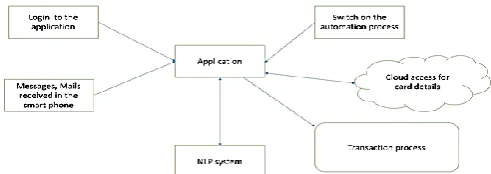
An android application is used as the UI for the user. The Android application is connected with cloud. Through registered username or Gmail authentication, a user can access their account. The UI provides activities to store card details, to select bills to pay, to select specific contact bills to pay and an UI for viewing the history of transactions. The application runs continuously in the background to read each message and mails the phone receives on a day. These messages are collected and then sent to the NLP system.
2) A Cloud Storage to store all the details:
A cloud is used to store every details of the user. The implemented cloud stores data in JSON format. Hence, processing of data is quite easier and faster [11]. After receiving the request from the client, the server reads the data in the cloud and responds accordingly. In case of payment, the server reads the inputs from the cloud and required attributes are sent through the request. The transaction process is carried over accordingly.
Figure 1: The flow diagram of the project
3) A NLP system to understand a message or a mail A NLP system is implemented in the android application itself. The android application reads the new message(s) and send the copy to the system as input data. Then, the system process each message and identifies the bill. After the identification, if the bill is one of the selected bills by the user, the transaction process is carried over [12].
IV. IMPLEMENTATIONAND RESULTS
Input: the following msg is considered to be the input for the application.
“Hello, Your Vodafone bill for Jan'19 of Rs.481.44
due on 12/02/2019 has been sent to your regd email ID ************. Here's a brief look at your Vodafone bill dt 25:01:19. All charges are in Rs
a. Plan Rental (1 units) : 399.00
Add Previous Bal : 590.00 Add adjustment : 0.00 Less Payment : 590.00 TOTAL O/S : 481.44.
Output:
The reflection in the database:
Figure 2 : The cloud database where the payment history is shown for the given bill.
V. FUTURE ENHANCEMENT
There are few possible future enhancements for the proposed system. In future, the proposed system can be used as a default application in every smartphone regardless of the os (Android/ ios). The bills which are generated in hard copy form, these bill can be scanned and sent to the application. Then the image
is analysed to conclude whether it is a bill or not. If so, the further process will be handled by the application.
VI.CONCLUSION
The proposed system thus fulfilled the objective of the problem statement thereby enabling the users to pay the bill automatically without human intervention.
VII. REFERENCES
[1]. Introduction to Natural Language Processing - Mary Dee Harris
[2]. Natural language processing with python - Edward Loper, Ewan Klein, and Steven Bird. [3]. Mastering Natural language processing with
python - Deepti chopra,Nisheeth joshi, Iti mathur.
[4]. https://web.stanford.edu/~jurafsky/slp3/ [5]. Natural Language and Speech - Ewan Klein [6]. https://opennlp.apache.org/docs/1.9.1/manual/o
pennlp.html
[7]. The Smart Card : Don’t leave home without it - Dirk Husemann, IBM Research Division, Zurich Research Laboratory
[8]. Near Field Communication : It Pays - William Lumpkins and Martin Joyce
[9]. Pay-cloak: A biometric back cover for smartphones - Alak Majumder, Joyeeta Goswami, Shirsha Ghosh, Rishu Shrivastawa, Saraju P. Mohanty, and Bidyut K. Bhattacharyya
[10]. Swing-Pay: One card meets all user payment and identity needs- Shirsha Ghosh, Joyeeta Goswami, Alak Majumder, Abhishek Kumar, Saraju P. Mohanty,and Bidyut K. Bhattacharyya.
[11]. https://www.javatpoint.com/nosql-databases [12]. Text Analytics with Python: A Practical
[13]. Siamala Devi S, “Hybridization of K- Means and Harmony Search Based On Optimized
Kernel Matrix and Unsupervised Constraints”,
2017, Asian Journal of Information Technology, vol 15, pp:4512-4521.