International Multicultural Name Matching Competition: Design, Execution,
Results, and Lessons Learned
Keith J. Miller, Elizabeth Schroeder Richerson, Sarah McLeod, James Finley, Aaron Schein
The MITRE Corporation7515 Colshire Drive McLean, VA 22102 USA
[email protected], [email protected], [email protected], [email protected], [email protected]
Abstract
This paper describes different aspects of an open competition to evaluate multicultural name matching software, including the contest design, development of the test data, different phases of the competition, behavior of the participating teams, results of the competition, and lessons learned throughout. The competition, known as The MITRE Challenge™, was informally announced at LREC 2010 and was recently concluded. Contest participants used the competition website (http://mitrechallenge.mitre.org) to download the competition data set and guidelines, upload results, and to view accuracy metrics for each result set submitted. Participants were allowed to submit unlimited result sets, with their top-scoring set determining their overall ranking. The competition website featured a leader board that displayed the top score for each participant, ranked according to the principal contest metric - mean average precision (MAP). MAP and other metrics were calculated in near-real time on a remote server, based on ground truth developed for the competition data set. Additional measures were taken to guard against gaming the competition metric or overfitting to the competition data set.
Keywords: multicultural name matching, evaluation, challenge competition
1.
Introduction
Person name matching is a problem that arises when different versions of a person’s name that exist in multiple sources must be identified as being related. A person can have multiple versions of a name for reasons such as using nicknames or reaching life milestones, such as marriage, making the Haj to Mecca, or receiving an advanced degree. Transliteration, translation, or simple data input errors can also lead to variations of the same name. These variations can be problematic, for example, when searching for a patient record at a doctor’s office, screening an individual before granting them access to sensitive information, or merging or deduplicating records in a customer database. In these situations, and many others, multicultural person name matching technology is used to find person name records that would otherwise not be located.
In 2011 the MITRE Corporation launched an open competition called The MITRE Challenge™ to evaluate multicultural name matching software. The open format of the Challenge allowed the evaluation of a large range of name matching solutions since no constraints were imposed on the algorithmic approach. Additionally, because virtually anyone could participate, the competition presented an opportunity to identify top-performing solutions that might not have previously received attention, rather than only those from a small set of previously identified solution providers. Participants were allowed to self-select team names for display on the publicly-visible leader boards. By allowing anonymity, the Challenge hoped to attract participants who might be wary of having performance metrics posted publicly.
2.
Contest Design
The MITRE Challenge was inspired by the Netflix Prize – a competition sponsored by Netflix challenging participants to improve the Netflix movie recommendation algorithm (www.netflixprize.com). Netflix provided participants with training data composed of anonymous user ratings, as well as test data sets, which participants ran through their algorithms and submitted to Netflix for scoring.
Because of the open format of the Netflix Prize virtually anybody could participate, including experienced professionals and curious amateurs. The data-driven nature of the competition allowed participants to develop solutions to achieve a goal, rather than to conform to a set of requirements. These aspects of the Netflix Prize parallel MITRE’s goals to identify a broad set of ideas and solutions to various challenges.
2.1 Domain
The initial MITRE Challenge focused on the evaluation of multicultural person name matching systems. This domain was chosen for two reasons: First, name matching has a broad range of uses, ranging from the support of screening and credentialing services to disaster relief, benefits distribution and fraud prevention. Second, MITRE has previous experience in evaluating person name matching software, and already had an existing infrastructure for carrying out those evaluations (Miller et al, 2008) upon which the Challenge could be based.
2.2 Data
randomly chosen true positive over a randomly chosen true negative (Fawcett, 2006). MITRE chose MAP as the determining metric, rather than the analogous AUC, as MAP is commonly used in the Information Retrieval field. Additionally, in keeping with the characteristics of a good evaluation as laid out by the EAGLES working group, an evaluation should be understandable to its consumers (EAGLES, 1996). Many consumers of previous MITRE name matching evaluations understand how precision, recall, and MAP apply to their particular use cases, so we decided in favor of this metric for the Challenge.
2.4 Application
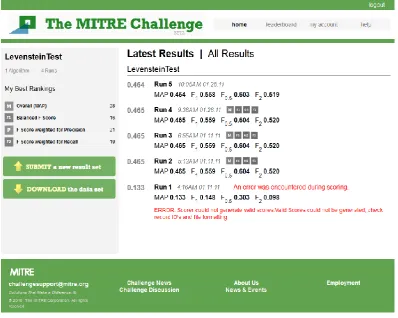
The MITRE Challenge application consisted of several screens, including an external login screen with a public leaderboard and several screens accessible to logged-in teams, on which they could upload results and see more detailed analysis of their result sets. The screenshot below shows one such team-accessible screen.
Figure 1. Participant Home Page
3.
Data Development
As mentioned above, person names from various sources were used to create the Challenge competition data set. Those sources were chosen to mitigate privacy concerns while still providing a diverse and interesting set of person names. In addition to creating an interesting set that incorporates some of the types of person names found in real-world data sets, it was necessary to create a large data set to ensure that no team “solved” the challenge by manually comparing all possible matches.
To create the ground truth for the competition data set, MITRE employed the pooling method used in the Text REtrieval Conference (Vorhees and Harman, 2001; Vorhees 2000). In the pooling method, the data set is run through name matching software configured with a very
permissive minimum matching threshold. The results of those runs are collected into an adjudication pool, then manually judged to determine whether each match is true or false. This manual adjudication process involves several human annotators, and is described in more detail in (Miller et al, 2008).
4.
Competition Phases
test set was not statistically significantly different. Other clusters can be observed in Figure 2 as well.
Figure 2. T-test clusters
In the validation phase of the competition teams were given a new data set. This new data followed the same format as the initial data set and had similar data characteristics, but contained entirely new names. As with the production data set, the validation set included names that contributed to the participant’s score as well as names that did not. The validation query set contained 8,668 names, 168 of which contributed to the score, and 808,246 index names, 8,246 of which contributed to the score. There were 354 correctly matching name pairs in the validation data set.
Participants were required to submit up to three sets of results for the validation data set within 36 hours of receiving it. This phase of the competition served several purposes, including verification that teams could reproduce the work done to create their initial results, that this could be done in a reasonable amount of time, and that participants weren’t over-fitting a solution to the production data. Satisfying the first two conditions additionally suggested that teams were in fact using computers and algorithms, as opposed to carrying out the processing task by hand.
Team Name
MAP
Beethoven
94.3
Riffraff
91.9
A Rose
91.7
Mean Mr Teach
91.6
Impala
90.7
0.7
88.9
JustForFun
88.0
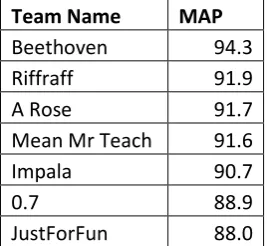
Table 2. Validation phase MAP scores
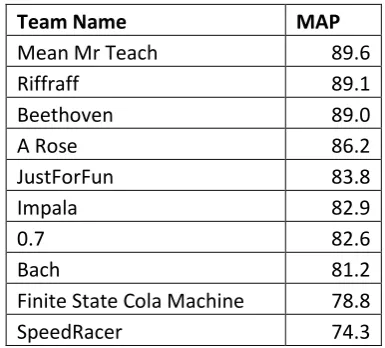
Table 2 shows the MAP scores from the validation phase of the Challenge for those teams that placed in the top ten during the production phase and submitted a valid set of results for the validation data. Each of the teams achieved a higher MAP score during the validation phase than production phase. The participant rankings differed between the validation and production phases, with the top performer during the production phase falling to fifth place, and the third place team from the production phase jumping to first. Given the results of the paired t-test, in which the top three teams in the production phase tied for first, it could be argued that the first place team did not in fact change in the validation phase.
Overall, the results of the validation phase indicate that all of the top teams produced a replicable solution to the name matching problem, and that none of the top teams over-fit their algorithms to the production data, in which case we would have noted a drop in MAP score.
7.
Lessons Learned
The MITRE Challenge was based on previous experience in evaluation of commercial and research name matching systems as well as knowledge of other similar competitions. Although design and execution decisions were based on these sources of prior knowledge, the team did gather many lessons from the experience of creating and running this publicly-available, externally-facing Challenge. These lessons ranged from considerations for technical design and architecture, computer security, and robustness, through issues involving communications strategies, logistics, and legal concerns. These lessons – many of which we believe will prove valuable not only for research teams seeking to run large-scale contests of the type described in this paper, but also for teams running smaller-scale evaluations – are outlined in this section.
Communications. The MITRE Challenge benefitted from working with both a web (UI) designer and a communications specialist. Having these team members work together to create a consistent look and feel for the Challenge site and communications materials was effective in developing a “personality” for the Challenge. This included everything from a color scheme and communications tone for the Challenge site and publicity
materials to the creation of
of the Cross-Language Evaluation Forum on Evaluation of Cross-Language Information Retrieval Systems, 2406 (pp. 355-370). London, UK: Springer-Verlag.